
The adopted UC model has shown that some of the thermal generators on the island remain unused except during maintenance and servicing of other generator sets. Monte Carlo simulations with synthetic time series have been performed to investigate the impact on the project of variability in wind speed and energy demand, highlighting the robustness of the selected design.
Introduction
Objectives
The scope of this work is to formulate a general model to investigate the possible increase of the renewable energy penetration in an island-mode microgrid, with a specific focus on the island of Faial, Azores. Apply the optimization model to the case study of Faial Island in the Azores, to validate it and to evaluate the renewable potential that can realistically be installed on the island respecting the technological and economic constraints.
Structure of the thesis
Develop a simulation model that uses measured weather and electricity demand data to evaluate the electricity generation of a hybrid, sustainable island energy system in hourly increments using a Unit Commitment (UC) algorithm, and to calculate the net cash value of the system configuration over a one-hour period. 20 years. Identify and develop a methodology to elaborate the measured wind and electricity demand data in Faial to generate synthetic time series, and use such time series to evaluate the variations in the model output using Monte Carlo simulations .
Literature review
The microgrid model
An extensive section is dedicated to the system's possible operational strategies, which have been a useful inspiration for this work. The versatility of the probabilistic approach, especially when few data are available, has proven to be fundamental to a significant part of this thesis.
Optimisation algorithms
The contributions are very detailed with equations that model the components of the system, which are partially adapted to the purpose of the thesis. On the other hand, [19] uses probabilistic methods to solve the UD problem, using the probability density function to describe the wind energy production, together with the failure probability in thermal units.
Azores’ energy challenges
Consequently, stochastic optimization has proven to be more economical and perform better than the deterministic approach, resulting in a reduced need for operating reserve in the system. Such requirements should be reconsidered by EDA, as they significantly limit the renewable penetration in the system by enforcing RES limitation.
Methodology
- Simulation model
- Optimisation model
- Unit Commitment and Economic Dispatch
- Financial model
The output from geothermal plants has been considered constant and equal to the nominal installed capacity of the plant. Finally, the NPV of the system is calculated according to the definition in equation (28) in section 3.4, where this process is described in detail. NPV represents the discounted value of all net income cash flows generated by the project, plus the residual value of the installations at the end of their nominal 20-year life.
It is assumed that environmental conditions and energy production remain constant for the remainder of the system's life. It is assumed that the shutdown costs are again negligible due to the small size of the generators. The following equation reports only the formula of the project's NPV, as this is the value used as the objective function.
1 + 𝑊𝐴𝐶𝐶)20 (28) The difference between the latter and the NPV of the current configuration is the value that was used as the objective function to maximize.
The Faial Case Study
Energy system in Faial
As can be seen in Figure 6, Faial's electrical system is quite simple and not very large, which justifies some of the simplifying assumptions used in the model and input data of this thesis, such as uniform efficiency for transmission lines. On the same map, the main production facilities on the islands can be seen. The Varadouro hydroelectric plant with an installed capacity of 320 kW follows the seasonal hydrological nature of most Açores rivers.
However, due to the drought in recent years, there was no production in 2016 and 2017, as can also be seen in Table 1. As for the Parque Eólico do Salão, its origins date back to 2002, when Windpark da Lomba dos Frades became built in the context of the Plano de Desenvolvimento de Energia Eólica dos Açores. It was subsequently decommissioned in 2011 due to protests from local residents, limiting the turbine's available time to such an extent that the wind farm's production was less than half of what was expected [43] [44].
Finally, the Santa Barbara power plant, which represents the main power source of the island with its capacity of 19.1 MW, contains six heavy oil (HFO) generators, the details of which are summarized in Table 2.
Trends in electric production and consumption
Such wind farm counted 6 ENERCON E-30 aerogenerators of 300 kW and was the first experience of EDA to integrate wind systems with the thermal production based on fuel oil. From the same data set, it is possible to observe how variable and uncertain the production of renewable energy is, as indicated in Figure 8. The production of the hydro plant is particularly highly unreliable and, when present, is a negligible part of the annual production in the island.
For these reasons, hydropower has been excluded from the model presented in this work for the sake of simplicity.
Input data and synthetic time series generation
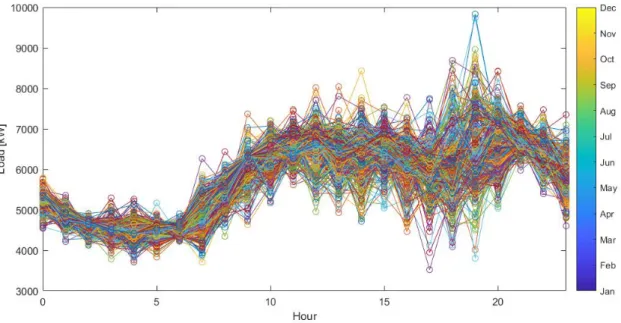
- Electricity demand
- Wind speed
- Solar irradiation
- Geothermal and Energy Storage
- Thermal generators
- Economic input data
The histogram of the absolute values of such variations in the sample is shown in Figure 12, at intervals of 0.2 m/s, and it has been normalized to show relative probabilities for each HAWS class. FIGURE 13–REPRESENTATION OF SOME OF THE EVALLICALLY GENERATED ANNUAL WIND SPEED (IN BLUE) NORMALIZED HITOGRAMS AGAINST THE SAMPLE YEAR (IN ORANGE). The panel chosen for the optimization is LG NeON2 [47], the company's best-selling solar module and one of the most common in Europe.
The efficiency of the panels is related to the air temperature, with the parameters provided by the manufacturer and summarized in Table 3. The isotropic component of the diffuse irradiation is received evenly throughout the entire sky dome. Regarding energy storage, an in-depth investigation into the optimal storage means is considered beyond the limits of this work.
Regarding the variation of start-up costs with generator size, it has been assumed that an exponential curve may be a reasonable scaling for smaller sized generators, as shown in Figure 16. Such an assumption can be justified by considering the small size of generators in the microgrid, which allows a more flexible use of generators. 𝐷𝑒𝑏𝑡 + 𝐸𝑬 6% of EBITDA.
Results
Base cases
The scenarios
With this limit on PV, if geothermal constraints are limited, the same thresholds of REF can be obtained only with an even higher storage capacity, which is so unrealistically high that it is not even visible in the plot. In any case, when imposing a limit on the maximum storage capacity, the optimization model cannot find any solutions with REF higher than 30%. This is again due to how SR is defined, leading to the conclusion that island systems with high RES penetration need more accurate and dynamic strategies for spinning reserve management, which should also involve BESS as non-spinning reserve.
Regarding the NPVs of the optimized system when the minimum REF constraint is variable, a more immediate representation for comparison between the six scenarios is reported in Figure 19 and Figure 20. It can be immediately observed that the scenarios using geothermal energy tend to reach Higher NPV, often greater than zero. The drop in some NPVs in Figure 20 is a consequence of the cap placed on PV: the installed power limitation necessitates a larger storage capacity to reach the minimum REF constraint when other RES capacities cannot be increased , which causes costs to increase and NPV to decrease.
FIGURE 19–NPV OF THE OPTIMAL DESIGNS, WITH AND WITHOUT GEOTHERMAL, VARIABLE REF AND COAL TAX.
Sensitivity analysis and Monte Carlo simulations
As can be seen in Figure 22, with the selected system design, 50% of the energy production comes from the geothermal plant alone, while wind is responsible for 17% of the production. It is true that part of the energy that is dissipated when charging and discharging the battery also comes from thermal generators, which makes the share of wind and geothermal energy in the breakdown of the sum lower than the "nominal" 70%. Due to the oversized components, the amount of energy is reduced every year, amounting to up to 53% of the total annual demand.
The system mostly depends on only two of the six generators, G4 and G5, while G3 provides a backup when the gap between load and RES production is particularly large. Thermal generators account for 33% of total energy production, of which around 51% is produced through the smaller generator, the 2MW Krupp. FIGURE 24 – COMPARISON OF THE RESULTS OF OPTIMIZATION WITH ONE OF THE OPTIMAL DESIGNS FROM HOMER A sensitivity analysis of the NPV has been carried out by varying the electricity retail price, and as expected has resulted in a linear trend, as shown in Figure 25.
In both simulations, the EIR always reached 100%, demonstrating a good system flexibility in adapting to variations in operating conditions.
Conclusions
However, the wind penetration in the system is already high enough to force a large use of the rolling reserve, and therefore forcing reductions amounting to 7% of the total annual demand in the base case. With the installation of more renewable sources, the limited energy increases and becomes 53% of the total demand in the optimal design chosen for the sensitivity analysis. In the case of Faial, their use can be reduced in a technically and economically feasible way by more than 55% from the current situation, allowing to save more than 365000 tons of CO2 every year.
However, it is unlikely that in the near future, at least in the next two decades, isolated energy systems will be able to operate for long periods of time in the complete absence of thermal generators. Many other approaches and technologies, such as price-driven or centrally managed demand management or vehicle-to-grid (V2G) energy storage, are very promising and likely to play an important role in the energy transition, especially in microgrids. Available: http://www.rtp.pt/acores/sociedade/eda-vai-desmantelar-o-parque-eolico-da-lomba-dos-frades-video_17155.
Beskikbaar: http://www.rtp.pt/acores/local/faial-eda-vai-instalar-novo-parque-de- aerogeradores-no-salao_20539.
