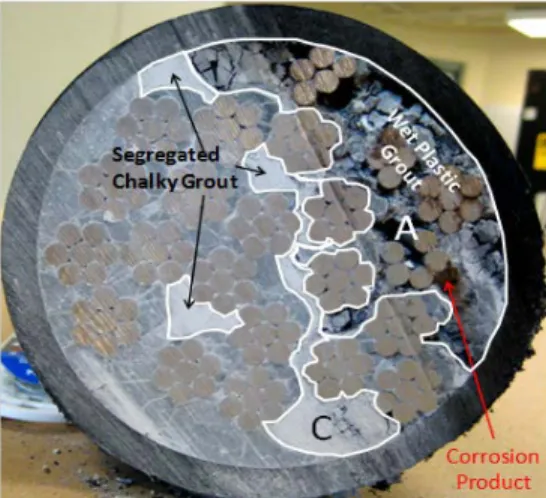
Grout is a cementitious material commonly used to provide corrosion protection to strands used in PT concrete bridges. Durability concerns related to PT tendons were raised as early as 1999 when tendon failures were seen in some PT bridges as a result of strand corrosion due to pooling of leached water in grout voids at tendon profile locations such as anchorages. and ridge areas. While the development of prepackaged thixotropic grouts was thought to offer a solution to the seepage water problem, corrosion-induced tendon failures have occurred in relatively new PT bridges, and forensic studies have revealed segregation and segregation of grout materials, such as and gentle presence. material, free water and high chloride and sulfate content. (1–3) Consequently, it has become important to examine the overall quality of materials and construction for some grouts in existing PT bridges.
This document is available to the public through the National Technical Information Service, Springfield, VA 22161.
BACKGROUND
OBJECTIVES OF INSPECTION
PT SYSTEMS
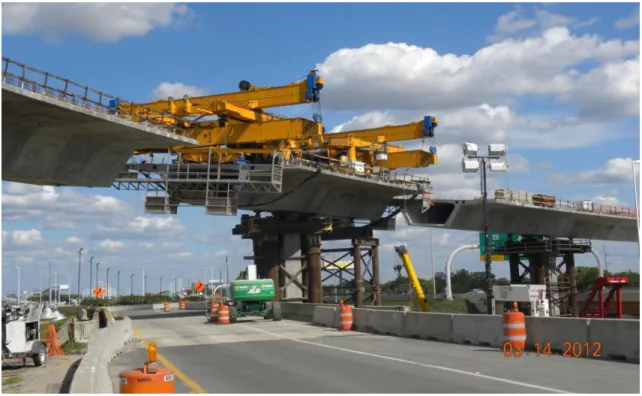
For long-span bridges, additional internal tendons are also provided in the top and bottom flanges and anchored in bellows (see figure 8 and figure 9). Typically, this type of structure has shallowly draped longitudinal internal tendons in the deck (see figure 12). Several long segments of prestressed or PT U-girders are PT that use draped internal tendons in the web to form a continuous multi-span beam from end to end.
During segment erection, epoxy is applied to the cast joints and stresses the internal cantilever tendons in the top flange.
GROUT DEFICIENCIES
Thus, for conventional reinforcement, ACI reports CT as 0.2 wt. percent cement for concrete, while Alonso et al. 2 Cl− concentration of the grout from this bridge was below the specified 0.08 wt percent cement upper limit. Any distribution trend for sulfates (SO42-) between grout types was also less clear than for Cl− and Ca2+; SO42 concentrations as high as 0.9 wt. however, percent was found in the type 1 grout-free water.
Cl concentrations greater than the upper limit of 0.08% by weight of cement specified by PTI, AASHTO and ACI.
MINIMUM NUMBER OF TEST SAMPLES
The acceptable number of tendons with undetected deficient grout is lower for high-risk elements. Minimal number of tendons needed to detect at least one tendon with a defective grout (75 percent confidence). Minimal number of tendons needed to detect at least one tendon with a defective grout (95 percent confidence).
The minimum number of tendons required to detect at least one tendon with deficient grout assuming that 5 percent of the samples are defective. The minimum number of tendons required to detect at least one tendon with deficient grout assuming that 10 percent of the samples are defective. The minimum number of tendons required to detect at least one tendon with deficient grout, assuming that 20 percent of the samples are defective.
Minimum number of tendons required to detect at least one defective grout tendon, assuming 30 percent of samples are defective. For each group identified, select an acceptable fraction of tendons with an undetected grout deficiency and determine the minimum number of tendons sampled (see Table 15). The first letter and number indicate the range number "S". The second letter indicates the cable name as shown in the as-built plans.
For each identified group, select an acceptable proportion of undetected defective grout locations and determine the minimum number of whales sampled (see Table 22). The first letters and number indicate girder number "G", pier number "P" and pier diaphragm number "DP". The second letter indicates the name of the chord "T", as shown in the plans of the executed works. For each defined group, select an acceptable proportion of undetected defective injection mass locations and determine the minimum number of tendons to be sampled (see Table 28).
For each defined group, select an acceptable proportion of undetected defective injection mass locations and determine the minimum number of tendons to be sampled (see Table 31).

GROUT SAMPLING AND TEST METHODS
An appropriate number of these end caps (see chapter 5) should be opened, and their condition assessed. If the grout condition is within this range and grout Cl− analysis results determine that concentration of this species is within acceptable limits, no further sampling should be required at intermediate locations. This access must be carried out by standard concrete excavation methods, but with the necessary care taken to ensure that reinforcement is not cut or otherwise compromised and the tendon itself is not damaged.
Before opening a tendon endcap or canal at an intermediate location (external or internal), preparations should be made to capture a sample of any free water that may be present and otherwise lost. If defects are present, components in the air space (the duct interior surface if access is at an intermediate location along the tendon or anchor end plate and ends) should be inspected to determine if grout residue is present. Samples should be taken as soon as practical after the tendon is exposed internally, as air exposure can change composition and structure of the grout and of any corrosion products and free water that may be present.
In cases where the duct opening is at an intermediate position along a tendon and strands are found to have pressed against the duct inner surface, grout sample should be obtained in the diametrical orientation where strands should have the greatest coverage. If corroding strands are present in the void, they should be examined with a borescope, either behind the anchor plate if access is at a tendon end, or further along the tendon beyond the length where the canal was removed at an intermediate location . A minimum of 75g solid sample (this may consist of more than one piece) of each grout type must be obtained and designated by number/letter according to location.
The grout itself should then be removed and placed in a separate bag, and the free water kept in the original bag for analysis of the composition. All analyzes must be performed by the national transportation department or a laboratory certified by the transportation department.

STRATEGIC SAMPLING LOCATIONS
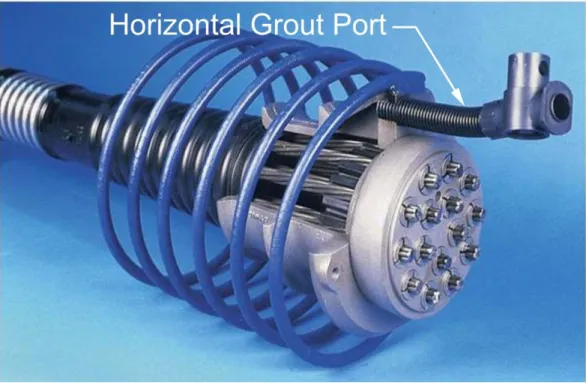
For internal tendons, before opening a hole in the tendon, the tendon must be located using GPR as shown in Figure 64. For both option 1 and 2 inspections, at least one joint sample must be selected per tendon from among the preselected tendons determined in Chapter 5. If a permanent joint cap is available or present, the cap must be removed from the blister pack (see Figure 62 and Figure 63).
The grout sample should be removed as required in Section 6 for further testing and its physical condition inspected, including the. If a cavity is present, a videoscope should be used to inspect the condition of the internal cavity. For any continuity cable selected, both ends of the anchor should be inspected as shown in Figure 66 and Figure 67.
If severe corrosion is discovered, the entire grout cap and grout over the anchor head should be removed for further investigation. After the grout sampling and inspection is completed, the grout cap should be repaired according to the procedure provided in chapter 8. After the tendon is identified, a chipping gun should be used to remove concrete in the PT exclusion a minimum of 1 × 2 feet in plan view or larger if necessary.
If permanent grout cap is present, a core drill should be used to remove approximately 3- to 4-inch-diameter sample from grout cap face to an upper location. For a typical two-span continuous bridge, at least three inspection points should be selected—the first point along the anchorages, the second point at a high point, and the third point at the lowest point of the tendon.

RESTORATION METHODS
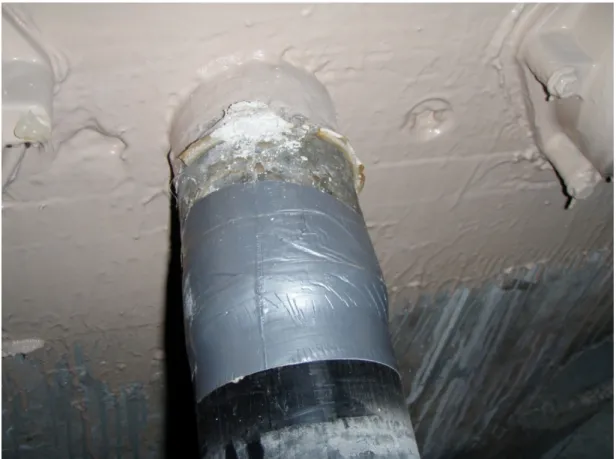
Clean any dust and soft material in the restoration area properly with a vacuum cleaner or a dry air blower. Wrap the restoration area with at least 4 inches of high-performance waterproof tape on each end (see Figure 73). Apply hydraulic cement mortar over the channel/magnesium ammonium phosphate concrete (MAPC) to the concrete surface.
Properly clean any dust and soft material in the restoration area with a vacuum cleaner or dry air blower. Wrap the restoration area with at least 4 inches of heat shrink wrap on each end (see figure 74). For the plastic channel, cover the grout with a new piece of identical plastic channel.
For an existing bridge with no grout cap or if the grout cap was damaged during removal, install a new grout cap for permanent repair. If a grout sample is removed from the anchor head, patch the area of missing grout with an approved hydraulic cement grout before reinstalling the grout cap. For a partially cored grout cap, patch the sampled area of grout with grout mortar and reinstall the original core piece.
It is recommended that material approved by the bridge owners be used in tendon restorations after invasive testing. For grout restoration, after the existing grout is removed for a test sample, the grout shall be primed with a prepackaged grout/hydraulic grout for approved cement grout applied to both interior and exterior tendons.
INTERPRETATION OF RESULTS AND COURSES OF ACTION
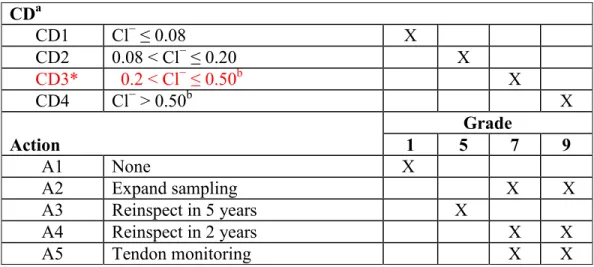
CD classifications as determined by the Cl− levels of the injection mass from the Option 1 review and the resulting recommended actions. The results of the grout laboratory tests showed that 60 percent of the samples had a Cl− content in the range of 0.08 to 0.2 percent by weight of cement, and 40 percent of the samples had a Cl− content lower than 0.08 percent by weight of the cement. A total of 30 percent of the putties examined have soft/separated grout, voids, exposed threads, and corrosion with greater than 5 percent cross-sectional loss.
A total of 25 percent of the tendons inspected have voids, exposed strands with corrosion with less than 5 percent section loss. The term "re-examination" in Table 33 is intended to refer to further inspection and sampling, as described in Chapters 5 to 8 of this report, to either increase the reliability of the results or determine whether deterioration has occurred since a previous inspection. and sampling. Post-Tensioned Bridges: Global Durability Issues and the Latest Developments for Future Improvement, 56th Annual Kansas University Structural Engineering Conference, Lawrence, KS.
The influence of the steel-concrete interface on the risk of chloride-induced corrosion, 227, Proceedings of COST521 Workshop, Luxembourg. The Influence of Calcium Nitrite on the Initiation of Chloride-Induced Corrosion of Steel in Concrete," Proceedings International Conference on Concrete Under Severe Conditions: Environment and Loading, 287, Seoul, South Korea. Effect of cement alkalinity on corrosion threshold and time to corrosion of reinforcing steel in concrete,” Corrosion, 64, 671.
Status of durability of post-tensioned tendons in France,” Durability of post-tensioned tendons, 25, Proceedings of FIB Workshop, Ghent, Belgium. Development of grouting and grouting techniques,” Durability of Posttensioned Tendons, 173, Proceedings of FIB Workshop, Ghent, Belgium. Standard Practice for Petrographic Examination of Hardened Concrete”, Book of Standards Volume 04.02, ASTM International, Conshohocken, PA.
Standard Test Method for Corrosion Potentials of Uncoated Reinforcing Steel in Concrete,” Book of Standards Volume 03.02, ASTM International, Conshohocken, PA.