This thesis examines the drivers of the non-market political strategy of the home country and why some emerging market multinational enterprises (EMNOs) strengthen these political ties more than other EMNOs. Theoretically grounded in an institutional-based view of strategy, we theorized and empirically tested international expansion as a driver of home country nonmarket political strategy.
Research objective
Specific objectives
Justification
Outline of the dissertation
In this thesis we adopted the institutionally based view of strategy, centered on new institutionalism (North, 1990). Moreover, the institutional-based view integrates and extends the isolated contributions of industry- and resource-based views in the EMNEs' setting (Kostova, Roth, & Dacin, 2008; Peng, Sun, Pinkham, & Chen, 2009; Peng et al. ., 2008 ).
Institutional theory
Thus, institutional environments are largely exogenous to firms (Oliver, 1991), although more recent theorizing has developed a more comprehensive framework of what institutional environments are (Garrido, Gomez, Maicas, & Orcos, 2014). As the institutional context differs in each country, the strategies adopted by firms may also be different in each environment in which these firms operate.
The institutional-based view of strategy
The institutional view of strategy is the result of taking into account currents of sociological and economic research in the context of business strategy. The term “institution-based view” was coined by Peng (2002) who was inspired by the economic (North, 1990) and sociological (DiMaggio & Powell, 1983; Scott, 1987) perspectives of the institutional theory literature.
EMNEs international expansion and home country nonmarket political
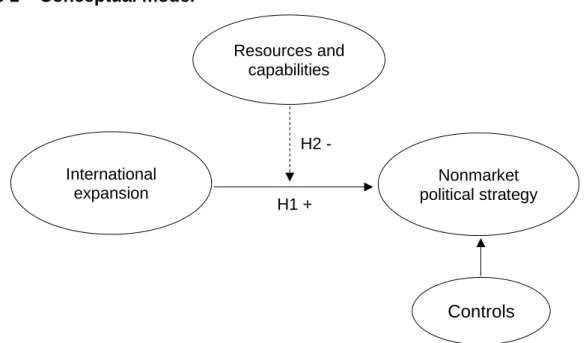
Given all these problems, a key issue facing EMNEs is how to respond to the institutional environment (J. Doh et al., 2017). In emerging markets, MNCs develop political ties with key political actors as a strategic way to mitigate the uncertainty of home country institutional voids and improve access to vital resources for their international expansion that would otherwise be scarce or unfeasible (Dorobantu et al., 2017). Hillman & Hitt, 1999; North, 1990; Rajwani & Liedong, 2015; White III et al., 2015). A non-market political strategy can act as a key element in the international expansion of EMNEs, as this strategy can serve as a substitute for market-supporting institutions (Brouthers, 2002; White III et al., 2018).
The home country government has discretion and controls critical resources for EMNEs' international expansion, such as the provision of bank loans, subsidies and favorable regulations, especially regarding FDI (Buckley et al., 2007; Luo, Xue, & Han, 2010). Thus, political connections with local government agents may be one of the relevant factors behind the success of EMNEs in overcoming home country institutional gaps (Chen et al., 2018). These political connections are particularly useful for predicting the future legal and regulatory environment in troubled markets (Chen et al., 2018).
Consequently, these MNEs are more ready to seize the strategic opportunities opened up by policy changes (Chen et al., 2018; Shi, Markóczy, & Stan, 2014).
Intensity of nonmarket political strategy in home country
Given the tremendous importance of non-trade political strategy to mitigate uncertainty and improve EMNEs' access to vital resources for their international expansion and that access to key actors and benefits can be the result of extensive political activities from EMNEs, it becomes imperative for EMNEs to build political connections to pursue support for their international expansion. In less developed institutional environments, the international expansion of EMNEs positively affects the non-trade political strategy of the home country. Some EMNEs may have a deep knowledge of the home country and, therefore, more availability of strategic alternatives, therefore, these MNEs do not rely heavily on political connections to gain access to desirable resources for their international expansion (Kingsley & Graham, 2017).
MNEs with more knowledge and skills are able to allocate fewer resources or use available resources more efficiently to cope with home country institutional gaps in international expansion. Thus, resource and more capable EMNEs may be less harmed by the absence or underdevelopment of critical institutions to support international expansion of EMNEs than less experienced ones due to their superior resource deployment efficiency, as well as more alternative sources of resources (Zhu & Chung, 2014). Thus, EMNEs are more likely to proactively intensify political ties to gain support in their international expansion and mitigate the effects of codified laws and regulations.
In less developed institutional contexts, the positive relationship between international expansion of EMNEs and non-market policy strategy intensity will be smaller for EMNEs with more resources and capabilities.
Empirical context
Market reforms and institutional voids in Brazilian context
In the 1980s, given the critical financial situation of state-owned and state-owned companies, mainly caused by the oil crisis in previous years, the government and multilateral agencies tried to implement reforms in the management model to change the negative situation. The PND officially expressed the Collor government's intention to reduce the state's presence in the economy. To mitigate criticism of the transfer of assets to foreign entities and to reduce the costs and uncertainties associated with entering new markets, the government allowed "mixed consortia" in privatizations (De Paula, Ferraz, & Iootty, 2002).
In the early 1990s, international investors were reluctant to allocate funds to the country due to the perceived risk in Brazil. In 1993, scandals of illegal financing of election campaigns followed, culminating in the approval of a law regulating this practice by the state Congress. In the following months, inflation fell, GDP grew, and several sectors of the economy expanded.
Although slow, market reforms progressed in the 1990s and 2000s until the end of Lula's first government.

Data set
Variables
- Dependent variables
- Explanatory variables
- Moderating variable
- Control variables
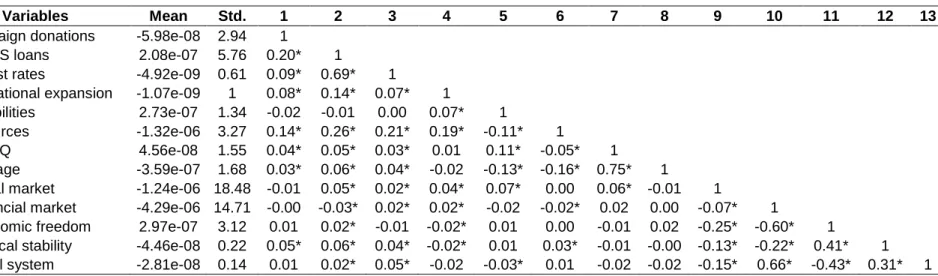
Second, it is paradoxical that during the period of analysis, market and regulatory institutions developed at the same time that politicians were offered strong incentives to cultivate unusual relationships with government (Inoue et al., 2013). Thus, campaign donations can be used as the most direct and objective measure of non-market political strategy between multinational companies and elected officials (Claessens et al., 2008; S. Furthermore, the Brazilian financial system is highly concentrated and long-term financing operations are still limited (Claessens et al., 2008; Lazzarini et al., 2015; Samuels, 2001; Xavier, Bandeira-de-Mello, & Marcon, 2014).
Since emerging markets may exhibit a greater degree of institutional gaps, transaction costs of M&A are generally higher (Hoskisson, Wright, Filatotchev, & Peng, 2013; Lebedev et al., 2015; S. L. Sun, Peng, Lee, & Tan, 2015). On the other hand, MNEs with very low levels of market performance, slack and leverage will be politically active because a political solution may be one of the only ways to correct their financial issues (Hillman et al., 2004; Lux et al. , 2011; Schuler & Rehbein, 1997). We are likely to see a gradually reduced role of political ties and a greater reliance on market-based capabilities as formal market-supportive institutions are gradually implemented (Peng et al., 2008).
Moreover, markets with less government interference are likely to encourage MNEs to concentrate their efforts on economic rather than political activities (Bonardi, Hillman, & Keim, 2005; Hillman & Hitt, 1999; Lux et al., 2011; North, 1990).
Estimation approach
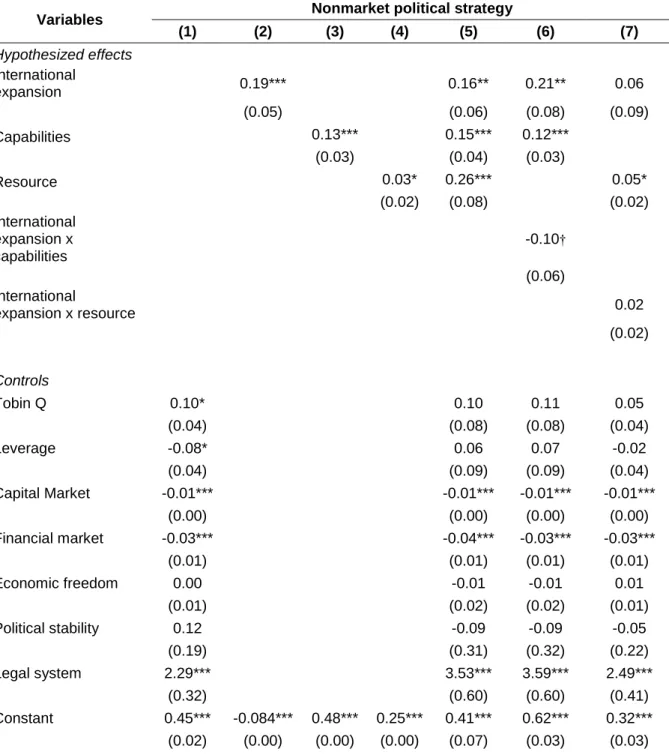
Second, we estimated the direct effects of international expansion and performance on nonmarket policy strategy with and without control variables (models 2 through 5). As we can see in Figure 4, international expansion of EMNEs positively affects the home country's non-market policy strategy. First, capital constraints have been one of the key obstacles to projects of international expansion by EMNEs.
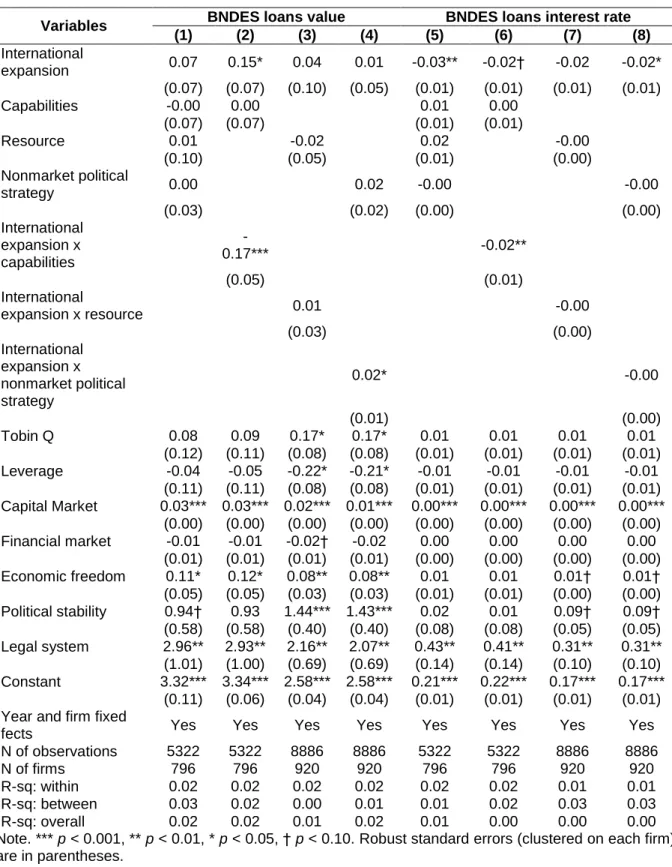
First, we evaluate the effects of EMNE's international expansion and non-market policy strategy on state-owned BNDES loans (model 1). Second, we evaluate the effects of EMNEs' international expansion and their resources and capabilities (models 2 and 3) and non-market policy strategy effects on state-owned BNDES loans (model 4). As we can see in Figure 6, international expansion of EMNEs has a stronger effect (steeper slope) on state-owned BNDES loans when these multinationals adopt more non-market strategy.
In Figure 7, international expansion has a stronger effect (steeper slope) on state-owned BNDES loans when MNCs have a low level of capacity.
Robustness Check
In this dissertation, we investigate the driving forces behind the home country's non-market political strategy and why some EMNEs intensify political ties more than others. Theoretically grounded in an institutional view of strategy, we theorized and empirically tested international expansion as a driver of home country nonmarket political strategy, and of resources and capabilities as a moderator of the intensity of political ties. Therefore, MNEs' non-market political strategy intensity is influenced by the resources and capabilities that EMNEs have to address international expansion issues, without depending on the relationship with non-market political actors from the home country.
This thesis proposed to analyze the international expansion as a driver of the home country's non-market policy strategy and investigated why some EMNEs intensify these political ties more than other EMNEs do. We found that international expansion can be a relevant driver of EMNEs' domestic non-market policy strategy and that EMNEs' resources and capabilities negatively moderate the effects of international expansion on policy tie decisions. This thesis extends the literature that focuses on the antecedents of non-market policy strategy employed by EMNEs.
We theorize and empirically demonstrate international expansion as an important driver of the home country's non-trade political strategy and the contingent role of resources and skills from EMNEs.
Managerial implications
Most research on non-market political strategy is mainly focused on developed markets (eg North American context). In addition, most research is cross-sectional based on management perceptions with self-reported measurements and therefore these studies have inherent limitations, such as common method bias, non-responses or potential false responses, mainly given that political ties is a sensitive question.
Limitations and future research avenues
We overcome these obstacles by integrating multiple data sources and developing an original longitudinal dataset to test our hypotheses in the largest economy in Latin America. The differential effects of types of minority state ownership on the internationalization of emerging market multinationals from Democratic states. The role of local context in the cross-border acquisitions by emerging economy multinationals.
The effect of state ownership on firms' FDI ownership decisions under institutional pressure: A study of Chinese outward investing firms. Integrated market and non-market strategies: political campaign contributions around merger and acquisition events in the energy sector. Mixing business with politics: A meta-analysis of the antecedents and outcomes of corporate political activities.
Escape from the iron cage: Origin obligations and CSR reporting of emerging market multinationals.