The design procedure recommended in the ninth edition of the IESNA Lighting Handbook is largely based on lighting quality. The purpose of ambient lighting is to illuminate most of the room to about one-third of the task lighting level. And of course, natural light sources typically produce ambient light, at least for part of the room.
Design ambient lighting to illuminate the majority of the room for about a third of the task. The ambient light level must be at least 1/3 of the task level up to the target lighting level defined for the room in question. See sections 3.2.4 and 3.2.5 for an overview of the environmental impacts of light penetration and light pollution, respectively.
Use lighting strategies that allow nighttime adaptation of the eye to very low light levels.

Space and Workplace Considerations
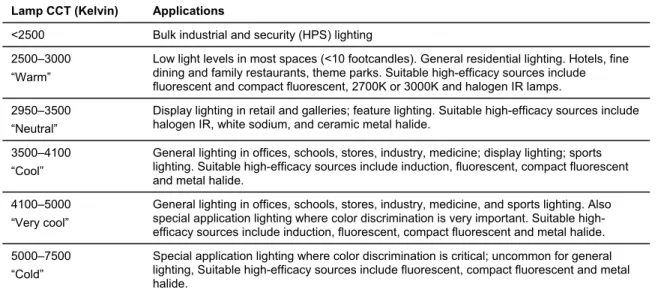
Use lightweight ceiling-hung luminaires Advanced Guide – Layout of space and luminaires In the IESNA design procedure, the appearance and style of the luminaire play a major role. Aside from scotopic effects, high color temperature lamps tend to better match natural daylight, which ranges between 4000K and 7500K for most of the day. However, whenever possible, a higher color temperature such as 4100K or even 5000K will allow scotopic effects to be achieved.
But this must be done in a way that does not destroy the ambience of the space. The brightness of the background of the task - usually white paper - should be used as a base and, in general, as the surfaces of the room. Luminance, being a quality of the room surface as well as light, places critical elements out of the hands of the lighting designer.
Use computer modeling to ensure that the average room surface luminance is at least 10% of the task background. Direct glare is caused by a view of the light source, often with a high contrast to the surroundings. Very bright lighting from a window can be balanced by daylight from a window or skylight on the other side of the room.
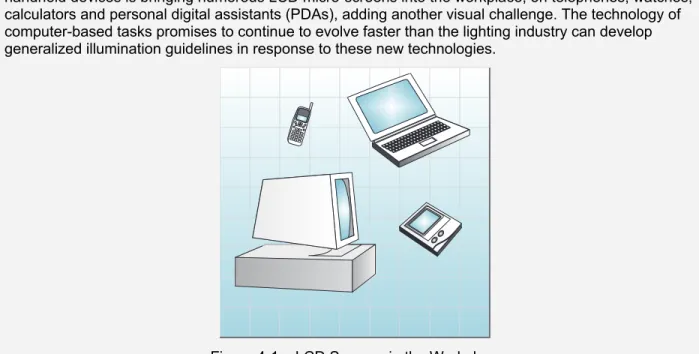
The angle of the monitor can be adjusted to further minimize these problems (see the sidebar below, Obscure reflections on computer monitors). Features such as the easily adjustable viewing angle, a matte surface and a flat screen make it easier to avoid blur reflections. There have always been at least three ways to solve a visibility problem: improve the lighting conditions (with more appropriate light), improve the viewer's vision (with corrective lenses), or improve the visibility of the task.
Lighting People and Objects
Techniques range from illuminating room surfaces or objects, such as wallwashing or cove lighting, to the use of brightly sparkling elements, such as crystal chandeliers. As an advanced lighting guideline, you should realize that it is wasteful to create more lighting than necessary. Strategies include creating highlights in contrast to lower ambient lighting levels and creating highlights with efficient sources as close to the object or surfaces as possible.
Small points of light from fiber optic sources or LEDs can offer effective ways to create highlights or draw attention where specifically desired. The high levels of illumination easily achieved from daylight are a very energy efficient way of providing highlights and focusing attention. For example, the center of a store can be daylighted with skylights, drawing customers deeper into the store, or central circulation areas can receive high lighting levels from daylight, emphasizes.
Such designs should carefully consider alternative night-time lighting strategies from electrical sources that do not attempt to duplicate the high levels of illumination available in daylight. In Chapter 5, grocery and specialty retail applications are examples of the use of accents in lighting design. Sparkles and related reflective accents have recently been recognized as essential elements of lighting design.
These issues are often very similar to those discussed in the Advanced Guide - Points of Interest. However, there are many commercial and industrial tasks where the highlights are critical to the job. As an advanced guide, appreciate these nuances of task work and use lighting systems that enhance or in some cases hide these effects.
Implementation
Lighting Analysis Tools
This value depends on the luminaire design and the characteristics of the room where the luminaire is located (see bullets above). Light loss factors may be recoverable due to maintenance of the lighting system and space, or non-recoverable and constant. Some manufacturers offer software for free or for a nominal price (less than $100), but these programs are generally limited to a stripped-down version of the "real" program.
Plan dimensions of the location to be studied, usually entered in x, y coordinates or via a CAD interface. Some programs allow you to block the printing of light levels in areas of the site where light levels are not critical, or where buildings or trees would block light. Most programs limit the analysis to parts of the site where lighting is important, such as between the curbs in roadway analysis.
No analysis has been performed (or at least not printed) for areas of the site where light levels are not critical. Luminous flux, measured in lumens, refers to the gross amount of light generated by a source, regardless of the intensity of the light in a given direction. Candle power is the measure of the intensity of a light source in a given direction, measured in candelas (cd).
The average illuminance on a surface can be calculated by dividing the number of lumens falling on the surface by the surface area. Rigorously, luminance is defined as the ratio of the intensity of light produced by a surface in a given direction to the projected area of the emitting surface. Brightness is used to describe the strength of the physical sensation caused by viewing surfaces (or volumes).
Daylighting Design Analysis Tools
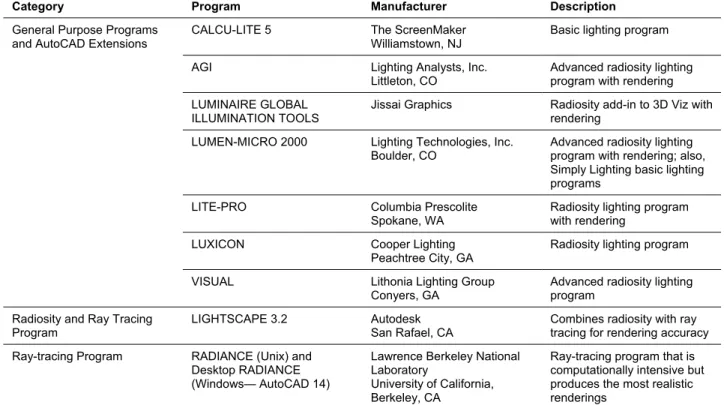
Each year, the Illuminating Engineering Society of North America (IESNA) publishes a lighting software survey in Lighting Design + Application. At the time of printing of the Advanced Lighting Guidelines, the IESNA survey was the most recent and complete source of information on lighting software on the market. The following are some of the more readily available and recognized software available at the time of this document's development.
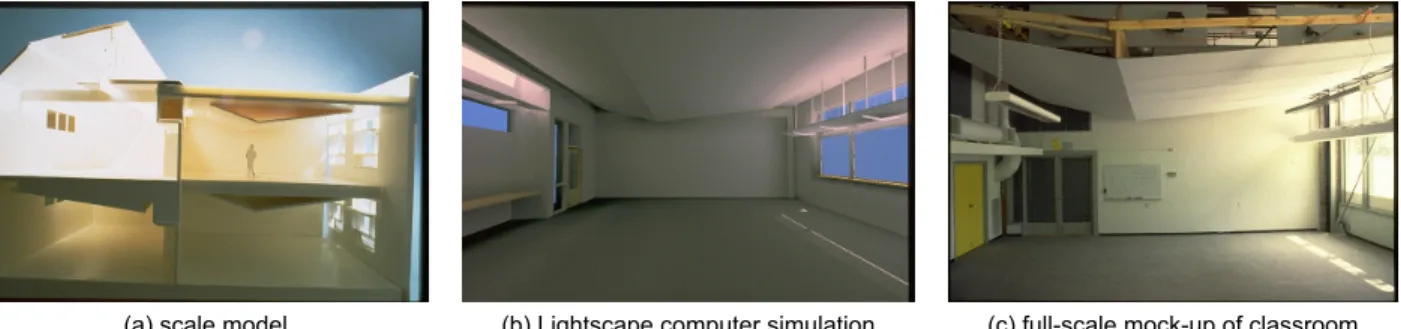
See Lighting Design + Application magazine's annual lighting software survey and http://www.lightsearch.com for additional software resources and benchmarks. Larger models can use actual building components (glazing, surface treatments, etc.) to improve model accuracy. If well constructed, the quantitative accuracy of scale models can be higher than most current computer simulations.
Although expensive, these studies can provide the most accurate qualitative and quantitative information about daylight and electric light and allow designers and clients to experience being in the space. The most sophisticated programs take architectural information from the designer's CAD file, add details, and generate rendered, textured color images with specular reflections for a specific location, day, and time. They can include the effect of both daylight and electric light in the room and can generate an automated "walkthrough" of the room for a specific day and time.
However, using the daylight analysis features of radiosity or ray tracing programs can be extremely useful, if not completely accurate. Simulations for simple spaces that do not require a refined representation can be done quickly (often faster than scale models) and with reasonably accurate accuracy. Some of the common daylight control simulation programs used in the United States are listed in Table 4-4.
Economic Analysis of Lighting Systems
However, without a more accurate financial assessment, the many benefits of advanced lighting systems will be ignored or underestimated. It is expressed as the time required to pay the incremental costs of the system with increased savings, in months or years. The final answer is expressed by the value of the investment in the system compared to the value of any other investment.
The key to any economic analysis will always be the accuracy and completeness of the information inputs. All costs and benefits associated with a lighting project must be considered in a careful economic evaluation of a lighting system. As discussed above, the cost of financing construction projects is significant and becomes a motivator to keep the project "on time and on budget." Any increase in the initial cost or extension of the construction financing period multiplies the final cost of a project.
To help these organizations, a new industry has developed that essentially finances projects by taking a share of the energy savings. National Council on the Qualifications of the Lighting Professions (NCQLP) requires that practitioners who have obtained the designation LC (Lighting Certified) have knowledge of economic analysis and can perform this function for their clients (see section 3.3.4). However, a better understanding of the cost savings resulting from an energy efficiency measure will involve knowing the time of use for different systems and the load profile for the building.
By reducing the connected load at lower power density or peak demand with controls that reduce consumption during peak periods, building owners can save more money than the value of the direct energy savings. Similarly, when utilities shift more of the cost of providing electricity to fixed rates per customer, the incremental value of energy savings to the customer generally becomes smaller. This is a function of both labor costs and the density of workers in the building.
In the case of federal office workers, consider a higher-quality lighting system that resulted in a 50% increase in the cost of lighting installation, from $2.50/ft² to $3.75/ft². A scoping study or "scoping" involves a rapid survey by an experienced auditor, followed by an economic analysis of the proposed energy conservation measures.