
In this work, we expose the results in the literature that extract thermodynamics from the collision model when the particles that make it up are in a thermal state. It is important to note that in parallel with thermodynamics, a new set of operational tools was developed in connection with quantum technologies: the quantum resource theories [6].
Entropy as an information measure
Relative entropy
A useful tool for inferring relationships and building intuition on information theory is the relative entropy, or Kullback-Leibler divergence [34]. As suggested, the state that returns the highest amount of information to a measurement is the maximally mixed state:.
Subadditivity and mutual information
Considering only the action of K1 on ρ, one notices that it does nothing: it is just a rescaling of the identity:. the condition is the same up to normalization. This interpretation of the operator-sum decomposition is called quantum jump dynamics, where each Kraus operator is associated with an action on the system, or jump [40].
Environment perspective
While the map is unique, the operator sum view is not. with the postulates of quantum dynamics. Both evidences taken together show that Eq. 3.18) represents a quantum operation that is equally valid as Eq. 3.2), and it is called the Stinespring dilatation.
Axiomatic definition of a quantum channel
Quantum coherence is a property similar to entanglement in many respects, nevertheless it does not rely on a partition of the system's Hilbert space. Although such properties are common in the quantum realm, the inhabitants of the classical world do not experience these characteristics. The mechanism behind it is related to the existence of reservoirs: Hilbert spaces that are much larger than the system's own Hilbert space, which cause the relaxation of the local system to a target state on a basis determined by the interaction between imposed on the system and reservoir, as will be discussed in Chapter 5.
In this chapter, Section 4.1 will take advantage of the physical appeal of the resource theory of entanglement to develop the basic elements of a general resource theory. A quantifier related to this task will establish an ordering of the sequence of entangled states, where its maximum value will correspond to the maximally entangled state.
Resource theory of coherence
Maximally coherent state
Here we prove the existence of a state from which one can reach any other state in Honly by disjoint operations. Note that the set formed by the Kraus operators (4.5) forms a family of maps parametrized by the coefficients. This completes the proof, as shown that any mixed state can be prepared by means of|Ψ and disjoint operations.
Coherence measures
This is complemented by several measurements, especially for relative entropy (2.7) and all metrics. It is shown that, under certain conditions, the reservoir degrees of freedom are compressed into an additional structure in the reduced von Neumann equation for the system. The GKSL equation decomposes some subspaces of the original Hilbert space of the system, and its decomposition rate is related to aγk, justifying their name [41].
From these examples, one can draw some general conclusions about how the choice of jump operators affects the dynamics of the system: they represent the transitions caused by the system's environment. But from a qualitative perspective, the relevant message is that jump operators represent the transitions caused by the bath on the system.
Microscopic derivation of a master equation
The total Hamiltonian of the system is H = HS +HE+V, where HS and HE are the respective free Hamiltonians for the system and the environment, and V is the interaction between them. It is not a limitation of the method, in fact, it has been chosen so that the thermodynamics can be derived from it later. This is called the Nakajima-Zwanzig equation and is exact for the local state of the system.
The continuous calculations are beyond the scope of this discussion and can be found in Ref. However, most of the results obtained in the following sections still apply to the general map Eq.
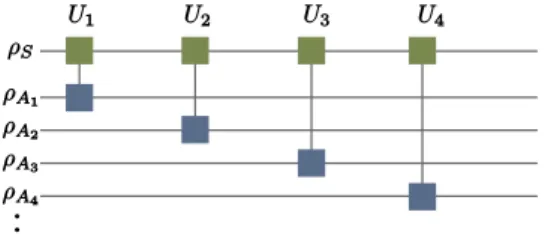
Reservoir engineering
Energy preserving interactions and its parametrization
When the interaction is energy-conserving, we can always write it as whereLk and Ak are eigenoperators of the system and ancilla Hamiltonians with opposite sign Bohr frequency: ωk for Lk and −ωk for Ak. This guarantees that each quanta leaving/entering the system has the same energy as the one entering/leaving the ancilla and conserves. It is thus shown that the collision model in the continuum limit thermalizes the system without the need for approximations.
Consider the array mancillaeρm interacting with the system between timeτ/ and Vrescaled asm/√. The yield of the first and second collisions from equation 6.26). With two different thermal ancils, for example, the system could be brought to a non-equilibrium stable state [65].
Thermodynamics
In the configuration of the collision model, where ancillaries are discarded after interacting with the system, we can distinguish two mechanisms for information loss. This form for the entropy production is valid for any collision model as general as Eq. In the last equality, we used the fact that the global evolution is unitary and thus conserves entropy.
We have successfully written the first and second laws of thermodynamics only in terms of information about the system in the collision model. The results agree with the desired effects for a system in contact with a heat reservoir in the weak coupling limit: they are the same not only from a dynamic point of view, as shown in the last section, but also from a thermodynamic one.
Weakly coherent collisional models
Hamiltonian engineering
In the continuum limit they will decay, so no change in the dissipative part of the dynamics is expected. For concreteness, it is interesting to cast G in terms of eigenoperators as done with the dissipator in Eq. wherehBjiχ = Tr{Bj χ} is the average of the eigenoperators of the ancilla Hamiltonian with. that G is hollow in the system energy basis. The choice for its elements can be made by the interaction, and their relative intensities can be independently chosen from χ: with weak coherences, the collision model can be used to perform Hamiltonian engineering.
The dissipator is the same, but there will be an additional termG. Thus, the full master equation will be read. 6.58). In the derivation it was clear that the additive property arises from the fact that each cross-term is of a higher order in τ and thus vanishes in the continuum limit.
Thermodynamics
For a detailed calculation, see Appendix A. The energy flux entering the system now has two distinct contributions: one through the dissipator and the other through the Hamiltonian. We argue here that since the nature of the former is dissipative, it is an incoherent source of energy just like heat. However, with the help of G, a transformation process occurs and the bath coherently injects part of its lost energy into the system.
Summing up both contributions and again taking the continuum limitτ→ 0, we finally write note here that both incoherent heat and coherent work play the usual roles within the functional form of the entropy production. The amount of work done in the system is therefore limited by the free energy difference experienced by the system. 6.59) signals a straightforward extension of both the first and second laws to multiple reservoirs.
Resource interconversion
In the first law, a work-like term appears, although the evolution of the global system is independent of time. To address such baths, one can set the arrival time of the ancillae as a Poisson process [17]. In this appendix we provide the updated state of the ancils after they have interacted with the system.
Using the general map (A.1), we can calculate the changes in energy of the system and ancilla, defined as ∆HS =tr. Note that the structure of these results is completely independent of any particular choice for the conditions of the ancillae.
Von Neumann entropy
To calculate the entropy production, defined in Eq. 6.35) of the main text one has to calculate different entropic quantities depending on these states. Since we are interested in the limit τ → 0, these quantities can be calculated using perturbation theory, which becomes exact in the limit τ → 0. We start by stating some general results about confounding extensions of von Neumann entropy , the relative entropy of coherence and the quantum Kullback-Leibler divergence (relative entropy). thepi are non-degenerate, we can then write to order2: Pi = pi+σii+2X. B.2), by extending PilogPi to the second order and using the fact that trσ=0, we find that.
Relative entropy of coherence
Quantum relative entropy
The σii populations contribute to both order and 2, while the (off-diagonal) coherences start to contribute only to order 2. where σandµ are arbitrary, but both depend on ρ0to order0. B.8). To calculate the last term, we will need not only the perturbation theory for the eigenvalues of ρ [Eq. B.3)], but also for its eigenvectors. Pi|˜iih˜i|allows us to write. B.10) Thus, in addition to writing logPi as a power series, we will also need to expand ˜i|ρ0|˜ii. Inserting this result into Eq. B.10) and expanding all terms in then finally leads to tr(ρ0logρ)= X.
Moreover, the result depends on both the populations and the correlations, and both with the same order2. Since system and environment always start uncorrelated and since the global dynamics are unitary, the mutual information developed in the map (A.1) can be written as
The term proportional to logZA disappears, because it is proportional to tr(ρ0A−ρA), and the second is therefore nothing but the total change in energy of the ancilla in Eq.
But this is consequently a minus change in energy in the system. the difference between the relative coherence entropies ρ0A and ρA [Eq. Substituting these results into Eq. B.16) and expressing the remaining sums in terms of traces, then we get Translation of Ludwig Boltzmann's article on the relationship between the second fundamental theorem of the mechanical theory of heat and probabilistic calculations regarding the conditions for thermal equilibrium sitzungberichte der kaiserlichen akademie der wissenschaften.
A note on symmetry reductions of the Lindblad equation: Transport in confined open spin chains. The theory of relaxation processes* *this work was initiated while the author was at harvard university, and was then partially supported by joint services contract n5ori-76, project order i.
