DOE
Design of Experiments / Factorial / Fractional / RSM
UNIFEI Jul 2017
Six Sigma | P. P. Balestrassi
2
Temperatura
170,0 167,5 165,0 162,5 160,0
Rendimento
42 69 71 Viscosidade 38
Overlaid Contour Plot of Rendimento; Viscosidade
An overview of
Design of Experiments
Summary
• Efficient Experimentation
• Factorial Designs
• Fractional Factorial Designs
• Screening Designs
• Taguchi Designs
• Response Surface Methodology
• Desirability
• Mixtures
Pedro P. Balestrassi
“Statistical thinking will one day be as necessary for
efficient citizenship as the ability to read and write.”
H. G. Wells (Writer, 1895)
ra
170,0 167,5
Rendimento
42 69 71 Viscosidade 38
Overlaid Contour Plot of Rendimento; Viscosidade
Statistical thinking Introduction
Factors of a Process
Process
Noise Factors Control Factors
Input Output
...
x 1 x 2 ... x p
z 1 z 2 z q
y 1 y 2 y m
... Source Client
SIPOC
Efficient
Experimentation
Robust Process
• Which factors influence y the
most?
• How to adjust x to get the desired value for y ?
• How to adjust x to achieve minimal variation for y ?
• How to adjust x so that the
z y
What is
Robustness?
Efficient
Experimentation
X
• Air strip pressure
• Air bag pressure
• Air front piston pressure
• Hydraulic pressure
• Temperature
• Oil flow
• Nitrogen pressure
Y
• Top Wall width
• Mid Wall width
• Dome depth
• Can height
• Painting
Bodymaker Process
Z
• Operator
• Electricity fluctuation
• Aluminiun quality
Example: Can Making
It’s complicated to infer about X,Y and Z without statistics
Y=f(X)+Z+e
Efficient
Experimentation
X
• Injection time
• Cooling time
• Mold temperature
• Machine temperature
• Injection velocity
• Injection pressure
Y
• Scrap
• Deformation
• Failure rate
Example: Injection Molding
Z
• Cycle time
• Operator
• ...
Efficient
Experimentation
TRIP Process of Can Making
- Ph da pré-lavagem
- Temperatura da lavagem química - Acidez livre da lavagem química - Acidez total da lavagem química - Milivolt da lavagem química - Ph do tratamento
- Temperatura do tratamento - Milivolt do tratamento - Teor de sílica
- Teor de cloro do mobility
- Pressão de vácuo da roda de transferência - Velocidade da printer
- Condutibilidade do mobility - Concentração do mobility
- Temperatura da primeira zona do forno - Temperatura da segunda zona do forno - Velocidade da lavadora
- Pressão superior do spray na pré-lavagem - Pressão inferior do spray na pré-lavagem - Pressão superior do spray na lavagem química - Pressão inferior do spray na lavagem química - Pressão superior do spray no tratamento - Pressão superior do spray no mobility - Pressão inferior do spray no mobility
- Condição da esteira de aço - Condição da esteira plástica da lavagem
- Qualidade do produto
- Condição do punção da bodymaker - Fundo fraturado
- Sujeira no conveyor - Desgaste do assento azul
- Lata chaleira
- Lata com rugas no fundo - Lata com rebarba
- Lata ovalizada
- Sujeira na calha de alimentação da printer
- Sincronismo da roda de transferência
- Sujeira no mandril - Mangueiras estouradas - Desgaste do wiper - Sujeira no single filer - Sujeira nos assentos azuis - Ajuste do manifold
7 Outputs -
Can features after TRIP process.
- Latas cortadas impregnadas de óleo solúvel - Ácido sulfúrico - Ridoline 1895 - Ridoline 120 - Alodine 404NC - Mobility ME 60 - Gás
- Dicloro
- Água deionizada
CONTROL
NOISE
Input
→
Z X
Y
How to handle this type of problem?
24 Factors
18 Factors
9
Inputs
Efficient
Experimentation
Experiment X1 X2 X3 X4 X5 X6 X7 Results
1. – – – – – – – 2.1
2. + – – – – – – 2.6
3. + + – – – – – 2.4
4. + – + – – – – 2.5
5. + – – + – – – 2.8
6. + – – + + – – 2.9
7. + – – + + + – 2.7
8. + – – + + – + 3.2
Final + – – + + – +
Consider the experimental design in 2-levels (-/+) for the factors X1 .. X7
Stick-a-winner Strategy Efficient
Experimentation
Experiment X1 X2 X3 X4 X5 X6 X7 Results
1. – – – – – – – 2.1
2. + – – – – – – 2.5
3. – + – – – – – 1.9
4. – – + – – – – 1.9
5. – – – + – – – 2.2
6. – – – – + – – 2.3
7. – – – – – + – 2.5
8. – – – – – – + 2.3
Final + – – + + + +
Another Common Sense approach
Consider the experimental design in 2-levels (-/+) for the factors X1 .. X7
The Stick-a-winner Strategy is a One-factor-at-a-time method to run experiments.
Efficient
Experimentation
• These methods are conventional (common sense).
• These methods are inefficient in determining the main factors.
• Interaction is totally negleted in this type of method.
One-factor-at-a-time method Efficient
Experimentation
Health
Alcohol
Without Good
With Regular
Excelent
Death
Interaction
With Medicine Without Medicine
Efficient
Experimentation
DOE for practitioners
• Knowledge of specialist is fundamental;
• DOE means simplicity;
• DOE recognizes what is important;
• Experiments are interactive
One-factor-at-a-time (Common Sense)
Factors vary simultaneously
(Central idea on DOE) X
Efficient
Experimentation
• Assume that you work at a chemical plant.
• You are studying one of the reactions that produces a chemical product.
• You would like to somehow increase the yield of a product that is produced by the reaction.
• From past experience, you have seen that varying the temperature, the pressure, and the type of catalyst seem to change the yield of the reaction.
• The problem is that everyone you work with has their own theory about how each of these factors affects the reaction.
• You want to make real improvements, so you decide to run an experiment to determine the actual effects of these three factors:
1. Temperature (Levels of 40 o C and 60 o C) 2. Catalyst (Levels A and B)
3. Pressure (Levels of 1 and 1.5 atmospheres)
An example of DOE using Minitab Efficient
Experimentation
Minitab Worksheet
2 3
Full Factorial Design with 2 Replicates
Efficient
Experimentation
P_value <0.05 → Coefficient is significant.
DOE Results
Factorial Fit: Yield (grams) versus Temperature, Catalyst, Pressure Estimated Effects and Coefficients for Yield (grams) (coded units)
Term effect Coef SE T P Constant 74.75 2.543 29.39 0.000 Temperature 1.25 0.63 2.543 0.25 0.812 Catalyst 14.00 7.00 2.543 2.75 0.025 Pressure -30.50 -15.25 2.543 -6.00 0.000 Temperature*Catalyst -0.25 -0.12 2.543 -0.05 0.962 Temperature*Pressure -1.25 -0.63 2.543 -0.25 0.812 Catalyst*Pressure -13.50 -6.75 2.543 -2.65 0.029 Temperature*Catalyst*Pressure -0.25 -0.13 2.543 -0.05 0.962
Efficient
Experimentation
Pareto Chart
Te rm
AB ABC A AC BC B C
6 5
4 3
2 1
0
2.306
F actor Name A Temperature B C ataly st C Pressure
Pareto Chart of the Standardized Effects
(response is Yield (grams), Alpha = .05)
Efficient
Experimentation
Normal Plot
Standardized Effect
P e rc e n t
3 2
1 0
-1 -2
-3 -4
-5 -6
99
95 90 80 70 60 50 40 30 20 10 5
1
F actor Name A Temperature B C ataly st C Pressure Effect Type Not Significant Significant
BC
C
B
Normal Probability Plot of the Standardized Effects
(response is Yield (grams), Alpha = .05)
Efficient
Experimentation
Factorial Plots
M e a n o f Y ie ld ( g ra m s)
60 40
90 80 70
60
B A
90 80 70 60
Temperature Catalyst
Pressure
Main Effects Plot (data means) for Yield (grams)
Efficient
Experimentation
T emperature
B
A 1.0 1.5
100
80
60
Catalyst
100
80
60
Pr essur e
Temperature 40 60
Catalyst A B
Interaction Plot (data means) for Yield (grams)
There is an interaction between Pressure and Catalyst that effects the Response.
Interaction Efficient
Experimentation
1.5
1 B
A
Pressure Catalyst
59.5
59.5 59.0
60.0
105.0
77.5 75.0
102.5
Cube Plot (data means) for Yield (grams)
The Cube Plot represents the experimental space at two levels. Axial values are the average of the replicates.
Cube Plot Efficient
Experimentation
Thinking Ahead ...
Process
Noise Factors Control Factors
Input Output
...
x 1 x 2 ... x p
z 1 z 2 z q
y 1 y 2 y m
... Source Client
Efficient
Experimentation
Design of Experiments
Renaissance of DOE in industry:
• Efficient computational softwares (JMP, Statistica, Minitab, WebDOE, SPSS, etc...)
• Six Sigma Methodology
✓Determining the main factors in a process (Screening DOE)
✓Establishing transfer function and optimization.
(Factorial DOE and RSM)
Y=f(X) +Z +e
Efficient
Experimentation
• ... a technique to decrease the amount of experiments (or
simulation)
• ... a graphical method to analyse experiments
•... a numerical method to analyse experiments
Use DOE as ... Efficient
Experimentation
Which combinations are missing?
Factor 1 Run
– + – – 1
2 3 4
– – + –
– – – + Factor
2
Factor 3
5 6 7 8
‘-’ represents the lower level and
‘+’ represents the upper level
Transition to DOE
- + -
- - +
+ - -
- - - 6
3
7 8
4
1 2
5
In the One-factor-at-a-time method the space is not balanced.
Factorial Designs
– + – + – + – + Factor
1 1
2 3 4 5 6 7 8
– – + + – – + +
– – – – + + + + Factor
2
Factor 3
Standard Order
Full Factorial
The Standard Order is not always the Run Order
Factorial Designs
Yellow Green Yellow Green Yellow Green Yellow
Factor 1
1 2 3 4 5 6 7
Standard Order
1.42 1.42 2.00 2.00 1.42 1.42 2.00
3.00 3.00 3.00 3.00 4.75 4.75 4.75 Factor 2 Factor 3
Factors are Qualitative or Quantitative
Full Factorial
2 3
Factorial Designs
Experimental space
2 Factors = A Square
Factor 1
– +
Factor 2
+
–
Factor 2
Factor 1
– +
+
– –
+
Factor 3 3 Factors = A Cube
Cube Plot Factorial Designs
4 Factors: Two Cubes
– +
Factor 4
Fourth Dimension Factorial Designs
–
Factor D
+
– +
Factor D Factor E
(-)
Factor E (+) A
B
C
1 = - - - - -
16 = ++++- 8 = +++ - -
17 = - - - - +
32 = +++++
5 Factors:
4 Cubes
Cube Plot Factorial Designs
runs = 2 k
• The whole experimental space is covered with
Factorial Designs.
• Factorial Designs are easy to conduct due to a well-
established pattern.
DOE Matrix
# of factors
Standard Order
Factorial Designs
Simple Model
Y=Constant + <Average>
k 1 X1 + k 2 X2 +k 3 X3 + <Main Factors >
k 4 X1X2 + k 5 X1X3 + k 6 X2X3 + <2 nd Order Interactions>
k 7 X1X2X3 <3 rd Order Interaction >
Y = f (X 1 , X 2 , X 3 , …, X n )
Y (Response)
X i (Factors) = X1, X2, X3
Factorial Designs
Constant
Order Std.
1 2 3 4 5 6 7 8
X1 – + + + + – – –
X2 – – + + – – + +
X3 – – – –
+ + + +
Data
(Rep 1, Rep 2, Rep 3) 49.5
49.5 49.75 48.75 51.25 50.00 49.50 50.50
Average
Sum _______ 1194.50 Average _____ 49.77 50.75
48.75 49.25 48.25 49.75 50.00 50.50 50.50
50.00 49.50 48.50 49.00 50.25 50.75 49.75 50.25
Y=49,77 + k 1 X1 + k 2 X2 +k 3 X3 + k 4 X1X2 + k 5 X1X3 + k 6 X2X3 + k 7 X1X2X3
Factorial Designs
Main Effects
Order Std.
1 2 3 4 5 6 7 8
– + + + + – – –
– – + + – – + +
– – – –
+ + + +
Average 50.10 49.25 49.17 48.67 50.42 50.25 50.42 49.92
X3 “+”
50.42 50.25 50.42 49.92 X3 “-”
50.10 49.25 49.17 48.67
Total X3 “+” _____ 201.01 Total X3 “-” _____ 197.19
Average of X3 “-” _____ 49.30
Average of X3 “+” _____ 50.25 Effect of X3 = [Average of X3 “+”] - [ Average of X3 “-”] = 0.95
X1 X2 X3
When X3 goes from “-” to “+” the response Y increases 0.95
Factorial Designs
- +
- +
Y 49 49. 5 50 50. 5
49.77
0 X3
X2
Y 49 49. 5 50 50. 5
When X3 goes from “-” to “+” the response Y increases 0.95
When X2 goes from “-” to “+” the response Y decreases 0.45
Main Effects Factorial Designs
Coefficients
A Effect
2 q
2
Effect tg q = A
Level
-1 +1
Response
29,50 29,75 30,00 30,25 30,50 30,75 31,00
Factor A
Factorial Designs
Coefficient of X3
- +
Y 49 49 .5 50 50 .5
49.77
0 X3
Y=49,77 + k 1 X1 + k 2 X2 +0.497X3 + k 4 X1X2 + k 5 X1X3 + k 6 X2X3 + k 7 X1X2X3
When X3 goes from “-” to “+” the response Y increases 0.95
k 3 = 0.95/2
Factorial Designs
Interaction Effect - Example
A B AB Response
- - + 50
+ - - 54
- + - 100
+ + + 60
AB Effect = (Average of AB “+” ) - (Average of AB “-”) AB Effect = (50+60)/2 - (54+100)/2
AB Effect = - 22
Coefficient of AB = - 11
Response= Constant + k
1A + k 2 B – 11AB
— Terminology:
A x B or AB
Factorial Designs
Interaction Plot
Response
Factor A
Factor B
+ –
– +
Factor A
Factor B
+ –
– +
+ –
– +
Factor A
Factor B
+ –
– +
+ –
– +
+ –
– +
High Interaction No Interaction
Low Interaction
Evaluate also P_value
ResponseResponse Response
Factor A
Factor B
Factor A
Factor B
Factor A
Factor B
ResponseResponse
Factorial Designs
Design with interactions
Response
________
________
________
________
________
________
________
Std.
Order 1 2 3 4 5 6 7 8
A – + – + – + – +
B – – + + – – + +
C – – – – + + + +
AB + – – + + – – +
AC + – + – – + – +
BC + + – – – – + +
ABC – + + – + – – +
________
2 3 Factorial Design Not usually visible
Factorial Designs
P-Value / Test of Hipothesys
▪ H o : factor is in the group
▪ H a : factor is different from the group
▪ If p < a: H o is rejected
Factorial Designs
Response= 50+ 0,5A+ 0,3B
Level
(-1) (+1) Factor A 10 20 Factor B 0 10
Max Response= 50+0,5(+1)+0,3(+1)=50,8
Coded Unit Factorial Designs
Example Factorial Designs
Main Effects Factorial Designs
Interaction Plots Factorial Designs
Surface Plots Factorial Designs
Contour Plots Factorial Designs
a) What is the linear model?
b) What is the main factor?
c) Does it have interaction among the factors?
Temperature Catalyst Yield (grams)
Example Factorial Designs
Temperature Catalyst Pressure Yield
Example
a) What is the linear model?
b) What is the main factor?
c) Does it have interaction among the factors?
Factorial Designs
Temperature Catalyst Pressure PH Yield
Example
a) What is the linear model?
b) What is the main factor?
c) Does it have interaction among the factors?
Factorial Designs
Full Factorial problems
Number of Factors
1 2 3 4 5 6 7 8 9 10
•
•
• 15
•
•
•
Number of Experiments
2 4 8 16 32 64 128 256 512 1024
•
•
• 32,768
•
•
•
2 k
Number of Experiments
Fractional Factorial
Design
Available Information
2 k
The vast majority of processes are dominated by main effects and lower order
interactions
Number of Factors
1 2 3 4 5 6 7 8 9 10
•
•
• 15
•
•
• 20
1 2 3 4 5 6 7 8 9 10
•
•
• 15
•
•
• 20 Main Effects
2
ndOrder Interaction
– 1 3 6 10 15 21 28 36 45
•
•
• 105
•
•
• 190
– – 1 5 16 42 99 219 466 968
•
•
• 32,647
•
•
• 1,048,365
> 2
ndOrder Interaction
Fractional Factorial
Design
Example for 4 factors
2 4
Response=Constant+ <Average>
A B C D + <Main Effects>
AB AC AD BC BD CD + <2
ndInteractions>
ABC ABD ACD BCD + < 3
rdInteractions>
ABCD < 4
thInteraction>
Fractional Factorial
Design
Fractional Factorial
2 3
A B
C
7 8
3 4
5 6
1 2
– + – + – + – + A Order
– – + + – – + + B
– – – – + + + + C 1
2 3 4 5 6 7 8
2 3-1
Half Fraction
Fractional Factorial
Design
Half Fraction
2 3-1
A B
C
7 8
3 4
5 6
1 2
+ – + A
– + – + B
– – + + Order C
2 3 5 8
–
Observe that C=AB
Fractional Factorial
Design
Building Half Fraction
2 4-1
A B
– + – + – + – +
– – + + – – + +
– – – – + + + + C
– + + – + – – +
D = ABC
2 3
Base
D=ABC= Design Generator
– + – + – + – + – + – + – + – + A
– – + + – – + + – – + + – – + + B
– – – – + + + + – – – – + + + + C
– – – – – – – – + + + + + + + + D
+ – – + – + + – – + + – + – – + E
2 5-1
2 4
Base
E=ABCD= Design Generator
Fractional Factorial
Design
Full Factorial x Half Fraction ---Trade-Offs
Number of Effects
Effects Average Main
2
ndorder Interactions
Total of Effect
Full Fraction 1
5 10 10 5 1 32
1 5 10
—
—
—
16 Number of
experiments
If you don’t have a reason to believe that higher order
interactions are present, you can choose half fraction.
3
rdorder Interactions 4
thorder Interactions 5
thorder Interaction
Fractional Factorial
Design
– – – – + + + +
Factor A 1
2 3 4 5 6 7 8 Run
– – – – + + + + Factor B
130 125 133 130 50 85 79 93
Response
Confounding A=B
The Effects of A and B are confounded.
Fractional Factorial
Design
D=ABC
A B C D AB AC
=
=
=
=
=
=
BCD ACD ABD ABC CD BD –
+ – + – + – + A
– – + + – – + + B
– – – – + + + + C
– + + – + – – + D
+ – – + + – – + AB
+ – – + + – – +
CD From the Base D=ABC
A.D=A.ABC=1.BC=BC
AD.D=A.1=D.BC
Etc...
1
1
Fractional Factorial
Design
D=ABC
– + – + – + – + A
– – + + – – + + B
– – – – + + + + C
– + + – + – – + D
+ – – + + – – + AB
+ – – + + – – + CD
10 20 18 12 12 18 20 10
Response
Effect of AB+CD = (10+12+12+10)/4 – (20+18+18+20)/4
= 11-19= -8
This is not AB effect or CD effect exclusively. Also, it is not possible to divide AB + CD.
Meaning of AB+CD Fractional Factorial
Design
Common Sense X DOE
Consider the experimental design in 2-levels (-/+) for the factors X1 .. X7
Experiment X1 X2 X3 X4 X5 X6 X7
1. – – – – – – –
2. + – – – – – –
3. – + – – – – –
4. – – + – – – –
5. – – – + – – –
6. – – – – + – –
7. – – – – – + –
8. – – – – – – +
The Stick-a-winner Strategy is a One-factor-at-a-time method
Fractional Factorial
Design
Common Sense X DOE
Consider the experimental design in 2-levels (-/+) for the factors X1 .. X7
Experiment X1 X2 X3 X4 X5 X6 X7
1. – – – + + + –
2. + – – – – + +
3. – + – – + – +
4. + + – + – – –
5. – – + + – – +
6. + – + – + – –
7. – + + – – + –
8. + + + + + + +
Resolution III Placket-Burman Design
Fractional Factorial
Design
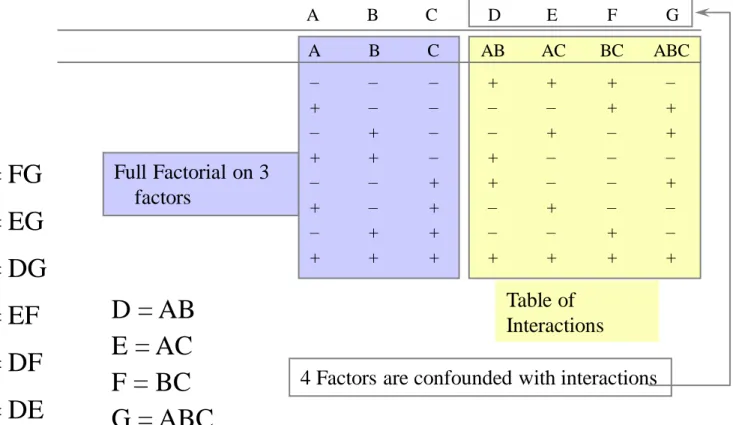
Minimal number of experiments
Ex.: 7 Factors on 8 experiments
Full Factorial on 3 factors
Table of Interactions 4 Factors are confounded with interactions
– + – + – + – +
– – + + – – + +
– – – – + + + +
+ – – + + – – +
+ – + – – + – +
+ + – – – – + +
– + + – + – – +
A B C AB AC BC ABC
A B C D E F G
A B C D E F
=
=
=
=
=
= BD AD AE AB AC AG
CE CF BF CG BG BC
FG EG DG EF DF DE
=
=
=
=
=
=
=
=
=
=
=
=
D = AB E = AC F = BC
Screening Designs Fractional Factorial
Design
Display available design Fractional Factorial
Design
Design’s Resolution
R Confounding III 1-2
IV 1-3 , 2-2 V 1-4 , 2-3
Fractional Factorial
Design
Nomenclature
7 factors 2 levels
Resolution IV
3 main factors confounded with 3 rd order interaction
With Replication Total of 32 runs
2 Times
Fractional Factorial
Design
Paper helicopter
(Box, Bisgaard and Fung – Designing
Industrial Experiments: The Engineer’s Key to Quality, 1990)
Fractional Factorial
Design
Resolution III Experiments Screening
Design
Example of Screening Design
Objective: Analyze the results of the following factors using Screening Designs.
Data: Damage.mtw
A B C D E F G
Load
Load method Packing
Box size Shipper
Open method
“Use Caution” message on box
partial std.
paper std.
x knife no
full rush
styrofoam custom p
scissors yes
Factors and Levels +
Y = Damage Claim ($)
Background: A mail order company is trying to reduce the Damage Claims caused by boxing, shipping, and opening methods. They ran a design with these factors:
Screening
Design
Session window - Alias Screening
Design
Session window - Results
Fractional Factorial Fit
Estimated Effects and Coefficients for $Damage (coded units) Term Effect Coef
Constant 20.375 Load 20.250 10.125 Method 2.250 1.125 Packing 0.750 0.375 Box -2.250 -1.125 Shipper 5.250 2.625 Open -11.750 -5.875 Message -13.250 -6.625
Analysis of Variance for $Damage (coded units)
Source DF Seq SS Adj SS Adj MS F P Main Effects 7 1524 1524 217.7 * * Residual Error 0 0 0 0.0
Total 7 1524
Estimated Coefficients for $Damage using data in uncoded units
Output deleted to save space:same as above for this situation (all factor levels are discrete)
Alias Structure (up to order 3)
I + Load*Method*Box + Load*Packing*Shipper + Load*Open*Message + Method
*Packing*Open + Method*Shipper*Message + Packing*Box*Message + Box*Shipper*Open Load + Method*Box + Packing*Shipper + Open*Message+ Method*Packing*Message + Method*Shipper*Open + Packing*Box*Open + Box*Shipper*Message
Method + Load*Box + Packing*Open + Shipper*Message+ Load*Packing*Message + Load*Shipper*Open + Packing*Box*Shipper + Box*Open*Message
Packing + Load*Shipper + Method*Open + Box*Message+ Load*Method*Message + Load*Box*Open + Method*Box*Shipper + Shipper*Open*Message
Box + Load*Method + Packing*Message + Shipper*Open+ Load*Packing*Open + Load*Shipper*Message + Method*Packing*Shipper + Method*Open*Message Shipper + Load*Packing + Method*Message + Box*Open+ Load*Method*Open + Load*Box*Message + Method*Packing*Box + Packing*Open*Message
Open + Load*Message + Method*Packing + Box*Shipper+ Load*Method*Shipper + Load*Packing*Box + Method*Box*Message + Packing*Shipper*Message
Message + Load*Open + Method*Shipper + Packing*Box+ Load*Method*Packing + Load*Box*Shipper + Method*Box*Open + Packing*Shipper*Open
Coefficients with largest values are highlighted; will need to check plots to see the size relative to each other
since there are no P-values No replicates means no estimate of experimental variability; no t-values; no P-values
Same information here as previous page, but Factor Names used
Screening
Design
Effects plots
• Because there are no replicates and 7 effects estimated in only 8 runs, Minitab cannot produce a P-value reference for these plots.
• It is left to your own judgment to determine which effects seem important enough for you to investigate further.
• 3 effects—load, message, and open—seem relatively larger than the rest
0 10 20
Packing Box Method Shipper Open Message Load
Pareto Chart of the Effects
(response is $Damage, Alpha = .05)
-10 0 10 20
-1.5 -1.0 -0.5 0.0 0.5 1.0 1.5
Effect
Normal Score
Normal Probability Plot of the Effects
(response is $Damage, Alpha = .05)
Screening
Design
Results
• Simplest explanation for three important effects
– Observed results could be due solely to main effects from 3 factors
Load (= A) Open-method (= F) Message-on-box (= G)
• Alternative explanations
– Observed results could also be due to two main effects and their interaction.
If you look carefully at the alias structure, you’ll see that the two-factor interactions of these three factors are confounded with each other as follow:
Screening
Design
Alias Information for Terms in the Model.
Totally confounded terms were removed from the analysis.
•Load + Method*Box + Packing*Shipper + Open*Message
•Method + Load*Box + Packing*Open + Shipper*Message
•Packing + Load*Shipper + Method*Open + Box*Message
•Box + Load*Method + Packing*Message + Shipper*Open
•Shipper + Load*Packing + Method*Message + Box*Open
•Open + Load*Message + Method*Packing + Box*Shipper
•Message + Load*Open + Method*Shipper + Packing*Box
Terms in bold are responsible for 90% of the effects.
Adjusts Screening
Design
• Full Factorial Designs can be constructed for any number of factors with any number of
levels. When there are more than two levels, they provide all the benefits of the Factorial designs, as well as the Response Surface
Designs.
1 factor of 2 levels 1 factor of 3 levels
1 factor of 5 levels
Runs=30
Mixed Levels Screening
Design
Background: An experiment was desired on finishing a
mechanical device. Response variable was the consistency of lubrication, measured subjectively on a 1–5 scale.
Factors Levels
Precoat Yes
No
Pressure Dies 2% larger than incoming wire 4%
5%
7%
9%
Speed 150 fpm
175 200 225 250 275 300
Example
Data: wire.mtw
Screening
Design
General Linear Model
Factor Type Levels Values Precoat fixed 2 Yes No Pressure fixed 5 2 4 5 7 9
Speed fixed 7 150 175 200 225 250 275 300
Analysis of Variance for Lubricat, using Adjusted SS for Tests Source DF Seq SS Adj SS Adj MS F P Precoat 1 4.129 4.129 4.129 12.80 0.001 Pressure 4 196.057 196.057 49.014 151.91 0.000 Speed 6 2.943 2.943 0.490 1.52 0.188 Error 58 18.714 18.714 0.323
Total 69 221.843
Unusual Observations for Lubricat
Obs Lubricat Fit StDev Fit Residual St Resid 1 3.00000 1.70000 0.23519 1.30000 2.51R 9 4.00000 5.27143 0.23519 -1.27143 -2.46R 47 1.00000 3.04286 0.23519 -2.04286 -3.95R 58 3.00000 1.70000 0.23519 1.30000 2.51R
The effects of Precoat and Pressure are significant.
Speed is borderline.
Example Screening
Design
Precoat Pressure Die Speed
1 2 3 4 5
Lubrication
From the graph you can understand the nature of the effects for the factors. From these plots it is easy to see that the 7%
or 9% Pressure Die is much preferred. With these Dies, the Speed and Precoat seems to have minimal effect.
Example Screening
Design
1 3 5 1 3 Precoat 5
Pressure Die
Speed Yes
No
2 4 5 7 9
Inte ra c ti o n P lo t - D a ta M e a ns fo r L ub ri c a tio n
Example Screening
Design
Research on DOE for Simulation Screening
Design
Research on DOE for Simulation Screening
Design
Kleijnen
1 2 3 4 5 6 7 8 1 1 1 2 2 2 2 2 A 1 1 2 1 1 2 2 2 B 1 1 2 2 2 1 1 2 C A B C D R1 R2 R3 R4 R5 R6 R7 R8
1 1 1 1 1 16 10 17 20 20 20 20 19 2 1 2 2 2 15 16 19 19 20 20 24 22 3 1 3 3 3 16 17 19 16 23 18 23 20 4 2 1 2 3 18 17 19 19 21 19 23 25 5 2 2 3 1 20 19 19 25 26 21 28 25 6 2 3 1 2 16 16 20 20 15 20 23 25 7 3 1 3 2 16 19 18 24 17 19 24 22 8 3 2 1 3 14 16 15 17 18 20 23 24 9 3 3 2 1 16 20 19 17 23 23 23 29
L 9
L 8
Crossed Array
Response Outer Array
Inner Array Ex.
Ex.
Control
Noise
Taguchi
Designs
Display available design Taguchi
Designs
• Kuerten’s coach used Taguchi Design to improve the serve of Gustavo Kuerten, the best Brazilian tennis player.
Example: Gustavo Kuerten
Level 1 Level 2 Level 3 A Force Low Medium High
B Technique Flat Topspin Slice-Topspin C Frequency
D Racquet Quantun Yonex Wilson Factors
Level 1 Level 2
A Hour Day Night
B Court Clay Grass
C Side Right Left
Factors
Taguchi Designs
Low Medium High
• Taguchi L 9 Design
• 4 Control Factors in 3 levels
Taguchi Design Taguchi
Designs
Force Technique Frequency Racquet
A B C D
Outer Array Taguchi
Designs
• Taguchi L 8 Design
• 3 Noise Factors in 2 levels
Time Court Side
A B C
1 2 3 4 5 6 7 8 1 1 1 2 2 2 2 2 A 1 1 2 1 1 2 2 2 B 1 1 2 2 2 1 1 2 C A B C D R1 R2 R3 R4 R5 R6 R7 R8
1 1 1 1 1 16 10 17 20 20 20 20 19 2 1 2 2 2 15 16 19 19 20 20 24 22 3 1 3 3 3 16 17 19 16 23 18 23 20 4 2 1 2 3 18 17 19 19 21 19 23 25 5 2 2 3 1 20 19 19 25 26 21 28 25 6 2 3 1 2 16 16 20 20 15 20 23 25 7 3 1 3 2 16 19 18 24 17 19 24 22 8 3 2 1 3 14 16 15 17 18 20 23 24
L 9
L 8
Crossed Array
Outer Array
Inner Array guga.mtw
Taguchi Designs
Smaller is better:
Response is the distance between where the ball hit the court and a
specified target.
Mean of SN ratios
3 2
1 -25.50
-25.75 -26.00 -26.25 -26.50
3 2
1
3 2
1 -25.50
-25.75 -26.00 -26.25 -26.50
3 2
1
Force Technique
Frequency Racquet
Main Effects Plot (data means) for SN ratios
Signal-to-noise: Smaller is better
S/N
Signal/noise Taguchi
Designs
−
=
= n
1 i
2 i
10 y
n log 1
10
Response Table for Signal to Noise Ratios Smaller is better
Level A: Force B: Technique C:Frequency D:Racquet 1 -25.54 -25.78 -25.48 -26.37 2 -26.43 -26.18 -26.22 -25.92 3 -26.06 -26.07 -26.33 -25.74 Delta 0.89 0.40 0.85 0.62 Rank 1 4 2 3
Factor that affect the
S/N - Levels Taguchi
Designs
−
=
= n
1 i
2 i
10 y
n log 1
10
Mean of Means
3 2
1 20.5
20.0 19.5 19.0 18.5
3 2
1
3 2
1 20.5
20.0 19.5 19.0 18.5
3 2
1
Force Technique
Frequency Racquet
Main Effects Plot (data means) for Means
Smaller is better Mean
Target Taguchi
Designs
Response Table for Means
Level A: Force B: Technique C:Frequency D:Racquet 1 18.71 19.25 18.50 20.63 2 20.79 20.21 20.25 19.54 3 19.83 19.88 20.58 19.17 Delta 2.08 0.96 2.08 1.46 Rank 1 4 2 3
Main factor
Smaller is Better Taguchi
Designs
Order of the Main factors
(1) Force (2) Frequency (3) Racquet (4) Technique
Selected Levels Taguchi
Designs
Level 1 Level 2 Level 3 A Force Low Medium High
B Technique Flat Topspin Slice-Topspin C Frequency Low Medium High
D Racquet Quantun Yonex Wilson
Factors
Orthogonal
Array (Sum=0)
Saturated Designs
(Each column one factor)
Array Taguchi
Designs
Taguchi Equations Taguchi
Designs
16 18 20 22 24 26
42 52 62
7 8 9
Soak Time (min.)
Concentration (%)
Contour Plot of Plating
• Response Surface Methodology refers to the design and analysis of experiments that can model curved relationships. For Response Surface Analysis, all X’s must be continuous variables.
15
Plating (mm)20 25
9.5
x2
x1
y
y
= Plating (mm)
Wire Diagram
What is RSM?
y = f(x 1 , x 2 )
RSM
Rotation
Time
3000 2500 2000 1500 1000 130 120 110 100 90 80 70 60 50
C.V. (%) 6 - 8 8 - 10 10 - 12
> 12
< 4 4 - 6 Contour Plot of C.V. (%)
RSM with Minitab RSM
Rotation
Time
3000 2500 2000 1500 1000 130 120 110 100 90 80 70 60 50
C.V. (%) 6 - 8 8 - 10 10 - 12
> 12
< 4 4 - 6 Contour Plot of C.V. (%)
Process Knowledge RSM
Rotation
Time
3000 2500 2000 1500 1000 130 120 110 100 90 80 70 60 50
C.V. (%) 6 - 8 8 - 10 10 - 12
> 12
< 4 4 - 6 Contour Plot of C.V. (%)
• Response Surface Methodology fits these curved surfaces using a quadratic model. A quadratic model in one X has the form:
• Some shapes produced by this model are:
The Quadratic Model, One X
x b x
b a
y = + 1 + 2 2
y y y y
Parabolas RSM
Rotation
Time
3000 2500 2000 1500 1000 130 120 110 100 90 80 70 60 50
C.V. (%) 6 - 8 8 - 10 10 - 12
> 12
< 4 4 - 6 Contour Plot of C.V. (%)
Similarly, a quadratic model for 2 X factors has the form:
The Quadratic Model, Two Xs
x x b x
b x
b x
b x
b a
y = + 1 1 + 2 1 2 + 3 2 + 4 2 2 + 5 1 2
Peak or Valley Rising RidgeRising Ridge
RSM
Rotation
Time
3000 2500 2000 1500 1000 130 120 110 100 90 80 70 60 50
C.V. (%) 6 - 8 8 - 10 10 - 12
> 12
< 4 4 - 6 Contour Plot of C.V. (%)
Why Use the Quadratic Model?
➢ Quadratic functions fit many functions over a narrow range, even if those functions aren’t quadratic in nature.
➢ Most surfaces can be approximated by hills, or valleys. They are basically flat when you are far away from the peaks and troughs, and more curvy near the tops and bottoms. We will use linear models when we are far from the optimums, and quadratics to approximate the surfaces when we are near the peaks.
Flat surfaces away from the optimum
Curved surfaces are found near the peak
RSM
Rotation
Time
3000 2500 2000 1500 1000 130 120 110 100 90 80 70 60 50
C.V. (%) 6 - 8 8 - 10 10 - 12
> 12
< 4 4 - 6 Contour Plot of C.V. (%)
Minitab allows the design and analysis of several different types of Response surface designs.
Full Factorial Designs Central Composite Box-Behnken with more than 2 levels Designs Designs
3
3and others 2
3with center and axial points
A special arrangements of surface points on a cube, with center points
Advantages:
Description:
RSM
Rotation
Time
3000 2500 2000 1500 1000 130 120 110 100 90 80 70 60 50
C.V. (%) 6 - 8 8 - 10 10 - 12
> 12
< 4 4 - 6 Contour Plot of C.V. (%)
RSM Designs
Since we have previously covered the design of a full factorial with more than two levels, we will now focus on the Central Composite Design.
a is used to represent the distance the axial point is from the center point in scaled units. a is chosen to assure rotatability and orthogonal blocking
Factorial points Axial points Center points
a
This design has desirable properties, including:
• It can be run in sequential orthogonal blocks, first cube points, then axial points
• a can be chosen for rotatability
RSM
Rotation
Time
3000 2500 2000 1500 1000 130 120 110 100 90 80 70 60 50
C.V. (%) 6 - 8 8 - 10 10 - 12
> 12
< 4 4 - 6 Contour Plot of C.V. (%)
Central Composite Designs
CCD for 2 factors
AXIAL POINTS
FACTORIAL POINTS
CENTER POINTS
a = [2 k ] 1/4
RSM
Rotation
Time
3000 2500 2000 1500 1000 130 120 110 100 90 80 70 60 50
C.V. (%) 6 - 8 8 - 10 10 - 12
> 12
< 4 4 - 6 Contour Plot of C.V. (%)
An example of Y1=f(X1,X2)
rsm1.mtw
40,3
Yield
Temperature
Time
RSM
Rotation
Time
3000 2500 2000 1500 1000 130 120 110 100 90 80 70 60 50
C.V. (%) 6 - 8 8 - 10 10 - 12
> 12
< 4 4 - 6 Contour Plot of C.V. (%)
Estimated Effects and Coefficients for Yield (coded units) Term Effect Coef SE Coef T P Constant 40,4250 0,1037 389,89 0,000 Time 1,5500 0,7750 0,1037 7,47 0,002 Temperatu 0,6500 0,3250 0,1037 3,13 0,035 Time*Temperat -0,0500 -0,0250 0,1037 -0,24 0,821 Ct Pt 0,0350 0,1391 0,25 0,814 Analysis of Variance for Yield (coded units)
Source DF Seq SS Adj SS Adj MS F P Main Effects 2 2,82500 2,82500 1,41250 32,85 0,003 2-Way Interactions 1 0,00250 0,00250 0,00250 0,06 0,821 Curvature 1 0,00272 0,00272 0,00272 0,06 0,814
Residual Error 4 0,17200 0,17200 0,04300 Pure Error 4 0,17200 0,17200 0,04300 Total 8 3,00222
Y=40,42+0,77Time+0,32Temperature
DOE Results
An example of Y1=f(X1,X2) RSM
Rotation
Time
3000 2500 2000 1500 1000 130 120 110 100 90 80 70 60 50
C.V. (%) 6 - 8 8 - 10 10 - 12
> 12
< 4 4 - 6 Contour Plot of C.V. (%)
Região orginal de Experimentação
Steepest Ascent
It may require a
model of high order
An example of Y1=f(X1,X2) RSM
Rotation
Time
3000 2500 2000 1500 1000 130 120 110 100 90 80 70 60 50
C.V. (%) 6 - 8 8 - 10 10 - 12
> 12
< 4 4 - 6 Contour Plot of C.V. (%)
New DOE rsm1_2.mtw
considering also a new response
An example of (Y1,Y2)=f(X1,X2) RSM
Rotation
Time
3000 2500 2000 1500 1000 130 120 110 100 90 80 70 60 50
C.V. (%) 6 - 8 8 - 10 10 - 12
> 12
< 4 4 - 6 Contour Plot of C.V. (%)