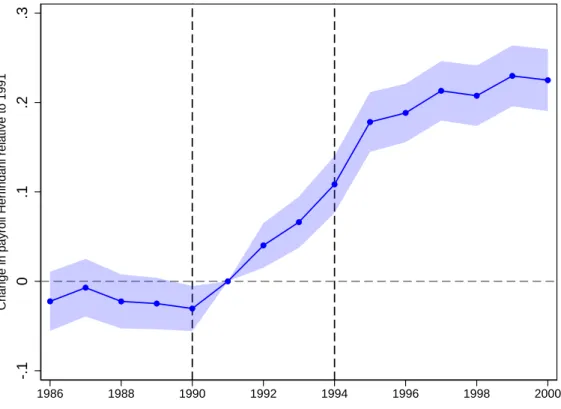
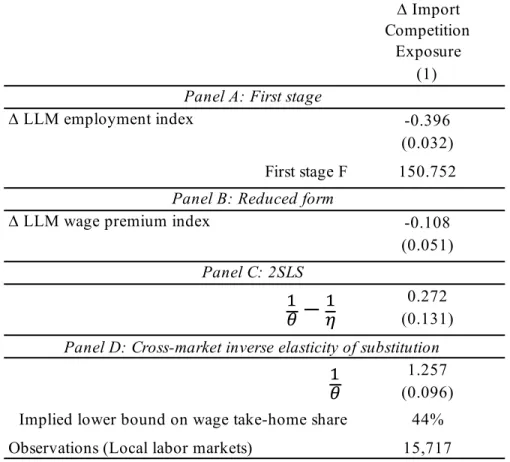
The first step in quantifying the effect of trade on firm labor market power is to estimate its effect on labor market concentration. The next step in quantifying the effect of trade on firm labor market power is to estimate my model's two key elasticities of substitution. This paper contributes to a growing literature on the local incidence of trade and firm labor market power.
Labor market concentration and the average wage markdown
This is the monopsonistic anticompetitive case, where µzm is constant and therefore labor market power is independent of firm size. The reason is simple: labor market concentration is the only endogenous component of the average wage decline in a market. Intuitively, the source of market power in the labor market environment described in Chapter 2 is the heterogeneity of workers' preferences for markets and firms.
Data: Formal sector, tariffs, exporters, informality
Thus, the degree of market power in a local labor market can change significantly only if the relative sizes of its firms change significantly. In this scenario, the effect of trade on labor market concentration would be insignificant for changes in labor market strength. This is the case in the two limiting cases of my model: monopsonistic competition (ie, there is no gap to drive effects on market power, but because 1θ = η1 > 0, there is still some level of market power) ; and perfect competition (ie, no gap to drive effects, and because 1θ = η1 = 0, no level of market power either).
Setting: Brazil’s 1990s trade liberalization
Finally, I use data from the 1991 and 2000 Brazilian census when I discuss in Appendix D.1 the external validity of my estimates of Brazil's informal sector involvement. My first step toward quantifying the effect of trade on firms' labor market power is to estimate the parameter βt from equation 10. Specifically, I exploit exogenous market-level labor demand shocks induced by trade liberalization of Brazil to estimate βt as the effect of trade in the country. Herfindahl indices of labor market payrolls.
Empirical strategy
After defining the import competition exposure shock, I proceed to estimate its effect on local labor market outcomes using a difference-in-differences strategy. Specifically, I estimate the cumulative effect (from year k) of import competition on a local labor market's outcome. 24While my measure of import competition exposure serves as a shift share shock for identifying the effect of trade on labor market outcomes, I note that it does not have an independent structural interpretation as in the measure derived by Kovak (2013) under assumptions about labor mobility, labor supply and fixed factors of production.
Estimates of effect of trade on concentration
Finally, the effect on concentration is also present, and is about half as large, when effective protection rates – much noisier measures of tariff shocks – are used to construct ∆ICEm (column (4) of Appendix Table A. 5).31. I also use estimation equation 12 for various other local labor market outcomes, presented in panels B and C of table 1 and the corresponding appendix tables. My estimates of the effect of import competition on employment and wage premiums are consistent with the patterns documented by Dix-Carneiro and Kovak (2017): trade liberalization reduced employment and wages in domestic labor markets more exposed to competition. import compared to less exposed markets. although the effect on wages showed positive preliminary trends.
Source of increased concentration
Furthermore, the change in the composition of employment in the domestic labor market towards exporters is not only visible at the aggregate level as shown in Figure 5, but also at the firm level, where I can further test whether a firm's export status before liberalization vs. Specifically, I regress the change in a firm's log employment (and, separately, log wages) on the change in the import tariff faced by the firm plus interactions with the firm's baseline export status and a phenomenon that indicates that the firm was large based .38. 1. η , and the between-market variation in exposure to import competition to estimate 1θ. pendix Table A.14 and Appendix Figure A.14), the reallocation of composition towards non-tradables cannot explain the increase in labor market concentration because those firms are as small and pay as little as the hardest-hit firms, as shown in the Appendix Figure. A.13.
Within-market cross-firm inverse elasticity of substitution
To estimate equations 15 and 16, I need to measure three model objects: the total units of labor supplied to firm z in market year t, the wage paid by this pair of firms, and the tariff shock to firm z. Second, I measure wzmt as the wage premium of firm z in market m for the month of December of year t. 40 This is the total number of workers employed on December 31 and who were also employed by the company on or before December 1. Employment on 31 December is a standard variable from the Brazilian RAIS data sets used to measure employment at the firm level in a given year.
Cross-market inverse elasticity of substitution
To address this concern, I instrument the market-level change in labor supply with a market-level labor demand shock introduced earlier: ∆ICEm, the market-level policy-induced import competition exposure shock commonly felt by all firms in market killings. . The two identifiable assumptions are that there is a first stage (i.e. λ 6= 0), and the instrument is excluded (i.e. ∆ICE affects ∆δm, the market-level component of fixed wages, only via market-level changes in employment , as opposed to changing workers' aversion ξm . for market m). To estimate equations 19 and 20, I need to measure three objects: ∆δm, the market-level component of the firm-level wage change; ∆ lnLm, the market-level change in the CES labor supply index; and∆ICEm, whose measurement I have already introduced in Section 4.
Within-market cross-firm inverse elasticity of substitution
Cross-market inverse elasticity of substitution
Pre-liberalization average wage markdown
More despicably, near-slavery working conditions—arguably the most extreme form of hard labor market power—continue to this day under informality. 53 In general, most current estimates of labor market strength or labor market concentration are for developed countries or subsets of what is essentially formal sector employment. 54 The use of exogenous shocks is likely to be a consequence of any estimate of firm labor market strength based on labor supply elasticities.
Decomposition
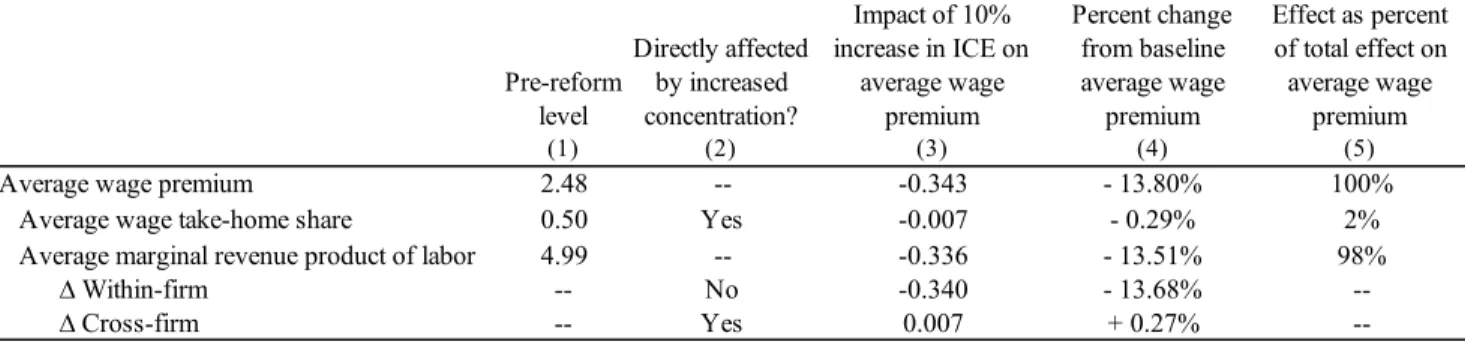
Given the estimates from Section 6, what does the trade-induced increase in labor market concentration documented in Section 4 mean for average wages. I address this question by first decomposing the effect of trade on average wages into its subcomponents: the effect on the share of average take-home pay and the effect on the average marginal revenue product of labor. My estimates from Sections 4 and 6 feed directly into the former for Equations 9 and 10, while the latter can be estimated by measuring the average marginal product of labor of markets using the elasticities estimated in Section 6.
Effect on average wage markdown
This corresponds to about 2% of the total 13.8% reduction in average wages due to exposure to import competition. The residual effect is accounted for by the average marginal revenue product of labor, which I discuss next.
Effect on average marginal revenue product of labor
Overall, my findings suggest that while firms possessed considerable labor market power in 1990s Brazil, and while trade liberalization further increased this labor market power by reallocating employment to larger firms, the effect of trade on firms' labor market power is not taken into account. most of the negative effect of trade on wages. The Effects of Multinational Companies on Workers: Evidence from the Costa Rican Microdata. Princeton University, Department of Economics, Center for Economic Policy Studies. The China Syndrome: Local Labor Market Effects of Import Competition in the United States. "The American Economic Review.
Concentration in US Labor Markets: Evidence from Online Job Vacancy Data.” National Bureau of Economic Research. Strong employers and weak employees: what influence does employer concentration have on wages?” National Bureau of Economic Research. Evolving Comparative Advantage and the Impact of Climate Change on Agricultural Markets: Evidence from 1.7 Million Fields Around the World.” Journal of Political Economy.
A Quasi-Experimental Approach to Identifying the Boundaries of the Labor Market: Evidence from Brazilian Workers.” Research in progress. Regional Impacts of Trade Reforms: What is the Right Measure for Liberalization?” The American Economic Review. The impact of trade on intra-sector relocations and overall sector productivity.” Econometrica: Journal of the Econometric Society.
Factor Immobility and Regional Impacts of Trade Liberalization: Evidence on Poverty from India.” American Economic Journal: Applied Economics.
4Worker
Derivation of labor supply equation
Consider an economy consisting of a continuum of homogeneous workers j, a large but limited number of local labor markets, and a limited number of firms z within each local labor market.
Other proofs and derivations
To see why this holds, proceed from the definition of the labor market index Lm in Section 2 to derive ∂lnLm/∂lnlzm as. In this expression, w¯m and r¯m are respectively the (employment-weighted) average wage and the average marginal revenue product of the labor market m. I show that a particular country-level average of the market-level average wage cut (i.e., equation 9) equals the average (employment-weighted) wage reduction at country level.
The reader can then directly verify that the resulting expression is the inverse of Berger, Herkenhoff, and Mongey's (2021) expression for the "labor market force adjustment" component of the country-level labor share (see authors' equation 10). . In that environment µm should be interpreted as the ratio of the average marginal revenue (net of expenditure in non-labour inputs) to the average wage. In this Appendix, I discuss how my strongly identified main regression specifications (i.e., no sub-sampling; standard errors clustered by firm for estimation of 1η and by local labor market for estimation of 1θ) are the appropriate specifications for identifying the model-consistent parameters that we want to treasure
First, consider robustness tests on the alternative subsample of firms that are the unique producers in their local labor market. While this check is informative about whether the nest structure is too widely misspecified, the model's key elasticities are intended to capture movements across all firms in the local labor market (including non-tradable sector firms), and it is unclear what failure to capture all in to close firms would imply for accuracy. Second, consider the robustness test to define labor market boundaries more broadly, only by microregion.
Although the model does not directly address the choice of the labor market boundary or the choice of clustering, I make these decisions based on my data and setting.
External validity of main findings to incorporating informality
On balance, the effect of excluding informality from estimates of the degree of labor market power is ambiguous. On the one hand, the power of the labor market is overestimated by overestimating the concentration levels in the labor market. This overestimation is likely to have distorted the picture in the 1990s, given the positive correlation I find between formal sector measures of local labor market concentration and measures of informal activities, shown in Appendix Figure A.15.
Specifically, the impact on employment is overstated because firms that appear to be shrinking in the formal sector may simply have moved workers off the books and into the informal. Similarly, the impact on wages is underestimated because once workers have moved into informal employment, their wages may fall below the minimum wage. Overall, whether my estimates of the level of firm labor force would be higher or lower if the informal sector were incorporated depends on the degree to which 1η and 1θ are underestimated versus the degree to which labor market concentration is overestimated.
Now consider how failing to account for informality might affect my estimates of the effect of trade on firm labor market power. While the consequences of excluding informality for the latter are not clear—it depends on the extent to which informal sector workers substitute more strongly between firms versus markets than formal sector workers—, evidence from the literature suggests that there are many it is likely to underestimate the effect of trade on the strength of the labor market. Specifically, excluding the informal sector underestimates the effect of trade on concentration because: a) informal firms are more likely to exit in response to import competition than formal sector firms because they are much less productive (Ulyssea, 2018) and Productivity is the main driver of output in the face of import competition (Dix-Carneiro et al., 2021;.
Melitz, 2003); and b) wages in companies in the informal sector may fall more than in the formal sector.