An objective structured laboratory animal science examination (OSLASE) to ensure the researcher's professional competence in LAS. Despite this need, there is a dearth of research dedicated to teaching and assessment in Laboratory Animal Science (LAS). Education and training in laboratory animal science, e-learning, performance assessment, competence and skill, objective structured laboratory animal science (OSLASE).
Published manuscript: "An Objective Structured Laboratory Animal Science Examination (OSLASE) to ensure researchers' professional competence in laboratory animal science", Costa et al.
Background and Aims
In recent decades, new and demanding requirements for education and training in LAS have been introduced, particularly stimulated by renewed European legislation, together with increasing LAS research and subsequent development of the field. Despite these changes, our understanding of how LAS education and training should be promoted, implemented and assessed is still limited. In addition, interest in the design and implementation of innovative assessment methods is growing noticeably.
The overall objective of this thesis is to contribute: to improve delivery by exploring the impact of e-learning in the courses and develop assessment strategies in LAS education.
Introduction
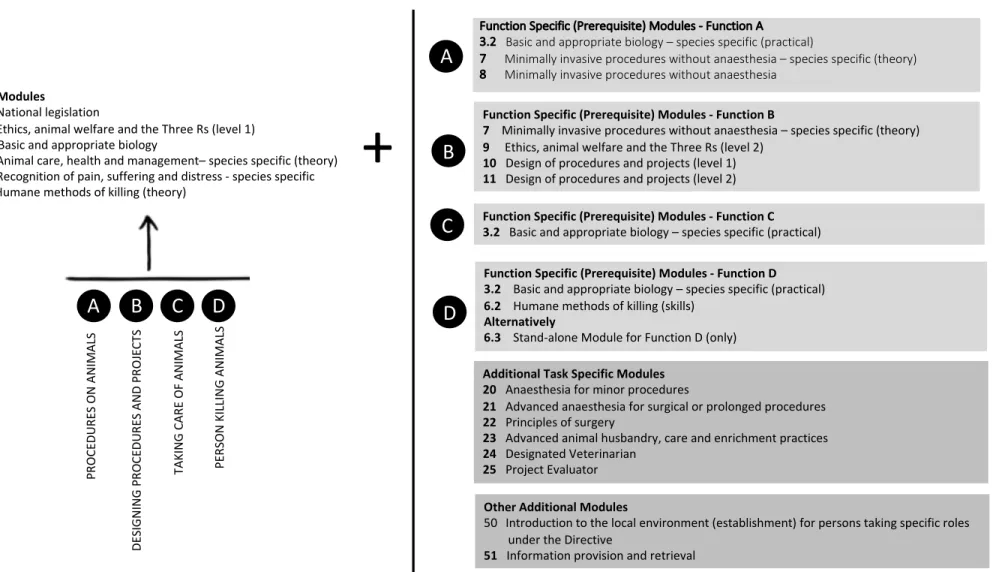
Twenty years later, in 1985, the most important federal law in the United States regarding the protection of laboratory animals – the Animal Welfare Act (AWA), was significantly revised following the reporting of several documented violations of the legislation. Currently, a large part of the offer of European Laboratory Animal Science (LAS) courses is aimed at researchers and technicians, covering the current directive functions A, B and D (former FELASA category C) and functions A and D (former FELASA category B) . To enable students to maximize their learning and preparation for extramural clinical placement, a Computer Assisted Learning (CAL) package entitled ''The EMS Driving License'' was developed in the United Kingdom.
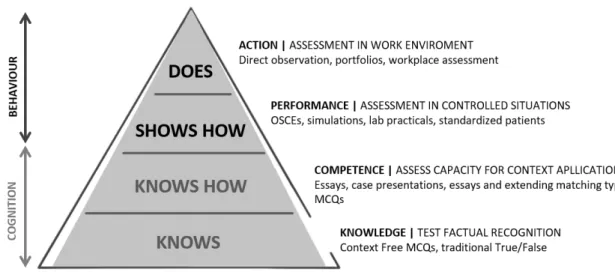
The observation time depends on the procedure being assessed, but on average the feedback time can take up one third of the procedure observation time (179). The stress experienced by the candidate during the assessment can be considered as another limiting aspect (181). Miller proposed a model for the assessment of clinical competence in 1990 (188). The model known as the 'Miller pyramid' distinguished different hierarchical layers of competence and therefore set different conditions/contexts within which assessment should take place (188). Durning SJ, Artino AR, Boulet JR, et al. The impact of selected contextual factors on clinical reasoning expert performance (does context affect clinical reasoning expert performance?).

Materials and Methods
The papers presented in this thesis include different studies and this section presents an overview of the particular material and methods used in the different studies. In paper I (chapter 3), acceptance of e-learning approaches by Laboratory Animal Science students was investigated using a questionnaire administered to a total of 229 course participants. In paper II (chapter 4) and paper III (chapter 5), the development and implementation, respectively, of a practical assessment for the LAS context is presented.
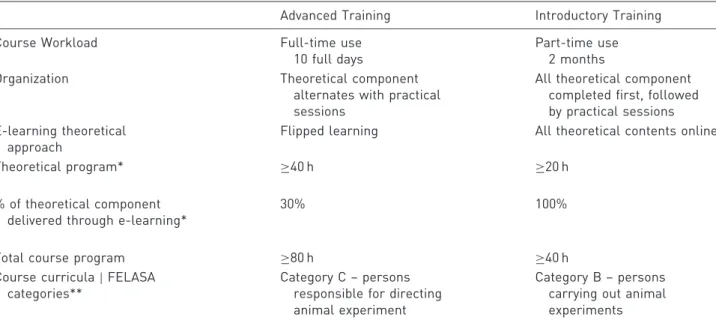
In paper III (chapter 5), report the implementation of an Objective Structured Laboratory Animal Science Exam (OSLASE) to assess researchers from different training courses. IBMC has been organizing training in laboratory zoology since 2005, with two course formats characterized as Introductory and Advanced. The participants enrolled in Laboratory Animal Science training between 2012 and 2021, in Introductory and in Advanced courses.
Three questionnaires have been developed specifically for this study; (1) a Sociodemographic and Professional Questionnaire (SDPQ), (2) a Students' Expectations of E-learning in Laboratory Animal Science (SEELAS), and (3) a Questionnaire of E-learning Acceptance (QELA) as indicated in Table 1 In the first study (paper II), the methodology for developing a rating scale is presented with a description of the different stages through the process up to the final version of the scale. The exam was conducted as part of an introductory and advanced training course for 3 consecutive years.
Analyzes of student acceptance data (Paper I) and interrater agreement (Paper III) were performed using IBM SPSS (version 25.0). 3 Regarding the QELA questionnaire, the 28-item version was used for students in the introductory course, with the exception of four items related to the flipped classroom approach and therefore not adapted to this course format.
Students’ Acceptance of E-learning Approaches in Laboratory Animal Science Training
Against this backdrop, the integration of e-learning appears to have the potential to overcome many of the specific challenges of laboratory animal science (LAS) training. Explanatory statistics were used to examine the general acceptance of the use of e-learning for different groups (courses B and C). More than half of the total number of respondents reported no prior experience with e-learning resources (60.7%), with a very similar split across the two training categories (B, 58.9%; C, 61.9% ).
In particular, the results of the domains personal perception of e-learning use, satisfaction with the content and satisfaction with the platform organization showed satisfaction rates of more than 95.5% in the different courses. Indeed, acceptance of the e-learning approach seems to be strongly influenced by whether students have previous experience with laboratory animals. Participants from the introductory (B) and advanced (C) training showed the same consistent difference: participants with more experience (1 year or more) showed less acceptance of the e-learning approach than participants with no previous experience with laboratory animals .
Background also influenced acceptance of e-learning, with students with a biomedical sciences background showing greater acceptance of e-learning than participants with a biology background. Although exploratory, this study addresses the lack of measurement in the field and constitutes a pioneering effort to develop a measure (QELA) to explore and assess student perceptions of e-learning access in a LAS context. Reports of the Federation of European Societies of Laboratory Animal Sciences Working Group on Education accepted by the Board of Management of FELASA.Lab Anim.
Report of the Federation of European Laboratory Animal Societies Working Group on the Education of Persons Carrying Out Experiments on Animals (Category B), adopted by the FELASA Board of Directors. Acceptance of case-based interactive e-education in veterinary medicine on the case of the CASUS system.
The Assessment of Researchers’ Competence in Experimental Procedures with Laboratory
We identified the following sequence with three key stages in the scale development process: (a) Item development, (b) Scale development, and (c) Scale piloting. Although there should be specific scales for each station, all scales can be designed and evaluated using the same methodology. Our work is guided by Boateng et al.'s recommendations for a systematic and sequential process of scale development through item development, scale development, and scale piloting.23.
In other words, it involves the selection of the task(s) to be performed by the candidates and the performance aspects to be assessed. As part of content validity, we also considered face validity (i.e., the extent to which assessors .. intended assessment goals24) by discussing the scales with two independent experts experienced in performing and teaching the selected procedures. The output of this phase was a first version of the scale consisting of a list of performance aspects to be assessed and descriptions of performance at different levels of competence.
It is crucial to ensure that the descriptors underlying the object of judgment – the sub-step of the skill, such as 'depth of puncture/angle' during the intra-peritoneal administration – make sense to the assessors going. apply the tool. After determining that the assessments were consistent and gave similar GRS outputs when applied to the same demonstrations, we moved to the third and final step in developing the scale. The piloting of the scale (C in Figure 1) was the last stage and served to ensure the scale's applicability with a wider range of assessors.
The scale was administered several times, in different contexts, with feedback from raters to the team and subsequent changes to the scale where necessary. This is in line with the guidance on competency assessment provided under Directive 2010/63/EU which states that "the assessor should observe and evaluate the trainee carrying out the procedures to assess practical competence".2 The final GRSs which use the described method. in this paper are available for review and use.27.
An Objective Structured Laboratory Animal Science Examination (OSLASE) to Ensure
This appears not only as an imposition of the revised European legislation (1, 2), but also as a way to guarantee the 3R's application in practice (3). The aim of this study was to explore the implementation of OSLASE in laboratory animal science training, evaluate the interrater agreement in the practical assessment and trainees' acceptance of the exam. Based on these results, there is room to improve the IRR in the application of OSLASE.
Interviewees also identified the positive impact of the exam on the learning process, as previously reported in the literature (9). Assessment of knowledge and skills is an essential part of the education and training process. The OSLASE was implemented at the end of the coping module, which is the first of the practical modules integrated on the advanced course programme.
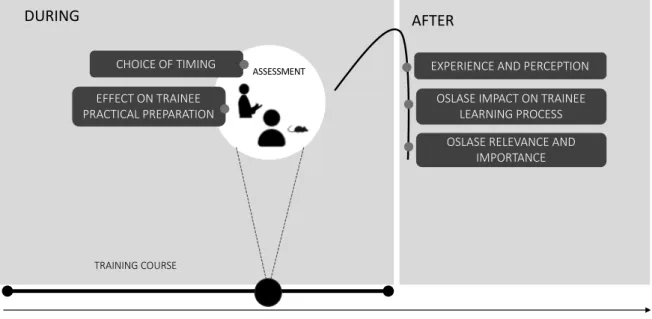
3 – Supervisor informed when procedures are taking place and available for rapid intervention if required (i.e. close to procedure). 2 – Supervisor informed when procedures are taking place and available to be present to provide advice if necessary (i.e. near the site). At the end of the procedure, five categories were identified (Choice of the timing to take the exam; Effect on the practical preparation of the trainee before performing the OSLASE; Experience and perception; OSLASE impact on the learning process of the trainee; and relevance and importance of OSLASE).
Several of the interviewees from the advanced course stated that the existence of a formal practical exam increased their commitment to the practical education in animal handling. An assessment carried out between the first and subsequent lessons can also help to level the standard between students. The aim of this study was to explore the implementation of OSLASE in LAS training, to evaluate the interrater agreement in the practical assessment and the trainees' acceptance of the exam.
Based on these results, there is room to improve the IRR in the application of the OSLASE.