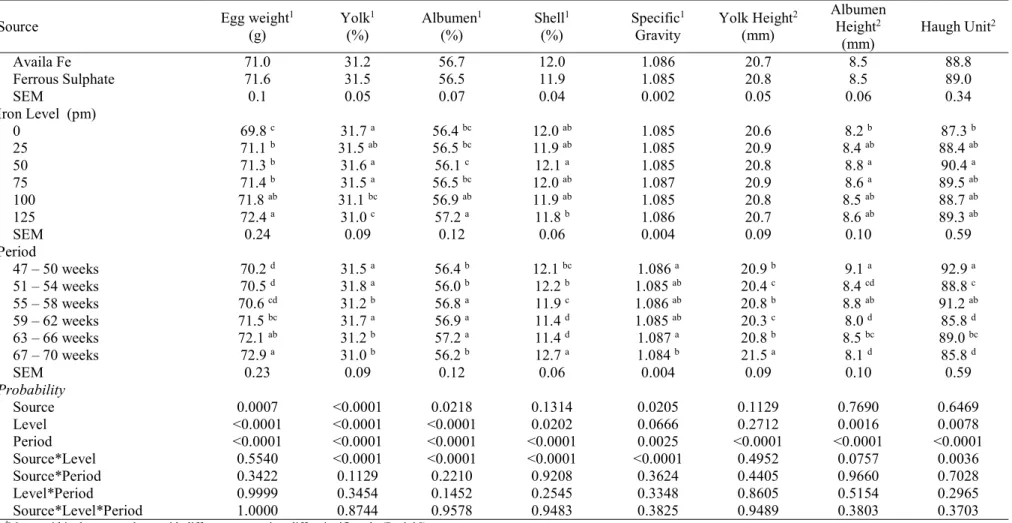
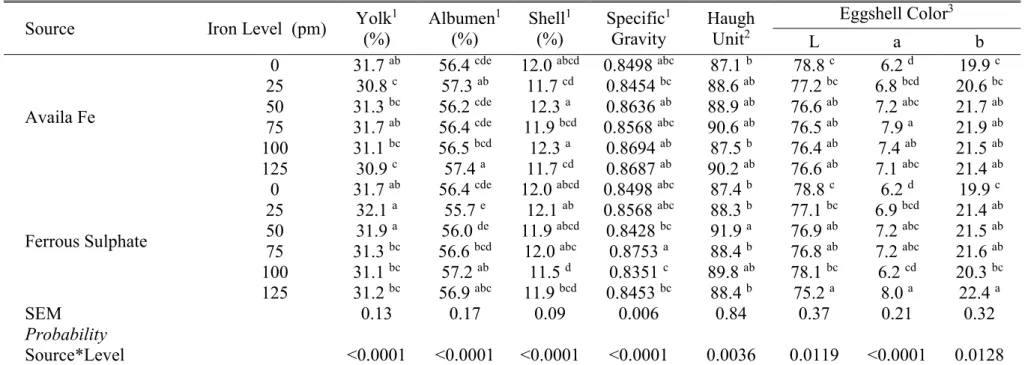
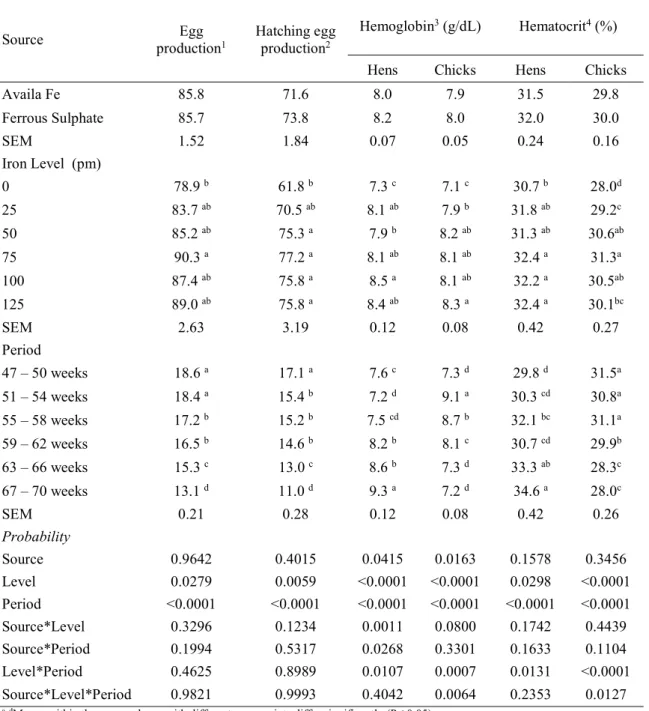
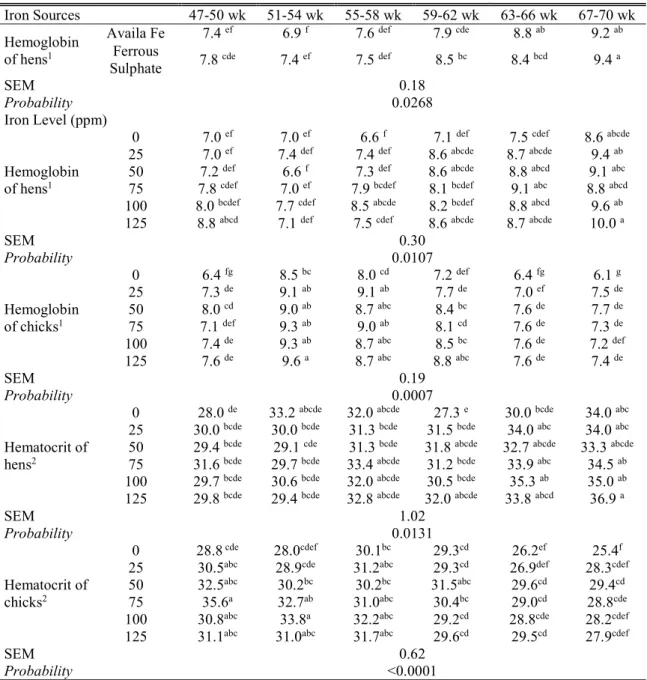
HEMATOLOGICAL PARAMETERS AND IRON CONTENT IN EGGS OF BROILER HEN FED DIFFERENT IRON LEVELS and. Effect of iron source, level and periods in egg quality of broilers in a period from 47 to 70 weeks of age. Interaction source*level in egg quality of broilers in a period from 47 to 70 weeks of age.
Regression equations of the variables studied from broilers in a period from 47 to 70 weeks of age.
INTRODUÇÃO
REVISÃO DA LITERATURA
- Funções do Ferro
- Absorção e Metabolismo do Ferro
- Interações entre Minerais
- Exigência de Ferro para as Aves
- Minerais Orgânicos
A absorção de Fe não heme é parcialmente regulada pelas concentrações intracelulares de Fe nos enterócitos. Os íons Fe são reduzidos pela citocromo b redutase duodenal (DcytB) a Fe+2 (a menos que já esteja na forma Fe+2) na borda em escova da membrana duodenal, que é então transportado para o enterócito pela proteína de transporte de metal divalente. . (DMT1). Os pintinhos alimentados com dieta deficiente também aumentaram a porcentagem de Fe no fígado, sangue e intestinos.
Segundo Paik (2001), o uso de Fe-met aumenta a concentração de Fe na gema de galinhas poedeiras.

JAQUES, 1994)
Qualidade de Ovos
A cor vermelha da casca do ovo é causada pela deposição de porfirina no útero durante a formação da casca, e é mais intensa 20 a 24 horas após a postura do ovo anterior. Porém, algumas aves da mesma linhagem tendem a botar ovos mais leves devido a uma mudança na cinética de deposição de pigmento na casca. Aves que produziram ovos mais leves apresentaram maiores concentrações de cálcio e fósforo ionizados no fluido uterino. o estágio final de formação da casca (NYS et al. testaram a eficácia da suplementação "em cima" de galinhas poedeiras semipesadas com duas fontes orgânicas de Fe, proteinato e quelato de Fe-met, ambas as fontes melhoraram a pigmentação da casca do ovo e aumentaram a deposição de Fe na gema, mas as aves, que receberam Fe-met diminuíram a produção de ovos, o peso dos ovos e a unidade Haugh, e além do aumento da conversão alimentar, os autores também demonstraram que a suplementação com Fe aumentou a concentração de Zn na gema dos ovos, seguida do Availa Fe®, enquanto a suplementação com Availa Fe® aumentou a pigmentação da casca.
A suplementação “on top” de 100 ppm de Fe de Fe-met aumentou a concentração de Fe na gema do ovo de poedeiras de médio porte (PARK et al., 2005).
HIPÓTESES E OBJETIVOS
Vieira ([email protected]), Departamento de Zootecnia, Universidade Federal do Rio Grande do Sul, Av.
ABSTRACT
INTRODUCTION
Iron ions (Fe) then bind to transferrin for distribution throughout the body via the plasma circulation (Ludwiczek et al., 2004). Increased deposition of Fe can improve egg quality for both human consumption with the production of enriched eggs and for breeders, improve resistance to contamination and provide a higher amount of mineral to the embryo (Park et al. The Fe content of eggs is limited, and is rapidly used in the end of the hatching period, when the embryo begins to breathe through the lungs.
For example, recommendations from Cobb (Cobb-Vantress, 2008a) are in the range 40-55 ppm for the production phase, the same level recommended by NRC (1994) Brazilian tables for poultry and pigs (Rostagno et al., 2011) recommend the use from 60 ppm on.
MATERIAL AND METHODS
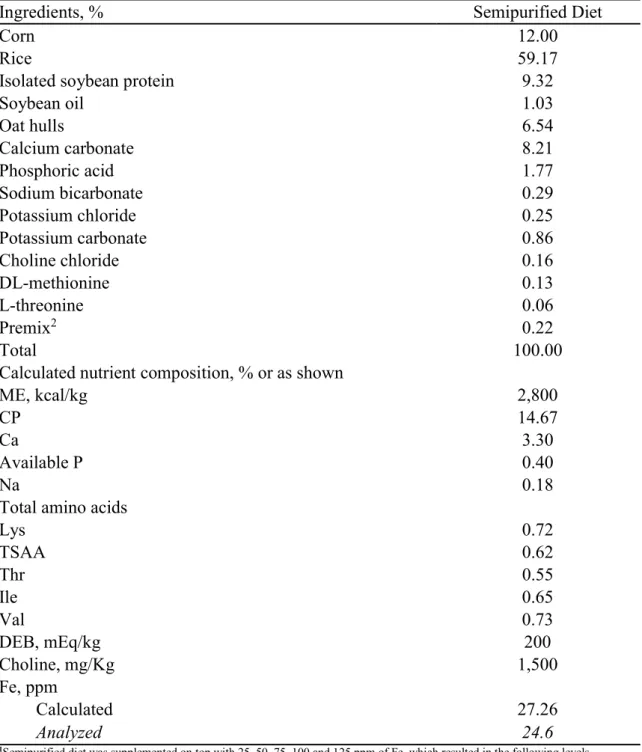
Chickens were fed diets based on cornmeal and soy until 35 weeks of age, semi-purified diets based on rice and isolated soy protein between 36 and 46 weeks, and between 47 and 70 weeks were fed 11 different diets . Eggs were collected 4 times a day and classified into hatching, broken/cracked and deformed, all study measurements were performed in 6 periods of 28 days, in the last week of each period specific gravity, egg weight and its components (yolk, albumen and shell), yolk height, albumen height, Haugh unit and shell thickness. Eggs produced in the last 3 days of each period were weighed, broken and separated into yolk, albumen and shell, each component was weighed and stored in a cold room at -18 °C.
At the end of each period 20 eggs per treatment were randomly selected for color using colorimeter Minolta CR-200 calibrated in white area.
RESULTS
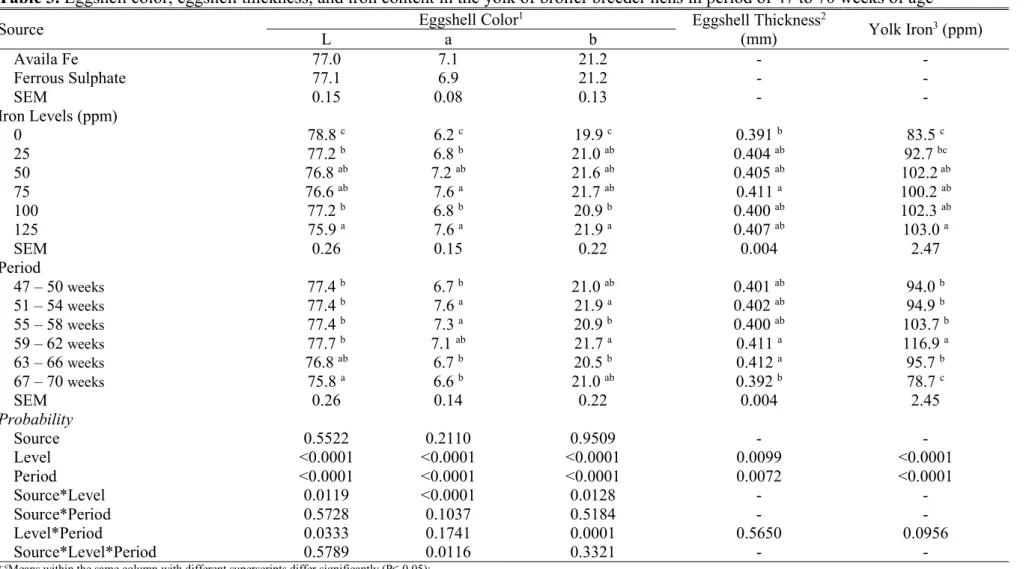
Similar results were observed for albumin height, which showed higher results for levels 50 and 75 ppm, and Haugh unit, with higher value for 50 ppm Fe. With the increased level of Fe, the hens laid eggs darker (P<0.001), with lower brightness value of the shells for 125 ppm, red color was higher for levels of 75 and 125 ppm. Significant interactions were observed between the level of Fe and periods of eggshell color for levels of L (P=0.033) and b (P=0.001) (Table 5).
All variables showed a quadratic response, however for albumin percentage the minimum point was observed for the 68 ppm Fe level in the diet.
DISCUSSION
Recently, it has also been shown in vitro that there is a specific pathway for the absorption of Fe in iron form (Conrad et al., 2000). The color of the eggshell is formed by the deposition of porphyrin that occurs in the uterus during eggshell formation, and the Fe level in the diet can alter this deposition, producing darker eggs (Nys et al., 1991 ; Paik et al., 2009). The iron stores available to the embryo are quickly used up during the last stage of embryonic development. Post-hatch, Fe status is poor and without an appropriate diet, its growth is compromised (Tako and Glahn, 2011), when higher amounts of Fe are used in the diet. in chickens, it is possible to increase the Fe concentration in the yolk, making a greater contribution to the embryo (Morck and Austic, 1981; Park et al., 2004; Skrivan et al., 2005; Bess et al. , 2012).
Using regression equations, it is possible to determine the best level of response for the desired trait and, based on the regression equation for yolk Fe concentration, a dietary level of 132.9 ppm Fe can be estimated for most of the response.
Eggshell Color 3
3 Measured with a colorimeter surface, where L is the luminance, a is the red and b is the yellow. Interactions between iron levels and periods for brightness and yellow eggshell color (L and b) of broilers in a period from 47 to 70 weeks of age. Regression analysis showed maximum response for levels of and 119.46 ppm Fe in the diet with ferrous sulfate supplementation for percentage of hatching eggs, hemoglobin and hematocrit of chickens and chicks respectively.
In this context, our objective was to re-evaluate the iron requirement for egg production and blood parameters of broiler chickens and their offspring.

MATERIAL AND METHODS Birds management and facilities
CONSIDERAÇÕES FINAIS
A fonte de Fe utilizada afeta diretamente o nível de suplementação devido à diferença de biodisponibilidade entre elas. Estudos demonstraram que as aves são mais eficientes na absorção do heme Fe e, às vezes, quando o nível de Fe na dieta é elevado, a suplementação não é necessária (Bertechini et al., 2000; Bess et al., 2012). A deposição de Fe na gema aumenta conforme a suplementação, em outros estudos essa característica também foi demonstrada (Park et al.
A deficiência de ferro é a alteração hematológica mais comum que afeta a espécie humana, tanto nos países desenvolvidos como nos países em desenvolvimento (TEFFERI, 2003).
BIBLIOGRAFIA
Efeito da temperatura e do tempo de armazenamento na qualidade interna de ovos de codorna japonesa (Coturnix coturnix japonica) para consumo humano. Alterações no ferro-transferrina e no ferro-fosvitina plasmáticos durante o período de postura em frangos de corte. A expressão duodenal de HFE e os níveis de hepcidina determinam a homeostase do ferro corporal: modulação pela diversidade genética e disponibilidade de ferro na dieta.
Effect of dietary ratios of Fe and Cu on hematological and growth responses of broilers. Effect of iron status on DMT1 expression in duodenal enterocytes from beta2-microglobulin knockout mice. Effects of organic iron supplementation on productivity and iron content of egg yolk of laying hens.
The effect of level and period of Fe-methionine chelate supplementation on iron content in broilers. Effects of the diet of zinc, iron and copper in layer feeds on the distribution of these elements in eggs, liver, excrement, soil and herbs.
Normas para publicação de artigos no periódico Poultry Science POULTRY SCIENCE INSTRUCTIONS TO AUTHORS
The Editor-in-Chief of Poultry Science may refuse to publish manuscripts that do not conform to these guidelines. The symposium organizer or leader must present the proposal and tentative budget to the Board of Directors at the summer meeting one full year before the symposium is scheduled. The symposium chair should then develop detailed symposium plans, including a formal summary of approved talks and full budget expectations, which should be presented to the Board of Directors at the January meeting prior to the meeting at which it is scheduled. the symposium.
The head of the symposium will review the contributions and, if necessary, return them to the authors for additions. The symposium leader then forwards the revised manuscript to the Editor-in-Chief for final review. Invited papers, such as the World Poultry Science Society lecture, should be submitted online; the editors then make this contribution available for review by the editor-in-chief.
The editor-in-chief sends invitations to the authors and reviews these contributions when they are submitted. Nominations or suggestions for possible timely reviews are welcome and should be sent directly to the editor-in-chief. As such, submissions to this section should be of interest to every poultry scientist, to the industry, to instructors and educators who teach classes on contemporary issues, and to students and students.
Book reviews are prepared in accordance with the style and format requirements of the magazine and are subject to editorial review. Letters and replies must follow the appropriate Poultry Science format and may be edited by the editor-in-chief and a technical editor.
SUBMISSION OF ELECTRONIC MANUSCRIPTS
Replies will have the same page limits and format as letters, and titles must end with "—Reply." Letters and replies will be published together. If several letters are received on the same subject, a representative letter relating to a particular article will be published.
REVIEW OF MANUSCRIPTS
More generally, the manuscript will be returned to the corresponding author for revision according to the guidelines of the reviewers. Authors have 6 weeks to complete the review, which will be returned to the section editor. Failure to return the manuscript within 6 weeks will result in the paper being deleted from the files.
Purged manuscripts can be reconsidered, but they will have to be processed as new manuscripts. The editor-in-chief informs the author of the final decision of acceptance or rejection. Rejected manuscripts can only be resubmitted with an invitation from the section editor or chief editor.
PRODUCTION OF PROOFS
Authors submitting articles with color illustrations are responsible for paying additional costs for color printing, including the printing of reprints they order, and must agree in writing to pay the additional costs prior to publication. Once an imprint is printed, the author must complete a print order requesting the number of prints desired and the name of the institution, agency, or individual responsible for publication costs.
MANUSCRIPT PREPARATION
STYLE AND FORM General
Measures must be in the metric system; However, US equivalents may be listed in parentheses. Units of measurement not preceded by numbers should be written out rather than abbreviated (for example, lysine content was measured in milligrams per kilogram of diet), unless used in parentheses. Measures of variation should be defined in the abstract and in the body of the article on first use.
Nucleotide sequence data must be related to poultry or poultry pathogens and must complement biological data published in the same or a companion document. If the sequences are excessively long, it is suggested that the most relevant sections of the data be published in Poultry Science and the remaining sequences be submitted to one of the sequence databases. Acceptance for publication is conditional upon submission of sequence data to one of the databases.
The following statement should appear as a title note on the title page of the manuscript. The publication of the description of the molecular clones is foreseen by the editors for their placement in the public sector. Nucleotide sequences should be submitted as camera-ready images no larger than cm in standard (portrait) orientation.
Use the slash only when it means "per" with numbered units of measure or "divided by" in equations. Registered (®) and trademarked (™) symbols should not be used unless as part of an article title in the References section.
Percentual de ovos incubáveis produzidos