Abstract— This study reports the preparation of monometallic (cobalt) catalyst supported on calcium carbonate for the synthesis of carbon nanotubes (CNTs). The catalyst was synthesized using wet impregnation method and optimized using factorial design of experiment to determine the effects of synthesis conditions (stirring speed, drying temperature, drying time and mass of the support) on the catalyst (Co/CaCO3) yield. The catalyst best yield after calcination was 87.8% at stirring speed, drying temperature, drying time and mass of support of 700 rpm, 120oC, 7 hours and 5.5 g respectively. The selected best yield of the produced catalyst was characterized using, SEM/EDX, XRD and TGA to determine its morphology, crystallinity and thermal stability respectively. FTIR was also used to determine the functional groups present in the catalyst. The characterization result showed that the catalyst produced is thermally stable with about 0.034% weight loss at 808.3oC indicating that the catalyst will be suitable for the synthesis of CNT. The catalyst was utilized in a CVD reactor to synthesize carbon nanotubes by investigating the influence of carbon source (acetylene) flow rate on the yield of CNTs. The results obtained revealed that the highest yield of 27% of CNTs was obtained at acetylene flow rate of 90 ml/min. The raw CNTs were analyzed and the results obtained revealed that they were thermally stable with specific surface area of 389.4 m2/g. Meanwhile, the TEM result showed that the synthesized CNTs
Manuscript received June 30, 2016; revised July 14, 2016.
This work was supported by the Nigeria Tertiary Education Trust Fund (TETFund) under Grant TETF/DESS/NRF/FUTM-2016/STI/VOL.1
Abdulkareem A.S is with the Department of Chemical Engineering, Federal University of Technology, PMB, 65, Gidan Kwano, Minna, Niger State. Nigeria. Centre for Genetic Engineering and Biotechnology, Federal University of Technology, PMB 65, Bosso, Minna, Niger State, Nigeria (phone number: +2347068482432) [email protected]
Suleiman B is with the Department of Chemical Engineering, Federal University of Technology, PMB, 65, Gidan Kwano, Minna, Niger State. Nigeria. [email protected]
Ajamah S.O.E is with the Department of Chemical Engineering, Federal University of Technology, PMB, 65, Gidan Kwano, Minna, Niger State. Nigeria. [email protected]
Mohammed I.A is with the Department of Chemical Engineering, Federal University of Technology, PMB, 65, Gidan Kwano, Minna, Niger State. Nigeria. Centre for Genetic Engineering and Biotechnology, Federal University of Technology, PMB 65, Bosso, Minna, Niger State, Nigeria.
Bankole M.T is with the Department of Chemistry, Federal University of Technology, PMB 65, Bosso, Minna, Niger State, Nigeria. Nanotechnology Research Group, Centre for Genetic Engineering and Biotechnology, Federal University of Technology, PMB 65, Bosso, Minna, Niger State, Nigeria. [email protected]
Afolabi A.S is with the Department of Chemical, Metallurgical and Materials Engineering, Botswana International University of Science and Technology, Palapye, Botswana. (*Corresponding author: Tel: +26776379179; e-mail: [email protected]).
were multiwalled carbon nanotubes. It can be therefore inferred from the results of various analyses conducted that the prepared monometallic (Co) catalyst on CaCO3 support is suitable for the synthesis of CNTs.
Keywords—CNTs, CVD, characterization, factorial design and monometallic catalyst.
I. INTRODUCTION
arbon, a group IV member in the periodic Table, with atomic number 6, occurs in different solid forms. Graphite which is a stable low pressure and low temperature phase has a structured planar-Hexagonal network of carbon atoms. Carbon at elevated pressure and temperature is called diamond and consists of tetrahedral network of carbon atoms forming a face centered cubic (fcc) lattice [1]. A closed cage type is called a fullerene while a tubular type is called a carbon nanotube. As such carbon can exist in several allotropes and forms such as diamond, graphite, fibers, fullerenes and nanotubes [1]. Diamond and graphite have for ages been well known as carbon materials over centuries. Carbon filaments, presumably nanotubes, were first observed by Radushkevich and Lukyanovich in 1952 [1]. Since the successful breakthrough in synthesis of carbon nanotubes (CNTs) by Iijima in 1991, methods to make these materials have been comprehensively and extensively investigated [2]. The synthesis of CNTs has sparked a global escalation of interest within the scientific community with a prime focus on the synthesis, modification, functionalization and application of these nano-materials [3]. The immense potential applications of CNTs are due to their exceptional properties e.g. thermal properties, optical properties and outstanding mechanical properties. These applications include their use as biosensors for harmful gases and chemical analyses, controlled drug release applications, biomedical applications, catalyst supports, coatings of all sorts, conducting composites/plastics, electronic nano-components and material protection applications, energy storage, field emission sources, fuel cell membranes, hydrogen storage, microscope probes, nanotube reinforced composites, nano-conveyors, sporting goods and also in water purification [3]. For effective industrial applications of CNTs, there is the need to produce CNTs of high quality with minimal impurities. Various methods of CNTs synthesis had been reported in literatures [3], catalytic vapour deposition method has been identified as the most suitable method for large scale production of CNTs [4].
Factorial Design Optimization of Monometallic
(Cobalt) Catalyst on Calcium Carbonate
Support for Carbon Nanotubes Synthesis
Abdulkareem A.S,
Member, IAENG
Suleiman B, Ajamah S.O.E, Mohammed I.A, Bankole M.T. and
*
Afolabi A.S,
Member, IAENG
The CVD method is generally classified into two categories namely, the substrate catalytic vapour deposition process, involving the use of a thermally stable support material to support metal particles responsible for the molecular decomposition of carbon to form the CNTs, and the floating catalyst processes, a gas phase process. The CNT production processes have their shortfalls in terms of purity and cost. The CVD process is generally accepted because it is a low cost process that can be industrially scaleable, it also allows for the controlled growth of high purity CNTs under optimized reaction conditions. The chemical vapour deposition method has two main stages, the catalyst preparation and the CNT synthesis. Several substances could be used as catalyst support but CaCO3 is
becoming increasing popular among CNT researchers because of its advantage over other types of supports [5]. CaCO3 is relatively cheap, readily available and possess an
excellent chemistry for CNTs growth. It decomposes at 700oC to CaO and CO2 which can easily be removed through
acid purification. Catalyst preparation methods used in the synthesis of CNT include sol-gel process, reverse micro emulsion, reduction-precipitation and co-precipitation [5]. Though, it has been reported that for improved yield of CNTs by CVD methods, bi-metallic catalyst on CaCO3
support will result into high yield, however the level of impurities produced with the CNTs becomes source of concern [2]. In order to improve the purity of CNTs synthesized by CNTs, it has been recommended that monometallic on a porous support will produced high quality CNTs with improved surface area. It is on this basis that this study focuses on the development of monometallic catalyst by studying the influence of process parameters on the yield of the catalyst using 24 experimental factorial designs.
II.MATERIALSANDMETHODS
All the chemicals used in this study were of analytical grade with percentage purity in the range of 98 – 99.99%. These chemicals include calcium trioxocarbonate (IV), and cobalt (II) trioxonitrate (V) hexahydrate. The gases were also of analytical grade with percentage purity of 99.9%. The catalyst was prepared by wet impregnation method and the process was optimized using 24 factorial design of experiment. This implies that four factors were studied at 2 levels (low and high) as shown in Table I.
TABLE I
VARIATION OF PARAMETERS OF THE 24FACTORIAL DESIGNS
Level Drying
temperature (oC)
Drying Time. (hrs) Stirring Speed (rpm) Mass of support (g) High Low 120 110 7 5 700 300 5.5 4.5
The parameters optimized are drying time, stirring speed, drying temperature and mass of support. A known weight (3.06 g) of cobalt nitrate salt Co (NO3).H2O was dissolved in
50 ml of distilled water, then a known mass of CaCO3 (4.5 g
and 5.5 g) was added to the suspension and stirred at a stirring speed of 300 rpm for low level and 700 rpm for high
level for a period of 15 minutes. The slurry obtained was then oven-dried at a selected temperature of 110oC and 120oC respectively for low and high levels. The drying was done for a period of 5 hours for the low level and 7 hours for high level, after which the sample was allowed to cool at room temperature. The product obtained was then grinded to avoid particle agglomeration and screened through 50 µm sieve. The final powder was then calcined at a temperature of temperature of 400oC for a period of 16 hours. The catalyst yield was determined using the relationship presented in equation (1). The detailed experimental combination obtained from the design expert with the yield of catalyst as the output is presented in Table II.
(1)
The sample that produced the highest yield was analyzed to determine the morphology, crystallinity using SEM and XRD respectively. FTIR analysis was also used to study the nature of the bond present in the catalyst.
TABLE II
VARIATION OF PARAMETERS OF THE 24FACTORIAL DESIGNS Mass of support (g) Stirring speed (rpm) Drying time (hrs) Drying temperature
(oC)
Catalyst Yield (%)
4.5 300 5 110 83.8
5.5 300 5 110 77.2
4.5 700 5 110 82.2
5.5 700 5 110 82.2
4.5 300 7 110 80.0
5.5 300 7 110 82.6
4.5 700 7 110 80.0
5.5 700 7 110 73.4
4.5 300 5 120 78.6
5.5 300 5 120 79.8
4.5 700 5 120 79.6
5.5 700 5 120 82.0
4.5 300 7 120 80.0
5.5 300 7 120 76.6
4.5 5.5 700 700 7 7 120 120 69.4 87.8
The catalyst produced was then used in the production of carbon nanotubes by chemical vapour deposition (CVD) method. The CVD reactor consists of a quartz tube of dimensions, 52 mm internal diameter, 4 mm thickness and 1010 mm length, placed in a furnace that has heating capacity up to about 1200oC. Gas cylinders for the carbon source (acetylene) and the carrier gas (argon) were connected to the inlet of the reactor where flow meters were available to control the gas flow rates. The control system of the CVD allows for an appropriate temperature program in maintaining consistent and appropriate heating rate, reaction temperature, and cooling rate. The exhaust gases through an exhaust pump at the reactor outlet were collected by bubbling in water. A known weight (1g) of monometallic Co/CaCO3 catalyst was evenly spread on a ceramic boat
(acetylene) was set at a known flow rate. The acetylene flow rate was varied from 60, 70, 80, 90 and 100 ml/min for different samples while all other parameters were kept constant.
Fig. 1. Schematics of the CVD process
The sample was then removed, weighed and analyzed. The carbon deposit yield was calculated using the relationship presented in equation (2). The sample that produced the highest yield was analyzed to determine the thermal stability, morphology, crystallinity, surface area/pore volume and particle size using TGA, SEM, XRD, BET and nanosizer respectively. FTIR analysis was also used to determine the nature of the bond present in the catalyst.
(2) where W1 is the weight of the catalyst before reaction, W2 is the
weight of the catalyst + carbon deposit after synthesis. III. RESULTS AND DISCUSSION
Reaction conditions play significant role in controlling the performance, structure, morphology, shape and metal contents of heterogeneous catalysts. But, very few literature reports are available on previous works done to investigate effects of CNTs-catalyst preparation conditions on the final solid catalyst for nanotubes growth. Mate et al. [6]; Miller et al. [7]; and Haber et al. [8] have found that catalyst synthesis parameters can influence its quality, morphology and properties which eventually affect its catalytic activity. These researchers identified such factors to include stirring conditions, temperature and heating rate, aggregate morphology, concentration, quantities of solution and carrier used, sequence and duration of all operations, and more. Chang Le [9] has also identified stirring speed, shape and volume of vessel as critical factors that could affect the final catalyst. In addition, Magrez et al. [10] found that catalyst composition and catalyst drying process have major influences on the catalyst particle size. Magrez et al. [10] also observed that heating the catalyst can strongly limit the efficiency and thus, they provided freeze drying as a favourable alternative that can prevent agglomeration of the supported catalyst particles. The prepared catalyst suspension can be frozen by dropping it in liquid nitrogen and the collected sample would be subsequently placed in a freeze drying chamber where sublimation occurs at specified conditions. These researchers found that freeze drying was about four times more efficient than heating. Further, the influence of drying time on the yield of catalyst preparation procedure has received less attention as most literature reports have been dedicated to studying its effect on quality of final catalyst material especially in terms of precursor distribution on pellets [11]. It is predominantly perceived
that the catalyst preparation parameters such as method of preparation, heat treatments, support material, and concentrations do influence primarily the catalyst activity and quality. For instance, Prasek et al. [12] identified type of support material as a factor that influences the physico-chemical properties of supported CoFe2O4. It has been
reported that compositional amount of alumina has effects on the crystal structure, coercivity and magnetization of final CoFe2O4. Generally, little importance has been attached to
the influence of these reaction conditions on final catalyst yield. Hence, the need to investigate the influence of basic parameters listed earlier on the yield of catalyst. The results obtained on the influence of these parameters on the yield of the catalyst are presented in Table II. The results indicate that the highest yield of 87.84% of catalyst was obtained after calcination under operating conditions of 120oC (drying temperature), 7 hours (drying time), 700 rpm (stirring speed) and 5.5 g (mass of support).
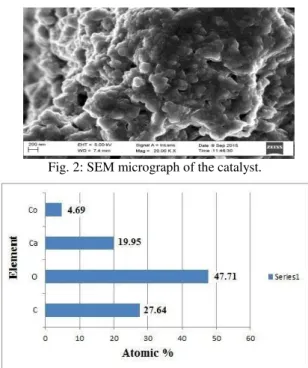
The catalyst obtained at the best operation conditions was characterized to determine the qualities of the catalyst produced. Presented in Fig. 2 is the SEM image of the catalyst. The morphology as presented showed that the solid clustered catalyst material is almost spherical in terms of geometry and porous with the presence of agglomerated materials which could be attributed to the drying process during the catalyst preparation and the constituents of the catalyst that cannot be broken down into smaller particles by mechanical process of grinding. The morphology of the catalyst as obtained from the SEM analysis also indicates that the CaCO3 were uniformly occupied by the oxides of Co
that were formed during the calcination of the catalyst sample. This observation can be confirmed by the BET surface area result showing the micro porous radius in the range of 25-30 nm which are not characteristics pores of the catalyst components but lattice-fringe patterns in the catalyst sample. The energy-dispersive X-ray spectroscopy (EDS) analysis of the catalyst is presented in Fig 3 which confirms the presence of the cobalt in the catalyst produced.
Fig. 2: SEM micrograph of the catalyst.
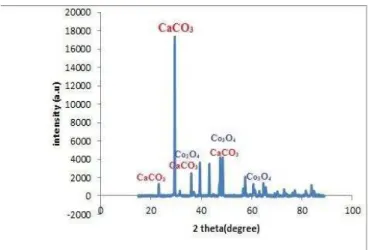
A wide-angle X-ray diffraction (XRD) technique was used to identify phases that are present in the final catalyst sample, its texture analysis and crystallite size measurement. Conflicting proposals were made in literatures concerning the nature of oxides formed by the catalyst components during heat treatment above 550oC [10]. The speculated phases are mainly Co3O4 and CoO distributed onto the
CaCO3 matrix. The XRD pattern of the spinel phase Co3O4
exhibits seven peaks located between 19.02 and 65.30 degrees [2,13]. Hence, an attempt has been made to identify the phases present in the Co/CaCO3 catalyst composite using
XRD analysis as shown in Fig 4. It was also used to measure the crystallinity of the structure. The identification of phases was done based on literature reports, the main phases present in the catalyst as shown in Fig 4 are the CaCO3 and Co3O4.
The Debye-Scherrer equation was applied to the XRD peak broadening to obtain catalyst crystallite sizes. The result shows that the catalyst particle size ranges from 29 to 36 nm. The mean crystallite size was obtained as 29.08 nm which is a characteristic of highly crystalline material.
Fig. 4. XRD pattern of Co/CaCO3 catalyst
The TGA profile of the catalyst produced (not shown) indicates that there is weight loss around 120oC, 500oC and 808oC. The first weight loss observed at 120oCwas attributed to the loss of absorbed moisture, while the weight loss at 500oC was attributed to the formation of Co3O4 due to the
evolution of CO2 when Co reacted with CaCO3. The final
weight observed around 803oC was attributed to the decomposition of CaCO3 to form CaO and CO2. The results
also indicate that about 0.034% weight of catalyst was lost, indicating that the developed catalyst will be suitable for CNTs production in a CVD system. The functional group analysis of the calcined catalyst was determined by Fourier transform infrared (FTIR) spectrometry and the result obtained is presented in Fig 5.
The FTIR spectrum represents a molecular fingerprint of the catalysts since the spectroscopy has the ability to represent the unique molecular structure of the analyzed sample. Different from the near infrared and the far infrared, the mid infrared spectrum (400–4000 cm−1) is approximately divided into four regions. The nature of a group frequency is determined by the region in which it is located. The regions are generalized as follows: the X–H stretching region (4000–2500 cm−1), the triple-bond region (2500–2000 cm−1), the double-bond region (2000–1500 cm−1) and the fingerprint region (1500–600 cm−1
). By convention, the
fundamental vibrations in the 4000–2500 cm−1 region are generally due to O–H, C–H and N–H stretching [14]. O–H stretching produces a broad band that occurs in the range 3700–3600 cm−1.
Fig. 5. FTIR of the catalyst sample
The effectiveness of the developed catalyst was tested in CNTs synthesis using chemical vapour deposition (CVD) method. The influence of carbon source (acetylene) flow rate on the yield of CNTs was investigated and the results obtained are presented in Fig 6. It has been reported that appropriate choice of carbon source, its flow rate, and its ratio to carrier gas is a primary factor in optimizing CNT production [15]. However, in this study only the influence of flow rate of carbon source was investigated while keeping all other parameters such as temperature and flow rate of carrier gas constant. The results indicate that increase in flow rate of acetylene led to increment in the yield of CNTs produced. However, further increment in the flow rate of acetylene from 90 ml/min to 100 ml/min led to reduction in the yield of CNTs. The reduction in the yield of the CNTs at high flow rate of acetylene is attributed to the low residence time of acetylene in the reactor as a result of high velocity profile that was created by the acetylene at high flow rate which suppresses the formation of CNTs [3].
Fig. 6. Influence of acetylene on the yield of CNTs
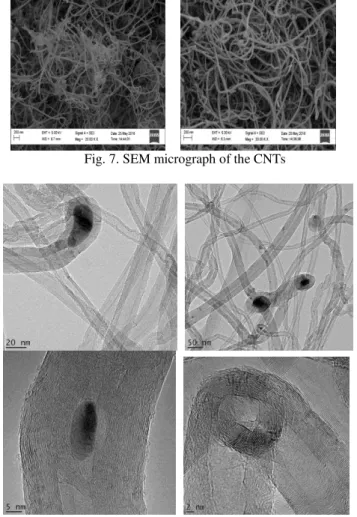
of carbon source. While the sample obtained at flow rate of 90 ml/min contains a clean and elongated CNTs. Fig 8 represents the TEM images of the CNTs synthesized showing some metal particles encapsulated along the inner diameter of the CNT tubes. It also indicates that the CNTs are multiwalled carbon nanotubes (Fig.8c) while Fig 8d reveals the multiple walls and concentric tubes that form the tip of the MWCNTs, which show how concentric tubes of hexagonal graphite are arranged to form MWCNTs. BET analysis was also conducted on the CNTs produced to determine the specific surface area and the results obtained reveal that the CNTs have a specific surface area of 389 m2/g, pore volume of 0.06225cc/g and pore size of 14.7 oA.
Fig. 7. SEM micrograph of the CNTs
Fig. 8. TEM image of the CNTs produced
Fig 9 represents the XRD pattern of CNTs synthesized at different flow rates of acetylene, which shows the characteristic patterns of graphitized carbon and shares similarity with the report of Zhang et al. [16]. This pattern also indicates low content of amorphous carbon and impurities from the catalyst hence indicating a high degree of crystallinity.
Dynamic light scattering (DLS) technique was also used to determine the particle size of the as-synthesized MWCNTs. A correlation chart developed (Fig 10) base on Z average diameter determined by DLS for length, diameter and aspect ratio was used. The Z average (Dh) of the sample
is given by DLS to be 546.4. The value of average diameter obtained from DLS was used in the relationship presented in equation (3) to estimate the length and diameter of the CNTs produced.
(3)
The aspect ratio of the CNTs produced was interpolated to be 72.86 while the length was evaluated to be 2.5135674µm.
Fig. 9: XRD pattern of CNTs produced at different flow rate
The thermal behavior of the CNT was investigated using TGA and the result obtained is presented in Fig 11. The result indicates that there is a gradual degradation from 45oC to 650oC with just 8 wt% loss after which there is a sharp degradation between 650oC – 690oC with about 17 wt% loss, then a gradual degradation is observed from 690oC – 907oC with about 10 wt% loss. It can be seen that at 907oC only 32.59 wt% have been lost indicating that the CNTs synthesized are thermally stable.
Fig. 10: Correlation chart showing the interaction of the aspect ratio, length and diameter of the CNT sample
Fig. 11. Thermal stability of the CNT
IV. CONCLUSIONS
hours, stirring speed of 700 rpm and mass of support of 5.5 g. The catalyst prepared was utilized in the synthesis of CNTs and the results obtained revealed that the flow rate of carbon source influenced the yield of the CNTs with the highest yield of 27% obtained at acetylene (carbon source) flow rate of 90 ml/min. The analysis of the CNTs produced indicated that the CNTs were multiwall carbon nanotubes with high surface area and good thermal stability. It can be therefore inferred that the developed monometallic catalyst on CaCO3 support is a suitable catalyst for the synthesis of
good quality carbon nanotubes. REFERENCES
[1] M.S Dresselhaus, G Dresselhaus and P. C. Eklund ―Science of fullerenes and carbon nanotubes”, California, USA, Academic Press, 1996, pp.627-628.
[2] A.S. Afolabi, A.S Abdulkareem and S.E Iyuke ―Synthesis of carbon nanotubes and nanoballs by swirled floating catalyst chemical Vapour deposition method‖ Journal of Experimental Nanoscience, vol. 2, no 4, pp.269-277, 2007.
[3] S.E Iyuke, A.S Abdulkareem, A.S Afolabi and H.vZ.C Piennar
―Catalytic production of carbon nanotubes in a swirled fluid chemical vapour deposition reactor‖ International Journal of Chemical Reactor Engineering‖ vol.5, pp 1-9, 2007.
[4] M. Aksak, S. Kir and Y Selame ―Effect of the growth temperature on carbon nanotubes grown by thermal chemical vapour deposition method‖ Journal of Optoelectronics and Advanced Materials-Symposia, vol, 1, no 3, pp 281-284, 2009.
[5] V.O. Nyamori, S.D Mhlanga and N.J Covile ―The use of organometallic metal complexes in the synthesis of shaped carbon nanotubes‖ Journal of Organometallic Chemistry, vol. 693, no 13, pp. 2205-2222.
[6] V.R Mate, A. Jha, U.D Joshi, K.R Patil, M. Shirai and C.V Rode
―Effect of preparation parameters on characterization and activity of Co3O4 catalyst in liquid phase oxidation of lignin model substrates‖
Applied Catalysis A: General, vol. 487, pp. 130-138, 2014.
[7] J.T. Miller, M. Schreier, A.J Kropf and J.R Regalbuto ―A fundamental study of platinum tetraamine impregnation of silica: The effect of method of preparation, loading and calcination tempperature on (reduced) particle size‖ Journal of Catalysis, vol. 225, pp. 203-212, 2004.
[8] J. Haber, J.H. Block and B, Delmon ―Manual of methods and procedures for catalyst characterization‖ International Union Of Pure Chemistry, pp.1257-1306, 1995.
[9] L. Chang ―Effects of stirring speed on the performance of Pd/Al2O3 caralysts for methane catalytic combustion‖ Journal of Industrial Catalysis, vol. 23, no 1, pp 45-49, 2015.
[10] A. Magrez, J.W Seo, R. Smajda, M. Mionic and L. Forro ― Catalytic CVD synthesis of carbon nanotubes: Towards yield and low temperature growth (review)‖ Materials, vol. 3, pp. 4871-4891, 2010. [11] M. Morbidelli, A. Gavriilidis and A. Varma ―Catalyst design:
Optimal distribution of catalyst in pellets, reactors, and membranes‖
Cambridge University Press, Cambridge, UK, 2001.
[12] J. Prasek, J. Drbohlavova, J. Hubalek, O. Jasek, V. Adam and R
Kizek ―Methods for carbon nanotubes synthesis—review, Journal of Materials Chemistry, vol. 21, pp. 158, 2011
[13] M. Kumar and Y Ando ―Chemical vapour deposition of carbon nanotubes: A review on growth mechanism and mass production‖,
Journal of Nanoscience and Nanotechnology, vol.10, pp. 3739-3758, 2010.
[14] H.Y. Naseri, O.Z. Zhou, B. Thriruvengadachari ―Physico-chemical properties ofsupport material‖ Materials Letters, vol. 61, no 21, pp. 4301-4304, 2007.
[15] N. Chiwaye ―In situ X-ray diffraction analysis of Fischer Tropsch synthesis‖ MSc Thesis, University of the Witwatersrand, Johannesburg, South Africa, unpublished, 2012.
[16] G. Zhang, D Mann, A. Javey, Y. Li, E. Yenilmez, Q. Wang, J.P
McVittie, Y. Nishi, J. Gibbons and H. Dai ―Ultra-high-yield growth of vertical single-walled carbon nanotubes: Hidden roles of hydrogen