ANA ANDRÉA TEIXEIRA DE CARVALHO
Fatores que interferem na produção de bovicina
HC5 e obtenção de mutantes não produtores de
bacteriocina
Tese apresentada à Universidade Federal de Viçosa, como parte das exigências do Programa de Pós-Graduação em Microbiologia Agrícola, para obtenção de título de Doctor Scientiae.
VIÇOSA
ANA ANDRÉA TEIXEIRA DE CARVALHO
Fatores que interferem na produção de bovicina
HC5 e obtenção de mutantes não produtores de
bacteriocina
Tese apresentada à Universidade Federal de Viçosa, como parte das exigências do Programa de Pós-Graduação em Microbiologia Agrícola, para obtenção de título de Magister Scientiae.
APROVADA: 05 de Junho de 2009
______________________________ ___________________________ Profa. Célia Alencar de Moraes Profa. Elza Fernandes de Araújo
(Co-orientadora)
_______________________________ ____________________________ Profa. Maria Cristina Baracat Pereira Dra. Maria Aparecida Vasconcelos
Paiva Brito
___________________________
“Glória seja dada a Deus, que pelo seu
grandioso poder operando em nós é capaz de fazer muito mais do que jamais ousaríamos pedir ou mesmo imaginar, infinitamente além de nossas mais sublimes orações, anseios, pensamentos ou esperanças”. (Ef 3.20)
Ao meu amado esposo e à minha querida mãe, dedico.
Ao professor Hilário,
AGRADECIMENTOS
Agradeço a Deus por sua presença constante em minha vida, pois sem Ele nada é possível. Agradeço não somente pelo que Ele fez, faz ou irá fazer em minha vida, mas pelo que Ele é, infinito em sua bondade, misericórdia e amor.
À Universidade Federal de Viçosa e ao Departamento de Microbiologia, pela oportunidade de realização do curso e ao Conselho Nacional de Desenvolvimento Científico e Tecnológico pela concessão da bolsa de estudos.
Agradeço ao Leandro, amor de minha vida, pelo amor incondicional, incentivo e companheirismo que foram essenciais para a conclusão deste trabalho.
Agradeço à minha mãe, que me deu suporte e incentivo durante todas as etapas de minha vida, e também ao meu pai, que apesar de não estar mais presente tenho certeza que estaria muito orgulhoso. Agradeço também a todos os meus irmãos, cunhados e cunhadas e sobrinhos pela força, incentivo e carinho.
eternamente grata. Muito obrigada pela confiança em mim depositada. Que Deus te abençoe muito.
Agradeço muito também à professora Marisa Vieira de Queiroz pela disponibilidade, incentivo e pelos aconselhamentos que foram imprescindíveis para a finalização deste trabalho.
Agradeço também à professora Elza Fernandes de Araújo pela disponibilidade em participar da banca e pelo incentivo e dicas que também contribuíram para a realização deste trabalho.
À professora Célia Alencar de Moraes pela força, incentivo, apoio e por ter me dado a primeira oportunidade de trabalhar na área de microbiologia.
Às professoras Maria Cristina Dantas Vanetti e Mirian Teresinha dos Santos minha eterna gratidão pelo apoio, incentivo e força sempre transmitidos. Agradeço também à professora Denise Mara pelas dicas e incentivo.
À professora Maria Cristina Baracat Pereira e à pesquisadora da Embrapa Gado de Leite, Dra. Maria Aparecida Vasconcelos Paiva Brito por terem aceitado participar da banca de defesa.
Agradeço aos amigos da Microbiologia Industrial: Alessandra, José Carlos, Ana Paula, Eliana e Marcelo, pela amizade e incentivo.
Aos amigos do laboratório de Genética de Microrganismos: Guilherme, Leandro, Ireninha, Juline, Janaína, Maycon, Leo, Mateus, Rafael, Jaqueline, Mariana, Mariane. Em especial ao Leandro pela ajuda na hibridização e pelas constantes dicas durante os experimentos. A todos vocês muito obrigada pela disponibilidade e pela receptibilidade.
Agradeço também às meninas da secretaria, Nilcéa e Laura, e aos funcionários José Carlos, Sr. Cesário, Evandro e Danilo.
BIOGRAFIA
ANA ANDRÉA TEIXEIRA DE CARVALHO, filha de Jésus Teixeira de Carvalho e Maria Teixeira Gomes, nasceu em Viçosa, Estado de Minas Gerais, em 10 de maio de 1977.
Em Março de 1999, iniciou o curso de Economia Doméstica pelo Departamento de Economia Doméstica da Universidade Federal de Viçosa, em Viçosa/MG, onde foi bolsista de iniciação científica pela FAPEMIG. Graduou-se em Janeiro de 2004, Licenciada e Bacharel em Economia Doméstica. Nesse mesmo ano, no mês de Agosto, iniciou o curso de Mestrado em Microbiologia Agrícola no Departamento de Microbiologia da Universidade Federal de Viçosa.
SUMÁRIO
RESUMO………...…….
ABSTRACT………...
INTRODUCTION……….
CHAPTER 1
LITERATURE REVIEW...………...
1.1. Bacteriocins from lactic acid bacteria………... 1.2. Factors that affect bacteriocin production by lactic acid bacteria……. 1.3. Genetics of bacteriocin production………... 1.4. Bovicin HC5……….. 1.5. References……….
CHAPTER 2
The effect of carbon and nitrogen sources on bovicin HC5 production by
Streptococcus bovis HC5……… xiii
xv
1
3
3
7
10
14
18
2.1. Abstract………
2.2. Introduction……….
2.3. Material and Methods……….
2.3.1. Microorganisms and growth conditions………. 2.3.2. Activity of bovicin HC5………. 2.3.3. Effect of carbon and nitrogen sources on bovicin HC5 production……… . 2.3.4. Other analyses……… 2.3.5 Statistical methods………..
2.4. Results………..
2.4.1. Influence of carbon sources on bovicin HC5 production…... 2.4.2. Influence of nitrogen sources on bovicin HC5 production… 2.4.3. Use of sugar cane juice and cheese whey for bovicin production………....
2.5. Discussion……….
2.6. Conclusion………
2.7. References………
CHAPTER 3
Effect of environmental conditions on bovicin HC5 production by
Streptococcus bovis HC5……….………...
3.1. Abstract………
3.2. Introduction……….
3.3. Material and Methods……….
3.3.2. Bovicin HC5 bioassay……… 3.3.3. Effect of aeration and media composition on bovicin HC5 production………
3.3.4. Production of bovicin HC5 at different pH values and incubation temperatures………...
3.3.5. Statistics ……….
3.4. Results………..
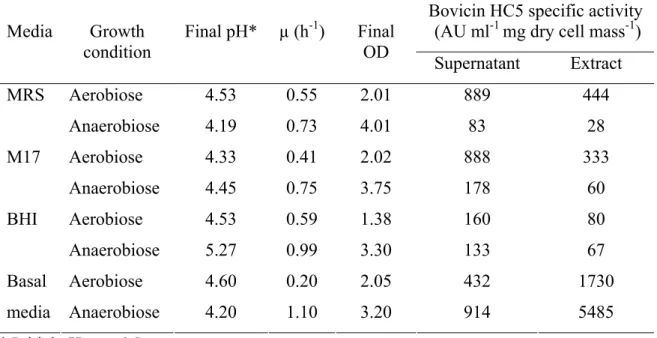
3.4.1. Effect of different growth media on S. bovis HC5 growth and bacteriocin production………...
3.4.2. Effect of pH and temperature on bovicin HC5 production… 3.4.3. Growth and bacteriocin production by S. bovis in basal media at different aeration conditions……….
3.5. Discussion………
3.6. Conclusion………..
3.7. References………..
CHAPTER 4
Effect of pH and growth rate on bovicin HC5 production by Streptococcus
bovis HC5………
4.1. Abstract………
4.2. Introduction……….
4.3. Material and Methods……….
4.3.1. Microorganisms and growth conditions………. 4.3.2. Bovicin HC5 activity………….………...……….. 4.3.3. Continuous culture experiments ………
4.3.4. Other analyses……… 4.3.5. Statistical analysis ……….
4.4. Results………..
4.4.1. Growth and bacteriocin production by S. bovis HC5 in continuous culture without pH control ……….….……..
4.4.2. Growth and bacteriocin production by S. bovis HC5 in continuous culture at controlled pH ………
4.5. Discussion………
4.6. Conclusion………
4.7. References………
CHAPTER 5
Isolation of bac- mutants of Streptococcus bovis HC5...
5.1. Abstract………
5.2. Introduction……….
5.3. Material and Methods……….
5.3.1. Microorganisms and growth conditions………. 5.3.2. Stability of bovicin HC5 production by S. bovis HC5……... 5.3.3. Electroporation of S. bovis HC5 competent cells…………... 5.3.4. Screening of mutants for non-bacteriocinogenic mutants….. 5.3.5. DNA techiniques………
5.4. Results………..
5.4.1. Stability of bovicin HC5 production by S. bovis HC5……... 5.4.2. Isolation of bac- mutants………. 5.4.3 Characterization of mutants……….………
5.5. Discussion………
5.6. Conclusion………
5.7. References………
105
108
RESUMO
CARVALHO, Ana Andréa Teixeira de, D.Sc. Universidade Federal de Viçosa, junho de 2009. Fatores que interferem na produção de bovicina HC5 e obtenção de mutantes não produtores de bacteriocina. Orientador: Hilário Cuquetto Mantovani. Co-orientadores: Marisa Vieira de Queiroz e Célia Alencar de Moraes.
ABSTRACT
CARVALHO, Ana Andréa Teixeira de, D.Sc. Universidade Federal de Viçosa, June, 2009. Factors that affect bovicin HC5 production and isolation of non-bacteriocin producing mutants. Adviser: Hilário Cuquetto Mantovani. Co-Advisers: Marisa Vieira de Queiroz and Célia Alencar de Moraes.
This work was performed to investigate the factors that influence bovicin HC5 production by S. bovis HC5 and to obtain mutants unable to produce bovicin. S. bovis
production was higher when the initial pH was 6.5 and the temperatures ranged from 30°C to 39ºC. When the pH was maintained at constant values, bacteriocin production was inversely proportional to lactate production, glucose consumption and the increase in pH. Continuous culture experiments with dilution rates varying from 0.07 to 1.20 h-1 under uncontrolled pH resulted in homolactic fermentation and greater bacteriocin production at lower dilution rates. In this latter case, residual glucose was never completely consumed, but the media pH was approximately 5.0. When the pH was maintained at 7.5, mixed-acid fermentation occurred at dilution rates below 1.20 h-1. Bacteriocin production increased at higher dilution rates but was at least 10 times lower when compared with uncontrolled pH conditions. Residual glucose was only detected in the fermentation vessel at dilution rates above 0.60 h-1. These results indicate that bovicin HC5 production is not directly related to S. bovis HC5 growth, and can vary depending on extracellular pH and growth rate. S. bovis HC5 cells were transferred 40 times in basal media and bovicin HC5 production was a stable phenotype in S. bovis
INTRODUCTION
Antimicrobial peptides have attracted the attention of several research groups in the last decades due to its industrial application. These antimicrobial substances are produced by several organisms, including insects, plants and animals, as part of their innate immunity, and also play a role in bacterial competition. Antimicrobial peptides are typically characterized as positively charged amphypatic molecules of low molecular mass. Although these molecules vary in their spectrum of activity, inhibitory effects against viruses, bacteria and fungi have been reported.
useful to control bacterial pathogens that cause animal and human infections such as mastitis, gastritis, acne and caries.
Considering the growing interest for commercial application of bacteriocins, the understanding of the factors that influence bacteriocin production is important to enhance peptide yield and to reduce production costs. Moreover, the genetic determinants involved in bacteriocin biosynthesis must be identified and characterized. Previous studies indicate that growth conditions can affect bacteriocin expression and secretion.
CHAPTER 1
LITERATURE REVIEW
1.1 Bacteriocins from lactic acid bacteria
application in the food industry and veterinary or human medicine (Delves-Broughton
et al., 1996; Grande et al., 2005; Bowe et al., 2006; Carvalho et al., 2007a,b).
Bacteriocins vary in molecular structure, mass, thermostability, mode of action, and genetic determinants. Most peptides produced by lactic acid bacteria (LAB) can be classified into two main classes. The lantibiotics (Class I) are composed of heat-stable antimicrobial peptides of low molecular mass (< 5 kDa) that contain post-translationally modified amino acids. Nisin and subtilin are peptides representatives of this class (Cleveland et al., 2001; Cotter et al., 2005; Deegan et al., 2006). Common post-translational modifications include dehydration of Ser and Thr residues in the precursor peptide to generate unsaturated amino acids, which react intramolecularly with nearby cysteine residues to form cyclic thioethers termed lanthionines and methyllanthionines (McAuliffe et al., 2001; Chatterjee et al., 2005). These thioethers rings are important for bacteriocin activity and stability against proteolysis and thermal inactivation (McAuliffe
et al., 2001; Chatterjee et al., 2005; Rink et al., 2007).
acids and range in size from 37 to 48 residues, such as pediocin and mesentericin (Cotter et al., 2005; Deegan et al., 2006).
The mechanisms by which bacteriocins exert their antimicrobial activity vary among bacterial species. Most peptides form pores on the cell membrane and at least some lantibiotics can also inhibit cell wall biosynthesis or prevent the outgrowth of bacterial endospores (Cleveland et al., 2001; Chatterjee et al., 2005). The inhibitory effect is more pronounced against gram-positive microorganism and can be mediated or not by specific receptors in the cell envelope. Bacteriocin activity can be either bacteriostatic or bactericidal, depending on the structure and biochemical properties of a given peptide (Héchard and Sahl, 2002; Deegan et al., 2006).
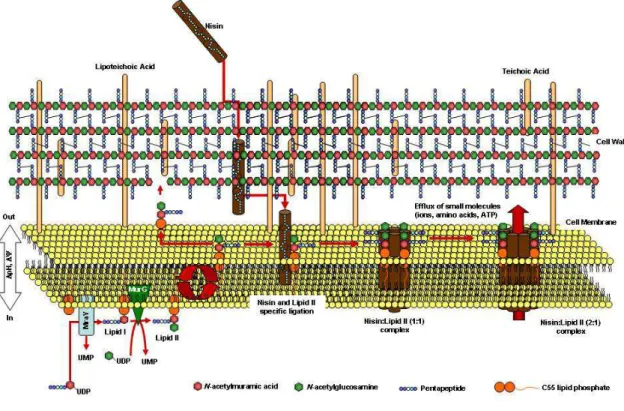
Pore formation was the first characterized mode of action. When a bacteriocin form pores on the cytoplasmic membrane of sensitive cells it causes the depolarization of the cell membrane and the loss of intracellular metabolites, such as ATP and cations (Figure 1.1). Some bacteriocins can also inhibit DNA replication and enzyme activity (Breukink et al., 1999; Papagianni, 2003). Even intrinsically resistant microorganisms, such as gram-negative bacteria, can become sensitive to bacteriocins if exposed to treatments that alter the integrity of the outer membrane (Stevens et al., 1991; Ray, 1993).
1999; Cleveland et al., 2001; Cotter et al., 2005; Deegan et al., 2006). Besides nisin, the use of pediocin PA1 in the form of ALTA® 2431 has been covered by several US and European patents (Rodríguez et al., 2002; Drider et al., 2006).
Figure 1.1. A scheme representing the mode of action of nisin. Nisin and some other
In order for a bacteriocin to be approved for industrial application its effectiveness and safety must be demonstrated. This usually requires biochemical characterization of the peptide and its mode of action, the identification of genetic determinants and the study of potential allergenic and toxicological effects (Cleveland
et al., 2001; Rodríguez et al., 2002). In this regard, the characterization of the factors that influence bacteriocin secretion and activity are important to understand the regulation of bacteriocin expression and to maximize its production.
1.2. Factors that affect bacteriocin production by lactic acid bacteria
Bacteriocin production by LAB has been generally associated with the shift from log to stationary phase. Nisin production appears to begin during mid-log phase and reaches its maximum when the cells enter stationary phase (Lejeune et al., 1998). Bacteriocin production also varies according to media composition, and carbon and nitrogen sources are considered major factors affecting cell growth and bacteriocin yield (Kim et al., 2006). Bacteriocin production by LAB is usually enhanced in complex media, such as MRS, due to the fastidious character of these bacteria (Kim et al., 2006). Todorov and Dicks (2006) observed that tryptone and yeast extract were the best nitrogen sources and maltose the best carbon source for bacteriocin production by
Lactobacillus plantarum strains. Chandrapati and O'Sullivan (1999) demonstrated that nisin expression was induced in Lactococcus lactis by lactose or galactose. Kim et al.
(2006) showed that tryptone were the best nitrogen source for micrococcin GO5 production by Micrococcus sp. GO5.
(Nicolas et al., 2004; Neysens and De Vuyst, 2005; Kim et al., 2006). These factors can either influence the growth of the producer strain or affect gene expression and the activity of a particular bacteriocin (Verluyten et al., 2004b). The media pH affects the growth of producer strains and interferes with the stability of bacteriocins by affecting post-translational modification, aggregation, adsorption, proteolysis and the activity of the peptide (De Vuyst et al., 1996; Cheigh et al., 2002). Certain bacteriocins are better produced in conditions of low extracellular pH (Bárcena et al. 1998; Guerra and Pastrana, 2003; Hindré et al., 2004). In the case of pediocin AcH, this fact was attributed to the low pH required for post-translational processing of the bacteriocin (Biswas et al., 1991).
The expression of lacticin 481, produced by Lactococcus lactis, is induced by the acidic pH resulting from lactic acid accumulation in the growth media or in media artificially acidified (Hindré et al., 2004), and similar results have been reported to nisin and pediocin (Guerra and Pastrana, 2003). As the expression of some bacteriocins appears to be regulated by quorum sensing, it has been proposed that the acidic pH might be related to a cell density signaling. However, more recent studies have shown that at least some bacteriocins might be optimally produced at neutral pH (Settanni et al., 2008).
Although most LAB grow better under anaerobic conditions, the production of nisin, amilovorin and pediocin was enhanced when cultures were grown under oxygen-enriched atmospheres (De Vuyst et al., 1996; Cabo et al., 2001; Anastasiadou et al., 2008). Aeration affects bacteriocin production through changes in metabolic pathways that alter growth yield (Neysens and De Vuyst, 2005). Neysens and De Vuyst (2005) showed that amylovorin titers were higher when the producer strain was kept in anaerobic condition under a continuous flow of carbon dioxide.
Typically, the conditions described to improve bacteriocin production may not coincide with the optimum growth condition for the producer strain (Messens et al., 2002; Mataragas et al., 2003; Drosinos et al., 2006). Van den Berghe et al. (2006) stated that under optimal growth conditions the consumption of available nutrients and formation of cell mass will be maximal. Less energy will be devoted to maintenance and competition does not become an issue. However, at low growth rates more energy is dedicated to maintenance and the production of antimicrobial substances confers competitive advantage. Therefore, under these conditions bacteriocin production might increase (De Vuyst et al., 1996; Aasen et al., 2000).
Because the immunity of the producer strain can affects the amount of bacteriocin that is produced, some attempts have been made in order to increase the resistance of the strains to their own peptide. In an earlier work, Kim et al. (1998) improved nisin production in L. lactis by increasing the expression of NisI, the immunity protein, with a plasmid that carried the immunity genes (Kim et al., 1998). Similar phenotypes were obtained by Quiao et al. (1997), whom selected for nisin resistance among nisin-producing strains.
1.3. Genetics of bacteriocin production
Bacteriocins are gene encoded peptides that can be found in the chromosome (subtilin) or in mobile genetic elements, such as plasmids (lacticin 3147) and conjugative transposons (nisin) (Chatterjee et al., 2005). Several proteins are involved in bacteriocin biosynthesis, including regulatory proteins, proteases, transport proteins and immunity proteins (Figure 1.2). The genes encoding these proteins are commonly located close to the structural gene and are organized in one or more operons, which may or not be divergently transcribed (Chatterjee et al., 2005).
Nisin, the most studied bacteriocin, has 11 genes involved in its biosynthesis:
nisA (structural peptide); nisB (modification); nisT (translocation); nisC (modification);
kinase (Figure 1.2). When sub inhibitory amounts of nisin are present in the growth media, the NisK protein is activated and the genes related to nisin production are activated (Figure 1.2). Nisin transcription can be induced by the addition of nisin to the culture medium and the level of induction obtained seems directly related to the level of nisin added (Kuipers et al., 1993; 1995).
Figure 1.2. A scheme showing the major events during nisin biosynthesis. Nisin is
Several lantibiotics, including subtilin, epidermim and lacticin 481 have been genetically characterized. Although characteristics among bacteriocins vary regarding gene distribution and transcriptional organization, peptides from the same class usually share similar characteristics (Chatterjee et al., 2005). Comparison of gene clusters indicated the presence of conserved ORFS encoding similar functions, as demonstrated for imunity proteins (McAuliffe et al., 2001). In fact, the organization of some operons encoding for lantibiotics might be similar to those involved in the biosynthesis of class II bacteriocins. Similar to the lantibiotics, class II bacteriocins have the genes involved in bacteriocin synthesis organized in one to three operon-like structures. However, class II bacteriocins operons do not harbor genes involved in peptide modification (Ennahar
et al., 2000).
The techniques that have been used to characterize bacteriocins at molecular level includes site-directed mutagenesis (Oppegård et al., 2007), PCR (Cookson et al.,
2004), the use of degenerate primers (Wirawan et al., 2006), expression systems (Rodriguez et al., 2003) and gene inactivation (Fontaine et al., 2007). Liu and Hansen (1992) and Oppegård et al. (2007) used site-directed mutagenesis to study structural aspects of subitlin and lactococcin G and Enterocin 1071, respectively, and their effect on antimicrobial activity.
To study the function of the genes involved in bacteriocin biosynthesis, several expression systems for production of lantibiotics have been constructed. Gutiérrez et al.
produce both enterocin A and nisin and the production of enterocin was greater in L. lactis than in the native host (Martín et al., 2007).
In a previous work, Maguin et al. (1996) developed a vector named pGh9:ISS1 that has been used to inactivate several genes of different strains of LAB. This vector is a thermosensitive plasmid that contains the insertion sequence ISS1. A high-frequency of transposition (at least 0.5 % in L. lactis) has been obtained for this system, which has allowed efficient gene inactivation and direct cloning of DNA surrounding the insertion. Ward et al. (2001) applied the vector to identify the biosynthetic genes encoding for hyaluronic acid capsule in Streptococcus uberis. And Mora et al. (2004) used the pGh9:ISS1 system to characterize the urease gene cluster of Streptococcus thermophilus. In a more recent work, Fontaine et al. (2007) utilized the pGh9:ISS1 vector to characterize the genes involved in quorum-sensing regulation of bacteriocin production by Streptococcus thermophilus.
1.4. Bovicin HC5
The antimicrobial activity of bovicin HC5 also resembles the lantibiotics, causing the loss of intracellular potassium from sensitive cells (Mantovani et al., 2002; Houlihan et al., 2004; Mantovani and Russell, 2008). Bovicin HC5 has a broad spectrum of activity, being inhibitory against several strains of food-borne and spoilage microorganisms, including Listeria monocytogenes, Clostridium tyrobutyricum,
Bacillus cereus, Bacillus thuringiensis, Alicyclobacillus acidoterrestris and strains of LAB, such as Streptococcus, Lactococcus, Enterococcus and Lactobacilus (Mantovani
et al., 2002; Mantovani and Russell, 2003; Carvalho et al., 2007ab; Carvalho et al., 2008).
Because of its biochemical characteristics and activity at low pH, bovicin HC5 might be suitable to control thermoacidophilic spoilage bacteria in heat-treated acidic drinks. Carvalho et al. (2007ab) showed that bovicin HC5 was bactericidal against B. cereus, B. thuringiensis and C. tyrobutyricum in mango pulp, and the inhibitory effect was even more pronounced at acidic conditions (Carvalho et al., 2007ab). Bovicin HC5 also reduces the outgrowth of endospores from B. cereus and B. thuringiensis in acidic mango pulp (Carvalho et al., 2007a). These latter results indicated that bovicin HC5 was as effective as nisin to control Bacillus and Clostridium strains in mango pulp (Carvalho et al., 2007ab).
results suggest that bovicin HC5 could be useful to prevent spoilage of acidic fruit products by spore-forming bacteria.
Bovicin HC5 has also potential for use in veterinary medicine. This bacteriocin was effective against strains of Stapphylococcus aureus, coagulase-negative
Stapphylococcus sp., Streptococcus agalactiae, Streptococcus bovis and Streptococcus uberis isolated from cows with mastitis (Pinto, 2007). The activity against these animal pathogens appears to be bactericidal. The combined use of bovicin HC5 with antibiotics or others bacteriocins that are effective against mastitis-causing pathogens may represent an alternative strategy to control bovine mastitis.
Bovicin HC5 has been recently used to manipulate ruminal fermentation in vitro and might be useful to improve feed efficiency in cattle (Lima et al. 2009). Bovicin was as effective as the feed additive monensin to inhibit the deamination of mixed ruminal bacteria in vitro. Considering that the European Union banned the use of monensin as a growth-promoting antibiotic (Russell and Houlihan, 2003), bovicin HC5 could be considered a potential feed additive for cattle.
Due to its potential commercial applications, the effectiveness, production and safety of bovicin HC5 must be fully understood. This requires the investigation of genetic determinants, mode of action, efficacy, spectrum of activity and allergenic and toxicological effects (Cleveland et al. 2001; Rodríguez et al. 2002). Even though bovicin HC5 has been characterized as an effective and broad-spectrum bacteriocin, the genetic determinants involved in bovicin HC5 biosynthesis are yet to be elucidated. Further studies are also needed to determine the cytotoxic and allergenic potential of bovicin HC5 against mammalian cells. Although bovicin HC5 is produced by
1.5. References
Aasen, I.M.; Moretro, T.; Katla, T.; Axelsson, L.; Storro, I. (2000) Influence of complex nutrients, temperature and pH on bacteriocin production by Lactobacillus sakei CCUG 42687. Applied Microbiology and Biotechnology. 53, 159–166.
Anastasiadou, S.; Papagianni, M.; Filiousis, G.; Ambrosiadis, I.; Koidis, P. (2008) Pediocin SA-1, an antimicrobial peptide from Pediococcus acidilactici NRRL B5627: Production conditions, purification and characterization. Bioresource Technology. 99, 5384-5390.
Bárcena, J.M.; Siñeriz F.; González de Llano, D.; Rodríguez, A.; Suárez, J.E. (1998) Chemostat Production of Plantaricin C By Lactobacillus plantarum LL441. Applied and Environmental Microbiology. 64, p. 3512–3514.
Biswas, S.R.; Ray, P.; Johnson, M.C.; Ray, B. (1991) Influence of growth conditions on the production of a bacteriocin, pediocin AcH, by Pediococcus acidilactici H. Applied Environmental Microbiology. 57, 1265-1267.
Bhugaloo-Vial, P.; Grajek, W.; Dousset, X.; Boyaval, P. (1997) Continuous bacteriocin production with high cell density bioreactors. Enzyme Microbial Technology. 21, 450-457.
Bowe, W.P.; Filip, J.C.; Dirienzo, J.M.; Volgina, A.; Margolis, D.J. (2006) Inhibition of propionibacterium acnes by bacteriocin-like inhibitory substances (BLIS) produced by
Streptococcus salivarius. Journal of Drugs in Dermatology. 5, 868-870.
Breukink, E.; Kruijff, B. (1999) The lantibiotic nisin, a special case or not? Biochemical et Biophysical Acta. 1462, 223-234.
Cabo, M.L.; Murado, M.A.; Gonzales, M.P.; Pastoriza, L. (2001) Effects of aeration and pH gradient on nisin production. A mathematical model. Enzyme and Microbial Technology. 29, 264–273.
Carvalho, A.A.T.; Costa, E.D.; Mantovani, H.C.; Vanetti, M.C.D. (2007a) Effect of bovicin HC5 on growth and spore germination of Bacillus cereus and Bacillus thuringiensis isolated from spoiled mango pulp. Journal of Applied Microbiology. 102, 1000-1009.
Carvalho, A.A.T.; Mantovani, H.C.; Vanetti, M.C.D. (2007b) Bactericidal effect of bovicin HC5 and nisin against Clostridium tyrobutyricum isolated from spoiled mango pulp. Letters in Applied Microbiology. 45, 68-74.
Carvalho, A.A.T.; Vanetti, M.C.D.; Mantovani, H.C. (2008) Bovicin HC5 reduces thermal resistance of Alicyclobacillus acidoterrestris in acidic mango pulp. Journal of Applied Microbiology. 104, 1685–1691.
nisin: role of dehydroalanine 5. Applied and Environmental Microbiology. 62: 2966– 2969.
Chandrapati S.; O'Sullivan, D.J. (1999) Nisin independent induction of the nisA promoter in Lactococcus lactis during growth in lactose or galactose. FEMS Microbiology Letters. 170, 191-198.
Chatterjee, C.; Paul, M.; Xie, L.; Van Der Donk, W.A. (2005) Biosynthesis and mode of action of lantibiotics. Chemical Reviews. 105, 633-683.
Cheigh, C.I.; Choi, H.J.; Park, H.; Kim, S.B.; Kook, M.C.; Kim, T.S.; Hwang, J.K.; Pyun, Y.R. (2002) Influence of growth conditions on the production of a nisin-like bacteriocin by Lactococcus lactis subsp. lactis A164 isolated from kimchi. Journal of Biotechnology. 95, 225–235.
Cleveland, J.; Montville, T.J.; Nes, I.F.; Chikinda, M.L. (2001) Bacteriocins: safe, natural antimicrobials for food preservation. International Journal of Food Microbiology. 71, 1-20.
Cookson, A.L.; Noel, S.J.; Kell, W.J.; Attwood, G.T. (2004) The use of PCR for the identification characterization of bacteriocin genes from bacterial strains isolated from rumen or caecal contents of cattle and sheep. FEMS Microbiology Ecology. 48, 199-207.
Cotter, P.D.; Hill, C.; Ross, P. (2005) Bacteriocins: developing innate immunity for food. Nature Reviews. 3, 777-788.
Deegan, L.H., Cotter, P.D., Hill, C.; Ross, P. (2006) Bacteriocins: biological tools for bio-preservation and shelf-life extension. International Dairy Journal. 16,1058-1071. Delves-Broughton, J.; Blackburn, P.; Evans, R.J.; Hugenholtz, J. (1996) Applications of the bacteriocin, nisin. Antonie van Leeuwenhoek. 69, 193-202.
Ennahar, S.; Sashihara, T.; Sonomoto, K.; Ishizaki, A. (2000) Class IIA bacteriocins: biosynthesis, structure and activity. FEMS Microbiology Reviews. 24, 85-106.
De Vuyst, L.; Callewaert, R.; Crabbé, K. (1996) Primary metabolite kinetics of bacteriocin biosynthesis by Lactobacillus amylovorus and evidence for stimulation of bacteriocin production under unfavourable growth conditions. Microbiology. 142, 817– 827.
Diep, D.B.; Axelsson, L.; Grefsli, C.; Nes, I.F. (2000) The synthesis of the bactericin sakacin A is a temperature-sensitive process regulated by a pheromone peptide through a three-component regulatory system. Microbiology. 146, 2155–2160.
Drosinos, E.H.; Mataragas, M.; Metaxopoulos, J. (2006) Modeling of growth and bacteriocin production by Leuconostoc mesenteroides E131. Meat Science. 74, 690– 696.
Fontaine, L.; Boutry, C.; Guédon, E.; Guillot, A.; Ibrhim, M.; Grossiord, B.; Hols, P. (2007) Quorum-sensing regulation of the production of blp bacteriocins in
Streptococcus thermophilus. Journal of Bacteriology. 189, 7195-7205.
Grande, M.J.; Lucas, R.; Abriouel, H.; Ben Omar, N.; Maqueda, M.; Martínez-Bueno M.; Martínez-Cañamero, M.; Valdivia, E.; Gálvez, A. (2005) Control of
Alicyclobacillus acidoterrestris in fruit juices by enterocin AS-48. International Journal of Food Microbiology. 104, 289– 297.
Guerra, N.P.; Pastrana, L. (2003) In£uence of pH drop on both nisin and pediocin roduction by Lactococcus lactis and Pediococcus acidilactici. Letters in Applied Microbiology. 37, 51-55.
Guitiérrez, J.; Criado, R.; Citti, R.; Martín, M.; Herranz, C.; Nes, I.F; Cintas, L.M.; Hernández, P.E. (2005) Cloning, production and functional expression of enterocin P, a sec-dependent bacteriocin produced by Enterococcus faecium P13, in Escherichia coli.
International Journal of Food Microbiology. 103, 239-250.
Héchard, Y.; Sahl, H.G. (2002) Mode of action of modified e unmodified bacteriocins from Gram-positive bacteria. Biochimie. 84, 1-13.
Hindré, T.; Le Pennec, J.P.; Haras, D.; Dufour, A. (2004) Regulation of lantibiotic lacticin 481 production at the transcriptional level by acid pH. FEMS Microbiology Letters. 231, 291-8.
Houlihan, A.J.; Mantovani, H.C.; Russell, J.B. (2004) Effect of pH on the activity of bovicin HC5, a bacteriocin from Streptococcus bovis HC5. FEMS Microbiology Letters. 231, 27-32.
Jarvis, G.N.; Kutovic, A.; Hay, A.G.; Russell, J.B. (2000) The physiological and genetic diversity of bovine Streptococcus bovis strains. FEMS Microbial Ecology. 35, p. 49– 56.
Kaletta, C.; Entian, K.D. (1989) Nisin, a peptide antibiotic: cloning and sequencing of the nisA gene and post-translational processing of its product. Journal of Bacteriology. 171, 1597-1601.
Kim, M.H.; Kong, Y.J.; Baek, H.; Hyun, H.H. (2006) Optimization of culture conditions and medium composition for the production of microccin GO5 by
Micrococcus sp. GO5. Journal of Biotechnology. 121, 54-61.
Kuipers, O.P.; Ruyter, P.G.G.A.; Kleerebezem, M.; Vos,W.M. (1998) Quorum sensing-controlled gene expression in lactic acid bacteria. Journal of Biotechnology. 64, 15– 21.
Kuipers, O.P.; Beerthuyzen, M.M.; Deruyter, P.G.G.A.; Luesink, E.J.; de Vos, W.M. (1995). Autoregulation of nisin biosynthesis in Lactococcus lactis by signal-transduction. Journal of Biological Chemistry. 270, 27299–27304.
Kuipers, O.P.; Beerthuyzen, M.M.; Siezen, R.J.; Devos, W.M. (1993). Characterization of the nisin gene-cluster nisABTCIP of Lactococcus lactis—requirement of expression of the nisA and nisI genes for development of immunity. European Journal of Biochemestry. 216, 281–291.
Kurtovic, A.; Jarvis, G.N.; Mantovani, H.C.; Russell, J.B. (2003) Ability of lysozyme and 2-deoxyglucose to differentiate human and bovine Streptococcus bovis strains. Journal of Clinical Microbiology. 41, 3951–3954.
Lejeune, R.; Callewaert, R.; Crabbeé, K.; De Vuyst, L. (1998) Modelling the growth and bacteriocin production by Lactobacillus amylovorus DCE 471 in batch cultivation. Journal of Applied Bacteriology. 84, 159-168.
Lima, J.R.; Ribon, A.O.; Russell, J.B.; Mantovani, H.C. (2009) Bovicin HC5 inhibits wasteful amino acid degradation by mixed ruminal bacteria in vitro. FEMS Microbiology Letters. 292, 78-84.
Liu, W.; Hansen, J.N. (1992) Enhancement of the chemical and antimicrobial properties of subtilin by site-directed mutagenesis. Journal of Biological Chemistry. 267:25078– 25085.
Maguin, E.; Prévost, H.; Ehrlich, S.D.; Gruss, A. (1996) Efficient insertional mutagenesis in lacococci and other gram-positive bacteria. Journal of Bacteriology. 178, 931-935.
Mantovani, H.C.; Russell, J.B. (2003) Inhibition of Listeria monocytogenes by bovicin HC5, a bacteriocin produced by Streptococcus bovis HC5. Interantional Journal of Food Microbiology. 89, 77-83.
Mantovani, H.C.; Russell, J.B. (2008) Bovicin HC5, a lantibiotic produced by
Streptococcus bovis HC5, catalyzes the efflux of intracellular potassium but not ATP. Antimicrobial Agents and Chemotherapy. 52, 2247–2249.
Mantovani, H.C.; HU, H.; Worobo, R.W.; Russell, J.B. (2002) Bovicin HC5, a bacteriocin from Streptococcus bovis HC5. Microbiology. 148, 3347 –3352.
Mataragas, M.; Metaxopoulos, J.; Galiotou, M.; Drosinos, E.H. (2003) Influence of pH and temperature on growth and bacteriocin production by Leuconostoc mesenteroides
Matsusaki, H.; Endo, N.; Sonomoto, K.; Ishizaki, A. (1996) Lantibiotic nisin Z fermentative production by Lactococcus lactis 10-1: relationship between production of the lantibiotic and lactate and cell growth. Applied Microbiology and Biotechnology. 45, 36–40.
Martín, M.; Guitiérrez, J.; Criado, R.; Herranz, C.; Cintas, L.M.; Hernádez, P.E. (2007) Cloning, production and expresión of the bacteriocin enterocin A produced by
Enterococcus faecium PLBC21 in Lactococcus lactis. Applied Microbiology and
Biotechnology. 76, 667-675.
McAuliffe, O.; Roos, R.P.; Hill, C. (2001) Lantibiotics: structure, biosynthesis and mode of action. FEMS Microbiology Reviews. 25, 285-308.
Messens, W.; Verluyten, J.; Leroy, F.; De Vuyst, L. (2002) Modelling growth and bacteriocin production by Lactobacillus curvatus LTH 1174 in response to temperature and pH values used for European sausage fermentation processes. International Journal of Food Microbiology. 81, 41– 52, 2002.
Mora, D.; Maguin, E.; Masiero, M.; Parini, C.; Ricci1, G.; Manachini, P.L.; Daffonchio, D. (2004) Characterization of urease genes cluster of Streptococcus thermophilus. Journal of Applied Microbiology. 96, 209–219.
Nicolas, G.; Auger, I.; Beaudoin, M.; Hallé, F.; Morency, H.; Lapointe, G.; Lavoie,C. Improved methods for mutacin detection and production. Journal of Microbiological Methods. 59, 351-361, 2004.
Neysens P.; De Vuyst, L. (2005) Carbon dioxide stimulates the production of amylovorin L by Lactobacillus amylovorus DCE 471, while enhanced aeration causes biphasic kinetics of growth and bacteriocin production. International Journal of Food Microbiology. 105, 191– 202.
Oppegard, C.; Fimland, G.; Thorbæk, L.; Nissen-Meyer, J. (2007) Analysis of the two-peptide bacteriocins lactococcin G and enterocin 1071 by site-directed mutagenesis. Applied and Environmental Microbiology. 73, 2931–2938.
Papagianni, M. (2003) Ribosomally synthesized peptides with antimicrobial properties: biosynthesis, structure, function, and applications. Biotechnology Advances. 21, 465-499.
Parente, E.; Brienza, C.; Ricciardi, A.; Addario, G. (1997) Growth and bacteriocin production by Enterococcus faecium DPC1146 in batch and continuous culture. Journal of Industrial Microbiology and Biotechnology. 18, 62-67.
Pinto, M.S. Atividade de própolis verde e bovicina HC5 sobre bactérias isoladas de mastite bovina. Universidade Federal de Viçosa. Dissertação de Mestrado. Viçosa: UFV, 2008, 94 p.
Rodríguez, J.M.; Martínez, M.I.; Horn, N.; Dodd, H.M. Heterologous production of bacteriocins by lactic acid bacteria. International Journal of Food Microbiology. 80, 101–116.
Russell, J.B.; Houlihan, A.J. (2003) Ionophore resistance of ruminal bacteria and its potential impact on human health. FEMS Microbiology Reviews. 27, 65-74.
Settanni, L.; Valmorri, S.; Suzzi, G.; Corsetti, A. (2008) The role of environmental factors and medium composition on bacteriocin-like inhibitory substances (BLIS) production by Enterococcus mundtii strains. Food Microbiology. 25, :722-728.
Siragusa, G.R.; Cutter, C.N.; Willett, J.L. (1999) Incorporation of bacteriocin in plastic retains activity and inhibits surface growth of bacteria on meat. Food Microbiology. 16, 229-235.
Souza, A.M.R. Atividade das bacteriocinas bovicin HC5 e nisina sobre o crescimento e a resistência térmica de Alicyclobacillus acidoterrestris em sucos de frutas. Universidade Federal de Viçosa. Dissertação de Mestrado. Viçosa: UFV, 2008, 94 p. Todorov, S.D.; Dicks, L.M.T. (2006) Effect of medium components on bacteriocin production by Lactobacillus plantarum strains ST23LD and ST341LD, isolated from spoiled olive brine. Microbiological Research. 161, 102-108.
Van Den Berghe, E.; Skourtas, G.; Tsakalidou, E.; De Vuyst, L. (2006) Streptococcus macedonicus ACA-DC 198 produces the lantibiotic, macedocin, at temperature and pH conditions that prevail during cheese manufacture. International Journal of Food Microbiology. 107, 138-147.
Van Der Meer, J.R.; Polman, J.; Beerthuyzen, M.M.; Siezen, R.J.; Kuipers, O.P.; De Vos, W. (1993) Characterization of the Lactococcus lactis nisin A operon genes nisP, enconding a subtilisin-like serine protease involved in precursor processing, and nisR, encoding a regulatory protein involved in nisin biosynthesis. Journal of Bacteriology. 175, 2578-2588.
Verluyten, J.; Messens, W.; De Vuyst, L. (2004) Sodium chloride reduces production of curvacin A, a bacteriocin produced by Lactobacillus curvatus strain LTH 1174, originating from fermented sausage. Applied and Environmental Microbiology. 70, 2271–2278.
Ward, P.N.; Field, T.R.; Ditcham, W.G.F.; Maguin, E.; LEIGH, J.A. (2001) Identification and disruption of two discrete loci encoding hyaluronic acid capsule biosynthesis genes hasA, hasB, and hasC in Streptococcus uberis. Infection and Immunity. 69, 392–399.
CHAPTER 2
The effect of carbon and nitrogen sources on bovicin HC5 production by
Streptococcus bovis HC5*
2.1. Abstract
The aim of this study was to investigate the effect of media composition and agroindustrial residues on bovicin HC5 production by Streptococcus bovis HC5. Batch cultures of S. bovis HC5 were grown in basal medium containing different carbon and nitrogen sources. The activity of cell-free and cell-associated bovicin HC5 was determined in culture supernatants and acidic extracts obtained from cell pellets, respectively. S. bovis HC5 produced bovicin using a variety of carbon and nitrogen sources. The highest specific activity was obtained in media containing 16 g l-1 of glucose, after 16 h of incubation. The peak in cell-free and cell-associated bovicin HC5
*
activity was detected when S. bovis HC5 cultures reached stationary phase. The bovicin HC5 specific activity and bacterial cell mass increased approximately 3-fold when yeast extract and Trypticase® (0.5 and 1.0 g l-1, respectively) were added together to the basal medium. S. bovis HC5 cultures produced bovicin HC5 in cheese whey and sugar cane juice and maximal volumetric productivity was obtained after 12 h of incubation. These results demonstrated that S. bovis HC5 is a versatile lactic acid bacterium that can utilize several carbon and nitrogen sources for bovicin HC5 production. This bacterium could be a useful model to study bacteriocin production in the rumen ecosystem. The use of agroindustrial residues as carbon sources could have an economical impact on bovicin HC5 production. To our knowledge, this is the first report to show the use of sugar cane juice for bacteriocin production by lactic acid bacteria.
Keywords: bacteriocin production, bovicin HC5, sugar cane juice, cheese whey, media composition
2.2. Introduction
Lactic acid bacteria (LAB) can produce several antimicrobial compounds (e.g. hydrogen peroxide, organic acids and bacteriocins) that inhibit spoilage and pathogenic microorganisms (Deegan et al., 2006). Bacteriocins produced by LAB have received great attention because of their use as ‘natural’ food preservatives and an increased demand for less-processed and microbiologically safe food products (Gálvez et al.,
sensitive bacteria can rapidly become nisin-resistant (Crandall and Montville, 1998; Mantovani and Russell, 2001; Naghmouchi et al., 2007). The development of nisin-resistant strains has increased the interest in studying other bacteriocins with similar spectrum of activity that show stability to heat and acidic conditions.
Bovicin HC5 is a bacteriocin produced by Streptococcus bovis HC5 that inhibits the growth of several foodborne and spoilage microorganisms, including Listeria monocytogenes (Mantovani and Russell, 2003a), Bacillus cereus and B. thuringiensis
(Carvalho et al., 2007a) and certain species of Clostridium (Flythe and Russell, 2004; Carvalho et al., 2007b). Bovicin HC5 is a small pore-forming peptide with a unique amino acid sequence that shows similarity to the lantibiotics (Mantovani et al., 2002; Mantovani and Russell, 2008). It has stability to high temperatures and acidic pH (Mantovani et al. 2002; Houlihan et al., 2004), and resistance development to bovicin HC5 has not yet been described. Because of its characteristics, bovicin HC5 could also have potential for industrial application (Russell and Mantovani, 2002; Diez-Gonzalez, 2007).
examine the potential for using sugar cane juice and cheese whey as alternative substrates for bacteriocin production.
2.3. Materials and methods
2.3.1. Microorganisms and growth conditions
Streptococcus bovis HC5 was originally isolated from a grain fed cow
(Mantovani et al., 2001) and cultivated as previously described (Mantovani and Russell, 2003). S. bovis HC5 was grown in basal media containing (per liter): 292 mg K2HPO4,
292 mg KH2PO4, 480 mg (NH4)2SO4, 480 mg NaCl, 100 mg MgSO4.7H2O, 64 mg
CaCl2.2H2O, 500 mg cysteine hydrochloride, 1 g Trypticase®, 0.5 g yeast extract and 4
g Na2CO3. The medium was prepared anaerobically under an O2-free carbon dioxide
flux and the final pH was adjusted to 6.5 with NaOH (1 mol l-1). Growth and maximal optical densities were determined at 600 nm (OD600nm) in a Spectronic 20D+
(Thermoelectron, Madison, WI). The indicator organism, Alicyclobacillus acidoterrestris DSMZ 2498, was grown at 40ºC in Alicyclobacillus acidoterrestris
medium (AAM), described by Yamazaki et al. (2000).
2.3.2. Activity of bovicin HC5
mmol l-1, pH 6.7) and re-suspended in a volume of acidic NaCl solution (100 mmol l-1, adjusted to pH 2.0 with 1 mol l-1 HCl) that corresponded to 5% of the initial culture volume. Cell suspensions were incubated under agitation (approximately 150 rev min-1) for 2 h at room temperature, followed by centrifugation (9000 x g, 4ºC, 15 min) and determination of bacteriocin activity in the cell-free extract. Preparations containing bovicin HC5 were serially diluted (2-fold increments) with NaCl solution (100 mmol l-1, pH 2.0) and tested for antimicrobial activity against A. acidoterrestris DSMZ 2498 by using the agar well diffusion technique described by Hoover and Harlander (1993). One arbitrary unit (AU, expressed per ml or cell dry mass) was defined as the reciprocal of the highest dilution that showed a zone of inhibition with at least 5 mm in diameter. When the determination of optical density was not possible due to the turbidity of the media containing sugar cane juice or cheese whey, bovicin activity was expressed as volumetric productivity (AU ml-1 h-1).
2.3.3. Effect of carbon and nitrogen sources on bovicin HC5 production
Carbon sources preferentially used by S. bovis strains were previously described by Russell and Robinson (1984) and used in this study. The carbon sources tested were glucose, lactose, maltose, mannose, sucrose and cellobiose at concentrations of 4 and 8 g l-1. Batch cultures (3% inoculum, v/v) were grown in anaerobic basal media (50 ml) and kept incubated for approximately 16 h at 39ºC and activity of bovicin HC5 was tested in the supernatant and in the cell extract.
extract was determined for each concentration as described above. In each case, the pH and the OD600nm were also determined.
Sugar cane juice and cheese whey were also tested as carbon sources for bacteriocin production by S. bovis HC5. Batch cultures were carried out in sealed anaerobic serum bottles (50 ml) or in 500 ml fleaker beaker flasks (Corning) that were continuously purged with O2-free carbon dioxide. Cheese whey was reconstituted in
water, heat-sterilized (121oC, 15 min) and added to 2-fold concentrated basal media (1:1 ratio, v/v). The final lactose concentration was approximately 24 g l-1. Sugar cane juice (16 o Brix) was extracted from ground sugar cane, heat-sterilized (121oC, 15 min) and mixed with basal media (1:1 ratio, v/v). The final sugar concentration was approximately 100 g l-1. Samples (20 ml) were taken at time intervals (0, 12, 24 and 48 hours) and tested for bacteriocin activity as previously described. Volumetric bacteriocin productivity (Qp, expressed as AU ml-1 h-1) was determined from the difference in bovicin activity in relation to the time (h).
To study the effect of different nitrogen sources on bovicin production, the basal medium, added of glucose at 16 g l-1, was supplemented with each different nitrogen source (1.5 g l-1). The nitrogen sources tested were yeast extract, Trypticase®, meat extract, soy peptone, meat peptone, casein peptone, ammonium sulfate. After 24 h of incubation at 39ºC, the final optical densities, culture pH value and bacteriocin activity in the culture supernatant and in the cell extract were determined.
2.3.4. Other analyses
buffer (5 mM, pH 6.5); the pellet was concentrated four times and aliquots of 5 ml were dried at 105ºC up to constant weight. The relationship between optical density (600 nm) and cell dry mass was 360 mg cell dry mass liter-1 turbidity unit-1.
Glucose and fermentation acids in cell-free supernatant were analyzed by high performance liquid chromatography (HPLC, Bio-Rad HPX-87H organic acid column). The sample size was 20 µl, the eluant was 0.005 mol l-1 H2SO4, the flow rate was 0.7 ml
min-1 and the column temperature was 60ºC.
2.3.5 Statistical methods
All experimental determinations were performed in three replicates and the mean, standard deviation and coefficients of variation were computed. The coefficients of variation were always less than 10 %. When error bars are given in the figures, they refer to the standard deviation.
2.4. Results
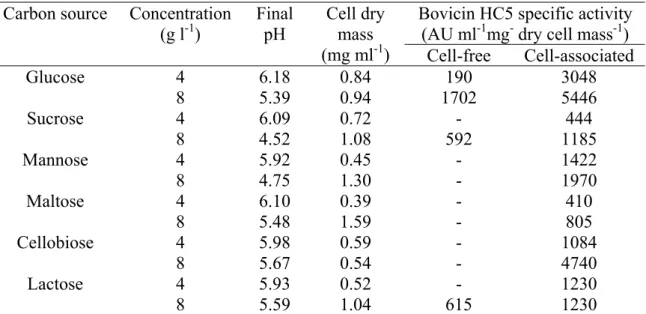
2.4.1. Influence of carbon sources on bovicin HC5 production
bovicin production (Table 2.1). Among the disaccharides tested, the highest activity of cell-associated bovicin HC5 was detected in cellobiose-grown cultures (Table 2.1). Based on these results, glucose was chosen for further characterization of its effect on bovicin HC5 production.
Table 2.1. Influence of carbon sources on cell growth and bovicin HC5 production by
S. bovis HC5
Bovicin HC5 specific activity (AU ml-1mg- dry cell mass-1) Carbon source Concentration
(g l-1)
Final pH
Cell dry mass
(mg ml-1) Cell-free Cell-associated
4 6.18 0.84 190 3048
Glucose
8 5.39 0.94 1702 5446
4 6.09 0.72 - 444
Sucrose
8 4.52 1.08 592 1185
4 5.92 0.45 - 1422
Mannose
8 4.75 1.30 - 1970
4 6.10 0.39 - 410
Maltose
8 5.48 1.59 - 805
4 5.98 0.59 - 1084
Cellobiose
8 5.67 0.54 - 4740
4 5.93 0.52 - 1230
Lactose
8 5.59 1.04 615 1230
- Inhibitory activity was not detected
decreased optical densities (results not shown) and the production of bovicin HC5 was drastically reduced (Figure 2.1).
Figure 2.1. The effect of glucose on bovicin HC5 specific activity. S. bovis HC5 was
inoculated into basal medium added with increasing amounts of glucose (0 to 160 g l-1) and incubated at 39ºC for 16 h. Bovicin HC5 activity was determined in cell-free culture supernatants (open bars) and in extracts from S. bovis cells treated with acidic NaCl (closed bars).
0 2000 4000 6000 8000 10000
0 4 8 16 40 160
Bovi c in H C 5s pe ci fi c a ct ivi ty (A U m l
-1 m
g
c
el
l dry m
as
s
-1 )
Figure 2.2. Growth and bovicin production by S. bovis HC5 cultivated in basal media containing glucose (16 g l-1) as sole carbon source. (a) Growth of S. bovis in basal media(open circles), lactate accumulation (closed circles) and residual glucose (open squares). (b) Activity of cell-free (open bars) and cell-associated (closed bars) bovicin HC5 determined at different time intervals.
0 0,5 1 1,5 2 2,5 3 3,5 0 20 40 60 80 100 120 140 160
0 10 20 30 40 50
O p ti c al de ns it y (O D 600 nm ) L a ct a te (m M ) and Re si dua l G luc os e (m M )
Incubation Time (h)
a
0 2000 4000 6000 8000 10000 120000 2 4 6 8 10 12 14 16 24 36 48
Bovi
c
in HC5 (A
U
ml
-1 )
2.4.2. Influence of nitrogen sources on bovicin HC5 production
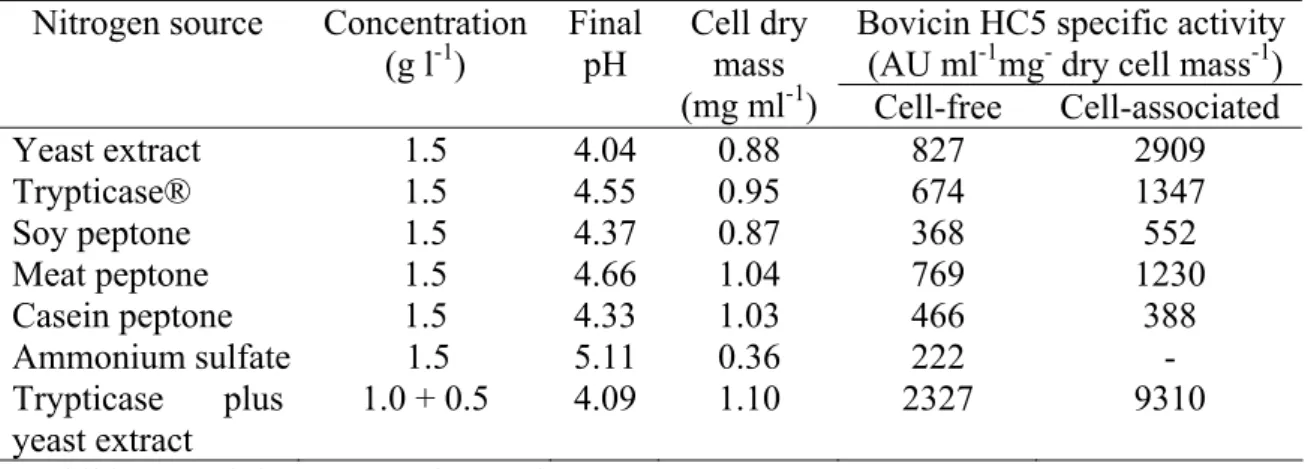
When S. bovis HC5 was cultivated in basal medium that lacked yeast extract and Trypticase® and was added of different nitrogen sources (at 1.5 g l-1), a range of cell mass and bovicin HC5 specific activities were obtained (Table 2.2). The amount of bovicin HC5 detected in the cell extracts was always higher than in the culture supernatants, except when casein peptone was used as the nitrogen source (Table 2.2). The specific activity of cell-free bovicin varied 10-fold among nitrogen sources, while the cell-associated activity varied approximately 24 fold. When ammonium sulfate was used as the single nitrogen source, S. bovis HC5 did not grow well and produced little bacteriocin (Table 2.2).
Table 2.2. Influence of nitrogen sources on cell growth and bovicin HC5 production by
S. bovis HC5
Bovicin HC5 specific activity (AU ml-1mg- dry cell mass-1) Nitrogen source Concentration
(g l-1)
Final pH
Cell dry mass
(mg ml-1) Cell-free Cell-associated
Yeast extract 1.5 4.04 0.88 827 2909
Trypticase® 1.5 4.55 0.95 674 1347
Soy peptone 1.5 4.37 0.87 368 552
Meat peptone 1.5 4.66 1.04 769 1230
Casein peptone 1.5 4.33 1.03 466 388
Ammonium sulfate 1.5 5.11 0.36 222 - Trypticase plus
yeast extract
1.0 + 0.5 4.09 1.10 2327 9310
- Inhibitory activity was not detected
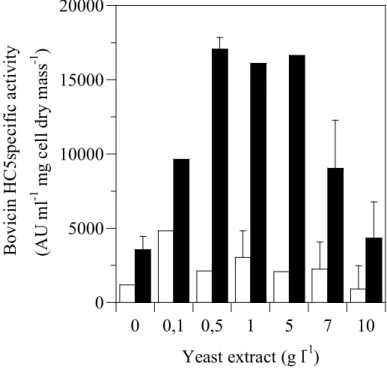
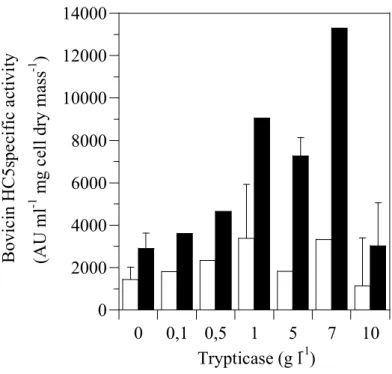
or Trypticase®, but the specific activity of bovicin HC5 decreased if the concentration of yeast extract and Trypticase® was greater than 5 g l-1 and 7 g l-1, respectively (Figure 2.3 and Figure 2.4). Interestingly, when optimal concentrations (7 g l-1 Trypticase and 1 g l-1 yeast extract) of both substrates were added to basal media, an increase in cell mass was observed (1.40 mg ml-1 cell dry mass), but the amount of bacteriocin produced was less than observed in basal media alone (data not shown).
0 5000 10000 15000 20000
0 0,1 0,5 1 5 7 10
Bovi c in H C 5s pe ci fi c a ct ivi ty (A U m l
-1 m
g
c
el
l dry m
as
s
-1 )
Yeast extract (g l-1)
Figure 2.3. The effect of yeast extract on bovicin HC5 specific activity. Basal medium
0 2000 4000 6000 8000 10000 12000 14000
0 0,1 0,5 1 5 7 10
Bovi c in HC5s pe ci fi c a ct ivi ty (A U m l
-1 m
g
c
el
l dry m
as
s
-1 )
Trypticase (g l-1)
Figure 2.4. The effect of Trypticase® on bovicin HC5 specific activity. Basal medium
2.4.3. Use of sugar cane juice and cheese whey for bovicin production
Since S. bovis HC5 could use sucrose and lactose for bovicin HC5 production, we tested sugar cane juice and cheese whey as potential abundant, low-cost substrates for bacteriocin production. Batch cultures grown in sealed anaerobic bottles had more cell-free bacteriocin than cultures that were continuously flushed with CO2 for both
substrates (Table 2.3). However, the amount of cell-associated bovicin HC5 was always greater than cell-free, regardless of the condition of incubation, at 12 or 24 h of incubation. In most cases, maximal volumetric productivity was obtained after 12 h of incubation, and sugar cane juice was the substrate that yielded the highest bovicin HC5 activity (Table 2.3).
Table 2.3. Volumetric productivity (Qp) of bovicin HC5 in media containing sugar
cane juice and cheese whey
Substrate
Sugar Cane Juice (AU ml-1 h-1) Cheese Whey (AU ml-1 h-1) Under CO2 flux Sealed bottles Under CO2 flux Sealed bottles
Incubation time (h)
CF CA CF CA CF CA CF CA
12 53 2560 736 2560 53 2133 426 853
24 53 1706 67 1706 160 853 106 640
48 26 10 53 426 53 33 53 320 CF – Cell-free bovicin HC5
CA – Cell-associated bovicin HC5
2.5. Discussion
Gálvez et al., 2007). LAB are fastidious organisms that often require several organic factors (e.g. amino acids, vitamins) for growth. In order to circumvent their nutritional limitations and stimulate the production of bacteriocins and other metabolites with applied interest, LAB are frequently cultivated in complex media (Møretrø et al., 2000; Kim et al., 2006). However, the recovery and purification of bacteriocins can be complicated and costly if the peptide of interest is secreted in media containing contaminating proteins and peptides (Carolissen-Mackay et al., 1997; Papagianni et al.,
2007).
Nonetheless, many S. bovis strains can use ammonium salts as their sole nitrogen source (Wolin et al., 1959) and simple media can often support S. bovis growth and the production of useful metabolites. Bergey´s Manual of Determinative Bacteriology defines Streptococcus bovis as “the least nutritionally fastidious species” among streptococci, without a “requirement for any specific amino acid” (Holt et al.,
1984) and S. bovis HC5, a rapidly growing, gram-positive ruminal bacterium, produces a bacteriocin (bovicin HC5) with broad spectrum of activity (Mantovani et al., 2002). Although S. bovis HC5 secretes bovicin into the supernatant when the culture pH is low, much of its antimicrobial activity remains cell-associated (Houlihan and Russell, 2006; Xavier et al., 2008). Because bovicin HC5 can be released from the producer cells with acidic NaCl, purification can be attained in a single chromatographic step using C-18 reversed-phase columns (Paiva, 2007). Therefore, improving bacteriocin production is of great interest for purification, characterization and commercial application of this peptide.
The highest specific activity of bovicin HC5 was obtained when S. bovis was grown in media containing glucose. Several LAB seems to use glucose preferentially for bacteriocin production, and previous studies indicated that Lactococcus lactis and
Streptococcus pyogenes preferred glucose for nisin Z (Matsusaki et al., 1996) and streptococcin A-FF22 production (Jack and Tagg, 1992), respectively. In Lactococcus lactis, glucose supports higher specific growth rates, faster substrate consumption and greater product formation, compared to other carbon sources (Even et al., 2001). Recently, Papagianni et al. (2007) indicated a direct relationship between nisin production and the rate of glucose consumption by L. lactis.
Early work by Russell and Baldwin (1978) demonstrated that ruminal S. bovis
uses glucose and sucrose preferentially to maltose and cellobiose and the utilization of these sugars was later shown to be regulated by specific phosphotransferase transport systems (PTS) (Martin and Russell, 1987). However, Russell (1990) verified that glucose PTS could not account for the glucose consumption rates of rapidly growing cultures and a low-affinity, facilitated diffusion mechanism was responsible for glucose transport at high substrate concentrations.
These latter results suggest that S. bovis can assimilate glucose over a wide range of conditions, which could favor the production of bovicin HC5. However, our results indicated that glucose concentrations greater than 16 g l-1 resulted in a decrease in bacterial mass and bovicin activity (Figure 2.1). Papagianni et al (2007) observed that batch cultures of L. lactis produced less nisin if glucose concentration was above 35 g l
-1
When S. bovis HC5 was grown in continuous cultures, the production of bovicin HC5 decreased at high glucose consumption rates and when the culture pH was below 5.4 (Mantovani and Russell, 2003b). In our batch cultures, S. bovis HC5 produced lactate even if glucose concentration was as high as 200 g l-1. However, specific growth rate decreased rapidly if glucose concentration was above 40 g l-1 and the final culture pH was approximately 4.4 (data not shown).
The peak in cell-free and cell-associated bovicin HC5 activity was detected after glucose consumption and lactate production had stopped and S. bovis HC5 cultures reached stationary phase (Figure 2.2). Because Houlihan and Russell (2006b) demonstrated that peptidase activity of S. bovis HC5 cultures decreased dramatically at acidic pH values and bovicin HC5 in culture was prevented from being degraded, it appears that the increase in bovicin HC5 activity was due to a greater bacteriocin recovery from S. bovis cells. However, bovicin HC5 activity decreased after 24 hours of incubation (Figure 2.2b), even though the culture pH was 4.0. It has been demonstrated that some bovine S. bovis strains show competence development and natural genetic transformation (Mercer et al., 1999) and changes in cell surface properties and autolytic activity have also been observed. Therefore, it is conceivable that bacteriocin secretion and the recovery of the cell-associated peptide could vary during growth. Further experiments using antibodies raised against bovicin HC5 will address the binding and the release of bovicin from S. bovis HC5 cells at different growth phases.
Among the single nitrogen sources tested in this study, the highest bovicin HC5 specific activity and bacterial cell mass were observed when yeast extract and Trypticase® (0.5 and 1.0 g l-1, respectively) were added together to the basal medium of
S. bovis HC5. Yeast extract is a common source of amino acids and B-complex
production (De Vuyst, 1995; Aasen et al., 2000). Trypticase® and other sources of amino acids seem to balance catabolic and anabolic rates and increase the specific growth rate and growth yield of ruminal S. bovis strains (Russell, 1993; Atasoglu et al.,
1998).
Previous work by Kim et al. (2006) indicated that yeast extract and tryptone were the best nitrogen sources for Micrococcus sp. GO5 growth and micrococcin GO5 production, respectively. Furthermore, when these nitrogen sources were used together, bacteriocin production increased. S. bovis HC5 produced at least 3 times more bovicin HC5 when the culture medium had yeast extract and Trypticase® combined compared to the use of each source alone (Table 2). Because cell mass production and bacteriocin activity are not readily related, the effect of nitrogen sources on bovicin HC5 production appears to involve multiple physiological responses.
Because some agroindustrial wastes can be used as alternative substrates to sustain bacterial growth and stimulate bacteriocin production, we tested the potential of sugar cane juice and cheese whey to improve bovicin HC5 activity. Cheese whey is a highly polluting, lactose-rich byproduct from cheese industries that has been used for bacteriocin production (Carolissen-Mackay et al., 1997; Alvarez et al., 2006). Sugar cane juice has been commonly used for fuel ethanol fermentation, production of sugar cane spirits and metabolites of industrial interest. However, bacteriocin production on sugar cane juice based media had not been demonstrated.
were grown in these complex, low-cost media. The observation that S. bovis had more bovicin HC5 activity when sugar cane juice was used as substrate is probably due to the fact that media containing sugar cane juice provided approximately four times more carbon and energy sources than cheese whey. To our knowledge, this is the first report of the use of sugar cane juice for bacteriocin production.
As previous studies demonstrated that bovicin HC5 has great potential for agricultural and industrial applications, S. bovis HC5 might be a useful model to study bacteriocin production. Considering that S. bovis HC5 is a versatile LAB that can utilize several carbon and nitrogen sources for bovicin HC5 production, high bacteriocin yields can be attained using alternative substrates. Further studies are being conducted to investigate the effect of physical-chemical factors (e.g. pH, temperature and reduction potential) on bovicin HC5 production and to evaluate its toxicity against animal cell lines.
2.6. Conclusions
S. bovis HC5 was able to grow and produce bovicin HC5 in a wide range of
2.7. References
Aasen, I.M.; Møretrø, T.; Katla, T.; Axelsson, L.; Storro, I. (2000) Influence of complex nutrients, temperature and pH on bacteriocin production by Lactobacillus sakei CCUG 42687. Applied Microbiology and Biotechnology. 53,159–166.
Alvarez, D.C.; Pérez, V.H.; Justo, O.R.; Alegre, R.M. (2006) Effect of the extremely low frequency magnetic field on nisin production by Lactococcus lactis subsp. lactis
using cheese whey permeate. Process Biochemistry. 41, 1967-1973.
Atasoglu, C.; Valdes, C.; Walker, N.D.; Newbold, C.J.; Wallace, R.J. (1998) De novo synthesis of amino acids by the ruminal bacteria Prevotella bryantii B14, Selenomonas
ruminantium HD4, and Streptococcus bovis ES1. Applied and Environmental
Microbiology. 64, 2836-2843.
Carolissen-Mackay, V.; Arendse, G.; Hastings, J.W. (1997) Purification of bacteriocin of lactic acid bacteria: problems and pointers. International Journal of Food Microbiology. 34, 1-16.
Cladera-Olivera, F.; Caron, G.R.; Brandelli, A. (2004) Bacteriocin production by
Bacillus licheniformis strain P40 in cheese whe using response surface methodology. Biochemical Engineering Journal. 21, 53–58
Cleveland, J.; Montville, T.J.; Nes, I.F.; Chikinda, M.L. (2001) Bacteriocins: safe, natural antimicrobials for food preservation. International Journal of Food
Microbiology. 71, 1-20.
Crandall, A.D.; Montville, T.J. (1998) Nisin resistance in Listeria monocytogenes
ATCC 700302 is a complex phenotype. Applied and Environmental Microbiology. 64, 231–237.
Carvalho, A.A.T.; Costa, E.D.; Mantovani, H.C.; Vanetti, M.C.D. (2007a) Effect of bovicin HC5 on growth and spore germination of Bacillus cereus and Bacillus thuringiensis isolated from spoiled mango pulp. Journal of Applied Microbiology. 102, 1000-1009.
Carvalho, A.A.T.; Mantovani, H.C.; Vanetti, M.C.D. (2007b) Bactericidal effect of bovicin HC5 and nisin against Clostridium tyrobutyricum isolated from spoiled mango pulp. Letters in Applied Microbiology. 45, 68-74.
Deegan, L.H.; Cotter, P.D.; Hill, C.; Ross, P. (2006) Bacteriocins: biological tools for bio-preservation and shelf-life extension. International Dairy Journal. 16, 1058-1071.