From rumors to genetic isolates
Eduardo E. Castilla
1and Lavinia Schuler-Faccini
21
Instituto Nacional de Genética Médica Populacional, Latin American Collaborative Study of Congenital
Malformations, Center for Medical Education and Clinical Research, Buenos Aires, Argentina.
2
Departamento de Genética, Instituto Nacional de Genética Médica Populacional,
Universidade Federal do Rio Grande do Sul, Porto Alegre, RS, Brazil.
Abstract
Here we propose a registration process for population genetic isolates, usually geographic clusters of genetic disor-ders, based on the systematic search of rumors, defined as any type of account regardless of its reliability. System-atically ascertained rumors are recorded, and validated through a progressive process of pre-established steps. This paper outlines the conceptual basis for this approach and presents the preliminary results from a rumor-based na-tionwide registry of genetically isolated populations, named CENISO (Censo Nacional de Isolados), operating in Brazil since 2009. During the first four years of its existence (2009-2013), a total of 191 Rumors were registered and validated, resulting in a prevalence rate of one per million inhabitants of Brazil. When the five statutory geographic re-gions of Brazil were considered, more Rumors were registered for the Northeast (2.11; 1.74-2.54 per 106
) than for the remaining four regions, North, Center-West, Southeast, and South, which did not differ among themselves. About half (86/191) of the recorded rumors were proven to be geographic clusters; of these disorders, 58 were autosomal recessive, 17 autosomal dominant, 5 X-linked, 3 multifactorial, and one environmental (thalidomide embryopathy).
Keywords: rumors, disease clustering, genetic diseases, population registers, Brazil.
Introduction
Rumors, clusters, alarms, and endemics or epidemics constitute a semi-continuous chain of events, some of which could be difficult to categorize, particularly those on the border between two categories. Working definitions for these different terms in the ECLAMC (Latin American Collaborative Study of Congenital Malformations) have been published elsewhere (Castilla and Orioli, 2004). More authorized significances can be found in Last’s dictionary of epidemiology (Porta, 2008).
Since 1967, the ECLAMC program has conducted birth defect surveillance aimed at the detection and investi-gation of unusual occurrences in time and/or space. For time clusters, or epidemics, routine monitoring is per-formed, and quarterly data are compared against other equivalent surveillance systems through the International Clearinghouse for Birth Defects Surveillance and Research (ICBDSR, 2011). In addition, Focus, a continuous protocol for the study of space clusters, or endemics, based on the systematic evaluation of rumors, has been on-going since
1967 in all South-American countries, including Brazil (Castilla and Orioli, 2004).
The complete and systematic survey of genetically isolated populations and related geographic clusters of ge-netic disorders has been performed for small and well-defined populations, such as those in Finland (de la Chapel-le, 1993), Israel (Zlotogoraet al., 2009), and the American Old Order Amish (Strauss and Puffenberger, 2009). Con-versely, a similar study of the population of a large country has never been attempted to the authors’ knowledge.
With a population of close to 200 million inhabitants, the population of Brazil makes up one half of South Amer-ica, and one third of Latin America. The genetic structure of Brazilian populations had been thoroughly investigated since the late 1950’s through the study of the frequency of consanguineous marriages in Roman Catholic Church re-cords by Newton Maia (Maia, 1958; Freire-Maia and Freire-Freire-Maia, 1961), as well as by the quantifica-tion of the ethnic admixture from biological markers in northeastern Brazilian populations by Newton Morton and Henrique Krieger (Morton, 1964; Krieger et al., 1965), among other methodologies. Furthermore, geographic clusters of some single gene diseases in Brazil have been known about for many decades. The pioneer publications include the studies of new mutations for Grebe’s achon-drogenesis (OMIM #200700) in the state of Bahia
(Quel-www.sbg.org.br
Send correspondencd to Lavinia Schuler-Faccini. Departamento de Genética, Instituto Nacional de Genética Médica Populacional, Universidade Federal do Rio Grande do Sul, Caixa Postal 15053, 91501-970 Porto Alegre, RS, Brazil. E-mail: [email protected].
ce-Salgado, 1964); acheiropodia (OMIM #200500) in the state of Minas Gerais (Freire-Maia, 1975, 1981); and oculo-cutaneous albinism (OMIM #203200) in Ilha dos Lençóis (Freire-Maiaet al., 1978). Nevertheless, no sys-tematic survey of genetically isolated populations, and/or geographic clusters of genetic disorders, has ever been per-formed in Brazil on a nationwide level.
In 2008, the Brazilian government created the ‘Instituto Nacional de Genética Médica Populacional (INAGEMP)’ for the study of medical genetics at the popu-lation level. Within the framework of this institute, a spe-cific program for the study of genetically isolated populations was started in 2009 under the name CENISO, a Portuguese acronym for National Census of Isolates: ‘Censo Nacional de Isolados’. CENISO is a surveillance system of sub-populations with endemic chronic diseases, most of them Mendelian disorders, aimed at their study, needs assessment, prevention and care.
This work presents a method for searching for genetic isolates and geographic clusters of genetic conditions based on the systematic collection, recording and validation of any rumors, regardless their source and reliability, as well as the results of its application in Brazilian populations.
Materials and Methods
Data collection
The data included here correspond to the first 48 months of operation of the CENISO program, from its start in August 2009 until the date of the last rumor included in this report: July 31, 2013.
Geographic distribution
Brazil is officially subdivided into more than 5,500 counties or municipalities, which are grouped into 27 States, and assembled into 5 Regions. Denominators for lo-cal population size were obtained from the Brazilian Insti-tute of Geography and Statistics (IBGE) (Brazilian InstiInsti-tute of Geography and Statistics, 2013), and expected values for disease prevalence rates from the Unique Health System (SUS) (DATASUS, Brazilian Universal Health Service, 2013). Due to the limited sample size of less than two hun-dred observations, only Regions were considered for grouping localities in this work. Each locality was defined by their geographic coordinates at the degree and minute level. For space areas, such as municipalities or states, co-ordinates of their capital or administrative head localities were used.
Illnesses and their etiologies
Illnesses were defined by their OMIM code number www.omim.org whenever possible. Furthermore, ICBDX-BPA (International Classification of Diseases, Tenth edition, extended to a fifth code digit by the British
Paediatric Association), was used when a specific coding slot was available.
Definitions
Rumors (gossip, hearsay) are any type of account, oral or written, of the unusual occurrence of a given fact, which in our case would be a suspected isolated population, and/or the unusual occurrence of a genetic or malformation disorder.
A geographic cluster is defined by a prevalence rate higher than expected (as determined from comparable pop-ulation data) for a given disorder, in a poppop-ulation living in a defined geographic area, over a long period of time. How-ever, for genetic diseases, this definition was reformulated, as the diseases in question are usually very rare, and ex-pected prevalence rates are commonly unknown. Because of asymptomatic heterozygotes for recessive conditions, and non-penetrants for dominant conditions, what actually needs to be considered is the frequency of genes and geno-types rather than that of phenogeno-types (Castilla and Orioli, 2004)
Rumor Collection: The core of this program is the regular ongoing collection of rumors, as defined above, in a given population. The search for these rumors is proactive, by disseminating the question: “do you know any popula-tion with genetic problems?” This direct, though loose, question was initially disseminated through two main chan-nels: national genetics meetings, and the internet. The for-mer included the distribution of a simple reporting form with the collaboration of the Brazilian Society of Genetics, and the Brazilian Society of Medical Genetics, while the latter is carried out through the availability of open
report-ing access to the INAGEMP webpage
http://www.INAGEMP.bio.br.
Rumor Validation: As rumors are groundless by defi-nition, and most of them will prove to be false, validation efforts should be proportional to the reliability of the rumor. Registration is performed without any exclusion criteria, and a validation process, which is structured in four pro-gressive phases, is then applied to registered rumors.
Phases of the study
Phase I is the registration of the Rumor, which is en-tered into the rumor registry. This is open to public observa-tion at www.INAGEMP.bio.br through the link CENISO, and the button ‘PARA VER AS POPULAÇÕES JÁ RE-GISTRADAS (pdf)’: ‘To See Already Registered Popula-tions (pdf).
rate for the reported condition. If the rumor is substantiated by the provided information, Phase III is then initiated.
Phase III includes further definition and delineation of the rumor, through a brief site-visit. One or two medical geneticists from the CENISO staff visit the involved popu-lation with these three objectives: 1) to confirm the cluster, 2) to observe the population general conditionsin loco, 3) to establish local contact with persons and institutions. A recording form with basic information is filled out for later discussion with the CENISO staff. This form includes in-formation about the involved disease details, and diagnos-tic certainty, local resources, including hospitals, day care centers, physicians, nurses, and social workers, parochial and civil registration books, local natural leaders, commu-nity perception of the problem, proposed strategies and ac-tion plans. Due to the long distances usually involved in travelling in a country as large as Brazil, there are reserved funds at INAGEMP to finance these campaigns.
Phase IV is the development of a research project, if justified. If the cluster is already being studied by other re-search groups, collaboration and/or support is offered if needed. Community aspects are discussed with the leaders and support is provided after needs are assessed.
Statistical analysis
Confidence intervals at a critical value of 5% were used in this study.
Ethics considerations
Data included here refer to identified human sub-populations in which all individual human subjects were anonymized at the initial registration phase. Brazilian legis-lation (Resolução CNS 466/2012) does not require IRB ap-proval for data obtained from public databases, as is the case for CENISO.
Results
After excluding three repeated and 13 irrelevant en-tries, 191 of 207 reported rumors were registered in the CENISO database during the initial 48 months of opera-tion. A summary of the whole database is available at the
INAGEMP-CENISO webpage, http://www.
INAGEMP.bio.br/sis/produtos/CENISO_planilha.pdf#. Figure 1 illustrates the geographic distribution of the 191 reported rumors, 86 of which were already confirmed as clusters, in the five official geographic regions of Brazil, which is further analyzed in Table 1.
While the observed total prevalence rate of reported rumors was one per million inhabitants (0.989; 95% CI 0.854-1.140), the northeastern Region (NE), had a signifi-cant higher prevalence rate of rumors (2.110; CI: 1.740-2.540) than the other four regions, north (N), center-west (CW), southeast (SE), and south (S), which did not differ among themselves. Furthermore, this difference was also true for clusters, for which NE had a higher prevalence
(1.017 per million; CI: 0.764-1.330) than the remaining four regions (See Table 1).
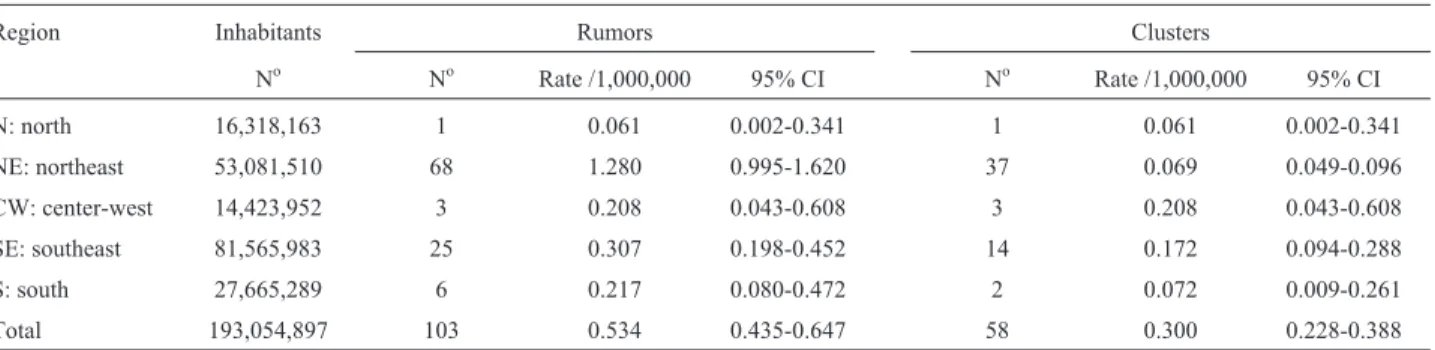
The reported 191 rumors represented 86 proven geo-graphic clusters, involving 58 autosomal recessive ders, 17 autosomal dominant disorders, 5 X-linked disor-ders, 3 multifactorial disordisor-ders, and 1 environmental disorder. The environmental disorder is thalidomide em-bryopathy, resulting from a drug used for the treatment of leprosy in endemic areas of Brazil (Viannaet al., 2013). Autosomal recessive disorders were the most prevalent ru-mors [0.534 per million inhabitants (CI: 0.435-0.647)] and clusters [0.300 per million inhabitants (CI: 0.228-0.388)] compared with the remaining etiologic groups: autosomal dominant, X-linked, multifactorial, environmental, and un-specified etiology (Table 2).
Likewise, the NE Region had a significant higher prevalence rate of rumors for autosomal recessive disorders per million inhabitants (1.280; CI: 0.995-1.620) than the other four regions. Nevertheless, this difference could not be substantiated for proven clusters (Table 3).
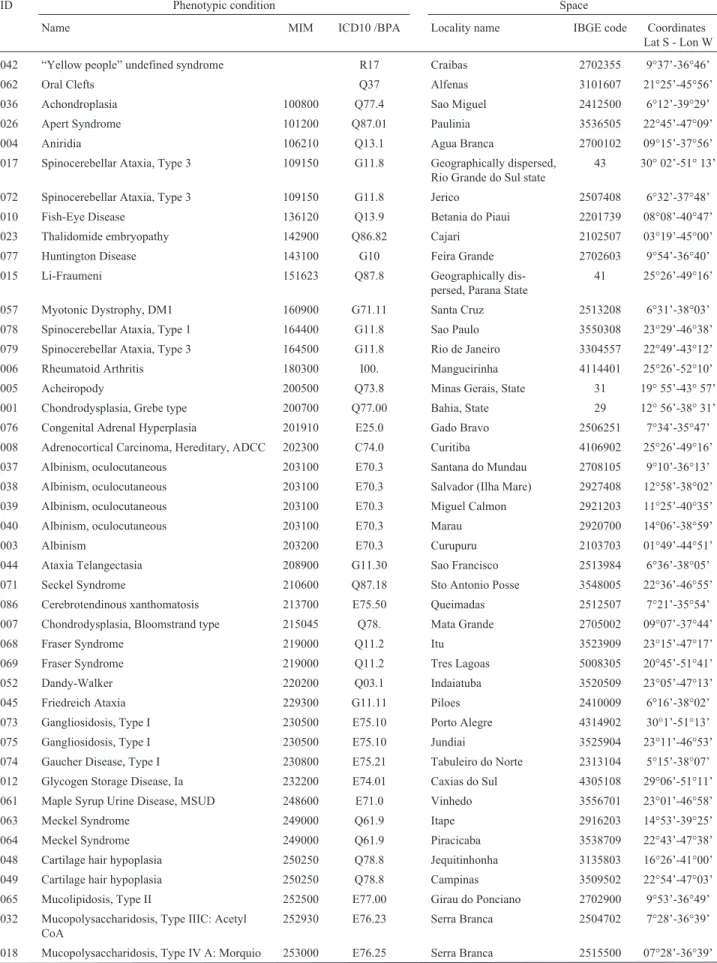
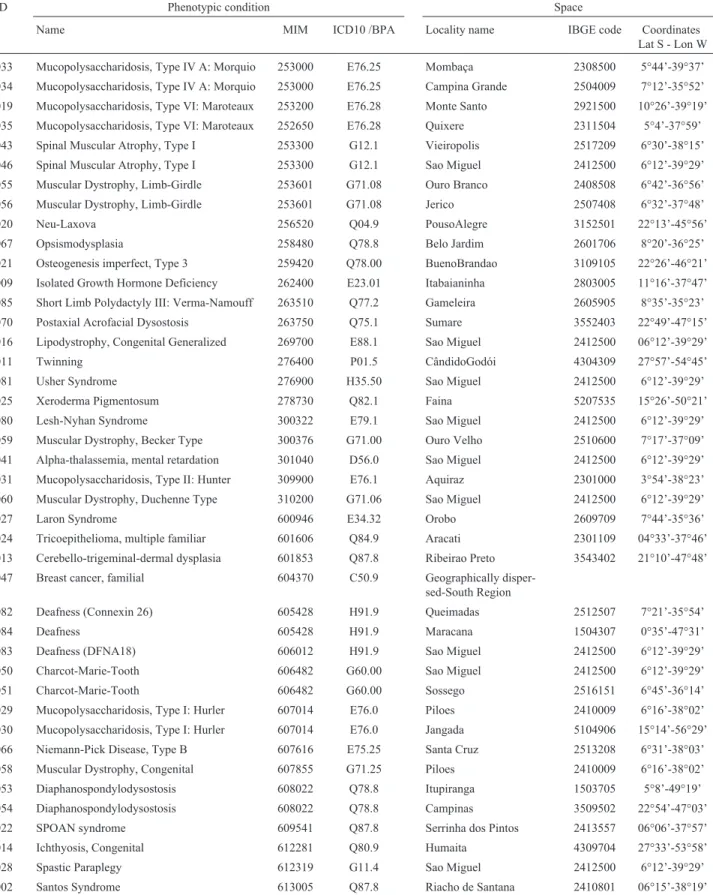
clustered in more than one geographic location, none of them contiguous (Table 4). Fifty one of the 70 identified diseases are autosomal recessive traits, 12 are autosomal dominant, 5 are X-linked recessive, and 2 are unknown.
The 13 disorders involved in more than one cluster are very rare conditions. All but one produce autosomal re-cessive phenotypes, with expected gene prevalence rates below one percent in the population at large. These condi-tions are (MIM codes in parenthesis): Spinocerebellar Ata-xia Type 3 (109150), Albinism, oculocutaneous (203100), Fraser Syndrome (219000), Gangliosidosis Type I (230500), Meckel Syndrome (249000), Cartilage hair
hypoplasia (250250), Mucopolysaccharidosis Type IV: Morquio (253000), Spinal Muscular Atrophy Type I (253300), Muscular Dystrophy, Limb-Girdle type (253601), Deafness, Connexin 26 type (605428), Charcot-Marie-Tooth (606482), Mucopolysaccharidosis Type I: Hurler (607014), and Diaphanospondylodysostosis (608022).
Discussion
To the authors’ best knowledge, a nationwide, sys-tematic register of genetic clusters, such as CENISO in Table 1- Regional distribution of 191 reported rumors and 86 clusters.
Region Inhabitants Rumours Clusters
No No Rate
/1,000,000
95% CI No Rate
/1,000,000
95% CI
N: north 16,318,163 7 0.429 0.172-0.884 2 0.123 0.015-0.443
NE: northeast 53,081,510 112 2.110 1.740-2.540 54 1.017 0.764-1.330
CW: center-west 14,423,952 3 0.208 0.043-0.608 3 0.208 0.043-0.608
SE: southeast 81,565,983 44 0.539 0.392-0.724 18 0.221 0.131-0.349
S: south 27,665,289 23 0.831 0.527-1.250 8 0.289 0.125-0.570
Geographically disperse 2 1
Total 193,054,897 191 0.989 0.854-1.140 86 0.445 0.356-0.550
Table 2- Etiologic grouping of 191 reported rumors and 86 clusters.
Etiology Rumors Clusters
No Rate /1,000,000 95% CI No Rate /1,000,000 95% CI
AR 103 0.534 0.435-0.647 58 0.300 0.228-0.388
AD 40 0.207 0.148-0.282 17 0.088 0.051-0.141
XL 9 0.047 0.021-0.088 5 0.026 0.001-0.060
MF 16 0.083 0.047-0.135 3 0.016 0.003-0.045
ENV 9 0.047 0.021-0.088 1 0.005 0.001-0.028
NS 14 0.073 0.039-0.122 2 0.010 0.001-0.037
Total 191 0.989 0.854-1.140 86 0.445 0.356-0.550
Prevalence rates over 193,054,897inhabitants.
Autosomal recessive: AR disorders, autosomal dominant: AD, x-linked: XL, multifactorial: MF, environmental: ENV, not-specified: NS.
Table 3- Regional distribution of 103 reported rumors and 58 clusters of autosomal recessive disorders.
Region Inhabitants Rumors Clusters
No No Rate /1,000,000 95% CI No Rate /1,000,000 95% CI
N: north 16,318,163 1 0.061 0.002-0.341 1 0.061 0.002-0.341
NE: northeast 53,081,510 68 1.280 0.995-1.620 37 0.069 0.049-0.096
CW: center-west 14,423,952 3 0.208 0.043-0.608 3 0.208 0.043-0.608
SE: southeast 81,565,983 25 0.307 0.198-0.452 14 0.172 0.094-0.288
S: south 27,665,289 6 0.217 0.080-0.472 2 0.072 0.009-0.261
Table 4- Description of 86 identified clusters, ordered by phenotypic condition and space.
ID Phenotypic condition Space
Name MIM ICD10 /BPA Locality name IBGE code Coordinates
Lat S - Lon W
042 “Yellow people” undefined syndrome R17 Craibas 2702355 9°37’-36°46’
062 Oral Clefts Q37 Alfenas 3101607 21°25’-45°56’
036 Achondroplasia 100800 Q77.4 Sao Miguel 2412500 6°12’-39°29’
026 Apert Syndrome 101200 Q87.01 Paulinia 3536505 22°45’-47°09’
004 Aniridia 106210 Q13.1 Agua Branca 2700102 09°15’-37°56’
017 Spinocerebellar Ataxia, Type 3 109150 G11.8 Geographically dispersed,
Rio Grande do Sul state
43 30° 02’-51° 13’
072 Spinocerebellar Ataxia, Type 3 109150 G11.8 Jerico 2507408 6°32’-37°48’
010 Fish-Eye Disease 136120 Q13.9 Betania do Piaui 2201739 08°08’-40°47’
023 Thalidomide embryopathy 142900 Q86.82 Cajarí 2102507 03°19’-45°00’
077 Huntington Disease 143100 G10 Feira Grande 2702603 9°54’-36°40’
015 Li-Fraumeni 151623 Q87.8 Geographically
dis-persed, Parana State
41 25°26’-49°16’
057 Myotonic Dystrophy, DM1 160900 G71.11 Santa Cruz 2513208 6°31’-38°03’
078 Spinocerebellar Ataxia, Type 1 164400 G11.8 Sao Paulo 3550308 23°29’-46°38’
079 Spinocerebellar Ataxia, Type 3 164500 G11.8 Rio de Janeiro 3304557 22°49’-43°12’
006 Rheumatoid Arthritis 180300 I00. Mangueirinha 4114401 25°26’-52°10’
005 Acheiropody 200500 Q73.8 Minas Gerais, State 31 19° 55’-43° 57’
001 Chondrodysplasia, Grebe type 200700 Q77.00 Bahia, State 29 12° 56’-38° 31’
076 Congenital Adrenal Hyperplasia 201910 E25.0 Gado Bravo 2506251 7°34’-35°47’
008 Adrenocortical Carcinoma, Hereditary, ADCC 202300 C74.0 Curitiba 4106902 25°26’-49°16’
037 Albinism, oculocutaneous 203100 E70.3 Santana do Mundau 2708105 9°10’-36°13’
038 Albinism, oculocutaneous 203100 E70.3 Salvador (Ilha Mare) 2927408 12°58’-38°02’
039 Albinism, oculocutaneous 203100 E70.3 Miguel Calmon 2921203 11°25’-40°35’
040 Albinism, oculocutaneous 203100 E70.3 Marau 2920700 14°06’-38°59’
003 Albinism 203200 E70.3 Curupuru 2103703 01°49’-44°51’
044 Ataxia Telangectasia 208900 G11.30 Sao Francisco 2513984 6°36’-38°05’
071 Seckel Syndrome 210600 Q87.18 Sto Antonio Posse 3548005 22°36’-46°55’
086 Cerebrotendinous xanthomatosis 213700 E75.50 Queimadas 2512507 7°21’-35°54’
007 Chondrodysplasia, Bloomstrand type 215045 Q78. Mata Grande 2705002 09°07’-37°44’
068 Fraser Syndrome 219000 Q11.2 Itu 3523909 23°15’-47°17’
069 Fraser Syndrome 219000 Q11.2 Tres Lagoas 5008305 20°45’-51°41’
052 Dandy-Walker 220200 Q03.1 Indaiatuba 3520509 23°05’-47°13’
045 Friedreich Ataxia 229300 G11.11 Piloes 2410009 6°16’-38°02’
073 Gangliosidosis, Type I 230500 E75.10 Porto Alegre 4314902 30°1’-51°13’
075 Gangliosidosis, Type I 230500 E75.10 Jundiai 3525904 23°11’-46°53’
074 Gaucher Disease, Type I 230800 E75.21 Tabuleiro do Norte 2313104 5°15’-38°07’
012 Glycogen Storage Disease, Ia 232200 E74.01 Caxias do Sul 4305108 29°06’-51°11’
061 Maple Syrup Urine Disease, MSUD 248600 E71.0 Vinhedo 3556701 23°01’-46°58’
063 Meckel Syndrome 249000 Q61.9 Itape 2916203 14°53’-39°25’
064 Meckel Syndrome 249000 Q61.9 Piracicaba 3538709 22°43’-47°38’
048 Cartilage hair hypoplasia 250250 Q78.8 Jequitinhonha 3135803 16°26’-41°00’
049 Cartilage hair hypoplasia 250250 Q78.8 Campinas 3509502 22°54’-47°03’
065 Mucolipidosis, Type II 252500 E77.00 Girau do Ponciano 2702900 9°53’-36°49’
032 Mucopolysaccharidosis, Type IIIC: Acetyl CoA
252930 E76.23 Serra Branca 2504702 7°28’-36°39’
ID Phenotypic condition Space
Name MIM ICD10 /BPA Locality name IBGE code Coordinates
Lat S - Lon W
033 Mucopolysaccharidosis, Type IV A: Morquio 253000 E76.25 Mombaça 2308500 5°44’-39°37’
034 Mucopolysaccharidosis, Type IV A: Morquio 253000 E76.25 Campina Grande 2504009 7°12’-35°52’
019 Mucopolysaccharidosis, Type VI: Maroteaux 253200 E76.28 Monte Santo 2921500 10°26’-39°19’
035 Mucopolysaccharidosis, Type VI: Maroteaux 252650 E76.28 Quixere 2311504 5°4’-37°59’
043 Spinal Muscular Atrophy, Type I 253300 G12.1 Vieiropolis 2517209 6°30’-38°15’
046 Spinal Muscular Atrophy, Type I 253300 G12.1 Sao Miguel 2412500 6°12’-39°29’
055 Muscular Dystrophy, Limb-Girdle 253601 G71.08 Ouro Branco 2408508 6°42’-36°56’
056 Muscular Dystrophy, Limb-Girdle 253601 G71.08 Jerico 2507408 6°32’-37°48’
020 Neu-Laxova 256520 Q04.9 PousoAlegre 3152501 22°13’-45°56’
067 Opsismodysplasia 258480 Q78.8 Belo Jardim 2601706 8°20’-36°25’
021 Osteogenesis imperfect, Type 3 259420 Q78.00 BuenoBrandao 3109105 22°26’-46°21’
009 Isolated Growth Hormone Deficiency 262400 E23.01 Itabaianinha 2803005 11°16’-37°47’
085 Short Limb Polydactyly III: Verma-Namouff 263510 Q77.2 Gameleira 2605905 8°35’-35°23’
070 Postaxial Acrofacial Dysostosis 263750 Q75.1 Sumare 3552403 22°49’-47°15’
016 Lipodystrophy, Congenital Generalized 269700 E88.1 Sao Miguel 2412500 06°12’-39°29’
011 Twinning 276400 P01.5 CândidoGodói 4304309 27°57’-54°45’
081 Usher Syndrome 276900 H35.50 Sao Miguel 2412500 6°12’-39°29’
025 Xeroderma Pigmentosum 278730 Q82.1 Faina 5207535 15°26’-50°21’
080 Lesh-Nyhan Syndrome 300322 E79.1 Sao Miguel 2412500 6°12’-39°29’
059 Muscular Dystrophy, Becker Type 300376 G71.00 Ouro Velho 2510600 7°17’-37°09’
041 Alpha-thalassemia, mental retardation 301040 D56.0 Sao Miguel 2412500 6°12’-39°29’
031 Mucopolysaccharidosis, Type II: Hunter 309900 E76.1 Aquiraz 2301000 3°54’-38°23’
060 Muscular Dystrophy, Duchenne Type 310200 G71.06 Sao Miguel 2412500 6°12’-39°29’
027 Laron Syndrome 600946 E34.32 Orobo 2609709 7°44’-35°36’
024 Tricoepithelioma, multiple familiar 601606 Q84.9 Aracati 2301109 04°33’-37°46’
013 Cerebello-trigeminal-dermal dysplasia 601853 Q87.8 Ribeirao Preto 3543402 21°10’-47°48’
047 Breast cancer, familial 604370 C50.9 Geographically
disper-sed-South Region
082 Deafness (Connexin 26) 605428 H91.9 Queimadas 2512507 7°21’-35°54’
084 Deafness 605428 H91.9 Maracana 1504307 0°35’-47°31’
083 Deafness (DFNA18) 606012 H91.9 Sao Miguel 2412500 6°12’-39°29’
050 Charcot-Marie-Tooth 606482 G60.00 Sao Miguel 2412500 6°12’-39°29’
051 Charcot-Marie-Tooth 606482 G60.00 Sossego 2516151 6°45’-36°14’
029 Mucopolysaccharidosis, Type I: Hurler 607014 E76.0 Piloes 2410009 6°16’-38°02’
030 Mucopolysaccharidosis, Type I: Hurler 607014 E76.0 Jangada 5104906 15°14’-56°29’
066 Niemann-Pick Disease, Type B 607616 E75.25 Santa Cruz 2513208 6°31’-38°03’
058 Muscular Dystrophy, Congenital 607855 G71.25 Piloes 2410009 6°16’-38°02’
053 Diaphanospondylodysostosis 608022 Q78.8 Itupiranga 1503705 5°8’-49°19’
054 Diaphanospondylodysostosis 608022 Q78.8 Campinas 3509502 22°54’-47°03’
022 SPOAN syndrome 609541 Q87.8 Serrinha dos Pintos 2413557 06°06’-37°57’
014 Ichthyosis, Congenital 612281 Q80.9 Humaita 4309704 27°33’-53°58’
028 Spastic Paraplegy 612319 G11.4 Sao Miguel 2412500 6°12’-39°29’
002 Santos Syndrome 613005 Q87.8 Riacho de Santana 2410801 06°15’-38°19’
ID: Cluster Identification code. MIM: Mendelian Inheritance in Man code. ICD10/BPA: ICD10 with British Paediatric Association fifth digit. IBGE code: Brazilian Institute of Geography and Statistics municipality code, in which the first two digits identify the State (http://www.ibge.gov.br/home/geociencias/areaterritorial/area.shtm).
Brazil, is an almost unique program, even considering some similar, albeit not equal, ongoing programs in other parts of the world, such as the aforementioned studies of Amish and Mennonites in the US and Canada (Strauss and Puffenberge, 2009; Rider et al., 2011), Arabs in Israel (Zlotogora et al., 2009), and isolates in Finland (de la Chapelle, 1993).
The purpose of CENISO is to base the building of a registry on sensitive and imprecise rumors, provided that validation by a cost-benefit efficient process is used. This system could be applied to other populations, not only for the registration and surveillance of endemic areas but also for outbreaks of diseases caused by environmental agents.
About half (86/191: 45.0%) of the CENISO-regis-tered rumors were confirmed as geographic clusters, while one third (57/191: 29.8%) has not yet reached validation phase-2 for Rumor definition, and therefore are not yet con-firmed. While low specificity is expected for this searching approach, based on extensive recording of unselected anec-dotes, this low validation rate could also reflect a passive response rate from the CENISO coordination during the re-ported period. Nevertheless, unlike time/space clusters of diseases, also known as epidemics (Williamset al., 2002), most genetic etiologic factors are rather stable over time, undergoing gradual variations through generations, mainly due to cultural changes in reproductive patterns within ge-netic population isolates. Existence of space clusters over such a long period reasonably explains their higher reliabil-ity when compared with time/space clusters (Williamset al., 2002).
More reported rumors were located in the Northeast-ern region than in the rest of Brazil, a finding which is most likely related to the reported higher prevalence of consan-guineous marriages in this region (Freire-Maia, 1958; Krie-geret al., 1965; Welleret al., 2012). With only approxi-mately 15 million inhabitants each, two of the five Brazilian geographic regions, North and Central-West are markedly less populated then the Northeast, with a popula-tion of 53 million. However, the low concentrapopula-tion of clus-ters in the remaining two regions cannot be explained by small population size, namely, the South with 28, and the Southeast with 82 million residents.
Because most genetically isolated sub-populations, for geographic or cultural reasons, are also inbred, the ob-served higher involvement of autosomal recessive pheno-types is expected. Nevertheless, autosomal dominant and X-linked, as well as oligo or polygenic traits, are also ob-served in the registered clusters in spite of not being di-rectly related to inbreeding. One possibly associated factor in these situations is the readiness to recognize familial ag-gregation in small, defined populations where acquaintance of relatives and knowledge of ancestors through several generations is more complete compared to families living in urban large cities. Another explanation is the low mobil-ity of isolated populations, so large pedigrees with
domi-nant or X-linked mutations are concentrated on small geo-graphic areas. The aniridia cluster in Alagoas is an example of this phenomenon (Fernandes-Limaet al., 2013). Fur-thermore, small isolates could have randomly selected spe-cific mutations during successive genetic drifts starting from a small number of founders and going through reduc-tions on the effective population size in periods of high mortality in the past, as reported for the Finnish population (de la Chapelle, 1993).
More recently, Moreauet al.(2011) have shown a se-lective advantage for people in the wave front of population range expansions in Quebec, Canada. This differential re-production in wave front migrating individuals can lead to substantial changes in gene frequency in the derived popu-lations. Considering the historical patterns of colonization and internal migrations in Brazil, we could expect that phe-nomena similar to those seen in Canada might have hap-pened here as well. The cancer clusters in southern Brazil (Achatzet al., 2009) could be an example of such a phe-nomenon, but further investigation is needed to test this hy-pothesis.
One drawback of this report is our ignorance of the completeness of ascertainment of clusters in Brazil. This will most likely come with time as the current register con-tinues operating, with the essential collaboration from the users, as stated for the Israeli National Genetic Database by Zlotogoraet al.(2009).
Expansion of this registry of rumors and clusters to the rest of South-America, first, and the whole of Latin America, later, is planned at CENISO after the Brazilian registry is consolidated. This extension to other countries will mainly, though not exclusively, use the ECLAMC hos-pital network, an INAGEMP program described elsewhere (Castilla and Orioli, 2004).
Acknowledgments
We thank Juan Gilli and Marcelo Zagonel de Oliveira for their participation in the geo-reference analysis of the reported data. To Gabriela and Vanessa Paixão-Cortes for their participation in organizing clusters and rumors spreadsheets. Financial support was provided by the fol-lowing agencies: INCT-INAGEMP; Ministry of Science and Technology/CNPq, (grants no. 476978/2008-4 and 306750/2009-0), a FIOCRUZ-FIOTEC fellowship to EEC, a CONICET, National Research Council of Argentina con-tract as researcher to EEC, a CNPq, research fellowship to LSF.
References
Castilla EE and Orioli IM (2004) ECLAMC: The Latin American collaborative study of congenital malformations. Commu-nity Genet 7:76-94.
de la Chapelle A (1993) Disease gene mapping in isolated human populations: The example of Finland. J Med Genet 30:857-865.
Fernandes-Lima ZS, Paixão-Côrtes VP, Andrade AKM, Fernan-des AS, Coronado BNL, Monte-Filho HP, Santos MJ, Omena-Filho RL, Biondi FC, Ruiz-Linares A,et al.(2013) Ocular and craniofacial phenotypes in a large Brazilian fam-ily with congenital aniridia. Clin Genet (Epub ahead of print).
Freire-Maia N (1958) Consanguineous marriages in Brazil. I -Structure of such marriages. II. Factors of geographic dis-tribution. Eugen Quart 5:105-114.
Freire-Maia A (1975) Genetics of acheiropodia (the handless and footless families of Brazil). Clin Genet 7:98-102.
Freire-Maia A (1981) Historical note: the extraordinary handless and footless families of Brazil - 50 years of acheiropodia. Am J Med Genet 9:31-41.
Freire-Maia N and Freire-Maia A (1961) The structure of consan-guineous marriages and its genetic implications. Ann Hum Genet 25:29-39.
Freire-Maia N, de Andrade FL, de Athayde-Neto A, Cavalli IJ, Oliveira JC, Marçallo FA and Coelho A (1978) Genetic in-vestigations in a Northern Brazilian island. II. Random drift. Hum Hered 28:401-410.
ICBDSR (2011) Annual Report, 2011 with Data for 2009. Centre of the International Clearinghouse for Birth Defects Surveil-lance and Research of ICBDSR, Rome, 302 pp.
Krieger H, Morton NE, Mi MP, Azevedo E, Freire-Maia A and Yasuda N (1965) Racial admixture in northeastern Brazil. Ann Hum Genet 29:113-125.
Moreau C, Bhérer C, Vézina C, Jomphe M, Labuda D and Excoffier L (2011) Deep human genealogies reveal a selec-tive advantage to be on an expanding wave front. Science 334: 1148-1150.
Morton NE (1964) Genetic studies of Northeastern Brazil. Cold Spring Harbor Symp Quant Biol 29:69-79.
Porta M (2008) A Dictionary of Epidemiology. 5th edition, Ox-ford University Press, New York, 320 pp.
Quelce-Salgado A (1964) A new type of dwarfism with various bone aplasias and hypoplasias of the extremities. Acta Genet Stat Med 14:63-66.
Rider NL, Strauss KA, Brown K, Finkenstedt A, Puffenberger EG, Hendrickson CL, Robinson DL, Muenke N, Tselepis C, Saunders L,et al.(2011) Erythrocyte pyruvate kinase defi-ciency in an old-order Amish cohort: longitudinal risk and disease management. Am J Hematol 86:827-834.
Strauss KA and Puffenberger EG (2009) Genetics, medicine, and the Plain people. Annu Rev Genomics Hum Genet 10:513-536.
Vianna FSL, Schüler-Faccini L, Leite JCL, de Sousa SHC, da Costa LMM, Dias MF, Morelo EF, Doriqui MJR, Maximino CM and Sanseverino MTV (2013) Recognition of the phe-notype of thalidomide embryopathy in countries endemic for leprosy: new cases and review of the main dysmor-phological findings. Clin Dysmorphol 22:59-63.
Weller M, Tanieri M, Pereira JC, Almeida Edos S, Kok F and Santos S (2012) Consanguineous unions and the burden of disability: a population-based study in communities of Northeastern Brazil. Am J Hum Biol 24:835-840.
Williams LJ, Honein MA and Rasmussen SA (2002) Methods for a public health response to birth defects clusters. Teratology 66:S50-S58.
Zlotogora J, van Baal S and Patrinos GP (2009) The Israeli Na-tional Genetic Database. Isr Med Assoc J 11:373-375.
Internet Resources
DATASUS, Brazilian Universal Health Service (2013) http://www2.datasus.gov.br/DATASUS/index.php?area = 0205&VObj=http://t
abnet.datasus.gov.br/cgi/deftohtm.exe?sinasc/cnv/nv (No-vember 12, 2013).
IBGE, Brazilian Institute of Geography and Statistics, http://www.ibge.gov.br/home/estatistica/populacao/registr ocivil/2011/default _xls.shtm (November 12, 2013).