FEATURES OF LOGISTIC SYSTEM ADAPTIVE MANAGEMENT
Natalya VOZNENKO*
Teodora ROMAN**
Abstract: The study presents literature survey on enterprise logistic system adaptive management place and structure in the general enterprise management system. The theoretical basics of logistic system functioning, levels of its management and its effectiveness had been investigated. The role of adaptive
management and its types had been scrutinized. The necessity of creating company’s adaptive regulator such
as its economic mechanism had been proved.
Key words: logistic system; levels of enterprise management; enterprise adaptive management; active adaptation; passive adaptation
JEL Classification: L290
Introduction
The changing global market enviroment, the increasing level of enterprises competiteveness
and high entry barriers to existing goods and services markets had made the necessary subsoil to use organizational and managerial set of tools as a mean of technique that can provide companies with additional advantage in goods productionto attract more customers and increase enterprise effectiveness. These global market tendencies brought the necessity to react quickly and produce speed high-quality managerial decisions. The company has not only to reply to the changes of business environement, but to provoke them as well. In this case the enterprise adaptive management
should be implemented. There is a lot of misunderstanding and mishandling in company’s
adaptability as a feature and enterprise adaptive managment as a conception.
The aim of this article is to investigate the place and structure of enterprise logistic system
adaptive management (ELSAM) in structure of company’sgeneral management. Due to this aim the
following tasks had been accomplished:
1.To analyze theoretical basics of enterprise logistic system management; 2.To define enterprise logistic system management structure;
3.To scrutinize enterprise logistic system adaptive management and state its role in general enterprise management structure.
1. Enterprise logistic system management. Theoretical basics
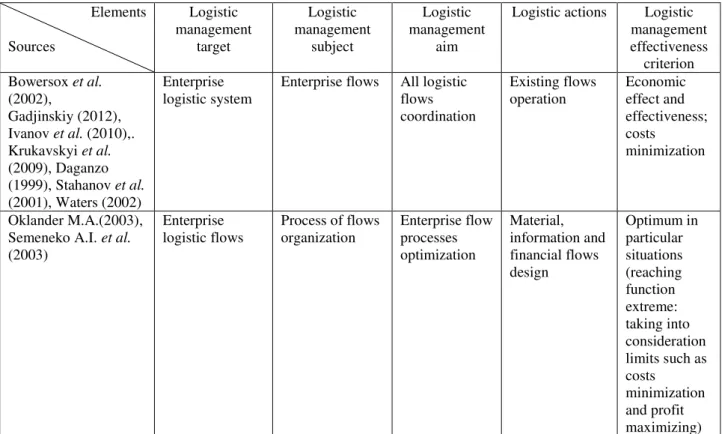
The question of enterprise logistic system management had brought an immense interest in the scientific society. The scrutiny had discovered two theoretical approaches that are presented in the table 1. According to the assumptions, the key element is the attitude towards company’s logistic
flow, whether it had been defined in advance and we can only coordinate and improve its characteristics or the managers have to design them first and afterwards create the other parts of organization. The main differences of these two conceptions can be defined in the target, subject, aim, actions and the key-criterion for company’slogistic management effectiveness evaluation.
Table 1 - Theoretical approaches to enterprise logistic system management
Elements Sources Logistic management target Logistic management subject Logistic management aim
Logistic actions Logistic management effectiveness
criterion Bowersox et al.
(2002),
Gadjinskiy (2012), Ivanov et al. (2010),. Krukavskyi et al. (2009), Daganzo (1999), Stahanov et al.
(2001), Waters (2002)
Enterprise logistic system
Enterprise flows All logistic flows coordination Existing flows operation Economic effect and effectiveness; costs minimization Oklander M.A.(2003), Semeneko A.I. et al.
(2003)
Enterprise logistic flows
Process of flows organization Enterprise flow processes optimization Material, information and financial flows design Optimum in particular situations (reaching function extreme: taking into consideration limits such as costs
minimization and profit maximizing) Source: authors combination by Bowersox et al. (2002), Gadjinskiy (2012), Ivanov et al. (2010),. Krukavskyi et al.
(2009), Daganzo (1999), Stahanov et al. (2001), Waters (2002), Oklander (2003), Semeneko A.I. et al. (2003)
Due to the first conception, its representatives (Bowersox et al., 2002; Ivanov and Sokolov, 2010; Gadjinskiy, 2012; Krukavskyi and Chornopuska, 2009; Stahanov and Ukraintsev, 2001; Waters, 2002) define absolute or comperative indicator as a criterion of logistic system (e.g. productivity of one worker or aimed results divided by costs to acheiving it) effestiveness when the managers operate only with existing flows and improve enterprise logistic system by coordinating
such as competitiveness, effectiveness, sustainability, responsiveness, cost-efficency, stability, quality and flexibility.
The representatives of the second paradigm (Oklander, 2003; Semeneko and Sergeev, 2003) state the necessity to design material, financial and information flows first, but their researches have only theoretical part without thoroughly practical recommendations. In this case the relative or
taxonomy indicators (e.g. aggregated indicator of one worker productivity or company’s productivity; logistic costs multiplied by function of optimization logistic flows) can be used to measure enterprise logistic system effectiveness in every particular situation and the prior aim of logistic system management is to construct its flows first.
According to this literature survey, the further investigation of logistic system of enterprise, the levels of its management and key-components andthe nature of mentioned processesare necessary to study.
2. Enterprise logistic system management structure
Generally company’s management can be categorized by levels of managerial decisions and
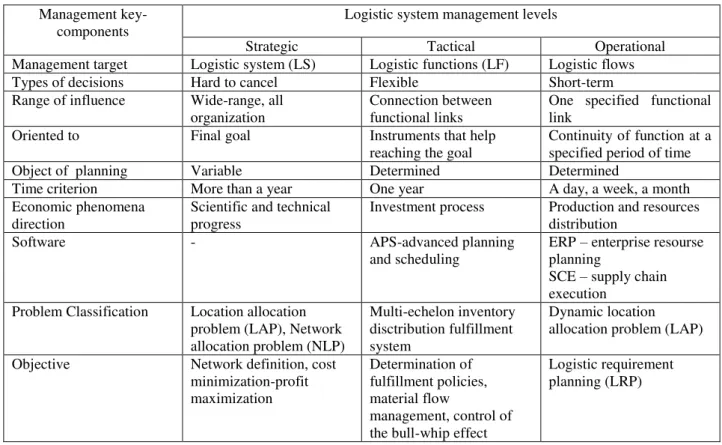
the areas of its influence within the enterprise. The assumption and classification made by authors are presented at the table 2.
Due to presented logistic system management structure, the levels and tasks of its maintaining can be defined by general logistic system for strategic level, its functions on tactical level and logistic flows at operational level. All mentioned above decisions can be separated by range of influence, problem classification, objectives, theirs orientation and limitations by time criterion.
Strategic level is stated by decisions on logistic system that are hard to cancel, had influence on
all organization, oriented on final goal of enterprise, can be changed due to market trends and the horizon of planning is generally more than one year. The effect of theirs implementation has usually great effort on scientific and technical progress. The typical tasks at this level are network definition solution, optimum balance between cost minimization and profit maximization.
The set of tools on the next tactical level has its objective to make flexible decisions and to create a connection between functional links of enterprise – logistic functions of each part of
company’s production stage. The object of planning is usually determined, limited by time criterion
Table 2 - Enterprise logistic system management levels and key-components
Management key-components
Logistic system management levels
Strategic Tactical Operational
Management target Logistic system (LS) Logistic functions (LF) Logistic flows Types of decisions Hard to cancel Flexible Short-term Range of influence Wide-range, all
organization
Connection between functional links
One specified functional link
Oriented to Final goal Instruments that help reaching the goal
Continuity of function at a specified period of time Object of planning Variable Determined Determined
Time criterion More than a year One year A day, a week, a month Economic phenomena
direction
Scientific and technical progress
Investment process Production and resources distribution
Software - APS-advanced planning
and scheduling
ERP – enterprise resourse planning
SCE – supply chain execution
Problem Classification Location allocation problem (LAP), Network allocation problem (NLP)
Multi-echelon inventory disctribution fulfillment system
Dynamic location allocation problem (LAP)
Objective Network definition, cost minimization-profit maximization
Determination of fulfillment policies, material flow
management, control of the bull-whip effect
Logistic requirement planning (LRP)
Sourse: combined by authors by Le rapport par le PIRAME (2009), Lambert Cooper et al. (1998), Christopher
(2005), Manzini and Gamberini (2008), SAID (2009)
Operational level of decisions is presented by logistic flows maintainance and short-term objectives. The task of this level usually faces production and resources problems determined by one specified functional link, which connected to logistic requirement planning.Each of described levels represent the decisions on logistic flows, functions and company’s logistic system in general.
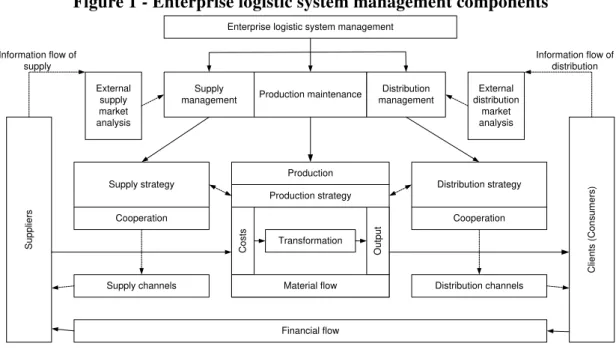
The general scheme of LS components (figure 1) from the point of view of production process and organizational functional structure of enterprise based upon "cost-output" production model, includes relations with external market (suppliers, customers), enterprise information flow and its analyse, supply, distribution management and production maintenance, financial flow that provides
the appropriate level of material flow due to cooperation strategy between supply and distribution
Figure 1 - Enterprise logistic system management components
Enterprise logistic system management
Su p p lie rs C lie n ts (C o n su me rs ) External supply market analysis External distribution market analysis Supply
management Production maintenance
Distribution management
Supply strategy
Cooperation
Supply channels Information flow of
supply
Information flow of distribution Production strategy C o st s Production O u tp u t Transformation Material flow Distribution strategy Cooperation Distribution channels Financial flow
Source: Mykhaylyk, 2005
According to the presented scheme the only cooperation strategies can be applied with existing supply and distribution channels. At the same moment to improve this description, the relations
between competitors have to be taken into consideration as well. Due to company’s life-cycle its
market positioning towards its competitors might be (Ansoff, 1988; Le rapport par le PIRAME, 2009) - cooperation, competition or coexistence.
3. Enterprise logistic system adaptive management
Generally, the enterprise adaptive management consists of active and passive adaptation that stands for provoking external market changes or answering for ones already existed.
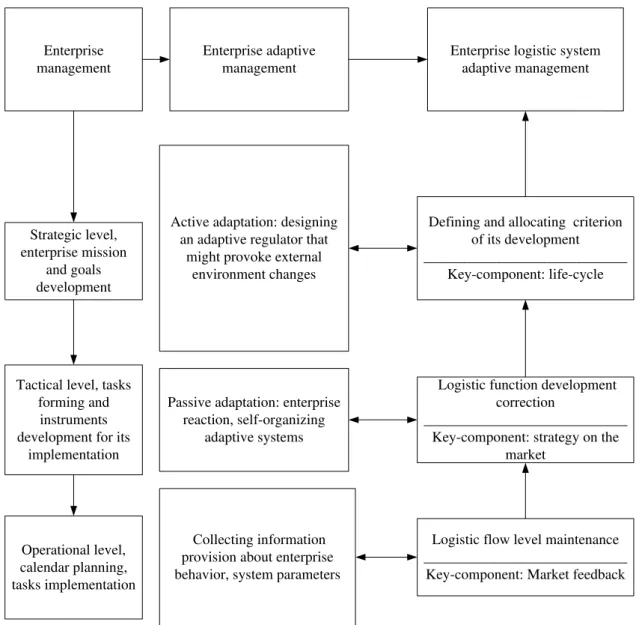
To describe place and role of enterprise logistic system adaptive management (ELSAM) authors suggest its conceptual model (figure 2).
Due to it, ELSAM is a part of enterprise adaptive management and it has three levels of decisions and activities to implement.
On strategic level active adaptation is presented by choosing and creating the criterion of LS
development. Due to company’s life-cycle this level is presented also by designing an adaptive
Figure 2 -Enterprise logistic system adaptive management in general enterprise management
Enterprise management
Enterprise adaptive management
Enterprise logistic system adaptive management
Strategic level, enterprise mission
and goals development
Tactical level, tasks forming and
instruments development for its
implementation
Operational level, calendar planning, tasks implementation
Passive adaptation: enterprise reaction, self-organizing
adaptive systems
Сollecting information provision about enterprise behavior, system parameters
Defining and allocating criterion of its development ____________________________
Key-component: life-cycle
Logistic function development correction
____________________________ Key-component: strategy on the
market
Logistic flow level maintenance ____________________________ Key-component: Market feedback Active adaptation: designing
an adaptive regulator that might provoke external
environment changes
Source: authors combinarion by Ansoff (1988), Voznenko (2009)
Tactical level as a medium term decisions implementation characterizes by passive adaptation:
choosing the appropriate strategy to react on competitors’ actions and on market tendencies. This
scope is described by LF evaluation and corrections of theirs development.
Conclusions
The suggested survey revealed the role and the place of enterprise logistic system adaptive
management in the general company’s management structure. It shows the necessity to design
adaptive regulator for its active adaptation to enviroment and create self-organizing adaptive system
upon collected information about company’s behavior. The best practice-used set of tools has to take
into consideration the pecularities of company’s life-cycle, the field of enterprise activities, relations
between suppliers and distributors and the state of its logistic flows. The future research is to make an enterprise economic mechanism that coordinates and controls enterprise logistic system internal
and external flows within all mentioned criteria.
References
Ansoff, I. (1988), The New Corporate Strategy, Revised Edition Hardcover, International Edition. Bowersox, D.J., Closs D.J. and Cooper, M. B. (2002), Supply Chain Logistics Management
McGraw-Hill.
Christopher, M. (2005), Logistics and supply chain management – Creating Value-Adding Networks,
Prentice Hall of Financial Times.
Christopher, M. and Rutherford, C. (2004), “Creating supply chain resilience throgh agile six sigma”,
Critical eye, June-August, pp. 24-28, available at: http://www.
valuenetworkmanagementforum.org/vnmf/images/past_events/competitive/publications/Creat ing_Supply_Chain_Resilience_Through_Agile_Six_Sigma.pdf
Daganzo, C.(1999), Logistics Systems Analysis. Springer Science & Business Media. Gadjinskiy, A.M. (2012), Logistika [Logistics], Dashkov and Co, Moskow
Ivanov, D. and Sokolov, B. (2010), Adaptive Supply Chain Management Springer-Verlag London. Krukavskyi, E.V. and Chornopuska, N.V. (2009), Logistuchni sustemu [Logistic systems] Publishing
house "Lvivskya Politehnika"- 264с.
Lambert, D.M., Cooper, M.C.and Pagh, J.D. (1998), "Supply chain management implementation issues and research opportunities", The international journal of logistics management, Vol.11, Issue 1, pp. 1-17.
Manzini, R. and Gamberini, R. (2008), "Design, Management and Control of Logistic Distribution Systems", available at http://cdn.intechopen.com/pdfs-wm/745.pdf (accessed 16 July 2015) Mykhaylyk, D.P. (2005), "Synthesis of logistic-oriented management mechanisms of
foreign-economic activity at metallurgical plant. Synopsis for the scientific degree of candidate of economic sciences by specialty 08.06.01 – Economics, organization and management of
enterprises", Donetsk national university of ministry of education and science of Ukraine, Donetsk.
Oklander, M.A. (2003), "Formation of the Logistic System’s in Enterprises.Synopsis of Dissertation
for Doctor’s degree in specialty 08.06.01 – Economics, Organization and Enterprise
Management", Odessa State Economics University, Odessa.
SAID S.-M. (2009), "Le système d’information :système nerveux des supply chains. De l’intégration à la modularisation", Les Annales des Mines Realites Industrielles, May - p. 49.
Semeneko, A.I. and Sergeev, V.I. (2003), Logistika: osnovu teorii [Logistics: the essences of theory], Soyz, St.Petersburg.
Stahanov, V.N. and Ukraintsev, V.B. (2001), Teoreticheskiye osnovu logistiki [Theoretical basics of logistics], Fenix.
Voznenko, N.I. (2009), "Ypravlinnya logistuchnou systemou pidrpuemstva [Enterprise logistic system management]", Ypravlinnya rozvutkom [Development management], Vol. 15, Publishing House HNEU, pp.75-76.