1503
EFFECT OF PHENOL ON GERMINATION CAPACITY AND POLYPHENOL OXIDASE, PEROXIDASE AND CATALASE ACTIVITIES IN LETTUCE
VOjIn TADIć, MArIjA PeTrIć, SnežAnA MIlOšeVIć, AlekSAnDAr CIngel, MArTIn rASPOr, DrAgICA SPASOjeVIć and jOVAn TADIć
1 Department for Plant Physiology, Institute for Biological Research “Siniša Stanković”, University of Belgrade, Bulevar
despota Stefana 142, 11000 Belgrade, Serbia
2 Institute for Multidisciplinary Research, University of Belgrade, kneza Višeslava 1, 11000 Belgrade, Serbia
3Department of Global Ecology, Carnegie Institution for Science, Stanford, CA 94305, USA
*Corresponding author: [email protected]
Abstract – In this study we examined the activities of polyphenol oxidase (PPO) and antioxidant enzymes, peroxidase (POX) and catalase (CAT) during lettuce seed germination at different concentrations of phenol. Out of eleven varieties of lettuce, four were chosen according to their germination tolerance to phenol as follows: plants exhibiting high (Lju-bljanska ledenka – LJL and Nansen – N) and low toleranace (Little Gem – LG and Majska kraljica – MK). A decrease
in germination eficiency after exposure to LD50 of phenol was determined for these four varieties. he efects of phenol treatment on POX, CAT and PPO activities were determined ater 4, 5, 6, 7 and 8 days of growth at LD50 concentrations. A trend of increased peroxidase activity was observed in seeds grown on LD50 of phenol compared to control seeds. A sig-niicant increase in CAT activity was observed at the beginning of treatment for Mk, lg and n in seeds grown on phenol as well as in control seeds. A trend of increased PPO activity was observed in all control seeds. We also investigated the
afinity of PPO for two different substrates that were used for the determination of enzyme activity. Our results show that ljl and n are the varieties most tolerant to growth on phenol. Here we report on the activities of their antioxidant enzymes and PPO during seed germination.
Key words: Lettuce seeds; phenol; antioxidant enzymes; polyphenol oxidase
InTrODUCTIOn
lettuce (Lactuca sativa l.) is an important leafy veg-etable that is primarily consumed fresh (liu et al., 2007). For example, in the USA, between 2001 and 2006, lettuce was cultivated on over 121 000 ha per year, which makes it the most important vegetable in the country (Contreras et al., 2008). here is little in-formation available on the efects of phenolic content in water on the the antioxidant capacity of diferent cultivars of lettuce.
Phenols are highly toxic compounds that have adverse efects on living organisms. Phenols bind to sulhydryl groups of vitally important enzymes and inhibit redox reactions in cells. Phenol vapors are dangerous at concentrations above 0.001 mg/dm3
and the maximum permissible concentrations of phenols range from 0.1 to 0.001 mg/dm3 (Davidenko
product of many technological processes and waste-water may contain diferent amounts of phenols. Methods that are currently used for the elimination of phenols from water have some disadvantages, such as high cost, incomplete puriication and low eiciency (Davidenko et al., 2004). he enzymatic destruction of phenols is typically an oxidative proc-ess with molecular oxygen serving as the oxidant for oxidases and hydrogen peroxide as the oxidant for peroxidases (Mayer 2006).
Polyphenol oxidase (PPO) is a copper protein that catalyzes two diferent reactions by using mo-lecular oxygen: the hydroxylation of monophenols to o-diphenols and the oxidation of the o-diphenols to o-quinones (Chazzara et al., 2001). In plants, PPO is located in the chloroplast thylakoid membranes and exists in an inactive or latent state (Mayer and Harel, 1979). his enzyme is widespread in nature and is in-teresting in the fruit and vegetable industry for being responsible for browning ater tissue injury (Chaz-arra et al., 1997). Beside PPO, peroxidases (POX) might be important factors in the browning process (Martin-Diana et al., 2005). In iceberg lettuce, one of the most important physiological processes is russet spotting in which phenolic compounds are accumu-lated and oxidized by PPO (ke and Saltveit, 1988). PPO can be released from their inactivated state by many agents including some substrates (golbeck and Cammarata, 1981). Plant PPOs are oten considered defense proteins for their herbivore-, pathogen- and wound-induced expression (Constabel et al., 1996). Previous studies have detected signiicant levels of antioxidant activity and phenolic components in lettuce (Caldwell, 2003; Chu et al., 2002). While the biochemical reactions catalyzed by PPOs are well known, data on the physiological function of these enzymes are rare (Tran et al., 2012).
Phenol diluted in water can be considered as a harmful stress factor during plant development. Fac-tors that have negative efects on the growth and development of plants, reducing their productivity levels, oten cause the release of large amounts of reactive oxygen species (rOS; Bowler et al., 1994). Oxidative stress has been studied in many plants, but
the mechanisms of its action are still not completely understood (Mittler 2002).
Plants have a very eicient enzymatic antioxidant system that catalyzes the removal of rOS (Inzé and Montagu, 1995). enzymes such as POX and catalase (CAT) are part of plant enzymatic antioxidative de-fense systems (Apel and Hirt, 2004). he amount of stress can be measured indirectly by measuring the activity of antioxidant enzymes that are part of the plant antioxidant defense system.
Peroxidases are heme-containing enzymes that oxidize a wide variety of organic and inorganic sub-strates by reducing hydrogen-peroxide and peroxides (kvaratskhelia et al.,1997). Most of plants secretory peroxidases are glycosylated proteins (Veitch 2004). hey play an important role in ligniication, cell-wall metabolism, plant resistance, elimination of hydrogen peroxide, healing of injuries and auxin metabolism (Hu et al., 2012). here are three groups of peroxi-dase, but the most common is group III, which is also called the plant peroxidase (Passardi et al., 2005).
CAT are metalloenzymes that remove hydrogen peroxide from plant cells(Mizuno et al., 1998). large amounts of hydrogen peroxide synthesized in photo-synthetic tissues can be removed by CAT, which rep-resents a irst line of cell defense from this harmful molecule(Mhamdi et al., 2010).
he aim of this work was to study the ability of lettuce peroxidase and polyphenol oxidase to elimi-nate phenol from water. In addition, we examined the resistance of 11 commercially valuable lettuce cultivars to diferent concentrations of phenol with the goal of determining the best cultivar and investi-gating its antioxidant capacity, as no previous studies have been conducted on the properties of antioxi-dant enzymes in lettuce growing on phenol.
MATerIAlS AnD MeTHODS
Plant material
Butterhead, Mascara, little gem (lg), ruby red, red ire)
were obtained from Trade Winds Fruit
(Santa Rosa, CA, USA),
ljubljanska ledenka (ljl) and nansen (n) from “Semenarna” (ljubljana, Slov-enia), Vera and Viola from “Institut za Povrtarstvo” (Smederevska Palanka, Serbia) and Majska kraljica (Mk) from “Agro Market” (Belgrade, Serbia).In order to investigate the inluence of phenol on the process of germination, seeds were treated with 50, 100, 150, 200, 250, 300, 350 and 400 mgl-1 phenol.
In all treatments, a population of 20 seeds was used. All seeds were grown in Petri dishes on ilter paper with phenol solution at 24±2°C and 16 h light/8 h dark photoperiod with irradiance of 40 µmol m-2 s-1.
lD50 concentrations of phenol were selected for each
lettuce variety as the concentrations in which 50% of seeds germinated. he percentage of germinated seeds was noted ater the end of the 8th day of
treat-ment. All measurements were repeated three times.
Seeds were collected ater 4, 5, 6, 7 and 8 days in order to study the efects of phenol treatment on the activities of antioxidant enzymes (POX and CAT) and PPO.
Enzyme extraction
lettuce seeds that germinated on lD50 phenol
con-centrations speciic for each variety, were used as a starting material for the analyses of antioxidant en-zyme activities.
Frozen (-70°C) seeds (1 g) were homogenized in 1 ml of 0.1 M potassium phosphate (k-P) extraction bufer (pH 7, containing 1.5% insoluble polyvinylpyr-rolidone (PVPP), 10 mM dithiothreitol (DTT) and 1 mM phenylmethylsulfonyl luoride (PMSF)). he ho-mogenate was centrifuged for 5 min at 12 000 g at 4°C. Quantiication of peroxidase (POX, eC 1.11.1.x) and catalase (CAT, eC 1.11.1.6.) was performed spectro-photometrically (Agilent 8453, life Science, USA).
Quantiication of POX activity
Activity of POX was determined according to
Furu-mo and Furutani (2008). he reaction mixture con-tained 2.7 ml of k-P bufer, 0.1 ml of 3% hydrogen peroxide and 0.15 ml of 4% guaiacol, pH 6.5. he inal concentration of hydrogen peroxide and guai-acol were 0.1 and 0.2%, respectively, in a total vol-ume of 3 ml. he assay mixture was incubated for 3 min at room temperature. Ater incubation, 50 µl of diluted extract was added and POX activity was monitored at 470 nm for 2 min at room temperature. enzyme activity is indicated as μmol min-1 mg-1 (U/g
fresh weight).
Quantiication of CAT activity
Catalase activity was determined spectrophoto-metrically according to Aebi (1984) by monitoring the kinetics of disappearance of hydrogen peroxide, which can be detected by measuring the decrease in absorbance at 240 nm of reaction mixture in 50 mM k-na-P bufer (pH 7), 20 mM hydrogen peroxide and enzyme extract. Catalase activity was measured at 20°C, every 20 s for 3 min. A unit of catalase activi-ty is deined as the amount of enzyme that degrades 1 µmol of hydrogen peroxide in 1 min and is expressed as μmol min-1 mg-1 (U/g fresh weight).
Quantiication of PPO activity Polyphenol oxidase (PPO, EC 1.10.3.1.) assay I
he reaction mixture contained 1.45 ml of 100 mM k-P bufer, pH 6.8, 0.5 ml of 100 mM 4-methylcate-chol (4-MC) prepared daily by dissolving 124.1 mg 4-MC in 10 ml of assay bufer. he inal 4-MC con-centration in 200 ml assay was 25 mM. he reaction mixture was incubated for 3 min at room tempera-ture. Diluted extract (50 µl) was added to the cu-vette containing the assay mixture. he reaction was monitored at 412 nm for 2 min at room temperature. enzyme activity is indicated as μmolmin-1mg-1 (U/g
fresh weight) and represents the quantity of enzyme required to produce 1 µmol of product per minute (Waite 1976).
Polyphenol oxidase assay II
as substrate for the spectrophotometric assay of PPO activity. Fity μl of extract was added to 2.95 ml of assay mix (5 mM l-DOPA in 50 mM MOPS bufer, pH 6.5) in a cuvette. Absorbance was measured at 475 nm, at which dopachrome has a molar absorp-tivity of 3 700 M-1 cm-1. he linear rate of increase in
absorbance for the irst 60-90 s of the reaction time was proportional to the amount of the enzyme (Beh-bahani at al. 1993).
Statistical analysis of data
he results of all experiments are presented as mean values ± standard errors. Statistical analysis was per-formed using Statgraics sotware version 4.2. Data were subjected to analysis of variance (AnOVA) and comparisons between the mean values of treatments were made by the least signiicant diference (lSD) test calculated at the conidence level of P ≤0.05. In all treatments, a population of 20 seeds was used. All measurements were repeated three times.
reSUlTS
Germination of lettuce seeds at diferent phenol concentrations
eleven varieties of lettuce were grown on 8 difer-ent concdifer-entrations of phenol (Table). Two varieties of lettuce (ljl and red Yugoslavian Butterhead) exhibited 100% germination on the two lowest con-centrations of phenol. Seeds of ljl germinated 100% at a concentration of 200 mg l-1. In addition, seeds
of this variety germinated up to a phenol concentra-tion of 350 mg l-1 on which no other variety could
germinate. herefore, it can be concluded that ljl is the most resistant cultivar during germination on phenol solution of all examined varieties. he low-est germination eiciency on all the concentrations of phenol except on 50 mg l-1, was recorded for the
variety Mk. In three varieties, Iceberg, ruby red and Vera, a total absence of germination occurred at 250 mg l-1 ater a relatively high percentage of
germina-tion at 200 mg l-1.
Two varieties (ljl and n) were selected for fur-ther analysis for their high germination eiciency on phenol, as well as two varieties (lg and Mk) with a strong decline in germination eiciency on the initial concentrations of phenol. For three of these four varieties (ljl, lg and n) lD50 concentrations
of phenol were chosen. All three lD50 concentrations
of phenol (Table 1) allowed for 50-51% germination. he lD50 concentration for the remaining variety
Mk was determined separately by growing seeds in a range of concentrations between 50 and 150 mg l-1,
and was estimated to equal 75 mg l-1.
Activity of antioxidant enzymes and polyphenol oxidase in lettuce seeds grown at diferent phenol
concentrations
Activity of peroxidase
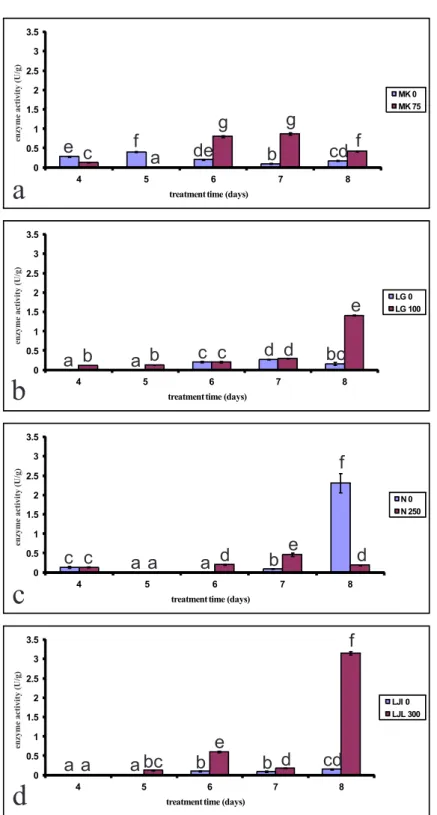
A trend of increased peroxidase activity was ob-served in seeds grown in the presence of lD50
con-centrations of phenol compared to control seeds (Figs. 1a-d). In the lettuce variety Mk, the activity of POX increased ater six days of growth (Fig. 1a). Figs. 1b and d show a sharp increase in peroxidase activity ater eight days of growth at lD50
concentra-tions of phenol.
Activity of catalase
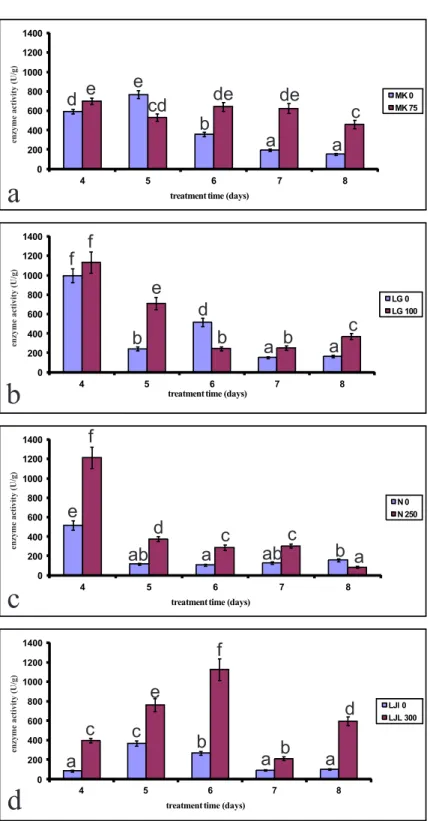
Activity of CAT was also increased in seeds grown in the presence of lD50 concentrations of phenol
com-pared to control seeds (Figs. 2a-d). A signiicant de-crease in activity of CAT was observed ater the ith day of treatment for varieties lg and n for both seeds grown on phenol and for the control seeds (Figs. 2 b and c). In ljl, which has the highest tolerance for phenol, catalase activity increased until the sixth day of growth in the presence of phenol, and displayed a signiicant drop aterwards (Fig. 2d).
Activity of polyphenol oxidase
0 0.5 1 1.5 2 2.5 3 3.5
4 5 6 7 8
treatment time (days)
MK 0 MK 75
e
f
de
b
cd
c
a
g
g
f
0 0.5 1 1.5 2 2.5 3 3.5
4 5 6 7 8
treatment time (days)
LG 0 LG 100
a
a
c
d
bc
b
b
c
d
e
0 0.5 1 1.5 2 2.5 3 3.5
4 5 6 7 8
treatment time (days)
N 0 N 250
a
a
c
b
f
c
a
d
e
d
0 0.5 1 1.5 2 2.5 3 3.5
4 5 6 7 8
treatment time (days)
LJl 0 LJL 300
a
a
a
bc
b
b
cd
e
d
f
a
b
c
d
Fig. 1. he efect of lD50 concentration of phenol on peroxidase activity of four varieties of lettuce seeds during ive days of germination. a) Mk; b) lg; c) n; d) ljl.
0
200 400 600 800 1000 1200 1400
4 5 6 7 8
treatment time (days)
MK 0 MK 75
d
e
b
a
a
e
cd
de
de
c
0 200 400 600 800 1000 1200 1400
4 5 6 7 8
treatment time (days)
LG 0 LG 100
f
b
d
a
a
f
e
b
b
c
0 200 400 600 800 1000 1200 1400
4 5 6 7 8
treatment time (days)
N 0 N 250
e
ab
a
ab
b
f
d
c
c
a
0 200 400 600 800 1000 1200 1400
4 5 6 7 8
treatment time (days)
LJl 0 LJL 300
a
c
b
a
a
c
e
f
b
d
a
b
c
d
Fig. 2. he efect of lD50 concentration of phenol on catalase activity of four varieties of lettuce seeds during ive days of germination. a) Mk; b) lg; c) n; d) ljl
0 20 40 60 80 100 120 140 160 180 200
4 5 6 7 8
treatment time (days)
MK 0 MK 75
e
f
d
e
c
a
cd
c
ab
b
0 20 40 60 80 100 120 140 160 180 200
4 5 6 7 8
treatment time (days)
LG 0 LG 100
b
e
d
c
b
a
bc
b
b
b
0 20 40 60 80 100 120 140 160 180 200
4 5 6 7 8
treatment time (days)
N 0 N 250
d
e
d
d
d
a
b
b
b
c
0 20 40 60 80 100 120 140 160 180 200
4 5 6 7 8
LJl 0 LJL 300
d
e
d
d
d
a
bc
c
a
b
treatment time (days)
a
b
c
d
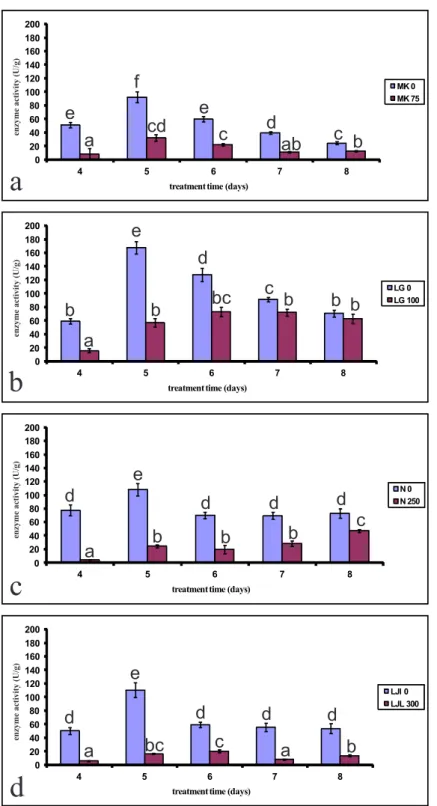
Fig. 3. he efect of lD50 concentration of phenol on polyphenol oxidase activity of four varieties of lettuce seeds during ive days of germination. a) Mk; b) lg; c) n; d) ljl
day from the beginning of germination in seeds that were not grown in the presence of phenol. Ater the ith day of germination, the activity of the enzyme decreased constantly for Mk and lg (Figs. 4a and b), while for n and ljl remained unchanged during the inal three days of growth (Figs. 4c and d). ljl, which shows the highest tolerance for phenol, has the low-est PPO activity when seeds germinate in the pres-ence of lD50 concentration of phenol (Fig. 4d).
Diferences in polyphenol oxidase activity related to the substrate
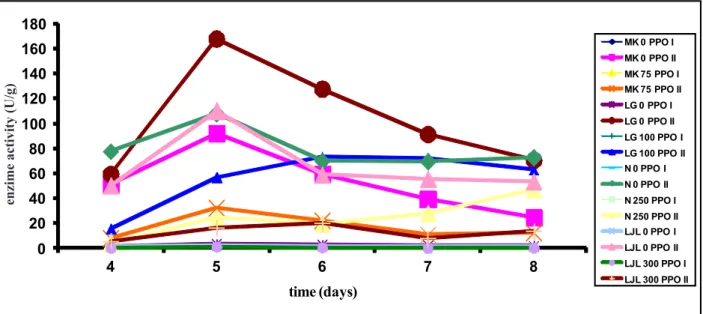
We used two substrates for the determination of PPO activity: 4-MC (enzyme assay I) and l-DOPA (enzyme assay II). 4-MC proved to be a much bet-ter substrate for the debet-termination of PPO activity, giving higher values for enzyme activity in all lettuce varieties (Fig. 5).
Morphological characteristics of lettuce seed during germination on phenol
As can be seen in Fig. 5, four varieties of lettuce seeds
that had germinated for eight days on the lowest con-centration of phenol (50 mg/l-1) are shown. ljl and
n, which have the highest tolerance for phenol, had green, well-developed leaves even eight days ater germination (Figs. 5a and b). Also, all of the germi-nated seeds are on the same level of development and have the same morphological characteristics.
Varieties lg and Mk are less resistant to phenol solution (Table 1), and, despite the less developed shoots, have light green and curled leaves (Figs. 5c and d).
DISCUSSIOn
enzymes that oxidize phenolic compounds are unique in plants and most other organisms. he literature on phenol oxidase has been reviewed by Mayer (Mayer, 2006), who suggests that the func-tion of most of these enzymes is yet to be studied. he same literature on POX is very scarce. Although phenol is primarily degraded by PPO, it can also be degraded by POX (hypapong et al., 1996). In all varieties of lettuce, POX activity increases if the
0 20
40 60 80 100 120 140 160 180
4 5 6 7 8
time (days)
MK 0 PPO I MK 0 PPO II MK 75 PPO I MK 75 PPO II LG 0 PPO I LG 0 PPO II LG 100 PPO I LG 100 PPO II N 0 PPO I N 0 PPO II N 250 PPO I N 250 PPO II LJL 0 PPO I LJL 0 PPO II LJL 300 PPO I LJL 300 PPO II
seeds grow on phenol, whereas the activity of PPO decreases at the same treatment. In sweet potato, the activities of both enzymes are increased in response to biotic and abiotic stresses (kwak et al., 1996). he relatively low value of peroxidase activity in all varie-ties of lettuce can be attributed to the inhibition of enzyme synthesis, activity or from relocalization to an environment such as the cell wall, which might be recalcitrant to bufer extraction (Bestwick et al., 1998). Hu et al., (2012) reported that peroxidases from lettuce have a wide-range optimum pH due to the presence of several isoenzymes that are not puri-ied or only partially puripuri-ied. he same authors re-port that maximum activity was at pH 5, which was
lower than in the standard procedure according to Furumo and Furutani (2008) that was used in our experiments. hey also indicate that POX enzymes difer in optimum pH and temperature even when they are from the same species.
environmental conditions as well as genotype may contribute to the antioxidant properties of let-tuce. Varieties that have a high content of anthocy-anins, which was not the case in our experiment, also have higher antioxidant capacity (liu et al., 2007).
low activity of PPO was also recorded in the leaves of silver birch seedlings, but increased with
evated temperatures (Tegelberg et al., 2008). elevated activity of PPO in all lettuce seeds that have not ger-minated on phenol can be attributed to the normally increased activity of this enzyme at the temperature of 24°C at which seeds were grown. Both PPO and POX have increased activities at room temperature, which decrease if the temperature increases or de-creases (Boo et al., 2011). It is also possible that the polyphenol oxidase is being released into the envi-ronment, whether by secretion or cell lysis, ending by degrading a broad spectrum of phenolic mol-ecules outside (Sinsabaugh 2010).
Wounding of poplar leaves by herbivores causes a strong induction of PPO activity (Constabel and ryan 1998), leading to covalent modiications of free amino and sulhydryl groups and thus reducing the nutritive value of proteins. he low PPO activity in lettuce seedlings that were grown on phenol could be attributed to the toxic efects of the phenol on meta-bolic processes and biosynthesis of PPO, or to the re-lease of PPO from the plant to the growth medium.
reduced activity of polyphenol oxidase may be also the result of diferent substrates used for deter-mination of the enzyme. Deterdeter-mination of phenolic compounds in plants may lead to the enormous dif-ferences in results related to diferent extraction pro-cedures (Dinçer et al., 2013). he same authors sug-gest that results may be afected by the geographical location of plants, ecological conditions and climate. Polyphenol oxidase with monophenolase activity, isolated from iceberg lettuce, showed inhibition by high substrate concentration (Chazarra et al., 1999), which may be related to our experiment where lD50
phenol concentration inhibited enzyme activity.
One obvious hypothesis about PPO is that the enzyme serves as a signal molecule (Bais et al., 2004) that alerts the plant to the presence of phenols. In that case, PPO would not require large amounts of substrate. To approximately igure out the role of the lettuce PPO, the activity of the enzyme should be de-termined in the roots and other parts of plants. It is estimated that enzymes could have a role in signal transduction if localized in root tips.
Polyphenol oxidase activity was determined in the whole plant (upper part + the root), so we cannot say exactly which part of the plant is responsible for the production of this enzyme. Holzapfel et al. (2010) believe that a large part of the production of the PPO comes from the plant roots as well as from seed-lings of Bromus spp. he same authors suggest that l-DOPA is not likely to be the naturally occurring substrate for the root enzyme, but they also noticed that catechol showed very weak results. his result does not correspond with our results, nor with those of gawlik-Dziki et al. (2008) ,who reported that PPO had the greatest activity detected with catechol, fol-lowed by 4-MC.
root elongation in lettuce showed signs of sup-pression two days ater exposure to 0.1 mM l-DOPA, which indicates that lettuce roots have very low PPO activity (Hachinohe et al., 2004). In any case, an en-zyme that functions to defend the plant against toxic compounds in soil would be expected to have broad substrate speciicity.
an elevated concentration of naCl at the start of the treatment (Mahmoudi et al., 2012). he origin of the rOS, especially hydrogen peroxide, produced during defense reactions in lettuce is intriguing. he largely apoplastic location suggests that either the plasma membrane or the cell wall is the primary site of the superoxide/H2O2 generator (lamb and
Dixon 1997).
We conclude that antioxidative enzyme activi-ties can play a protective role against stress caused by phenol and these enzymes were efective in pro-viding resistance to damage from the harmful inlu-ence of phenol at the stages of seed germination and growth of seedlings. he increase in the activity of antioxidant enzymes may be due to the higher levels of rOS produced under the stress. Further experi-ments should clarify whether PPO is released from the plant to the phenol solution. In that case, the most resistant varieties from our study can be used for cleaning water from phenol.
Acknowledgments - his work was supported by the Serbian Ministry of education, Science and Technological Develop-ment (Project no. On173017)
reFerenCeS
Aebi, H. (1984). Catalase in vitro. Methods Enzymol.105: 121-126.
Apel, K. and Hirt, H. (2004). reactive oxygen species: Metabo-lism, Oxidative Stress and Signal Transduction. Annu. Rev. Plant Biol. 55, 373-399.
Bais, H.P., Vepachedu, R., Gilroy, S., Callaray, R.M.. and Vivanco, J.M. (2005). Allelopathy and exotic plant invasion: From molecules and genes to species interaction. Science. 301: 1377-1380.
Behbahani, I., Miller, S.A. and O’Keefe, D.H. (1993). A com-parison of mushroom tyrosinase dopaquinone and dop-achrome assays using diode-array spectrophotometry: dopachrome formation vs ascorbate - linked dopaquinone reduction. Microchem. J. 47: 251-260.
Bestwick, C.S., Brown, I.R. and Mansield, J.W. (1998). localized changes in peroxidase activity accompany hydrogen per-oxide generation during the development of nonhost hy-persensitive reaction in lettuce. Plant Physiol. 118: 1067-1087.
Boo, H.O., Heo, B.G., Gorinstein, S. and Chon, S.U. (2011). Posi-tive efects of temperature and growth conditions on en-zymatic and antioxidant status in lettuce plants. Plant Sci. 18: 479-484.
Bowler, C., Van Camp, W., Van Montagu, M. and Inzé, D. (1994). Superoxide dismutases in plants. Crit. Rev. Plant Sci. 13: 199-218.
Bradford, M.M. (1976). A rapid and sensitive method for the quantitation pf microgram quantities of protein utilizing the principle of protein binding. Anal. Biochem. 72: 248-254.
Caldwell, C.R. (2003). Alkylperoxyl radical scavenging activity of red leaf lettuce (Lactuca sativa l.) phenolics. J. Agr. Food. Chem. 51: 4589-4595.
Chazarra, S., Cabanes, J., Escribano, J. and Garcia-Carmona, F. (1997). kinetic study of the suicide inactivation of latent polyphenoloxidase from iceberg lettuce (Lactuca sativa) induced by 4-tert-butylcatehol in the presence of SDS. Biochemica et Biophysica Acta 1339: 297-303. J. Agr. Food Chem. 47: 1422-1426.
Chazarra, S., Garrcia-Carmona, F. and Cabanes, J. (1999). Char-acterization of monophenolase activity of polyphenol oxidase from iceberg lettuce. J. Agr. Food Chem. 47: 1422-1426.
Chazzara, S., Garcia-Carmona, F. and Cabanes, J. (2001). evi-dence for a tetrameric form of iceberg lettuce (Lactuca sativa l.) polyphenol oxidase: Puriication and character-ization. J. Agr. Food Chem. 49: 4870-4875.
Chu, Y.F., Sun, J., Wu, X. and Liu, R.H. (2002). Antioxidant and antiproliferative activities of common vegetables. J. Agr. Food Chem. 50: 6910-6916.
Constable, C.P., Bergey, D.R. and Ryan, C.A. (1996). Polyphenol oxidase as a component of the inducible defense response in tomato against herbivores, In: Phytochemical Diver-sity and redundancy in ecological Interactions (eds. j.T. romeo, j.A. Sanders, P. Barbosa) 231-252. Plenum Press, new York.
Constable, C.P. and Ryan, C.A. (1998). A survey of wound-and methyl jasmonate-induced leaf polyphenol oxidase in crop plant. Phytochemistry .47: 507-511.
Contreras, S., Rabara, R., Bennett, M.A., Tay, D. and McDonald, M. (2008). Acquisition of germination capacity, photosen-sitivity, and desiccation tolerance in lettuce seeds. Seed Sci. Technol. 36: 667-678.
Davidenko, T.I., Oseychuk, O.V., Sevastyanov, O.V. and Ro-manovskaya, I. (2004). Peroxidase oxidation of phenols. Appl. Biochem. Micro. 6: 542-546.
Pheno-lic composition and antioxidant activity of Salia tomentosa Miller: efect of cultivation, harvesting year and storage. Turk J. Agric. For. 37: 561-567.
Furumo, N.C. and Furutani, S. (2008). A simple method for as-saying total protein, polyphenol oxidase and peroxidase activity from ‘kaimana’ litchi chinensis Sonn. J. Hawaiian Paciic Agr. 15: 1-7.
Gawlik-Dziki, U., Zlotek, U. and Swieca, M. (2008). Character-ization of polyphenol oxidase from butter lettuce (lactuca sativa var. capitata l.). Food Chem. 107: 129-135.
Golbeck, J.H. and Cammarata, K.V. (1981). Spinach thylakoid polyphenol oxidase. Plant Physiol. 67: 977-984.
Hachinohe, M., Sunohara, Y. and Matsumoto, H. (2004). Absorp-tion, translocation and metabolism of l-DOPA in barn-yardgrass and lettuce: their involvement in species-selec-tive phytotoxic action. Plant Growth Regul. 43: 237-243.
Holzapfel, C., Shahrokh, P. and Kakewitz, D. (2010) Polyphenol oxidase activity in the roots of seedlings of Bromus (Poace-ae) and other grass genera. Am. J. Bot. 97: 1195-1199
Hu, Y., Wu, J., Luo, P. and Mo, Y. (2012). Puriication and par-tial characterization of peroxidase from lettuce stems. Afr. Biotechnol. 11: 2752-2756.
Inzé, D. and Montagu, M. (1995). Oxidative stress in plants. Curr. Opin. Biotech. 6: 153-158.
Ke, D. and Saltveit, M.E. (1988). Plant hormone interaction and phenolic metabolism in the regulation of russet spotting in iceberg lettuce. Plant Physiol. 88: 1136-1140.
Kvaratskhelia, M., Winkel, C. and horneley, R.N. (1997). Purii-cation and characterization of peroxidase of a novel class III peroxidase isoenzyme from tea leaves. Plant Physiol. 114: 1237-1245.
Kwak, S.S., Kim, S.K., Park, I.H. and Liu, J.R. (1996). enhance-ment of peroxidase activity by stressed-related chemicals in sweet potato. Phytochemistry 43: 565-568.
Lamb, C. and Dixon, R. (1997). he oxidative burst in plant dis-ease resistance. Annu. Rev. Plant Physiol. Mol. Biol. 48: 251-275.
Liu, X., Ardo, S., Bunning, M., Parry, J., Zhou, K., Stushnof, C., Stoniker, F., Yu, L. and Kendall, P. (2007). Total phenolic content and DPPH· radical scavenging activity of lettuce (Lactuca sativa l.) grown in Colorado. LWT 40: 552-557.
Mahmoudi, H., Nasri, M.B., Huang, J., Tarchoun, I., Nasri, N., Rym, K., Gruber, M., Lachaâl, M., Hannoufa, A. and Ouerghi, Z. (2012). Diferential response to elevated naCl by antioxidant enzymes and gene transcripts in two con-trasting lettuce genotypes. Aust. J. Crop Sci. 6: 632-640.
Martin-Diana, A.B., Rico, D. and Barry-Ryan, C. (2005). efect of heat shock on browning-related enzymes in minimally processed iceberg lettuce and crude extracts. Biosci. Bio-tech. Bioch. 69: 1677-1685.
Mayer, A.M. and Harel, E. (1979). Polyphenol oxidase in plants: A review. Phytochemistry 18: 193-215.
Mayer, A.M. (2006). Polyphenol oxidases in plants and fungi: going places? A review. Phytochemistry 67: 2318-2331.
Mhamdi, A., Queval, G., Chaouch, S., Vanderauwera, S., Van Breusegem, F. and Noctor, G. (2010). Catalase function in plants: a focus on Arabidopsis mutants as stress-mimic models. J. Exp. Bot. 61: 4197-4220.
Mittler, R. (2002). Oxidative stress, antioxidants and stress toler-ance. Trends Plant Sci. 4: 405-410.
Mizuno, M., Kamei, M. and Tsuchida, H. (1998). Ascorbate per-oxidase and catalase cooperate for protection against hy-drogen peroxide generated in potato tubers during low-temperature storage. Biochem Mol. Biol. Int. 44, 717-726.
Passardi, F., Cosio, C., Penel, C. and Dunand, C. (2005). Peroxi-dases have more function than a Swiss army knife. Plant Cell Rep. 24: 255-65.
Sinsabaugh, R.L. (2010). Phenol oxidase, peroxidase and organic matter dynamics of soil. Soil Biol. Biochem. 42: 391-404.
Tegelberg, T., Julkunen-Tiito, R., Vartiainen, M., Paunonen, R., Rousi, M. and Kellomaki, S. (2008). exposure to elevated CO2, elevated tempertures and encheced UV-B radiation modify activities of polyphenol oxidese and guiacol per-oxidase and concentration of chlorophylls, polyamines and soluble proteins in the leaves of Betula pendula seed-lings. Environ. Exp. Bot. 62: 308-315.
hypyapong, P., Hunt, M.D. and Stefens, J.C. (1996). Systemic wound induction of potato (Solanum tuberosum) poly-phenol oxidase. Phytochemistry 43: 673-676.
Tran, L.T., Taylor, J.S. and Constabel, P. (2012). he polyphenol oxidase gene family in land plants: lineage-speciic dupli-cation and expansion. BMC Genomics 13: 395-406.
Vamos-Vigyazo, L. (1981). Polyphenol oxidase and peroxidase in fruits and vegetables. CRC Crit. Rev. Food Sci. Nutr.15: 49-126.
Veitch, N.C. (2004). Structural determinants of plant peroxidase function. Phytoch. Rew. 3: 3-18.