Effects of Improving Physical Activity Level on Quality of Life and
Functional Status of Patients Receiving Peritoneal Dialysis
Periton Diyaliz Hastalar
ı
nda Fiziksel Aktivite Düzeyindeki Art
ı
ş
ı
n
Ya
ş
am Kalitesi ve Fonksiyonel Duruma Etkileri
Deran OSKAY1
Nevin ATALAY GÜZEL1
Elif ÇAMCI1 Salih İNAL2 Nevin ŞANLIER3
Yasemin ERTEN2
Zeynep TUNA1
1 Gazi University Faculty of Health Sciences, Physiotherapy and Rehabilitation Department, Ankara, Turkey
2 Gazi University Faculty of Medicine, Department of Internal Medicine, Nephrology Department, Ankara, Turkey
3 Gazi University Faculty of Health Sciences, Nutrition and Dietetics Department, Ankara, Turkey
Correspondence Address:
Deran OSKAY
Gazi Üniversitesi Sağlık Bilimleri Fakültesi, Fizyoterapi ve Rehabilitasyon Bölümü, Ankara, Turkey
Phone : + 90 312 216 26 31 E-mail : [email protected] Received : 15.07.2013
Accepted : 27.10.2013
ABSTRACT
OBJECTIVE: The aim of this study was to determine whether patients receiving peritoneal dialysis (PD) experience an improvement in physical activity, quality of life and functional status as a result of exercise training at home by motivation about benefi ts of exercising.
MATERIAL and METHODS: Twenty-one PD patients of 46.7±14.1 years participated in the study. Participants were encouraged by a physiotherapist to walk for 30 minutes, 3 days a week and motivated by explaining benefi ts of exercising. We assessed quality of life by Kidney Disease Quality of Life Questionnaire-Turkish Version (KDQOL-SF), functional status by Six Minute Walk Test (SMW), physical activity level by International Physical Activity Questionnaire – Long Form (IPAQ-LF). The antropometric measurements were performed with the bioelectrical impedance. Assessments were done at the beginning and 3 months later.
RESULTS: Total physical activity score of IPAQ-LF increased signifi cantly 3 months later (p<0.05). There were no signifi cant differences in walking, moderate-intensity, vigorous intensity and sitting subscores of IPAQ-LF, SMW distance and anthropometric measurements (p>0.05). Improvements in pain and emotional score of KDQOL-SF were statistically signifi cant (p<0.05).
CONCLUSION: Regular exercise should be allocated in the PD standard care. Participation of the patient into such a program could be possible by explaining the benefi ts of exercising at the beginning of the treatment.
KEY WORDS: Peritoneal dialysis, Physical activity, Quality of life, Functional status
ÖZ
AMAÇ: Bu çalışmanın amacı, periton diyaliz hastalarının, egzersizin yararlarıyla ilgili motive edilip evde egzersiz yapmalarının fi ziksel aktivite düzeylerini, yaşam kalitesi ve fonksiyonel durumlarını
geliştirip geliştirmediğini belirlemektir.
GEREÇ ve YÖNTEMLER: Çalışmaya yaş ortalaması 46.7±14.1 olan 21 periton diyaliz hastası
katılmıştır. Katılımcılar bir fi zyoterapist tarafından haftanın 3 günü 30 dakika yürüyüş için cesaretlendirilmiş ve onlara egzersizin yararları açıklanmıştır. Yaşam kalitesi Kidney Disease Quality of Life Questionnaire-Türkçe versiyon (KDQOL-SF) ile, fonksiyonel durumları 6 Dakika Yürüme Testi (SMW) ile, fi ziksel aktivite düzeyleri International Physical Activity Questionnaire – Long Form (IPAQ-LF) Türkçe versiyon ile değerlendirilmiştir. Antropometrik ölçümler biyoelektriksel empedans ile yapılmıştır. Tüm değerlendirmeler başlangıçta ve 3 ay sonra tekrarlanmıştır.
BULGULAR: IPAQ-LF total fi ziksel aktivite puanı 3 ay sonunda anlamlışekilde artmıştır (p<0.05). IPAQ-LF yürüme, orta şiddet, yüksek şiddet ve oturma alt puanlarında, SMW mesafesinde ve antropometrik ölçümlerde belirgin fark bulunmamıştır (p>0.05). KDQOL-SF’nin ağrı ve emosyonel puanlarındaki gelişmeler istatistiksel olarak anlamlıdır (p<0.05).
SONUÇ: Düzenli egzersiz, periton diyaliz standart tedavisinde yer almalıdır. Hastanın böyle bir programa katılımı, tedavi başlangıcında egzersizin yararlarının açıklanmasıyla mümkün olabilir.
INTRODUCTION
Chronic renal failure (CRF) patients present not only progressive and irreversible loss of renal function but also a complex syndrome with various effect on musculoskeletal, respiratory, cardiovascular, nervous, immune, endocrine and metabolic systems (1). It has been well recognized that most CRF patients are in poor general health and physical activity and shows signs of malnutrition. A decline in physical activity begins in early stages of the disease and progress is mainly due to the loss of strength caused by renal anemia and skeletal muscle dysfunction (2). Inactivity is a common cause of muscle atrophy and could be contributing factor to the muscle abnormalities and reduce functional status of the dialysis population. In addition to musculoskeletal system, respiratory system being specifi cally the most impaired system according to the some authors (3, 4, 5, 6).
Dialysis patients typically tend to lead a sedentary life. Studies on physical activity levels of people with CRF have extensively examined both hemodialysis (HD) and peritoneal dialysis (PD) patients. These studies showed that, in comparison with healthy subjects, the level of physical activity in HD and PD patients have decreased. The literature on HD studies also conclude that inter and intra dialitic exercises increase the effectiveness of the treatment. Although there remains a need for studies that specifi cally assess the balance of risks and benefi ts of exercise training, there have been no reports of injury as a result of participation in physical activity programs. Whenever possible, it is recommended that dialysis units develop an in-center physical activity program (7). Availability of a center means that patient do not have to plan extra time for physical activity. Exercise training during dialysis reduces the deconditioning effects of forced inactivity during HD session (8).
However, it is not the case for PD patients who perform treatment by themselves at home. Control of physical activity performance in PD patients is not easy as HD patients treated in dialysis centers. These patients usually carry on their physical activity trainings by themselves without any professional support. Not being sure how to perform the exercises by a dialysis patient can make the patient hesitate about the contributions of the exercises. Kontos and colleagues report that talking about physiological and psychological benefi ts of exercise increases the motivation of HD patient to perform physical activity (9). In the literature, there is no study about long-term clinical results of peritoneal dialysis patients motivated by professional recommendations about exercising.
The primary aim of this investigation was to determine whether CRF patients who are receiving PD treatment experience an improvement in physical activity, health related quality of life and functional status as a result of exercise training at home by motivation about benefi ts of exercising in long-term follow-up.
MATERIAL and METHODS
Material
Patients with CRF receiving peritoneal dialysis (PD) were recruited from Gazi University Faculty of Medicine, Department of Internal Medicine, Division of Nephrology. Patients had to be on PD for a minimum of 6 months, over the age of 18, and willing to sign an informed consent form approved by Gazi University Research Ethics Committee prior to their inclusion in the study. Subjects with signifi cant cardiovascular, neurologic, and/or orthopedic complications, as determined by the attending nephrologists, were excluded from the study.
Twenty-one PD patients with mean age 46.7±14.1 years (minimum 21 years, maximum 70 years) were taken to the study. Fourteen (66.6%) of patients were male and seven (33.3%) of them were female.
Subjects were encouraged by physiotherapist in terms of daily physical activity. Also, patient education about disease, health and positive effects of exercise as well as diet recommendations were made in outpatient clinic.
We suggested 30 minutes walk for 3 days a week to patients to improve their physical activity levels. The greatest problem was the patients’ resistance to exercise at home. Basic information about the benefi ts of improving physical activity level was the crucial part of our recommendations. We motivated them by explaining that exercises have the potential to reduce cardiovascular mortality, the leading cause of death among CRF patients.
Dieticians determined each participant’s food intake with 24-hour records. They estimated the volume and portion size picture booklet, which included 120 photographs of food, each with 3-5 different portion sizes. Nutrition education is considered to be an important tool in providing knowledge about the contents of a healthy diet and encouraging behavior change. Therefore, dietitians gave an education to patients how to improve their nutritional status.
All subjects underwent an assessment at the beginning and after a period of 3 months.
Outcome Measures
Demographic characteristics (age and gender) were recorded.
Anthropometric Measurements
8 generics (physical function, role limitations due to social problems, bodily pain, general health, social function, role limitations due to physical problems, energy and fatigue, mental health) and 12 disease-specifi c subscales (effects of kidney disease, symptom list, work status, burden of kidney disease, cognitive function, sexual function, quality of life social interaction, sleep, social support, dialysis staff encouragement, overall health, patient satisfaction). Each subscale is scored out of 100, with higher score indicating greater perceived health (16).
Statistical Analysis
Individual changes in all parameters were analyzed by comparing values at baseline with 3 months later using Wilcoxon test by using SPSS version 15. Correlation between the changing amount of physical activity level and functional capacity, antrhopometrics and quality of life were analyzed by Spearman correlation coeffi cient test. Physical activity level, functional capacity, quality of life and anthropometric data are presented as median and interquartile range (IQR). Descriptive statistics were calculated and reported as mean and standard deviation. A signifi cance level was setting p value of 0.05.
RESULTS
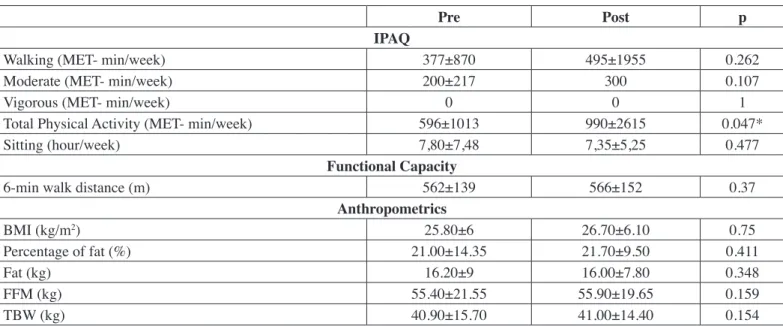
Three months after professional recommendations about exercising, a signifi cant improvement in the total physical activity (IPAQ-LF) scores was found as it increased from averagely 596 to 990 MET-min/week (p<0.05) (Table I). Analysis of subscores of IPAQ (walking, moderate-intensity, vigorous intensity and sitting) showed no signifi cance in the study group (p>0.05) water content were assessed by measuring the bioelectrical
impedance analysis (BIA) by Quadscan 4000 multi-frequency bioimpedance spectrum analyzer (BodyStat, Douglas, Isle of Man) (11, 12). The measurement was performed at the right calf using 4 frequencies (5, 50, 100, and 200 kHz) in the supine position after patients had emptied their abdomen (13).
International Physical Activity Questionnaire – Long Form. Physical activity level was evaluated by using International Physical Activity Questionnaire – Long Forma (IPAQ-LF). The IPAQ-LF is a reliable and validated instrument used to estimate levels of vigorous activity, moderate activity, walking, and time sitting during the past 7 days. It’s a patient-reported questionnaire and includes questions assessing the time spent on different intensities of physical activity. Walking, Moderate-Intensity, Vigorous-Intensity and total physical activity scores are expressed as MET- minutes per week (MET- min/week) and sitting score as hour per week (hour/week) (14).
Six Minute-Walk Test. Functional capacity was assessed with 6
minute-walk test (SMW). The SMW was performed using the methodology specifi ed by the American Thoracic Society (ATS-2002)b in a hard surface, covered, long, fl at and walled corridor which was 30 m long; meter-by-meter marks were done and two cones signaled the walk turn. Participants were instructed to walk as fast as possible without running during 6 minutes and the total distance was recorded in meters (15).
Kidney Disease Quality of Life Questionnaire-Turkish Version
(KDQOL-T). KDQOL was developed from the 36- Item
Short-Form Health Survey (SF-36) and assesses quality of life on
Table I: Comparison of pre- and post-treatment physical activity, functional capacity and anthropometrics scores (p>0.05).
Pre Post p
IPAQ
Walking (MET- min/week) 377±870 495±1955 0.262
Moderate (MET- min/week) 200±217 300 0.107
Vigorous (MET- min/week) 0 0 1
Total Physical Activity (MET- min/week) 596±1013 990±2615 0.047*
Sitting (hour/week) 7,80±7,48 7,35±5,25 0.477
Functional Capacity
6-min walk distance (m) 562±139 566±152 0.37
Anthropometrics
BMI (kg/m2) 25.80±6 26.70±6.10 0.75
Percentage of fat (%) 21.00±14.35 21.70±9.50 0.411
Fat (kg) 16.20±9 16.00±7.80 0.348
FFM (kg) 55.40±21.55 55.90±19.65 0.159
TBW (kg) 40.90±15.70 41.00±14.40 0.154
Pre-: before treatment, Post-: after treatment, IPAQ: International Physical Activity Questionnaire, BMI: Body Mass Index, FFM: Fat Free Mass,
signifi cant differences in BMI, percentage of fat, fat free mass and total body weight (p>0.05).
The changes in the physical activity level of PD patients were not related signifi cantly to functional capacity, anthropometrics and quality of life (p>0.05).
(Table I). Furthermore, 6 minute-walk distance was found to be similar at end of three months (p>0.05) (Table I).
Pain scores (Figure 1) and emotional status scores (Figure 2) of KDQOL-SF were found to improve (p<0.05) while no signifi cant differences were found in other quality of life subscores (p>0.05).
A comparison of pre and post-treatment body composition parameters has been presented in Table I. There were no
Figure 1: Comparison of pre and post-treatment KDQoL-SF disease specifi c sub domain scores. (PL-problem list, EKD- effect of kidney disease, BKD-burden of kidney disease, WS-work status, CF-cognitive function, QSI-quality of social interaction, SeF- sexual function, S-sleep, SS-social support, DSE-dialysis staff encouragement, OH-overall health, PS-patient satisfaction)
Kontos and colleagues emphasized the importance of exercise in CRF patients in their study and stated that presence of regular exercise should be asked in the assessments (9). It should be recognized that regular physical activity, like medication and dialysis, is a part of dialysis treatment. Johanson notes that, ‘it seems that almost any method of increasing activity in this population is likely to be benefi cial’ (16). In our study we recommended PD patients to walk for 30 minutes on 3 days a week to improve physical activity levels. The greatest obstacle was the resistance of patients to exercise at home. To break this resistance we take into account a sentence, a patient said in the study of Kontos et al. ‘if the benefi ts of physical activity discussed, that would certainly motivated me’(9). Informing the patients about the benefi ts of improving physical activity level was the crucial aim of our study. We tried to motivate them by explaining that exercises have the potential to reduce cardiovascular mortality, which is the most common cause of death in CRF. We thought that it helped the patients to allocate some time for physical activity. As a result, not all subparameters but total physical activity scores of IPAQ of patients increased signifi cantly at 3 months follow up.
The SMW has been used as an outcome measurement of functional capacity in a number of exercise studies in the CRF population. All these studies included intra- and interdialysis exercise program in HD patients (9, 23, 25, 26). Despite the different methods of dialysis, the goal of exercise training is same in both HD and PD patients. Clearance of the toxic molecules by exercising would minimize their destructive effects on various physiological systems and thereby enhance the skeletal muscle performance (1). Motivating the PD patients to increase the physical activity levels also resulted in improvement of physical performance. After 3 months follow up, physical performance scores of the patients improved briefl y likewise other studies. This change was not statistically signifi cant due to may be small number of our study population and shorter duration of follow up.
Regarding psychological dimensions in CRF, it seems PD patients are better adapted to the treatment than other CRF patients. This may be due to the peritoneal treatment method offering increased autonomy and control, fl exibility in daily life, ease of work, doing dialysis alone, nighttime dialysis and dietary regime, as well as fewer social restrictions. PD patients have been found to have better quality of life scores than other CRF patients in specifi c areas like ‘perceived ability to time’, ‘fi nancial concerns’, ‘restriction in eating and drinking’ and ‘dialysis access problems’. Furthermore, PD patients have indicated less kidney disease burden, and being more satisfi ed with care (8, 27). In our study, quality of life scores have increased although the change was not signifi cant or not changed except cognitive function at 3 months follow-up. Furthermore, increase in physical activity had no effect on quality of life scores. Literature research considering these results, showed CONCLUSION
In our study, we investigated the effects of education program planned to improve physical activity level in sedentary PD patients in 3 months follow up. The primary fi nding of this study was the signifi cant increase in total physical activity level by motivating the patients with professional recommendations about benefi ts of physical activity. However, this increase in physical activity did not refl ect in functional capacity, BMI and quality of life of the patients.
Regular physical activity can have many benefi cial effects for dialysis patients just as far the general population. An excellent overview of what is known about exercise in the CRF population has recently been provided by the researchers (17). A large research literature demonstrates the benefi ts of physical activity on CRF population (18-25). Many of these outcomes are relevant for reducing cardiovascular mortality, the major cause of death among patients with CRF.
Whenever possible, it is recommended that dialysis units develop an in-center exercise program to improve physical activity level of CRF patients (8). Exercising during dialysis at the treatment center has advantages like availability of medical oversight, which may be reassuring for both patient and staff. Additionally, patients do not have to plan extra time for exercise and training during dialysis reduces the reconditioning effects of forced inactivity during dialysis sessions (16). Exercising during dialysis session under the supervision of health professionals is possible only for HD patients among CRF patients. For this reason, researchers can obtain reliable and current data during the HD sessions. Thus, the greater numbers of studies have been performed on HD patient population (17-23). However, it is not the case for peritoneal dialysis patients because of the difference in dialysis technique. Perhaps for this reason in the literature no studies have examined the effect of exercise training on PD patients.
7. Chang Y, Cheng SY, Lin M, Gau FY, Chao YF: The effectiveness of intradialytic leg ergometry exercise for improving sedentary life style and fatigue among patients with chronic kidney disease: Arandomized clinical trial. Int J Nurs Stud 2010; 47(11): 1383-1388
8. Kutner NG: How can exercise be incorporated into the routine care of patients on dialysis? Int Eurol Nephrol 2007; 39: 1281-1285
9. Kontos PC, Miller K-L, Brooks D, Jassal SV, Spanjevic L, Devins GM, De Sauza MJ, Heck M, Laprade J, Naglie G: Factors infl uences exercise participation by older adults requiring chronic hemodialysis: A qualitative study. Int Urol Nephrol 2007; 39(4): 1303-1311
10. Gibson SR: Principles of Nutritional Assessment (2nd ed). New York: Oxford University Press, 2005; 259-265
11. Gibson SR: Principles of Nutritional Assessment (2nd ed). New York: Oxford University Press, 2005; 363-365
12. Heymsfi eld SB, Lohman TG, Wang ZM, Going IL: Human Body Composition (2nd ed). USA: Human Kinetics, 2005; 79-89
13. Sipahi S, Hur E, Demirtas S, Kocayigit İ, Bozkurt D, Tamer A, Gunduz H, Duman S: Body composition monitor measurement technique for the detection of volume status in peritoneal dialysis patients: The effect of abdominal fullness. Int Urol Nephrol 2011; 43(4): 1195-1199
14. Saglam M, Arikan H, Savci S, Inal-Ince D, Bosnak-Guclu M, Karabulut E, Tokgozoglu L: International physical activity questionnaire: reliability and validity of the Turkish version. Percept Mot Skills 2010; 111(1): 278-284
15. Solway S, Brooks, D, Lacasse Y, Thomas S: A qualitative systematic overview of the measurement properties of functional walk tests used in cardio respiratory domain. Chest 2001; 119(1): 256-270
16. Yıldırım A, Ogutmen B, Bektaş E, Mete M, Tolgay HI: Translation, cultural adaptation, initial reliability, and validation of the kidney disease and quality of life-sort form (KDQOL-SF 1.3) in Turkey. Translat Proc 2007; 39: 51-54
17. Johansen KL: Exercise in the end-stage renal disease population. J Am Soc Nephrol 2007; 18: 1845-1854
18. Van Vilsteren MCBA, de Greef MHG, Huisman RM: The effects of a low-to-moderate intensity pre-conditioning exercise programme linked with exercise cancelling for sedentary hemodialysis patients in The Netherlands: Results of a randomized clinical trial. Nephrol Dial Transplant 2005; 20: 141-146
19. Deligiannis A, Kouidi E, Tasscoulas E, Gigis P, Tourkantonis A, Coats A: Cardiac effects of exercise rehabilitation in the hemodialysis patients. Int J Cardiol 1999; 70: 253-266
20. Kouidi E, Iacovides A, Iordanidis P, Vassiliou S, Deligiannis A, Ierodiakonou C, Tourkantonis Al: Exercise renal rehabilitation program: Psychosocial effects. Nephron 1997; 77: 152-158
21. Mustata S, Chan C, Lai V, Miller JA: Impact of an exercise program on arterial stiffness and insulin resistance in hemodialysis patients. J Am Soc Nephrol 2004; 15: 2713-2718
a lack of any studies assessing the effects of exercise training programs on quality of life in PD patients. Thus, our study is the
fi rst on this topic, and analyzing our results by comparing them with any other study was not possible.
As follow-up of in-center exercise programs of HD patients is easier, the literature on the effects of exercising in PD patients is very poor. However, the similar systemic and physical symptoms with HD in patients receiving PD are emerging.
The small number of patients in the study, limiting the follow-up period follow-up to 3 months, lack of cycle controls for checking the participation of the patients in regular exercise are the limitations of this study. We thought that widening the exercise training program according to the patient and supervision of a physiotherapist on patients would have resulted much more striking changes. However, our study is a preliminary one carried out in this regard.
In conclusion, in spite of everything, incorporating an exercise training program into PD patient care should be a crucial part of standard care. In order to facilitate incorporation of regular exercise into standard treatment, exercise program should be individually tailored according to patient. To increase the participation of the patients in regular exercise, the benefi ts of exercising should be explained to the patient in detail at the beginning of the treatment.
REFERENCES
1. Parson TL, Toffelmire EB, King-VanVlack CE: Exercise training during hemodialysis improves effi ciency and physical performance. Arch Phys Med Rehabil 2006; 87: 680-687
2. Johansen KL, Kaysen GA, Young BS, Hung AM, da Silva M, Chertow GM: Longitudinal study of nutritional status, body composition, and physical function in hemodialysis patients. Am J Clin Nutr 2003; 77: 842-846
3. Diesel W, Knight B, Noakes T, Swanepoel C, Smit R, Kaschula R, Sinchlair Smith C: Morphologic features of the myopathy associated with chronic renal failure. Am J Kidney Dis 1993; 22: 677-684
4. Moore G, Parsons D, Stray-Gundersan J, Painter P, Brinker K, Mitchell J: Uremic myopathy limits aerobic capacity in hemodialysis patients. Am J Kidney Dis 1993; 22(2): 277-287
5. Koudi E, Albani M, Natsis K, Megalapoulos A, Gigis P, Guıba- Tziampiri O, Tourkantonis A, Deligiannis A: The effects of exercise training on muscle atrophy in hemodialysis patients. Nephrol Dial Transplant 1998; 13(3): 685-699
25. Kutner NG, Bamhart H, Wolf SL, McNeely E, Xu T: Self- reported benefi ts of Tai Chi practice by older adults. J Gerantol B Psychol Sci Soc Sci 1997; 52: 242-246
26. Ling K, Wong FSY, Chan W: Effect of a home exrcise program based on Tai Chi in patient with end stage renal disease. Perit Dial Int 2003; 23: 99-103
27. Mustata S, Cooper L, Langrick N, Simon N, Jassal SV, Oreopoulos DG: The effect of a Tai Chi exercise program on quality of life in patients in peritoneal dialysis: A pilot study. Perit Dial Int 2005; 25: 291-294
22. Parsons TL, Toffelmire EB, King-Van Vlack CE: The effect of an exercise program during hemodialysis on dialysis effi ciency, blood pressure and quality of life in end stage renal disease patients. Clin Nephrol 2004; 61: 261-274
23. Macdonald JH, Marcora SM, Jibani M, Phanish MK, Holly J, Lemmey AB: Intra-dialytic exercise as anabolic therapy in hemodialysis patients: A pilot study. Clin Physiol Funct Imaging 2005; 25: 113-118