191
ANALYSIS OF LEAF BLADE AREA AND TOTAL ILLUMINATION INDEXES OF
PANICUM MAXIMUM JACQ. CV. ARIES GRASS WITH DIFFERENT NITROGEN
RATES FOR SHEEP FEEDING 1
L. P. R. da Costa1; A. L. Moreira2; L. R. A. Gabriel Filho3,4,*; R. DE O. Souza5; C. P. Cremasco3,4; F. F. Putti3; M. G. M. Chacur6
1
FATEC - Faculdade de Tecnologia, Presidente Prudente, SP, Brasil
2
APTA - Agência Paulista de Tecnologia dos Agronegócios, Polo Alta Sorocabana, Presidente Prudente, SP, Brasil
3
UNESP - Univ Estadual Paulista, Campus de Tupã, Laboratório de Matemática Aplicada e Computacional, Tupã, SP, Brasil
4
Faculdade de Ciências Agronômicas, UNESP - Univ Estadual Paulista, Botucatu, SP, Brasil
5
Escolade Engenharia, UFRGS - Univ Federal do Rio Grande do Sul, Porto Alegre, RS, Brasil
6
UNOESTE - Univ do Oeste Paulista, Laboratório de Reprodução Animal, Presidente Prudente, SP, Brasil
ABSTRACT
Improvement of nutrition of small ruminants increases production and minimizes costs, especially during dry periods. On the other hand, investments in energy and protein foods cause high production costs. An economical alternative lies in investing in fodder production featuring quality and quantity, by lowering costs and maximizing profits of commercial farms. Current research analyzes forage of the pasture grass Panicum maximum Jacq. cv. Aries, fertilized with 200 and 400 kg of nitrogen per ha/year, and applying Student´s t test to compare the effects in pasture development. The best fertilization for quality forage production within the region´s climate and for sheep breeding was assessed. There were no significant differences among the different levels of nitrogen with regard to total illumination and leaf area index. Results show that the use of the least amount of fertilizer, i. e. 200 kg-1ha-1 year, is economically viable, taking into account lower costs in their acquisition, transportation and application.
Keywords: pasture management, small ruminants, forage production, Student t test, agribusiness.
ANÁLISE DOS ÍNDICES DE ÁREA FOLIAR E DE ILUMINAÇÃO TOTAL DO CAPIM
PANICUM MAXIMUM JACQ. CV. ÁRIES COM DIFERENTES DOSES DE
NITROGÊNIO PARA A ALIMENTAÇÃO DE OVINOS
RESUMO
Melhorar à alimentação de pequenos ruminantes é uma das formas de aumentar a produção e minimizar os gastos, principalmente em períodos secos. Por outro lado, investimentos
192 em alimentos proteicos e energéticos geram um alto custo de produção. Uma alternativa econômica é o investimento em produção de forragens que possuam qualidade e quantidade, possibilitando a diminuição de gastos, concomitantemente, aumento do lucro nas criações comerciais. Estudou-se a forragem de capim Panicum maximum Jacq. cv. Áries, adubado com 200 e 400 kg de nitrogênio por hectare ano, aplicando o teste estatístico t de Student para comparar os efeitos no desenvolvimento da pastagem, avaliando a melhor adubação para produção de forragem de qualidade ao clima da região, voltada a criação de ovinos. Foi constatado que entre os níveis de adubação adotados não ocorreu diferenças significativas no índice de iluminação total e no índice de área foliar. Pode-se afirmar, que é viável economicamente a utilização da menor quantidade de adubo, isto é 200 kg ha-1ano-1, tendo em vista que os gastos com aquisição, transporte e aplicação do mesmo serão menores.
Palavras-chave: manejo de pastagem, pequenos ruminantes, produção de forragens, teste t de
Student, agronegócio.
INTRODUCTION
Pasture is the main feed resource for ruminants in different product animal systems in Brazil. According to SANTOS et al. (2010), pasture-based animal production is one of the most competitive and profitable alternatives in the country. However, it is important to understand the soil/plant/animal management so that an increase in the degradation of pasture area may be avoided and profit occurs.
Preference to pasture in Brazil is bonded to economic factors, climate diversity, species, productivity and quality of pasturelands in several regions of Brazil (SANTOS et al., 2011). It has been estimated that pastures cover approximately 180 million hectares and correspond to more than 20 % of Brazilian territory (IBGE, 1998; ZIMMER et al, 2002), out of which some 90 million hectares are somewhat degraded. Several forage species are used in the formation of pastures, among which the
grass Panicum maximum may be
underscored due to its high capacity for the production of dry matter and good quality as animal feed. However, lack of adequate management of the grass and replacement of nutrients in the soil has been the main cause
of pasture degradation (JUNIOR;
MONTEIRO, 2006).
Forage plants are relevant due to their role in animal feed. In fact, 88% of meat produced in Brazil comes from cattle herds kept exclusively on pasture (PENATI et al.,1999).
The optimization of pasture systems may not be exclusive to the maximization of forage produced or ingested by animals. The plants´ characteristics, such as perenniality, fast regrowth after leaf falling, tolerance to the presence of animals (treading) and adequate nutrition rates should also be assessed. Soil compaction is another factor than potentially impairs the development and accumulation of nutrients (CABRAL et al., 2012).
The growth of forage plants and animal produce are restricted by low supply of nitrogen in the soil (CORSI; NUSSIO, 1993). Nitrogen availability in tropical soil is generally inadequate for the needs of the production of dry matter. This fact is due to high requirements of many forage grasses and to the low supply of the nutrient by the mineralization of the soil´s organic matter (SYLVESTRE et al., 2012; GOMES et al., 2011; BATISTOTI et al., 2012).
193 the soil for the production of dry matter,
coupled to the non-occurrence of chemical changes.
Nitrogen is highly important in nutrition and in the production of forage grasses. The theme is underscored in several studies since it is the component of numberless organic compounds which is basic to plants´ life (MENGEL; KIRKBY, 2001). It actually has a very important participation in the productivity of pastures (WERNER, 1986).
Nitrogenated fertilization is highly relevant to maintain productivity and perenniality, especially in intensive systems when species with high production capacity of dry matter and good feed features are employed.
The use of pastures also constitute one of the most practical and economic forms in the feed of ruminants, especially in the production of sheep and lambs. Ovine herds and production units have recently experienced an increase due to a higher demand in ovine meat, especially lamb, in the great consumption centers such as the Greater São Paulo area and the great cities of the interior of the state.
The municipality of Presidente Prudente, with 207000 inhabitants, distant 560 km from the capital city São Paulo, has the fourth greatest sheep herd of the state of São Paulo, with an estimated 15,232,000 sheep, approximately 4.5% of total in the state, and 150 breeders, according to the Instituto Brasileiro Geografia e Estatística (IBGE, 2009). Although the region is highly appropriated for sheep breeding due to extensive pasturelands (1,360,425 ha), according to Donzelli and Carvalho Filho
(2009), the region lacks the technology for sheep breeding.
As a rule, Brazil has a high production capacity of sheep due to increasing consumer market of quality sheep meat which triggers research on pasturelands (PIRES et al., 2000).
Current assay assesses the effects of nitrogen use at 200 and 400 kg/ha/year in the production of forage in pastures with
Panicum maximum Jacq. cv. Aries, to verify
the amount of ideal nitrogen for the climatic conditions of the Alto Sorocabana region in the state of São Paulo, Brazil, for sheep breeding.
Aries grass is an F1 apomictic hybrid cultivar of LSC2 (Sexual Strain of Centaurus) x Aruana, obtained from the cross-breeding of two accesses Panicum maximum Jacq., featuring a perennial cycle, rugged plant with great capacity of shoots, thin stem, narrow hairless leaves, with a light green color (ALMEIDA et al., 2011). It tolerates badly drained soils. It has an early cycle and is a great producer of seeds, causing constant populations. It is highly diffused among sheep breeders due to its tastiness and digestibility (TAKASHI, 2003). It is a middle size plant, approximately 120 - 150 cm high, with fast regrowth after cutting and production of 18 - 20 t/ha/year of dry mass, with 10 - 15% crude protein and 70% digestibility. Panicum maximum is a forager plant that may be employed as direct pasture. Plants have fine stalks and a great number of shoots with excellent tastiness. The above features recommend the forage plant for demanding animals such as sheep, horses and recently weaned calves (TAKASHI, 2003).
MATERIALS AND METHODS
The assay was performed at the Agência Paulista de Tecnologia dos Agronegócios (APTA) in Presidente Prudente SP Brazil, 22º11’ S and 51º23’ W, 429.29 m above sea level, mean annual
194 dry and wet seasons. According to Köppen´s
system (KÖPPEN, 1948), climate is subtropical, with dry and cold winters.
The soil of the experimental area is clayey Red-Yellow Latisol, with a slightly wavy relief. Grass cuts were undertaken in January 2008 and readings on SunScan were done. Treatments comprised two groups of nitrogenated fertilization, 200 kg/ha/year and 400 kg/ha/year, with three replications. Fertilization had two variables identified as Leaf Area Index (IAF) and Total Illumination (TI). Experiment design consisted of totally randomized blocks, composed of two types of fertilization for
each variable, with three measurements in five days, totaling 15 data for each type of index and fertilization.
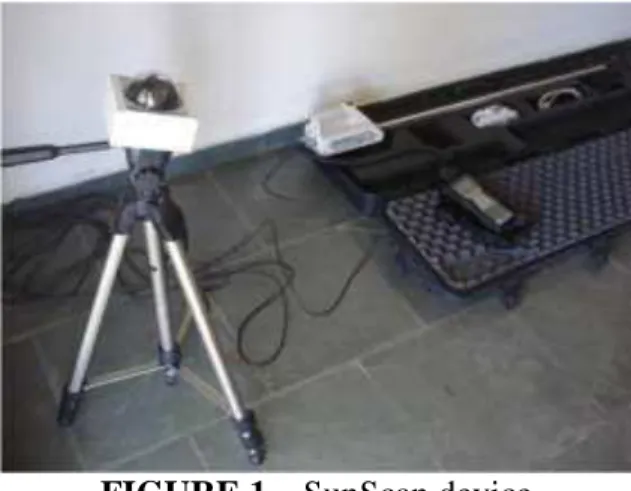
Pastures were managed with sheep within a rotational lot system, with a pasturing start when plants reached a height where intercepted and captured by the leaf area of the canopy reached 90 – 95%. Height was established by simultaneous readings with regard to the interception of photosynthetically active radiation (IRFA) in the enclosures, with Sun Scan (Delta-T Cambridge, UK) to measure the forage canopy (Figure 1).
FIGURE 1 – SunScan device
The Sun Scan is composed of three parts: a light sensor that measures radiation on the vegetation; a probe with quantic sensors that measures the radiations transmitted by the canopy and a terminus for data collection that integrates the reading of the first two instruments. Estimates of the interception of photosynthetically active radiation are thus performed.
Seven readings were performed weekly per parcel as from the first pasture, covering a circumference with a 10-m radius around the point which represents the mean height of the vegetation of the parcels where the radiation sensor tripod was installed.
The minicomputer locked to the computer transfers files of the SunDate program to the Randrive of the computer
with My Psion program, with the observation and analysis of data by
Microsoft Excel .
Analysis was extended to the test of differences between sample means and fertilizations with regard to variables. Further, t test was applied for independent samples with the following:
𝑡 𝑙 = 𝑥
_
− 𝑥_ − μ− − μ−
√ 02 𝑛 + 𝑛
,
e
𝑙 = 𝑥̅ − 𝑥̅
√ 02
195 Test requires the estimate of the
common variance between the two populations, called 02, obtained by the weighed mean of sample variances, as follows:
02 = 𝑛 −
2− 𝑛 − 2
𝑛 + 𝑛 − .
Where 2 and 2 are the variants of the two
samples under analysis.
In current test, the critical rate is calculated by 𝑔𝑙 = 𝑛 + 𝑛 − , where 𝑛 and 𝑛 are the size of the samples A and B.
Boxplot graphs were developed with
Minitab 15, since its graphic interface
provided good visual results similar to the statistical analyses developed in current assay.
RESULTS AND DISCUSSION
After measuring the indexes IAF and IT, the values for tests t were calculated with
Minitab, resulting in 𝑡 = . 4 for IAF and
𝑡 =- .4 for IT.
Analysis showed that data on fertilization with regard to indexes were not
significantly different since p rates were respectively 0.778 and 0.636.
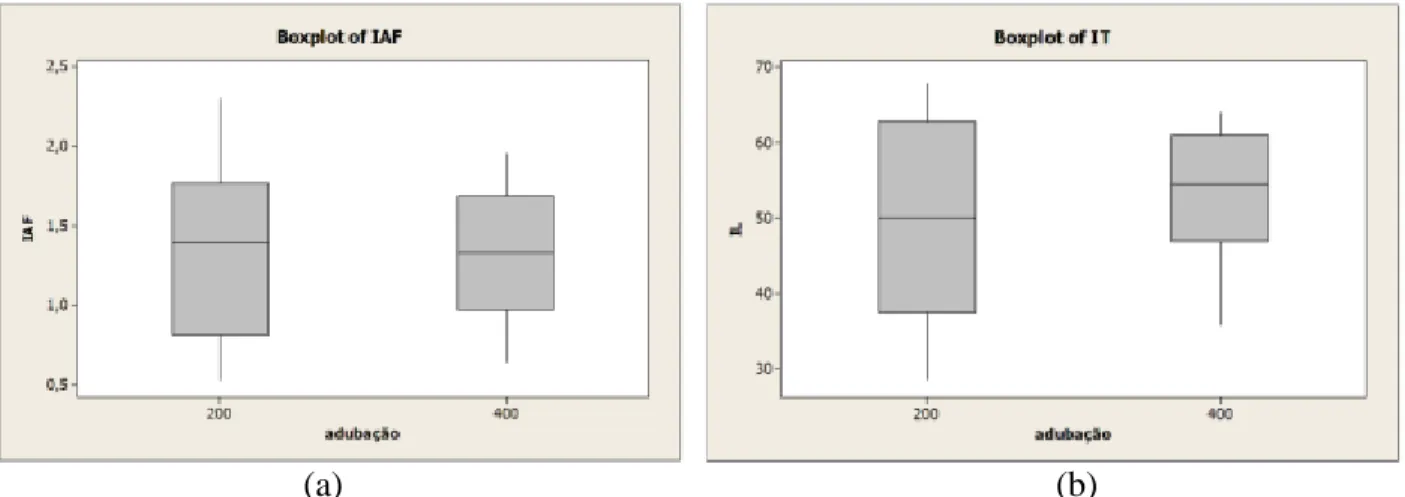
A significance level at α = 0.05 (5%) was established. A descriptive analysis of the variables of mean rates and standard deviations was provided for an adequate description of the variables with regard to types of fertilization (Figure 2).
(a) (b)
FIGURE 2 – Boxplot graph for variables IAF and IT.
Figure 2 shows that data median for the variable IAF in 200 kg-1ha-1 year is 1.39, whereas for 400 kg-1ha-1 year it is 1.33. Data median for the variable IT for measurements for 200 kg-1ha-1 year is 50.05 and for 400 kg1 ha1 year it is 54.53.
196
TABLE 1 – Descriptive analysis and confidence interval for means of the variables IAF and IT
with regard to fertilization types 200 kg-1ha-1 year and 400 kg-1ha-1 year.
Variable Fertilization Descriptive Analysis Interval of confidence for means
IAF 1 1.38 ± 0.55 [1.08; 1.68]
2 1.33± 0.40 [1.11; 1.55]
IT 1 50.89 ± 12.61 [43.91; 57.87]
2 52.83 ± 9.37 [47.64; 58.02]
It should be underscored that there were no significant differences between IAF and IT with regard to fertilization. The
application of 200 kg-1ha-1 year of nitrogen on the pasture may provide less costs.
CONCLUSIONS
After studying the characteristics of the grass Aries, a hypothesis was raised on the possible levels of growth with different quantities of nitrogen. Experiments and statistics revealed that different levels of fertilization in region with similar climate features and equivalent soil did not provide any significant differences on the index of
total illumination and on the index of leaf area.
Results show that the use of a small amount of nitrogenated fertilization, 200 kg/ha/year, is economically feasible since acquisition, transport and applications costs are lower.
ACKNOWLEDGEMENTS
The authors would like to thank the Agência Paulista de Tecnologia dos Agronegócios (APTA) of the Polo Alta Sorocabana, Presidente Prudente SP Brazil, for its help in the assays performed; thanks are also due to the Fundação de Amparo à
Pesquisa do Estado de São Paulo (FAPESP) for funding of current research (Process n. 06/55786-5) and for the scholarships in technical training (Processes n. 08/11300-8 and 08/11322-0).
REFERENCES
ALMEIDA, M. C. C.; CHIARI, L.; JANK, L.; VALLE, C. B. Diversidade genética molecular entre cultivares e híbridos de Brachiaria spp. E Panicum maximum.
Ciência Rural, Santa Maria, v.41, n.11,
p.1998-2003, nov, 2011.
BATISTOTI, C.; LEMPPA, B.; JANK, L.; MORAIS, M. G.; CUBAS, A. C.; GOMES, R. A.; FERREIRA, M. V. B. Correlations
among anatomical, morphological, chemical and agronomic characteristics of leaf blades in Panicum maximum genotypes. Animal
Feed Science and Technology, v.171,
p.173–180,2012.
197 macronutrientes primários na Brachiaria
brizantha cv. Piatã e Panicum maximum cv.
Mombaça. R. Bras. Eng. Agríc. Ambiental, v.16, n.4, p.362–367, 2012.
CORSI, M., NUSSIO, L. G. Manejo do capim-elefante: Correção e adubação do solo. In: Simpósio sobre Manejo de Pastagem, 10, 1993, Piracicaba. Anais... Piracicaba: FEALQ, 1993. p.87-115.
DONZELLI, J. R. G; CARVALHO FILHO, A. A. Estudo da produção de ovinos no ano
de 2008 na 10ª região administrativa do Estado de São Paulo - SP utilizando-se da técnica de estatística multivariada de análise fatorial. In: IV SIMPÓSIO DE
MATEMÁTICA, 2009, Presidente Prudente, SP. Anais... Presidente Prudente : UNESP, 2009, p.1-4.
GOMES, R. A.; LEMPP, B.; JANK, L.; CARPEJANI, G. C.; MORAIS, M. G.
Características anatômicas e
morfofisiológicas de lâminas foliares de genótipos de Panicum maximum. Pesq.
Agropec. Bras., Brasília, v.46, n.2,
p.205-211, fev. 2011.
INSTITUTO BRASILEIRO DE
GEOGRAFIA E ESTATÍSTICA - IBGE. Censo agropecuário. Recenseamento geral do Brasil. Rio de Janeiro: Fundação Instituto Brasileiro de Geografia e Estatística. 1998.
INSTITUTO BRASILEIRO DE
GEOGRAFIA E ESTATÍSTICA - IBGE. Pesquisa da Pecuária Municipal. Available at: <http://www.ibge.com.br>. On 10/01/2013.
JUNIOR, J. L; MONTEIRO, F. A. Diagnose nutricional de nitrogênio no capim aruana em condições controladas. Ciência do Solo, Viçosa, v.30, n.5, p.829-837, 2006.
KÖPPEN, W. Climatologia. Buenos Aires: Gráfica Panamericana, 1948. 478p.
MENGEL, K.; KIRKBY, E. Principles of
plant nutrition. 5.ed.
Dordrecht/Boston/London: Kluwer
Academic Publishers, 2001. 849p.
PENATI, M. A.; CORSI, M.; MARTHA JR. et al. Manejo de plantas forrageiras no
pastejo rotacionado. In: SIMPÓSIO
GOIANO SOBRE PRODUÇÃO DE
BOVINOS DE CORTE, 1999. Goiânia, GO. Anais.... Goiânia: CBNA, 1999.p.123-144.
PIRES, C. C. et al. Cria e terminação de cordeiros confinados. Ciência Rural, Santa Maria, v.30, n.5, p.875-880, 2000.
SANTOS, J. T et al. Atributos físicos e químicos do solo de Áreas sob Pastejo na Micro Região do Brejo Paraibano. Ciência
Rural, Santa Maria, v.40, n.12,
p.2486-2492, 2010.
SANTOS, P. M.; SANTOS, A. C.; NEGREIROS NETO, J. V. N.; ARAÚJO, A. S.; SILVA J. E. C. Caracterização de pastagens de capim tanzânia e mombaça consorciados com estilosantes em ecótono de ransição Cerrado: Floresta Amazônica.
Revista Brasileira de Ciências Agrárias, v.
6, n.1, jan-mar, pp. 163-173,2011.
SILVA, J. G. D.; MATOS, A. T. DE; BORGES, A. C.; PREVIERO, C. A. Composição químico-bromatológica e produtividade do capim-mombaça cultivado em diferentes lâminas de efluente do tratamento primário de esgoto sanitário.
Rev. Ceres, Viçosa, v. 59, n.5, p. 606-613,
set/out, 2012.
198 TAKASHI, A. Novas sementes para
pastagens chegam ao mercado pelas mãos da Matsuda. São Paulo, Presidente Prudente,
2003. Available at:
<http://www.sinomar.com.br/em_290703.as p>. On 10/01/2013.
WERNER, J. C. Adubação de pastagens. Nova Odessa, Instituto de Zootecnia, 1986. 49p. (IZ. Boletim Técnico, 18).
ZIMMER, A.; SILVA, M. P.; MAURO, R. Sustentabilidade e impactos ambientais da produção animal em pastagens. In:
PEIXOTO, A. M.; MOURA, J.C.;