Atherogenesis in Mice
Florian Willecke1., Katharina Zeschky1., Alexandra Ortiz Rodriguez1
, Christian Colberg1, Volker Auwa¨rter2, Stefan Kneisel2, Melanie Hutter2, Andrey Lozhkin1, Natalie Hoppe1, Dennis Wolf1, Constantin von zur Mu¨hlen1, Martin Moser1, Ingo Hilgendorf1, Christoph Bode1, Andreas Zirlik1*
1Department of Cardiology, University of Freiburg, Freiburg, Germany,2Forensic Toxicology, Institute of Forensic Medicine, University Medical Center Freiburg, Freiburg, Germany
Abstract
Background: Strong evidence supports a protective role of the cannabinoid receptor 2 (CB2) in inflammation and
atherosclerosis. However, direct proof of its involvement in lesion formation is lacking. Therefore, the present study aimed to characterize the role of the CB2receptor in Murine atherogenesis.
Methods and Findings:Low density lipoprotein receptor-deficient (LDLR2/2) mice subjected to intraperitoneal injections of the selective CB2receptor agonist JWH-133 or vehicle three times per week consumed high cholesterol diet (HCD) for 16
weeks. Surprisingly, intimal lesion size did not differ between both groups in sections of the aortic roots and arches, suggesting that CB2activation does not modulate atherogenesis in vivo. Plaque content of lipids, macrophages, smooth
muscle cells, T cells, and collagen were also similar between both groups. Moreover, CB22/2/LDLR2/2 mice developed
lesions of similar size containing more macrophages and lipids but similar amounts of smooth muscle cells and collagen fibers compared with CB2+/+/LDLR2/2 controls. While JWH-133 treatment reduced intraperitoneal macrophage
accumulation in thioglycollate-illicited peritonitis, neither genetic deficiency nor pharmacologic activation of the CB2
receptor altered inflammatory cytokine expression in vivo or inflammatory cell adhesion in the flow chamber in vitro.
Conclusion:Our study demonstrates that both activation and deletion of the CB2receptor do not relevantly modulate
atherogenesis in mice. Our data do not challenge the multiple reports involving CB2 in other inflammatory processes.
However, in the context of atherosclerosis, CB2does not appear to be a suitable therapeutic target for reduction of the
atherosclerotic plaque.
Citation:Willecke F, Zeschky K, Ortiz Rodriguez A, Colberg C, Auwa¨rter V, et al. (2011) Cannabinoid Receptor 2 Signaling Does Not Modulate Atherogenesis in Mice. PLoS ONE 6(4): e19405. doi:10.1371/journal.pone.0019405
Editor:Alma Zernecke, Universita¨t Wu¨rzburg, Germany
ReceivedOctober 29, 2010;AcceptedApril 4, 2011;PublishedApril 26, 2011
Copyright:ß2011 Willecke et al. This is an open-access article distributed under the terms of the Creative Commons Attribution License, which permits unrestricted use, distribution, and reproduction in any medium, provided the original author and source are credited.
Funding:The study was supported by a grant of the Deutsche Forschungsgemeinschaft (DFG ZI 743/3-2) and internal grants of the University of Freiburg to Dr. Andreas Zirlik. The funders had no role in study design, data collection and analysis, decision to publish, or preparation of the manuscript.
Competing Interests:The authors have declared that no competing interests exist. * E-mail: [email protected]
.These authors contributed equally to this work.
Introduction
Atherosclerosis is a chronic inflammatory disease and represents the primary cause of heart disease and stroke worldwide [1]. While the inflammatory nature of atherosclerosis has been uncovered for sometime already, genuine anti-inflammatory treatment options are still lacking. Drugs with pleiotropic anti-inflammatory properties, such as statins, are cornerstones of current state-of-the-art therapy, while great efforts are made to find new agents primarily designed to abate the inflammatory and immunologic mechanisms promoting atherosclerosis and its complications. A growing body of evidence suggests that the cannabinoid system plays a critical role in the pathogenesis of inflammation and recent reports also implicated it with the pathobiology of atherosclerosis [2,3,4]. The endocannabinoid system comprises two membrane receptors, CB1 and CB2, their endogenous ligands, such as
anandamide (arachidonoylethanolamide, AEA) and 2-arachido-noylglyceral (2-AG), and several enzymes required for their
biosynthesis and inactivation [5,6]. The receptor CB1is primarily
expressed in the central nervous systems (CNS), but also in peripheral tissues and on immune cells [7]. Selective blockade of the CB1receptor inhibits atherogenesis in LDL receptor
(LDLR)-deficient mice [8].
The CB2receptor is predominantly expressed in immune and
hematopoetic cells but also in adipose tissue [9], brain [10], myocardium [11], and endothelial cells [12]. Numerous studies have demonstrated anti-inflammatory effects of CB2 receptor
activation in different diseases and pathological conditions, including cerebral injury [13,14], inflammatory pain [15], and myocardial injury [16]. Most notably, CB2receptor activation has
also been suggested to modulate atherosclerosis [17]. In this latter study, Steffens and colleagues showed that oral administration of low doses ofD9-tetrahydrocannabinol (THC, 1 mg/kg per day)
significantly reduced plaque progression in apolipoprotein E (ApoE) knockout mice. They also observed CB2
plaques and reduced macrophage content in atherosclerotic lesions of THC-treated mice. Since these effects were reversed by a selective CB2 but not CB1 receptor antagonist, the authors
hypothesized the involvement of CB2 receptors on immune cells
in atherogenesis [17]. Another recent study also showed ameliora-tion of atherosclerosis in ApoE-deficient mice after treatment with a CB2/CB1 receptor agonist and the authors postulated a CB2
receptor-dependent effect [3]. However, up to now noin vivostudy evaluated the direct contribution of CB2receptor signaling in the
context of atherosclerosis. There is a need for such studies to ultimately evaluate whether CB2-targeted therapies may be suitable
to fight atherosclerosis. Therefore, the aim of this study was to investigate the influence of the CB2receptor on atherogenesis in low
density lipoprotein receptor (LDLR)-deficient mice.
Methods
In vivo study
CB2-deficient mice and LDLR-deficient mice, both on a pure
C57/BL6 background, were obtained from Jackson Laboratories. Mice were crossbred to generate CB22/2/LDLR2/2 mice.
Genotyping of each mouse used polymerase chain reaction and employed the following primers: LDLR, 59-CCA TAT gCA TCC CCA gTC TT-39(common primer), 59-gCg ATg gAT ACA CTC ACT gC-39 (wild-type primer), 59-AAT CCA TCT TgT TCA ATg gCC gAT C-39 (mutant primer); CB2, 59- gAC Tag AgC
TTT gTA ggT Agg Cgg -39(common primer), 59- ggA gTT CAA CCC CAT gAA ggA gTA-39(wild-type primer) and CB2, 59- ggg
gAT CgA TCC gTC CTg TAA gTC T-39(mutant primer). Six-week-old male CB2+/+/LDLR2/2and CB22/2/LDLR2/2mice
consumed a high-cholesterol diet (HCD) for 16 weeks (Ssniff modified after Research Diets D12108 containing 21% total fat and 1.235% cholesterol, Soest, Germany). In parallel, JWH-133 (diluted in a water-soluble solution with Tocrisolve, from Tocris, Bristol, UK) or vehicle was injected intra-peritoneally (i.p.) into LDLR-deficient mice consuming HCD at a concentration of 5 mg/kg body weight three times a week for 16 weeks. Subsequently, mice were euthanized, hearts and aortas were removed, and tissue was prepared and analyzed histologically as described previously [18,19,20]. Total cholesterol and triglyceride levels were assayed in EDTA plasma from blood obtained by retro-orbital bleeding before feeding and drawn from the right ventricle upon harvest. The total wall area ( = intima + media), intimal lesion area (intima) and medial area (media) as well as the percentage of positively stained area for macrophages (anti-mouse Mac-3), lipids (Oil-Red-O), T cells (anti-CD4), collagen (Picrosir-ius red), smooth muscle cells (anti-a-actin), and apoptotic cells (TUNEL, Roche, Basel, Switzerland) were quantified by blinded investigators employing computer-assisted image analysis software (Image Pro, Media Cybernetics, Bethesda, MD). Abdominal aortas were fixed with 10% formalin, opened longitudinally, pinned, stained with Oil-red-O solution (Sigma-Aldrich, St. Louis, MO, 2.5 h, RT), washed with 85% propylene glycol, and lipid accumulation was quantified as described above. All mice were housed under specific pathogen-free conditions. All procedures were approved by the Animal Care Committee of the University of Freiburg and the local authorities (Regierungspra¨sidium Freiburg) with the permit number G-08/46.
Cell Culture and in vitro stimulation
Murine endothelial cells were isolated using Invitrogen DynabeadsH (Invitrogen, Paisley, UK) as previously described [21]. Endothelial cells were seeded in 6 or 24 wells until they reached 80% confluence. Flow cytometric analysis for PECAM-1
and ICAM-2 showed a purity of about 97% of isolated murine endothelial cells (data not shown). After incubation in FCS-free medium for 24 hours, cells were stimulated with indicated concentrations of JWH-133 or vehicle, followed by TNFa
(20 ng/ml) after 30 minutes. After 24 hours of incubation at 37uC supernatents were removed for ELISA and endothelial cells were lysed and used for Western Blotting. Apoptosis and cytotoxicity was evaluated by Apo-ONEH and CytoTox-OneTM Assay according to the instructions of the manufacturer (Promega, Madison, WI).
Enzyme-linked immuno-absorbent assay (ELISA)
Mouse MCP-1 was quantified in the supernatants of cell cultures using commercially available ELISA Kits (R&D DuoSet, Minneapolis, MN) according to the manufacturer’s instructions.
Western blotting
Murine endothelial cells were stimulated with TNFa(20 ng/ml) for 24 hours. After incubation, murine endothelial cells were lysed, separated by SDS-PAGE under reducing conditions, and blotted to polyvinylidene difluoride membranes as described previously [21]. An anti-mouse ICAM-1 antibody (Santa Cruz, Santa Cruz, CA) was used as primary antibody, followed by an anti-peroxidase-conjugated AffiniPure Goat Anti-Rabbit IgG (Jackson Laboratories, West Grove, PA) as secondary antibody.
Cytokine challenge and cytometric bead assay
To induce inflammation, mice were subjected to intraperitoneal injection of TNFa(200 ng/ml) as indicated. Blood was collected by cardiac puncture and serum separation. For analysis of inflammatory markers in mice the cytometric bead assay for Murine inflammation detecting IL-6, MCP-1, IFNc, IL-10, and IL-12p70 was used according to manufacturer’s instructions (BD Biosciences, San Diego, CA) optimized for higher sensitivity. Results were analyzed using the corresponding FCAP software (BD Franklin Lakes, NJ). The lower detection limits were in the range of 5–10 pg/ml.
Dynamic adhesion assays
Dynamic adhesion assays in the flow chamber were performed as described previously [19]. Murine endothelial cells were grown in 35 mm dishes (Costar, Bethesda, MD) and were subjected to the flow chamber. In brief, the Glycotech flow chamber (Gaithers-burg, MD) was assembled with the dish as the bottom of the resulting parallel flow chamber. The chamber and tubes were filled with PBS without serum prior to the experiment. Subsequently, Murine leukocytes were applied with a syringe pump (Harvard apparatus PHD2000, Holliston, MA) with flow rates of 0.04 dyne/cm2(venous flow; a total of 10 min). Adherent cells were quantified under the microscope.
Flow cytometry
Flow cytometry was performed as previously described [22]. Cells were pre-incubated with mouse Fc-Block (aCD16/32, ebioscience, San Diego, CA). Antibodies included CD11b-FITC, CD115-PE, Ly6C/G (Gr1)-APC, CD4-Alexa488, CD8-PE, CD3-APC, CD20-PE, ICAM-1-FITC (all from ebioscience, San Diego, CA), ICAM-2-FITC, and PECAM-1-PE (PharMingen, San Diego, CA). The mean fluorescence indices (MFI) were quantified employing the FlowJo software (Tree Star Inc, Ashland, OR).
Murine peritonitis
CB2+/+/LDLR2/2and CB22/2/LDLR2/2mice were treated
mice were euthanized with CO2, the peritoneal cavity was flushed
with 6 ml of RPMI for 3 min. Leukocytes were quantified in a CASY counter. Similarly, wild-type (Bl6) mice received JWH-133 one hour before injection of 4% thioglycollate. The resulting leukocyte migration was measured after 4 and 72 hours.
Mass spectrometry - pharmacokinetics of JWH-133
Mice were subjected to i.p. injection of JWH-133 (5 mg/kg body weight) on day 1, 3, 6, 8 and 10. On day 10 retro-orbital blood was taken at 2, 12, 24, and 48 hours after the last injection of JHW-133. Mouse sera (100ml, N = 6) were added to 5ml internal standard (d3-THC; 5mg/ml in ethanol), followed by
2.9 ml acetic acid 0.1 M, followed by automated solid phase extraction using Aspec GX-274 (Gilson, Middleton, USA), reversed phase C18 SPE-cartouche (type chromabond), and a
500 mg column bed (Macherey-Nagel, Du¨ren, Germany). Sam-ples were eluted with 1 ml acetonitrile, evaporated in a stream of nitrogen at 40uC, and incorporated in 25ml ethyl acetate.
Frozen aortic tissue was incubated in 500ml ethanol in an ultrasound bath twice for 15 min, pooled, 25 ng internal standard was added (d3-THC), samples were evaporated in a stream of
nitrogen at 40uC, reconstituted in ethanol, acetic acid was added, and automated solid phase extraction and elutriation was performed as described above.
1ml of samples was analyzed using the Agilent 5973 GC-MS system (temperature gradient 100uC for 1 min, increase to 290uC for 2.5 min, increase to 310uC for 4 min, fragmentation energy 70 eV). The following fragments were chosen. For JWH-133: m/z 269 (quantifier), m/z 312 and m/z 229 (qualifier), retention time 6.5 min. For d3-THC: m/z 302 (quantifier), m/z 317 and m/z
234 (qualifier), retention time 7.4 min. The detection limit was 25 ng/ml.
Quantitative real-time PCR. Aortas from CB22/2/
LDLR2/2 and CB2+/+/LDLR2/2 mice consuming HCD for
16 weeks were harvested and stored in RNAlater (Qiagen, Venlo, Netherlands) at 280uC. Total RNA was extracted using TRIzol Reagent (Invitrogen, San Diego, CA) and glycogen as a co-precipitator (Roche, Basel, Switzerland). Homogenization was performed using a rotor-stator dispergator (IKAH, Staufen, Germany). 1mg of total RNA was transcribed into cDNA using the Transcriptor First Strand cDNA Synthesis Kit (Roche, Basel, Switzerland). Subsequent quantitative real-time PCR was performed with a LightCycler 480 System using the LightCycler 480 SYBR Green I Master (Roche) detection format. mGAP-DH served as endogenous control. Primer sequences: mCNR1: 59 -TCC TTG TAG CAG AGA GCC AGC C-39(forward), 59-GCC AGG CTC AAC GTG ACT GAG A-39(reverse); mGAP-DH: 59 -TGC ACC ACC AAC -TGC TTA G-39(forward), 59-GAT GCA GGG ATG ATG TTC-39(reverse).
Statistical analysis
Data are expressed as means6SEM of absolute or normalized values. Groups were compared employing the Student’s t-test. A value of P,0.05 was considered significant. Data sets were analysed using GraphPad PrismH (GraphPad Software Inc, La Jolla, CA).
Results
Treatment with the selective CB2receptor agonist JWH-133 does not attenuate atherogenesis in mice
To explore the contribution of direct CB2receptor stimulation
LDLR2/2mice consuming a high-cholesterol diet (HCD) for 16 weeks were treated with intraperitoneal injections of the selective
CB2 receptor agonist JWH-133 or vehicle three times a week.
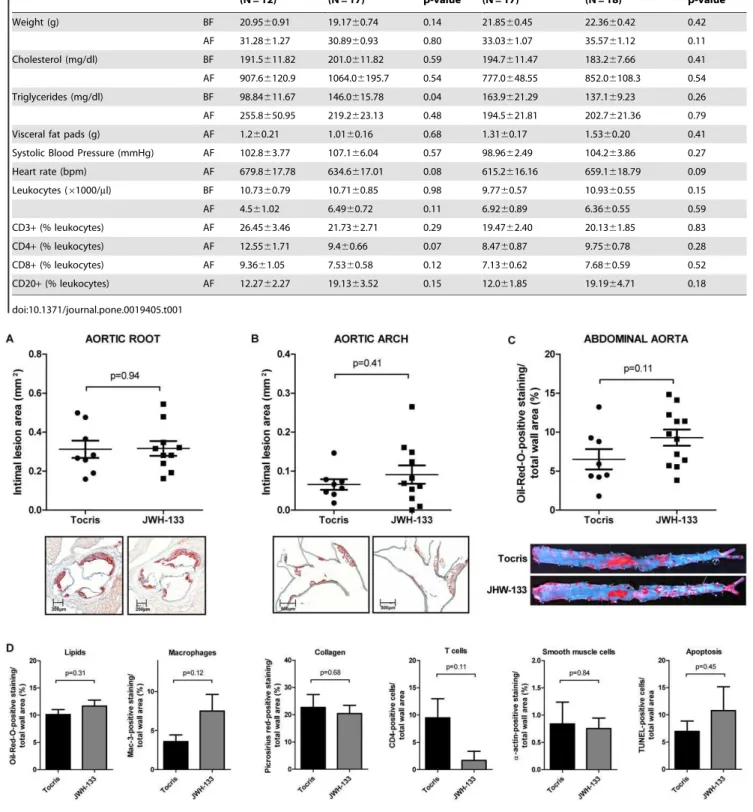
JWH-133 was detectable in mouse serum after 2, 12, and 24 hours by mass spectrometry, proving bioavailabilityin vivo(Fig. 1). More importantly, JWH-133 could also be detected directly in aortic tissue of treated animals 48 hours after administration at a level of 2.260.67 ng/mg while it was undetectable in vehicle control-treated animals. Weights, cholesterol levels, and total leukocyte numbers did not differ between the study groups at baseline and end of feeding. Both groups also showed no difference in visceral fat mass, blood pressure, heart rate, and leukocyte subtypes as quantified at the end of the study (Table 1). Surprisingly, intimal lesion size in aortic roots was similar between JWH-133-treated mice and those receiving vehicle control (0.31660.038 mm2, N = 10 vs. 0.31260.044 mm2, N = 8, P = 0.94; Fig. 2A). Similar results were obtained in aortic arches (0.09160.024 mm2, N = 11 vs. 0.06660.013 mm2, N = 8, P = 0.41, Fig. 2B). Also, lipid deposition in en face analysis of abdominal aortas did not differ between both groups (Fig. 2C), demonstrating that CB2receptor
stimulation does not attenuate atherogenesis in mice. Similarly, JWH-133 treatment did not modulate the content of lipids, macrophages, collagen, T cells, smooth muscle cells, and the cellular apoptosis rates in atherosclerotic plaques (Fig. 2D).
CB2receptor deficiency does not affect the development of atherosclerotic lesions in mice
Consistent with our results for selective CB2receptor
stimula-tion, CB22/2/LDLR2/2 mice consuming HCD for 16 weeks
developed lesions of similar size as respective CB2+/+/LDLR2/2
control animals in aortic roots (0.26160.038 mm2, N = 12 vs. 0.22360.023 mm2, N = 13, P = 0.40, Figure 3A), aortic arches (0.09560.022 mm2, N = 12 vs. 0.07560.022 mm2, N = 13, P = 0.54, Figure 3B), and abdominal aortas (Fig. 3C). Again, there was no change in the degree of apoptosis, the content of collagen, T cells, and smooth muscle cells within the atheroscle-rotic plaque. However, we could detect increased lipid and macrophage content (Fig. 3D). CB1expression quantified by
RT-PCR did not differ between both groups rendering a CB1-driven
bias unlikely (0.001360.0002 vs. 0.001860.0004, P = 0.34, N = 3).
Figure 1. Pharmacokinetics of JWH-133 using mass spectrom-etry. Mice were subjected to intraperitoneal injection of JWH-133 (5 mg/kg body weight) on day 1, 3, 6, 8, and 10. On day ten, the serum levels of JWH-133 were determined at the indicated time points using mass spectrometry. The concentration of JWH-133 is given as the mean6SEM (N = 6).
Figure 2. Treatment with the CB2agonist JWH-133 does not modulate atherosclerosis in mice.A and B, LDLR2/2mice consuming high
cholesterol diet for 16 weeks (HCD) received intraperitoneal injections of 5 mg/kg JWH-133 (N = 10) or vehicle control (Tocris, N = 8) three times a week. Intimal lesion area in the aortic root (A) and arch (B) are diplayed as pooled data6SEM; representative images stained for lipid deposition (Oil-red-O) are shown below the corresponding graph. C, The abdominal aortas of mice treated as described above underwenten faceanalysis of lipid deposition. Oil-red-O-positive staining in relation to total wall area was quantified and is displayed as pooled data 6 SEM (N = 8 and 10); representative images are shown below. D, Sections of aortic roots of mice treated as described above were analyzed for lipid-, macrophage-, collagen-, T cell-, smooth muscle cell- and apoptotic cell content. Oil-red-O-, Mac-3-, picosirius red-, CD4-,a-actin- and TUNEL-positive staining in relation to total wall area is given as mean6SEM (N = 8 and 10).
doi:10.1371/journal.pone.0019405.g002
Table 1.Characteristics of study animals before and after feeding.
Tocris (N = 12)
JWH-133
(N = 17) p-value
CB2+/+/LDLR2/2 (N = 17)
CB22/2/LDLR2/2
(N = 18) p-value
Weight (g) BF 20.9560.91 19.1760.74 0.14 21.8560.45 22.3660.42 0.42
AF 31.2861.27 30.8960.93 0.80 33.0361.07 35.5761.12 0.11
Cholesterol (mg/dl) BF 191.5611.82 201.0611.82 0.59 194.7611.47 183.267.66 0.41
AF 907.66120.9 1064.06195.7 0.54 777.0648.55 852.06108.3 0.54
Triglycerides (mg/dl) BF 98.84611.67 146.0615.78 0.04 163.9621.29 137.169.23 0.26
AF 255.8650.95 219.2623.13 0.48 194.5621.81 202.7621.36 0.79
Visceral fat pads (g) AF 1.260.21 1.0160.16 0.68 1.3160.17 1.5360.20 0.41
Systolic Blood Pressure (mmHg) AF 102.863.77 107.166.04 0.57 98.9662.49 104.263.86 0.27
Heart rate (bpm) AF 679.8617.78 634.6617.01 0.08 615.2616.16 659.1618.79 0.09
Leukocytes (61000/ml) BF 10.7360.79 10.7160.85 0.98 9.7760.57 10.9360.55 0.15
AF 4.561.02 6.4960.72 0.11 6.9260.89 6.3660.55 0.59
CD3+(% leukocytes) AF 26.4563.46 21.7362.71 0.29 19.4762.40 20.1361.85 0.83
CD4+(% leukocytes) AF 12.5561.71 9.460.66 0.07 8.4760.87 9.7560.78 0.28
CD8+(% leukocytes) AF 9.3661.05 7.5360.58 0.12 7.1360.62 7.6860.59 0.52
CD20+(% leukocytes) AF 12.2762.27 19.1363.52 0.15 12.061.85 19.1964.71 0.18
Study characteristics were similar between both groups at baseline and end of feeding (Table 1).
CB2receptor signaling differentially affects inflammatory cell recruitment
Since previous reports implicated the CB2 receptor in the
recruitment of inflammatory cells, we investigated a potential role of CB2 receptor signaling in Murine peritonitis [12,23,24].
72 hours after intraperitoneal injection of thioglycollate peritoneal macrophage numbers were significantly reduced in JWH-133-treated mice compared with vehicle controls (Fig. 4A N = 5 per group). In contrast, JWH-133 treatment did not affect short term (4 h) thioglycollate-induced peritonitis predominated by neutro-phils (Fig. 4A, N = 9 per group). Similar amounts of leukocytes accumulated in the peritoneal cavity of CB22/2/LDLR2/2mice
and CB2+/+/LDLR2/2 control animals after 72 and 4 hours
(N = 5 and N = 13 per group, respectively, Fig. 4B). In accord, CB2
receptor signaling did not affect adhesion of inflammatory cells in the flow chamber (Fig. 4C), expression of ICAM-1 as assessed by Western blotting (Fig. 5A) and FACS (Fig. 5B), as well as chemokine expression in cultured endothelial cells (Fig. 5 C). JWH-133 did not modulate apoptosis (Fig. 5D) and cytotoxicity of the cells tested (Fig. 5E).
Treatment with JWH-133 attenuates the recruitment of inflammatory monocytes to the blood pool in an acute Murine model of inflammation
Since we did not observe an effect of CB2receptor signaling on
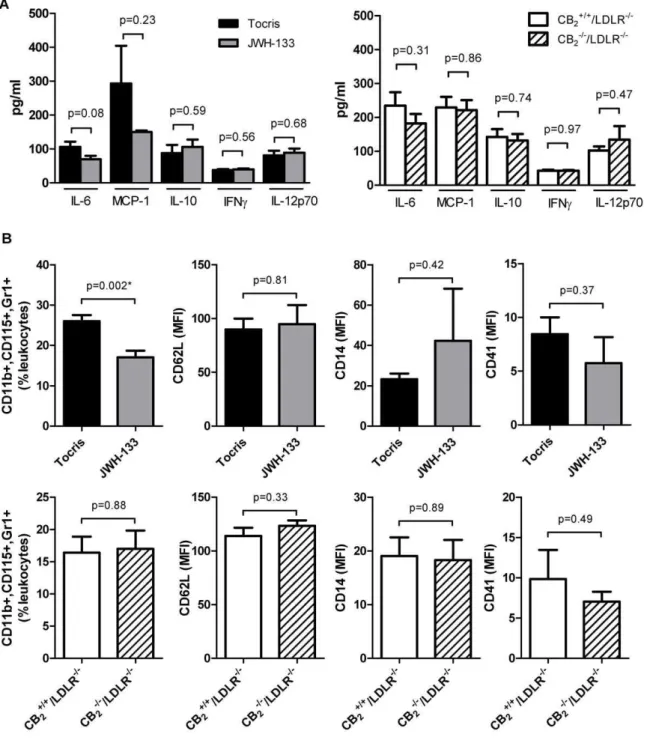
atherosclerosis, a chronic inflammatory disease, we sought to explore its role in an acute model of inflammation. Interestingly, neither genetic deficiency nor selective stimulation of CB2 by
JWH-133 modulated the expression of IL-6, MCP-1, IL-10, IFNc, or IL-12p70 in mice challenged intraperitoneally with TNFa
(Fig. 6A). However, JWH-133-treated mice recruited lower numbers of monocytes with an inflammatory, GR1high subtype to the blood pool upon stimulation with TNFa. Of note, no difference in numbers of this cellular subtype could be measured between CB22/2/LDLR2/2and CB2+/+/LDLR2/2mice.
Discussion
The present study made the surprising finding that selective CB2
receptor stimulation did not affect the development of atheroscle-rotic plaques in LDLR-deficient mice. Accordingly, deletion of the CB2 receptor in LDLR-deficient mice did neither increase nor
decrease atherosclerotic burden. There was a significant elevation of lipid and macrophage content in plaques of CB22/2/LDLR2/2
Figure 3. CB2 receptor deficiency does not influence atherosclerosis in mice.A and B, CB2+/+/LDLR2/2 (N = 13) and CB22/2/LDLR2/2
(N = 12) mice consumed HCD for 16 weeks and underwent analysis of intimal lesion area in the aortic root (A) and arch (B). Pooled data6SEM are shown on the left; representative images stained for lipid deposition (Oil-red-O) are displayed below the corresponding graph. C, The abdominal aortas of mice treated as described above underwenten faceanalysis of the lipid deposition. Oil-red-O-positive staining in relation to total wall area was quantified and is dispayed as pooled data6SEM (N = 13 and 12); representative images are shown below. D, Sections of aortic roots of mice treated as described above were analyzed for lipid-, macrophage-, collagen-, T cell-, smooth muscle cell- and apoptotic cell content. Oil-red-O-, Mac-3-, picosirius red-, CD4-,a-actin- and TUNEL-positive staining in relation to total wall area is described as mean6SEM (N = 13 and 12). Asterisks indicate a significant change, defined as p,0,05.
mice, though. A recent study also showed no significant difference in atherosclerotic lesion area between CB2+/+/LDLR2/2and CB22/2/
LDLR2/2 mice after 8 or 12 weeks on atherogenic diet. In accordance with our findings, plaques of these CB2-deficient
animals contained more macrophages [25]. One possible explana-tion is that CB2 receptor deficiency reduces the susceptibility of
macrophages to oxidzed LDL-induced apoptosis in vitro [26]. Therefore, the elevated macrophage levels in plaques of CB22/2/
LDLR2/2mice might be the result of reduced apoptosis. Indeed, Netherland et al. observed decreased cellular apoptosis rates in atherosclerotic plaques from CB22/2/LDLR2/2 mice [25]. In
contrast, we could not detect CB2-dependent changes in apoptosis
Figure 4. Inflammatory cell recruitment is differentially affected by CB2receptor stimulation.A, Wild-type mice received intraperitoneal
injections of 4% thioglycollate after pre-treatment with JWH-133 or vehicle control. Leukocyte recruitment into the peritoneal cavity was quantified after 72 and 4 h. Data represent mean6 SEM. Asterisks indicate significant change, defined as p,0,05. B, In parallel, thioglycollate-elicited accumulation of leukocytes in the peritoneal cavity was quantified in CB22/2/LDLR2/2mice and CB2+/+/LDLR2/2control animals. Data for both 72
and 4 h stimulation are expressed as mean6SEM. C, PMA-activated thioglycollate-elicited peritoneal leukocytes obtained from wild-type (Bl6) mice were allowed to adhere on TNFa-activated endothelial cells (EC) isolated by magnetic bead separation from wild-type mice in the presence or absence of 40mM JWH-133. Adhering leukocytes were quantified under microscope after the indicated time points in the flow chamber (N = 3 each).
In parallel experiments PMA-activated thioglycollate-elicited peritoneal leukocytes from CB22/2/LDLR2/2mice were allowed to adhere on TNFa
-activated EC isolated from CB22/2/LDLR2/2mice. Adhesion was quantified and compared with the interaction of peritoneal leukocytes and EC
isolated from CB2+/+/LDLR2/2(N = 5 each). Pooled data represent mean6SEM.
in our study animals. Increased macrophage content is a feature associated with more unstable plaques in humans. However, plaque stability also depends on collagen and smooth muscle content, which were both not modulated in our study. Furthermore, if CB2
deficiency results in more plaque inflammation and less stability, one would expect that CB2agonism promotes less inflamed, more
stable lesions. We could not observe such an effect in animals treated with JWH-133. In accord, i.p. application of the direct CB2
antagonist SR144528 in HCD-consuming ApoE2/2mice did not modulate atherogenesis in another report [27]. Thus, while we cannot rule out that CB2signaling may affect macrophage biology,
in the context of atherosclerosis this does not appear to be relevant. Since CB1 receptor signaling is thought to be proatherogenic
[8,28,29], we also quantified CB1mRNA expression via RT-PCR,
showing no significant difference between the CB22/2/LDLR2/2
and CB22/2/LDLR+/+ mice. This makes a CB1-driven bias
unlikely, however we cannot rule out a change of receptor activation due to receptor internalization.
Our data challenge two previous reports suggesting CB2
-dependent anti-atherosclerotic properties of endocannabinoids [3,17]. Both studies observed only indirect evidence for a CB2
-dependent effect and lacked the use of highly selective CB2
agonists or genetic CB2knock-out animals. They demonstrated
attenuation of atherosclerotic lesion formation by the CB1/CB2
agonists tetrahydrocannabinol (THC) and WIN55212-2, effects partially reversed by treatment with the CB2 antagonists
SR144528 and AM630. Some reports claim selectivity of WIN-55,212-2 for the CB2 receptor but the compound also
has a relatively high affinity for the CB1 receptor [30]. In
contrast, JWH-133, used in this study, is a potent and selective CB2receptor agonist, with a Ki of 3.4 nM and a 200-fold higher
affinity for CB2over CB1receptors [31]. Numerous studies used
JWH-133in vivoat concentrations ranging from 0.015–15 mg/kg [14,32,33,34,35]. In the present study, we administered JWH-133 three times a week by intraperitoneal injection for the complete duration of high cholesterol diet, e.g. 16 weeks. This regimen resulted in detectable serum and aortic concentrations of JWH-133 as assessed by mass spectrometry, demonstrating bioavailability.
Imbalance in the ratio of the T cell subgroups and inflammatory monocytes as well as in their effector cytokines can modulate atherogenesis and plaque composition in mice [36,37]. Several studies have shown that THC regulates Th1/ Th2 cytokine balance in activated human T cells [7,38,39]. The expression of IFNcwas dose-dependently reduced in splenocytes after THC stimulation in a report whereas only a modest, non-significant down-regulation of IL-10 and TGFb was detected, leading the authors to the conclusion that THC induces a dose-dependant shift in the Th1/Th2 balance [17]. Cytokine levels were too low to be quantified in our atherosclerosis model. To investigate whether deficiency or stimulation of the CB2receptor
has an influence on cells and cytokines also known to be involved
in atherosclerosis, we chose a cytokine challenge model of acute Murine inflammation. The present study found no difference in IL-6, MCP-1, IL-10, IFNc, and IL-12p70 expression after intraperitoneal TNFa challenge in both JWH-133-pretreated and CB22
/2/LDLR2/2mice compared with respective controls.
Therefore, in contrast to the non-selective THC, selective CB2
stimulation or deletion of the CB2receptor has no influence on
the expression of these cytokinesin vivo. However, mice treated with JWH-133 for 10 days recruited lower numbers of inflammatory Gr1high monocytes to the blood pool after
intraperitoneal TNFachallenge, suggesting that CB2stimulation
may indeed have short term anti-inflammatory effects.
The recruitment of inflammatory cells (e.g., monocytes and T lymphocytes) to the intima is an essential step in the development and progression of atherosclerosis [40]. Rolling, adhesion, and trans-endothelial migration of leukocytes are triggered by local production of chemokines, chemokine receptors, and adhesion molecules [41]. Several previousin vitrostudies have investigated the role of CB2 receptor activation on baseline or stimulated
inflammatory cell migration, with both increases and decreases of cell migration reported, depending on the endocannabinoid, synthetic agonist/antagonist, and cell type used [for review, see 42]. Intraperitoneal injection of HU-210 and WIN-55,212-2 reduced the influx of neutrophils into peritoneal cavity in mice in one report [43]. However, both substances are considered to be both CB1and CB2agonists [44,45,46]. Using the highly selective
CB2 agonist JWH-133, we detected a significant decrease of
macrophage accumulation in the peritoneum of JWH-133-treated mice 72 hours after thioglycollate injection, suggesting anti-inflammatory properties of this drug in vivo at the dosage employed. In contrast, JWH-133 did not affect peritoneal neutrophil accumulation 4 hours after thioglycollate exposure. Accordingly, exposure of isolated LDLR2/2endothelial cells to increasing concentrations of JWH-133 followed by TNFa
stimulation did not mitigate MCP-1 and ICAM-1 expression. We could also not detect any significant differences in the expression of MCP-1 in TNFa-stimulated endothelial cells, isolated from CB22/2/LDLR2/2 mice compared to respective
controls. In contrast, Rajeshet al.found a significant decrease of MCP-1 and ICAM-1 in TNFa-stimulated human coronary artery endothelial cells after incubation with JWH-133 [12]. This might be due to cell type specific differences and methodical differences.
There are several limitations of this study that need to be considered: 1. Despite detection of JWH-133 in mouse serum and aortas by mass spectrometry, we cannot rule out that the dose of JWH-133 applied was insufficient to adequately stimulate the CB2
receptor in vivo. This is, however, unlikely since several other studies applied doses in a similar range to micein vivoand observed biological effects [32,33,34,35,47]. Also, even if the dosage was insufficient one would still expect the genetic deficient animals to show an opposite effect which they did not in our study. 2. It is
Figure 5. Viability and ICAM-1 expression on murine endothelial cells is unaffected by CB2receptor signaling.A, Murine EC isolated
from LDLR2/2mice were stimulated with or without TNFa(20 ng/ml) and JWH-133 (4
mM and 40mM, N = 4). In parallel, experiments, EC isolated from
CB22/2/LDLR2/2mice and CB2+/+/LDLR2/2control animals were stimulated with or without TNFa(20 ng/ml, N = 6). Cell lysates were analyzed for
ICAM-1 by Western blotting. Western blots were analyzed densitometrically and adjusted for GAP-DH. Pooled data are given as mean6SEM and representative blots are shown. B, Similarly, Murine EC isolated from wild-type mice where stimulated with indicated concentrations of JWH-133 and with or without TNFa(20 ng/ml). The cells were then analyzed for ICAM-1 expression using flow cytometric assays. Data is shown as mean6SEM (N = 6). Asterisks indicate significant change, defined as p,0,05. C, In supernatants of EC treated as described above MCP-1 was quantified by ELISA. Data is shown as mean6SEM. D and E, Murine EC isolated from wild-type mice were stimulated with indicated concentrations of JWH-133 and then the rate of apoptosis was determined using the Apo-ONEHAssay (D). Data is shown as the mean6SEM (N = 5). The supernatant of cells treated in a similar manner were used to examine cytotoxicity with the CytoTox-ONETMAssay (E). Data is shown as the percent of control (N = 6).
possible that CB2 receptor signaling affects intial but not later
stages of atherosclerosis as tested in this study. However, one may question the biological and therapeutic relevance of such effects if they do not hold up through the course of atherogenesis. Also, plaques in the aortic arch are generally regarded to be at an earlier stage of development whereas those in the aortic root are considered to be more advanced [18]. Since we did not observe
any modulation of atherosclerosis at both sites a stage-dependent effect is unlikely.
In summary, the present study made the novel observation that neither CB2 receptor stimulation nor its genetic deficiency
modulates atherogenesis. Therefore, therapies targeting the CB2
receptor may not be beneficial in reducing atherosclerotic burden.
Figure 6. CB2receptor stimulation or CB2receptor deficiency does not affect inflammatory cytokine expression.A, LDLR2/2mice
treated intraperitoneally with 5 mg/kg JWH-133 or vehicle control (Tocris, N = 6 each) for 10 days were challenged with 200 ng TNFafor 4 hours. Subsequently, serum samples were analyzed for IL-6, MCP-1, IL-10, IFNc, and IL-12p70 by cytometric bead array. In parallel, experiments the same analytes were quantified in CB22/2/LDLR2/2mice and CB2+/+/LDLR2/2control animals after challenge with 200 ng TNFafor 4 hours (N = 5 each).
Data represent mean6SEM. B, Blood cells obtained from the animals treated as described above were quantified by FACS analysis for expression of CD11b, CD115, Gr-1, CD62L, CD18, CD14, and CD41. Data represent mean fluorescent intensity or per cent of leukocytes6SEM where appropriate. Asterisks indicate significant change, defined as p,0,05.
Acknowledgments
We thank Sandra Ernst and Christian Mu¨nkel for excellent technical support.
Author Contributions
Conceived and designed the experiments: FW KZ DW AZ. Performed the experiments: FW KZ AOR CC VA SK MH AL NH. Analyzed the data: FW KZ DW IH AZ. Contributed reagents/materials/analysis tools: CVZM MM IH. Wrote the paper: FW KZ CB AZ.
References
1. Libby P (2002) Inflammation in atherosclerosis. Nature 420: 868–874. 2. Mach F, Steffens S (2008) The role of the endocannabinoid system in
atherosclerosis. J Neuroendocrinol 20 Suppl 1: 53–57.
3. Zhao Y, Yuan Z, Liu Y, Xue J, Tian Y, et al. (2010) Activation of cannabinoid CB2 receptor ameliorates atherosclerosis associated with suppression of adhesion molecules. J Cardiovasc Pharmacol 55: 292–298.
4. Han KH, Lim S, Ryu J, Lee CW, Kim Y, et al. (2009) CB1 and CB2 cannabinoid receptors differentially regulate the production of reactive oxygen species by macrophages. Cardiovasc Res 84: 378–386.
5. Di Marzo V (2008) Targeting the endocannabinoid system: to enhance or reduce? Nat Rev Drug Discov 7: 438–455.
6. Pacher P, Batkai S, Kunos G (2006) The endocannabinoid system as an emerging target of pharmacotherapy. Pharmacol Rev 58: 389–462. 7. Klein TW, Newton C, Larsen K, Lu L, Perkins I, et al. (2003) The cannabinoid
system and immune modulation. J Leukoc Biol 74: 486–496.
8. Dol-Gleizes F, Paumelle R, Visentin V, Mares AM, Desitter P, et al. (2009) Rimonabant, a selective cannabinoid CB1 receptor antagonist, inhibits atherosclerosis in LDL receptor-deficient mice. Arterioscler Thromb Vasc Biol 29: 12–18.
9. Roche R, Hoareau L, Bes-Houtmann S, Gonthier MP, Laborde C, et al. (2006) Presence of the cannabinoid receptors, CB1 and CB2, in human omental and subcutaneous adipocytes. Histochem Cell Biol 126: 177–187.
10. Van Sickle MD, Duncan M, Kingsley PJ, Mouihate A, Urbani P, et al. (2005) Identification and functional characterization of brainstem cannabinoid CB2 receptors. Science 310: 329–332.
11. Mukhopadhyay P, Batkai S, Rajesh M, Czifra N, Harvey-White J, et al. (2007) Pharmacological inhibition of CB1 cannabinoid receptor protects against doxorubicin-induced cardiotoxicity. J Am Coll Cardiol 50: 528–536. 12. Rajesh M, Mukhopadhyay P, Batkai S, Hasko G, Liaudet L, et al. (2007)
CB2-receptor stimulation attenuates TNF-alpha-induced human endothelial cell activation, transendothelial migration of monocytes, and monocyte-endothelial adhesion. Am J Physiol Heart Circ Physiol 293: H2210–2218.
13. Zhang M, Martin BR, Adler MW, Razdan RK, Jallo JI, et al. (2007) Cannabinoid CB(2) receptor activation decreases cerebral infarction in a mouse focal ischemia/reperfusion model. J Cereb Blood Flow Metab 27: 1387–1396. 14. Murikinati S, Juttler E, Keinert T, Ridder DA, Muhammad S, et al. (2010)
Activation of cannabinoid 2 receptors protects against cerebral ischemia by inhibiting neutrophil recruitment. FASEB J 24: 788–798.
15. Guindon J, Hohmann AG (2009) The endocannabinoid system and pain. CNS Neurol Disord Drug Targets 8: 403–421.
16. Montecucco F, Lenglet S, Braunersreuther V, Burger F, Pelli G, et al. (2009) CB(2) cannabinoid receptor activation is cardioprotective in a mouse model of ischemia/reperfusion. J Mol Cell Cardiol 46: 612–620.
17. Steffens S, Veillard NR, Arnaud C, Pelli G, Burger F, et al. (2005) Low dose oral cannabinoid therapy reduces progression of atherosclerosis in mice. Nature 434: 782–786.
18. Bavendiek U, Zirlik A, LaClair S, MacFarlane L, Libby P, et al. (2005) Atherogenesis in mice does not require CD40 ligand from bone marrow-derived cells. Arterioscler Thromb Vasc Biol 25: 1244–1249.
19. Zirlik A, Maier C, Gerdes N, MacFarlane L, Soosairajah J, et al. (2007) CD40 ligand mediates inflammation independently of CD40 by interaction with Mac-1. Circulation 115: 1571–1580.
20. Missiou A, Kostlin N, Varo N, Rudolf P, Aichele P, et al. (2010) Tumor necrosis factor receptor-associated factor 1 (TRAF1) deficiency attenuates atherosclerosis in mice by impairing monocyte recruitment to the vessel wall. Circulation 121: 2033–2044.
21. Zirlik A, Bavendiek U, Libby P, MacFarlane L, Gerdes N, et al. (2007) TRAF-1, -2, -3, -5, and -6 are induced in atherosclerotic plaques and differentially mediate proinflammatory functions of CD40L in endothelial cells. Arterioscler Thromb Vasc Biol 27: 1101–1107.
22. Missiou A, Kostlin N, Varo N, Rudolf P, Aichele P, et al. (2010) Tumor necrosis factor receptor-associated factor 1 (TRAF1) deficiency attenuates atherosclerosis in mice by impairing monocyte recruitment to the vessel wall. Circulation 121: 2033–2044.
23. Montecucco F, Burger F, Mach F, Steffens S (2008) CB2 cannabinoid receptor agonist JWH-015 modulates human monocyte migration through defined intracellular signaling pathways. Am J Physiol Heart Circ Physiol 294: H1145–1155.
24. Sacerdote P, Massi P, Panerai AE, Parolaro D (2000) In vivo and in vitro treatment with the synthetic cannabinoid CP55, 940 decreases the in vitro migration of macrophages in the rat: involvement of both CB1 and CB2 receptors. J Neuroimmunol 109: 155–163.
25. Netherland CD, Pickle TG, Bales A, Thewke DP (2010) Cannabinoid receptor type 2 (CB2) deficiency alters atherosclerotic lesion formation in hyperlipidemic Ldlr-null mice. Atherosclerosis 213: 102–108.
26. Freeman-Anderson NE, Pickle TG, Netherland CD, Bales A, Buckley NE, et al. (2008) Cannabinoid (CB2) receptor deficiency reduces the susceptibility of macrophages to oxidized LDL/oxysterol-induced apoptosis. J Lipid Res 49: 2338–2346.
27. Montecucco F, Matias I, Lenglet S, Petrosino S, Burger F, et al. (2009) Regulation and possible role of endocannabinoids and related mediators in hypercholesterolemic mice with atherosclerosis. Atherosclerosis 205: 433–441. 28. Sugamura K, Sugiyama S, Fujiwara Y, Matsubara J, Akiyama E, et al. (2010)
Cannabinoid 1 receptor blockade reduces atherosclerosis with enhances reverse cholesterol transport. J Atheroscler Thromb 17: 141–147.
29. Sugamura K, Sugiyama S, Nozaki T, Matsuzawa Y, Izumiya Y, et al. (2009) Activated endocannabinoid system in coronary artery disease and antiinflam-matory effects of cannabinoid 1 receptor blockade on macrophages. Circulation 119: 28–36.
30. Huffman JW (2000) The search for selective ligands for the CB2 receptor. Curr Pharm Des 6: 1323–1337.
31. Huffman JW, Liddle J, Yu S, Aung MM, Abood ME, et al. (1999) 3-(19,19-Dimethylbutyl)-1-deoxy-delta8-THC and related compounds: synthesis of selective ligands for the CB2 receptor. Bioorg Med Chem 7: 2905–2914. 32. Patel HJ, Birrell MA, Crispino N, Hele DJ, Venkatesan P, et al. (2003) Inhibition
of pig and human sensory nerve activity and the cough reflex in guinea-pigs by cannabinoid (CB2) receptor activation. Br J Pharmacol 140: 261–268. 33. Defer N, Wan J, Souktani R, Escoubet B, Perier M, et al. (2009) The
cannabinoid receptor type 2 promotes cardiac myocyte and fibroblast survival and protects against ischemia/reperfusion-induced cardiomyopathy. FASEB J 23: 2120–2130.
34. Xu H, Cheng CL, Chen M, Manivannan A, Cabay L, et al. (2007) Anti-inflammatory property of the cannabinoid receptor-2-selective agonist JWH-133 in a rodent model of autoimmune uveoretinitis. J Leukoc Biol 82: 532–541. 35. Jonsson KO, Persson E, Fowler CJ (2006) The cannabinoid CB2 receptor
selective agonist JWH133 reduces mast cell oedema in response to compound 48/80 in vivo but not the release of beta-hexosaminidase from skin slices in vitro. Life Sci 78: 598–606.
36. Shimada K (2009) Immune system and atherosclerotic disease: heterogeneity of leukocyte subsets participating in the pathogenesis of atherosclerosis. Circ J 73: 994–1001.
37. Galkina E, Ley K (2009) Immune and inflammatory mechanisms of atherosclerosis (*). Annu Rev Immunol 27: 165–197.
38. Yuan M, Kiertscher SM, Cheng Q, Zoumalan R, Tashkin DP, et al. (2002) Delta 9-Tetrahydrocannabinol regulates Th1/Th2 cytokine balance in activated human T cells. J Neuroimmunol 133: 124–131.
39. Zhu LX, Sharma S, Stolina M, Gardner B, Roth MD, et al. (2000) Delta-9-tetrahydrocannabinol inhibits antitumor immunity by a CB2 receptor-mediated, cytokine-dependent pathway. J Immunol 165: 373–380.
40. Braunersreuther V, Mach F (2006) Leukocyte recruitment in atherosclerosis: potential targets for therapeutic approaches? Cell Mol Life Sci 63: 2079–2088. 41. Weber C, Zernecke A, Libby P (2008) The multifaceted contributions of leukocyte subsets to atherosclerosis: lessons from mouse models. Nat Rev Immunol 8: 802–815.
42. Miller AM, Stella N (2008) CB2 receptor-mediated migration of immune cells: it can go either way. Br J Pharmacol 153: 299–308.
43. Smith SR, Denhardt G, Terminelli C (2001) The anti-inflammatory activities of cannabinoid receptor ligands in mouse peritonitis models. Eur J Pharmacol 432: 107–119.
44. Felder CC, Joyce KE, Briley EM, Mansouri J, Mackie K, et al. (1995) Comparison of the pharmacology and signal transduction of the human cannabinoid CB1 and CB2 receptors. Mol Pharmacol 48: 443–450. 45. Showalter VM, Compton DR, Martin BR, Abood ME (1996) Evaluation of
binding in a transfected cell line expressing a peripheral cannabinoid receptor (CB2): identification of cannabinoid receptor subtype selective ligands. J Pharmacol Exp Ther 278: 989–999.
46. Hillard CJ, Manna S, Greenberg MJ, DiCamelli R, Ross RA, et al. (1999) Synthesis and characterization of potent and selective agonists of the neuronal cannabinoid receptor (CB1). J Pharmacol Exp Ther 289: 1427–1433. 47. Murikinati S, Juttler E, Keinert T, Ridder DA, Muhammad S, et al. (2010)