J o u r n a l o f Nematology 30(4S):542-546. 1998. © The Society o f Nematologists 1998.
An Alternative Field Method for Screening Soybean
Genotypes for Resistance to
Heterodera glycines
N. E. ARANTES, 1 A. O . MAURO, 2 AND D. T I H O H O O D 2
Abstract: The soybean cyst n e m a t o d e (Heterodera glycines) has b e c o m e an increasingly severe p r o b l e m in soybean p r o d u c t i o n areas in Brazil. The d e v e l o p m e n t and use of resistant cultivars is the most efficient m e t h o d of minimizing losses due to this pathogen. O u r objective was to test the efficiency of an alternative m e t h o d for screening soybean genotypes for resistance to H. glycines in field plots. T h e alternative m e t h o d was c o m p a r e d to the standard m e t h o d o f sowing the test genotypes in fields f o u n d to be infested d u r i n g the previous crop season. In the alternative m e t h o d , the test genotypes are sown in the furrow following the u p r o o t i n g o f 45-day-old infected plants. T h e alternative m e t h o d resulted in twice the cyst p o p u l a t i o n and fewer escapes, and m o r e consistent results than the standard method. The major advantage o f the alternative m e t h o d is that it permits screening in a m o r e h o m o g e n e o u s distri- b u t i o n of H. glycines i n the soil.
Key words: Heterodera glycines, resistance, screening, soybean, soybean cyst nematode.
A m o n g cultivated plants in Brazil, soy- b e a n has h a d the greatest expansion in hect- arage over the last few decades. Genetic im- p r o v e m e n t u n d o u b t e d l y has b e e n the main f a c t o r responsible f o r the success o f soy- bean, specially in the c e r r a d o region. Along with the increase in hectarage, m a n y prob- lems have arisen c o m p r o m i s i n g yield a n d expansion o f the cultivated area. Soybean cyst n e m a t o d e
(Heterodera glycines
I c h i n o h e ) is c o n s i d e r e d the most serious threat to the soybean c r o p in Brazil. Since its identifica- tion in 1992 (Lima et al., 1992; Lordello et al., 1992; M o n t e i r o a n d Morais, 1992), the n e m a t o d e has spread quickly, causing seri- ous damage a n d even preventing the use o f infested areas for soybean culture. Genetic i m p r o v e m e n t aimed at the d e v e l o p m e n t o f resistant culdvars is a m o n g the most efficient a n d e c o n o m i c alternatives for r e d u c i n g crop losses d u e toH. glycines,
t o g e t h e r with crop rotation using non-host species a n d suscep- tible s o y b e a n cultivars ( W r a t h e r et al.,1984).
Received for publication 2 June 1998.
1 Centro Nacionai de Pesquisa de Soja/Embrapa. Cx. Postal 351. 38001-970-Uberaba, MG, Brazil.
2 Universidade Estadual Paulista, UNESP/DFT. 14870-000- Jaboticabal, SP, Brazil.
E-mail: [email protected]
The authors thank Jos6 Erivaldo Pereira, Jos6 Tadashi Yori- nori, Romeu Afonso de Souza Kiihl (Embrapa-CNPS, Londrina, State of Paranfi, Brazil) and Todd Pfeiffer (University of Ken- tucky, Lexington, KY, USA) for valuable contributions, and "Conselho Nacional de Desenvolvimento Cient~fico e Techno- 16g~co" (CNPq) for the doctoral fellowship awarded to N. E. Arantes.
542
In Brazil, evaluation o f soybean genotypes for resistance to soybean cyst n e m a t o d e is mostly p e r f o r m e d in the field. T h e u n e v e n distribution o f cysts in the soil dictates the use o f a large n u m b e r o f replications a n d r e p e a t e d testing to d e t e r m i n e w h e t h e r a ge- notype is resistant or has escaped detection. According to Schmitt (1992), the popula- tion density o f the soybean cyst n e m a t o d e can be barely detectable in a given field or can vary from 10,000 to 20,000 e g g s / 5 0 0 cm 3 o f soil a m o n g sampling points located 5 to 10 m apart. Thus, an efficient t e c h n i q u e for evaluating soybean genotypes is essential w h e n c o n d u c t i n g a b r e e d i n g program. T o evaluate the resistance o f soybean genotypes to
H. glycines,
Ross a n d Brim (1957) used 3-m rows with o n e row cultivated with a non- p u b e s c e n t susceptible genotype 10 to 15 cm to the side o f those being evaluated. With this p r o c e d u r e the p u b e s c e n t g e n o t y p e s could be recognized a n d c o m p a r e d to the n o n - p u b e s c e n t a n d susceptible genotypes, thus increasing the c o n f i d e n c e that geno- types free o f females in the roots were resis- tant.Resistance S c r e e n i n g for H. glycines: Arantes et aL 543
s c r e e n i n g soybean genotypes for resistance to soybean cyst n e m a t o d e u n d e r field con- ditions.
M A T E R I A L S AND M E T H O D S
T h e e x p e r i m e n t was carried out in sum- m e r 1995 o n the F o r q u e t e n s e Farm, located in the c o u n t y o f Irai de Minas, Minas Gerais State, g e o g r a p h i c a l c o o r d i n a t e s 19 °S, 49 °W, a n d 990-m altitude. T h e soil, previously c o v e r e d with c e r r a d o vegetation a n d with m o r e t h a n 8 years o f cultivation, is classified as Yellow Red Latosol a n d was naturally in- fested with H. glycines race 3.
T h e g e n e a l o g y a n d reaction to H. glycines
race 3 o f the 10 soybean g e n o t y p e s u s e d to evaluate the two s c r e e n i n g m e t h o d s are pre- s e n t e d in T a b l e 1. T h e s e g e n o t y p e s were previously evaluated u n d e r field conditions a n d u n d e r g r e e n h o u s e conditions to deter- m i n e their reaction to H. glycines.
For the s t a n d a r d m e t h o d , an infested a r e a was c h o s e n a n d d e m a r c a t e d d u r i n g the pre- vious year b a s e d o n the p r e s e n c e o f soybean cyst n e m a t o d e signs a n d symptoms. Before sowing, the soil was p r e p a r e d by plowing a n d harrowing. T h e rows, 0.50 m e t e r apart, were o p e n e d with a conventional driller.
T h e alternative m e t h o d differed f r o m the s t a n d a r d o n e in the way the s c r e e n i n g a r e a was chosen. T h e e x p e r i m e n t was c o n d u c t e d in an a r e a sown with soybean cv. FT-Estrela in rows 0.50 m apart, 45 days previously. Plants, which were in the V 6 d e v e l o p m e n t stage (Fehr a n d Caviness, 1979) a n d showed
signs a n d s y m p t o m s o f H. glycines, were up- r o o t e d , a n d new rows w e r e o p e n e d a n d seeds o f g e n o t y p e s to b e e v a l u a t e d were planted.
For b o t h m e t h o d s , the e x p e r i m e n t a l de- sign was a r a n d o m i z e d block with six repli- cations, with e a c h p l o t consisting o f a row 2 m l o n g with a p p r o x i m a t e l y 40 plants. T h e areas u s e d in this study for b o t h s t a n d a r d a n d alternative m e t h o d s were located in the s a m e field.
In b o t h m e t h o d s , after the e m e r g e n c e o f the plants, soil samples were collected in the first f o u r replications to d e t e r m i n e the ini- tial p o p u l a t i o n o f H. glycines. T e n samples were t a k e n f r o m e a c h p l o t at a d e p t h o f 0 to 20 c m to f o r m a c o m p o s i t e sample. T h e total n u m b e r o f cysts was d e t e r m i n e d in the Labo- ratory o f N e m a t o l o g y o f EPAMIG using the m e t h o d d e s c r i b e d by S h e p h e r d (1970).
T h e n u m b e r s o f females a n d cysts o n the roots were c o u n t e d 34 days after sowing the soybean genotypes. In each plot, 10 plants were r e m o v e d a n d s c o r e d a c c o r d i n g to the rating system u s e d by Hartwig (1985) as fol- lows: 0 - n o cysts o n roots; 1-1 to 5 cysts; 2 - 6 to 10 cysts; 3-11 to 20 cysts; 4 - m o r e t h a n 20 cysts.
In a b r e e d i n g p r o g r a m plants scored f r o m 2 to 4 would b e c o n s i d e r e d susceptible a n d t h e r e f o r e discarded, a n d this p a r a m e t e r was u s e d to calculate the p e r c e n t a g e o f e r r o r o r escape since the r e a c t i o n o f the g e n o t y p e s to the soybean cyst n e m a t o d e was known. If, f o r instance, 60 plants (10 f r o m each repli-
TABLE 1. G e n e a l o g y a n d r e a c t i o n o f 10 s u s c e p t i b l e g e n o t y p e s u s e d to evaluate two m e t h o d s to s c r e e n for resistance or susceptibility to Heterodera glycines.
Genotype Genealogy Reaction a
BR-16 D69-B10-M58 x Davis S
Br 91-10557 C e n t e n n i a l 2 × BR 85-26105 R
BR 92-15266 [F81-2128 x (Kirby x Tracy M)] x F o r r e s t R BR 92-15454 [F81-2128 x (Kirby x Tracy M)] x F o r r e s t R
BR 92-15465 Kirby x (Forrest x F81-6184) R
CAC-1 Selection f r o m IAC-8 S
Embrapa-20 Selection f r o m p o p u l a t i o n RB 72-1 S
FT-Cristalina N a t u r a l cross in UFV-1 S
FT-Estrela M-2 x FT-1 S
P F / B R 87-4291 BR84-11109 x [IAS-52 x Davis) x Forrest] R
544 Supplement to the Journal of Nematology, Volume 30, No. 4S, December 1998
cation) o f g e n o t y p e BR-16, which is suscep- tible to the n e m a t o d e , received scores 2, 3 or 4, the p e r c e n t a g e o f e r r o r would be zero.
Analysis o f variance o f total n u m b e r s o f cysts was p e r f o r m e d on log (x) t r a n s f o r m e d data for b o t h evaluation m e t h o d s . C o m p a r i - son o f the m e t h o d s was b a s e d o n coefficient o f variation, s t a n d a r d error, average stan- d a r d deviation, a n d p e r c e n t a g e o f escape. T h e coefficient o f variation indicates the precision o f the e x p e r i m e n t , the s t a n d a r d e r r o r indicates the variation a m o n g values, a n d the average s t a n d a r d deviation indicates the precision for the average estimate, with values a p p r o a c h i n g zero b e i n g m o r e desir- able in all cases ( P i m e n t e l Gomes, 1985).
T h e chi-square test (X2), as described by P i m e n t e l G o m e s (1985), was u s e d to deter- m i n e differences between the two m e t h o d s . T h e test was u s e d to c o m p a r e the frequen- cies o f the n u m b e r o f escapes (observed a n d e x p e c t e d ) based o n the following hypoth- esis: the n u m b e r o f escapes p r o d u c e d by b o t h m e t h o d s does n o t differ o n the evalu- a t e d genotypes. O n the basis o f this hypoth- esis, tested with 4 d e g r e e s o f f r e e d o m , the e x p e c t e d frequencies were calculated by the o b s e r v e d m a r g i n a l p r o d u c t o f the escape di- vided by the total n u m b e r o f escapes.
With the b i n o m i a l test (Campos, 1979), it was possible to calculate the variance for the a s s u m e d b i n o m i a l distribution a n d to verify if t h e r e were differences in the p r o p o r t i o n s o f escape b e t w e e n the selection m e t h o d s . Thus, the following variable was c r e a t e d for e a c h genotype:
X i = 1 if the ith p l a n t showed escape,
0 if it did not. (1)
Since 60 plants o f e a c h g e n o t y p e were evalu- ated with e a c h m e t h o d , the n u m b e r o f es- capes p r o d u c e d for each o n e was o b t a i n e d with the following f o r m u l a ( W o n n a c o t t a n d W o n n a c o t t , 1982):
6O
Y = E
Xi
(2)i=a
W h e r e Y = n u m b e r o f escapes.
O n this basis, the p r o p o r t i o n o f escapes
for each g e n o t y p e was p r o v i d e d by the equa- tion: Y" 60 = ~Xi-" N. With this a p p r o a c h , the r a n d o m variable Y has b i n o m i a l distribu- tion with p a r a m e t e r s N a n d P, w h e r e N = 60 is the size o f the sample a n d P is the prob- ability o f escape o c c u r r i n g in the observed plant. Thus, the variance, the lowest values o f which are associated with h i g h e r preci- sion, was o b t a i n e d by N " P" (1 - P).
RESULTS AND D I S C U S S I O N
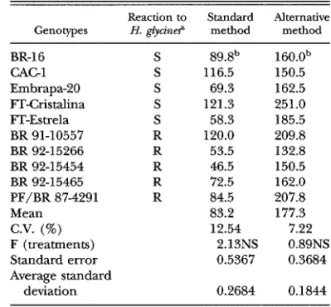
N u m b e r s o f cysts p e r 100 c m 3 o f soil as d e t e r m i n e d by the two s c r e e n i n g m e t h o d s a n d results derived f r o m the analysis o f vari- a n c e are given in T a b l e 2. In the alternative m e t h o d the coefficient o f variation, stan- d a r d error, a n d average s t a n d a r d deviation h a d lower values t h a n those o b t a i n e d by the s t a n d a r d m e t h o d . T h e r e were n o significant differences in the initial p o p u l a t i o n o f the soybean cyst n e m a t o d e a m o n g t r e a t m e n t s in e a c h o f the studied m e t h o d s , as d e t e r m i n e d f r o m the F test.
Average n u m b e r s o f cysts in the soil (ini- tial p o p u l a t i o n ) were 83 cysts/100 cm ~ soil for the s t a n d a r d m e t h o d a n d 177 cysts/100 c m 3 soil for the alternative m e t h o d (Table 2). Percentages o f escape for b o t h m e t h o d s
TABLE 2. Initial n u m b e r of Heterodera glycines p e r 100 cm 3 soil obtained with two screenings for H. glycines u n d e r field conditions a n d statistical p a r a m e t e r s ob- tained from the analysis of variance.
Reaction to Standard Alternative Genotypes H. glycines a method method
BR-16 S 89.8 b 160.0 b
CAC-1 S 116.5 150.5
Embrapa-20 S 69.3 162.5
FF-Cristalina S 121.3 251.0
FT-Estrela S 58.3 185.5
BR 91-10557 R 120.0 209.8
BR 92-15266 R 53.5 132.8
BR 92-15454 R 46.5 150.5
BR 92-15465 R 72.5 162.0
P F / B R 8%4291 R 84.5 207.8
Mean 83.2 177.3
C.V. (%) 12.54 7.22
F (treatments) 2.13NS 0.89NS
Standard e r r o r 0.5367 0.3684
Average standard
deviation 0.2684 0.1844
a S-Susceptible; R-Resistant.
Resistance Screening for H. glycines: Arantes et al. 545
are p r e s e n t e d in Table 3. Considering only the susceptible genotypes, since escape oc- curs w h e n a susceptible g e n o t y p e does n o t show cysts o r females o n its roots, the stan- d a r d m e t h o d h a d an e r r o r o f 37.7%, which d i f f e r e d f r o m 7.7% f o r t h e a l t e r n a t i v e m e t h o d . This difference was significant ac- c o r d i n g to the binomial test a n d showed that the alternative m e t h o d allowed fewer escapes.
T h e calculated value for the chi-square test (×2), c o m p a r i n g b o t h selection m e t h o d s based o n the observed a n d e x p e c t e d n u m - ber o f escapes, was 19.95. Since the ×2 dis- tribution with 4 degrees o f f r e e d o m a n d ~ = 0.05 was equal to 4.49, the hypothesis was r e j e c t e d a n d the n u m b e r o f escapes ob- tained by the two m e t h o d s was significatively different a m o n g the genotypes. T h e alterna- five m e t h o d p r o d u c e d lower m e a n escape v a l u e s , t h u s s h o w i n g h i g h e r e f f i c i e n c y (Table 3). In all susceptible genotypes used in the present study, the variances o b t a i n e d for the alternative m e t h o d were lower than those o b t a i n e d f o r the s t a n d a r d m e t h o d (Table 3). Thus, the alternative m e t h o d was m o r e accurate a n d precise than the stan- d a r d m e t h o d .
Considering that the u n e v e n spatial distri- b u t i o n o f H. glycines is o n e o f the difficulties
to be faced w h e n evaluating soybeans for re- sistance to the soybean cyst n e m a t o d e in naturally infested soybean areas (Schmitt, 1992), the alternative m e t h o d h a d specific advantages. It allowed the evaluation o f an area with a h i g h e r p o p u l a t i o n a n d with a better spatial distribution o f the soybean cyst n e m a t o d e p o p u l a t i o n t h a n the s t a n d a r d m e t h o d . T h e h i g h e r initial p o p u l a t i o n den- sity o b t a i n e d with the alternative m e t h o d was due to the fact that the n e m a t o d e mul- tiplied just before sowing the test genotypes, while in the standard m e t h o d the experi- mental area lay fallow for approximately 7 months.
T h e advantages o f the m e t h o d p r o p o s e d here over that p r o p o s e d by Ross a n d Brim (1957), in which a non-pubescent, suscep- tible g e n o t y p e was used as control, a n d also over the standard m e t h o d are easier operat- ing conditions a n d a lower p e r c e n t a g e o f escape. Evaluation o f soybean genotypes un- d e r g r e e n h o u s e conditions is certainly the m o s t reliable m e t h o d (Caviness, 1992). Ideal c o n d i t i o n s are n o t always available, a n d the alternative m e t h o d for selecting soy- bean genotypes u n d e r field conditions rep- resents a g o o d o p t i o n since it allows evalua- tion in a m o r e h o m o g e n o u s cyst-infested area.
TABLE 3. P e r c e n t a g e o f escapes o f two m e t h o d s for s e l e c t i o n for resistance to Heterodera glycines u n d e r field conditions.
Standard method Alternative method
Genotype % escapes Variance % escapes Variance Susceptible
BR-16 45.0
CAC-1 16.7
Embrapa-20 28.3 FT-Cristalina 43.3 FT-Estrela 55.0 Mean (S) 37.7 Resistant
BR 91-10557 0.0 BR 92-15266 0.0 BR 92-15454 0.0 BR 92-15465 0.0
PF/BR 87-4291 13.3
Mean (R) 2.7
14.85 5.0 2.85
8.34 5.0 2.85
12.17 3.3 1.91
14.73 25.0 5.25
14.85 0.0 0.00
5 4 6 Supplement to the Journal of Nematology, Volume 30, No. 4S, December 1998
LITERATURE CITED
Campos, H. 1979. Estatistica e x p e r i m e n t a l n~o- param~trica. Piracicaba, Brazil: Escola Superior de Ag- ricultura Luiz de Queir6z/Universidade de S~o Paulo. Caviness, C.E. 1992. Breeding for resistance to soy-
bean cyst nematode. Pp. 143-156 in R. D. Riggs and
J. A. Wrather, eds. Biology and management of the soy- bean cyst nematode. St. Paul, MN: APS Press.
Fehr, W. R., and C. E. Caviness. 1979. Stages of soy- bean development. Special Report 80. Iowa State Uni- versity, Ames, IA.
Hartwig, E.E. 1985. Breeding productive soybeans with resistance to soybean cyst nematode. Pp. 394-399
in R. Shibles, ed. World soybean research conference,
III. Ames, IA, 12-17 August 1984. Boulder, CO: V~rest -
view Press.
Lima, R. D., S. Ferraz, a n d J . M. Santos. 1992. Ocor-
r6ncia de Heterodera sp. em soja no Trifingulo Mineiro.
P. 81 in Soc. Bras. de Nematologia, ed. XXVI Congresso Brasileiro de Nematologia. Lavras, Brazil, MG: Escola Superior de Agricultura de Lavras.
Lordello, A. I. L., R. R.A. Lordello, and J. A. Quag-
gio. 1992. Heterodera sp. reduz produ~Xo de soja no Bra-
sil. P. 81 in Sociedade Brasileira de Nematologia, ed.
XXVI Congresso Brasileiro de Nematologia. Lavras, Brazil: Escola Superior de Agricultura de Lavras.
Monteiro, A. R., and S. R. A. C. Morals. 1992. Ocor-
r~ncia do nemat6ide de cisto da soja, Heterodera glycines,
Ichinohe, 1952, prejudicando a cultura no Mato Grosso do Sul. Nematologia Brasileira 16:101.
Pimentel Comes, F. 1985. Curso de Estatistica experi- mental. Piracicaba, Brazil: Editora da Universidade de S~o Paulo.
Ross, J. P., and C.A. Brim. 1957. Resistance of soy- beans to soybean cyst nematode as determined by the double-row method. Plant Disease Reporter 41:923- 924.
Schmitt, D. P. 1992. Population dynamics. Pp. 51-69
in R. D. Riggs andJ. A. Wrather, eds. Biology and man-
agement of the soybean cyst nematode. St. Paul, MN: APS Press.
Shepherd, A. M. 1970. Extraction and estimation of
Heterodera. Pp. 23-33 in J. F. Southey, ed. Laboratory methods for work with plant and soil nematodes. Lon- don: Her Majesty's Stationery Office.
Wonnacott, R.J., and T. H. Wonnacott. 1982. Statis- tics-discovering its power. New York: J o h n Wiley & Sons.