Atypical chromosome abnormalities in acute myeloid leukemia type M4
Agnes C. Fett-Conte
1, Roseli Viscardi Estrela
2, Cristina B. Vendrame-Goloni
3, Andréa B. Carvalho-Salles
1,
Octávio Ricci-Júnior
4and Marileila Varella-Garcia
51
Departamento de Biologia Molecular, Faculdade de Medicina de São José do Rio Preto,
São José do Rio Preto, SP, Brazil.
2
Austa Hospital, São José do Rio Preto, SP, Brazil.
3Departamento de Biologia, Instituto de Biociências, Letras e Ciências Exatas,
Universidade Estadual Paulista, São José do Rio Preto, SP, Brazil.
4
Hemocentro, São José do Rio Preto, SP, Brazil.
5
Comprehensive Cancer Center, University of Colorado, Denver, CO, USA.
Abstract
This study reports an adult AML-M4 patient with atypical chromosomal aberrations present in all dividing bone mar-row cell at diagnosis: t(1;8)(p32.1;q24.2), der(9)t(9;10)(q22;?), and ins(19;9)(p13.3;q22q34) that may have origi-nated transcripts with leukemogenic potential.
Key words:acute myeloid leukemia, chromosomal abnormalities, chromosomal translocations. Received: February 10, 2006; Accepted: June 22, 2006.
Acute non-lymphocytic or myelogenous leukemia (ANLL or AML) represents a hematopoietic malignancy characterized by abnormal cell proliferation and stalled dif-ferentiation leading to the accumulation of immature cells in the marrow itself, in peripheral blood and eventually in other tissues. Primary chromosomal abnormalities in AML are highly specific and considered to be associated with leukemic transformation, whereas secondary changes are less specific and probably contribute to disease progres-sion. As reviewed by Chen and Sandberg. (2002), the com-mon chromosomal abnormalities in the acute myelocom-mono- myelomono-cytic leukemia FAB (French-American-British Cooperative Group) type M4 include monosomy 5 or del(5q), monosomy 7 or del(7q), trisomy 8, t(6;9) (p23;q34), and rearrangements involving the Mixed Lin-eage Leukemia (MLL) gene mapped at 11q23 [del(11) (q23); t(9;11)(p22;q23), t(11;19)(q23;p13)], and Core Bin-ding Factor B (CBFβ) mapped at 16q22 [del(16)(q22), inv(16)(p13q22), t(16;16)(p13;q22)]. Less frequently, trisomy 4, trisomy 22, t(8;21)(q22;q22) and rearrange-ments with breakpoints in 3q21, 3q26, 8p11, 11p15 and 11q13 have also been reported in FAB M4 type patients
(Mitelman Database of Chromosome Aberration in Cancer 2006). Karyotype is generally an important prognostic fac-tor in AML, a favorable prognosis being associated with minor karyotypic changes, low frequency of abnormal bone marrow cells and changes specifically involving the
CBFβ gene, while a poor prognosis is associated with a monosomy 5, monosomy 7, trisomy 8, abnormalities in the 3q andchanges specifically involving theMLLgene (Strout et al., 1999; Chen and Sandberg, 2002). Atypical
cyto-genetic findings have been sporadically reported in AML-M4 but the scarcity of these abnormalities poses a chal-lenge to using such changes as prognostic factors, reinforc-ing the need for the collection of clinical data on rare events.
In this paper we describe an adult male patient diag-nosed with hematological and clinical characteristics of AML-M4 who presented good response to treatment. Cyto-genetic analyses revealed atypical structural aberrations not previously described in AML-M4 that could only be prop-erly identified using G-banding, spectral karyotyping (SKY) and metaphase fluorescence in situ hybridization
(FISH) analyses.
Bone marrow aspirate withdrawn at diagnosis of the disease was used for classical and molecular cytogenetic analysis after a 24-h non-stimulated culture in RPMI1640 medium with 20% fetal calf serum. G-banding (20 cells) and spectral SKY analyses (10 cells) were performed as
de-Genetics and Molecular Biology, 30, 1, 6-9 (2007)
Copyright by the Brazilian Society of Genetics. Printed in Brazil www.sbg.org.br
Send correspondence to Agnes Cristina Fett-Conte. Departamento de Biologia Molecular, Faculdade de Medicina de São José do Rio Preto, Av. Brigadeiro Faria Lima 5416, Bairro Universitário, 15090-000 São José do Rio Preto, SP, Brazil. E-mail: genetica@ famerp.br.
scribed in Vendrame-Goloniet al. (2003) and the
karyo-types were described according to the International System for Human Cytogenetic Nomenclature (ISCN, 2005). The metaphase FISH assays were performed according to a standard protocol (Estécio et al., 2002) and used the
TelVysion 8q and the LSI C-MYC probes labeled with SpectrumOrange (Vysis/Abbott Laboratories) and a 4-cosmid contig mapped just centromeric to theTFP3
(E2A) gene (Boomeret al., 2001) which was labeled with
SpectrumGreen.
The patient was a 32-year-old man who presented to the Austa Hospital (São José do Rio Preto, São Paulo state, Brazil) in October 2000 with fever, petechiae, cough and fatigue. He had no hepatosplenomegaly or lymph node en-largement but his hemogram showed pancytopenia, with 8.2 g/dL of hemoglobin, a hematocrit of 25.3% and a white blood cell count of 2 x 10⁹/µL (8% neutrophils, 41%
lym-phocytes and 46% blast cells). A bone marrow aspirate showed hypercelullarity with 78% of myeloblasts and monocyte lineage cells. Cytochemical tests showed 44% Sudan-Black positive and 10% periodic acid Schiff (PAS) positive blast cells and 32% of non-erythroid blast cells were positive for non-specific alpha-naphylacetate este-rase. The patient reported no previous exposure to cyto-toxic or mutagenic agents. The diagnosis ofde novoacute
myeloid leukemia FAB classification type M4 was made. This study was approved by the ethics committee of the IBILCE-UNESP, São José do Rio Preto, SP, Brazil.
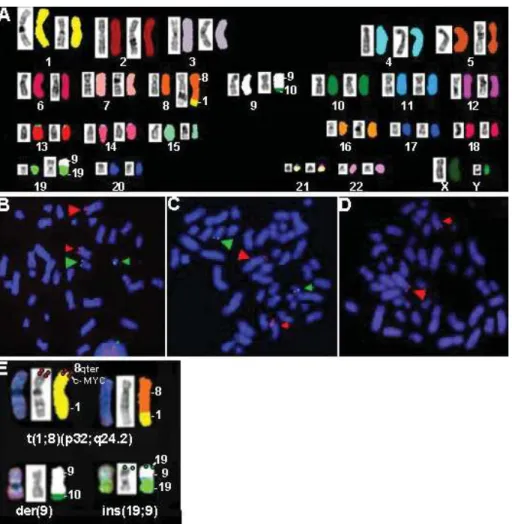
Cytogenetic analysis using G-banding showed struc-tural changes interpreted as two reciprocal translocations, t(1;8)(p32;q24) and t(9;19)(q22;p13), in the 20 cells ana-lyzed.Independent SKY analysis detected four abnormal chromosomes [i.e. del(1)(p32), der(8)t(1;8)(p32.1;q24.2), der(9)t(9;10)(q22;?) and der(19)t(9;19)(q22;p13.3)] in the 10 cells analyzed by this technique (Figure 1A). These find-ings were supported by the metaphase FISH studies per-formed using the C-MYC, TelVysion 8q and 19p13.3 contig probes. The TelVysion probe recognized homology with the normal 8q and with the terminal region of the short arm of the chromosome designated as del(1)(p32) in the SKY analysis (Figures 1B, C), therefore confirming the re-ciprocal translocation t(1;8) detected by G-banding analy-sis. The MYC gene sequence was also detected in the
der(1), indicating that the 8q24 breakpoint was proximal to this gene (Figure 1D). The 19p13.3 contig probe recog-nized homology with the distal region of the p-arm of the normal chromosome 19 and the end of the rearranged arm of the abnormal chromosome 19, distal to the material iden-tified as originating from chromosome 9 (Figures 1B, C). Therefore, the chromosome postulated previously to be der(19)t(9;19) was identified as an ins(19;9)(p13.3;q22 q34) with the breakpoint proximal to theTFPT(E2A) gene.
On the basis of all the tests (summarized in Figure 1E), the patient’s karyotype was interpreted as 46,XY,t(1;8)
(p32.1;q24.2), der(9)t(9;10)(q22;?), ins(19;9)(p13.3;q22 q34).
The patient was submitted to remission-induction chemotherapy with 100 mg/m2/day of intravenous cytosine
arabinoside (ara-C) continuously for 7 days and 12 mg/m2/day of intravenous idarubicin for 2 days.
Com-plete remission was achieved after the first course of induc-tion chemotherapy. The patient then received three courses of consolidation chemotherapy consisting of 2 mg/m2/day
of ara-C for 4 days and 45 mg/m2/day of doxorubicin for
2 days followed by non-related allogeneic bone marrow transplantation. The patient has remained disease-free as at January 2006.
Clinical descriptions of atypical cytogenetic cases are rare but can be useful for clinicians. An inv(4)(p14q27) was described as the sole karyotypic anomaly at diagnosis in the bone marrow from an adult patient who responded poorly to chemotherapy and had a short survival time (Benasayag
et al., 2002).
At the time of the AML-M4 diagnosis our patient pre-sented a karyotype with three atypical clonal abnormalities, t(1;8)(p32.1;q24.2), der(9)t(9;10)(q22;?), and ins(19;9) (p13.3;q22q34). Interestingly, these abnormalities in-volved four breakpoints (1p32, 8q24.2, 9q22, and 19p13.3) reported as being disrupted in a few AML M4 cases. Of these breakpoints the 9q22 breakpoint has most often been reported to be involved in anomalies, although in the major-ity of patients it has occurred in association with other ma-jor changes (Stroutet al., 1999) such as t(8;21)(q22;q22),
t(12;19)(p11;p11), t(16;21)(p11;q22), del(11(q23) and del(12)(p11). In the literature, only three AML-M4 patients have shown single deletions involving this region. The 9q22 regionharbors numerous potential leukemogenic genes, such as theHEMGN(EDAG) gene which is
sequen-tially expressed at active hematopoietic sites and down-regulated during the differentiation of blood cells (Yanget al., 2001) and theNOR-1(NRA3) gene which is an `orphan
member’ of the nuclear hormone receptor superfamily im-plicated in cell proliferation, differentiation and T-cell apoptosis, although the mechanisms controlling transcrip-tional activation, coactivator recruitment and agonist-mediated activation still remain obscure (Laflammeet al.,
2003).
The other three breakpoints (1p32, 8q24.2 and 19p13.3) detected in our patient have been less frequently reported in AML-M4. Deletions and translocations involv-ing 1p32 are common in T-ALL (T-cell acute lympho-blastic leukemia) but only three AML-M4 cases are listed in the Cancer Genome Anatomy Project (Mitelman Data-base of Chromosome Aberration in Cancer 2006; Stroutet al., 1999), two with t(1;11)(p32;q23) and one with t(1;21)
(p32;q22). Numerous genes clustered at 1p32 are potential candidates in leukemogenesis, among them theTAL1gene
(Perottiet al., 1999; Carlotti et al., 2002) and the AF1P
gene which was investigated in one of the AML-M4
tients (Cherryet al., 2001). Breakpoints at 8q24.2, in
asso-ciation with multiple chromosome abnormalities have been reported in two AML M4 patients(Stroutet al.1999) and may affect the expression of theMYConcogene. In our pa-tient, theMYCgene was confirmed as translocated to the
derivative chromosome 1, but specimens from the patient were not available for protein expression assessment. Ab-normalities involving chromosome band 19p13.3 are com-mon in ALL and AML. The chromosome 19 insertion breakpoint was proximal toTFPT(TCF3, E2A) which
sug-gested that theMLLT1(ENL) gene could be a target for
dis-ruption. The MLLT1 gene has been causally related to leukemias including AML-M4 (Stroutet al.,1999; Rubnitz and Look, 1998; Brambillasca et al., 2001; Kopf and
Miskin, 2005). All these structural abnormalities are poten-tially associated with deregulation of genes playing key roles in cell proliferation and differentiation, either by jux-taposing these genes to constitutively active foreigner pro-moters or producing fusion transcripts with leukemogenic
potential. However the nature of the specific gene(s) altered in our patient remains unknown.
In conclusion, our study indicates that a combination of techniques was essential to reveal cryptic chromosome rearrangements in this leukemia patient. Importantly, de-spite presenting a complex karyotype, which is recognized as poor prognostic factor in leukemia (Chen and Sandberg, 2002; Ferrantet al., 1997), the patient showed an excellent response to treatment and has remained in remission for over 5 years.
Acknowledgments
The study was partially supported by a United States National Institute of Health-National Cancer Institute con-tract grant CA 46934 to the University of Colorado Com-prehensive Cancer Center and by funding from the Brazilian institutions BAP (Bolsa de Auxílio à Pesquisa) da Faculdade de Medicina de São José do Rio Preto
8 Atypical chromosomal changes in AML-M4
(FAMERP) and the Brazilian Federal agency Coordenação de Aperfeiçoamento de Pessoal de Nível Superior (CA-PES).
References
Benasayag S, Arias E, Baialardo E, Reyes M, Sapia S, Bistmans A and Slavutsky I (2002) Inv(4)(p14q27) in a case with de novo acute nonlymphocytic leukemia. Acta Haematol 108:39-42.
Boomer T, Varella-Garcia M, Mc Gavran L, Meltesen L, Olsen AS and Huger SP (2001) Detection of E2A translocations in leukemias via fluorescencein situhybridization. Leukemia 15:95-102.
Brambillasca F, Mosna G, Ballabio E, Biondi A, Boulukos KE and Privitera E (2001) Promoter analysis of TFPT (FB1), a molecular partner of TCF3 (E2A) in childhood acute lymphoblastic leukemia. Biochem Biophys Res Commun 288:1250-1257.
Carlotti E, Pettenella F, Amaru R, Slater S, Lister TA, Barbui T, Basso G, Cazzaniga G, Rambaldi A and Biondi A (2002) Molecular characterization of a new recombination of the SIL/TAL-1 locus in a child with T-cell acute lymphoblastic leukaemia. Br J Haematol 118:1011-1018.
Chen Z and Sandberg AA (2002) Molecular cytogenetic aspects of hematological malignacies: Clinical implications. Am J Med Genet 115:130-141.
Cherry AM, Charles DB, Jones P, Hall S and Natkunam Y (2001) A unique AML1 (CBF1A) rearrangement, t(1;21)(p32;q22), observed in a patient with acute myelomonocytic leukemia. Cancer Genet Cytogenet 129:155-160.
Estécio MRH, Fett-Conte AC, Varella-Garcia M, Cíntia Fridman C and Silva AE (2002) Molecular and cytogenetic analyses on Brazilian youths with pervasive developmental disor-ders. J Autism Dev Disord 32:35-42.
Ferrant A, Labopin M, Frassoni F, Prentice HG, Cahn JY, Blaise D, Reiffers J, Visani G, Sanz MA, Boogaerts MA, Löwen-berg B and Gorin NC (1997) Karyotype in acute myelo-blastic leukemia: Prognostic significance for bone marrow
transplantation in first remission: An European group for blood and marrow transplantation study. Blood 90:2931-2938.
ISCN (2005) An International System for Human Cytogenetic Nomenclature. Shaffer LG and Tommerup N (ed), S. Kar-ger, Basel, 130 pp.
Kopf E and Miskin R (2005) A RUNX/AML-binding motif resid-ing in a novel 13-bp DNA palindrome may determine the ex-pression of the proximal promoter of the human uPA gene. J Thromb Haemost. 3:2057-2064.
Laflamme C, Filion C, Bridge JÁ, Ladanyi M, Goldring MB and Labelle Y (2003) The homeotic protein Six3 is a coactivator of the nuclear receptor NOR-1 and a corepressor of the fu-sion protein EWS/NOR-1 in human extraskeletal myxoid chondrosarcomas. Cancer Res 63:449-454.
Mitelman Database of Chromosome Aberrations in Cancer (2006) Mitelman F, Johansson B and Mertens F (eds), http://cgap.nci.nih.gov/Chromosomes/Mitelman.
Perotti D, Pettenella F, Luksch R, Giardini R, Gambirasio F, Ferrari D, Fossati-Bellani F and Biondi A (1999) Molecular analysis of 1p32 genetic involvement in pediatric T-cell non-Hodgkin’s. Hematologica 84:110-113.
Rubnitz E and Look AT (1998) Molecular genetics of childhood leukemias. J Hematol Oncol 20:1-11.
Strout MP, Marcucci G, Caligiuri MA and Bloomfield CD (1999) Core-binding factor (CBF) and MLL-associated primary acute myeloid leukemia: Biology and clinical implications. Ann Hematol 78:251-264.
Vendrame-Goloni CB, Varella-Garcia M, Carvalho-Salles AB, Ruiz MA, Ricci Júnior O and Fett-Conte AC (2003) Trans-location (11;19)(q23;p13.3) associated with a novel t(5;16) (q13;q22) in a patient with acute myelocytic leukemia. Can-cer Genet Cytogenet 141:71-74.
Yang LV, Nicholson RH, Kaplan J, Galy A and Li L (2001) Hemogen is a novel nuclear factor specifically expressed in mouse hematopoietic development and its human homo-logue EDAG maps to chromosome 9q22, a region contain-ing breakpoints of hematological neoplasms. Mech Dev 104:105-111.
Associate Editor: Peter L. Pearson