Multiple RNA Processing Defects and
Impaired Chloroplast Function in Plants
Deficient in the Organellar Protein-Only
RNase P Enzyme
Wenbin Zhou, Daniel Karcher, Axel Fischer, Eugenia Maximova, Dirk Walther, Ralph Bock*
Max-Planck-Institut für Molekulare Pflanzenphysiologie, Potsdam-Golm, Germany
Abstract
Transfer RNA (tRNA) precursors undergo endoribonucleolytic processing of their 5’and 3’
ends. 5’cleavage of the precursor transcript is performed by ribonuclease P (RNase P). While in most organisms RNase P is a ribonucleoprotein that harbors a catalytically active RNA component, human mitochondria and the chloroplasts (plastids) and mitochondria of seed plants possess protein-only RNase P enzymes (PRORPs). The plant organellar PRORP (PRORP1) has been characterized to some extentin vitroand by transient gene si-lencing, but the molecular, phenotypic and physiological consequences of its down-regula-tion in stable transgenic plants have not been assessed. Here we have addressed the function of the dually targeted organellar PRORP enzymein vivoby generating stably trans-formedArabidopsisplants in which expression of thePRORP1gene was suppressed by RNA interference (RNAi).PRORP1knock-down lines show defects in photosynthesis, while mitochondrial respiration is not appreciably affected. In both plastids and mitochondria, the effects ofPRORP1knock-down on the processing of individual tRNA species are highly var-iable. The drastic reduction in the levels of mature plastid tRNA-Phe(GAA) and tRNA-Arg (ACG) suggests that these two tRNA species limit plastid gene expression in thePRORP1
mutants and, hence, are causally responsible for the mutant phenotype.
Introduction
In all organisms, transfer RNAs (tRNAs) are synthesized as precursor transcripts that undergo extensive post-transcriptional processing, before they can be aminoacylated and serve as amino acid donors in protein biosynthesis. tRNA maturation involves processing of the 5’and 3’ends as well as extensive chemical modification of individual nucleosides [1–4]. Plant cells need tRNA-processing and tRNA-modifying enzymes in three distinct cellular compartments (nucleocytosolic compartment, mitochondria and plastids). In recent years, several enzymes
OPEN ACCESS
Citation:Zhou W, Karcher D, Fischer A, Maximova E, Walther D, Bock R (2015) Multiple RNA Processing Defects and Impaired Chloroplast Function in Plants Deficient in the Organellar Protein-Only RNase P Enzyme. PLoS ONE 10(3): e0120533. doi:10.1371/journal.pone.0120533
Academic Editor:Lennart Randau, Max-Planck-Institute for Terrestrial Microbiology, GERMANY
Received:November 4, 2014
Accepted:January 23, 2015
Published:March 20, 2015
Copyright:© 2015 Zhou et al. This is an open access article distributed under the terms of the
Creative Commons Attribution License, which permits unrestricted use, distribution, and reproduction in any medium, provided the original author and source are credited.
Data Availability Statement:All relevant data are within the paper and its Supporting Information files.
Funding:This work was supported by a grant from the Deutsche Forschungsgemeinschaft (FOR 804, BO 1482/15-2) to RB and by the Max Planck Society. The funders had no role in study design, data collection and analysis, decision to publish, or preparation of the manuscript.
involved in tRNA processing and tRNA modification have been identified for all three com-partments (e. g., [5–9]).
In eukaryotes and most prokaryotes, the mature 5’end of tRNAs is generated by the endori-bonuclease RNase P. An exception are some archaea that lack an RNase P activity and synthe-size 5’leaderless tRNAs [10]. In most organisms that possess RNase P, it is a ribonucleoprotein consisting of a highly structured RNA and one or more protein subunits [11,1]. The catalytic activity resides in the RNA component of RNase P, thus qualifying it as a ribozyme [12–15]. Evidence for the existence of a different type of RNase P that lacks an RNA component was first provided for spinach chloroplasts [16]. However, the subsequent identification of putative RNase P genes in the plastid genomes of algae cast some doubt on the existence of protein-only RNase P enzymes [17–20]. Only recently a protein-only RNase P was unambiguously identi-fied. The enzyme, isolated from human mitochondria, is composed of three protein subunits, called MRPP1, MRPP2 and MRPP3, of which subunit 3 was suggested to be catalytically active [21]. Subsequently, based on sequence similarity to MRPP3, RNA-free RNase P enzymes were also identified from the model plantArabidopsis thaliana[7,8] and from the moss Physcomi-trella patens[22]. TheArabidopsisnuclear genome contains three putative homologs of MRPP3, termed PRORP1, PRORP2 and PRORP3. PRORP2 and PRORP3 are localized in the nucleus, where they process tRNAs and small nucleolar RNAs (snoRNAs). Lack of mutant phenotypes inprorp2andprorp3single mutants and embryo lethality ofprorp2/prorp3double mutants suggests that the two proteins exert overlapping, if not redundant, functions in the nucleocytosolic compartment [8]. By contrast, PRORP1 is targeted to both DNA-containing cell organelles. Evidence fromin vitrostudies [7] and transient transformation experiments (using virus-induced gene silencing; [8]) suggests that both mitochondrial and chloroplast tRNAs (as well as some mitochondrial mRNAs harboring tRNA-like secondary structures at their termini) are substrates of PRORP1. Interestingly, PRORP1 can also rescue an RNase P-deficientEscherichia colistrain [7], providing further evidence for the protein being sufficient to faithfully perform tRNA 5’maturation.
Although the identification of PRORP1 as organellar RNase P is now well established, the phenotypic and physiological consequences of PRORP1 deficiency and the relative importance of RNase P functions in plastids versus mitochondria have not been assessed. This is due to
PRORP1being an essential gene inArabidopsisthat cannot be knocked out [7]. Here we have generated stable transgenic plants, in whichPRORP1is down-regulated by RNA interference (RNAi). Characterization of the molecular and physiological defects in the mutants revealed that, while there is little evidence for impaired mitochondrial function, photosynthesis as the main function of chloroplasts is severely affected. Moreover, the effects on the processing of different tRNA species in mitochondria and plastids are highly variable. Extremely low levels of mature plastid tRNA-Phe(GAA) and tRNA-Arg(ACG) suggests impaired maturation of these two tRNA species as a main cause of the RNase P-deficient mutant phenotype.
Materials and Methods
Plant material and growth conditions
chlorophyll fluorescence and respiration, plants were grown under short-day conditions (8 h light/16 h dark).
Generation of
PRORP1
RNAi plants
The transformation vector for down-regulation ofPRORP1inArabidopsiswas obtained from the AGRIKOLA collection of RNAi vectors [24]. Plasmid CATMA2a30510 carries a 402-bp PCR product corresponding to positions 74 to 475 of thePRORP1coding region. The gene-specific tag ofPRORP1(in CATMA2a30510) was recombined from the pENTR207 vector into pK7GWIWG2(I) [25]. The construct was then transformed intoAgrobacterium tumefaciens
strain GV3101 and introduced intoArabidopsis thalianawild-type plants via the floral dip method [26]. Transgenic plants were selected for kanamycin resistance by germination of sur-face-sterilized seeds on agar-solidified half-strength MS medium containing 1% sucrose and 50 mg L-1kanamycin. Resistant seedlings were transferred to soil and grown to maturity in a controlled environment chamber under long-day conditions.
Pigment analysis
Chlorophyll and carotenoid contents were measured spectrophotometrically according to pub-lished protocols [27]. All measurements were performed with three biological replicates.
Measurement of respiration activity
Oxygen consumption ofArabidopsisleaves was measured in the dark at 25°C using a Clark-type oxygen electrode (Hansatech Instruments). Respiration activity of mutant and wild-Clark-type leaves was determined by cutting leaf samples into small pieces with a sharp razor blade and adding leaf pieces equivalent to 15 to 25 mg fresh weight to the measuring chamber containing 1 mL of buffer (10 mM MES-KOH, pH 6.5).
Analysis of chlorophyll fluorescence
Chlorophyllafluorescence at room temperature was measured in intact plants using a pulse amplitude modulated fluorometer (DUAL-PAM-100; Heinz Walz GmbH; [28]). Plants were dark adapted for 15 min prior to all measurements. The minimum fluorescence in the dark-adapted state (F0) was excited by a weak measuring light (650 nm; 0.05 to 0.1μmol photons m
-2s-1). A saturating pulse of white light (800 ms, 3000
μmol photons m-2s-1) was applied to
de-termine the maximum fluorescence in the dark-adapted state (Fm) and during illumination
with actinic light (Fm’). The maximum photochemical efficiency of photosystem II (PSII) was
calculated as [Fv/Fm= (Fm-F0)/Fm]. The steady state fluorescence level (Fs) was recorded during
illumination with actinic light (15 to 1000μmol photons m-2s-1). The minimum fluorescence
in the light-adapted state (F0’) was measured in the presence of far-red light after the actinic
light had been turned off. The quantum yield of PSII (ФPSII) was calculated as (Fm’-Fs)/Fm’.
The relative rate of electron transport through PSII (electron transport rate) was calculated as
ФPSII× light intensity (μmol photons m-2s-1). Non-photochemical quenching (qN) was
calcu-lated as 1-(Fm’-F0’)/(Fm-F0). For measurements of light-response curves, plants were
illuminat-ed at the following light intensities: 0, 18, 30, 42, 62, 83, 105, 135, 173, 222, 280, 347, 432, 540, 661 and 813μmol photons m-2s-1.
isolation, leaves from 20-day-old plants were homogenized in a buffer containing 0.33 M sorbi-tol, 50 mM HEPES (pH 8.0), 1 mM MgCl2and 2 mM Na2EDTA. The slurry was filtered
through two layers of Miracloth (Calbiochem) and centrifuged at 10,000 x g for 15 min at 4°C. The pellet was resuspended in the same buffer, and the chlorophyll concentration was adjusted to 10μg/ml.
Microscopic techniques
Leaf anatomy was analyzed by light microscopy. To this end, tissue samples of approximately 1 mm3were fixed with 4% paraformaldehyde and 0.2% glutaraldehyde in 0.1 M phosphate buffer (pH 7.4), vacuum infiltrated and incubated at 4°C overnight. The samples were then rinsed in the same buffer, dehydrated in an ethanol series (30, 50, 70, 80, 90 and 100%) by incu-bation for 1 h in each solution, and infiltrated with Technovit 7100 resin (Heraeus Kulzer) for up to 24 h [30]. Following polymerization at room temperature, light microscopic analysis was performed on 5μm cross-sections cut with a rotary microtome (RM 2265; Leica) and placed
on poly-L-lysine-coated glass slides (Sigma). The slides were air-dried at 37°C for 2 h on a heat-ing plate, and then stained with toluidine blue O (0.05% solution). The stained leaf sections were examined with a motorized epi-fluorescence microscope (Olympus BX61) using the cell^P software (Olympus).
For ultrastructural analysis of chloroplasts and mitochondria, leaf samples were fixed in 2.5% glutaraldehyde in 0.2 M sodium cacodylate (pH 7.4) for a minimum of 8 h. Post-fixation with 2% osmium tetroxide was done in the same buffer for 4 h. After rinsing the leaf samples in cacodylate buffer, dehydration and embedding in Spurr’s epoxy resin were carried out follow-ing standard protocols. Semithin sections (1–2μm) were cut with glass knives, and thin
sec-tions for silver impregnation were cut with diamond knives. For electron microscopy, thin sections were stained with 2% uranyl acetate and lead citrate and examined in a Zeiss EM 912 Omega transmission electron microscope (Carl Zeiss).
Isolation of nucleic acids and hybridization procedures
Total plant DNA was extracted from fresh leaf material using a cetyltrimethylammoniumbro-mide (CTAB)-based protocol [31]. Total RNA was isolated using a guanidine isothiocyanate-/phenol-based method (peqGOLD TriFast; Peqlab GmbH) following the manufacturer’s instructions. For northern blot analysis, RNA samples were electrophoretically separated in formaldehyde-containing 1.5% agarose gels and transferred to positively charged nylon mem-branes (Roche). Hybridizations were performed with digoxigenin (DIG)-labeled probes at 50°C overnight. Probes were produced by labeling PCR products with the PCR DIG Probe Syn-thesis Kit (Roche). Hybridization signals were detected using the CDP-Star reagent. Pre-hy-bridization, hyPre-hy-bridization, washing and detection were performed according to Roche’s DIG Application Manual. The primers used to generate PCR products for DIG labeling are listed in
S1 Table.
Analysis of tRNA editing and DNA sequencing
electrophoresis in agarose gels and purified from excised gel slices using a NucleoSpin Extract II kit (Macherey-Nagel).
Quantitative RT-PCR
Samples of 1μg total RNA treated with TURBO DNase I (Ambion) was used as a template for
first-strand cDNA synthesis in a volume of 20μl with 1μl of Superscript III reverse
transcrip-tase (Invitrogen). cDNAs were used as templates for quantitative real-time PCR (qRT-PCR). Amplification reactions were carried out with the StepOnePlus real-time PCR system (Applied Biosystems) using Absolute SYBR Green ROX mix (Thermo Scientific) for quantitation. Three biological replicates were analyzed. The 2-ΔΔCTmethod was applied to determine
rela-tive transcript levels [32]. Reactions for each tested gene in each cDNA sample were indepen-dently repeated at least three times.EF1alpha(At5g60390) was used as a reference (for primer sequences, see [33]). Specific primers for amplification ofPRORP1(At2g32230) were
Pprorp1_5’(5'-GTTTGATGCAGTCATTGATGGAGC-3') and Pprorp1_3’(
5'-TACAC-GACTCTTGTGCAGGATCAC-3').
Protein isolation and immunoblotting
Total cellular protein fromArabidopsisplants was extracted from 100 mg tissue ground in liq-uid nitrogen and suspended in 150μL extraction buffer (4 mM Tris-HCl, pH 7.5; 5 mM NaCl;
6.25μM MgCl2; 10μM EGTA; 10μM DTT; 1% Triton X-100; protease inhibitor cocktail). Cell
debris were removed by centrifugation at 12,000 rpm for 20 min at 4°C. The protein concentra-tion was measured with a protein assay kit (Bio-Rad) using a diluconcentra-tion series of bovine serum al-bumin (BSA) as standard. For western blot analysis, protein samples were separated by electrophoresis in 12% SDS-polyacrylamide gels and blotted onto polyvinylidene difluoride (PVDF) membranes (GE Healthcare). Membranes were treated with blocking buffer (20 mM Tris-HCl, pH 7.6; 137 mM NaCl; 0.5% BSA) for 1 h and then incubated with the appropriate primary antibody. Detection was performed with the ECL Plus system (GE Healthcare).
tRNA sequencing (tRNAseq) and data analysis
Samples of 12μg of total RNA (extracted from wild-type plants or RNAi-2 mutant plants)
were separated on urea-containing 8% polyacrylamide gels followed by staining with ethidium-bromide. The small RNA fraction (~70 to ~150 nt) was excised from the gel, and the RNA was purified as described previously [5]. RNA libraries were prepared using the NEBNext1
Small RNA Library Prep kit (New England Biolabs), and sequencing was performed on an Illumina HiSeq2000 sequencer at the Max Planck Genome Centre, Cologne, Germany. Illumina se-quencing of size-fractionated RNAs generated 44,992,406 and 48,108,194 raw reads for the wild type and the RNAi-2 line, respectively. These resulted in 40,150,680 genome-mapped reads with an average length of 80 nt for the wild type, and 41,391,939 genome-mapped reads with an average length of 79 nt for the RNAi-2 line. Of those, 2,151,353 and 3,163,815 reads were mapped to tRNA genes in the wild type and the RNAi-2 line, respectively (S1 Fig.).
accumulation levels and tRNA processing efficiency, respectively. Given the repetitive nature of tRNA sequences across the genome, no uniqueness filter was set in genome mapping. Samtools (v0.1.19) was used to compress, sort and index the alignment SAM output (view-bS, sort, index) and generating mapping statistics (flagstat; [35]).
For tRNA accumulation levels, mapped reads were counted for each unique mature tRNA sequence in order to compute RPKM (reads per kilobase per million reads) values and calculate differences (M) and averages (A) for the MA plot. In the MA plot, the average of both log2
ex-pression values [A = {log2(RNAi-2) + log2(WT)}/2] is plotted against the difference in log2
ex-pression values of the two samples [M = (log2(RNAi-2)—log2(WT)].
To generate comparable read annotation statistics, mapped reads were annotated according to their first assignment to a genomic feature in the following order using intersectBed of the BEDtools package [36]: exons, 5’and 3’untranslated regions (‘prime UTRs’), repeats (exclud-ing‘dust’) and tRNA flanks (±50 bp of mature tRNA locations). The annotation file in GTF format was obtained from the same EnsemblPlants FTP site (ftp://ftp.ensemblgenomes. org/pub/release-19/plants/gtf/arabidopsis_thaliana/Arabidopsis_thaliana.TAIR10.19.gtf.gz) and converted into BED format to be compatible with BEDtools input formats.
To determine tRNA processing efficiency, read counts were estimated by intersecting ge-nome mapped data with mature tRNA regions and tRNA flanks (±50 bp of mature tRNA loca-tions) using intersectBed [36] with-f 0.3 and 0.1, respectively. Afterwards, a processing
efficiency rate (PER), defined as the log2ratio of reads mapped on mature and 3' or 5' flanking
region, respectively, was computed for each tRNA in the wild type and the RNAi line to calcu-late differences (M) and averages (A). In the MA plot, the average of both log2expression
val-ues [A = {log2(RNAi-2) + log2(WT)}/2] is plotted against the difference in log2expression
values of the two samples [M = (log2(RNAi-2)—log2(WT)]. The eight plastid tRNAs harboring
introns were not considered in the processing efficiency computations, because of the inevita-ble algorithmic uncertainties associated with gapped transcript read mapping on genome se-quences. Additionally, for the five tRNAs without intron that are present as exact forward and inverted duplicate pairs, read counts were combined and assigned to the forward strand in-stance only. In all subsequent analyses, the respective inverted repeat inin-stance was ignored. For three tRNAs occurring twice in the mitochondrial genome and which have identical mature tRNA sequences and identical 50 bp flanking sequences (but are not annotated as du-plicated regions), read counts were also combined and assigned to the instance listed first on the mitochondrial sequence, as defined by genome coordinates. This instance was then used in all subsequent analyses and all others were ignored.
R v3.0.2 was used for all further statistical analyses and visualizations ( http://www.R-project.org/) including P value calculation and adjustment using Fisher’s exact test and Benja-mini-Hochberg multiple testing correction, respectively.
Results and Discussion
Generation of stable RNAi lines for the organellar RNase P in
Arabidopsis
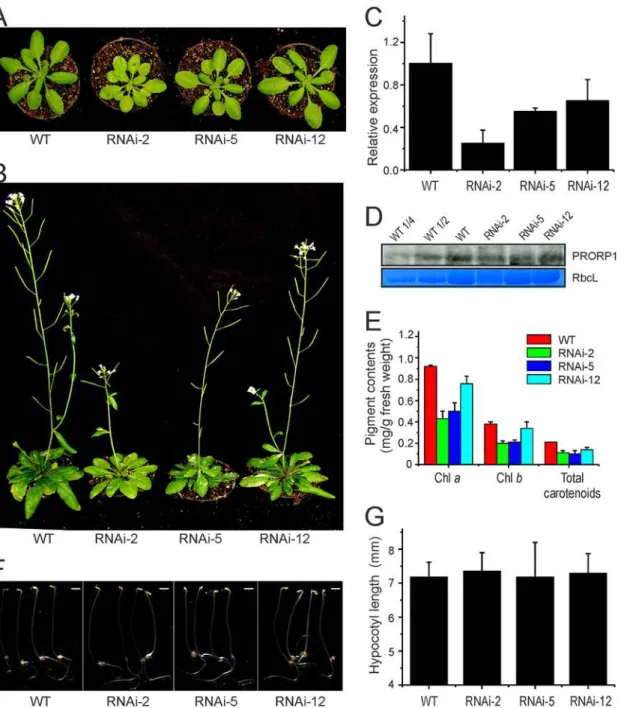
In the absence of viable T-DNA knock-out lines forPRORP1[7], we sought to produce mu-tant plants by RNA interference (RNAi). Transformation ofArabidopsis thalianaplants with a hairpin-type RNAi construct [24] targeted againstPRORP1yielded several independent trans-genic lines, which were subsequently assayed for their phenotypes under standard greenhouse conditions. RNAi is capable of producing a spectrum of phenotypes due to different levels of down-regulation of the target gene in independently generated transgenic lines. Indeed, such a spectrum of phenotypes ranging from a mild reduction in leaf pigment content to severe pig-ment loss and growth retardation was obtained whenPRORP1RNAi lines were analyzed (Fig. 1A,B). Three representative RNAi lines (RNAi-2, RNAi-5 and RNAi-12) were selected for in-depth analysis.
Real-time quantitative RT-PCR was employed to measure the level of down-regulation of
PRORP1expression in the RNAi lines. Consistent with the severity of the phenotypes, RNAi suppression of gene expression was found to be strongest in line RNAi-2, with the residual ex-pression level ofPRORP1being approximately 25% of the expression in the wild type (Fig. 1C), followed by line RNAi-5 (55% residual expression) and line RNAi-12 (65% residual expres-sion). Western blot analysis using an anti-PRORP1 antibody confirmed that the reduction of gene expression was strongest in line RNAi-2 (Fig. 1D).
To preliminarily assess the effects ofPRORP1down-regulation on chloroplast and mito-chondrial function, we determined photosynthetic pigment contents (Fig. 1E) and assayed seed-ling growth in the dark (Fig. 1F,G). While photosynthetic pigment content can serve as a proxy of chloroplast function, seedling growth in the dark can provide information about mitochon-drial function. This is because, in the dark, growth is entirely dependent upon energy produc-tion by respiraproduc-tion, the main funcproduc-tion of mitochondria and the funcproduc-tion that all mitochondrial genes are directly or indirectly involved in [37,38]. In line with the pale-green phenotype of the RNAi lines, the contents of photosynthetic pigments (chlorophylls and carotenoids) were sig-nificantly reduced. The extent of the reduction correlated with the level of down-regulation of
PRORP1expression and the severity of the phenotype of the mutants (Fig. 1A-E). In contrast, seedling growth in the dark (measured as hypocotyl length) was not appreciably impaired in any of the RNAi mutants, possibly indicating that mitochondrial function is less affected by the knock-down ofPRORP1than chloroplast function.
Altered leaf morphology and organellar ultrastructure in
PRORP1
RNAi
mutants
In conjunction with the function of RNase P in tRNA processing, the pigment-deficient pheno-type of thePRORP1RNAi lines provided circumstantial evidence for chloroplast translation being affected in the mutants. The activity of chloroplast gene expression is known to act as the source of a retrograde signal that affects various aspects of plant development, including leaf morphology [39,40] and anatomy [41,33]. At the level of leaf anatomy, the most pronounced effects are seen in mesophyll cell proliferation and differentiation. To analyze whetherPRORP1
mutants show defects in mesophyll cell differentiation, we investigated leaf anatomy by epi-fluorescence microscopy of stained cross sections. Interestingly, thePRORP1RNAi lines showed pronounced alterations in mesophyll organization. Compared to wild-type leaves, the number of spongy mesophyll cell layers was reduced in the RNAi plants and the size of cylin-drical palisade cells was significantly increased (Fig. 2). Again, the severity of this phenotype at the anatomical level correlated with the severity of the phenotype at the level of the whole plant and with the intensity ofPRORP1down-regulation (Figs.1and2).
Fig 1. Phenotypic and molecular analysis ofPRORP1RNAi mutant lines generated inArabidopsis.(A) Phenotypes of three independently generated PRORP1RNAi mutants (RNAi-2, RNAi-5 and RNAi-12) in comparison to wild-type plants (WT). Seven-day-old seedlings raised on synthetic medium were transferred to soil and grown under long-day conditions for 21 days. (B) Phenotypes of the same plants after 35 days under long-day conditions. (C) Down-regulation ofPRORP1expression in the three independently generated RNAi lines as determined by qRT-PCR. Error bars indicate the standard deviation (n = 3). (D) PRORP1 protein accumulation in RNAi mutants and wild-type plants. Total protein was extracted from 25 day-old plants grown under long day conditions, and the PRORP1 protein was detected with a specific antibody (kindly provided by Dr. Philippe Giegé). For quantitative assessment of protein accumulation in the RNAi mutants, a dilution series of the wild-type sample (100%, 50% and 25%) was loaded. The Coomassie-stained RbcL protein band is shown as a loading control. (E) Pigment accumulation in 20-day-old RNAi mutants and WT plants. Error bars indicate the standard deviation (n = 3). Chl: chlorophyll. (F) Phenotypes of five-day-old etiolated seedlings. Scale bar: 1mm. (G) Hypocotyl length of 5-day-old etiolated seedlings. Error bars indicate the standard deviation (n = 15).
changes were seen in both chloroplast and mitochondrial ultrastructure, which were most pro-nounced in the strongest RNAi line, RNAi-2. Chloroplasts were smaller than in wild-type cells and displayed a somewhat more intense stacking of grana thylakoids. This observation is in line with the chlorophylla:bratio being decreased in the mutants (2.43±0.13 in the wild type
Fig 2. Leaf anatomy in wild-type plants and three independently generatedPRORP1RNAi mutants
(RNAi-2, RNAi-5 and RNAi-12).Cross sections of 15-day-old leaves stained with toluidine blue O are
shown. Note reduced spongy mesophyll cell layers and increased size of cylindrical palisade cells in the RNAi plants. E: epidermis; P: palisade parenchyma; S: spongy mesophyll. Scale bars: 200μm.
versus 2.16±0.17 in line RNAi-2;Fig. 1E), which was found to correlate with increased grana stacking also in other mutants with impaired chloroplast function [42]. Mitochondrial shape was also altered in thePRORP1RNAi lines. Whereas, in wild-type cells, mitochondria were round or oval, they were bigger and much more elongated in the mutants, especially in cells of the RNAi-2 line (Fig. 3). In contrast to the previously reported transient repression ofPRORP1
(by virus-induced gene silencing; [8]), we did not observe“dense mitochondrial structures
Fig 3. Transmission electron microscopic images of chloroplasts and mitochondria in 15-day-old
leaves fromPRORP1RNAi mutants and wild-type plants.(A, B) Ultrastructure of chloroplasts and
mitochondria in wild-type cells. For easy organelle identification, a chloroplast (P) and a mitochondrion (M) are labeled. (C-E) Ultrastructure of chloroplasts and mitochondria in cells of the strongPRORP1RNAi mutant line RNAi-2. Note smaller chloroplasts with more pronounced grana stacking and bigger, more elongated mitochondria. (F) Ultrastructure of chloroplasts and mitochondria in line RNAi-5. (G) Chloroplast ultrastructure in the weakest RNAi line (RNAi-12). Scale bars: 1μm.
containing vacuoles”. Whether this alteration in mitochondrial morphology represents a direct compensatory response to impaired mitochondrial gene expression or rather an indirect conse-quence of disturbed chloroplast function in the RNAi mutants, remains to be determined.
Analysis of photosynthesis and respiration in
PRORP1
mutants
In order to analyze the physiological consequences of knocked-downPRORP1expression in more detail, a number of photosynthetic parameters and leaf respiration rates were deter-mined. When photosystem II (PSII) activity was analyzed by measuring chlorophyll fluores-cence at room temperature, the RNAi lines showed a strongly increased minimum
fluorescenceF0(Fig. 4A). ElevatedF0usually results from the presence of free PSII antenna
proteins that are uncoupled from PSII reaction centers and is seen both in mutants with defi-ciencies in PSII core subunits [43] and in mutants with defects in chloroplast gene expression [44,33]. The latter is because most of the reaction center proteins of the photosystems are coded in the chloroplast genome, whereas all proteins of the light-harvesting antenna are en-coded in the nuclear genome. Thus, the enhanced minimum chlorophyll fluorescence emission in the mutants provided circumstantial evidence for a deficiency in PSII reaction centers, which in turn could be caused by a reduced efficiency of chloroplast translation in the absence of sufficient amounts of RNase P for tRNA processing. Consistent with this assumption, the maximum quantum efficiency of PSII (Fv/Fm) was reduced in the mutants (Fig. 4B), with the
intensity of the reduction again correlating with the severity of the phenotype and the strength of the RNAi suppression ofPRORP1expression. Also, the PSII-based electron transport rates were reduced in the mutants in a light intensity-dependent manner (Fig. 4C) and the RNAi plants initiate photoprotective mechanisms (non-photochemical quenching, qN) already in low light (Fig. 4D). Finally, recording of 77K chlorophyllafluorescence emission spectra re-vealed that the fluorescence emission maxima of both photosystems are shifted towards shorter wavelengths in the RNAi mutants (Fig. 4E), well in line with the presence of antenna complexes that are disconnected from their reaction centers [45,46].
To assess mitochondrial function, respiration rates in leaves of wild-type plants and
PRORP1mutant plants were measured (Fig. 4F). Respirational oxygen consumption in mutant leaves was not significantly different from wild-type leaves, indicating that respiration as the main physiological function of mitochondria (and of the gene products encoded in the mito-chondrial genome) is not significantly affected by the knock-down of RNase P. Together with the unaltered growth of mutant seedlings in the dark, these results suggest that the mutant phe-notype of thePRORP1RNAi lines is unlikely to be caused by impaired mitochondrial function, but may be chiefly due to defects in chloroplast gene expression.
Processing and accumulation levels of organellar tRNAs in
PRORP1
RNAi plants
Fig 4. Analysis of photosynthetic activity and mitochondrial respiration in 30-day-oldPRORP1mutants and wild-type plants grown under short
day conditions.(A) Minimum fluorescence (F0). (B) Maximum quantum efficiency of PSII (Fv/Fm). (C) Light saturation curve of linear electron flux as
calculated from the PSII yield. (D) Non-photochemical quenching (qN). (E) 77K chlorophyllafluorescence emission spectra. Note that the fluorescence emission maxima of PSII (688 nm) and PSI (733 nm in the wild type) are slightly shifted towards shorter wavelengths in the RNAi mutants. (F) Measurement of total leaf respiration in the dark (n = 4). FW: fresh weight.
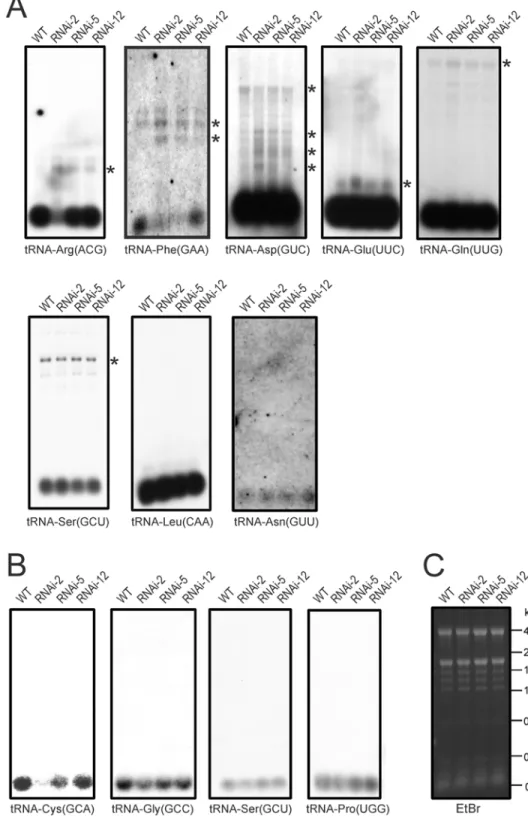
Fig 5. Accumulation and processing patterns of chloroplast and mitochondrial tRNAs inPRORP1
RNAi mutants and wild-type plants as determined by northern blotting.Detectable precursor RNA
species are marked with asterisks. (A) Northern blot analysis of chloroplast tRNAs. Weaker exposures of the northern blots for tRNA-Glu(UUC), tRNA-Gln(UUG) and tRNA-Asp(GUC) are presented inS4 Fig.
(B) Northern blot analysis of mitochondrial tRNAs. (C) An ethidium bromide (EtBr)-stained agarose gel photographed prior to blotting as a control for equal loading. Fragment sizes of the RNA size marker are indicated in kilobases (kb).
strongest RNAi line (RNAi-2;Fig. 5A) and tRNA-Phe(GAA) was reduced to barely detectable levels in the two strongest RNAi lines (RNAi-2 and RNAi-5). In both cases, this reduction in mature tRNA molecules was accompanied by the overaccumulation of precursors (Fig. 5A).
When a set of mitochondrial tRNAs were investigated, a strong reduction was seen for tRNA-Cys(GCA), the mitochondrial tRNA species most intensely investigated in previous studies [7,47]. The other three tRNAs tested showed a somewhat milder reduction in the accu-mulation of the mature tRNA, which for the tRNA-Ser(GCU) and tRNA-Pro(UGG) was only apparent in the strongest RNAi line (Fig. 5B).
Mild processing defects in messenger RNAs and ribosomal RNAs in
PRORP1
mutant plants
To confirm that the phenotypic consequences of knocked-downPRORP1expression are main-ly due to defective tRNA processing, a set of ribosomal RNAs (rRNAs) and messenger RNAs (mRNAs) in plastids and mitochondria was also investigated by northern blotting (Fig. 6). When plastid rRNA species were analyzed, only minor differences were observed. The 0.5 kb hidden-break product of the 23S rRNA (rrn23) was slightly reduced in the strongest RNAi line (RNAi-2) and the 3.2 kb precursor of the 4.5S rRNA (rrn4.5) accumulated to detectable levels in the RNAi-2 and RNAi-5 lines, but not in the wild type (Fig. 6A).
When the accumulation of plastid mRNAs was analyzed, differences in both mRNA abun-dance and processing patterns were observed upon comparison of wild-type plants and RNAi lines. The most pronounced alteration was a significant decrease in accumulation of the 5.3 kb tricistronic transcript comprising the genespsaA,psaB(encoding the two PSI reac-tion center subunits A and B) andrps14(encoding protein S14 of the small ribosomal sub-unit). Minor changes were seen in the processing patterns of theatpBoperon (comprising the genesatpBandatpE, both encoding subunits of the chloroplast ATP synthase) and the pentacistronic transcript of thepsbBoperon (containing three genes for PSII subunits and two genes for subunits of the cytochrome b6f complex,petBandpetD;Fig. 6A), whereas no
significant changes were seen inpsbAmRNA accumulation (encoding the D1 reaction center protein of PSII). It is conceivable that the changes in plastid mRNAs contribute to the physio-logical defects identified in the RNAi mutants (Fig. 4). Whether these alterations in the abun-dance and processing patterns of non-tRNA transcripts are direct consequences of impaired RNase P function (in that these RNAs are processed by PRORP1) or, alternatively, are sec-ondary consequences of reduced plastid translational activity, is currently unclear. The latter scenario is conceivable, because previous research has established that defective plastid trans-lation causes diverse alterations in plastid RNA metabolism [48]. Importantly, impaired translation does not affect all mRNAs equally. While some chloroplast mRNAs are destabi-lized as a consequence of their decreased association with ribosomes, others accumulate to normal levels [48].
Fig 6. RNA gel blot analyses to assess accumulation and processing of chloroplast and
mitochondrial mRNAs and rRNAs inPRORP1mutants and wild-type plants.The 25S rRNA band of the
ethidium bromide-stained gel prior to blotting is shown as a loading control for all blots. Transcript sizes are indicated in kb. (A) Accumulation and processing patterns of chloroplast mRNAs and rRNAs as determined by northern blotting. (B) Accumulation and processing patterns of mitochondrial mRNAs. Thecox1mRNA harbors a tRNA-like structure in its 5’UTR, a so-called t-element, that potentially could be processed by RNase P [49,7].
Reduced accumulation of organellar genome-encoded proteins in
PRORP1
mutants
To directly confirm that impaired processing of organellar tRNA species results in reduced synthesis of organellar genome-encoded proteins, western blots with specific antibodies against plastid and mitochondrial proteins were performed (Fig. 7). Two plastid-encoded and three nucleus-encoded chloroplast proteins were comparatively analyzed in the wild type and the strongestPRORP1RNAi line (RNAi-2): the plastid-encoded PsbD protein (the D2 subunit of the PSI reaction center), the plastid-encoded AtpB protein (the ATP synthaseβ-subunit) and three nucleus-encoded proteins of the light-harvesting antennae of PSII (Lhcb2 and Lhcb4) and PSI (Lhca2), respectively. Consistent with thePRORP1mutants being defective in plastid gene expression, but largely unaffected in nuclear gene expression, accumulation of the plastid-encoded proteins was strongly reduced in the RNAi plants, whereas the nucleus-plastid-encoded light-harvesting complex proteins even overaccumulated (Fig. 7A). The latter is probably not due to their overexpression, but rather to the loading of the protein gels based on equal amounts of total cellular protein. As chloroplast-encoded proteins represent a sizeable fraction of the total leaf protein, their reduced accumulation leads to an overrepresentation of nucleus-encoded proteins in the samples.
The limited availability of antibodies against mitochondrial proteins that are sufficiently sensitive to facilitate detection in western blots with total cellular protein allowed only the test-ing of a stest-ingle mitochondrial genome-encoded protein, Cox2 (the subunit II of the mitochon-drial cytochrome c oxidase). Accumulation of this protein in thePRORP1RNAi mutant was significantly reduced, suggesting that impaired processing of mitochondrial tRNAs results in reduced rates of mitochondrial protein biosynthesis. This is a specific effect in that a nucleus-encoded protein analyzed as control (MnSOD) was not reduced in the mutant (Fig. 7).
Reduced accumulation of plastid tRNA-Arg(ACG) results in lower
adenosine-to-inosine editing in
PRORP1
mutants
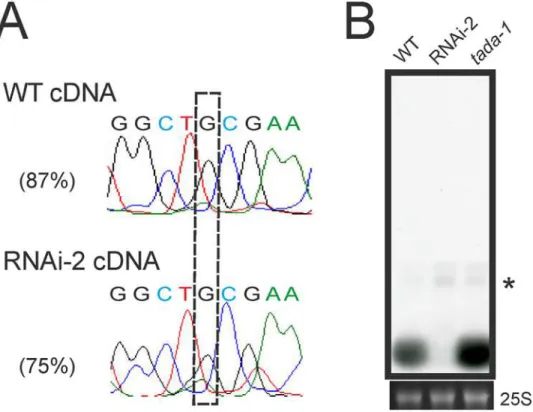
One of the plastid tRNA species that was severely affected in thePRORP1mutants is tRNA-Arg(ACG). The abundance of the mature tRNA-Arg(ACG) is strongly reduced in the RNAi-2 line and significant amounts of precursor tRNAs accumulate (that are undetectable in the wild type;Fig. 5A). The plastid tRNA-Arg(ACG) is special in that it is the only plastid tRNA species that undergoes adenosine-to-inosine RNA editing. The editing event changes the adenosine in the wobble position (position 34) of the anticodon to inosine (ACG to ICG). The A-to-I conversion is performed by a dedicated enzyme, an adenosine deaminase (TadA) of which the tRNA-Arg(ACG) is probably the only substrate [5,6]. The editing is functionally im-portant in that it facilitates decoding of CGN arginine codons by wobbling [50]. A-to-I tRNA editing is a post-transcriptional event, but its relationship with tRNA 5’end processing is un-known. To test whether tRNA 5’maturation by PRORP1 is required for efficient editing of tRNA-Arg(ACG), the editing status of the tRNA was determined in the wild type and the RNAi-2 mutant (Fig. 8A). While editing in the wild type was nearly complete, it was signifi-cantly less efficient in thePRORP1RNAi mutant. This could be due to 5’unprocessed tRNA precursors being less efficient substrates of the TadA editing deaminase. Alternatively, the 5’
unprocessed tRNA molecules could suffer from a higher turnover rate than the mature tRNAs, thus giving the editing enzyme less time to act on them. Further investigations are needed to distinguish between these two possibilities.
Finally, we investigated whether editing at position 34 of tRNA-Arg(ACG) is required for 5’
Northern blot analyses revealed that mature tRNA-Arg(ACG) accumulates to normal levels in thetada-1mutant (Fig. 8B), indicating that 5’end processing of the tRNA does not depend on prior A-to-I editing.
Comparative RNAseq reveals additional tRNA processing defects
To obtain a more comprehensive picture of the tRNA processing defects caused by down-regu-lated PRORP1 activity, we sought to determine the abundances of mature and unprocessed tRNAs by RNA sequencing (RNAseq) using next-generation sequencing technology. High-throughput Illumina sequencing of total RNA samples turned out not to be a suitable approach to analyze tRNA processing. Coverage of mature and unprocessed tRNAs was so low that no
Fig 7. Accumulation of chloroplast and mitochondrial proteins in the wild type and thePRORP1mutant line RNAi-2.(A) Immunoblot analysis of
selected chloroplast and mitochondria proteins. While PsbD and AtpB are chloroplast-encoded proteins, the three light harvesting complex proteins (Lhcb2, Lhcb4 and Lhca2) are nucleus-encoded and post-translationally imported into the chloroplast. Note that the two chloroplast-encoded proteins are strongly reduced in thePRORP1mutant, whereas the nucleus-encoded proteins accumulate to higher levels than in the wild type. Cox2, a mitochondrial genome-encoded protein, also accumulates to lower levels in the RNAi-2 mutant plants. Immunoblot analyses were conducted with samples of total cellular protein (20μg) extracted from leaves and probed with specific antibodies against PsbD (the photosystem II reaction center protein D2), AtpB (theβ-subunit of the chloroplast ATP synthase), Lhcb2 and Lhcb4 (light-harvesting proteins of the photosystem II antenna), Lhca2 (a light-harvesting protein of the photosystem I antenna), Cox2 (subunit II of the mitochondrial cytochrome c oxidase), and MnSOD (the nucleus-encoded mitochondrial superoxide dismutase). (B) As a control for equal loading, a replicate gel was stained with Coomassie brilliant blue.
statistical analysis could be performed. This is likely due to cDNA synthesis strongly discrimi-nating against tRNAs because of their compact secondary structure (making priming of reverse transcription inefficient) and their extensive post-transcriptional modification with some mod-ifications strongly inhibiting reverse transcription [51]. We, therefore, size-fractionated the RNA samples and constructed libraries enriched for tRNAs (for details, seeMaterials and Methods).
Illumina sequencing of size-fractionated RNAs yielded sufficient coverage of both mature and unprocessed tRNAs to allow the calculation of processing efficiencies for many, but not all, organellar tRNA species (Tables1and2;S1–S3Figs.; see alsoMaterials and Methods). The strong underrepresentation of some tRNA species could be due to their low expression levels and/or the presence of RNA modifications that largely block reverse transcription [51].
Analysis of the abundance of mature tRNAs confirmed that accumulation of the plastid tRNA-Arg(ACG) and tRNA-Phe(GAA) and the mitochondrial tRNA-Cys(GCA) are strongly reduced in the RNAi line (Tables1and2;S2–S3Figs). Calculation of a tRNA processing effi-ciency based on the ratio of mature tRNA reads to precursor reads confirmed the processing defects detected by our northern blot analyses (Fig. 5) and, moreover, revealed additional tRNA species as likely substrates of PRORP1. In the case of the chloroplast, these tRNAs in-clude tRNA-Val(GAC), tRNA-Cys(GCA), tRNA-Tyr(GUA), tRNA-His(GUG) and tRNA-Gly (GCC) (Table 2;S3A Fig.). Due to their much lower copy numbers per cell [52], mitochondrial
Fig 8. Investigation of the relationship between tRNA editing and 5’end maturation.(A) Analysis of the
editing status of tRNA-Arg(ACG) in the chloroplast. The A-to-I editing event changes the adenosine in the wobble position (position 34) of the ACG anticodon to inosine, which is read as guanosine (boxed) by reverse transcriptases [5,6]. Editing efficiencies are shown for the wild type (WT) and the most affected RNAi line (RNAi-2). (B) Assessment of the efficiency of tRNA-Arg(ACG) processing by RNase P in the absence of A-to-I editing.tada-1is a knock-out allele of the specific adenosine deaminase that edits the anticodon of the plastid tRNA-Arg(ACG) [5,6]. Due to the weak exposure of the blot, the mature tRNA in the RNAi line is hardly visible.
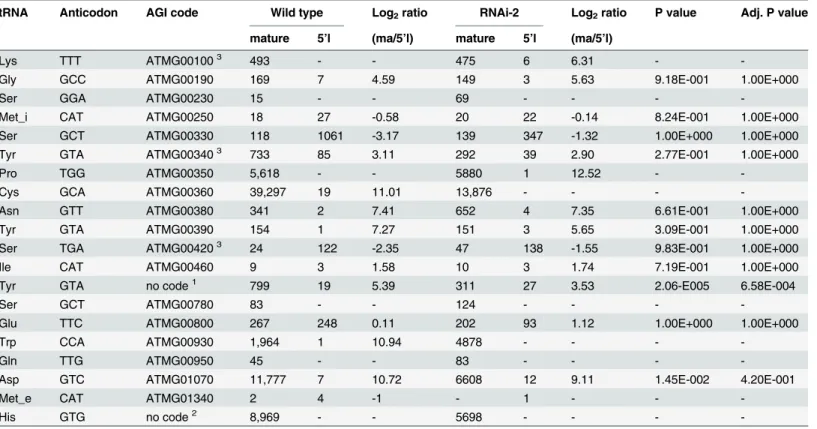
genes are generally expressed to lower levels than chloroplast genes, and, therefore, the number of mitochondrial tRNA species that gave statistically significant data for processing efficiency was relatively low (Table 1;S3 Fig.). Nonetheless, a tyrosine tRNA, tRNA-Tyr(GUA), could be identified as defective in 5’end processing in the RNAi-2 mutant and, therefore, is likely to rep-resent an additional substrate of PRORP1 (Table 1;S3C Fig.).
In several cases, the reduced accumulation of mature tRNA molecules was also accompa-nied with overrepresentation of 3’unprocessed tRNAs (S3B,D Fig.). This was the case, for ex-ample, for the two most strongly reduced plastid tRNAs, tRNA-Arg(ACG) and tRNA-Phe (GAA) (S3B Fig.). It seems likely that this is a secondary consequence of inefficient 5’ process-ing, but due to the short reads generated by the Illumina sequencing technology, we currently do not know whether (most of) these 3’unprocessed molecules are also 5’unprocessed.
Conclusions
Our reverse genetic analysis of the dually targeted proteinaceous RNase P revealed that the effects of knocked-downPRORP1on the processing of individual tRNA species in chloro-plasts and mitochondria are highly variable. While a few tRNAs are severely affected, many
Table 1. Log2ratios of reads mapping to the mature tRNA sequence to reads mapping to the 5’leader sequence for all tRNAs encoded in the
Arabidopsismitochondrial genome.
tRNA Anticodon AGI code Wild type Log2ratio RNAi-2 Log2ratio P value Adj. P value
mature 5’l (ma/5’l) mature 5’l (ma/5’l)
Lys TTT ATMG001003 493 - - 475 6 6.31 -
-Gly GCC ATMG00190 169 7 4.59 149 3 5.63 9.18E-001 1.00E+000
Ser GGA ATMG00230 15 - - 69 - - -
-Met_i CAT ATMG00250 18 27 -0.58 20 22 -0.14 8.24E-001 1.00E+000
Ser GCT ATMG00330 118 1061 -3.17 139 347 -1.32 1.00E+000 1.00E+000
Tyr GTA ATMG003403 733 85 3.11 292 39 2.90 2.77E-001 1.00E+000
Pro TGG ATMG00350 5,618 - - 5880 1 12.52 -
-Cys GCA ATMG00360 39,297 19 11.01 13,876 - - -
-Asn GTT ATMG00380 341 2 7.41 652 4 7.35 6.61E-001 1.00E+000
Tyr GTA ATMG00390 154 1 7.27 151 3 5.65 3.09E-001 1.00E+000
Ser TGA ATMG004203 24 122 -2.35 47 138 -1.55 9.83E-001 1.00E+000
Ile CAT ATMG00460 9 3 1.58 10 3 1.74 7.19E-001 1.00E+000
Tyr GTA no code1 799 19 5.39 311 27 3.53 2.06-E005 6.58E-004
Ser GCT ATMG00780 83 - - 124 - - -
-Glu TTC ATMG00800 267 248 0.11 202 93 1.12 1.00E+000 1.00E+000
Trp CCA ATMG00930 1,964 1 10.94 4878 - - -
-Gln TTG ATMG00950 45 - - 83 - - -
-Asp GTC ATMG01070 11,777 7 10.72 6608 12 9.11 1.45E-002 4.20E-001
Met_e CAT ATMG01340 2 4 -1 - 1 - -
-His GTG no code2 8,969 - - 5698 - - -
-1Location of tRNA-Tyr(GTA) in theArabidopsismitochondrial genome is from position 191,954 to 192,025. 2Location of tRNA-His(GTG) in theArabidopsismitochondrial genome is from position 359,666 to 359,739.
3The read counts for the two copies of tRNA-Lys(TTT) (ATMG00100 and ATMG00700), the two copies of tRNA-Tyr(GTA) (ATMG00340 and
ATMG00790), and the two copies of tRNA-Ser(TGA) (ATMG00420 and ATMG01160) were combined, because both tRNA copies have identical sequences and also identicalflanking sequences (up to 50 nt). Dashes indicate transcripts that were not detected in our RNAseq datasets or values that could not be calculated. AGI: Arabidopsis Genome Initiative. 5’l: 5’leader. ma: mature. Adj. P value: adjusted P value.
others show little or no changes in accumulation of the mature tRNA. This might suggests that the organellar RNase P recognizes some tRNA substrates more efficiently than others. The molecular basis for these substrate preferences is currently unclear. Comparison of se-quences upstream of tRNA 5’ends failed to reveal recognizable motifs that could correlate with processing efficiency (data not shown), raising the possibility that higher-order struc-ture of the tRNA precursors influences their recognition by PRORP1. It is noteworthy in this respect that the mitochondrial tRNA most affected by knock-down ofPRORP1, tRNA-Cys (GCA) (Fig. 5B), has a somewhat unusual secondary structure and contains an CA mismatch
in a stem region which is not corrected to a UA base pair by RNA editing [53]. Alternatively,
it seems possible that differences in the tRNA turnover rates (i.e., the balance between syn-thesis and degradation) and/or the interplay with other tRNA maturation steps are, at least in part, responsible for the observed large differences in the effect ofPRORP1knock-down on the processing of individual tRNA species. Finally, it also cannot be excluded that another RNase P-like activity exists in plant organelles that is distinct from the PRORP protein family and yet remains to be discovered.
Table 2. Log2ratios of reads mapping to the mature tRNA sequence to reads mapping to the 5’leader sequence for all intronless tRNAs
encoded in theArabidopsisplastid genome.
tRNA Anti-codon AGI code Wild type Log2ratio RNAi-2 Log2ratio P value Adj. P value
mature 5’l (ma/5’l) mature 5’l (ma/5’l)
His GTG ATCG00010 587,933 38 13.92 1,039,481 119 13.10 9.37E-004 2.81E-002
Gln TTG ATCG00060 10,784 47 7.84 29,908 71 8.72 9.99E-001 1.00E+000
Ser GCT ATCG00090 18,967 140 7.08 51,117 170 8.23 1.00E+000 1.00E+000
Arg TCT ATCG00110 17,656 60 8.20 25,274 81 8.29 6.68E-001 1.00E+000
Cys GCA ATCG00200 402 12 5.07 888 95 3.22 2.45E-006 8.10E-005
Asp GTC ATCG00230 423,255 294 10.49 442,408 351 10.30 5.01E-002 1.00E+000
Tyr GTA ATCG00240 18,228 135 7.08 11,151 230 5.60 6.05E-022 2.12E-020
Glu TTC ATCG00250 73,516 263 8.13 98,975 375 8.04 2.51E-001 1.00E+000
Thr GGT ATCG00260 667 232 1.52 1,529 283 2.43 1.00E+000 1.00E+000
Ser TGA ATCG00290 136 46 1.56 353 106 1.74 7.56E-001 1.00E+000
Gly GCC ATCG00310 106,563 221 8.91 207,724 552 8.56 9.06E-004 2.81E-002
Met_i CAT ATCG00320 165,918 1,529 6.76 328,644 2,355 7.12 1.00E+000 1.00E+000
Ser GGA ATCG00370 15,326 30 9.00 72,110 49 10.52 9.99E-001 1.00E+000
Thr TGT ATCG00390 111 72 0.62 348 149 1.22 9.91E-001 1.00E+000
Phe GAA ATCG00410 953 177 2.43 516 536 -0.05 3.71E-071 1.82E-069
Met_e CAT ATCG00460 159 37 2.10 406 55 2.88 9.92E-001 1.00E+000
Trp CCA ATCG00610 9,553 94 6.67 20,220 108 7.55 9.99E-001 1.00E+000
Pro TGG ATCG00620 3,078 55 5.81 9,963 81 6.94 9.99E-001 1.00E+000
Arg ACG ATCG00980 4,002 387 3.37 1,000 386 1.37 1.01E-064 3.64E-063
Val GAC ATCG00910 945 27 5.13 387 70 2.47 4.29E-017 1.46E-015
Leu TAG ATCG01030 6,076 11 9.11 6941 20 8.44 1.43E-001 1.00E+000
Asn GTT ATCG01140 7,039 403 4.13 14,784 867 4.09 3.62E-001 1.00E+000
Ala TGC ATCG01190 4,763 533 3.16 6,808 309 4.46 1.00E+000 1.00E+000
Leu CAA ATCG01260 51,895 119 8.77 97,720 262 8.54 8.61E-002 1.00E+000
Ile CAT ATCG01290 97 11 3.14 140 35 2.00 2.04E-002 5.70E-001
AGI: Arabidopsis Genome Initiative. 5’l: 5’leader. ma: mature. Adj. P value: adjusted P value.
The processing defects reported here in stable transgenic RNAi mutants are similar but not absolutely identical to the defects described previously upon transient repression ofPRORP1
gene expression using virus-induced gene silencing [8]. For example, Gutmann et al. observed less mature mitochondrial tRNA-Lys(UUU), which is not supported by our RNAseq data (Table 1). However, consistent with the previous study by Gutmann et al., 5’unprocessed pre-cursors of mitochondrial tRNA-Lys(UUU) are detectable in the RNAi line but not in the wild type (Table 1), suggesting that mitochondrial tRNA-Lys(UUU) is indeed a substrate of PRORP1. Another difference between the two studies is that the reduction in mature chloro-plast tRNA-Phe(GAA) is stronger in our stable RNAi plants. Whether or not these differences are solely due to differences in the level ofPRORP1repression or have other reasons, remains to be determined by future investigations.
The physiological analysis of ourPRORP1mutants indicated that photosynthesis (as the main function of plastid gene expression) is much more strongly affected than respiration (the main function dependent on mitochondrial gene expression), suggesting that the mutant phe-notype is largely caused by impaired chloroplast gene expression. Moreover, the drastic reduc-tion in mature plastid tRNA-Phe(GAA) and tRNA-Arg(ACG) suggests these two tRNA species as a major limiting factor in plastid gene expression inPRORP1mutants. Although plant mitochondria, unlike chloroplasts, import some tRNAs from the cytosol (one third to half of the plant mitochondrial tRNA species are encoded in the nucleus), tRNA import cannot explain the lack of effects on mitochondrial function and gene expression in our RNAi mu-tants, because tRNA import is restricted to a specific set of tRNA species [54] which can be identified by their nucleotide sequences [55].
Supporting Information
S1 Fig. Read annotation statistics for the RNAseq experiment.Genome mapped reads were annotated according to their first assignment to a genomic feature using intersectBed in the fol-lowing order: exons, 5’and 3’untranslated regions (‘prime UTRs’), repeats (excluding 'dust') and tRNA flanks (±50 bp of mature tRNA locations). SeeMaterials and Methodsfor details. (TIF)
S2 Fig. MA plot of the accumulation of mature tRNAs in wild-type plants and RNAi-2 mu-tant plants.Expression of mature tRNAs was quantified by computing RPKM values for unique tRNA sequences which were used to calculate differences (M) and averages (A). Densi-ty plots show the distribution of M and A, respectively. The M values on the vertical axis repre-sent differential accumulation between the wild type and the RNAi line. The A values on the horizontal axis represent average tRNA accumulation levels. Red dots: mitochondrial genome-encoded tRNAs; green dots: plastid-genome-encoded tRNAs; gray dots: nucleus-genome-encoded tRNAs. Ex-perimentally validated tRNAs are highlighted by their three-letter amino acid code.
(TIF)
S3 Fig. MA plots of the efficiency of tRNA processing in wild-type plants and RNAi-2 mu-tant plants.A processing efficiency rate (PER), defined as the log2ratio of reads mapped on
are indicated by the three-letter amino acid codes. Green: experimentally tested chloroplast tRNAs; slate blue: experimentally validated chloroplast tRNAs with adjusted P value<0.05;
red: experimentally tested mitochondrial tRNAs; gray: not experimentally tested chloroplast or mitochondrial tRNAs; black: not experimentally tested chloroplast or mitochondrial tRNAs with adjusted P value<0.05.
(TIF)
S4 Fig. Weaker exposures of the northern blots for tRNA-Glu(UUC), tRNA-Gln(UUG) and tRNA-Asp(GUC) shown inFig. 5.
(TIF)
S1 Table. Gene-specific primers used for the generation of hybridization probes.
(DOC)
Acknowledgments
We thank Carola Paepke for help with respiration measurements, Joost van Dongen (both Max-Planck-Institut für Molekulare Pflanzenphysiologie) for providing the Cox2 antibody, Philippe Giegé and Anthony Gobert (IBMP-CNRS, Strasbourg) for making available a PRORP1 antibody, and the MPI-MP Green Team for plant cultivation and care.
Author Contributions
Conceived and designed the experiments: WZ DK AF EM DW RB. Performed the experi-ments: WZ EM. Analyzed the data: WZ DK AF EM DW RB. Wrote the paper: WZ RB.
References
1. Kirsebom LA. RNase P—a 'Scarlet Pimpernel'. Mol Microbiol. 1995; 17: 411–420. PMID:8559060 2. Helm M. Post-transcriptional nucleotide modification and alternative folding of RNA. Nucleic Acids Res.
2006; 34: 721–733. PMID:16452298
3. Agris PF, Vendeix FAP, Graham WD. tRNA's wobble decoding of the genome: 40 years of modification. J Mol Biol. 2007; 366: 1–13. PMID:17187822
4. Phizicky EM, Alfonzo JD. Do all modifications benefit all tRNAs? FEBS Lett. 2010; 584: 265–271. doi: 10.1016/j.febslet.2009.11.049PMID:19931536
5. Karcher D, Bock R. Identification of the chloroplast adenosine-to-inosine tRNA editing enzyme. RNA 2009; 15: 1251–1257. doi:10.1261/rna.1600609PMID:19460869
6. Delannoy E, Le Ret M, Faivre-Nitschke E, Estavillo GM, Bergdoll M, Taylor NL, et al. Arabidopsis tRNA adenosine deaminase arginine edits the wobble nucleotide of chloroplast tRNAArg(ACG) and is essen-tial for efficient chloroplast translation. Plant Cell 2009; 21: 2058–2071. doi:10.1105/tpc.109.066654 PMID:19602623
7. Gobert A, Gutmann B, Taschner A, Gößringer M, Holzmann J, Hartmann RK, et al. A single Arabidopsis organellar protein has RNase P activity. Nature Struct Mol Biol. 2010; 17: 740–744. doi:10.1038/nsmb. 1812PMID:20473316
8. Gutmann B, Gobert A, Giegé P. PRORP proteins support RNase P activity in both organelles and the nucleus in Arabidopsis. Genes & Dev. 2012; 26: 1022–1027.
9. Zhou W, Karcher D, Bock R. Importance of adenosine-to-inosine editing adjacent to the anticodon in an Arabidopsis alanine tRNA under environmental stress. Nucleic Acids Res. 2013; 41: 3362–3372. doi: 10.1093/nar/gkt013PMID:23355609
10. Randau L, Schröder I, Söll D. Life without RNase P. Nature 2008; 453: 120–123. doi:10.1038/ nature06833PMID:18451863
11. Altman S. RNase P in research and therapy. Bio/Technology 1995; 13: 327–329. PMID:9634774 12. Yuan Y, Altman S. Selection of guide sequences that direct efficient cleavage of mRNA by human
ribo-nuclease P. Science 1994; 263: 1269–1273. PMID:8122108
14. Kirsebom LA, Svaerd SG. Base pairing betweenEscherichia coliRNase P RNA and its substrate. EMBO J. 1994; 13: 4870–4876. PMID:7525271
15. Burgin AB, Pace NR. Mapping the active site of ribonuclease P RNA using a substrate containing a photoaffinity agent. EMBO J. 1990; 9: 4111–4118. PMID:1701142
16. Wang MJ, Davis NW, Gegenheimer P. Novel mechanisms for maturation of chloroplast transfer RNA precursors. EMBO J. 1988; 7: 1567–1574. PMID:16453848
17. Reardon EM, Price CA. Plastid genomes of three non-green algae are sequenced. Plant Mol Biol Rep. 1995; 13: 320–342.
18. Baum M, Cordier A, Schön A. RNase P from a photosynthetic organelle contains an RNA homologous to the cyanobacterial counterpart. J Mol Biol. 1996; 257: 43–52. PMID:8632458
19. Pascual A, Vioque A. Functional reconstitution of RNase P activity from a plastid RNA subunit and a cyanobacterial protein subunit. FEBS Lett. 1999; 442: 7–10. PMID:9923593
20. Li D, Willkomm DK, Schön A, Hartmann RK. RNase P of theCyanophora paradoxacyanelle: a plastid ribozyme. Biochimie 2007; 89: 1528–1538. PMID:17881113
21. Holzmann J, Frank P, Löffler E, Bennett KL, Gerner C, Rossmanith W. RNase P without RNA: Identifi-cation and functional reconstitution of the human mitochondrial tRNA processing enzyme. Cell 2008; 135: 462–474. doi:10.1016/j.cell.2008.09.013PMID:18984158
22. Sugita C, Komura Y, Tanaka K, Kometani K, Satoh H, Sugita M. Molecular characterization of three PRORP proteins in the mossPhyscomitrella patens: Nuclear PRORP protein is not essential for moss viability. PLoS One 2014; 9: e108962. doi:10.1371/journal.pone.0108962PMID:25272157
23. Murashige T, Skoog F. A revised medium for rapid growth and bio assays with tobacco tissue culture. Physiol Plant. 1962; 15: 473–497.
24. Hilson P, Allemeersch J, Altmann T, Aubourg S, Avon A, Beynon J, et al. Versatile gene-specific se-quence tags for Arabidopsis functional genomics: transcript profiling and reverse genetics applications. Genome Res. 2004; 14: 2176–2189. PMID:15489341
25. Karimi M, Inzé D, Depicker A. GATEWAY™vectors for Agrobacterium-mediated plant transformation. Trends Plant Sci. 2002; 7: 193–195. PMID:11992820
26. Clough SJ, Bent AF. Floral dip: a simplified method for Agrobacterium-mediated transformation of Ara-bidopsis thaliana. Plant J. 1998; 16: 735–743. PMID:10069079
27. Lichtenthaler HK. Chlorophylls and carotenoids: Pigments of photosynthetic biomembranes. Methods Enzymol. 1987; 148: 350–382.
28. Lohmann A, Schöttler MA, Bréhélin C, Kessler F, Bock R, Cahoon EB, et al. Deficiency in phylloqui-none (vitamin K1) methylation affects prenyl quiphylloqui-none distribution, photosystem I abundance, and an-thocyanin accumulation in the Arabidopsis AtmenG mutant. J Biol Chem. 2006; 281: 40461–40472. PMID:17082184
29. Schöttler MA, Flügel C, Thiele W, Bock R. Knock-out of the plastid-encoded PetL subunit results in re-duced stability and accelerated leaf age-dependent loss of the cytochrome b6f complex. J Biol Chem. 2007; 282: 976–984. PMID:17114182
30. Beeckman T, Viane R. Embedding thin plant specimens for oriented sectioning. Biotech Histochem. 2000; 75: 23–26. PMID:10810979
31. Doyle JJ, Doyle JL. Isolation of plant DNA from fresh tissue. Focus 1990; 12: 13–15.
32. Livak KJ, Schmittgen TD. Analysis of relative gene expression data using real-time quantitative PCR and the 2-ΔΔCT Method. Methods 2001; 25: 402–408. PMID:11846609
33. Tiller N, Weingartner M, Thiele W, Maximova E, Schöttler MA, Bock R. The plastid-specific ribosomal proteins of Arabidopsis thaliana can be divided into non-essential proteins and genuine ribosomal pro-teins. Plant J. 2012; 69: 302–316. doi:10.1111/j.1365-313X.2011.04791.xPMID:21923745
34. Li H, Durbin R. Fast and accurate short read alignment with Burrows-Wheeler transform. Bioinformatics 2009; 25: 1754–1760. doi:10.1093/bioinformatics/btp324PMID:19451168
35. Li H, Handsaker B, Wysoker A, Fennell T, Ruan J, Homer N, et al. The Sequence Alignment/Map for-mat and SAMtools. Bioinforfor-matics 2009; 25: 2078–2079. doi:10.1093/bioinformatics/btp352PMID: 19505943
36. Quinlan AR, Hall IM. BEDTools: a flexible suite of utilities for comparing genomic features. Bioinformat-ics 2010; 26: 841–842. doi:10.1093/bioinformatics/btq033PMID:20110278
37. Knoop V. The mitochondrial DNA of land plants: peculiarities in phylogenetic perspective. Curr Genet. 2004; 46: 123–139. PMID:15300404
39. Hricová A, Quesada V, Micol JL. The SCABRA3 nuclear gene encodes the plastid RpoTp RNA poly-merase, which is required for chloroplast biogenesis and mesophyll cell proliferation in Arabidopsis. Plant Physiol. 2006; 141: 942–956. PMID:16698900
40. Fleischmann TT, Scharff LB, Alkatib S, Hasdorf S, Schöttler MA, Bock R. Nonessential plastid-encoded ribosomal proteins in tobacco: a developmental role for plastid translation and implications for reductive genome evolution. Plant Cell 2001; 23: 3137–3155.
41. Wycliffe P, Sitbon F, Wernersson J, Ezcurra I, Ellerström M, Rask L. Continuous expression in tobacco leaves of a Brassica napus PEND homologue blocks differentiation of plastids and development of pali-sade cells. Plant J. 2005; 44: 1–15. PMID:16167891
42. Häusler RE, Geimer S, Kunz HH, Schmitz J, Dörmann P, Bell K, et al. Chlororespiration and grana hyperstacking: How an Arabidopsis double mutant can survive despite defects in starch biosynthesis and daily carbon export from chloroplasts. Plant Physiol. 2009; 149: 513–533.
43. Hager M, Hermann M, Biehler K, Krieger-Liszkay A, Bock R. Lack of the small plastid-encoded PsbJ polypeptide results in a defective water-splitting apparatus of photosystem II, reduced photosystem I levels, and hypersensitivity to light. J Biol Chem. 2002; 277: 14031–14039. PMID:11827973 44. Walter M, Piepenburg K, Schöttler MA, Petersen K, Kahlau S, Tiller N, et al. Knockout of the plastid
RNase E leads to defective RNA processing and chloroplast ribosome deficiency. Plant J. 2010; 64: 851–863. doi:10.1111/j.1365-313X.2010.04377.xPMID:21105931
45. Albus C, Ruf S, Schöttler MA, Lein W, Kehr J, Bock R. Y3IP1, a nucleus-encoded thylakoid protein, co-operates with the plastid-encoded Ycf3 protein in photosystem I assembly. Plant Cell 2010; 22: 2838– 2855. doi:10.1105/tpc.110.073908PMID:20807881
46. Krech K, Ruf S, Masduki FF, Thiele W, Bednarczyk D, Albus CA, et al. The plastid genome-encoded Ycf4 protein functions as a nonessential assembly factor for photosystem I in higher plants. Plant Phy-siol. 2012; 159: 579–591. doi:10.1104/pp.112.196642PMID:22517411
47. Gobert A, Pinker F, Fuchsbauer O, Gutmann B, Boutin R, Roblin P, et al. Structural insights into pro-tein-only RNase P complexed with tRNA. Nature Commun. 2013; 4: 1353. doi:10.1038/ncomms2358 PMID:23322041
48. Barkan A. Nuclear mutants of maize with defects in chloroplast polysome assembly have altered chlo-roplast RNA metabolism. Plant Cell 1993; 5: 389–402. PMID:12271069
49. Forner J, Weber B, Thuss S, Wildum S, Binder S. Mapping of mitochondrial mRNA termini in Arabidop-sis thaliana: t-elements contribute to 5' and 3' end formation. Nucleic Acids Res. 2007; 35: 3676–3692. PMID:17488843
50. Alkatib S, Scharff LB, Rogalski M, Fleischmann TT, Matthes A, Seeger S, et al. The contributions of wobbling and superwobbling to the reading of the genetic code. PLoS Genet. 2012; 8: e1003076. doi: 10.1371/journal.pgen.1003076PMID:23166520
51. Wittig B, Wittig S. Reverse transcription of tRNA. Nucleic Acids Res. 1978; 5: 1165–1178. PMID:77522 52. Preuten T, Cincu E, Fuchs J, Zoschke R, Liere K, Börner T. Fewer genes than organelles: extremely
low and variable gene copy numbers in mitochondria of somatic plant cells. Plant J. 2010; 64: 948–959. doi:10.1111/j.1365-313X.2010.04389.xPMID:21143676
53. Giegé P, Brennicke A. RNA editing in Arabidopsis mitochondria effects 441 C to U changes in ORFs. Proc Natl Acad Sci USA 1999; 96: 15324–15329. PMID:10611383
54. Duchêne A-M, Pujol C, Maréchal-Drouard L. Import of tRNAs and aminoacyl-tRNA synthetases into mi-tochondria. Curr Genet. 2009; 55: 1–18. doi:10.1007/s00294-008-0223-9PMID:19083240