FUNDAÇÃO GETULIO VARGAS
ESCOLA BRASILEIRA DE ADMINISTRAÇÃO PÚBLICA E DE EMPRESAS MESTRADO EM ADMINISTRAÇÃO
Do virtual platforms impact user behavior?
An experimental comparison between messages on the
company
’
s website and Facebook page.
Pedro Henrique de Mendonça Lopes
Ficha catalográfica elaborada pela Biblioteca Mario Henrique Simonsen/FGV
Lopes, Pedro Henrique de Mendonça
Do virtual platforms impact user behavior? : an experimental comparison between messages on the company’s website and Facebook page / Pedro Henrique de Mendonça Lopes. – 2014.
43 f.
Dissertação (mestrado) - Escola Brasileira de Administração Pública e de Empresas, Centro de Formação Acadêmica e Pesquisa.
Orientador: Eduardo Bittencourt Andrade. Inclui bibliografia.
1. Comunicação e tecnologia. 2. Comportamento do consumidor. 3. Sites da Web. 4. Redes sociais on-line. 5. Facebook (Rede social on-line). 6. Internet. I. Andrade, Eduardo Bittencourt. II. Escola Brasileira de Administração Pública e de Empresas. Centro de Formação Acadêmica e Pesquisa. III. Título.
FUNDAÇÃO GETULIO VARGAS
ESCOLA BRASILEIRA DE ADMINISTRAÇÃO PÚBLICA E DE EMPRESAS MESTRADO EM ADMINISTRAÇÃO
Do virtual platforms impact user behavior?
An experimental comparison between messages on the
company
’
s website and Facebook page.
Pedro Henrique de Mendonça Lopes
Dissertação submetida à Escola Brasileira de Administração Pública e de Empresas como requisite parcial para a obtenção do grau de Mestre em Administração
Orientador: Eduardo Bittencourt Andrade
2
C
ONTENTS
1. Introduction ... 3
2. Theoretical Background ... 6
2.1. Physical Environment and Social Norms ... 8
2.2. Linguistic Differences Across Virtual Platforms ... 10
2.2.1. Informal Writing ... 12
2.2.2. Emotional Tone ... 15
2.2.3. Additional Analysis: Message Clarity ... 17
3. Experiment 1A ... 18
4. Experiment 1B ... 25
5. Conclusion ... 28
5.1. Managerial Implication ... 29
5.2. Limitations ... 29
5.3. Future Research ... 31
6. References ... 31
3
1.
I
NTRODUCTION
The Internet has become an important part of everyday life (Bargh & McKenna, 2004). Nowadays, people massively interact and communicate through online electronic devices for all types of personal and business correspondence (Ogan, Ozakca, & Groshek, 2007). The Internet has not only changed person-to-person interaction, but it has also dramatically modified the way consumers connect with companies (Barnes & Mattsson, 2008; Smith, Fischer, & Yongjian, 2012).
The dissemination of the Internet and of one-to-many communication has brought immeasurable strength to consumer opinion (Pitt, Berthon, Watson, & Zinkhan, 2002). Because of this new setting, companies needed to get closer to their customers through new engagements (Brown, Barry, Dacin, & Gunst, 2005). Besides having a presence in the real world, it has become urgent for companies to be present in virtual environments (Fischer & Reuber, 2011). Two forms are the most notable and common: the company website, which
would be equivalent of its formal address in the virtual world, and their social network pages
(e.g., Facebook profile or page), which focus on brand promotion and their relationship with customers (Sterling, 2013). For instance, customer complaints or general reactions to the
company’s products and services can be posted online on either the company website or on
the company Facebook page.
4 virtual spaces may foster particular social norms (Aarts & Dijksterhuis, 2003), which will in turn impact the way consumers communicate with the company.
Indeed, the impact of the Internet on the linguistic structuring of messages is well established (Baron, 2005; Crystal, 2001), and many studies have analyzed the impact of different forms of virtual media on communication. Some authors have investigated the impact of spoken language on email messages (Baron, 1998), on text-messaging (Thurlow & Brown, 2003; Zurhellen, 2011), and on instant messaging (Tagliamonte & Denis, 2008). Others have studied specific features of Internet messages, such as formality on email (Peterson, Hohensee, & Xia, 2011), the impact of gender and age on emoticon use (Schnoebelen, 2012a), and a comparison between text-messaging and instant messaging (Ling & Baron, 2007).
Also, it has been shown that different virtual spaces can lead to different behaviors and communication patterns (Gunkel & Gunkel, 1997; Papacharissi, 2009). However, this phenomenon is confounded with the fact that people often use these different platforms for different purposes (e.g., socialize on Facebook vs. look for a job on LinkedIn). The question still remains about the extent to which differences in communication patterns arise even when the purpose of the communication is identical across platforms. In this study, we
decided to study one of the most common types of communications on the web: complaint messages (Harrison-Walker, 2001). Simply put, will an online platform prime a particular social norm, which can in turn impact the way a consumer complains on the Internet?
5 main purpose of this research enterprise, we also check whether the content of the message varies across conditions. Given that the social norm in social networks such as Facebook is informal communication (Boyd, 2007), we hypothesize first that messages will be more informal when the consumer writes a complaint on the company Facebook page as compared
to the company websiteholding constant the purpose of the communication.
We do not have an obvious hypothesis about the emotional tone of the message. On one hand, if people communicate more with friends and family on Facebook, they might well be more emotional in this setting, since users are used to frequently expressing their emotions to their peers on social networking sites (Konijn, 2012; Medaglia, Rose, Nyvang, & Sæbø, 2009). On the other hand, people can use emotions to catch the attention of a company (Fussell, 2002; Hänninen, 2007). Knowing that people strategically express emotions in negotiation settings (Andrade & Ho, 2009), people may express more emotions when complaining on the company website in an attempt to be persuasive.
6
2.
T
HEORETICAL
B
ACKGROUND
Researchers have investigated the impact of the Internet on the linguistic structuring of messages for a while (Baron, 1998; Crystal, 2001; Werry, 1996). A large body of the literature has adopted a more descriptive approach and focused attention on the features of Internet linguistics and its different communication mediums. Werry (1996) studied the linguistic structure of Internet Relay Chat (IRC), Baron (1998, 2000, 2003b) focused on the linguistic structure of email messages, Crystal (2008) and Thurlow & Brown (2003) investigated text-messaging and Baron (2010) and Tagliamonte & Denis (2008) studied instant messaging.
A few studies aimed to sum up all the linguistic structures observed in many different virtual platforms and interactions. For instance, Crystal (2001), in a simple and objective manner, divides the virtual environments into five main categories: Web Pages
(variety will come from the theme of the webpage, the formality level expected, the expected readers, and the author demographics), E-mail (there is no regular structure of an e-mail, it
is the new version of a regular letter), Virtual Worlds (all the imaginary environments which
people can enter to engage in text-based social interaction), and Chat Groups (continuous
discussions of any subject where people are allowed to interact) which are split into
Synchronous (based on a real time chats) and Asynchronous (messages are sent and can be
7 A somewhat different research stream has tried to understand the impact of the physical properties of the communication channel on content and/or linguistic style. Jucker & Dürscheid (2012) analyzed the impact of the gadget used to write the message (regular keyboard vs. touch-screen keyboard) on communication. Others have compared communication by telephone to web-based chat (Fukkink & Hermanns, 2009; Fukkink, 2011), and speech to instant messaging (Seltzer, Prososki, Ziegler, & Pollak, 2012).
In addition to these comparisons, some other researchers have held the physical medium constant, but changed the virtual platform used to communicate. For example, Dwyer, Hiltz, & Passerini (2007) compared trust and privacy between different social networks. Others assessed the differences in political engagement as a result of type of platforms (Kavada, 2012), the variation in brand-related user-generated content across Youtube, Facebook and Twitter (Smith, Fischer, & Yongjian, 2012), the differences in self-image on Facebook and LinkedIn (Dijck, 2013), and the consumption engagement on Facebook and Instagram (Salomon, 2013).
8 these spaces. She finds that Facebook (open access to friends and others) has looser social norms, where people create their own rules and ways to behave. On the other hand, LinkedIn (professional approach) and ASmallWorld (exclusive social network for invitees only) define their allegiances for their members.
In contrast to the previous literature, the main objective of this work is to assess the extent to which differences in communication styles arise even when the purpose of the communication is identical across platforms. But why would the simple exposure to a given
platform change one’s way of communicating? Social norms can help us shed light on this
issue.
2.1.
P
HYSICALE
NVIRONMENT ANDS
OCIALN
ORMSIt is well established that the physical environment as well as the behavior of others
can affect one’s own behavior (Cialdini & Trost, 1998). In a seminal paper, Sherif (1936)
registered an experiment based on auto-kinetic effect1 and group opinion. People changed their opinion about pinpoint light movements just to be in conformity with group norms. In accordance with this idea, Pepitone (1976) makes an analogy that social norms and behaviors are organisms that are part of the shared system of interdependent individuals or environmental components.
These ideas can be clearly extended to our societal norms on how to behave in each place. A study from Aarts & Dijksterhuis (2003) showed that the environment can automatically induce normative behavior. Through a series of experiments, the authors
9 demonstrated that, when situational norms are well-established and learned by participants,
an environment can activate a normative behavior and influence people’s actions. For
instance, participants were exposed to two different pictures (library vs. railway station), in order to test if the normative behaviors of a library could induce silence. The researchers
found that participants’ voices in the library condition were considerably quieter than
participants’ voices in the railway station condition.
Based on these situational and environmental norms, the well-known “Broken
Window Theory” (Wilson & Kelling, 1982) suggests that signals of disorder (graffiti,
littering, broken windows, etc.) will make people cause more disorder, commit petty crimes and have bad behavior. Keizer et al. (2008) provided strong empirical support for this theory. In one of the studies, researchers manipulated two places where people park their bicycles: walls with graffiti vs. clean walls, both with a “No Graffiti” sign. They put flyers on the parked bicycles and measured littering behavior. They showed that participants littered more
when the norm of “no graffiti” was violated (in the walls with Graffiti condition).
Cialdini & Goldstein (2004) argue that conformity to social norms can happen unconsciously or as a result of direct and overt social pressure. The latter suggests that this normative influence is mostly observed in public settings. In a classic article, Asch (1951) ran a study in which each participant was put inside a small room with six confederates
(“fake participants”). These confederates were scripted to select the obvious wrong answer
10 us evidence that people behave differently depending on the public (high social pressure) or private (low social pressure) settings.
In summary, there is clear evidence that social norms can impact behavior automatically through the priming of social norms. However, social pressure is likely to magnify this effect.
Our study aims to show that social norms will also impact cyberspace, as the virtual world can be considered a transcription of the real world (Benedikt, 1993; Turkle, 1997; Tyler, 2002). According to this idea, each website is a different virtual place with its own organization and norms (Stefik, 1996). Users know the frontiers of each virtual space (Valentine & Holloway, 2002), along with their respective social and behavioral norms (Papacharissi, 2009).
2.2.
L
INGUISTICD
IFFERENCESA
CROSSV
IRTUALP
LATFORMSA company’s website represents the official platform for communication between
consumers and business in the virtual world. It provides information about the company itself and its products and services, and it is often run either by members of the company or by a specialized service that monitors websites (Dodge & Kitchin, 2004; Messinger et al., 2009). On the website, only the company has control of the content produced or disseminated, unless they open a spot where users can post freely. In this way, the consumers are not encouraged to generate content for the website and the interaction between them is restricted (Rezabakhsh, Bornemann, Hansen, & Schrader, 2006; Smith & Rupp, 2003).
The company’s social networking website (e.g., the company Facebook page), on
11 interactions between consumers and businesses (Shih, 2009). In this environment, a company can create their social profile or a webpage, but the company member will control only the information posted by the company. Other users can tag the company wherever they
want and post anything on the company’s wall. It is the individual rather than the community that is the focus of attention (Boyd & Ellison, 2007).
One might expect that these two virtual spaces will prime consumers with different
social norms. The website effectively becomes the company’s address in the virtual world (Kinsley, 2013), often referred to its headquarters in the real world (Zook & Graham, 2007). Thus, when entering the company website, the consumer would be within the boundaries of the company in cyberspace (Batty, 1997). As a result, the company website is likely to prime tighter, more formal social norms, and consequently, communication styles.
The social networking sites, on the other hand, correspond in the physical world to the squares where you can meet your friends and make new friends as well (Papacharissi, 2009). The presence of companies on social networking sites acts a showcase for services and products, and a new way of interaction between businesses and consumers (Lin & Lu, 2011). As a result, a social networking site (e.g., a company Facebook page) is likely to prime looser, more informal social norms, and as result, more informal communication styles.
In short, we hypothesize that, when complaining through online platforms, participants will communicate in a relaxed/informal way when sending a message to the company through the company Facebook page (vs. company website), which means that participants will be less cautious about formal grammar rules.
But what does this “relaxed way” exactly mean? For the purpose of this research,
12
of the axioms of sociolinguistics: “brevity and speed”, “paralinguistic restitution”, and
“phonological approximation” (Grice, 1975; Thurlow & Brown, 2003). We condensed
“brevity and speed” and “phonological approximation” in the category “informal writing”,
since the variables inside it measure the amount of casual writing used in each message (shortenings, non-standard grammar, wrong capitalization, etc). Moreover, we named
“paralinguistic restitution” as “emotional tone”, since we aim to measure the emotion-related words used to expose their emotion inside each message, not only check the linguistic tools used to overcome the lack of facial expressions, tone of voice and other emotional cues from speaking. These two broad categories are presented below.
2.2.1. INFORMAL WRITING
This category will take into account “message length” (Crystal, 2001; Thurlow & Brown, 2003), “nonstandard capitalization, punctuation and grammar” (Baron, 2010; Thurlow & Brown, 2003), and “shortening and contractions” (Baron, 2003b, 2004;
Kloučková, 2012) to measure the level of informality in each message.
Baron (2003) explains that these grammar issues and omissions do not come from an unconcerned attitude toward spelling but from a “linguistic whatever-ism”, where people are more interested in communicating faster than following regular grammar rules. In this extent, people pay more attention to grammatical issues when something important or formal is being sent (Peterson, Hohensee, & Xia, 2011).
13 in "netspeak" comes from two factors: the first one is that the tendency of writing a short code is a legacy of the days when online media had a restricted number of characters (Werry, 1996). Other authors attributed it to the speed of the writing (Crystal, 2008), in the sense that each character not typed means saved time (Baron, 2010). So, our rationale is that people will write less characters and/or words in informal messages.
Nonstandard Grammar: Nonstandard spelling and grammar occur when users do not respect the rules of formal writing to communicate, in cases where they opt to write the message without rereading messages to find errors that may have been caused by the speed of typing (Thurlow & Brown, 2003). They will be measured based on the number of grammar/spelling errors found in the message (Crystal, 2008), where each error will receive one point (Charters, 2014). In order to control for the length of the message, we will divide the number of occurrences by the number of words in the message. We created this tool to make sure that the size of the message in any condition will not affect the results.
These nonstandard grammar and spelling issues are commonly found in everyday messages, mostly when we analyze real-time messaging (Baron, 2010). Herring (2007) observed that factors such as the recipient of the message, the level of formality expected, and the platform where the message was written will impact the use of standard grammar and spelling. Our rational is that people on Facebook will make more grammar and spelling errors.
14 systems on the Internet are not case-sensitive, so people carried this strong tendency to use lower-case letters everywhere. Furthermore, the principle of “save a keystroke” is widely spread when we talk about fast communication, like emails, web chats, and virtual worlds (Crystal, 2008). It leads us to the idea that informal communication tends to have less standard capitalization and punctuation.
Extra Punctuation: Contrary to this idea of saving a keystroke, some users opt to write more characters to express surprise, horror, shock and other intense emotions (Crystal,
2001). It is also a way to emphasize a word or sentence, such as “Awesome!!!!!!!!!!!!!!!”,
“What???????”, or “Are you crazy?!?!?!?!?!!?”.
Shortenings and Contractions: Following the same logic, people developed several types of abbreviations in “netspeak” (Crystal, 2001). Abbreviations can be used to
shorten a word2 or even a whole sentence3 (Kloučková, 2012). Besides these shortenings based on the writing itself, there are some cases where the words are shortened to match the spoken language4 (Crystal, 2001; Zurhellen, 2011). The occurrences of contractions in each message (Baron, 1998, 2003b, 2004) will be counted as in the previous aspects. These shortenings are commonly found in informal CMC (Tagliamonte & Denis, 2008). In short,
based on all the aspects exposed in the “informal writing” realm, we expect that:
2 I.e.: l8r = later; tx = thanks; 4e = forever…
3 I.e.: ic = I see; btw = by the way; cu = see you; idk = I don’t know; rotfl = rolling on the floor
laughing…
4 I.e.: ye, yup, ya (yes), gr8 (great), m8 (mate), or such forms as: k (ok), c u (see you), and sokay
15 Hypothesis 1: In terms of “informal writing”, participants will be briefer and less formal when writing a complaint message on the company Facebook page (vs. the company website).
2.2.2. EMOTIONAL TONE
The rise of new apparatuses to display affective states emerge in computer-mediated communication as an attempt to compensate the characteristics of voice, tone, facial expressions, gestures present in face to face communication (Zurhellen, 2011). Many studies investigated these emotional cues (Crystal, 2008; Thurlow & Brown, 2003).
As this paper investigates the communication established between companies and consumers, the room for using emoticons, hashtags and other emotional tools is virtually nonexistent. Thus, we decided to measure the emotional tone based on the words that show emotion, urgency and intensity in the messages, known as polarity lexicons (Fussell, 2002; Schnoebelen, 2012b).
Emotional Words: The “emotional words” will be measured based on counting “polarity lexicons”, which means that words that demonstrate any sentiment/emotion/mood
will be extracted from the text to identify the feelings exposed by the writer (Fiehler, 2002; Gill, Gergle, French, & Oberlander, 2008; Schnoebelen, 2012b). As we will do with
“nonstandard grammar/capitalization”, the number of emotional words will also be adjusted by the number of words in the message.
16 As we believe that machine extraction will not capture the possible nuances of each word, we opted to use manual coding based on three dimensions of the emotional tone of the message: Emotionality (i.e. disappointed, unhappy, insulted, angry, embarrassed), Urgency (i.e. immediately, now, asap5, soon) and Intensity (i.e. very, quite, greatly, little). The words were extracted from the messages. We did not predefine a list of expected words. After classifying the words, we counted them and divided by the total number of words in the message. This index was created so we could compare the emotional tone across the messages with a standardized measure.
Although we can measure the lexicons used in each message, there is no obvious direction we can predict the results will follow. Some argue that people will identify the social networking sites as a space where they are used to send and receive more personal messages, such that it can lead to more emotional display (Konijn, 2012; Medaglia et al., 2009). Thus, it is plausible to hypothesize that:
Hypothesis 2A: People will express more emotions when writing a complaint message on the company Facebook page (vs. the company website).
On the other hand, people often overexpose their emotions when trying to formally convince the reader (Fussell, 2002; Hänninen, 2007). Although the interlocutor of the message is the same in both conditions, the website is the place perceived as the formal address of the company (Kinsley, 2013; Zook & Graham, 2007), where users purportedly communicate more directly with the company.
17 As people feel inside the company itself when messaging through the website, people will overexpose their emotions (Baños et al., 2004) in a complaint message. According to this idea, Andrade and Ho (2009) put that, in social interactions, emotions are one of the most important displayed aspects used to control or modify the opinion from others during the communication. In this sense, it is also plausible that people would use more emotional tools when writing a complaint message on the company website:
Hypothesis 2B: People will express more emotions when writing a complaint message on the company website page (vs. Facebook page).
2.2.3. ADDITIONAL ANALYSIS:MESSAGE CLARITY
Although it is not the main purpose of this study, we will also measure message content (rather than the style), to see if any variations happen across conditions. It will measure if the message is objective and clear to the reader (Dulek, 1992; Zimmerman & Clark, 1987). Precisely, we created the following classification of “Message Clarity”. We classified the following variables as present vs. absent, depending on the presence of each aspect in the text. This judgment was made based on objective observation based on a specific set of words and expressions. The observed items will be:
(a) Product/Service Identification: Since the company cannot solve a problem about a product/service without knowing which item is being criticized, we started measuring if the product or service was properly identified.
18 This item will check if an efficient narration of facts was developed in order for the company to understand the message sent.
(c) Action for Solving the Cited Problem: It is important for the company to know what the consumer expects from them to find the best solution for both parts. So, this aspect will check if any action was requested by the consumer. (d) Protocol Citation: Some companies offer protocol codes to facilitate access
and treatment with their customers. The citation of a protocol code will positively affect the treatment provided by the company, since it impacts the effectiveness of solution (Mitchell, 1993). This item will see if consumers will report the protocol number given.
To address the empirical questions and aspects above, two experiments will be conducted. As already pointed out, there is evidence that social norms can impact behavior automatically through the priming of social norms (i.e., even in a private setting). However, social pressure is likely to magnify this effect (i.e., a public setting). To address these two possibilities, participants in experiment 1A will be posting their message in public, whereas in experiment 1B, the message will be sent privately to the company. Following the theoretical advancements and empirical evidence in this area, we expect that the impact of the platform will be more likely to emerge in experiment 1A (public) than in experiment 1B (private).
3.
E
XPERIMENT1A
19 Consumers (our participants) then had to write a complaint message to the company. After the task, participants provided some socio-demographic information about themselves.
Sample and Design. One hundred eighty seven individuals, recruited through Amazon’s Mechanical Turk, participated in this study in exchange for US$ 0.50. The experiment took around 7 minutes and employed a single factor between subjects design.
Participants were randomly assigned to either the company’s website or the company’s
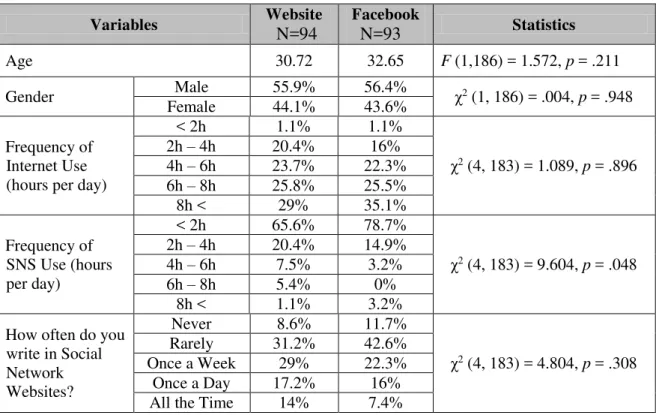
Facebook page (i.e., to the platform where the participant would write the complaint). As we can see on Table 1, the randomization worked as predicted. The socio-demographic variables
were comparable across conditions, with the exception of “Frequency of SNS Use”. We
included this variable as a covariate in the main analysis, and the results remained the same. No significance level was impacted by this variable.
Table 1. Main Characteristics of the Sample by Platform condition
Variables N=94 Website N=93 Facebook Statistics
Age 30.72 32.65 F (1,186) = 1.572, p = .211
Gender Male 55.9% 56.4% χ2 (1, 186) = .004, p = .948
Female 44.1% 43.6%
Frequency of Internet Use (hours per day)
< 2h 1.1% 1.1%
χ2 (4, 183) = 1.089, p = .896
2h – 4h 20.4% 16%
4h – 6h 23.7% 22.3%
6h – 8h 25.8% 25.5%
8h < 29% 35.1%
Frequency of SNS Use (hours per day)
< 2h 65.6% 78.7%
χ2 (4, 183) = 9.604, p = .048 2h – 4h 20.4% 14.9%
4h – 6h 7.5% 3.2%
6h – 8h 5.4% 0%
8h < 1.1% 3.2%
How often do you write in Social Network Websites?
Never 8.6% 11.7%
χ2 (4, 183) = 4.804, p = .308
Rarely 31.2% 42.6%
Once a Week 29% 22.3%
Once a Day 17.2% 16%
20 Procedure. After reading an online consent form and agreeing to participate in the study, the participants were provided with the following situation:
“Please imagine the following scenario: You decided to start a workout
program this month. After surfing the web, you found an amazing offer on
‘Discounts&Coupons.com’: A full year workout package at a 70% discount in
a new gym nearby. You thought a bit, and eventually bought it!
After the purchase, "Discounts&Coupons.com" sent you an email stating that you could start using the gym package you bought immediately.
When you arrived at Gym UH! for your first workout day, you learned that you were not registered on the Gym Uh! customer database. Somehow, Discount&Coupons.com had not yet notified Gym UH! of your purchase. The Gym UH! manager said that you needed to talk to the website where you bought the package to solve this problem.
Then you got back home, entered the ‘Discounts&Coupons.com' website (or Facebook page) and decided to write them a message.”
In this experiment, participants were informed that according to the company’s policy, all the messages received would be made public and that the company does not work with message moderation. All the messages received would therefore be directly posted on the company's wall and be visible to all other visitors and consumers. Indeed, participants were led to believe that whatever they wrote would be made public (in this case, to all other participants).
At this point, the main manipulation was conducted. Some of the participants were
directed to the contact page on the company website versus the company’s Facebook page.
Both on Facebook as on the company website, the text of comments were blurred not to
influence the participants’ messages (see Appendix 1). Only after their messages were sent,
21 In the Facebook condition, people wrote their messages on the company’s timeline. We also created a similar timeline to the company website, showing a feed with the latest reviews published by other users. Both conditions were identical except for the background platform.
To be sure that participants knew they were sending public messages, we conducted a manipulation check. The manipulation check consisted of the following question: “While writing your message you knew that your message would be… ”. Only one participant failed to provide the correct answer. We decided then to keep this participant in the sample.
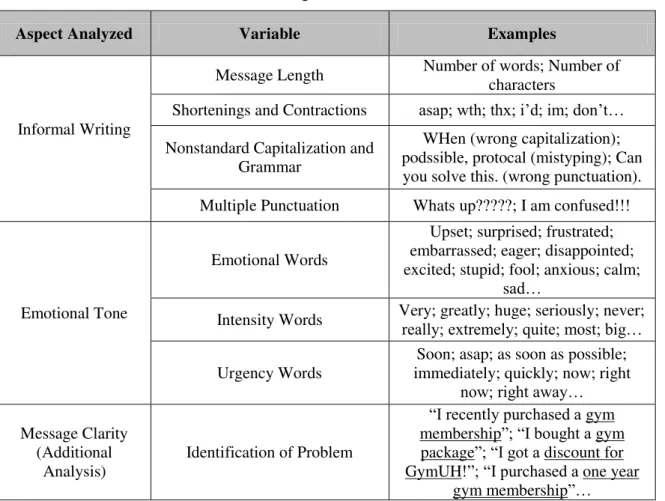
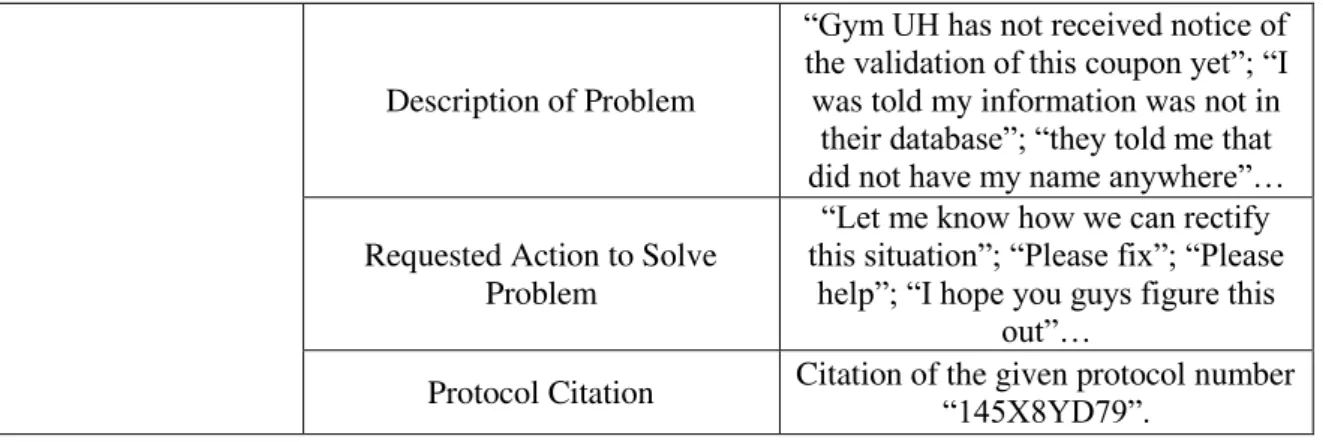
Coding of the main dependent variables. We coded the messages sent by the participants based on the aspects described in our theoretical background. In the following table, we exemplify some words and terms used to make the word coding.
Table 2. Words and Terms used on Coding
Aspect Analyzed Variable Examples
Informal Writing
Message Length Number of words; Number of characters
Shortenings and Contractions asap; wth; thx; i’d; im; don’t…
Nonstandard Capitalization and Grammar
WHen (wrong capitalization); podssible, protocal (mistyping); Can you solve this. (wrong punctuation). Multiple Punctuation Whats up?????; I am confused!!!
Emotional Tone
Emotional Words
Upset; surprised; frustrated; embarrassed; eager; disappointed; excited; stupid; fool; anxious; calm;
sad…
Intensity Words Very; greatly; huge; seriously; never; really; extremely; quite; most; big…
Urgency Words
Soon; asap; as soon as possible; immediately; quickly; now; right
now; right away…
Message Clarity (Additional
Analysis)
Identification of Problem
“I recently purchased a gym membership”; “I bought a gym package”; “I got a discount for GymUH!”; “I purchased a one year
22 Description of Problem
“Gym UH has not received notice of the validation of this coupon yet”; “I
was told my information was not in
their database”; “they told me that did not have my name anywhere”…
Requested Action to Solve Problem
“Let me know how we can rectify this situation”; “Please fix”; “Please
help”; “I hope you guys figure this out”…
Protocol Citation Citation of the given protocol number “145X8YD79”.
As the probability of having specific words when the message is bigger increases, all variables were controlled for number of words or characters on each message. For instance, the variable “emotional words” was verified taking into account the total number of words in the message, so we created the index of “emotional words (adjusted)”. Both
results will be presented in the results (adjusted and unadjusted). The same happened for variables based on number of characters.
Results. To understand the direct effects of the platform on our results, we ran a series of ANOVAs to compare the means between the two main conditions. The results are presented in Table 3.
Table 3. Main effect of Platform on Experiment 1A
Variable Condition Mean Std.
Deviation F p-value
INFORMAL WRITING
Number of Characters Website 270.96 135.279 5.456 .021 Facebook 228.49 112.403
Number of Words Website 52.30 25.672 6.542 .011
Facebook 43.56 20.813
Shortenings and Contractions
Website .46 .904
.626 .430
Facebook .56 .850
Shortenings and Contractions (adjusted)
Website .0101 .01981
1.937 .166
Facebook .0154 .03120
23 Non-Standard
Grammar/Capitalization Facebook
.48 .959
Non-Standard Grammar and Capitalization (adjusted)
Website .0070 .01990
3.758 .054
Facebook .0239 .08202
Extra Punctuation Website .00 .000 3.865 .051
Facebook .13 .626
Extra Punctuation (adjusted) Website .0000 .00000 2.743 .099
Facebook .0043 .02488
EMOTIONAL TONE
Intensity Words Website .25 .481 4.732 .031
Facebook .12 .323
Intensity Words (adjusted) Website .00551 .011736 2.534 .113 Facebook .00296 .010149
Urgency Words Website .27 .446 4.116 .044
Facebook .15 .358
Urgency Words (adjusted) Website .00534 .009592 1.347 .247 Facebook .00369 .009817
Emotional Words Website .43 .758 3.021 .084
Facebook .27 .512
Emotional Words (adjusted) Website .00917 .016745 2.231 .137 Facebook .00591 .012878
Intensity, Urgency & Emotional
Website .95 1.330
6.234 .013
Facebook .53 .900
Intensity, Urgency & Emotional (adjusted)
Website .02 .030
3.474 .064
Facebook .01 .025
Generally speaking, two main conclusions can be drawn from Table 3. First, in line with hypothesis 1, there is stronger evidence of more informal writing on Facebook relative
to company website platform. The complaint messages were briefer on Facebook than on the company website. They also tended, at the margin, to more frequently use extra punctuation as non-standard grammar and capitalization more frequently on Facebook than on the company website.
Second, in line with hypothesis 2B, participants in the Facebook condition were less prone to display their negative emotions than those in the website condition when making a public complaint. “Intensity Words”, “Urgency Words” and “Intensity, Urgency
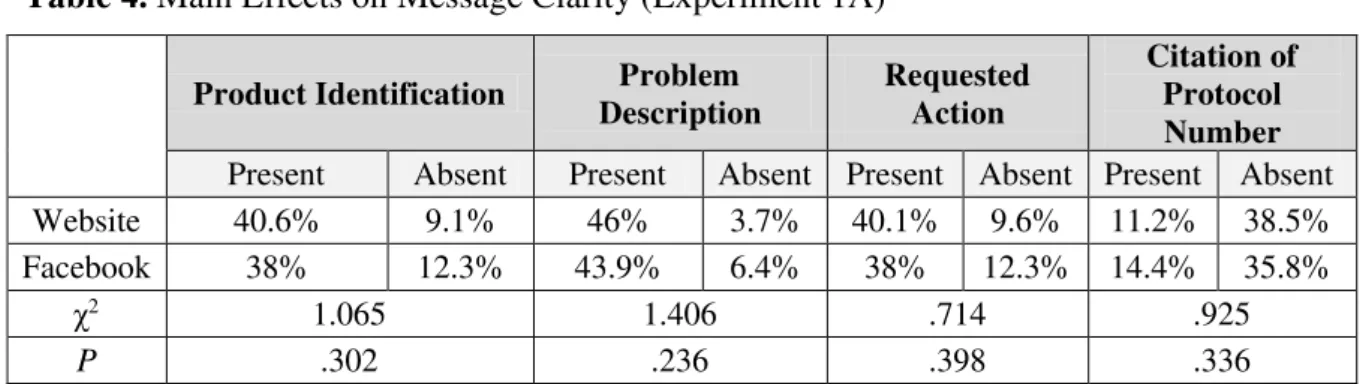
24 Message Clarity. Remember thatwe also measured message content, to see if any variations happen across conditions. It is clear that platform had no impact on the clarity of the messages sent by the participants.
Table 4. Main Effects on Message Clarity (Experiment 1A)
Product Identification Problem
Description
Requested Action
Citation of Protocol Number Present Absent Present Absent Present Absent Present Absent
Website 40.6% 9.1% 46% 3.7% 40.1% 9.6% 11.2% 38.5%
Facebook 38% 12.3% 43.9% 6.4% 38% 12.3% 14.4% 35.8%
χ2 1.065 1.406 .714 .925
P .302 .236 .398 .336
Discussion. The main results of this experiment provide evidence consistent with hypothesis 1. Participants’ messages were briefer and less formal when writing a complaint message on the company Facebook page than on the company website. Given that the purpose of the message complaint was exactly the same across conditions, this phenomenon shows that the platform primed a certain social norm, which in turn impacted the
participants’ writing style.
The platform also impacted the emotional tone of the message. The findings support hypothesis 2B. Participants express more emotions when writing a complaint message on the company website page than on the Facebook page.
25 Another aspect that could be impacting emotional tone difference across conditions is “impression management” (Schlenker & Weigold, 1992). Assuming that people do not want to be perceived as rude by their friends (Vohs, Baumeister, & Ciarocco, 2005), those in the public Facebook condition had an incentive to tone down the negativity of the message.
Finally, whereas the platform had a clear impact on linguistic style it did not impact the main content to the messages. Message clarity was similar across conditions.
4.
E
XPERIMENT
1B
This second experiment was conducted in order to check if the private setting would mitigate the impact of platform on informal writing and expression of emotions observed in Experiment 1A. Assuming that public settings tend to magnify the impact of social norms, a private setting would likely reduce its impact.
Sample and Design. Three hundred eighty eight individuals, recruited through Amazon’s Mechanical Turk, participated in this study in exchange for US$ 0.50. This experiment also took around 7 minutes and employed a single factor between subjects
design. Participants were randomly assigned to either company website or the company’s
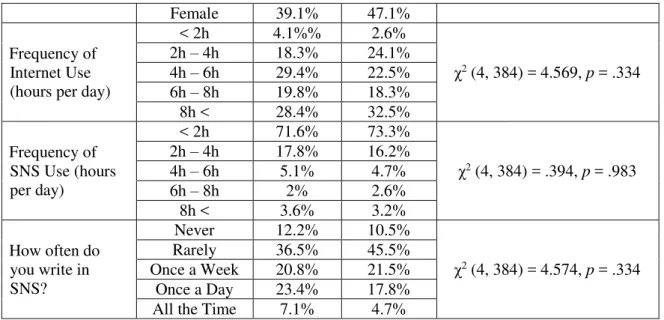
Facebook page. As we can see on Table 5, there is no significant difference on the control variables across the main conditions. Thus, the randomization worked as expected.
Table 5. Main Characteristics of the Sample by Condition
Variables Website N= 197 Facebook N = 191 Statistics
Age 33.52 34.31 F (1,387) = .466, p = .495
26
Female 39.1% 47.1%
Frequency of Internet Use (hours per day)
< 2h 4.1%% 2.6%
χ2 (4, 384) = 4.569, p = .334 2h – 4h 18.3% 24.1%
4h – 6h 29.4% 22.5%
6h – 8h 19.8% 18.3%
8h < 28.4% 32.5%
Frequency of SNS Use (hours per day)
< 2h 71.6% 73.3%
χ2 (4, 384) = .394, p = .983 2h – 4h 17.8% 16.2%
4h – 6h 5.1% 4.7%
6h – 8h 2% 2.6%
8h < 3.6% 3.2%
How often do you write in SNS?
Never 12.2% 10.5%
χ2 (4, 384) = 4.574, p = .334
Rarely 36.5% 45.5%
Once a Week 20.8% 21.5%
Once a Day 23.4% 17.8%
All the Time 7.1% 4.7%
Procedure and Coding. The experiment 1B was conducted with the same procedures and coding from the previous experiment. The only difference was that in Experiment 1A the messages sent were public (other users could read the message sent), and in Experiment 1B, messages were private (direct to the company). In the case of Facebook, rather than typing on the company’s wall, participants wrote a “Direct Message”. On the company Website, participants wrote on a regular contact page. As the default in these conditions is to place private messages, we did not feel the need for a manipulation check. We reinforced the idea of privacy saying that “all messages sent would be sent privately to
the company”. Again, in both platforms, the comments were blurred not to influence the
participants’ messages (see Appendix 3).
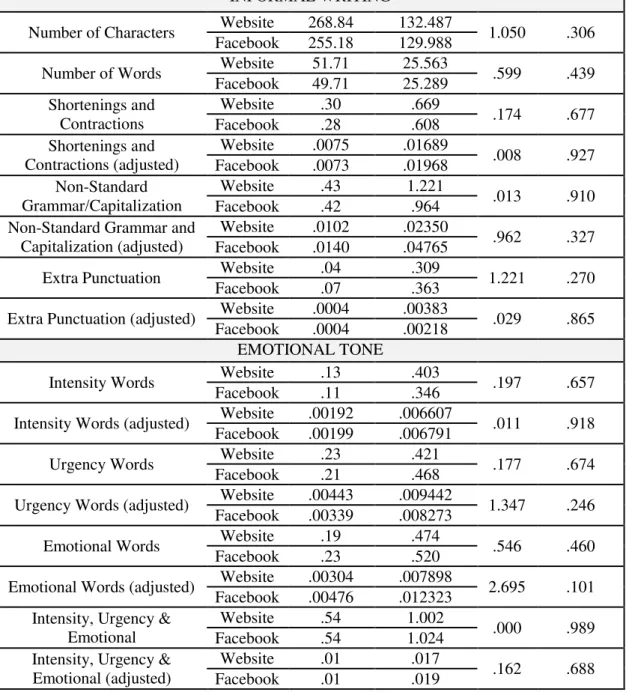
Results. Once again, we conducted a series of ANOVAs to compare the means between platforms. No significant effect was obtained in Experiment 1B in neither informal writing nor the emotional tone. The full results are displayed in Table 6.
Table 6. Main effect of Platform on Experiment 1B
Variable Condition Mean Std.
27 INFORMAL WRITING
Number of Characters Website 268.84 132.487 1.050 .306 Facebook 255.18 129.988
Number of Words Website 51.71 25.563 .599 .439
Facebook 49.71 25.289
Shortenings and Contractions
Website .30 .669
.174 .677
Facebook .28 .608
Shortenings and Contractions (adjusted)
Website .0075 .01689
.008 .927
Facebook .0073 .01968
Non-Standard Grammar/Capitalization
Website .43 1.221
.013 .910
Facebook .42 .964
Non-Standard Grammar and Capitalization (adjusted)
Website .0102 .02350
.962 .327
Facebook .0140 .04765
Extra Punctuation Website .04 .309 1.221 .270
Facebook .07 .363
Extra Punctuation (adjusted) Website .0004 .00383 .029 .865
Facebook .0004 .00218
EMOTIONAL TONE
Intensity Words Website .13 .403 .197 .657
Facebook .11 .346
Intensity Words (adjusted) Website .00192 .006607 .011 .918 Facebook .00199 .006791
Urgency Words Website .23 .421 .177 .674
Facebook .21 .468
Urgency Words (adjusted) Website .00443 .009442 1.347 .246 Facebook .00339 .008273
Emotional Words Website .19 .474 .546 .460
Facebook .23 .520
Emotional Words (adjusted) Website .00304 .007898 2.695 .101 Facebook .00476 .012323
Intensity, Urgency & Emotional
Website .54 1.002
.000 .989
Facebook .54 1.024
Intensity, Urgency & Emotional (adjusted)
Website .01 .017
.162 .688
Facebook .01 .019
Message Clarity: We also measured the message content to see if any variations would happen across conditions. Similarly as in Experiment 1A, no significant difference was found across the platforms. The results are presented on Table 7.
Table 7. Main Effects on Message Clarity (Experiment 1B) Product
Identification
Problem
Description Requested Action
28
Website 38.4% 12.4% 46.6% 4.1% 34.5% 16.2% 22.4% 28.4%
Facebook 36.6% 12.6% 45.1% 4.1% 34.8% 14.4% 20.6% 28.6%
χ2 .086 .008 .323 .205
P .769 .927 .570 .651
Discussion: As previously observed, no significant difference was found between platforms, even with many more participants than in Experiment 1A. In other words, the simple priming of social norms seem not sufficient to impact linguistic style on the Internet when writing a complaint message. It requires the public exposition to be magnified by the social pressure.
5.
C
ONCLUSION
We could see in this study that an online platform can influence the way people communicate with the company, especially when making a complaint. We saw that even when we keep the purpose of the message constant, people tend to be more informal on
Facebook than on the company website (H1) but tended to be more emotional on the
company website than on Facebook (H2B). However, these effects emerge only when the consumer is aware that the complaint message will be made public.
29 Although we started this study seeking to find only the differences in communication brought by virtual platforms, the observed effect of the secondary audience turns out to be a very relevant contribution to studies of CMC. This study contributed taking the first step about secondary audience in virtual communication. It goes beyond the one-to-one or one-to-one-to-many communication, because the writer is engaged in a one-to-one-to-one-to-one communication (customer-to-company), but in public settings he/she knows that other people can read the message sent (secondary audience).
5.1.
M
ANAGERIALI
MPLICATIONThe main implication for companies is to understand the differences in communication provided by each platform. Businesses can use this study as an initial point when deciding where to establish a new communication channel between company and customers. This study showed the differences in communication promoted by the virtual platforms and the public/private settings.
Based on these results, if the company wants an informal approach with customers, the Facebook would be the best option for them to place their page. But, if the company prefers to have a more direct channel, where the clients feel more in touch with the business, the website should be considered.
5.2.
L
IMITATIONS30 write it. Although the results are in the directions expected by previous studies, the findings of this study are neither indisputable nor definitive.
The main limitation of this study is that, even though we have tried to reproduce the experiments in the real world, it is still a hypothetical study. While it is possible to realize the actual engagement of participants in the study, we are assessing emotions. We cannot know if that participants would behave in the same way when exposed to a real situation. Undoubtedly, the magnitude of emotions in the real world tends to be much greater than in hypothetical situations. This study is valid because we used the same hypothetical settings for both platforms, and the differences were statistically significant. It would be good to have an analysis with real messages sent to companies.
It is possible to perceive that on Experiment 1B the size of the sample is much bigger than in Experiment 1A. It happened because Experiment 1B was conducted in two batches. When we conducted the first batch, we perceived that the results were really blurry. We decided to conduct the second batch to see if the weird results were a problem with the participants or a real effect of the Experiment. The results were almost the same. We then decided to run the analysis with the two batches together, since no difference was found on the control variables. Even with a doubled sample size, no significant differences were observed in Experiment 1B (private setting).
31
5.3.
F
UTURER
ESEARCHAs shown in this study, the listener ends up influencing a lot the communication. Although some authors pointed out the importance of the interlocutors (Baron, 2010; Peterson et al., 2011; Thurlow & Brown, 2003), future research should focus on the relationship between sender and recipient to understand the peculiarities of the communication, beyond one-to-one and one-to-many communication.
Another possibility would be to investigate if the real listener/reader influences the communication or if it is just a matter of perception about the receiver. In this study, for example, both main and secondary parties were hypothetical. Therefore, we draw some conclusions based on what the perception of participants when writing a message would be. None of them stated that they were imagining the company itself or the secondary listeners when sending the message.
Studies comparing the secondary listener with a real listener would bring a great theoretical contribution to the virtual communication field. It would be great to have messages received by real companies. Furthermore, studies investigating situations beyond the complaint with the company, other interlocutors, and different virtual platforms could add new insights to this field.
6.
R
EFERENCES
Aarts, H., & Dijksterhuis, A. (2003). The silence of the library: Environment, situational norm, and social behavior. Journal of Personality and Social Psychology, 84(1), 18–
32 Andrade, E. B., & Ho, T. (2009). Gaming Emotions in Social Interactions. Journal of
Consumer Research, 36(4), 539–552. doi:10.1086/599221
Asch, S. E. (1951). Effects of group pressure upon the modification and distortion of judgments. In H. Guetzkow (Ed.), Groups, leadership and men; research in human relations (pp. 177–190). Oxford: Carnegie Press.
Baños, R. M., Botella, C., Alcañiz, M., Liaño, V., Guerrero, B., & Rey, B. (2004). Immersion and emotion: their impact on the sense of presence. CyberPsychology & Behavior, 7(7),
734–741. doi:10.1089/cpb.2004.7.734
Bargh, J. a, & McKenna, K. Y. a. (2004). The internet and social life. Annual Review of Psychology, 55, 573–90. doi:10.1146/annurev.psych.55.090902.141922
Barnes, S., & Mattsson, J. (2008). Brand Value in Virtual Worlds: An axiological approach.
Journal of Electronic Commerce Research, 9(3), 195–206.
Baron, N. (1998). Letters by phone or speech by other means: the linguistics of email.
Language & Communication, 18(2), 133–170. doi:10.1016/S0271-5309(98)00005-6
Baron, N. (2000). Alphabet to E-mail: How Written English Evolved and Where It’s Heading. London, New York: Routledge.
Baron, N. (2003a). Language of the Internet. The Stanford Handbook for Language Engineers, 1–63.
Baron, N. (2003b). Why email looks like speech: proofreading, pedagogy and public face. In J. Aitchison & D. Lewis (Eds.), New media language (pp. 102–113). London:
Routledge.
Baron, N. (2004). See you Online: Gender Issues in College Student Use of Instant Messaging. Journal of Language and Social Psychology, 23(4), 397–423.
doi:10.1177/0261927X04269585
Baron, N. (2005). The future of written culture: Envisioning language in the New Millennium. Ibérica, 7–31.
Baron, N. (2010). Discourse structures in instant messaging: The case of utterance breaks.
Language@ Internet, 7(Im).
Batty, M. (1997). Virtual geography. Futures, 29(4/5), 337–352.
Benedikt, M. (1993). Cyberspace: first steps (pp. 1–224). Cambridge: MIT Press.
Biesenbach-Lucas, S. (2007). Students writing emails to faculty: An examination of e-politeness among native and non-native speakers of English. Language Learning & Technology, 11(2), 59–81. Retrieved from
33 Boyd, D. (2007). Why youth (heart) social network sites: The role of networked publics in teenage social life. In D. Buckingham (Ed.), MacArthur Foundation Series on Digital Learning – Youth, Identity, and Digital Media Volume (pp. 1–26). Cambridge: MIT
Press.
Boyd, D. M., & Ellison, N. B. (2007). Social Network Sites: Definition, History, and Scholarship. Journal of Computer-Mediated Communication, 13(1), 210–230.
doi:10.1111/j.1083-6101.2007.00393.x
Brown, T. J., Barry, T. E., Dacin, P. A., & Gunst, R. F. (2005). Spreading the Word:
Investigating Antecedents of Consumers’ Positive Word-of-Mouth Intentions and Behaviors in a Retailing Context. Journal of the Academy of Marketing Science, 33(2),
123–138. doi:10.1177/0092070304268417
Charters, M. J. (2014). An Examination of High School and College Students’ Chatspeak
Use in Twitter and Tumblr. In Syracuse University Honors Program Capstone Projects
(p. 57). Syracuse.
Cialdini, R. B., & Goldstein, N. J. (2004). Social influence: compliance and conformity.
Annual Review of Psychology, 55(1974), 591–621.
doi:10.1146/annurev.psych.55.090902.142015
Cialdini, R. B., & Trost, M. R. (1998). Social influence: Social norms, conformity and compliance. In D. T. Gilbert, S. T. Fiske, & G. Lindzey (Eds.), The handbook of social psychology (Vol. I and II) (4th ed., pp. 151–192). New York: McGraw-Hill.
Crystal, D. (2001). Language and the Internet (1st ed., p. 284). Cambridge: Cambridge
University Press.
Crystal, D. (2005). The scope of Internet linguistics, (February).
Crystal, D. (2008). Txtng: The gr8 db8 (1st ed., p. 250). Oxford: Oxford University Press.
Deutsch, M., & Gerard, H. B. (1955). A study of normative and informational social influences upon individual judgment. The Journal of Abnormal and Social Psychology, 51(3), 629–636.
Dijck, J. van. (2013). “You Have on identity”: performing the self on Facebook and
LinkedIn. Media, Culture & Society, 35(2), 199–215. doi:10.1177/0163443712468605
Dodge, M., & Kitchin, R. (2004). Code, space and everyday life. In Association of American Geographers Annual Conference (Vol. 44, pp. 1–35). Philadelphia.
Dulek, R. (1992). Could You Be Clearer? An Examination of the Multiple Perspectives of Clarity. IEEE Transactions on Professional Communication, 35(2), 84–87.
34 Fiehler, R. (2002). How to do emotions with words: Emotionality in Conversations. In S. Fussell (Ed.), The Verbal Communication of Emotions: Interdisciplinary Perspectives
(pp. 72 – 96). Mahwah: Lawrence Erlbaum Associates, Inc., Publishers.
Fischer, E., & Reuber, R. (2011). Social interaction via new social media: (How) can interactions on Twitter affect effectual thinking and behavior? Journal of Business Venturing, 26(1), 1–18. doi:10.1016/j.jbusvent.2010.09.002
Fukkink, R. (2011). Peer counseling in an online chat service: A content analysis of social support. Cyberpsychology, Behavior, and Social Networking, 14(4).
doi:10.1089/cyber.2010.0163
Fukkink, R., & Hermanns, J. (2009). Children’s experiences with chat support and telephone support. Journal of Child Psychology and Psychiatry, 50(6), 759–766.
doi:10.1111/j.1469-7610.2008.02024.x
Fussell, S. (2002). The verbal communication of emotions: interdisciplinary perspectives.
(S. Fussell, Ed.) (p. 294). Mahwah: Lawrence Erlbaum Associates, Inc., Publishers. Gill, A. J., Gergle, D., French, R. M., & Oberlander, J. (2008). Emotion rating from short
blog texts. In ACM Conference on Human Factors in Computing Systems (pp. 1–4).
Florence.
Grice, H. (1975). Logic and conversation. In J. L. Morgan & P. Cole (Eds.), Syntax and Semantics 3: Speech arts (pp. 41–58). Cambridge: Harvard University Press.
Gunkel, D., & Gunkel, A. (1997). Virtual geographies: The new worlds of cyberspace.
Critical Studies in Media Communication.
Hänninen, K. (2007). Perspectives on the narrative construction of emotions. ELORE (ISSN 1456-3010), 14(1), 1–9.
Harrison-Walker, J. (2001). E-complaining: a content analysis of an Internet complaint forum. Journal of Services Marketing, 15(5), 397–412.
Herring, S. (2007). A faceted classification scheme for computer-mediated discourse.
Language@ Internet, 2007, 1–37.
Jucker, A. H., & Dürscheid, C. (2012). The Linguistics of Keyboard-to-screen Communication: A New Terminological Framework. Linguistik Online, 56(6), 1–20.
Kavada, A. (2012). Engagement, bonding, and identity across multiple platforms: Avaaz on Facebook, YouTube, and MySpace. MedieKultur. Journal of Media and Communication Research, 52, 28–48.
Keizer, K., Lindenberg, S., & Steg, L. (2008). The spreading of disorder. Science, 322(5908),
35 Kim, S., & Hovy, E. (2004). Determining the sentiment of opinions. In Proceedings of the
COLING Conference (p. 8). Geneva.
Kinsley, S. (2013). The matter of “virtual” geographies. Progress in Human Geography, 38(3), 364–384. doi:10.1177/0309132513506270
Kloučková, V. (2012). The degree of spokenness in two modes of CMC. THEPES, VI(2),
75–92.
Konijn, E. A. (2012). The Role of Emotion in Media Use and Effects. In K. E. Dill (Ed.),
The Oxford Handbook of Media Psychology (pp. 1–82). Oxford: Oxford University
Press. doi:10.1093/oxfordhb/9780195398809.001.0001
Lin, K.-Y., & Lu, H.-P. (2011). Intention to continue using Facebook fan pages from the perspective of social capital theory. Cyberpsychology, Behavior and Social Networking, 14(10), 565–70. doi:10.1089/cyber.2010.0472
Ling, R., & Baron, N. (2007). Text Messaging and IM: Linguistic Comparison of American College Data. Journal of Language and Social Psychology, 26(3), 291–298.
doi:10.1177/0261927X06303480
Medaglia, R., Rose, J., Nyvang, T., & Sæbø, Ø. (2009). Characteristics of social networking services. In MCIS 2009 Proceedings.
Messinger, P. R., Stroulia, E., Lyons, K., Bone, M., Niu, R. H., Smirnov, K., & Perelgut, S. (2009). Virtual worlds — past, present, and future: New directions in social computing.
Decision Support Systems, 47(3), 204–228. doi:10.1016/j.dss.2009.02.014
Mitchell, V.-W. (1993). Handling Consumer Complaint Information: Why and How?
Management Decision, 31(3), 21–28. doi:10.1108/00251749310036306
Ogan, C. L., Ozakca, M., & Groshek, J. (2007). Embedding the Internet in the Lives of College Students: Online and Offline Behavior. Social Science Computer Review, 26(2), 170–177. doi:10.1177/0894439307306129
Papacharissi, Z. (2009). The virtual geographies of social networks: a comparative analysis of Facebook, LinkedIn and ASmallWorld. New Media & Society, 11(1-2), 199–220.
doi:10.1177/1461444808099577
Pepitone, A. (1976). Toward a normative and comparative biocultural social psychology.
Journal of Personality and Social Psychology, 34(4), 641–653.
Peterson, K., Hohensee, M., & Xia, F. (2011). Email formality in the workplace: A case study on the enron corpus. In Proceedings of the Workshop on Languages in Social Media (pp. 86–95). Portland.
Pitt, L. F., Berthon, P. R., Watson, R. T., & Zinkhan, G. M. (2002). The Internet and the birth of real consumer power. Business Horizons, 45(4), 7–14.
36 Rezabakhsh, B., Bornemann, D., Hansen, U., & Schrader, U. (2006). Consumer Power: A Comparison of the Old Economy and the Internet Economy. Journal of Consumer Policy, 29(1), 3–36. doi:10.1007/s10603-005-3307-7
Salomon, D. (2013). Moving on from Facebook: Using Instagram to connect with undergraduates and engage in teaching and learning. College & Research Libraries News, (September), 408–412.
Schlenker, B., & Weigold, M. (1992). Interpersonal processes involving impression regulation and management. Annual Review of Psychology, 43, 133-168. doi:
10.1146/annurev.ps.43.020192.001025
Schnoebelen, T. (2012a). Do you smile with your nose? Stylistic variation in Twitter emoticons. Selected Papers from NWAV 40, 18(2). Retrieved from
http://repository.upenn.edu/pwpl/vol18/iss2/14/
Schnoebelen, T. (2012b). Emotions are relational: positioning and the use of affective linguistic resources. Stanford University.
Seltzer, L., Prososki, A., Ziegler, T., & Pollak, S. (2012). Instant messages vs. speech: hormones and why we still need to hear each other. Evol Hum Behav, 33(1), 42–45.
Sherif, M. (1936). The psychology of social norms (p. 210). Oxford: Harper.
Shih, C. (2009). The Facebook era: tapping online social networks to build better products, reach new audiences, and sell more stuff (2nd ed., p. 236). New Jersey: Prentice Hall.
Smith, A. D., & Rupp, W. T. (2003). Strategic online customer decision making: leveraging the transformational power of the Internet. Online Information Review, 27(6), 418–432.
doi:10.1108/14684520310510055
Smith, A., Fischer, E., & Yongjian, C. (2012). How Does Brand-related User-generated Content Differ across YouTube, Facebook, and Twitter? Journal of Interactive Marketing, 26(2), 102–113. doi:10.1016/j.intmar.2012.01.002
Stefik, M. (1996). Internet Dreams, Archetypes, Myths, and Metaphors. Cambridge: MIT
Press.
Sterling, G. (2013). Facebook: We Have 25 Million Active Small Business Pages. Retrieved February 07, 2014, from http://marketingland.com/facebook-we-have-25-million-active-small-business-pages-65629
Tagliamonte, S. a., & Denis, D. (2008). Linguistic Ruin? Lol! Instant Messaging and Teen Language. American Speech, 83(1), 3–34. doi:10.1215/00031283-2008-001
37 Thurlow, C., & Brown, A. (2003). Generation Txt? The sociolinguistics of young people’s
text-messaging. Discourse Analysis Online.
Turkle, S. (1997). Life on the Screen: Identity in the Age of the Internet. New York:
Touchstone.
Tyler, T. R. (2002). Is the Internet Changing Social Life? It Seems the More Things Change, the More They Stay the Same. Journal of Social Issues, 58(1), 195–205.
doi:10.1111/1540-4560.00256
Valentine, G., & Holloway, S. L. (2002). Cyberkids? Exploring Children’s Identities and
Social Networks in On-line and Off-line Worlds. Annals of the Association of American Geographers, 92(2), 302–319. doi:10.1111/1467-8306.00292
Vohs, K., Baumeister, R., & Ciarocco, N. (2005). Self-regulation and self-presentation: Regulatory resource depletion impairs impression management and effortful self-presentation depletes regulatory resources. Journal of Personality and Social Psychology, 88(4), 632–657.
Werry, C. (1996). Linguistic and Interactional Features of Internet Relay Chat. In S. Herring (Ed.), Computer-Mediated Communication: Linguistic, social, and cross-cultural perspectives (pp. 47–63). Philadelphia: John Benjamins Publishing.
Wilson, J., & Kelling, G. (1982). Broken windows. Atlantic Monthly, (March), 1–9.
Zimmerman, D. E., & Clark, D. G. (1987). The Random House guide to technical and scientific Communication (p. 451). New York: Random House.
Zook, M. a, & Graham, M. (2007). Mapping DigiPlace: geocoded Internet data and the representation of place. Environment and Planning B: Planning and Design, 34(3),
466–482. doi:10.1068/b3311
38
A
PPENDIXES
A
PPENDIX1
40
A
PPENDIX2
42