RESEARCH ARTICLE
Characterization of the
In Situ
Ecophysiology
of Novel Phylotypes in Nutrient Removal
Activated Sludge Treatment Plants
Simon Jon McIlroy1, Takanori Awata1,2,3, Marta Nierychlo1, Mads Albertsen1, Tomonori Kindaichi3, Per Halkjær Nielsen1*
1Center for Microbial Communities, Department of Chemistry and Bioscience, Aalborg University, Aalborg, Denmark,2EcoTopia Science Institute, Nagoya University, Furo-cho, Chikusa-ku, Nagoya, Aichi, 464–
8603, Japan,3Department of Civil and Environmental Engineering, Graduate School of Engineering, Hiroshima University, 1–4–1 Kagamiyama, Higashihiroshima, 739–8527, Japan
Abstract
An in depth understanding of the ecology of activated sludge nutrient removal wastewater treatment systems requires detailed knowledge of the community composition and meta-bolic activities of individual members. Recent 16S rRNA gene amplicon surveys of activated sludge wastewater treatment plants with nutrient removal indicate the presence of a core set of bacterial genera. These organisms are likely responsible for the bulk of nutrient trans-formations underpinning the functions of these plants. While the basic activities of some of these generain situare known, there is little to no information for the majority. This study applied microautoradiography coupled with fluorescencein situhybridization (MAR-FISH) for thein situcharacterization of selected genus-level-phylotypes for which limited physio-logical information is available. These includedSulfuritaleaand A21b, both within the class Betaproteobacteria, as well as Kaga01, within sub-group 10 of the phylum Acidobacteria. While theSulfuritaleaspp. were observed to be metabolically versatile, the A21b and Kaga01 phylotypes appeared to be highly specialized.
Introduction
Wastewater treatment using activated sludge represents one of the largest biotechnology indus-tries in the world. These systems employ a diverse consortium of microbes primarily for the removal of carbon, nitrogen and phosphorus from wastewater streams. Removal of such nutrients is important for the prevention of the eutrophication of aquatic ecosystems receiving the treated water [1]. An in depth understanding of the ecology of these biotechnological systems is key for their optimal design and efficient operation [2]. Important to this goal will be the characterization of the individual contribution of each bacterial genus-level-taxon to system function [3].
Several long-term surveys of full-scale treatment plants, with both quantitative fluorescence in situhybridization (qFISH) [2,4] and 16S rRNA gene sequencing [5,6], have aimed to eluci-date the microbial community composition of these systems. An amplicon-sequencing based survey of 13 Danish full-scale plants with nutrient removal observed that a relatively small
PLOS ONE | DOI:10.1371/journal.pone.0136424 September 4, 2015 1 / 13
OPEN ACCESS
Citation:McIlroy SJ, Awata T, Nierychlo M, Albertsen M, Kindaichi T, Nielsen PH (2015) Characterization of theIn SituEcophysiology of Novel Phylotypes in Nutrient Removal Activated Sludge Treatment Plants. PLoS ONE 10(9): e0136424. doi:10.1371/journal. pone.0136424
Editor:Nicole Webster, Australian Institute of Marine Science, AUSTRALIA
Received:June 11, 2015
Accepted:August 3, 2015
Published:September 4, 2015
Copyright:© 2015 McIlroy et al. This is an open access article distributed under the terms of the Creative Commons Attribution License, which permits unrestricted use, distribution, and reproduction in any medium, provided the original author and source are credited.
Data Availability Statement:All relevant data are within the paper and its Supporting Information files.
number of genus-level-taxa (64) constitute a large percentage (approx. 70% read abundance on average) of the community. These abundant core genera are therefore likely collectively responsible for the bulk of the nutrient transformations that underpin system function [6]. The subsequent goal will be to systematically characterize each of the abundant organisms and add this information to public resources such as the MiDAS database for wastewater treatment sys-tems [3]. Most of these groups have no cultured representatives and for those that do the iso-lates do not always represent the abundant environmental strains [7]. Moreover,
microorganisms appear to be much more specializedin situthan when grown in pure culture [8].In situmethods, such as FISH in combination with microautoradiography (MAR) [9], are therefore essential in determining the ecology of these organisms. Whilein situinformation is available for some there is little to no information for the majority, and thus no indication as to their relevance to the ecology of these systems.
This study applied MAR-FISH based methods to characterize a selection of the abundant core phylotypes identified by Saunders et al. [6] for which limited information is available about their ecophysiology in activated sludge. These included the genusSulfuritaleaand the novel level-taxon A21b, both within the class Betaproteobacteria, as well as a genus-level-taxon, within sub-group 10 of the phylum Acidobacteria, known as Kaga01. All were reported to be among the top 10 genus-level-taxa by median read abundance [6].
Materials and Methods
Phylogenetic analysis and probe design
Phylogenetic placement of representative 16S rRNA gene sequences (generated by Saunders et al. [6]) and the design of FISH probes for selected groups were performed with the ARB soft-ware package [10]. Potential probes were assessedin silicowith the mathFISH software for hybridization efficiencies of target, and potentially weak non-target, matches [11]. Unlabeled helper probes [12] were designed for calculated inaccessible regions. Unlabeled competitor probes were also designed for single base mismatched non-target sequences [13]. The existence of non-target indel sequences were identified with the Ribosomal Database Project (RDP) PROBE MATCH function [14] and assessed with the LOOPOUT program [15]. Probe valida-tion and optimizavalida-tion was based on generated formamide dissociavalida-tion curves [16], where fluo-rescent intensities of at least 50 cells were measured with ImageJ software (National Institutes of Health, Maryland, USA). Calculated average values were compared for hybridization buffer formamide concentration over a range of 5–50% (v/v) with 5% increments (data not shown). As no isolates were available for probe target groups, activated sludge from four separate full-scale WWTPs was used to optimize the probes. Where available, weak base-mismatch non-tar-get axenic cultures were also used for probe assessment (seeTable 1).
Fluorescence
in situ
hybridization (FISH)
Selected activated sludge samples were obtained from the aerobic tanks of full-scale WWTPs as part of the MiDAS FISH survey [4]. Sample fixation and FISH were performed essentially as described by Daims et al. [16]. Probes were applied, with recommended competitors and help-ers, at the stringency conditions given inTable 1or their original publications. The NON-EUB nonsense probe was used as a negative hybridization control [17]. Both the 3’and 5’ends of oli-gonucleotide probes were labeled, with 5(6)-carboxyfluorescein-N-hydroxysuccinimide ester (FLUOS) or with the sulfoindocyanine dyes (Cy3 and Cy5) (DOPE-FISH [18]), in order to improve thein situfluorescent signal to background ratio. Microscopic analysis was performed with either an Axioskop epifluorescence microscope (Carl Zeiss, Oberkochen, Germany) or a LSM510 Meta laser scanning confocal microscope (Carl Zeiss).
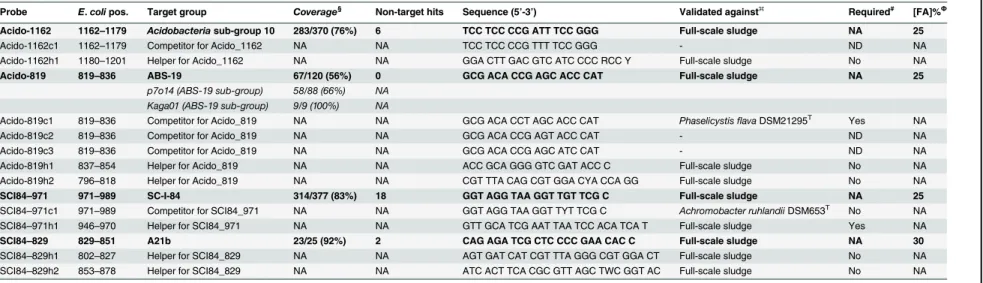
Table 1. Probes designed and optimized in this study.
Probe E.colipos. Target group Coverage§ Non-target hits Sequence (5
’-3’) Validated against⌘ Required# [FA]%Φ
Acido-1162 1162–1179 Acidobacteriasub-group 10 283/370 (76%) 6 TCC TCC CCG ATT TCC GGG Full-scale sludge NA 25
Acido-1162c1 1162–1179 Competitor for Acido_1162 NA NA TCC TCC CCG TTT TCC GGG - ND NA
Acido-1162h1 1180–1201 Helper for Acido_1162 NA NA GGA CTT GAC GTC ATC CCC RCC Y Full-scale sludge No NA
Acido-819 819–836 ABS-19 67/120 (56%) 0 GCG ACA CCG AGC ACC CAT Full-scale sludge NA 25
p7o14 (ABS-19 sub-group) 58/88 (66%) NA Kaga01 (ABS-19 sub-group) 9/9 (100%) NA
Acido-819c1 819–836 Competitor for Acido_819 NA NA GCG ACA CCT AGC ACC CAT PhaselicystisflavaDSM21295T Yes NA
Acido-819c2 819–836 Competitor for Acido_819 NA NA GCG ACA CCG AGT ACC CAT - ND NA
Acido-819c3 819–836 Competitor for Acido_819 NA NA GCG ACA CCG AGC ATC CAT - ND NA
Acido-819h1 837–854 Helper for Acido_819 NA NA ACC GCA GGG GTC GAT ACC C Full-scale sludge No NA
Acido-819h2 796–818 Helper for Acido_819 NA NA CGT TTA CAG CGT GGA CYA CCA GG Full-scale sludge No NA
SCI84–971 971–989 SC-I-84 314/377 (83%) 18 GGT AGG TAA GGT TGT TCG C Full-scale sludge NA 25
SCI84–971c1 971–989 Competitor for SCI84_971 NA NA GGT AGG TAA GGT TYT TCG C Achromobacter ruhlandiiDSM653T No NA
SCI84–971h1 946–970 Helper for SCI84_971 NA NA GTT GCA TCG AAT TAA TCC ACA TCA T Full-scale sludge Yes NA
SCI84–829 829–851 A21b 23/25 (92%) 2 CAG AGA TCG CTC CCC GAA CAC C Full-scale sludge NA 30
SCI84–829h1 802–827 Helper for SCI84_829 NA NA AGT GAT CAT CGT TTA GGG CGT GGA CT Full-scale sludge No NA
SCI84–829h2 853–878 Helper for SCI84_829 NA NA ATC ACT TCA CGC GTT AGC TWC GGT AC Full-scale sludge No NA
§Coverage of groups as defined in MiDAS database (Release 1.20)[3]. Values given as group hits/ group totals. Percentage values are given in parenthesis;
⌘For optimization with‘Full-scale sludge’samples taken from the Odense North East, Odense North West, Ejby Mølle and Randers BNR WWTPs were used. In each case
optimization with the different plants gave similar dissociation profiles (data not shown);
# Requirement of accessory probes: If available, isolates with single-base mismatches to the probe were used to assess the requirement for a competitor probe. Competitor probes perfectly match the target site in the listed isolate. If the mismatch alone is enough to prevent non-target binding of the labeled probe, at the recommended formamide concentration, then the competitor probe is assessed as not being required (note: it is recommended that competitor probes are included for un-validated mismatches); helper probes assessed on ability to improvefluorescence signal of the associated labeled probe. NA = Not applicable; ND = Not determined;
ΦDetermined optimal formamide concentration for use in FISH hybridizations. doi:10.1371/journal.pone.0136424.t001
In
Situ
Characteriz
ation
of
Novel
Phyloty
pes
in
Activated
Sludge
PLOS
ONE
|DOI:10.137
1/journal.p
one.0136424
September
4,
2015
3/1
Microautoradiography (MAR)-FISH
Activated sludge was sampled from aeration tanks at Randers WWTP (56.453767° N, 10.070249° E) (sampled January 7th, 2014) and Ejby Mølle WWTP (55.399534° N, 10.414787° E) (sampled January 22nd, 2014) and transported overnight. Both plants are configured for bio-logical phosphorus removal and have stable performance. The Randers WWTP is a recircula-tion plant with side stream hydrolysis and the Ejby Mølle WWTP has an alternating
configuration (Biodenipho). For further details on the plants assessed in this study see Mielc-zarek et al. [19]. MAR incubations were performed immediately upon arrival in the laboratory. Sampling was carried out with the permission of Randers Spildevand A/S and VandCenter Syd A/S.
The MAR-FISH procedures were carried out essentially as described in Nielsen and Nielsen [20]. Radiolabeled compounds used were: [14C]-propionate, [14C]-butyrate, [3H]-amino acid mix, [3H]-ethanol, [3H]-glycerol, [3H]-N-acetyl glucosamine, (American Radiolabeled Chemi-cals Inc., Saint Louis MO, USA); [3H]-acetate, [14C]-pyruvate, [3H]-glucose (PerkinElmer Inc., Waltham MA, USA); [3H]-oleic acid (Amersham Bioscience, Denmark).
Prior to MAR incubations, the activated sludge was aerated for 1 h to remove traces of organics present. For all anaerobic incubations an additional 1 h anaerobic pre-incubation was performed to remove traces of oxygen and NOx present. For MAR incubations, pre-incubated mixed liquor was diluted to 1 gSS/L with sludge supernatant and transferred to 11 ml serum bottles. Unlabeled and labeled substrates were added to give final concentrations of 2 mM and 10μCi/ml, respectively. For anaerobic incubations oxygen was removed by repeated evacuation of the headspace and subsequent injection of O2-free N2prior to substrate addition. Bottles were sealed with thick rubber stoppers and incubated for 3 h. In order to better assess true denitrification, anaerobic incubations with selected substrates were supplemented with 0.5 mM nitrite, as many non-denitrifiers are able to reduce nitrate to nitrite [21]; acknowledging that this will not cover denitrifiers unable to directly utilize nitrite. For incubations assessing the use of nitrite as an electron acceptor, the supernatant nitrite concentration was monitored during the incubation period using Quantofix Nitrate Nitrite strips (Macherey-Nagel, Düren, Ger-many) and readjusted to approx. 0.5 mM anaerobically to prevent exhaustion. Incubations using pasteurized mixed liquor (70°C, 10 min) were performed as negative controls for all experiments.
Following MAR incubations, the cells were fixed for 3h with cold 4% [w/v] paraformalde-hyde (final concentration) and the fixed samples were washed 3 times with sterile filtered tap water. Aliquots of 20μl of the biomass were gently homogenized between glass coverslips. Following FISH, slides were coated with Ilford K5D emulsion (Polysciences, Inc., Warrington, PA, USA), exposed in the dark for 10 days and developed with Kodak D-19 developer.
Results
FISH probe design and optimization
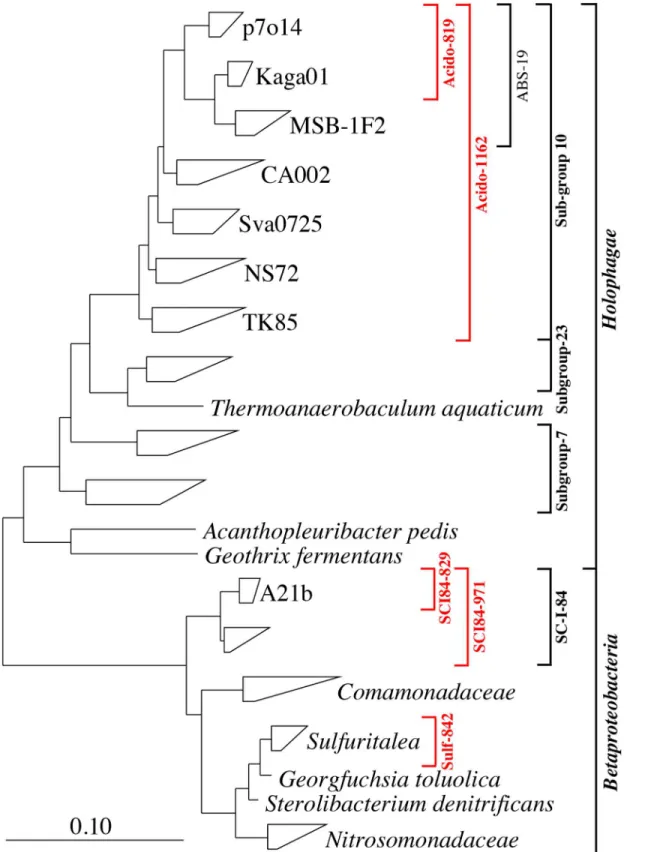
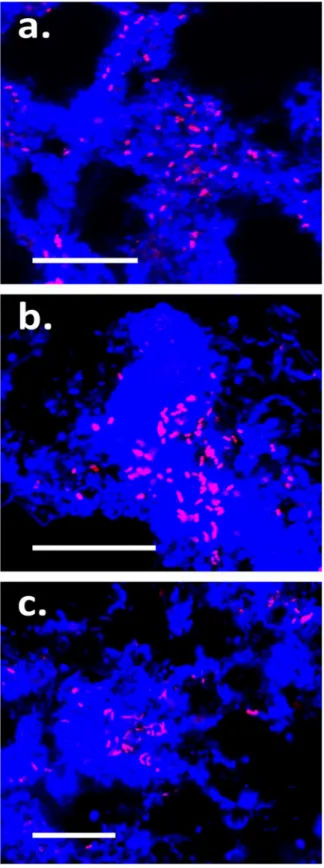
application are given inTable 1.Probe coverage and phylogeny are shown inFig 1. FISH images of the selected phylotypes are shown inFig 2.
The previously designed Sulf842 probe was applied to cover theSulfuritaleaspp. [24]. The specificity of the Sulf842 probe was confirmed for the Ejby Mølle and Randers WWTP com-munities by the recommended application of the Sulf431 probe labeled with a different fluoro-chrome (see McIlroy et al. [24]).
In this study the SCI84–829 was designed and optimized for coverage of the MiDAS defined genus-level-taxon A21b. The probe hybridized with small rod shaped cells (typically approx. 0.6 × 1.5μm) that were mostly present as single cells, but were also observed as loosely associ-ated clusters (seeFig 2B). Quantitative FISH analysis suggests that members of the genus are not abundant in full-scale communities (<1% of the biovolume (S1 Table)). The SCI84–971 was designed to cover the candidate order SC-I-84, containing the A21b phylotype, to allow higher confidence in the specificity of the SCI84–829 probe. Cells hybridising with the SCI84– 829 probe showed good overlap with the SCI84–971 probe, which supports a high specificity of the former probe.
Probes specific for the Kaga01 were not found. However, the Acido-819 probe was designed to cover both Kaga01 and p7o14, which are both genus-level taxa within the family-level-taxon ABS-19. Sequences classifying to the genus p7o14 are rarely detected in full-scale sludges (see Table 2), thus Acido-819 probe positive cells in activated sludge likely belong to the Kaga01 genus. The probe hybridized with small rods (typically approx. 0.5 × 1.4μm), present as dis-persed single cells in full-scale sludges (seeFig 2C). Positive cells constituted up to 2% of the community biovolume in full-scale systems (seeS1 Table). A hierarchical probe set was also applied to better assess specificity. Good overlap was observed for the Acido-819 probe and the broader newly designed Acido-1162, targeting the order sub-group 10 of the Acidobacteria, and the SS_HOL1400 probe [25], targeting the phylum Acidobacteria.
Distribution of the phylotypes
The genera characterized represent three of the top ten genera, by median abundance (all>1%), of a previous 16S rRNA gene based survey of 13 full-scale nutrient removal WWTPs [6]. However, the recent 8-year MiDAS survey of 20 Danish full-scale treatment plants suggested lower abundances (seeTable 2). Quantitative FISH analyses performed with the probes designed in this study better supported the values of the MiDAS survey (seeS1 Table), suggesting they were overestimated in the previous study. One key difference between these studies was the use of primers targeting different regions of the 16S rRNA gene. The v4 and v1–3 regions were used for the surveys of Saunders et al. [6], and the MiDAS, respectively. However, recent analyses comparing the application of these primer sets to activated sludge found no substantial difference in the calculated abundances of the three phylotypes investi-gated in this study [26]. The only other major difference between the MiDAS survey and study of Saunders et al. [6] is the DNA extraction method applied. Both studies applied the Fast DNA Soil kit (MP Biomedicals, USA), but the former used an extended bead beating time for cell lysis while the latter used hot phenol (at 80°C). The influence of DNA extraction on the resulting community composition is well studied for activated sludge samples (see Albertsen et al. [26]) and is likely largely responsible for the previous overestimation of the phylotypes analysed here.
In situ
physiology
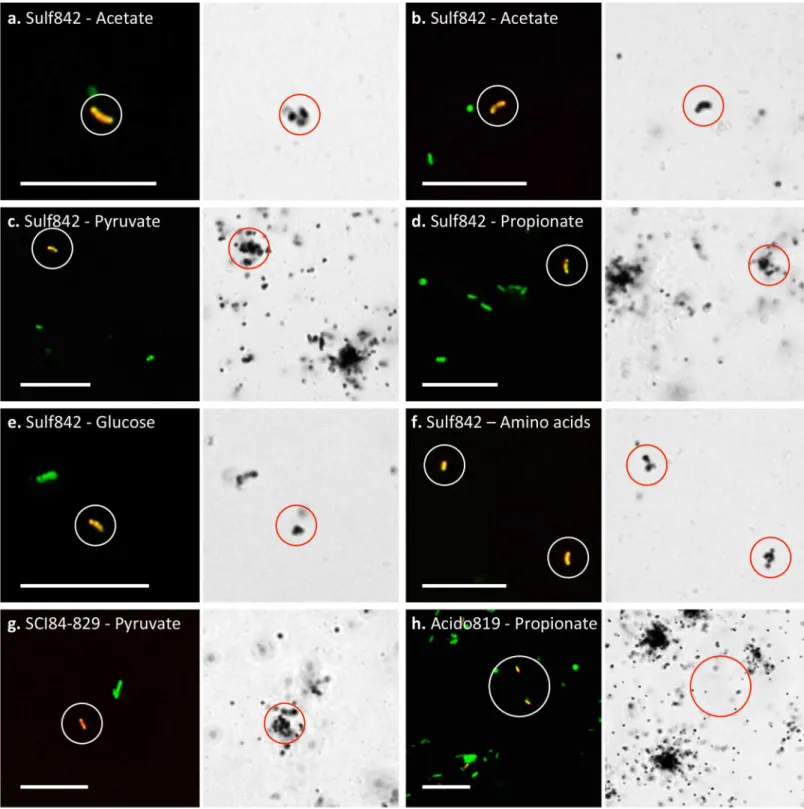
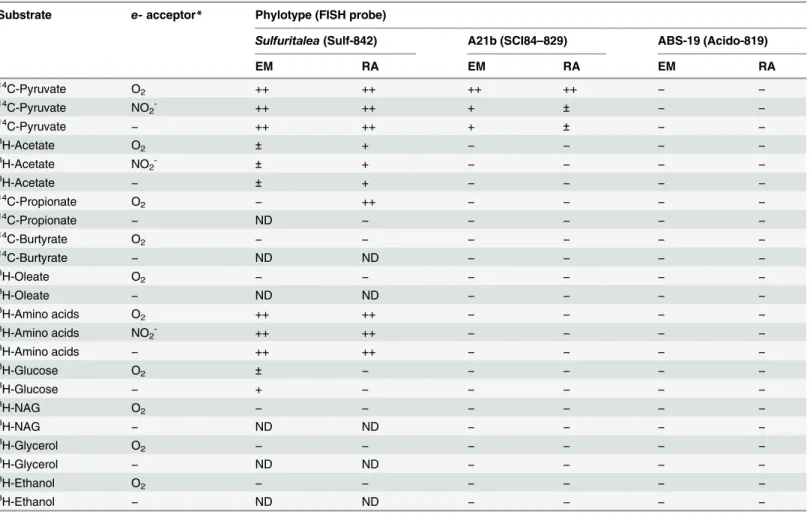
TheSulfuritaleaspp. were able to assimilate pyruvate, acetate and amino acids, while the uptake of propionate and glucose varied between plants (Fig 3A–3F;Table 3). With the
In SituCharacterization of Novel Phylotypes in Activated Sludge
Fig 1. Maximum-likelihood (PhyML) 16S rRNA gene phylogenetic tree of target groups and selected related sequences.All sequences are>1200 bp in length. Phylogenetic classification is taken from the MiDAS database (Release 1.20), which is a version of the SILVA database (Release 119; [23]) curated for activated sludge sequences [3]. Clades represent 5–15 selected sequences. Probe coverage for probes applied in this study is shown in red. For the Sulf842 this represents the overlap in coverage for the Sulf842 and Sulf432 probes. The scale bar represents substitutions per nucleotide base.
Fig 2. Composite FISH micrographs of target phylotypes in full-scale sludge.(a)Sulfuritalea-related (Sulf-842); (b) A21b (SCI84–829); (c) ABS-19 (Acido-819). Target cells in FISH micrograph overlays appear magenta [target probe (Cy3 = red) + EUBmix (Cy5 = blue)] and non-target blue (EUBmix only). Scale bars represent 20μm.
doi:10.1371/journal.pone.0136424.g002
In SituCharacterization of Novel Phylotypes in Activated Sludge
exception of propionate, all substrates could be assimilated under both aerobic and anaerobic conditions. Butyrate, oleate, glycerol, ethanol andN-acetylglucosamine were not assimilated by the genus in either WWTP (Table 3).
Of the substrates tested, members of the A21b phylotype were only able to assimilate pyru-vate (Table 3;Fig 3G). Uptake of pyruvate under anaerobic conditions was detected, indicating that it is possibly stored and/or fermented or that an alternate unidentified residual electron acceptor is utilized. Addition of nitrite under anaerobic conditions did not appear to increase substrate uptake, thus suggesting an inability for denitrification.
ABS-19 species were unable to assimilate any of the substrates tested (Table 3,Fig 3H). Assessment of several autotrophic activities gave inconclusive results (seeS1 Text).
Discussion
This study applied MAR-FISH for the preliminary characterization of thein situbehaviour of three phylotypes suggested as abundant members of the activated sludge community. Quanti-tative FISH values, supported by more recent surveys with optimized protocols [3,26], suggest thatSulfuritalea, A21b and Kaga01 taxa were previously overestimated [6]. With widespread application of 16S rRNA gene amplicon sequencing to characterize bacterial communities it is important to acknowledge that the abundance values obtained are estimations at best. The observations of this study highlight the need for DNA extraction and amplification indepen-dent approaches, such as the FISH analyses conducted here, in the validation of profiling methods.
Despite being present at lower abundances than originally reported, theSulfuritaleaare still among the most 50 abundant genera in full-scale plants in Denmark [3]. Other than a reported ability for denitrification with amino acids as carbon source [24], little was known about thein situphysiology of theSulfuritaleaspp. in activated sludge. This study found these organisms to have broad substrate specificity, including short chain fatty acids, amino acids and perhaps sugars. Their ability to assimilate acetate under anaerobic conditions (Fig 3B) suggests that they are able to utilize an unidentified residual terminal electron acceptor. One possibility is Fe (III) [27], a hypothesis supported by its close relatedness of the genus to the iron reducing Georgfuchsia toluolica[28] (seeFig 1). However, such activities remain to be tested for mem-bers of the genusin situ, with the removal of residual ferric iron from the activated sludge being problematic.Sulfuritalea hydrogenivoransT, the sole described species of the genus, is able to use molecular hydrogen and thiosulphate as sole electron donors with nitrate as the ter-minal electron acceptor under anaerobic conditions. Such ability for the species in activated sludge could not be confirmed in this study (seeS1 Text) and the potential for mixotrophic growth remains to be demonstrated.
Table 2. Distribution of selected phylotypes in full-scale WWTPs.
Phylotype Abundance (%)
Median Q25 Q75 Min Max
Sulfuritalea 0.4 0.2 0.7 <0.1 2.4
A21b 0.1 <0.1 0.1 - 0.4
Kaga01 (ABS-19) 0.1 0.1 0.2 <0.1 1.0
p7o14 (ABS-19) - - - - <0.1
Data is sourced from the MiDAS 16S amplicon survey of 20 full-scale WWTPs in Denmark over 8 years (n = 396)(Albertsen, M., Nielsen, P.H. et al., unpublished—for details see McIlroy et al. [3]).
Fig 3. Selected FISH and corresponding bright-field MAR micrographs.FISH probes and MAR substrate are indicated for each image set. Target cells in FISH micrograph overlays appear yellow [target probe (Cy3 = red) + EUBmix (FLUOS) = green] and non-target green (EUBmix only). Circles indicate location of FISH-positive cells. Black silver granules indicate positive MAR signal:a.-g.show positive MAR signal for cells hybridizing with the specific FISH probe;h.shows a negative MAR signal. Images represent incubations performed under either aerobic (a. and c.-h.) or anaeorbic incubation conditions (b.) with biomass from the Randers (a., b., d. and f.-h.) or the Ejby Mølle (c. and e.) WWTPs. Scale bars represent 10μm.
doi:10.1371/journal.pone.0136424.g003
In SituCharacterization of Novel Phylotypes in Activated Sludge
While the substrate uptake profiles were similar for the target phylotypes in both plants assessed in this study, there were differences in the uptake of glucose and propionate for the Sulfuritaleaspp.. Such an observation is not unusual and, while the genus is considered a rea-sonably good phylogenetic unit for study [3], it is worth acknowledging that different members of the same genus may occupy slightly different niches.
Members of the genus-level-taxa A21b and Kaga01 appeared much more specialized than theSulfuritalea. The A21b phylotype was only able to assimilate pyruvate, which it may fer-ment, while carbon uptake for the Kaga01 FISH-positive cells was not detected. However, it is unlikely that the species are not metabolically activein situas they are reported to be growing in the system, and not simply washed in with the influent [6]. The observed lack of activity may be due to the failure of the applied experimental conditions to replicate the optimal condi-tions experienced by the species in the full-scale sample.
While members of the class Betaproteobacteria are well studied in activated sludge, little is known of the role of the phylum Acidobacteria. Members of the phylum were first detected in WWTPs with FISH by Ludwig et al. [29], but to our knowledge this is the first attempt to Table 3. Summary of MAR-FISH results for carbon uptake profiles.
Substrate e-acceptor* Phylotype (FISH probe)
Sulfuritalea(Sulf-842) A21b (SCI84–829) ABS-19 (Acido-819)
EM RA EM RA EM RA
14C-Pyruvate O
2 ++ ++ ++ ++ − −
14C-Pyruvate NO
2- ++ ++ + ± − −
14
C-Pyruvate − ++ ++ + ± − −
3H-Acetate O
2 ± + − − − −
3H-Acetate NO
2- ± + − − − −
3H-Acetate
− ± + − − − −
14
C-Propionate O2 − ++ − − − −
14C-Propionate
− ND − − − − −
14C-Burtyrate O
2 − − − − − −
14C-Burtyrate
− ND ND − − − −
3
H-Oleate O2 − − − − − −
3H-Oleate
− ND ND − − − −
3H-Amino acids O
2 ++ ++ − − − −
3H-Amino acids NO
2- ++ ++ − − − −
3
H-Amino acids − ++ ++ − − − −
3H-Glucose O
2 ± − − − − −
3H-Glucose
− + − − − − −
3H-NAG O
2 − − − − − −
3
H-NAG − ND ND − − − −
3H-Glycerol O
2 − − − − − −
3H-Glycerol
− ND ND − − − −
3H-Ethanol O
2 − − − − − −
3
H-Ethanol − ND ND − − − −
Data represent the proportion of 50 FISH-positive cells that are also MAR positive:−,10%;±, 11–30%; +, 30–60%; ++,>60%. ND = Not determined.
Results are given for both WWTPs:EM= Ejby Mølle;RA= Randers.
*Electron acceptors:‘O2’= aerobic conditions;‘NO2-’= anaerobic conditions with nitrite added;‘−’= None added, anaerobic conditions.
characterize theirin situbehaviour in activated sludge. The phylum is phylogenetically diverse and relatively poorly studied, with few characterized isolates [30]. The Kaga01 phylotype belongs to the order‘sub-group 10’of the Acidobacteria (Fig 1), for which there are currently no cultured isolates.
This study has provided preliminary characterization of the potential activities of the genera Sulfuritaleaand A21b. Further classification is required to elucidate the ecology of the phylo-types of this study; especially for the A21b and Kaga01, which appear to have relatively special-ized metabolisms in sludge. Given the labor intensive nature ofin situmethods, such as MAR-FISH, obtaining genomes from these uncultured organisms [31] will allow a more tar-geted approach to characterize their ecology in the future. For example, we recently applied MAR-FISH to assess the genome annotation-derived potential of the uncultured“Ca. Compe-tibacter spp.”to ferment glucose [32]. The class and genus level FISH probes described in this study will be essential tools for future analyses of these organisms in both activated sludge and other environments.
Supporting Information
S1 Table. Abundance estimations for the selected phylotypes.§ Egå, Viby, Aars, Randers and Hjørring have biological nitrogen and phosphorus removal; Esbjerg East nitrogen removal only.Taken from the MiDAS amplicon survey. Plants and sample times selected for qFISH gave the highest abundances for the phylotypes in the extended MiDAS amplicon survey (53 plants).Quantitative FISH (qFISH) values represent a percentage of the EUBmix positive cells that also hybridize with the specific probe (biovolume %) ± the standard deviation. Each value is determined from the analysis of 20 FISH micrographs (at 630x magnification) using the Daime image analysis software.
(DOCX)
S1 Text. Labeled14CO2-MAR for the detection of heterotrophic and autotrophic activities. Labeled14CO2uptake MAR electron acceptor/donor combinations tested (Table A). FISH and corresponding bright-field MAR micrographs for14CO2incubations (Figure A).
(PDF)
Author Contributions
Conceived and designed the experiments: SJM MN PHN. Performed the experiments: SJM TA MN. Analyzed the data: SJM TA MN MA. Contributed reagents/materials/analysis tools: PHN MA. Wrote the paper: SJM TA MN MA TK PHN.
References
1. Seviour RJ, Nielsen PH. Microbial Ecology of Activated Sludge. London: IWA Publishing; 2010.
2. Nielsen PH, Mielczarek AT, Kragelund C, Nielsen JL, Saunders AM, Kong Y, et al. A conceptual eco-system model of microbial communities in enhanced biological phosphorus removal plants. Water Res. 2010; 44: 5070–5088. doi:10.1016/j.watres.2010.07.036PMID:20723961
3. McIlroy S, Saunders AM, Albertsen M, Nierychlo M, McIlroy B, Hansen AA, et al. MiDAS: the field guide to the microbes of activated sludge. Database. 2015; 2015: bav062. doi:10.1093/database/bav062 PMID:26120139
4. Mielczarek AT, Saunders AM, Larsen P, Albertsen M, Stevenson M, Nielsen JL, et al. The Microbial Database for Danish wastewater treatment plants with nutrient removal (MiDas-DK)—a tool for under-standing activated sludge population dynamics and community stability. Water Sci Technol. IWA Pub-lishing; 2013; 67(11): 2519–26. doi:10.2166/wst.2013.151PMID:23752384
5. Zhang T, Shao M-F, Ye L. 454 pyrosequencing reveals bacterial diversity of activated sludge from 14 sewage treatment plants. ISME J.; 2012; 6: 1137–47. doi:10.1038/ismej.2011.188PMID:22170428
In SituCharacterization of Novel Phylotypes in Activated Sludge
6. Saunders AM, Albertsen M, Vollertsen J, Nielsen PH. The activated sludge ecosystem contains a core community of abundant organisms. ISME J. 2015; doi:10.1038/ismej.2015.117PMID:26262816
7. Albertsen M, Hansen LB, Saunders AM, Nielsen PH, Nielsen KL. A metagenome of a full-scale micro-bial community carrying out enhanced biological phosphorus removal. ISME J. 2012; 6: 1094–1106. doi:10.1038/ismej.2011.176PMID:22170425
8. Kindaichi T, Nierychlo M, Kragelund C, Nielsen JL, Nielsen PH. High and stable substrate specificities of microorganisms in enhanced biological phosphorus removal plants. Environ Microbiol. 2013; 15: 1821–1831. doi:10.1111/1462-2920.12074PMID:23320853
9. Lee N, Nielsen PH, Andreasen KH, Juretschko S, Nielsen JL, Schleifer KH, et al. Combination of fluo-rescentin situhybridization and microautoradiography-a new tool for structure-function analyses in microbial ecology. Appl Env Microbiol. 1999; 65: 1289–1297.
10. Ludwig W, Strunk O, Westram R, Richter L, Meier H, Yadhukumar, et al. ARB: a software environment for sequence data. Nucleic Acids Res. 2004; 32: 1363–1371. PMID:14985472
11. Yilmaz LS, Parnerkar S, Noguera DR. mathFISH, a web tool that uses thermodynamics-based mathe-matical models forin silicoevaluation of oligonucleotide probes for fluorescence in situ hybridization. Appl Env Microbiol. 2011; 77: 1118–1122.
12. Fuchs BM, Glockner FO, Wulf J, Amann R. Unlabeled helper oligonucleotides increase the in situ accessibility to 16S rRNA of fluorescently labeled oligonucleotide probes. Appl Env Microbiol. 2000; 66: 3603–3607.
13. Manz W, Amann R, Ludwig W, Wagner M, Scheifer K-H. Phylogenetic oligodeoxynucleotide probes for the major subclasses of Proteobacteria: problems and solutions. Syst Appl Microbiol. 1992; 15: 593–
600.
14. Cole JR, Wang Q, Fish JA, Chai B, McGarrell DM, Sun Y, et al. Ribosomal Database Project: data and tools for high throughput rRNA analysis. Nucleic Acids Res. 2014; 42: D633–42. doi:10.1093/nar/ gkt1244PMID:24288368
15. McIlroy SJ, Tillett D, Petrovski S, Seviour RJ. Non-target sites with single nucleotide insertions or dele-tions are frequently found in 16S rRNA sequences and can lead to false positives in fluorescence in situ hybridization (FISH). Env Microbiol. 2011; 13: 38–47.
16. Daims H, Stoecker K, Wagner M. Fluorescencein situhybridization for the detection of prokaryotes. In: Osborn AM, Smith CJ, editors. Molecular Microbial Ecology. New York: Taylor & Francis; 2005. pp. 213–239.
17. Wallner G, Amann R, Beisker W. Optimizing fluorescentin situhybridization with rRNA-targeted oligo-nucleotide probes for flow cytometric identification of microorganisms. Cytometry. 1993; 14: 136–143. PMID:7679962
18. Stoecker K, Dorninger C, Daims H, Wagner M. Double labeling of oligonucleotide probes for fluores-cence in situ hybridization (DOPE-FISH) improves signal intensity and increases rRNA accessibility. Appl Environ Microbiol. 2010; 76: 922–6. doi:10.1128/AEM.02456-09PMID:19966029
19. Mielczarek AT, Nguyen HT, Nielsen JL, Nielsen PH. Population dynamics of bacteria involved in enhanced biological phosphorus removal in Danish wastewater treatment plants. Water Res. 2013; 47: 1529–1544. doi:10.1016/j.watres.2012.12.003PMID:23317522
20. Nielsen JL, Nielsen PH. Advances in microscopy: microautoradiography of single cells. Methods Enzy-mol. 2005; 397: 237–256. PMID:16260295
21. Daims H, Wagner M. (2010) The microbiology of nitrogen removal. In: Seviour RJ, Nielsen PH, editors. Microbial Ecology of Activated Sludge. London: IWA Publishing; 2010. pp. 259–280.
22. DeSantis TZ, Hugenholtz P, Larsen N, Rojas M, Brodie EL, Keller K, et al. Greengenes, a chimera-checked 16S rRNA gene database and workbench compatible with ARB. Appl Env Microbiol. 2006; 72: 5069–5072.
23. Quast C, Pruesse E, Yilmaz P, Gerken J, Schweer T, Yarza P, et al. The SILVA ribosomal RNA gene database project: improved data processing and web-based tools. Nucleic Acids Res. 2013; 41: D590–6. doi:10.1093/nar/gks1219PMID:23193283
24. McIlroy SJ, Starnawska A, Starnawski P, Saunders AM, Nierychlo M, Nielsen PH, et al. Identification of active denitrifiers in full-scale nutrient removal wastewater treatment systems. Environ Microbiol. 2014; doi:10.1111/1462–2920.12614PMID:25181571
25. Meisinger DB, Zimmermann J, Ludwig W, Schleifer K-H, Wanner G, Schmid M, et al.In situdetection of novel Acidobacteria in microbial mats from a chemolithoautotrophically based cave ecosystem (Lower Kane Cave, WY, USA). Environ Microbiol. 2007; 9: 1523–34. PMID:17504489
27. Rasmussen H, Nielsen PH. Iron reduction in activated sludge measured with different extraction tech-niques. Water Res. 1996; 30: 551–558.
28. Weelink SAB, van Doesburg W, Saia FT, Rijpstra WIC, Röling WFM, Smidt H, et al. A strictly anaerobic betaproteobacteriumGeorgfuchsia toluolicagen. nov., sp. nov. degrades aromatic compounds with Fe (III), Mn(IV) or nitrate as an electron acceptor. FEMS Microbiol Ecol. 2009; 70: 575–85. doi:10.1111/j. 1574-6941.2009.00778.xPMID:19799633
29. Ludwig W, Bauer SH, Bauer M, Held I, Kirchhof G, Schulze R, et al. Detection and in situ identification of representatives of a widely distributed new bacterial phylum. FEMS Microbiol Lett. 1997; 153: 181–
190. PMID:9252585
30. Barns SM, Cain EC, Sommerville L, Kuske CR. Acidobacteria phylum sequences in uranium-contami-nated subsurface sediments greatly expand the known diversity within the phylum. Appl Environ Micro-biol. 2007; 73: 3113–6. PMID:17337544
31. Albertsen M, Hugenholtz P, Skarshewski A, Nielsen KL, Tyson GW, Nielsen PH. Genome sequences of rare, uncultured bacteria obtained by differential coverage binning of multiple metagenomes. Nat Bio-technol. 2013; 31: 533–538. doi:10.1038/nbt.2579PMID:23707974
32. McIlroy SJ, Albertsen M, Andresen EK, Saunders AM, Kristiansen R, Stokholm-Bjerregaard M, et al.
“CandidatusCompetibacter”-lineage genomes retrieved from metagenomes reveal functional meta-bolic diversity. ISME J. 2014; 8: 613–624. doi:10.1038/ismej.2013.162PMID:24173461
In SituCharacterization of Novel Phylotypes in Activated Sludge