P
ARAMETRIC CORRELATIONS BETWEEN EXPERIMENTAL
RESULTS AND THE BASE ISOLATION
,
IN SITU
,
STRUCTURAL ONES
Polidor BRATU
Prof., PhD, Dipl.-Eng., ICECON S.A., Bucharest “Dunărea de Jos” University - Galaţi, Faculty of Engineering - Brăila, E-mail: [email protected]
Ovidiu VASILE
Lect., PhD, Dipl.-Eng., ICECON S.A., Bucharest Department of Mechanics, University “Politehnica”- Bucharest E-mail: [email protected]
Patricia MURZEA
Assist. Prof., PhD, Dipl.-Eng., ICECON S.A., Bucharest Technical University of Civil Engineering - Bucharest E-mail: [email protected]
Carmen ALEXANDRU
PhD stud, Dipl.-Eng., ICECON S.A., Bucharest “Dunărea de Jos” University, Galaţi E-mail: [email protected]
Abstract. The paper addresses the topic of the inconsistency between experimental, laboratory results for antiseismic devices and the dynamic stiffness, internal damping and dissipation parameters through additional devices. The nec essary corrections of the stiffness and dissipation (damping) parameters will be presented when the antiseismic devices are equipped to satisfy the adequate functions in a complex structural system (buildings, viaducts, bridges) under the conditions of seismic motions characteristic to the Romanian territory. In this context, the kinematic excitation method, compared to the dynamic evaluation method of the vibration dissipation capacity, produced by a seismic shock is shown.
Key words: dynamic and kinematic excitation, laboratory testing, isolators
1. Introduction
In accordance with the European Standard EN 15129:2009, the conformity assessment and CE marking of the anti-seismic elastomeric isolators, used as components of the base isolation systems, are done. Experimental research carried
out on specialized testing facilities, under dynamic regime, is conducted. The testing should reproduce the loading conditions equivalent to the operation specific parameters mainly defined by the
geometrical and mechanical
and stiffness parameters (Rivice, 1999; Meinovitch, 1990; Bratu, 2011a).
In order to determine the damping capacity, the elastomeric isolators are subjected to shearing by means of kinematic harmonic
excitations defined under the
formx =A0sinω1t, where A0 is the absolute
displacement amplitude of the loaded plate edge, in respect to the fixed edge and ω1 is
the kinematic excitation pulsation (Bratu, 2000; Kelly and Konstantinidis, 2011). In this case, considering of the hysteresis loop for the instantaneous viscoelastic force
x c kx
Q= + &depending on the instantaneous deflection x, the loss factor of the internal energy η, representing the dissipation effect, as well as the equivalent critical damping fraction ζeq are determined (Giuliani, 1993; Tyler 1991).
The loading conditions showed that the isolator has no attached concentrated mass, meaning that m≡0, and the excitation is kinematic exclusively with the harmonic displacement externally applied (Bratu and Dragan, 1997; Bratu and Vasile, 2012).
In this context, the damping expressed by the system parameter ζeq, defined by
max 4 el eq
W W π
ζ = ∆ (Bratu and Mihalcea, 2011),
differs as compared with the parameter ζ related to a linear viscoelastic system having the mass m≠0, expressed under the form of
km c
2
=
ζ (Viola, 2001).
Thus, the damping parameter ζeq could be determined by laboratory testing only. Thus, the actual structural analysis using the supporting and the base passive isolation system, having appropriate configuration, the values of parameter
eq
ζ in correlation with the effective parameter ζ for the actual system, should be taken into account (Bratu and Vasile, 2010; Bratu, 2011c).
2. Exterior Harmonic Actions applied on the Elastomeric Isolator
This correlation between ζeq obtained
under harmonic elastic deflection actions kinematic applied and ζd under dynamic
actions could be performed, so that the energy dissipated under the kinematic regime ∆Wcwould be equal to the energy
dissipated under dynamic regime∆Wd.
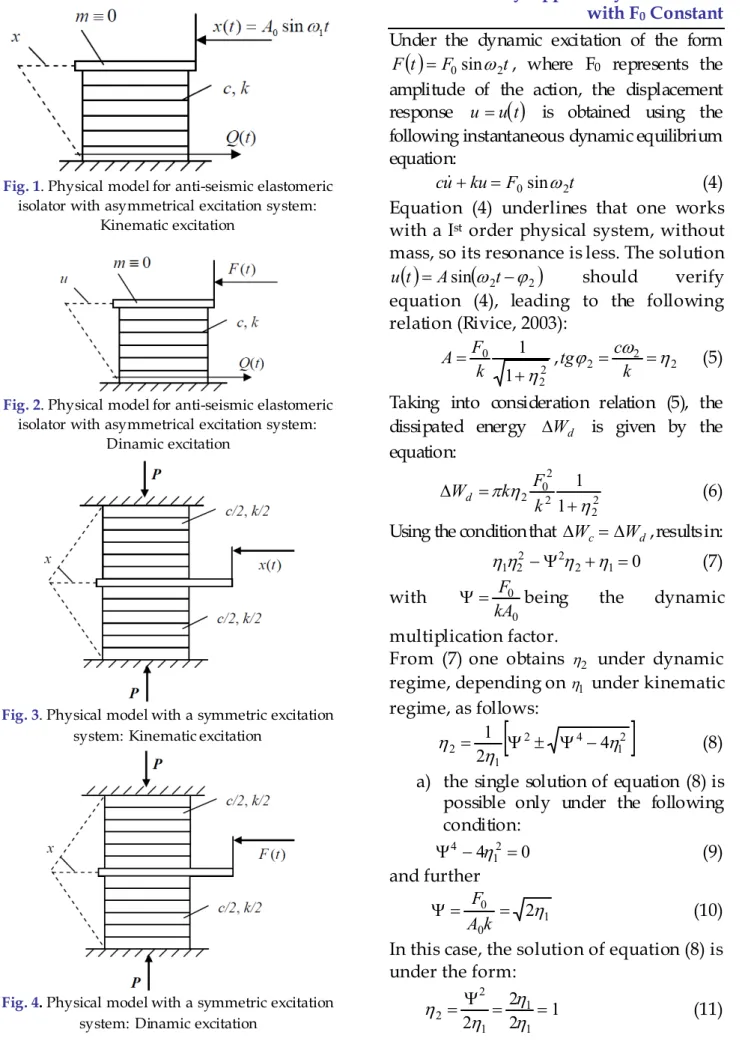
Figures 1 and 2 illustrate one elastomeric isolator consisting of several rubber layers separated by steel shims, under
kinematic excitation of the form
( )
t A tx = 0sinω1 (Fig. 1) and under
dynamic excitation governed by the law
( )
t F tF = 0sinω2 (Fig. 2). Fig. 3 and 4, represent a physical system with a symmetric excitation system. The linear viscoelastic system characteristics are c and k, without an added mass.
Under the kinematic excitation, of the formx
( )
t =A0sinω1t, the dynamic response related to the viscoelastic connection force Q( )
t is obtained as (Dolce et.al., 2010; Faccioli and Paolucci, 2005):( )
t =kx+cx≡Q0sin(ω1t−ϕ1)Q & and further:
2 1 0 0 =kA 1+η
Q (1)
1 1
1 η
ω
ϕ = =
k c
tg (2)
The dissipated energy ∆Wc can be written as:
2 0 1A
c Wc=π ω
∆
If one introduces cω1=kη1, the previous
relation becomes:
2 0 1A
k Wc=π η
Fig. 1. Physical model for anti-seismic elastomeric isolator with asymmetrical excitation system:
Kinematic excitation
Fig. 2. Physical model for anti-seismic elastomeric isolator with asymmetrical excitation system:
Dinamic excitation
Fig. 3. Physical model with a symmetric excitation system: Kinematic excitation
Fig. 4. Physical model with a symmetric excitation system: Dinamic excitation
3. Externally Applied Dynamic Force with F0 Constant
Under the dynamic excitation of the form
( )
t F tF = 0sinω2 , where F0 represents the
amplitude of the action, the displacement response u =u
( )
t is obtained using the following instantaneous dynamic equilibrium equation:t F
ku u
c&+ = 0sinω2 (4) Equation (4) underlines that one works with a Ist order physical system, without
mass, so its resonance is less. The solution
( )
t =Asin(
ω2t−ϕ2)
u should verify
equation (4), leading to the following relation (Rivice, 2003):
2 2 0
1 1
η
+ =
k F
A , 2 2
2 η
ω
ϕ = =
k c
tg (5)
Taking into consideration relation (5), the dissipated energy ∆Wd is given by the equation:
2 2 2 2 0 2
1 1
η η
π
+ =
∆
k F k
Wd (6)
Using the condition that ∆Wc=∆Wd, results in:
0 1 2 2 2 2
1η −Ψη +η =
η (7)
with
0 0
kA F
=
Ψ being the dynamic
multiplication factor.
From (7) one obtains η2 under dynamic
regime, depending on η1 under kinematic
regime, as follows:
[
2]
1 4 2
1
2 4
2
1 η
η
η = Ψ ± Ψ − (8)
a) the single solution of equation (8) is possible only under the following condition:
0 4 12
4 − =
Ψ η (9)
and further
1 0
0
2η
= = Ψ
k A
F
(10)
In this case, the solution of equation (8) is under the form:
1 2 2
2 1
1
1 2
2 = =
Ψ =
η η η
Thus, the loss factor has a unitary value
and 0,5
2 1
2 2 = η =
ζ .
5 , 0 max
2 =
ζ represents the maximum value.
b) the actual and distinct solutions of equation (8) are possible only for
0 4 12 4 − >
Ψ η , or Ψ > 2η1. In case
of actual parametric values
6 , 1 2
,
0 ≤η1≤ , the range for Ψis
obtained as 0,63≤Ψ≤1,78.
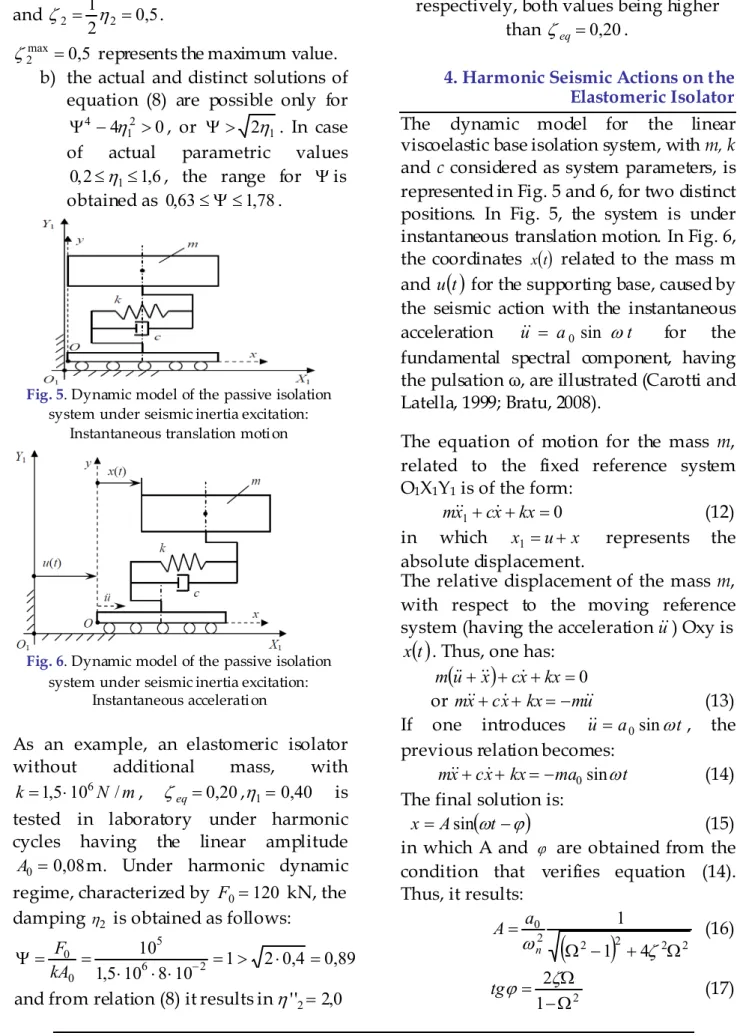
Fig. 5. Dynamic model of the passive isolation system under seismic inertia excitation:
Instantaneous translation moti on
Fig. 6. Dynamic model of the passive isolation system under seismic inertia excitation:
Instantaneous accelerati on
As an example, an elastomeric isolator
without additional mass, with
m N
k=1,5⋅106 / , ζeq=0,20,η1=0,40 is tested in laboratory under harmonic cycles having the linear amplitude
08 , 0 0 =
A m. Under harmonic dynamic
regime, characterized by F0=120 kN, the
damping η2 is obtained as follows:
89 , 0 4 , 0 2 1 10 8 10 5 , 1
10 2 6
5
0
0 = > ⋅ =
⋅ ⋅ ⋅ = =
Ψ −
kA F
and from relation (8) it results in η ''2=2,0
leading to ζ'2=0,25 and ζ"2=1,0,
respectively, both values being higher than ζeq =0,20.
4. Harmonic Seismic Actions on the Elastomeric Isolator
The dynamic model for the linear viscoelastic base isolation system, with m, k and c considered as system parameters, is represented in Fig. 5 and 6, for two distinct positions. In Fig. 5, the system is under instantaneous translation motion. In Fig. 6, the coordinates x
( )
t related to the mass m and u( )
t for the supporting base, caused by the seismic action with the instantaneous acceleration u&& = a0 sin ωt for the fundamental spectral component, having the pulsation ω, are illustrated (Carotti and Latella, 1999; Bratu, 2008).The equation of motion for the mass m, related to the fixed reference system O1X1Y1 is of the form:
0 1+cx+kx =
x
m&& & (12) in which x1=u+x represents the absolute displacement.
The relative displacement of the mass m, with respect to the moving reference system (having the acceleration u&&) Oxy is
( )
tx . Thus, one has:
(
u+x)
+cx+kx=0m && && &
or mx&&+cx&+kx=−mu&& (13) If one introduces u&&=a0sinωt, the previous relation becomes:
t ma
kx x c x
m&&+ &+ =− 0sinω (14) The final solution is:
(
ω −ϕ)
=A t
x sin (15)
in which A and ϕ are obtained from the condition that verifies equation (14). Thus, it results:
(
2)
2 2 22 0
4 1
1
Ω + − Ω =
ζ ωn
a
A (16)
2
1 2
Ω −
Ω
= ζ
ϕ
n ω ω = Ω ; m k n = 2
ω (18)
The energy dissipated under seismic dynamic excitation regime, is (Bratu et. al, 2011):
(
2)
2 2 22 0 2 4 1 2 Ω + − Ω Ω = ∆ ζ ω
πζ m a W
n
d (19)
The condition ∆Wc =∆Wd, leads to the following relation:
(
2)
2 2 22
4
1 + Ω
− Ω Ω = ζ ζ α
ζeq (20)
and further we have the second order equation in ζ , of the form:
(
)
ζ α ζζ
ζ + Ω − = Ω
Ω2 2 2 12 2
4 eq eq (21)
having the solution:
(
)
Ω± Ω − Ω Ω −
Ω
= 2 4 2 2 2 2 2
2 16 1
8 1 eq eq ζ α α ζ ζ
At resonance, for Ω=1, one obtains:
eq rez ζ α ζ 2 4 1
= (22)
where 2
0 0 n A a ω
α = is the acceleration
multiplication factor.
As an example, an elastomeric isolator having k =1,5⋅106N/m, ζeq=0,2 is tested
at A0 =0,088m. For a structural system with ωn =2π subjected to a maximum acceleration a0 =0,25g, the result is:
707 , 0 4 088 . 0 10 25 , 0 2 = ⋅ ⋅ = π α 62 , 0 2 , 0 707 , 0 4
1 2 =
=
ζ
meaning that ζ for the system is three times higher than ζech determined in the
laboratory.
6. Conclusions
The following conclusions can be synthesized based on the analysis intended to equalize the dissipated
energy under different excitation
regimes, kinematic and dynamic:
a) the testing method with kinematic excitation only, with harmonic
displacement of the form
( )
t A tx = 0sinω1 allows the
determination of the equivalent damping ζeq. This is specific to the isolation system under laboratory experimental configuration, only.
b) the damping evaluation under
dynamic excitation for systems having actual dynamic behavior puts into evidence the necessity to determine the system parameter ζ as a function of the experimental parameter ζeq;
c) ζ for the system under actual configuration depends both on the type of the dynamic excitation as well as the existence of the mass with inertial effect.
BIBLIOGRAPHY
Bohler J., Baumann T. (1999), Different numerical models for the hysteretic behavior of HDRB’s on the dynamic response of base-isolated structures with lumped-mass models under seismic loading, Proceedings of the 1st European Conf. on Consti tutive Models for Rubber, Constitutive Models for Rubber, pp. 267-273.
Bratu P. (2000), Vibration of elas tic systems, Technical Publishing House, Bucharest, Romania, pp. 600.
Bratu P. (2008), The modelling of the composite neoprene antivibrating isolators realized by microstructure and macrostructure using significant rheological laws, 2nd International Conference ‚Advanced Composite Materials Engineering, Brasov Romania COMAT2008, pp. 20.
Bratu P. (2009), Experimental Evaluation of the Antivibrating Damping Capacity in case of Elastomers Used for tram Railway Supporting, Materiale Plastice ISI 1999(2): 198.
Bratu P. (2011), Influence of kinematic or dynamic exciting regime upon the damping characteristics of the elastomeric elements, The International Conference on Structural Engineering Dynamics ICEDyn, Tavira, Portugal, CD, pp. 8. Bratu P., Drăgan N. (1997), L'analyse des
mouvements désaccouplés appliquée au modèle de solide rigide aux liaisons élastiques, Analele Universitatii “Dunarea de Jos” of Galati 14:15-20.
Bratu P., Gheorghe A. (2011), Hysteretic damping for isolation systems consisting of elastomeric devices. Experimental analysis, Anual Symposium of the Institute of Solid Mecanics SISO M, Bucharest, 249-253. Bratu P., Mihalcea A. (2011), Experimental methods
intended for stating the damping parameters for elastomeric anti-seismic devices and systems, International Institute of Acousti cs and Vibration (IIAV). 18th International Congress on Sound and Vibration (ICSV 18), Rio de Janeiro, Brazil, pp. 2206-2214.
Bratu P., Mihalcea A., Vasile O. (2011), Evaluation of the dissipation capacity in case of structural system consisting of elastomeric anti-seismic devices tested under laboratory conditions, Proceedings of The annual Symposium of the Institute of Solid Mechanics and Session of the Commissi on of Acousti cs, The XXII-th SISOM 2011, Bucharest, pp. 342-348.
Bratu P., Vasile O. (2010), Experimental analysis of neoprene systems excited by inertial harmonic vibrations, Acta Tehnica Napocensis, Applied mathematics and mechanics
2(53): 301-304.
Bratu P., Vasile O. (2012), Modal analysis of viaducts supported on elastomeric insulation within the Bechtel constructive solution for the
Transilvania highway, Romanian Journal of Acousti cs and Vibration 9(2):77-82.
Carotti A., Latella M. (1999), Tecniche innovative in ingegneria antisismica e del vents, Pitagora Editrice, Bologna, Italy.
Dolce M., Ponzo F., DiCesare A., Arleo G. (2010), Progetto di Edifici con Isolamento Sismico, Iuss Press, Pavia, Italy.
Faccioli E., Paolucci R. (2005), Elementi di sismologia applicata all’ingegneria, Pitagora Editrice, Bologna, Italy.
Gent A. (1964), Elastic Stability of Rubber Compression Springs, Journal of Mechanical Engineering Science 6(4):318-326.
Giuliani G. (1993), Structural design analysis and full-scale seismically isolated buildings, Eng. Struct. International Journal 15(N2 ): 102-106.
Kelly M. (2011), Konstantinidis A.D., Mechanics of Rubber Bearings for Seismic and Vibration Isolation, Wiley.
Lindley P. (1978), Engineering Design with Natural Rubber Units, Journal of Strain Analysis
1(7):150-195.
Meinovitch L. (1990), Dynamics and Control of Structures, New York.
Pandey A., Setua D. (2006), Study of Damping Behavior of Rubber-Plastic Blend, Raw Materials and Applications 1(1):45-48. Rivice E. (1999), Stiffness and Damping in
Mechanical Design, Marcel Dekker Inc., New York.
Rivice I. (2003), Passive Vibration Isol ation, ASME Press, New York.
Tyler R. (1991), Rubber Bearings in Base-Isolated Structures, Bulletin of the New Zeeland National Society for Earthquake Engineering 24(3):251-274.
Viola E. (2001), Fondamenti di dinamica e vibrazione delle strutture, Pitagora Editrice, Bologna, Italy.