Research Paper
Mediatorsof Inflammation4,359-363 (1995)
ThE effect of an n-3 (fish)andn-6 (soybean) fatty
acid-rich diet on carrageeninpawoedemainrats, and the participation of adrenal gland,
corticos-terone and z-macroglobulin (2-M) in this
process were studied. A significant inhibition of
carrageenin oedema wasobservednotonlyin rats
fed a diet richinfish oilbut alsointhe soybean group.
z-M
wasnotdetectablebefore carrageenininjection, suggesting that this putative
anti-inflammatory factor does not participate in the
observedanti-inflammatory effect.Corticosterone levels werehigherin fat-fedthanincontrol rats,
before carrageenin stimulus and adrenalectomy
abolished the anti-inflammatory response in
fat-fed animals, showing the important role of the adrenocortical hormonesinthisprocess.
Key words: Carrageenin oedema, Corticosteroids,
02-Macroglobulin, Polyunsaturated fattyacids.
Participation
of
the
adrenal gland
in the
anti-inflammatory
effect of
polyunsaturated
diets
V. L. F. Silveira,cAE. A. Limbos and D. W. Nunes
Departmentof Physiology, Escola Paulista de Medicina, Universidade Federal de So Paulo, So
Paulo, SP, Brasil
C2orresponding
AuthorIntroduction
The fatty acids of membrane phospholipids
act as precursors of several biologically active
mediators. Arachidonic acid, an
n-6
poly-unsaturated fatty acid
(n-6
PFA),
is a substratefor both
cyclooxygenase,
which leads to thepro-inflammatory prostaglandins
(Pg)
andthromboxanes
(Tx);
and lipoxygenase, whichcauses the production of leukotrienes
(Lt),
which are important mediators of the
inflamma-1,2
It is now well established that
tory response.
the fatty acid composition of membrane
phos-pholipids can be modified bysome dietary
com-ponents. As n-3
polyunsaturated
fatty acids(n-3
PFA)
are rapidly and preferentially incorporatedinto membrane phospholipids, the presence of
large
quantities of these fatty acids in the diet results in reduced production of arachidonic acid metabolites. In this situationproducts
withless potent inflammatory activity are
pro-duced.1,3,4
It has been suggested that this lower level of
arachidonic acid-derived mediators exerts a ben-eficial effect on some inflammatory processes.5
Indeed,
several studies have shown that theseverity of rheumatoid arthritis is reduced when high quantities of n-3 PFA are given.6-8 Fish oil
that is rich in n-3 PFA has been associated with reduction in mortality from coronary artery disease.9 On the other hand, evidence that fish oil administration enhances collagen-induced
arthritis in rats and exacerbates auto-immune
vasculitis in mice1 have dictated caution in
pre-mature use of fish oil treatments ininflammatory
diseases.
Changes
in the lipid composition of cellmembranes may also alter the production of
non-lipid inflammatory mediators such as
inter-leukin-1
(IL-1)
and tumour necrosis factor(TNF).
11IL-1 has been shown to stimulate the
secretion of glucocorticoids from the adrenal
gland,
an effect mediatedby locally
releasedcatecholamines.2’3 On the other hand,
gluco-corticoids have been shown to alter the
produc-tion of cytokines, such as TNF-0 and
IL-1.14
Aninhibitory effect of glucocorticoids on the in
vitro release of TNF1and cytokines16 has been
demonstrated. Glucocorticoids am known to
induce synthesis of lipocortins,17 which in turn
have been demonstrated to inhibit
phospholi-pase
A2
8 with decreased arachidonic acid andPg
production.In a previous paper, we showed that the
pre-senceof
adequate
levels ofadrenal hormones are essential for the production ofacutephase
reac-tants.9 In another study, utilizing the rat paw
oedema model we also demonstrated that
02-macroglobulin
(02-M)
is an importantanti-inflam-matory factor acting on the counter-irritation
phenomenon
and that this effect is mediated byglucocorticoids.2
Although
the inflammatory process has been associated withglucocorticoids, acutephase
reac-tants, and arachidonic acid metabolites, the parti-cipation of these factors on the inflammatoryresponse of animals fed different lipid diets has
not been determined.
Consequently,
the presentstudywas aimed at investigating the effects ofan
n-6
or n-3 PFA-rich diet on acute inflammatoryoedema, and the participation of adrenal
gland,
corticosterone and
2-M
on this process.Materials and Methods
Animalsand treatment: MaleWistar rats
(28-34
days
old)
weighing approx. 70g were used.They
were housed under controlled condition of light
(light
on from 7:00 am to 7:00pm)
with free access to chow andwater. Body weightand foodintake were determined weekly. For
48-53
days the rats received one of three types of diet:(1)
standard balanced chow with 4% fat and 22%
protein (Nuvilab)
(control
group);
(2)
n-6poly-unsaturated fat-rich diet
prepared
by adding 15%of soybean oil to control chow
(soybean group);
and
(3)
n-3 polyunsaturated fat-rich dietpre-pared by adding 15% of fish oil
(Sigma)
tocontrol chow (fish
group).
Soybean and fish oilare rich in fatty acids of the n-6 and n-3 type,
respectively. Owing to the addition of
fat,
12% ofcasein
(Sigma)
was also added to diets 2 and 3,to prevent these diets being hypoproteic relative
to control chow.
Measurement
of
plasma corticosteroneand2-M."
Blood
samples
were collected from the tail vein,1 week before the oedema experiment.
Tri-sodium citrate at a final concentration of 23mM
was used as anticoagulant. Corticosterone was
estimatedby afluorometric method.21
:2-M
was determined by radialimmunodiffu-sion.22 Because pure
2-M
a
standard was notavailable, the results were
compared
toplasma
from turpentine injured rats to which a value of 100arbitraryunits
(a.u.)
of (2-Mwasascribed,iBilateral adrenalectomy: The adrenal
glands
were removedunder pentobarbitalsodium
anaes-thesia
(50mg/ml i.p.)
by the dorsalapproach.
2 The adrenalectomized rats were supplied with saline ad libitum and were used6-7
days aftersurgery.
To
check the success of theadrena-lectomy, plasmacorticosteronewasdetermined.
Production and measurement
of
paw
oedema: Carrageenin(Sigma
typeIV)
was dissolvedindis-tilled water,
(1.0mg/ml)
and 0.1ml of thissolu-tionwas injected into the sub-plantararea ofthe
hindpaw. Allanimalsweremaintained underlight
anaesthesia (sodium pentobarbital,
40mg/kg,
i.p.), throughout
the experiments. Paw volumesweredetermined
hourly
byphlethysmography (H.
Basile, Milan,
Italy).
Each measurementwasrepe-ated three times and the mean value calculated.
The period ofobservationwas4h.
Statisticalanalysis: Datawere
expressed
as meanvalues
___
S.E.M. Statistical analysis wasperformed
using ANOVA followed by the
Duncan’s
test formultiple comparison. Significance was set at the
p
<
0.05 level.Results
Food intake and body weight: The food intake resultswere expressed as
g/rat/day
and thebody
weight as percentage increase of initial weight.
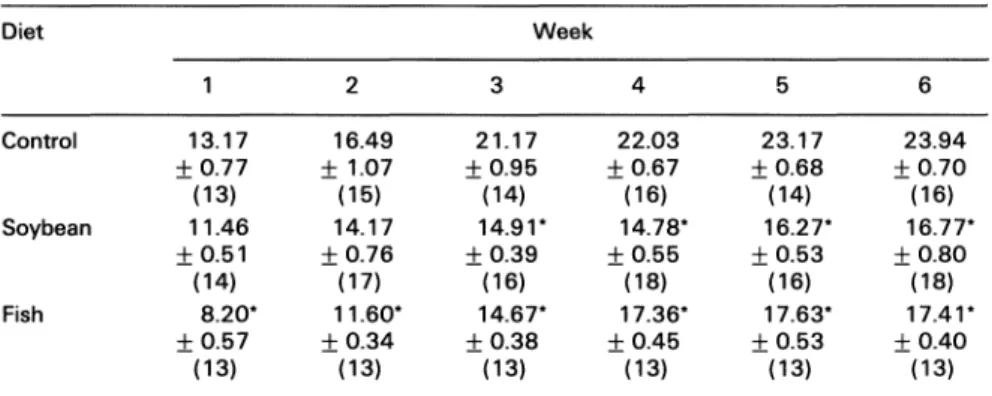
The food intakewas significantlyreduced inboth
soybean and fish groups when compared to the
control group. The soybean group had its food
intake reduced after the third week and the fish
group had a reduction after the first week of
treatment
(Table 1).
A significant increase ofbody weight was observed in soybean rats after
the fourth week and in fish group after the first week
(Table 2).
Carrageenin oedema, 2-M, and corticosterone
levels: Results of carrageenin oedema were
expressed
as the percentage increase from basalvalue, to correct for variability between initial
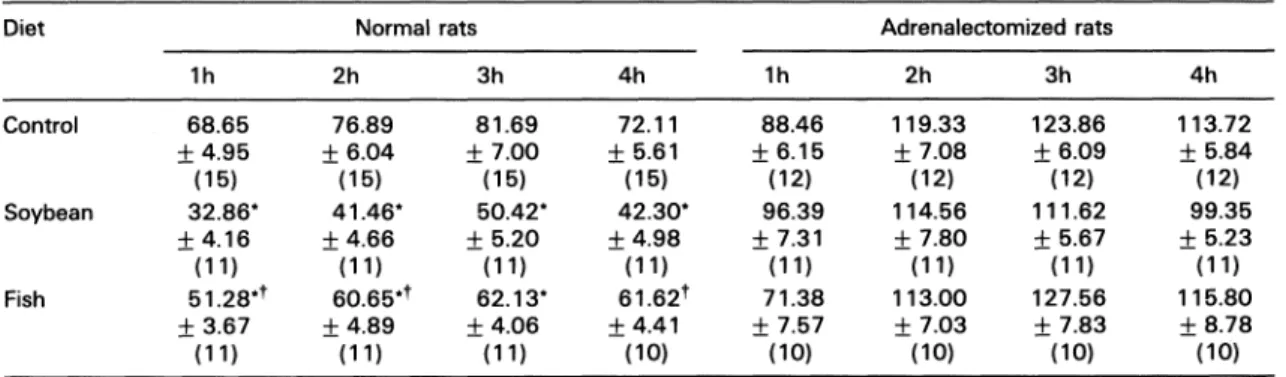
pawvolume. A significant inhibition of the carra-geenin oedemawas observedin the soybeanand
fish groups as
compared
with control rats. Thecarrageenin oedema of the soybean group was even smaller than that of the fish group
(Fig.
1 and Table3).
:2-M
was not detectable before the oedemaexperiment in soybean, fish or control rats
Table 1. Food intake(g/rat/day) ofratsfed the threediets, duringthefirst6 weeks
Diet Week
2 3 4 5 6
Control 13.17
_+0.77
(13)
Soybean 11.46
___0.51
(14)
Fish 8.20*
-+
0.57(13)
16.49 21.17 22.03 23.17 23.94
-+
1.07-+
0.95-+
0.67 _+0.68 __+0.70(15) (14) (16) (14) (16)
14.17 14.91" 14.78" 16.27" 16.77"
___
0.76-+
0.39-+
0.55 _+0.53 _+0.80(17) (16) (18) (16) (18)
11.60" 14.67" 17.36" 17.63" 17.41"
_+0.34 _+0.38 _+0.45 _+0.53
___
0.40(13) (13) (13) (13) (13)
Dataareshown asmeans -t- S.E.M. *Statistically significant difference(p
Inparenthesis is the number ofgroups.Eachgrouphad 5-7 rats.
<0.05)from control group.
gland polyunsaturated
Table 2. Percentage increase in body weight of rats fed the three diets during the first 6
weeks
Diet Week
2 3 4 5 6
Control 32.32 65.20 128.12 171.46 217.40 249.79
Jr 2.08 Jr4.02 Jr5.20 Jr6.38 Jr7.82 Jr8.15
(45) (35) (45) (45) (45) (45)
Soybean 36.75 70.30 141.41 197.58" 249.61" 286.09*
Jr2.55 -t- 5.43 Jr5.58 Jr6.94 -I-9.34 Jr9.94
(38) (24) (38) (38) (38) (38)
Fish 47.57* 106.83" 162.13" 212.88" 253.15" 285.69*
Jr2.39 Jr2.69 Jr3.32 -I-4.29 Jr5.12 6.06
(41) (41) (41) (41) (41) (41)
Dataareshownas means -I- S.E.M.The number ofrats is given in parenthesis. *Statistically significant difference(p<0.05)fromcontrolgroup.
(Table 4).
The corticosterone plasma concentra-tionwasexpressed
as btg ofcorticosterone/dl
ofplasma.
The corticosterone levels ofsoybean andfish groups, before carrageenin injection, were
significantly increased in relation to the control
group
(Table 4).
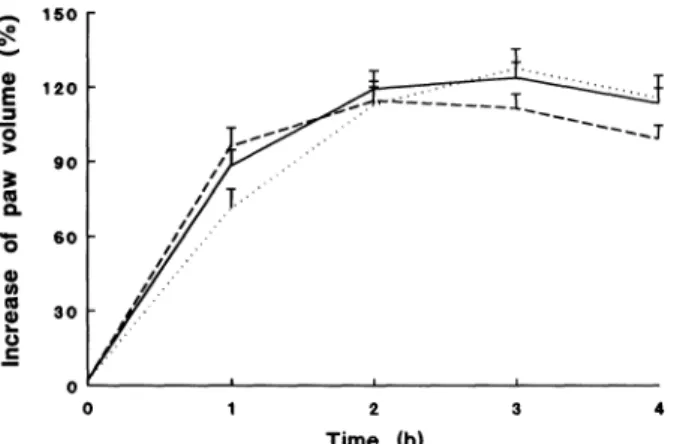
Carrageenin oedema in adrenalectomized
groups:
The adrenalectomized control group hada significantly increased oedematous response
when compared with control rats. In
adrenal-ectomized soybeanand fish groups the observed
oedemawas significantlyincreased in relation to
intact fish and soybean groups, but these
responses were not different from that of
adre-nalectomizedcontrol rats
(Fig.
2 andTable3).
lOO
m 8o
’
60...
40 O
m 20
0 2 3 4
Time
FIG. 1. Carrageenin-induced paw oedema formation in rats fed
withcontrol(),soybean(--)or fish oil-richdiets.
Discussion
The alterations in the production of inflamma-tory mediators and modulators evoked by
changes
in dietary fatty acid composition might result fromchanges
in membrane fluidity orchanges
in the release of membrane derived intracellular messengers.24 In addition to the factthat fatty acids are of great importance in
main-taining cell membrane structure,
they
are keydeterminants of the behaviour of membrane
bound enzymes and receptors.25
In the present experiments, fat-fed rats had a
higherincrease in body weightwith alower food
intake than animals fed control chow. In
opposi-tion to these
results,
some authors26’27 haveTable 3. Oedema formation (% increase of paw volume) in rat paws 1-4h after carrageenin, in normal and
adrenalectomizedratsfed the threediets
Diet Normalrats Adrenalectomizedrats
lh 2h 3h 4h lh 2h 3h 4h
Control 68.65 76.89 81.69 72.11 88.46 119.33 123.86 113.72
Jr4.95 Jr6.04 -I-7.00 Jr5.61 Jr6.15 Jr7.08 -t- 6.09 __+5.84
(15) (15) (15) (15) (12) (12) (12) (12)
Soybean 32.86* 41.46" 50.42* 42.30* 96.39 114.56 111.62 99.35
Jr4.16 Jr4.66 Jr5.20 Jr4.98 Jr7.31 Jr7.80 5.67 Jr5.23
(11) (11) (11) (11) (11) (11) (11) (11)
Fish 51.28"* 60.65** 62.13" 61.62’ 71.38 113.00 127.56 115.80
Jr3.67 Jr4.89 Jr4.06 Jr4.41 Jr7.57 Jr7.03 Jr7.83 Jr8.78
(11) (11) (11) (10) (10) (10) (10) (10)
Dataare shown asmeans-t-S.E.M.Thenumber of rats is given in parenthesis. *Statistically different(p<0.05)fromcontrolgroup.
Table 4. Corticosterone (lg/dl) and 2-macroglobulin (a.u.)
plasmalevels inrats,after6 weeks ofdiets
Control Soybean Fish
Corticosterone 18.89 25.7 O* 27.52"
-i-1.19 -I- 1.07 +_ 1.42
(17) (12) (14)
2-Macroglobulin nd nd nd
(lO) (lO) (15)
Data are shown as means -t-S.E.M. The number of rats is given in parenthesis.Forcorticosteronethenumbers indicate pools from 2-3 rats. nd notdetectable.
*Statistically significant difference(p<0.05)fromcontrolgroup.
150
E 1"0
0
0
"
6O3o
Time (h)
FIG.2. Carrageenin-induced paw oedema in adrenalectomized
ratsfedwithcontrol(),soybean (- -)orfish oil-rich diets.
observed a similar evolution of body weight and
food intake between rats fed control chow and
an
n-6
fatty acid-rich diet. Theseauthors,
however,
studied a lower number of animals and used Purinachow,
to which 12% of casein was addedas control chow.In this study, the intake of an n-3 or n-6
PFA rich-diet for approx. 7 weeks caused a
significant anti-inflammatoryeffect on carrageenin
oedema in rats. The inflammatory response of
the soybean groupwas even smaller than that of
the fish group. Corticosterone levels were higher
in fat-fed rats than in control rats, before
carra-geenin injection. Additionally, adrenalectomy
abolished the anti-inflammatory effect observed
in thefat-fed animals.
Some studies have associated anti-inflammatory
effects with diets high in n-3 PEA6’7’8 and a reduced production of arachidonic acid
meta-bolites was
thought
to be responsible for someof these effects. Studying an acute inflammation
model,
the carrageeninoedema,
we coulddemonstrate not only an anti-inflammatory effect
of an n-3 PFA-rich diet but also a strong
anti-inflammatory effect ofan
n-6
PFA-rich diet.It is difficult to attribute our results to
changes
in
Pg
production, since ithas been demonstratedthat different kinds of
Pgs
areproduced
inresponse to these different fatty acid-rich diets.2
Moreover,
it has been shown thatKupffer
callsfrom rats fed an n-3 PFA rich-diet, when
stimu-latedwith lipopolysaccharide
(LPS),
have a lowerproduction of the pro-inflammatory arachidonic
acid metabolites PgE2, PgI2, and
TxA
2 thanKupffer
cellsfrom rats fed ann-6
PFA rich-diet,asWe
suggested
previously2 thatCz2-M
levelswere an importantfactor accounting for the
anti-inflammatory effect observed in the
counter-irri-tation
phenomenon,
when a second carrageeninoedema was induced 24h after the first one.
Since
Cz2-M
is a specific proteinase inhibitor, this putative anti-inflammatory factor2’29 could con-tribute to the anti-inflammatory effect observedin fat-fed animals. However, (z2-M was not
detectable before carrageenin injection in
soybean, fish or control rats. This finding
demonstrates that the two kinds offatdiets used
did not stimulate (zi-M synthesis and suggests
that this protein does not participate in the
anti-inflammatory effect obseeeed during acute
inflammation in rats fed ’fat diets. On the other
hand,
the elevated corticosterone levels offat-fedanimals, before carrageenin
oedema,
suggestthatthis hormone could be one of the factors
deter-mining the anti-inflammatory effect observed.
To
our
knowledge,
this is the first demonstration ofa putative association between corticosterone
levels
and/or
the presence of the adrenalgland
and the inflammatory response of rats fed fat-rich diets.
Billiar et a/.28 showed a reduction in TNF and
IL-1 release by
Kupffer
cells from rats fed n-3 orn-6 PFA rich-diets. They could not explain these findings by changes in Pg production, since the
reduced PgE2 release induced by a fish oil diet
would be
expected
to result in a greater releaseof cytokines, as a result of a loss of the negative
feedback of PgE2
.3
Although
these authors2have not studied a pure chow-fed control group
(not
receiving an excess offat)
it is possiblethat the decrease of these important monokines involved in the inflammatory process may have
contributed to the anti-inflammatory effect
obseeeed in carrageenin oedema in the present
experiments. Some studies have demonstrated
that glucocorticoids may not only modulate the
function of
Kupffer
cells and other.macrophages
but also potentially interact with TNF-cz
pro-duced by Kupffer cells. Indeed, Kutteh et
al.5
showed that LPS-induced production of TNF-a
by
Kupffer
cells can besuppressed
bygluco-corticoids. In view of these observations it can be
speculated
that the high corticosteroid levelsin ourfat-fed animals had an inhibitory effect on
the release of important inflammatory mediators,
resulting in an anti-inflammatory action of fat
gland
levels associated with decreased oedematous
response in the fat-fed animals.
Moreover,
adre-nalectomy
abolished the inhibitory effect inthese groups.
In the present study
adrenalectomy
increasedthe oedematous response ofall groups.
Interest-ingly, it suppressed the differences in oedema
response among
controls,
soybean and fishgroups. These results seem to be correlatedwith
those
reported
by Baybut and Holsboer.32 Theseauthors
demonstrated,
in culturedcells,
aninhi-bitory effect of cortisol on LPS-induced IL-1
release. The removal of cortisol resulted in an
increased ability of those cells to synthesize IL-1, which exceeded the response ofthe control cells
that had notbeenpre-treated withcortisol.
Thus,
it is possible that the
pre-adrenalectomy
highlevels of corticosteroids may have increased the
ability of the adrenalectomized fat-fed rats to
produce inflammatorymediators.
The anti-inflammatory response of the soybean
group was higher than that of the fish group but
the corticosterone levels were not different
between them. The absence of a clear relation
between corticosterone levels and oedema inhi-bition indicates that other anti-inflammatory
factors,
in addition to corticosteroids, may beinvolved. Additionally, it is possible that
soybean-rich diet has a more pronounced effect on
inflammatory mediators than that of a fish
oil-rich diet in the acute inflammation. Since the
anti-inflammatoryeffectwas abolished by
adrena-lectomy,
it is reasonable to think that thoseputa-tive factors are corticosterone
dependent
and theadrenal
glands
are likely to play a role in thephenomenon.
Further studies, however, arenecessary to determine the precise sequence of
events that take
place
in thiscomplex
process.References
1.PikeCM. Anti-inflammatoryeffectsof dietary lipidmodification.J Rbeu-mato11989;16:718-720.
2. ZurierB. Essentialfattyacidsand inflammation.Ann RheumDis1991;
50: 745-746.
3. LeeTH,Mencia-HuertaJM,ShihC,CoreyEJ,LewisRA,Austen KF.
Char-acterization and biologic properties of 5,12-dihydroxy derivatives of
eicosapentaenoic acid, including leukotrieneB5 and the double lipox-ygenaseproduct.JBiolCbem1984; 259:2383-2390.
4.LeeTH,HooverRL,WilliamsJD,etal.Effects of dietaryenrichment with eicosapentaenoic and docosahexaenoic acids in vitro neutrophil and monocyte leukotriene generationand neutrophilfunction.N EnglJMed 1985;312: 1217-1224.
5. Darlington LG. Dodiets richinpolyunsaturated fattyacidsaffectdisease activityinrheumatoidarthritis?Ann RheumDis1988;47: 169-172.
6. KremerJM,BiganoetteJ,MichalekAV,etal. Theeffectsof manipulation of dietary fattyacids onclinical manifestationsofrheumatoid arthritis. Lancet 1985; 1: 184-187.
7. LeslieCA,GonnermanWA,UllmanMD,Hayes KC, Franzblace C, Cathcart ES.Dietary fish oilmodulates fattyacidsand decreasesarthritis suscept-ibilityin mice.JExpMed1985;162: 1336-1349.
8.Cathcart ES, MortensenRF,LeslieCA, ConteJM,Gonnerman WA. Afish oil diet inhibits amyloid P component(AP) acutephase responsesin
arthritisinsusceptiblemice.JImmuno11987;139:89-91.
9. KromhoutD,BosschieterEB, Coulander C deL. The inverse relation
betweenfish consumption and 20-year mortality from coronary heart disease. NEnglJMed1985; 312;1205-1209.
10. PrickettJD,Trentham DE,Robinson DR.Dietary fish oil augments the inductionofarthritisin ratsimmunized withtype II collagen.JImmunol
1984;132; 725-729.
11. Endres S, Ghorbani R, KelleyVE, etal.The effect of dietary
supple-mentationwithn-3polyunsaturatedfatty acidsonthe synthesis of
inter-leukin-1 andtumornecrosisfactor by mononuclear cells. N EnglJMed 1989; 320;265-271.
12.Andreis PG,Neri G, BelloniAS, MazzocchiG, KasprzakA,Nussdorfer
GG.Interleukin-l[3 enhancescorticosterone secretionbyactingdirectly
ontheratadrenal gland. Endocrinology 1991; 129; 53-57.
13. GwosdowAR,O’ConnellNA,SpencerJA,etal.Interleukin-1 induced
cor-ticosteronerelease occurs byanadrenergicmechanismfromratadrenal
gland. AmJPhysio11992;163; E461-E466.
14. Baybutt HN, Holsboer F. Inhibition ofmacrophage differentiationand functionbycortisol.Endocrinology1990;127;476-480.
15. KuttehWh,RaineyWE,CarrBR.Glucocorticoids inhibit lipopolysacchar-ide induced production of tumor necrosis factor- by human fetal Kupffer cells.JClin EndocrinolMetab 1991; 73;296-301.
16. FleetwoodMK,GanderGW,GoodaleF.Effect ofmetabolic inhibitors on pyrogen production byrabbitleukocytes. Proc SocExpBiol1975;149;
336-339.
17. Errasfa M, Rothhut B, FradinA, et al. The presence of lipocortinin
human skin fibroblasts and regulation by anti-inflammatory steroids. BiocbimBiophys Acta1985; 874;247-254.
18. DavidsonFF,DennisEA,PowellM,GlenneyJR.Inhibitionof phospholl-paseAby ’lipocortins’ and calpactins:aneffect of bindingto substrate phospholipids.JBiolChem 1987; 262;1698-1705.
19. SilveiraVLF, LimSosEA. Effect of bacterial endotoxin onplasma
con-centrationof haptoglobin and fibrinogenin ratstreatedwith
metopyr-one.AgentsandActions1990; 31;143-147.
20. SilveiraVLF,LimbosEA.Participationof 2-macroglobulinin
counter-irri-tation.AgentsandActions1992;36; 294-298.
21. GuilleminR,Clayton GW, Lipscomb HS,SmithJD.Fluorometric
measure-mentofratplasma and adrenalcorticosteroneconcentration.JLab Clin Med1959; 53;830-832.
22. ManciniG,CarbonaraAD,HeremansJF.Immunochemicalquantitationof
antigens by single radial immunodiffusion. Immunochemistry1965; 2; 235-254.
23. ZarrowMX,YochimJM,McCarthyJL.The adrenalcorticoids. In:Zarrow MX,ed.A SourcebookofBasicTechniques.AcademicPress: New York, London,1964;177-223.
24. Stubbs CD, SmithAD. Themodification of membrane polyunsaturated fattyacid compositionin relation to membrane fluidity and function. BiocbemBiopbys Acta1984;779; 89-137.
25. McMurchieEJ.Dietarylipids and the regulation of membrane fluidity and function. In: AloidRC,CurtainCC, GordonLM,eds. Physiological
regula-tionofmembrane fluid#y.NewYork: Alan RLiss,1988;189-237.
26.Guimares ARP, Sitnik RH, Nascimento Curi CMPO, Curl R. Poly-unsaturated and saturated fatty acids-rich diets and immune tissue. 2. Maximal activitiesof key enzymes of glutaminolysis, glycolysis,
pentose-phosphate-pathway and Krebs cycle inthymus, spleen andmesenteric
lymph nodes.Biocbem Int1990;22;1015-1023.
27.EgamiMI,GuimarSesAPR,NascimentoCuriCMPO,CurlR. Effectoffatty acid-rich diets onthymocyte proliferation and thymusinvolutionduring growing.PhysiolBebav1993; 53;531-534.
28.BilliarTR,BankeyPE,SyingenBA,etal.Fattyacid intakeand Kupffer cell function: fish oil alterseicosanoidandmonokine productionto
endo-toxinstimulation.Surgery 1988;104= 343-349.
29. Van GoolJ,ShreuderJ,LadigesNCJJ.Inhibitory effect of fetal a-globulin,
anacutephaseprotein on carrageeninoedemaintherat.JPath1974;
112:245-262.
30. Kunkel SL, Chensue SW, PhanSH.Prostaglandinsasendogenous
media-torsofinterleukin production.JImmuno11986; 136;186-192. 31. Silen ML,HesseDG, FelsenD, etal. Cachectin/tumor necrosisfactor
production by fetal and newbornrat hepatic macrophages. JPediatr Surg 1989; 24;34-38.
32. BaybuttHN, Holsboer F. Inhibitionofmacrophage differentiation and functionbycortisol.Endocrinology1990;127;476-480.
ACKNOWLEDGEMENTS. The authors are grateful to
Dr E. B. Ribeiro for help in the preparation of the
manuscriptand forhelpfuldiscussions.V. L. F. Silveira
and E. A. Lim.os are recipients of fellowships from CNPq and D. W. Nunes is a recipient of aPIBIC fel-lowship.
Received 19 June 1995;
Submit your manuscripts at
http://www.hindawi.com
Stem Cells International Hindawi Publishing Corporation
http://www.hindawi.com Volume 2014
Hindawi Publishing Corporation
http://www.hindawi.com Volume 2014
MEDIATORS
INFLAMMATIONof
Behavioural Neurology
EndocrinologyInternational Journal of
Hindawi Publishing Corporation
http://www.hindawi.com Volume 2014
Hindawi Publishing Corporation
http://www.hindawi.com Volume 2014
Disease Markers
Hindawi Publishing Corporation
http://www.hindawi.com Volume 2014
BioMed
Research International
OncologyJournal of
Hindawi Publishing Corporation
http://www.hindawi.com Volume 2014
Oxidative Medicine and Cellular Longevity
Hindawi Publishing Corporation
http://www.hindawi.com Volume 2014 PPAR Research
The Scientiic World Journal Hindawi Publishing Corporation
http://www.hindawi.com Volume 2014
Immunology Research
Hindawi Publishing Corporation
http://www.hindawi.com Volume 2014
Journal of
ObesityJournal of
Hindawi Publishing Corporation
http://www.hindawi.com Volume 2014
Computational and Mathematical Methods in Medicine
OphthalmologyJournal of
Hindawi Publishing Corporation
http://www.hindawi.com Volume 2014
Diabetes ResearchJournal of
Hindawi Publishing Corporation
http://www.hindawi.com Volume 2014
Research and Treatment
AIDS
Hindawi Publishing Corporation
http://www.hindawi.com Volume 2014
Gastroenterology Research and Practice
Parkinson’s Disease
Evidence-Based Complementary and Alternative Medicine
Volume 2014 Hindawi Publishing Corporation