SAGE Open
July-September 2016: 1 –9 © The Author(s) 2016 DOI: 10.1177/2158244016669550 sgo.sagepub.com
Creative Commons CC-BY: This article is distributed under the terms of the Creative Commons Attribution 3.0 License (http://www.creativecommons.org/licenses/by/3.0/) which permits any use, reproduction and distribution of
the work without further permission provided the original work is attributed as specified on the SAGE and Open Access pages (https://us.sagepub.com/en-us/nam/open-access-at-sage).
Article
The Pew Research Center reports a rapid rise in audiobook consumption among adults as digital device ownership increases (Zickuhr & Rainie, 2014). With the emergence of new technologies, long gone are the days of cassette tapes and CDs that made stopping, rewinding, studying, and restarting an audio recording a hassle. Digital media now makes it possible for individuals to easily listen, read, or do both simultaneously from their smart phones, e-readers, electronic tablets, and computers. Recent integration of digi-tal content into electronic textbooks also offers multiple modalities from which to present content. Although gaining popularity by many, some argue that listening to an audio recording is inferior to reading it and, in essence, “cheating” (Miller, 2010; Reimer, 2007). If it were the case that listening to a text was inferior to reading the text, one would predict that comprehension after listening to a digital audio record-ing would differ from comprehension after readrecord-ing the same electronic version of the text.
Given the importance of text comprehension across the life span, and strong opinions expressed by teachers and the public at large on the effectiveness of reading compared with listening on comprehension (Baskin & Harris, 1995; Beers, 1998; Bomar, 2006; Goldsmith, 2002; Moody, 1989), there is a surprising lack of empirical research that directly evaluates the effect of mode of input on comprehension. Furthermore, a review of the research on adults yields conflicting results. Across several studies, recall after reading text was better
than recall after listening to text (Daniel & Woody, 2010; Dixon, Simon, Nowak, & Hultsch, 1982; Green, 1981; Lund, 1991). For example, Daniel and Woody (2010) found that participants who read an article scored significantly higher on a quiz than those who listened to a podcast of the same article. In contrast, Moyer found no significant differences between the two modalities. One possible explanation for the conflict-ing results across these studies pertains to whether partici-pants were (Daniel & Woody, 2010) or were not (Moyer, 2011) given the opportunity to go back and study the informa-tion before being tested for comprehension.
Likewise, studies comparing single and dual modality modes of input have been varied, and yielded inconsistent results (Baddeley, 2003; Lee & Young, 1974; Low & Sweller, 2005; Paivio, 1991). Much of the research investigating the effects of dual modality presentation of verbal information on comprehension has been done with foreign language learners. For example, Chang (2009) did not include a read-only
1
Bloomsburg University of Pennsylvania, USA 2
Nashville, Tennessee, USA 3
University of California, San Diego, La Jolla, USA 4
Salk Institute for Biological Studies, La Jolla, CA, USA
Corresponding Author:
Beth A. Rogowsky, College of Education, Bloomsburg University of Pennsylvania, 2213 McCormick Center, Bloomsburg, PA 17821, USA. Email: [email protected]
Does Modality Matter? The Effects of
Reading, Listening, and Dual Modality
on Comprehension
Beth A. Rogowsky
1, Barbara M. Calhoun
2, and Paula Tallal
3,4Abstract
With advancing technology, there is increasing interest in differences between listening versus reading comprehension or doing both simultaneously. Ninety-one participants were randomly assigned to one of three groups that received the same instructional material (the preface and a chapter from a non-fiction book), but each in a different input modality (digital audiobook, e-text, dual modality). After completing the material, participants took the same comprehension test in written form to establish both immediate comprehension (Time 1) and 2-week retention (Time 2). No statistically significant differences were found for any analyses pertaining to effects of the three different instructional conditions on comprehension at Time 1 or Time 2. Additional analyses showed that both males and females in each condition recalled an equal amount of information, regardless of whether they listened to an audiobook, read from an electronic tablet, or both listened and read simultaneously (dual modality).
Keywords
condition, but found gains in comprehension when students read and listened simultaneously to stories, rather than listen-ing only. In contrast, Diao and Sweller (2007) found signifi-cant gains in comprehension in the reading modality only rather than the reading while listening condition, but did not include a listening-only condition. Their results support cog-nitive load theory, wherein it is hypothesized that simultane-ous inputs from two modes increase cognitive load and, hence, can be detrimental to learning compared with the pre-sentation of the material in a single modality only (Plass, Moreno, & Brunken, 2010). In yet another study, Moreno and Mayer (2002) found that students who read while listening to text learned the material better than those who only listened, or those whose text was accompanied by animations. Unfortunately, the findings from these studies cannot be com-pared directly because of differences across studies in the nature of the readings, the opportunity to review content after reading, population characteristics, or different instructional conditions.
Given the rapid advances in technology and the growing availability and use of multiple modes of input of content, coupled with a lack of consistency in the research literature pertaining to the effect of mode of input (listening, reading, or listening and reading simultaneously) on verbal compre-hension for adults, we conducted an experiment to investi-gate the extent to which input modality (digital audio, e-text, dual modality) affects comprehension and retention of verbal material. Although the role of gender has been largely ignored in previous research on this topic, it is possible that there may be gender differences in reading and listening comprehension. Pauls, Petermann, and Lepach (2013) found that women outperformed men on auditory episodic memory tasks and explained that the women’s superior auditory memory performance could be explained by their advantage in verbal ability. As such, gender differences may also con-tribute to inconsistency across studies. Therefore, we included an analysis for gender effects in our experiment as well.
The purpose of this experiment was to investigate the effect of input modality (digital audiobook, e-text, or dual modality) on participants’ immediate comprehension (Time 1) and 2-week retention (Time 2) of a “real-world” non-fic-tion book. As such, the following research quesnon-fic-tions were addressed:
Research Question 1: Does input modality (digital audiobook, e-text, or dual modality) affect immediate (Time 1) comprehension of content from a non-fiction book?
Research Question 2: Is the effect of input modality on immediate comprehension (Time 1) different for males and females?
Research Question 3: Does input modality (digital audiobook, e-text, or dual modality) affect 2-week reten-tion of content from a non-ficreten-tion book?
Research Question 4: Is the effect of input modality on long-term retention (Time 2) different for males and females?
Method
Participants
To be included in this study, participants had to meet the fol-lowing inclusionary and exclusionary criteria: adults between the ages of 25 and 40; college educated (bachelor’s degree only), native speakers of English, of normal hearing and vision (with correction), and no self-reported history of neurological or learning impairments. To increase population homogeneity, potential participants outside this age range, with more advanced degrees, or who had not graduated from college were excluded. Early to middle-aged adults with college degrees were chosen because they are the fastest growing pop-ulation of audiobook consumers (Zickuhr & Rainie, 2014). The population was recruited through flyers located through-out Manhattan coffee shops and Craig’s List advertisements.
Based on these study criteria, 121 participants from the New York City metropolitan area were selected. The partici-pants (N = 121) were randomly assigned to one of four groups. Three of the groups (n = 91) comprised the three input modality conditions of interest in this study: digital audiobook (n = 30), e-text (n = 31), or dual modality (n = 30). The remaining participants were included in the random assignment, but participated in a different study not focused on listening versus reading comprehension. Of the 91 partici-pants in this study, 46 were male and 45 were female. The mean age of the males was 31.1 (SD = 4.9), and the mean age of the females was 30.4 (SD = 4.4). An independent t test showed that there were no significant differences in age across the males and females, t(89) = 0.70; p > .05.
This study was conducted in accordance with the pre-scribed standards of the university’s Institutional Review Board. All participants provided informed consent and were financially compensated for their participation.
The verbal comprehension aptitude of participants was assessed using a listening and reading comprehension test. The detailed methods and validity of the test used for assess-ing comprehension aptitude in this adult sample are reported in Rogowsky, Calhoun, and Tallal (2015).
aptitude results. The main effect for condition was not sig-nificantly related to the mean scores on comprehension apti-tude, F(2, 87) = 1.35; p > .05, indicating that overall comprehension aptitude of the participants was not signifi-cantly different across the three conditions and that random-ization resulted in comparable groups across conditions. Table 1 provides demographic data (age and gender) of the participants in each of the three study group conditions (audiobook, e-text, dual modality).
Although there was not a significant difference in the comprehension aptitude scores across the three conditions: digital audiobook, e-text, or dual modality, the participants in the e-text condition had the highest scores. To assure that individual differences in participant’s comprehension apti-tude did not inadvertently affect the results pertaining to mode of input, all analyses were run both with and without controlling for comprehension aptitude. There were no dif-ferences found based on whether or not comprehension apti-tude was used as a covariate. To avoid redundancy, only the data using aptitude as a covariate are reported.
Comprehension Measure
The content used in this experiment and across all input modality conditions was the preface and Chapter 17 of the non-fiction novel, Unbroken: A World War II Story of Survival, Resilience, and Redemption, written by Laura Hillenbrand and read by Edward Hermann. This text was chosen because it was a fact-based text in the context of a story. None of the participants had previously read this book, and the study was conducted prior to the movie being released. The total content contained 3,184 words. Forty-eight multiple-choice questions were designed to assess the participants’ recollection of the two aforementioned pas-sages. These 48 questions will be referred to as the Unbroken Comprehension test.
The question set that comprised the Unbroken Comprehension test was developed by a certified teacher of English (B.R.) who serves on the Pennsylvania State Standardized Assessment Panel where she reviews reading assessment items for content and rigor alignment, bias, and universal and technical design. Questions were piloted for difficulty on a sample of 10 individuals meeting the eligibil-ity requirements for participation in this study. None of the individuals who piloted the questions were subsequent
participants in the study. Example tests questions are pro-vided in the appendix.
The validity of the Unbroken Comprehension test was determined empirically to assure that results obtained from this test were an accurate measure of comprehension. To do this, regardless of which condition participants were in, the comprehension scores of each participant at Time 1 on the Unbroken Comprehension test were compared with the same participant’s comprehension aptitude score. A Pearson r cor-relation coefficient was calculated. As shown in Figure 1 and Table 2, a significant positive correlation was found, r(89) = .62, p < .01, indicating that there was a significant relation-ship between the participants’ comprehension aptitude scores and their scores on the Unbroken Comprehension test at Time 1. This analysis shows that participants who had higher com-prehension aptitude scores also had higher comcom-prehension scores on the Unbroken Comprehension test, providing con-struct validity for this test. Two-week test–retest reliability was also established by comparing each participant’s score at Time 1 and 2 weeks later at Time 2. Again, a significant posi-tive correlation was found, r(87) = .85, p < .01, indicating that there was significant test–retest reliability across 2 weeks for participants’ scores on the Unbroken Comprehension test at Time 1 and Time 2 as shown in Table 2.
Procedure
Three input modality conditions were used in this study. In Condition 1 (digital audiobook), participants listened to both the preface and Chapter 17 of Unbroken presented on a com-mercially available Kindle® in digital audiobook format. In Condition 2 (e-text), participants read both the preface and Chapter 17 of Unbroken presented on the Kindle® in e-text format. In Condition 3 (dual modality), participants listened Table 1. Demographics by Instructional Condition.
Input modality
Female Male Age
n n M SD
Audiobook 15 15 32.6 4.8
E-text 15 16 30.2 4.9
Dual modality 15 15 29.5 3.5
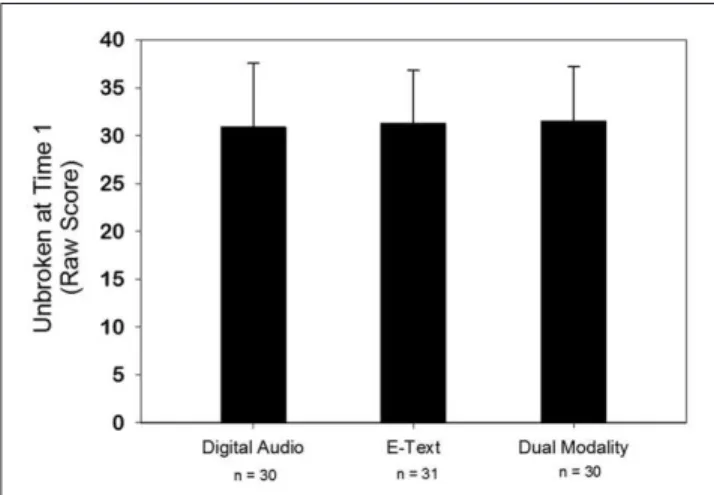
Figure 2. The mean scores on the Unbroken Comprehension test at Time 1 for each of the three groups were not significantly different.
to the digital audiobook recording of the preface and Chapter 17 of Unbroken, while reading the e-text that was highlighted in real time and synchronized by the Kindle® with the audio recording. Participants in the digital audio and dual modality conditions used headphones. A research assistant pre-cued the e-text and/or audio, as well as monitored each participant to assure that there were no interruptions. The research assis-tant also made sure that the participants understood how to use the equipment, were on-task, and did not extend reading/ listening beyond the prescribed passages. Prior to adminis-tering the passage, the volume was adjusted to a comfortable level. The audio and dual modality conditions lasted 16 min and 24 s, and were read at a pace of 149 words per minute. Specific to the dual modality condition, the text was elec-tronically highlighted in pace with the audio recording. Participants in the e-text condition read at their own pace without time restraint. The replaying/fast-forwarding of audio and the re-reading/skipping of text were prohibited. The research assistant monitored participants’ compliance.
Upon completion of Chapter 17, participants proceeded immediately (Time 1) to take the Unbroken Comprehension test and answered 48 questions derived from the preface and Chapter 17. Participants were not allowed to use the e-text or digital audiobook as a reference. Each question was individ-ually displayed in written text only on a computer screen. The online multiple-choice assessment required a response for each question before the examinee could proceed to the next question. No feedback was given. In addition to the online, on-site immediate comprehension assessment (Time 1), participants completed the same multiple-choice assess-ment online 2 weeks later at home (Time 2) to evaluate their retention of the information in the story.
Results
Research Question 1: Does input modality (digital audio-book, e-text, or dual modality) affect immediate (Time 1) comprehension of content from a non-fiction book?
Immediate Comprehension (Time 1)
A one-way between-subjects ANCOVA was conducted to determine the effect of input modality condition (digital
audiobook, e-text, or dual modality) on the mean scores of the Unbroken Comprehension test at Time 1, controlling for the effect of comprehension aptitude. As shown in Figure 2, out of a possible 48 points, participants in the digital audio-book condition had a mean score on the Unbroken Comprehension test at Time 1 of 30.9 (SD = 6.7). Participants in the e-text condition had a mean score of 31.3 (SD = 5.4). Participants in the dual modality condition had a mean score of 31.5 (SD = 5.7). Comprehension aptitude had a significant effect on Unbroken Comprehension test results at Time 1, F(1, 87) = 56.86; p < .001, indicating that individual differ-ences in comprehension aptitude was significantly related to their score on the Unbroken Comprehension test at Time 1; participants who had higher comprehension aptitudes also had higher Unbroken Comprehension test scores. The main effect for input modality condition (digital audiobook, e-text, or dual modality) was not significantly related to the mean scores on the Unbroken Comprehension test at Time 1, F(2, 87) = 0.76; p > .05, even after controlling for the effect of comprehension aptitude. This analysis demonstrates that participants in each condition recalled similar amounts of information, regardless of whether they listened to an audio-book, read on an electronic tablet, or listened and read simul-taneously (dual modality).
Research Question 2: Is the effect of input modality on immediate comprehension (Time 1) different for males and females?
Males
A one-way between-subjects ANCOVA was calculated to determine the effect of input modality condition (digital audio-book, e-text, or dual modality) on the mean scores for the males on the Unbroken Comprehension test at Time 1 (as shown in Table 3), controlling for the effect of comprehension Table 2. Descriptive Statistics and Correlation Matrix for
Comprehension Aptitude and Unbroken Scores at Time 1 and Time 2.
Variables n M SD 1 2 3
1. Comprehension aptitude
91 26.19 5.58 — .62** .67**
2. Unbroken (Time 1) 91 31.24 5.89 — .85**
3. Unbroken (Time 2) 89 28.33 6.72 —
aptitude. Comprehension aptitude results for males signifi-cantly influenced the results on the Unbroken Comprehension test results at Time 1, F(1, 42) = 41.43; p < .001. The main effect for input modality condition was not significantly related to the mean scores for the males on the Unbroken Comprehension assessment at Time 1, F(2, 42) = 0.62; p > .05, even after co-varying out the effect of comprehension apti-tude. This analysis finds that males recalled an equal amount of content from a non-fiction book, regardless of whether they listened on an audiobook, read on an electronic tablet, or lis-tened and read simultaneously (dual modality).
Females
Table 3 shows the mean scores for the females on the Unbroken Comprehension assessment at Time 1. A one-way between-subjects ANCOVA was calculated to determine the effect of input modality condition (digital audiobook, e-text, or dual modality) on the mean scores for the females on the Unbroken Comprehension assessment at Time 1, controlling for the effect of comprehension aptitude. Comprehension aptitude results for females significantly influenced the results on the Unbroken Comprehension assessment results at Time 1, F(1, 41) = 19.23; p < .001. The main effect for input modality condition was not significantly related to the mean scores for the females on the Unbroken Comprehension assessment at Time 1, F(2, 41) = 0.44; p > .05, even after co-varying out the effect of comprehension aptitude. This analy-sis shows that females in each condition recalled an equal amount of information from a non-fiction book at Time 1, regardless of whether they listened on an audiobook, read from an electronic tablet, or listened and read simultaneously (dual modality).
A final analysis was conducted to determine whether there were any significant interactions between input modal-ity conditions and gender on Unbroken Comprehension test scores at Time 1, controlling for the effect of comprehension aptitude. A 3 (condition) × 2 (gender) between-subjects two-way ANCOVA was calculated comparing Unbroken Comprehension test scores at Time 1 for males and females who were randomly assigned to one of the three input modal-ity conditions (digital audio, e-text, or dual modalmodal-ity). Comprehension aptitude results were significantly related to
Unbroken Comprehension assessment results at Time 1, F(1, 84) = 53.3; p < .001. The main effect of input modality con-dition was not significant, F(2, 84) = .74; p > .05. The main effect for gender was also not significant, F(1, 84) = 0.007; p > .05. Finally, the interaction between input modality condi-tion and gender was not significant, F(2, 84) = 0.26; p > .05. The results of this analysis show that neither input modality nor gender has any significant effect on immediate recall of non-fiction information as measured by the Unbroken Comprehension test at Time 1. That is, all three modes of input were similarly effective for comprehending non-fiction text for both males and females.
In sum, when participants were randomized into input modality conditions, the overall comprehension aptitude of participants did not significantly vary across conditions at Time 1, and no significant differences were found in the immediate comprehension of non-fiction content for the overall population, for males, or for females. All analyses in this experiment were done both with and without co-varying for comprehension aptitude. No differences were found for any analysis depending on whether comprehension aptitude was or was not co-varied out.
Research Question 3: Does input modality (digital audiobook, e-text, or dual modality) affect 2-week reten-tion of content from a non-ficreten-tion book?
Attrition
Two weeks after completing the Unbroken Comprehension test at Time 1, participants completed the same comprehen-sion test online (Time 2). Of the 91 participants who com-pleted testing at Time 1, 89 participants comcom-pleted the Unbroken Comprehension test at Time 2. One participant from the e-text condition and one participant from the dual modality condition did not complete the 2-week follow-up assessment.
A one-way between-subjects ANCOVA was calculated to determine the effect of input modality (digital audiobook, e-text, or dual modality) on the mean scores of the Unbroken Comprehension assessment at Time 2, controlling for the effect of comprehension aptitude. Participants in the digital audiobook condition had a mean score of 28.2 (SD = 7.8). Participants in the e-text condition had a mean score of 29.1 (SD = 5.9). Participants in the dual modality condition had a mean score of 27.6 (SD = 6.5). Total possible score on this test was 48 points. Comprehension aptitude results were sig-nificantly related to Unbroken Comprehension assessment results at Time 2, F(1, 85) = 68.57; p < .001, indicating that individual differences in comprehension aptitude were sig-nificantly related to 2-week Unbroken Retention scores. The main effect for input modality was not significantly related to the mean scores on Unbroken Retention scores at Time 2, F(2, 85) = 0.18; p > .05, even after controlling for the effect of comprehension aptitude. This analysis demonstrates that Table 3. Unbroken Comprehension Results at Time 1 Across
Study Conditions for Males and Females.
Input modality
Males Females
n M SD n M SD
Digital audiobook 15 29.7 5.4 15 32.0 7.8
E-text 16 32.1 5.4 15 30.6 5.5
Dual modality 15 31.5 5.0 15 31.5 6.5
Note. Results shown are based on raw scores on the Unbroken
at 2-week follow-up, participants in each input modality con-dition retained an equal amount of information, regardless of whether they initially listened to an audiobook, read e-text from an electronic tablet, or both listened and read simulta-neously. This result is consistent with the comprehension results at Time 1.
Research Question 4: Is the effect of input modality on long-term retention (Time 2) different for males and females?
Males
A one-way between-subjects ANCOVA was conducted to determine the effect of input modality (digital audiobook, e-text, or dual modality) on the mean scores for males on the Unbroken Retention test at Time 2, controlling for the effect of comprehension aptitude. Table 4 shows the retention scores for the males at Time 2. Comprehension aptitude results for males were significantly related to Unbroken Retention results at Time 2, F(1, 42) = 58.70; p < .001. The main effect for input modality condition was not signifi-cantly related to the mean scores for the males on the Unbroken Retention assessment at Time 2, F(2, 42) = 0.08; p > .05, even after co-varying out the effect of comprehension aptitude. This analysis shows that input modality condition (digital audiobook, e-text, or dual modality) did not signifi-cantly affect the amount of information retained after 2 weeks for males.
Females
A one-way between-subjects ANCOVA was calculated to determine the effect of input modality (digital audiobook, e-text, or dual modality) on the mean scores for females on the Unbroken Retention assessment at Time 2, co-varying out the effect of comprehension aptitude. Table 4 shows the retention scores for the females at Time 2. Comprehension aptitude results for females were significantly related to Unbroken Retention scores at Time 2, F(1, 39) = 17.69; p < .001. The main effect for input modality was not signifi-cantly related to the mean scores for the females on the Unbroken Retention assessment at Time 2, F(2, 39) = 0.34; p
> .05, even after co-varying out the effect of comprehension aptitude. This analysis reveals that, for females, input modal-ity (digital audiobook, e-text, or dual modalmodal-ity) did not sig-nificantly affect the amount of information retained from a non-fiction book over a 2-week period of time.
A final analysis was conducted to determine whether there were any significant interactions between input modality con-dition and gender on Unbroken Retention scores at Time 2, controlling for the effect of comprehension aptitude. A 3 (con-dition) × 2 (gender) between-subjects factorial ANOVA was calculated comparing retention at Time 2 for males and females who were randomly assigned to one of the three input conditions (digital audiobook, e-text, dual modality). Comprehension aptitude was significantly related to Unbroken Retention scores at Time 2, F(1, 82) = 64.21; p < .001. The main effect of input modality condition was not significant, F(2, 82) = 0.16; p > .05. The main effect for gender was also not significant, F(1, 82) = 0.37; p > .05. Finally, the interaction between gender and input modality condition was not signifi-cant, F(2, 82) = 0.30; p > .05. The results of this analysis show that neither gender nor input modality condition has any sig-nificant effect on 2-week retention of non-fiction information as measured by the Unbroken Retention test at Time 2. That is, all three modes of input were equally effective for retaining non-fiction text for both genders.
Discussion
There is considerable interest in potential effects on learning, especially verbal comprehension, based on input modality. As an increasing amount of information is becoming avail-able electronically, especially for adults, there is a growing interest in whether there are differences between listening to audiobooks, podcasts, or webinars, as compared with read-ing the same material via e-text. The purpose of this study was to investigate empirically the effect of modality of input on verbal comprehension in native English-speaking college graduates. We compared the comprehension and retention of “real-world” content presented in three different modes of input: reading e-text presented on a Kindle®, listening to a digital audio recording presented via a Kindle®, and listen-ing while readlisten-ing the e-text that was highlighted in real time and synchronized by the Kindle® with the audio recording.
Participants were randomly assigned to one of three groups that received the same instructional material (the preface and Chapter 17 from the historical, non-fiction book, Unbroken), but each in a different input modality. Once they completed the material, participants took the same compre-hension test in written form to establish both immediate comprehension (Time 1) and 2-week retention (Time 2). No statistically significant differences were found for any analy-ses pertaining to effects in the three different input modality conditions on Unbroken Comprehension at Time 1 or Time 2. It did not matter whether participants read, listened to, or simultaneously read and listened to the material; all groups Table 4. Unbroken Comprehension Results at Time 2 Across
Study Conditions for Males and Females.
Input modality
Males Females
n M SD n M SD
Digital audiobook 15 26.5 7.3 15 29.9 8.0
E-text 16 29.6 6.2 14 28.6 5.7
Dual modality 15 27.5 6.7 14 27.8 6.6
Note. Results shown are based on raw scores on the Unbroken
performed similarly across conditions and there were no sig-nificant gender effects.
The finding that there is no significant difference in com-prehension for adults who read a book or listen to an audio-book is consistent with the findings of Moyer (2011), even though much longer passages were used in the current study than in the Moyer study. However, the current study’s find-ings are not consistent with Daniel and Woody (2010), which found significantly greater comprehension after reading as compared with listening to text, despite the similarity in length of text across the two studies. The main difference between the current study that did not find any difference based on mode of input and that of Daniel and Woody (2010) that found an advantage for written material was that in the Daniel and Woody (2010) study, participants were allowed to review and study content before taking the comprehension test, whereas in the current study participants were not able to review material. Because reviewing information in the podcast condition would have been more difficult than reviewing the written material, participants may have been less likely to re-examine the podcast; thus, creating an advan-tage to the participants in the written condition.
Several studies found either an advantage for dual modal-ity presentation (Chang, 2009) or a disadvantage (Diao & Sweller, 2007; Moreno & Mayer, 2002), whereas the results of the current study failed to show any significant difference between single modality of input (either listening to digital audio or reading e-text) or dual modality (reading and listen-ing simultaneously). As such, our results failed to support either the cognitive load theory wherein it is thought that simultaneous written and spoken presentations of the same material increases cognitive load and, hence, is detrimental to learning compared with the presentation of the material in a single modality only (Plass et al., 2010) or the dual modal-ity theory wherein information presented simultaneously in both a reading and listening format elicits more elaborate memory traces, thereby facilitating better retrieval (Baddeley, 2003; Lee & Young, 1974; Paivio, 1991). However, the pre-vious studies evaluating the effects of single as compared with dual modality presentation on verbal comprehension were conducted with students who were learning English as a second language, whereas our study was conducted with native English speakers. This suggests that different results may apply to adults who have different levels of English pro-ficiency, with modality of presentation playing a less signifi-cant role for those individuals who already are proficient in English.
Limitations
The focus of this study was on newer technologies and whether mode of input using these technologies affected ver-bal comprehension. A print text condition was not included and presents itself as a limitation of the study. Neither age nor level of English proficiency were included as variables in
this study, as this study focused only on college-educated, native English speakers. Thus, the extent to which these find-ings generalize to younger or older populations, children at different stages of reading proficiency, non-English language or English as a Second Language speakers, and/or more or less educated populations cannot be determined from this study. Similarly, only one non-fiction novel was used to assess verbal comprehension and retention across three dif-ferent modes of input (audiobook, e-text, dual modality). Thus, the extent to which these data can be generalized to comprehension and retention of other forms and genres of verbal materials (e.g., fiction, textbooks, professional manu-als, and newspaper articles) and other modalities (i.e., anima-tion and video) cannot be determined from this study. In addition, our research assistants oversaw the use of the tech-nology; as such, a person’s prior experience using a Kindle® was not examined.
Future Research
This study was done only with college-educated adults and so it can only be generalized to individuals with well-devel-oped listening and reading comprehension skills. However, there is considerable interest in the use of computer technol-ogy in education and there may be multiple advantages to offering differing modes of input for teaching different com-ponents of literacy. For example, using audio input when ini-tially teaching phonological awareness skills, visual presentations for teaching orthographic skills and subse-quently being able to present both simultaneously to build vocabulary and comprehension skills may have differential benefits for children at different stages of reading acquisition or different levels of English proficiency. Similarly, being able to present audiobooks to populations with visual impair-ments or dyslexia may be an important adjunct to their edu-cation. As such, it will be important to conduct additional research that explores these and similar questions pertaining to verbal comprehension in children who are at various stages of learning to read, individuals with different levels of English proficiency, as well as populations with auditory or visual processing challenges. The effects of input modality may lead to very different outcomes at different stages of language and reading development and English language proficiency. Longitudinal studies evaluating academic out-comes for children and adults who have received ongoing instruction that does or does not include the use of audio-books, e-text, or both simultaneously may have important educational and clinical implications.
Conclusion
technologies also allow individuals to annotate text, review by keywords, or highlight specific segments for future study. To our knowledge, this is the first study to directly compare these new technologies, specifically listening to audiobooks, reading e-text, and dual modality presentation of non-fiction text on immediate comprehension and 2-week retention. Our study found no significant differences based on whether a portion of a non-fiction book was presented via audiobook, e-text, or dual modality. We conclude that, for the average, college-educated, native language English reader, compara-ble comprehension and retention of text occur regardless of the modality of presentation. We caution, however, that the non-fiction text material used in this study was more narra-tive in style, and may not be representanarra-tive of the discourse style typically found in textbooks. It may be that reading textbooks, with the goal of learning, studying, and retaining new, factual information or difficult concepts may yield dif-ferent results than were found in this study with non-fiction literature.
Appendix
Sample Items From Unbroken Comprehension
Assessment
1. What branch of the military did the castaways represent?
A. Armya B. Navy C. Marines D. Coast Guard
2. What purpose does it serve to know that one of the castaways was an Olympic athlete?
A. To know that he was famous before the war B. To compare his physique to earlier daysa
C. To predict that he will be able to flee from captivity
D. To foreshadow the life he will return to after the war
3. What sport did one of the castaways excel in? A. Basketball
B. Bicycling C. Decathlon D. Tracka
4. The first sound the castaways heard in 27 days was due to
A. The blistering heat which caused the water inside the raft to boil
B. The shriek of a bird overhead C. Pistons of a planea
D. Machine gun fire
5. What caused the water surrounding the raft to turn a vivid color?
A. Powered dyea
B. The raft’s dye reacting to the salt in the water C. Provisions from the crew in the airplane circling
overhead D. Blood
6. How did the castaways feel when they first saw land? A. Rapturous
B. Indifferenta C. Relieved D. Elated
7. What was the most effective measure the castaways employed to survive the typhoon?
A. They stood in the middle of the raft
B. They positioned themselves on opposite ends of the raft to balance their weight
C. They pitched themselves into the water and hung together under the raft
D. They tied themselves to the rafta
8. What can we infer the captain on the rescue boat instructed the soldiers to do to the castaways? A. Blindfold them
B. Threaten the castaways by waving a bayonet in front of their faces
C. Crack a pistol across one of the castaway’s jaw D. Give them cigarettesa
9. How did the castaways react to the food given to them on the freighter?
A. With great relief
B. The food had agreed with them C. They vomited and had diarrheaa D. They ate voraciously
10. At the end of the chapter, the castaways were able to_______.
A. find solace in their own solitude B. plan for their escape
C. ask each other if they were okaya D. say a final goodbye
a
Indicates correct response.
Acknowledgments
The authors are grateful to Audible, Inc. who provided the digital audiobook and e-text materials used in this study.
Declaration of Conflicting Interests
Funding
The author(s) disclosed receipt of the following financial support for the research and/or authorship of this article: This work was funded by Audible, Inc. and National Science Foundation (NSF) Grant SBE-0542013 to the Temporal Dynamics of Learning Center, an NSF Science of Learning Center.
References
Baddeley, A. (2003). Working memory and language: An over-view. Journal of Communication Disorders, 36, 189-208. Baskin, B. H., & Harris, K. (1995). Heard any good books lately?
The case for audiobooks in the secondary classroom. Journal of Reading, 38, 372-376. Retrieved from http://www.jstor.org/ stable/40033253
Beers, K. (1998). Listen while you read: Struggling readers and audiobooks. School Library Journal, 44, 30-35.
Bomar, L. (2006). iPods as reading tools. Principal, 85, 52-53. Retrieved from http://www.naesp.org/resources/2/ Principal/2006/M-Jp52.pdf
Chang, A. (2009). Gains to L2 listeners from reading while listen-ing vs. listenlisten-ing only in comprehendlisten-ing short stories. System,
37, 652-663. doi:10.1016/j.system.2009.09.009
Daniel, D. B., & Woody, W. D. (2010). They hear, but do not lis-ten: Retention for podcasted material in a classroom context.
Teaching of Psychology, 37, 199-203. doi:10.1080/00986283 .2010.488542
Diao, Y., & Sweller, J. (2007). Redundancy in foreign language reading comprehension instruction: Concurrent written and spoken presentations. Learning and Instruction, 17, 78-88. doi:10.1016/j.learninstruc.2006.11.007
Dixon, R. A., Simon, E. W., Nowak, C. A., & Hultsch, D. F. (1982). Text recall in adulthood as a function of level of information, input modality, and delay interval. Journal of Gerontology, 37, 358-364.
Goldsmith, F. (2002). Earphone English. School Library Journal,
48, 50-53.
Green, R. (1981). Remembering ideas from text: The effect of modal-ity of presentation. British Journal of Educational Psychology,
51, 83-89. doi:10.1111/j.2044-8279.1981.tb02458.x
Lee, G., & Young, V. (1974). Auditory versus visual: A dual modal-ity theory. Kappa Delta Pi Record, 11, 28-30.
Low, R., & Sweller, J. (2005). The modality principle in multi-media learning. In R. E. Mayer (Ed.), The Cambridge hand-book of multimedia learning (pp. 147-158). New York, NY: Cambridge University Press.
Lund, R. J. (1991). A comparison of second language listening and reading comprehension. The Modern Language Journal, 75, 196-204. doi:10.1111/j.1540-4781.1991.tb05350.x
Miller, L. (2010, June 30). “War and peace” made easy. Salon. Retrieved from www.salon.com/2010/06/30/audiobooks_2/ Moody, K. (1989). Audio tapes and books: Perfect partners. School
Library Journal, 35, 27-29.
Moreno, R., & Mayer, R. (2002). Verbal redundancy in multimedia learning: When reading helps listening. Journal of Educational Psychology, 90, 156-163. doi:10.1037//0022-0663.94.1.156
Moyer, J. (2011). “Teens today don’t read books anymore”: A
study of differences in comprehension and interest across formats (Doctoral dissertation, University of Minnesota, MN). Retrieved from http://readingformatchoicesdissertation. pbworks.com/f/ReadingFormatsFinalJuly27.pdf
Paivio, A. (1991). Dual coding theory: Retrospect and current sta-tus. Canadian Journal of Psychology, 45, 255-287.
Pauls, F., Petermann, F., & Lepach, A. C. (2013). Gender differ-ences in episodic memory and visual working memory includ-ing the effects of age. Memory, 21, 857-874. doi:10.1080/096 58211.2013.765892
Plass, J. L., Moreno, R., & Brunken, R. (2010). Cognitive load the-ory. Cambridge, MA: Cambridge University Press.
Rogowsky, B. A., Calhoun, B. M., & Tallal, P. (2015). Matching learning style to instructional method: Effects on comprehen-sion. Journal of Educational Psychology, 107(1), 64-78, doi: 10.1037/a0037478.
Reimer, S. (2007, August 14). Listening to books is not cheating.
The Baltimore Sun. Retrieved from http://articles.baltimore-sun.com/2007-08-14/features/0708140192_1_
Zickuhr, K., & Rainie, L. (2014). E-reading rises as device own-ership jumps: Three in ten adults read an e-book last year; half own a tablet or e-reader. Washington, DC: Pew Research Center.
Author Biographies
Beth A. Rogowsky, EdD, has 14 years of experience teaching
English language arts to middle level learners in both rural and urban settings. She completed postdoctoral training at the Center for Molecular and Behavioral Neuroscience at Rutgers University. Being a postdoctoral fellow in a neuroscience research center linked Dr. Rogowsky’s previous teaching experience with the science of how the brain learns. Currently, Dr. Rogowsky is an Assistant Professor at Bloomsburg University of Pennsylvania.
Barbara M. Calhoun, PhD, earned her PhD in Bioengineering
from the University of California, Berkeley and University of San Francisco Graduate Program in Bioengineering with additional training in auditory neuroscience from the Johns Hopkins University. Dr. Calhoun is currently a Senior Research Scientist at Scientific Learning Corporation.
Paula Tallal,PhD, received her PhD in Experimental Psychology