Submitted 1 July 2015 Accepted 15 September 2015 Published1 October 2015 Corresponding author Shaopeng Wang, [email protected]
Academic editor Alan Hastings
Additional Information and Declarations can be found on page 13
DOI10.7717/peerj.1295 Copyright
2015 Wang et al.
Distributed under
Creative Commons CC-BY 4.0
Dispersal and metapopulation stability
Shaopeng Wang, Bart Haegeman and Michel Loreau
Centre for Biodiversity Theory and Modelling, Station d’Ecologie Exp´erimentale du CNRS, Moulis, France
ABSTRACT
Metapopulation dynamics are jointly regulated by local and spatial factors. These factors may affect the dynamics of local populations and of the entire metapopulation differently. Previous studies have shown that dispersal can stabilize local populations; however, as dispersal also tends to increase spatial synchrony, its net effect on metapopulation stability has been controversial. Here we present a simple metapopulation model to study how dispersal, in interaction with other spatial and local processes, affects the temporal variability of metapopulations in a stochastic environment. Our results show that in homogeneous metapopulations, the local stabilizing and spatial synchronizing effects of dispersal cancel each other out, such that dispersal has no effect on metapopulation variability. This result is robust to moderate heterogeneities in local and spatial parameters. When local and spatial dynamics exhibit high heterogeneities, however, dispersal can either stabilize or destabilize metapopulation dynamics through various mechanisms. Our findings have important theoretical and practical implications. We show that dispersal functions as a form of spatial intraspecific mutualism in metapopulation dynamics and that its effect on metapopulation stability is opposite to that of interspecific competition on local community stability. Our results also suggest that conservation corridors should be designed with appreciation of spatial heterogeneities in population dynamics in order to maximize metapopulation stability.
Subjects Conservation Biology, Ecology, Mathematical Biology
Keywords Asymmetry, Dispersal, Metapopulation, Variability, Synchrony, Stability, Corridor, Spatial heterogeneity
INTRODUCTION
At the local scale, theoretical and empirical studies have widely documented that dispersal can decrease population variability and hence local extinction rate through spatial averaging or rescue effects (Lande, Engen & Sæther, 1998;Briggs & Hoopes, 2004;Vogwill, Fenton & Brockhurst, 2009;Abbott, 2011). However, the effect of dispersal on metapopulation stability, i.e., the stability of the whole metapopulation, has been controversial. While stabilizing local dynamics, dispersal also tends to increase the spatial synchrony between local populations (Kendall et al., 2000;Ripa, 2000;Liebhold, Koenig & Bjørnstad, 2004;Abbott, 2011). Such synchronizing effects have been demonstrated to impair the persistence and stability of metapopulations (Heino et al., 1997;Earn, Levin & Rohani, 2000;Gouhier, Guichard & Gonzalez, 2010; but seeBlasius, Huppert & Stone, 1999). Therefore, dispersal is a double-edged sword (Hudson & Cattadori, 1999): it can either decrease metapopulation variability and extinction rate through its local stabilizing effects or increase them through its spatial synchronizing effects. Experimental studies have reported stabilizing, destabilizing, or no effects of dispersal on metapopulation variability (Dey & Joshi, 2006;Vogwill, Fenton & Brockhurst, 2009;Steiner et al., 2013). Given these controversies, it is necessary to use theoretical models to quantitatively study the two effects of dispersal together and understand the net effects of dispersal on stability at the metapopulation scale.
Recently, we have developed a general framework that links population or ecosystem stability across multiple scales (Wang & Loreau, 2014). When applied to a single-species metapopulation, this framework shows that metapopulation variability can be calculated as the product of local population variability and a metapopulation-wide measure of spatial synchrony. Consequently, the net effect of dispersal on metapopulation variability is determined by the relative strengths of its local stabilizing and spatial synchronizing effects. This framework provides a useful tool to investigate how the effects of dispersal (or any other factors) on variability scale up from population to metapopulation scales.
or biotic (e.g., active dispersal; seePulliam, 1988;Bowler & Benton, 2005) factors. It remains unexplored how spatial heterogeneities in population dynamics and asymmetric dispersal interact and affect the stability of metapopulations at multiple scales (but seeDey, Goswami & Joshi, 2014). By studying metapopulation models with heterogeneous local and spatial parameters, we identify several mechanisms by which dispersal can increase or decrease metapopulation variability. Finally, we discuss the implications of our model for landscape management.
METHODS
Model
Consider a metapopulation composed ofmlocal patches. The dynamics of local populations are governed by density-dependent growth and density-independent dispersal between patches. We use a continuous-time model as follows:
dNi(t)
dt =riNi(t)·
1−Ni(t)
ki
−diNi(t)+
j̸=i
dj
m−1·Nj(t)+Ni(t)εi(t) (1)
whereNi(t)represents the population size (or biomass) in patchiat timet,riandki
represent the intrinsic growth rate and carrying capacity in patchi, respectively, anddi
represents the rate for each individual in patchito immigrate into other patches. Here, we consider an implicit spatial structure so that individuals from patchihave equal probabilities to reach any other patch (di/(m−1)). The random variablesεi(t)represent
environmental stochasticity in the growth rate of populationiat timet. For simplicity, we assume that the environmental stochasticity is independent through time (i.e., white noise). The spatial correlation of the white-noise variablesεi(t)are characterized by
the covariance matrixVε, for which we assume the following symmetric structure:
Vε(i,i)=σ2for anyiandVε(i,j)=ρσ2 for anyi̸=j(seeAppendix S1for details).
Particularly,ρrepresents the between-patch correlation in population environmental responses.
Previous studies have often used discrete-time models to study metapopulation dynamics in stochastic environments (e.g.,Kendall et al., 2000;Ripa, 2000;Abbott, 2011). In these models, the order of spatial and local processes can alter the results quantitatively (Ripa, 2000). Our continuous-time model avoids this problem. In order to compare it with previous models, however, we also study two discrete-time models that capture essentially the same spatial and local processes, with distinct orderings of these processes
(Appendix S3). The results under the discrete-time models are qualitatively similar to
those of the continuous-time model (except for the effects of the intrinsic growth rate
r; seeAppendix S3). We thus present only the continuous-time model in the main text. Interested readers can find all the details about the discrete-time models inAppendix S3.
Solving for the covariance matrix
Ripa & Ives, 2003;Greenman & Benton, 2005). This linearization approach provides approximate analytic solutions for the stationary covariance matrix, on condition that the dynamical system has a stable equilibrium in the absence of stochasticity and undergoes moderate stochasticity. With this approach, we first derive the analytic solutions for homogeneous metapopulations in which local and spatial dynamics have identical parameters, i.e., for anyi,ri=r,ki=k,di=d. In this case, the equilibrium local population
size is simplyN∗=k. AroundN
i(t)=N∗andεi(t)=0,Eq. (1)can be linearized into the
following form (seeAppendix S1):
d−→X(t)
dt =J −
→X(t)+N∗−→ε (t) (2)
where:
− →X(t)
=N1(t)−N∗,...,Nm(t)−N∗′
⇀
ε (t)=(ε1(t),...,εm(t))′
J=
−r−d d
m−1 ···
d m−1
d
m−1 −r−d . ..
.. .
..
. . .. . .. d
m−1
d
m−1 ···
d
m−1 −r−d
.
Note thatJis the Jacobian matrix, and the equilibrium is locally stable whenr>0 (see
Appendix S1). Under the assumption of white noise, we can derive fromEq. (2)the
stationary covariance matrix of metapopulation dynamics (VN =Cov(−→X(∞))), which
is the solution of the following equation (Van Kampen, 1992; seeAppendix S1):
VNJ′+JVN+N∗2·Vε=0. (3)
For general cases with heterogeneous local and spatial parameters, we analyze two-patch metapopulation models using similar procedures as above (seeAppendix S2). First, by ignoring environmental fluctuations, we compute the equilibrium local population sizes (N1∗,N2∗) numerically. Our simulations suggest that there is always one globally stable equilibrium, i.e., trajectories starting from different initial conditions all converge to the same equilibrium. We then calculate the Jacobian matrix around this equilibrium:
J= r1
1−2N ∗
1
k1
−d1 d2
d1 r2
1−2N ∗
2
k2
−d2
Based on this Jacobian matrix and the covariance matrix of population environmental responses, we can solve the stationary covariance matrix (seeAppendix S2).
The covariance matrices are then used to calculate temporal variability at the population and metapopulation scales (see ‘Temporal variability at multiple scales’). To evaluate the accuracy of our linearized solutions, we also perform stochastic simulations based on the nonlinearEq. (1). Simulation results show that the linearization generally provides a good approximation unless environmental stochasticity is large and exhibits a strong spatial asynchrony (seeFig. SA1). Note that in natural ecosystems, environmental asynchrony is not expected to be strong, because the environment generally exhibits positive spatial correlations (Moran, 1953;Hudson & Cattadori, 1999). Therefore, the linearization approach may provide a good approximation in natural ecosystems.
Temporal variability at multiple scales
Within a metapopulation, variability can be measured at alpha, beta, and gamma scales, which correspond to local population variability, spatial asynchrony among local populations, and metapopulation variability, respectively (Wang & Loreau, 2014). All these measures can be derived from the mean (N∗=(N∗
1,N2∗,...,Nm∗)) and covariance matrix
(VN =Cov(−→X(∞))) of local population sizes. We use the coefficient of variation (CV),
i.e., the ratio of the standard deviation to the mean, to measure variability. For instance, the temporalCVof populationiis:CVi=
√
VN(i,i)
N∗
i . Then, alpha variability is defined as the
square of the weighted average of the local populationCV:
αCV=
i
Ni∗
jNj∗
·CVi
2
=
i
√ VN(i,i)
jNj∗
2
(4)
and gamma variability (γcv) is defined as the square of the temporalCV of total
metapopulation size:
γCV =
i,jVN(i,j)
jNj∗
2 . (5)
Beta variability or spatial asynchrony, is defined as the reciprocal of spatial population synchrony:β=1/ϕp, where the spatial synchrony is defined as:
ϕp=
i,jVN(i,j)
i
√ VN(i,i)
2. (6)
Metapopulation variability is then linked to local alpha variability and spatial (a) synchrony as follows:γcv=αcv·ϕp=αcv/β(Wang & Loreau, 2014). For the homogeneous
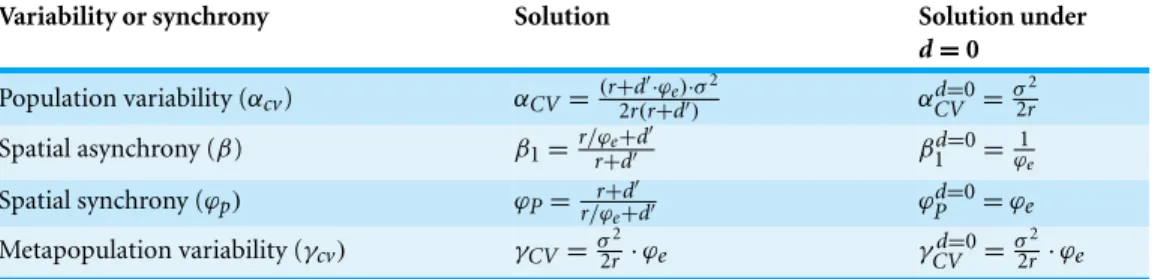
case, we derive analytic formulae for this multi-scale variability, which is summarized in
Table 1 Analytic solutions for multi-scale variability and spatial synchrony in homogeneous metapopulations.For clarity, we denoted′=md/(m−1)andϕe=1+(m−1)ρ
m . Note that by definition, we haveβ=αcv/γcvandϕp=1/β.
Variability or synchrony Solution Solution under
d=0
Population variability (αcv) αCV= (r+d′·ϕe)·σ2
2r(r+d′) αdCV=0=σ 2 2r
Spatial asynchrony (β) β1=r/ϕr+e+d′d′ β1d=0= ϕ1e Spatial synchrony (ϕp) ϕP=r/ϕr+e+d′d′ ϕ
d=0 P =ϕe Metapopulation variability (γcv) γCV= σ
2
2r ·ϕe γCVd=0=σ 2 2r ·ϕe
Dispersal-induced stability and synchrony
As demonstrated by previous studies, dispersal can simultaneously provide stabilizing and synchronizing effects on local population dynamics (Abbott, 2011). The dispersal-induced stability (Dα) can be defined as the ratio of alpha variability without dispersal to
that with dispersal (Abbott, 2011):Dα =αCVd=0/αCV. Similarly, the dispersal-induced
synchrony (Dϕ) can be defined as the ratio of spatial synchrony with dispersal to that
without dispersal:Dϕ =ϕp/ϕpd=0=βd=0/β.Dα andDϕquantify the local stabilizing
and spatial synchronizing effects of dispersal, respectively. The effect of dispersal on metapopulation stability (Dγ) is determined by the relative magnitudes of these two
effects, i.e.,Dγ =γCVd=0/γCV =Dα/Dϕ. WhenDγ is larger than 1, the local stabilizing effect
is larger than the spatial synchronizing effect, and thus dispersal decreases metapopulation variability. Otherwise, dispersal increases metapopulation variability.
RESULTS
Multi-scale variability in homogeneous metapopulations
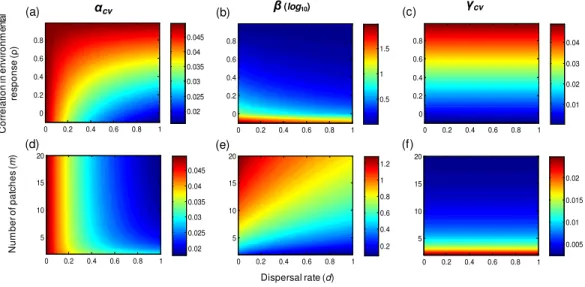
Through its stabilizing and synchronizing effects, respectively, dispersal decreases both alpha and beta variability (Fig. 1). These dispersal-induced effects are stronger under lower population growth rate, lower correlation of population environmental responses, and higher number of patches (Fig. 2). Interestingly, in homogeneous metapopulations, the dispersal-induced stability (Dα) is always identical to the dispersal-induced synchrony
(Dϕ); both equal the ratio of spatial population synchrony (ϕp) to the synchrony of
environmental responses (ϕe=1+(mm−1)ρ) (seeAppendix S1):
Dα=Dϕ=
ϕp
ϕe
. (7)
This implies that in homogeneous metapopulations, the effects of dispersal cancel out at the metapopulation level and thus dispersal has no net effects on gamma variability (Dγ =1; seeTable 1andFig. 1). These results, however, are based on linear
Dispersal rate (d)
αcv β(log10) γcv
C or rel at ion i n env ir onm e n ta l res pons e ( ρ )
0 0.2 0.4 0.6 0.8 1
0 0.2 0.4 0.6 0.8 0.02 0.025 0.03 0.035 0.04 0.045
(a) (b) (c)
0 0.2 0.4 0.6 0.8 1
0 0.2 0.4 0.6 0.8 0.01 0.02 0.03 0.04
0 0.2 0.4 0.6 0.8 1
0 0.2 0.4 0.6 0.8 0.5 1 1.5
0 0.2 0.4 0.6 0.8 1
5 10 15 20 0.02 0.025 0.03 0.035 0.04 0.045
0 0.2 0.4 0.6 0.8 1
5 10 15 20 0.2 0.4 0.6 0.8 1 1.2
0 0.2 0.4 0.6 0.8 1
5 10 15 20 0.005 0.01 0.015 0.02
(d) (e) (f)
N um ber of pat c hes ( m )
Figure 1 Multi-scale variability in homogeneous metapopulations. Effects of the correlation in environmental responses (ρ), number of patches (m), and dispersal rate (d) on multi-scale variability in homogeneous metapopulations. Parameters:r=0.5, σ2=0.05, andm=10 for (A–C) andρ=0 for (D–F).
0 0.1 0.2 0.3 0.4 0.5 0.6 0.7 0.8 0.9 1
1 1.2 1.4 1.6 1.8 2 2.2 2.4 2.6 2.8 3
Dispersal rate (d)
D is per s al -i nduc ed s tabi lit y or s y nc hr ony
0 0.5 1 1.5 2 0
0.05 0.1 0.15
Intrinsic growth rate (r) αcv
(a) (b) (c)
0 0.5 1 1.5 2
0 0.01 0.02 0.03
Intrinsic growth rate (r) γcv
0 0.5 1 1.5 2
0 2 4 6 8 10 12
Intrinsic growth rate (r) β1
Figure 3 Effects of the intrinsic population growth rate (r) on multi-scale variability in homogeneous metapopulations.Black and red lines show results underd=0 and 0.2, respectively. Solid and dashed lines show results underρ=0 and 0.2, respectively. Other parameters:m=10,σ2=0.05.
provide weak stabilizing effects on gamma variability (Fig. SA1; see alsoLoreau, Mouquet & Gonzalez, 2003).
The correlation of population environmental responses (ρ) and the number of patches (m) affect the multi-scale variability mainly through their effects on the spatial synchrony of population environmental responses (ϕe; seeTable 1). Asρincreases and/ormdecreases
(such thatϕeincreases), alpha and gamma variability both increase, and the beta variability
decreases (Fig. 1). Besides, as the intrinsic growth rate (r) increases, the temporal variability at alpha and gamma scales all decrease (Fig. 3). An increasingralso weakens the spatial synchronizing effects of dispersal and environmental correlation and thereby increases spatial asynchrony (Fig. 3B). Note that dispersal is required for spatial parameters (ρandm) to affect local alpha variability and for the local parameter (r) to affect spatial asynchrony. When there is no dispersal (d=0), alpha variability is independent ofρand
m, and spatial asynchrony is independent ofr(Table 1).
Effects of spatial heterogeneities on metapopulation variability
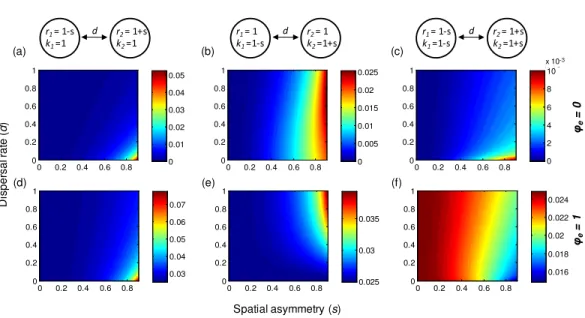
In two-patch metapopulations, when keeping dispersal rates symmetric between the two patches, spatial heterogeneities in local parameters (randk) generally increase gamma variability (Fig. 4). However, when the larger population (largerk) has faster local dynamics (largerr), such heterogeneity can contribute to reducing gamma variability if environmental responses are highly synchronous (Fig. 4F). When local populations have heterogeneous dynamics, increased (symmetric) dispersal rate tends to decrease gamma variability (Figs. 4A–4D). However, when local populations differ in carrying capacity (k), dispersal can be destabilizing, particularly when environmental responses are highly synchronous (Figs. 4Eand4F). Finally, note that in the cases with low or moderate heterogeneities in local parameters, symmetric dispersal has very limited effects on metapopulation variability, just as it does in homogeneous metapopulations.
r1= 1-s
k1=1
r2= 1+s
k2=1
d
0 0.2 0.4 0.6 0.8
0 0.2 0.4 0.6 0.8 1 0.03 0.04 0.05 0.06 0.07
0 0.2 0.4 0.6 0.8
0 0.2 0.4 0.6 0.8 1 0.025 0.03 0.035
0 0.2 0.4 0.6 0.8
0 0.2 0.4 0.6 0.8 1 0.016 0.018 0.02 0.022 0.024
0 0.2 0.4 0.6 0.8
0 0.2 0.4 0.6 0.8 1
0 0.2 0.4 0.6 0.8
0 0.2 0.4 0.6 0.8 1
0 0.2 0.4 0.6 0.8
0 0.2 0.4 0.6 0.8 1 0 0.01 0.02 0.03 0.04 0.05 0 0.005 0.01 0.015 0.02 0.025 0 2 4 6 8 10
x 103
φe = 0 φe = 1
Spatial asymmetry (s)
D is per s al r at e ( d )
(a) (b) (c)
(d) (e) (f)
x 10-3
r1= 1
k1=1-s
r2= 1
k2=1+s
d r1= 1-s
k1=1-s
r2= 1+s
k2=1+s
d
Figure 4 Effect of spatial heterogeneities in local dynamical parameters and of (symmetric) dispersal rate on gamma variability in two-patch metapopulations.(A–C): gamma variability when environ-mental responses are perfectly asynchronous (ϕe=0); (D–F) gamma variability when environmental responses are perfectly synchronous (ϕe=1). The two patches differ in their intrinsic population growth rate (r) and/or carrying capacity (k), where a largersindicates a higher heterogeneity. Other parameters:
σ2=0.05. SeeFigs. SA2andSA3for the patterns of variability at other scales.
(seeAppendix S2). Consequently, the metapopulation is dominated by one population (the non-dispersing one) and thereby exhibits larger variability (Figs. 5Aand5D). However, spatial heterogeneities in local population dynamics can alter this prediction qualitatively. For instance, if the non-dispersing population has faster local dynamics (largerr), its dominance may contribute to reducing gamma variability, especially when environmental responses are highly synchronous (Fig. 5E). Moreover, when local dynamics are highly heterogeneous, the metapopulation is most stable when dispersal rates exhibit moderate asymmetries. More specifically, gamma variability is lowest when the faster population has a moderately higher dispersal rate (Figs. 5Band5E), or when the larger population has a moderately higher dispersal rate in asynchronous environments (Fig. 5C) or has a moderately lower dispersal rate in synchronous environments (Fig. 5F).
DISCUSSION
We have used dynamical models to study the role of dispersal, in interaction with other spatial and local factors, in regulating the stability of metapopulations at multiple scales. Both the local stabilizing and spatial synchronizing effects of dispersal have been documented in previous studies (reviewed inAbbott, 2011), and are again demonstrated by our models. One remarkable finding is that in homogeneous metapopulations, the local stabilizing effect of dispersal is always identical to its spatial synchronizing effect; consequently, dispersal has no net effect on the variability of the whole metapopulation
(Fig. 1). This result is robust to moderate heterogeneities in local and spatial parameters
(Figs. 4and5), and is consistent with findings from experiments with the same settings
(i.e., experimental metapopulations with stable and homogeneous local populations; see
Vogwill, Fenton & Brockhurst, 2009). In deterministic metapopulation models, previous studies have shown that random dispersal does not alter stability properties of the linearized system when local population dynamics are homogeneous (reviewed inBriggs & Hoopes, 2004). Here we have further shown that dispersal does not affect the temporal stability of homogeneous metapopulations in a fluctuating environment.
In heterogeneous metapopulations, spatial heterogeneities in local dynamical parameters or dispersal rates generally increase metapopulation variability. However, when local dynamics are heterogeneous, dispersal can provide stabilizing effects on metapopulation variability in several ways. First, by linking populations with fast and slow dynamics, dispersal can decrease gamma variability by either stabilizing both populations
(Fig. SA2) or providing stronger stabilizing effects on the slower population and weaker
destabilizing effects on the faster populations (Fig. SA3; see alsoBriggs & Hoopes, 2004;
Ruokolainen et al., 2011). In particular, a moderately higher dispersal rate of the faster population can produce lowest gamma variability (Fig. SA5; see alsoDey, Goswami & Joshi, 2014). Second, a much higher dispersal rate of the slower population can leave the metapopulation dominated by the faster population, which decreases gamma variability in highly synchronous environments (Fig. 5E). Third, in highly synchronous environments, while symmetric dispersal rate between small and large patches can be destabilizing
net spatial flow of individuals, which decreases alpha and gamma variability (Fig. SA5). Finally, in highly asynchronous environments, dispersal can also provide stabilizing effects by reducing spatial synchrony. Specifically, a higher dispersal rate of the larger population can increase spatial evenness, which decreases spatial synchrony (Wang & Loreau, 2014) and thereby reduce gamma variability (Fig. SA4). Similarly, when asymmetries in dispersal rates operate in opposite ways—for instance the faster population has a much higher dispersal rate or a moderately lower rate, or the larger population has a higher (smaller) dispersal rate in (a)synchrounous environments—dispersal can increase the variability of the whole metapopulation.
It is interesting to compare the role of dispersal in metapopulation stability with that of interspecific competition in community stability. In metapopulations, populations interact through dispersal in physical space; in competitive communities, populations interact through interspecific competition in an abstract niche space. Remarkably, the effects of dispersal in our models are just opposite to those of competition in community stability. As shown in previous studies, competition can increase species variability but simultaneously decrease species synchrony; in symmetric communities with identical species parameters, these two effects cancel each other out and consequently competition has no effect on community stability (Hughes & Roughgarden, 1998;Ives, Gross & Klug, 1999;Loreau & De Mazancourt, 2008;Loreau & De Mazancourt, 2013). In asymmetric communities, an increasing asymmetry in competitive abilities generally increases community variability (Hughes & Roughgarden, 1998;Loreau & De Mazancourt, 2013); however, a moderately higher competitive ability of the slower species, or a much higher competitive ability of the faster species, can decrease community variability (Loreau & De Mazancourt, 2013). All these effects demonstrate the opposite roles played by interspecific competition in community stability and dispersal in metapopulation stability. These contrasting patterns could be understood from the fact that competition reduces the population size of recipient species while dispersal increases the size of recipient populations. This is reflected in the Jacobian matrices in which competition and dispersal produce negative and positive interaction coefficients, respectively. In other words, dispersal acts as a form of spatial intraspecific mutualism in the dynamics of metapopulations.
corridors may enhance or impair the stability of metapopulations. Our model suggests that in a heterogeneous landscape, the most efficient design of corridors is often one that generates asymmetric dispersal (Fig. 5). For instance, if local patches have different growth rates, the metapopulation is most stable when the faster-growing patch has a moderately higher dispersal rate than the slower-growing patch. Such asymmetric dispersal might be achieved by two mechanisms. First, when connected by corridors, the faster-growing population may have a higher level of dispersal activity spontaneously, e.g., by active dispersal (Pulliam, 1988). Second, it might be possible to design corridors that produce directional dispersal in some cases, for instance by taking advantage of water and/or wind flow (S¨aumel & Kowarik, 2010;Anderson, Hilker & Nisbet, 2012).
CONCLUDING REMARKS
In this paper, we have explored how spatial processes govern the variability of metapopulations at multiple scales in a stochastic environment. We show that within a metapopulation, dispersal functions as a form of spatial intraspecific mutualism. While stabilizing local populations, dispersal has very limited stabilizing effects on metapopulations if local population dynamics are homogeneous. In highly heterogeneous metapopulations, however, dispersal can stabilize or destabilize metapopulations through various mechanisms. Therefore, corridor designs, in order to increase metapopulation stability and persistence, should be context dependent with explicit consideration of spatial heterogeneities in population dynamics.
Our results are based on a simple metapopulation model and thus its limitations should be kept in mind. First, in our models local populations always have stable equilibrium if there is no environmental stochasticity. However, if local populations undergo complex dynamics (e.g., limit cycles or chaotic attractors), dispersal can provide stabilizing effects through interacting with nonlinearity and spatial heterogeneity (Briggs & Hoopes, 2004;
ACKNOWLEDGEMENTS
We thank Claire de Mazancourt for discussions, and Dries Bonte, Elad Shtilerman, and anonymous reviewers for helpful comments on earlier versions of the manuscript.
ADDITIONAL INFORMATION AND DECLARATIONS
Funding
This work was supported by the TULIP Laboratory of Excellence (ANR-10-LABX-41). The funders had no role in study design, data collection and analysis, decision to publish, or preparation of the manuscript.
Grant Disclosures
The following grant information was disclosed by the authors: TULIP Laboratory of Excellence: ANR-10-LABX-41.
Competing Interests
The authors declare there are no competing interests.
Author Contributions
• Shaopeng Wang conceived and designed the experiments, performed the experiments, wrote the paper.
• Bart Haegeman performed the experiments, wrote the paper.
• Michel Loreau conceived and designed the experiments, wrote the paper.
Supplemental Information
Supplemental information for this article can be found online athttp://dx.doi.org/
10.7717/peerj.1295#supplemental-information.
REFERENCES
Abbott KC. 2011. A dispersal—induced paradox: synchrony and stability in stochastic
metapopulations.Ecology Letters14:1158–1169DOI 10.1111/j.1461-0248.2011.01670.x.
Abrams PA, Ruokolainen L. 2011.How does adaptive consumer movement affect population
dynamics in consumer–resource metacommunities with homogeneous patches?Journal of
Theoretical Biology277:99–110DOI 10.1016/j.jtbi.2011.02.019.
Anderson KE, Hilker FM, Nisbet RM. 2012.Directional biases and resource—dependence in
dispersal generate spatial patterning in a consumer–producer model.Ecology Letters15:209–217
DOI 10.1111/j.1461-0248.2011.01727.x.
Blasius B, Huppert A, Stone L. 1999.Complex dynamics and phase synchronization in spatially
extended ecological systems.Nature399:354–359DOI 10.1038/20676.
Bowler DE, Benton TG. 2005.Causes and consequences of animal dispersal strategies: relating
individual behaviour to spatial dynamics.Biological Reviews80:205–225
DOI 10.1017/S1464793104006645.
Brown JH, Gillooly JF, Allen AP, Savage VM, West GB. 2004.Toward a metabolic theory of
ecology.Ecology85:1771–1789DOI 10.1890/03-9000.
De Roissart A, Wang S, Bonte D. 2015.Spatial and spatiotemporal variation in metapopulation
structure affects population dynamics in a passively dispersing arthropod.Journal of Animal
EcologyIn PressDOI 10.1111/1365-2656.12400.
Dey S, Goswami B, Joshi A. 2014.Effects of symmetric and asymmetric dispersal on the dynamics
of heterogeneous metapopulations: two-patch systems revisited.Journal of Theoretical Biology
345:52–60DOI 10.1016/j.jtbi.2013.12.005.
Dey S, Joshi A. 2006.Stability via asynchrony in Drosophila metapopulations with low migration
rates.Science312:434–436DOI 10.1126/science.1125317.
Earn DJ, Levin SA, Rohani P. 2000.Coherence and conservation.Science290:1360–1364
DOI 10.1126/science.290.5495.1360.
Gilbert-Norton L, Wilson R, Stevens JR, Beard KH. 2010.A meta—analytic review of corridor
effectiveness.Conservation Biology24:660–668DOI 10.1111/j.1523-1739.2010.01450.x.
Gonzalez A, Lawton J, Gilbert F, Blackburn T, Evans-Freke I. 1998.Metapopulation dynamics,
abundance, and distribution in a microecosystem.Science281:2045–2047
DOI 10.1126/science.281.5385.2045.
Gouhier TC, Guichard F, Gonzalez A. 2010.Synchrony and stability of food webs in
metacommunities.The American Naturalist175:E16–E34DOI 10.1086/649579.
Greenman J, Benton T. 2005.The impact of environmental fluctuations on structured discrete
time population models: resonance, synchrony and threshold behaviour.Theoretical Population
Biology68:217–235DOI 10.1016/j.tpb.2005.06.007.
Haddad N, Hudgens B, Damschen E, Levey D, Orrock J, Tewksbury J, Weldon A, Liu J, Hill V,
Morzillo A. 2011.Assessing positive and negative ecological effects of corridors. In: Liu J,
Hull V, Morzillo A, Wiens JA, eds.Sources, sinks and sustainability. Cambridge: Cambridge
University Press, 475–503.
Heino M, Kaitala V, Ranta E, Lindstr¨om J. 1997.Synchronous dynamics and rates of extinction
in spatially structured populations.Proceedings of the Royal Society of London Series B: Biological
Sciences264:481–486DOI 10.1098/rspb.1997.0069.
Holland MD, Hastings A. 2008.Strong effect of dispersal network structure on ecological
dynamics.Nature456:792–795DOI 10.1038/nature07395.
Hudson PJ, Cattadori IM. 1999.The Moran effect: a cause of population synchrony.Trends in
Ecology & Evolution14:1–2DOI 10.1016/S0169-5347(98)01498-0.
Hughes JB, Roughgarden J. 1998.Aggregate community properties and the strength of species’
interactions.Proceedings of the National Academy of Sciences of the United States of America
95:6837–6842DOI 10.1073/pnas.95.12.6837.
Inchausti P, Halley J. 2003.On the relation between temporal variability and persistence time in
animal populations.Journal of Animal Ecology72:899–908
DOI 10.1046/j.1365-2656.2003.00767.x.
Ives AR. 1995.Measuring resilience in stochastic systems.Ecological Monographs65:217–233
DOI 10.2307/2937138.
Ives A, Gross K, Klug J. 1999.Stability and variability in competitive communities.Science
286:542–544DOI 10.1126/science.286.5439.542.
Kendall BE, Bjørnstad ON, Bascompte J, Keitt TH, Fagan WF. 2000.Dispersal, environmental
correlation, and spatial synchrony in population dynamics. The American Naturalist
Koelle K, Vandermeer J. 2005.Dispersal—induced desynchronization: from metapopulations to
metacommunities.Ecology Letters8:167–175DOI 10.1111/j.1461-0248.2004.00703.x.
Lande R, Engen S, Sæther B-E. 1998.Extinction times in finite metapopulation models with
stochastic local dynamics.Oikos83:383–389DOI 10.2307/3546853.
Levine JM. 2003.A patch modeling approach to the community-level consequences of directional
dispersal.Ecology84:1215–1224DOI 10.1890/0012-9658(2003)084[1215:APMATT]2.0.CO;2.
Liebhold A, Koenig WD, Bjørnstad ON. 2004.Spatial synchrony in population dynamics.Annual
Review of Ecology, Evolution, and Systematics35:467–490
DOI 10.1146/annurev.ecolsys.34.011802.132516.
Loreau M, De Mazancourt C. 2008.Species synchrony and its drivers: neutral and nonneutral
community dynamics in fluctuating environments.The American Naturalist 172:E48–E66
DOI 10.1086/589746.
Loreau M, De Mazancourt C. 2013.Biodiversity and ecosystem stability: a synthesis of underlying
mechanisms.Ecology Letters16:106–115DOI 10.1111/ele.12073.
Loreau M, Mouquet N, Gonzalez A. 2003.Biodiversity as spatial insurance in heterogeneous
landscapes.Proceedings of the National Academy of Sciences of the United States of America
100:12765–12770DOI 10.1073/pnas.2235465100.
Lundberg P, Ranta E, Ripa J, Kaitala V. 2000.Population variability in space and time.Trends in
Ecology & Evolution15:460–464DOI 10.1016/S0169-5347(00)01981-9.
Moran P. 1953.The statistical analysis of the Canadian Lynx cycle.Australian Journal of Zoology
1:291–298DOI 10.1071/ZO9530291.
Pimm SL. 1984. The complexity and stability of ecosystems. Nature307:321–326
DOI 10.1038/307321a0.
Pulliam HR. 1988.Sources, sinks, and population regulation.American Naturalist132:652–661
DOI 10.1086/284880.
Ripa J. 2000.Analysing the Moran effect and dispersal: their significance and interaction in
synchronous population dynamics.Oikos89:175–187DOI 10.1034/j.1600-0706.2000.890119.x.
Ripa J, Ives AR. 2003.Food web dynamics in correlated and autocorrelated environments.
Theoretical Population Biology64:369–384DOI 10.1016/S0040-5809(03)00089-3.
Ruokolainen L, Abrams PA, McCann KS, Shuter BJ. 2011.The roles of spatial heterogeneity
and adaptive movement in stabilizing (or destabilizing) simple metacommunities.Journal of
Theoretical Biology291:76–87DOI 10.1016/j.jtbi.2011.09.004.
Ruokolainen L, Linden A, Kaitala V, Fowler MS. 2009.Ecological and evolutionary dynamics
under coloured environmental variation. Trends in Ecology & Evolution24:555–563
DOI 10.1016/j.tree.2009.04.009.
S¨aumel I, Kowarik I. 2010.Urban rivers as dispersal corridors for primarily wind-dispersed
invasive tree species.Landscape and Urban Planning94:244–249
DOI 10.1016/j.landurbplan.2009.10.009.
Steiner CF, Stockwell RD, Kalaimani V, Aqel Z. 2013.Population synchrony and stability in
environmentally forced metacommunities.Oikos122:1195–1206
DOI 10.1111/j.1600-0706.2012.20936.x.
Strevens CM, Bonsall MB. 2011.Density—dependent population dynamics and dispersal in
heterogeneous metapopulations.Journal of Animal Ecology80:282–293
Vogwill T, Fenton A, Brockhurst MA. 2009.Dispersal and natural enemies interact to drive
spatial synchrony and decrease stability in patchy populations.Ecology Letters12:1194–1200
DOI 10.1111/j.1461-0248.2009.01374.x.
Wang S, Loreau M. 2014.Ecosystem stability in space:α,β andγ variability.Ecology Letters