Linear, Step by Step Managerial Performance,
versus Exponential Performance
George MOLDOVEANU Bucharest Academy of Economic Studies [email protected] Ion Gh. ROŞCA Bucharest Academy of Economic Studies [email protected]
Abstract. The paper proposes the transition from the potential management concept, which its authors approached by determining its dimension (Roşca, Moldoveanu, 2009b), to the linear, step by step performance concept, as an objective result of management process. In this way, we “answer” the theorists and practitioners, who support exponential management performance. The authors, as detractors of the exponential performance, are influenced by the current crisis (Roşca, Moldoveanu, 2009a), by the lack of organizational excellence in many companies, particularly in Romanian ones and also reaching “the finality” in the evolved companies, developed into an uncontrollable speed.
Keywords: Linear performance; step by step; business maximizing; the business line regression slope; exponential performance; singularity.
JEL Codes: M10, M11, M12, M14. REL Code: 14K.
1. From management potential to the step by step linear performance
The management potential (Roşca, Moldoveanu, 2009b) has a higher or lower probability of generating effective and efficient activities. Management performance is the objective result of a management exercise. This is often identified with maximizing of the business value for shareholders, partners, investors, which may only have a natural, linear trend.
For the listed organizations, the business value (v) is estimated by the product between the number of issued shares (n) and the average transaction price (p):
ν = n × p (1)
Another factor that should be considered is the so-called “goodwill” (GW), which is considered a profit margin in a business sale:
GW
DA
CP
v
=
−
+
(2)in which:
CP – equities (in real terms);
DA – debits to associates and creditors (if there are, also, in real terms); GW – estimated goodwill (the brands’ value and trade found, in real terms).
This approach of the management performance is based on the thesis that it adds a value to the strategic business unit.
If there had not also been involved external organizational environment factors, then the performance measuring might even be the increase indicator of business value. But the external factors affect this value, especially during turbulence and crisis, independent of management actions. For example, the use of passengers’ airplanes, after the terrorist act from the 11th of September 2001, the amount of traveling companies decreased dramatically, their managers having no involvement, in principle. The same situation is recorded with real estate organizations or companies with some export products, by the end 2008.
In the described context it may be said that a performing manager is the one who is providing increased business value, above the average in the working area on asimilar dimensional business category:
an > an (3)
Where:
an is the slope of the regression line in the points that define the annual
business’ value;
n
In order to eliminate the environment distraction factors, the evaluation should be made over a period of at least five years. Operation of the presented concept is simple and the business value may be replaced with the turnover, although the range of indicators that can be used is much wider.
The regression model is defined by a mathematical relationship in which the managerial performance level (y) depends on two sets of factors: the turnover considered as a main, determinant factor marked by x and a residual variable u, which consists of all the other factors that are considered unessential.
u x f
y = ( )+ (4)
We propose three companies that, for a period of five years, have registered the turnover, as in the Table 1.
Table 1
The turnover of three representing companies for the industry
Turnover (mil. euro) – iternational level Managerial
performance level Company A Company B Company C
1 32.00 80.00 38.90
2 35.00 95.00 40.00
3 38.00 100.00 41.00
4 39.94 150.00 43.00
5 40.68 170.00 45.11
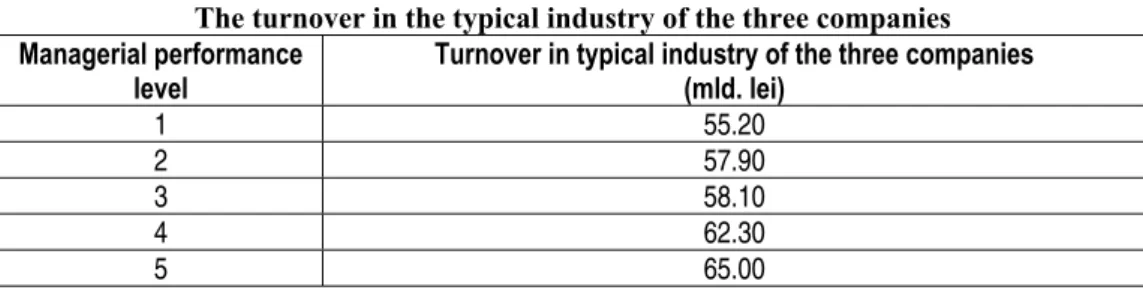
The three companies’s evolution of turnover in typical industry is described in Table 2.
Table 2
The turnover in the typical industry of the three companies
Managerial performance level
Turnover in typical industry of the three companies (mld. lei) 1 55.20 2 57.90 3 58.10 4 62.30 5 65.00
In case of company B, the line slope of regression (0.039037) compared with the industry's one that is part in, is smaller, which leads to bad management assessment.
At the level of company C, regression line slope is higher than the industry one, allowing us assessing performing management. The calculations are presented in Annex 1.
After processing the three companies’ data and industry that belong to (Annex 1), it results that in all four cases there are strong links between the level of turnover and management performance.
Summarizing the concept of management performance based on quantitative assessment of the value created in the management process has the following advantages:
It is pragmatic;
It is relatively easy to assess public data about the business;
It is objective;
It is in accordance with the fundamental purpose of management (“maximizing shareholder value”).
The disadvantages of such definitions are as follows:
It is needed a period of time for operating a business under a specific management for a practical assessment;
It is more than a normative method;
When used as a function to motivate managers, it leads to a conservative attitude, with aversion against risk, it is good for mature markets, but is losing in emerging markets.
Despite all its disadvantages, this definition is now the main criterion for assessing managerial performance in the US and EU based on which there are taken decisions of rewarding managers with bonuses, respectively the decisions for dismissal of a manager by the General Assembly of Shareholders.
For growing organizations, with an aggressive marketing strategy, the classic definition of management performance leads to management approach that is too reserved and too conservative. For this reason, management performance appraisal in these companies is done differently on any of the following substitute criteria for the business value:
The turnover;
The market share;
The relative market share.
By applying the method to measure performance in some profit organizations, we reached the view that, in normal conditions of economic and social stability, it evolves linearly, according to a right angle by a higher or lower factor.
We believe that this state is an expression of evolution without being supporters of Darwin’s "work". Evolution does not eliminate creationism and the organizations’ favorable condition warrants management performance.
2. Institutionalization of linear performance in the current corporations
Evolution in time of strategic business units (SBU) and managerial performance, too, canbedeductedfrom thereturnequityindicator(ROI), too.
AU ROS
ROI = × (5)
Where:
ROI - Return on Investment, the net profit for a year compared to total assets;
ROS - Return on Sales, the net profit reported to net sales over a year; AU - Asset Utilization, total asset turnover rate (number of complete rotations within one year).
Thus, some authors have likened these indicators as follows:
Financial Indicator ROI ROS AU
Significance in evaluating managerial Performance Management Managerial Effectiveness Managerial Efficiency Definition of assessment items in
the financial perspective
Quality of invested capital in unit time
Management's ability to achieve the proposed
objective
The management’s ability to make best use
of resources (assets)
3. Exponential performance
In the specific literature and economic practice there are designed and used several methods such as reengineering, six sigma etc., which sometimes propose and increase performances towards 40-60%, during a year, which on a relatively short period may represent an exponential increase.
The new paradigm is provided by the exponential growth in technology in recent years, resulting in a pattern like “brain reverse engineering” or “brain copying”.
As an opposite of this theory we raise an issue: “Who has allowed the exponential growth in technology?” There may be other non-biological intelligence than the biological one?
Let’s consider that during the next 50-100 years we would articulate performing developments, of exponential type. We believe that we were tangential to the notion of “singularity”, a concept clamed today by mathematicians, as a point where the derivative of a function can not be calculated, a point where the fraction is infinite.
Assessment is completed by physicists, cosmologists, etc. who brings us closer to a terrible crisis, the final one, in which the Universe is doomed to disappear. So the “singularity” is a point of “the black hole” where the laws are suspended.
Let us return to the current organizational area, without removing the virtual one (Pande et al., 2008). We consider that distance between the departure point and the evolution points, described by the planning/strategic vision, it seems to be continuous, linear, with some deviations depending on the environmental factors, not one with over imposed accelerator with a final future difficult to design or impossible to formulate (Moldoveanu, 2009, Moldoveanu, Roşca, 2010).
After the “birth” of an organization, we should see its finality. The organizational environmental factors ultimately require the road with a final more or less predictable. The progress, performances’ rates, require to be checked out, this is what the managers do or not. Angle αn of the performances
evolution can be controlled and the development realized.
4. Managerial linear/exponential performance and benchmarking
In order to be useful for economic practice, the concept of management performance must bejoined, linkedtogether withthebenchmarking concept. In thiscontextwe wantto make the followinghighlights:
ii)The following highlighting is the use of a standard that aims two actions; namely, assessing the current status of the performance spread out and the standard, and also the attempts to improve the registered status.
The standard is based on quantitative/qualitative economic indicators that are described at current levels, for a longer period of time, such as five years and their size is essential compared with that of world-class competitors.
Thus, in operational management the performance is based on indicators of cost, quality, flexibility and delivery, actions that are identified over the current year, over the next five years and “landing” range from of world class competitors.
iii)The third underlined element is the organizational changes’ speed, in order to adapt it to the environment. This implies, in particular in turbulent environments, the actual strategic aggressiveness that we describe by:
a) The degree of discontinuity of the organization's strategic movements (margin of time between the moments of the marketing of two products, services according to agreed standards);
b) The rhythm of organization's strategic movements (the number of new products per time unit).
Managerial, linear, step by step performance reduces the organizational changes time, in order that ownerships of global competitors to appropriate it, and the exponential, step by step one minimizes this time, causes disruption and seeks with all costs, the “top” of achievements.
5. Instead of conclusions
Currently, the overall management is happily completed with the operational one that the performance mostly depends on. Theory and practice are invaded by old or recent methods. In this respect we should revise methods such as J.I.T, lean manufacturing/lean thinking/kaizen, Six Sigma, TQM, constraints theory, reengineering, TCR, etc.
All have common elements such as the central place of the customer, process focus, etc., but also specific features.
(what, when and how we process) and not against the “uncontrolled rush” after profit, bonuses, etc.
This approach provides “health” within companies, and resource losses are reduced, the shareholders and managers expectations are “tempered” by customers, although the two approaches are often convergent (Moldoveanu, Roşca, 2010).
However, we wish to emphasize the need for growth at any cost and the exponential development of the processing system that many managers formulate, according to economic and not to socio-economic pattern. This thinking generates crises elements, like the current one, which involves rethinking the interests and gains.
The offered model by the living world describes a progressive evolution, linear process in which organizations have adapted to the environment, and not the more “intelligent” ones were performed.
References
Moldoveanu, G., Roşca I. Gh., Pleter, O.Th., „Improving Organizations by Replacing the
«Mechanical» Model with «Organic» one”, Studii şi cercetări de calcul economic şi
cibernetică economică, nr. 2/2007, Academia de Studii Economice, Bucureşti
Moldoveanu, G., Pleter, O.Th., „Multidisciplinary Optimization in Services Management”,
Theoretical and Applied Economics, nr. 5, 2007
Moldoveanu, G., „Ritmul de procesare – vector esenţial al sistemului organizatoric” (Procesing
rhythm. An Essential Vector of the organizational system), Acces la succes. Calitatea
nr. 9/2009
Moldoveanu, G., Roşca, I.Gh., „Comparative Approach between «Organizational Life Cycle»
and «Rational Biological Model»”, Revista de Management Comparat Internaţional,
volume 11, issue 3, july 2010
Pande, P.S., Neuman, R.P., Cavanagh, R.R. (2008). Cum îşi îmbunătăţesc performanţele GE,
Motorola şi alte companii de top, Editura All, Bucureşti
Roşca, I. Gh., Moldoveanu, G., „Management in turbulent conditions”, Economic Computation
and Economic Cybernetics Studies and Research, nr. 2, 2009
Roşca, I. Gh., Moldoveanu, G., „Measuring the Management Potential”, Amfiteatru Economic,
Annex 1
Annex 2
Annex 3
Annex 4