\
Pedro Alcântara
Arvelos
When to make or buy?
A framework for make-or-
-buy decision making
Master thesis in Production Engineering
Acknowledgments
Going back to school after many years of professional life was an exciting experience specially considering my shift from Civil to Production Engineering. Sitting in the class room, attending lectures, working on the various tasks and preparing for exams like in the past has helped me to get back some habits of reading, studying. However this would not have been possible without the understanding of my working colleagues and the support of my family during the last two years
I have learned about many new subject matters and I would like to thank all of my professors and colleagues for their contribution to this almost two-year learning process.
To Professor Pedro Cunha I leave special thanks for being my thesis supervisor, whose knowledge and guidance proved to be very important to this work.
Abstract
The purpose of this study was to develop a make-or-buy framework that could be applied when the make-or-buy issue arises. The framework was developed after a literature review and it is based on a two-phase model which has in the external environment the trigger for the make-or-buy process. The first phase starts with three different value disciplines – customer intimacy, product leadership and operational excellence, which form the value discipline of the customer. To the value disciplines there are six objectives associated: cost, quality, variability, flexibility, time and human capital. In the second phase, three options are available: Make, Make and Buy and Buy. The structure of the model was designed so that the Analytic Hierarchy Process (AHP) methodology could be applied in ranking the considered criteria. A three phase implementation procedure was also developed in which a multi-functional team ranks each all the criteria.
The framework was implemented in a company that operates in the automotive sector. Although the practical application did not follow the proposed steps in the implementation procedure, it was determined that the best option was to make the product instead of buying or even making and buying. The obtained results demonstrated coherency between the results obtained in each level, as the judgments made were subjected to a consistency check throughout the process.
However, a larger empirical research is suggested to assess the model’s utility and applicability
in real-world make-or-buy decision making situations. This would be accompanied by workshops in the companies where the framework would be implemented, as well as by the development of a software tool to facilitate the application of the AHP methodology.
Resumo
O âmbito deste estudo foi o de desenvolver uma metodologia de apoio à tomada de decisão quando o problema de “make-or-buy” surge. A metodologia foi desenvolvida após uma revisão à bibliografia existente e tem como base um modelo de duas fases que onde o ambiente externo vai desencadear o processo de “make-or-buy”.
A primeira fase tem início com três diferentes disciplinas de valor – proximidade com o cliente, liderança do produto, e a excelência operacional, que formam a disciplina do valor para o cliente. A estas disciplinas de valor estão associados seis objetivos: custo, qualidade, variabilidade, flexibilidade, tempo e o capital humano. Na segunda fase estão disponíveis três opções: Fazer, Fazer e Comprar, e Comprar. A estrutura do modelo foi desenvolvida de forma que o Analytic Hierarchy Process (AHP) pudesse ser aplicado na classificação dos critérios considerados. Foi também desenvolvido um procedimento para a implementação de três fases, onde uma equipa multifuncional classifica os todos os critérios.
A metodologia foi implementada numa empresa que opera no setor automóvel. Apesar da aplicação prática não ter seguido os passos do procedimento de implementação, determinou-se que a melhor opção era a fazer o produto em vez de comprar ou mesmo fazer e comprar. Os resultados obtidos demonstraram coerência em cada nível, uma vez que os julgamentos/decisões tomadas foram sujeitas a uma verificação de consistência ao longo do processo. No entanto, é sugerido um maior estudo empírico para avaliar a utilidade do modelo e a sua aplicabilidade em situações reais de tomada de decisão de “make-or-buy”. Este estudo seria acompanhado por “workshops” nas empresas onde a metodologia seria implementada, bem como pelo desenvolvimento de software que facilite a aplicação da metodologia de AHP.
Index
Acknowledgments ... iii
Abstract ... iv
Resumo ... v
Index ... vi
List of Figures ... viii
List of Tables ... xi
List of Abbreviations and Acronyms ... xii
List of Symbols ... xiii
Chapter 1 - Introduction ... 1
1.1. Introduction and developed work ... 2
Chapter 2 - Make-or-Buy: Where do we stand ... 6
2.1. Trends ... 7
2.2. Models and approaches ... 8
2.3. Make-or-buy attributes ... 15
2.3.1. Cost... 16
2.3.2. Time ... 17
2.3.3. Quality ... 18
2.3.4. Flexibility ... 18
2.3.5. Variability... 19
2.3.6. Human Capital ... 19
2.4. Multiple attribute decision making methods (MADM) ... 20
2.5. Analytic Hierarchy Process (AHP) ... 23
Chapter 3 - Framework development ... 26
3.1. A two phase framework ... 27
3.1.1. Phase 1: Determine the value discipline of the customer and the
performance objectives ... 28
3.1.2. Phase 2: Determine whether to outsource or in-source ... 30
3.2. The AHP format ... 33
Chapter 4 - Case Study ... 45
4.1. Case presentation ... 46
4.2. Phase 1: Preparation phase ... 46
4.3. Phase 2: Data Collection ... 47
4.4. Phase 3: Analysis and supplier relation selection ... 57
Chapter 5 - Conclusions and future work ... 59
5.1. Conclusions ... 60
5.2. Proposals for future studies ... 61
Bibliography ... 62
Annex I - Numerical references ... A.1
Codes for the indicators ... A.2
Annex II - Calculations ... A.3
Level 1 calculations ... A.4
Level 2 calculations ... A.6
Level 3 calculations ... A.11
List of Figures
Figure 1.1. Management pyramid ... 3
Figure 2.1. Process attributes space ... 16
Figure 2.2. Product attributes space ... 16
Figure 2.3. A generic AHP model ... 24
Figure 3.1. A two-phase model for the make-or-buy decision process ... 28
Figure 3.2. The three value disciplines ... 29
Figure 3.3. Portfolio model... 31
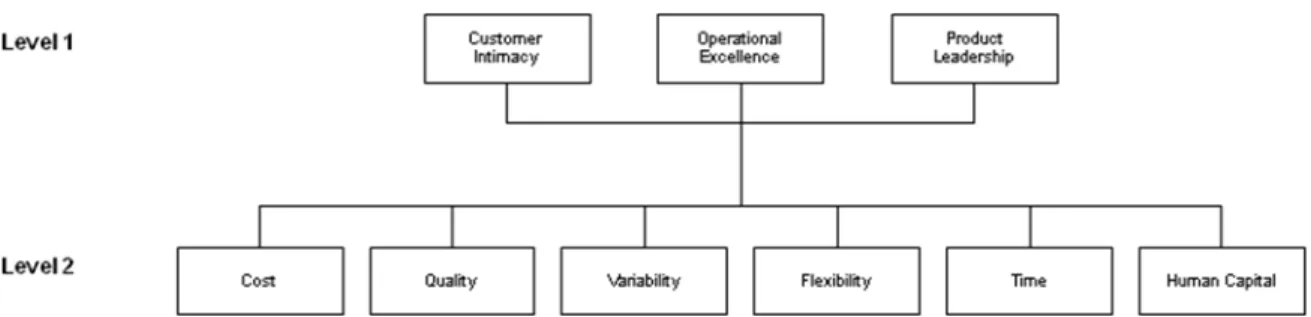
Figure 3.4. The first two hierarchical levels of the developed framework in
the AHP format ... 33
Figure 3.5. Comparison matrix ... 35
Figure 3.6. Generic square matrix ... 35
Figure 3.7. The hierarchical structure with the objective indicators
identified ... 38
Figure 3.8. Hierarchic structure with the three options: Make, Make and
Buy, and Buy. ... 39
Figure 3.9. The final AHP hierarchy ... 40
Figure 3.10. Implementaion procedure ... 43
Figure 4.1. Comparison matrix, M1, for Level 1 ... 47
Figure 4.2. Priority vector, Pv.L1, of Level 1 ... 47
Figure 4.3. Comparison matrix, M1, for Level 2 regarding the value
discipline of “Customer Intimacy”
... 48
Figure 4.4. Comparison matrix, M2, for Level 2 regarding the value
discipline of “Operational Excelence”
... 48
Figure 4.5. Comparison matrix, M3, for Level 2 regarding the value
discipline of “Produ
c
t Leadership”
... 48
Figure 4.6. Priority matrix, M4, for Level 2 ... 49
“Cost”
... 50
Figure 4.9. Comparison matrix, M2, for Level 3 regarding the objective
“Quality”
... 50
Figure 4.10. Comparison matrix, M3, for Level 3 regarding the objective
“
Variability
”
... 50
Figure 4.11. Comparison matrix, M4, for Level 3 regarding the objective
“
Flexibility
”
... 51
Figure 4.12. Comparison matrix, M5, for Level 3 regarding the objective
“
Time
”
... 51
Figure 4.13. Comparison matrix, M6, for Level 3 regarding the objective
“Human Capital”
... 51
Figure 4.14. Global priority vector for Level 3... 52
Figure 4.15. Comparison matrix, M1, for Level 4 regarding the Cost
indicator “Investment Costs”.
... 52
Figure 4.16. Comparison matrix, M2, for Level 4 regarding the Cost
indicator “Production costs
/ unit produced”.
... 52
Figure 4.17. Comparison matrix, M3, for Level 4 regarding the Cost
indicator “Start up costs”.
... 53
Figure 4.18. Comparison matrix, M4, for Level 4 regarding the Cost
indicator
“Cost reduction activities with suppliers”.
... 53
Figure 4.19. Comparison matrix, M5, for Level 4 regarding the Quality
indicator “Product Quality”.
... 53
Figure 4.20. Comparison matrix, M6, for Level 4 regarding the Quality
indicator “Process Quality”.
... 53
Figure 4.21. Comparison matrix, M7, for Level 4 regarding the Quality
indicator “Supplier Quality”.
... 53
Figure 4.22. Comparison matrix, M8, for Level 4 regarding the Variability
indicator “On time deliveries”.
... 54
Figure 4.23. Comparison matrix, M9, for Level 4 regarding the Variability
indicator “Hourly production output”.
... 54
Figure 4.24. Comparison matrix, M10, for Level 4 regarding the Variability
indicator “Labor content per part”.
... 54
Figure 4.25. Comparison matrix, M11, for Level 4 regarding the Variability
Figure 4.26. Comparison matrix, M12, for Level 4 regarding the Flexibility
indicator “Change over time”.
... 54
Figure 4.27. Comparison matrix, M13, for Level 4 regarding the Flexibility
indicator “Sourcing leadtime”.
... 55
Figure 4.28. Comparison matrix, M14, for Level 4 regarding the Flexibility
indicator “Engineering changes leadtime”.
... 55
Figure 4.29. Comparison matrix, M15, for Level 4 regarding the Time
indicator “Production cycle time”.
... 55
Figure 4.30. Comparison matrix, M16, for Level 4 regarding the Time
indicator “Production leadtime”.
... 55
Figure 4.31. Comparison matrix, M17, for Level 4 regarding the Time
indicator “Delivery leadtime”.
... 55
Figure 4.32. Comparison matrix, M18, for Level 4 regarding the Human
Capital indicator “Availability new personnel”.
... 56
Figure 4.33. Comparison matrix, M19, for Level 4 regarding the Human
Capital indicator “Absentism”.
... 56
Figure 4.34. Comparison matrix, M20, for Level 4 regarding the Human
List of Tables
Table 2.1. Summary of the make-or-buy approaches described in this
study ... 12
Table 2.2. Decision table in MADM methods ... 21
Table 2.3. MADM vs MODM ... 22
Table 3.1. Motives underlying entry of companies into partnerships ... 31
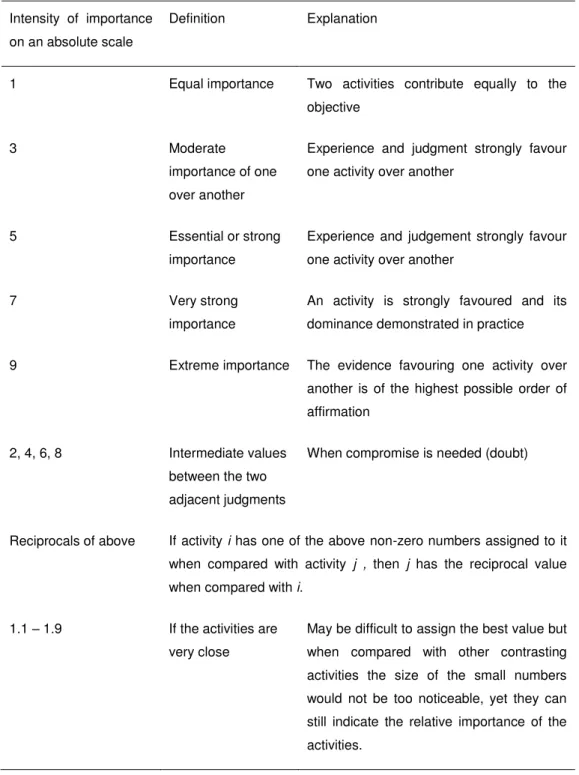
Table 3.2. The fundamental scale of absolute numbers ... 34
List of Abbreviations and Acronyms
AHP Analytic Hierarchy Process
ANP Analytic Network Process
CBR Case-Based Reasoning
CI Consistency Index
CR Consistency Ratio
DA Discriminant Analysis
DM Decision Maker
ELECTRE Elimination Et Choix Traduisant la Realité
MAA Multi-Attribute Analysis
MADM Multi-Attribute Decision Making
MCDM Multiple Criteria Decision Making
MEW Multiplicative Exponential Weighting
MODM Multiple Objectives Decision Making
PA Product Architecture
R&D Research and Development
RI Random Index
ROCE Return On Capital Employed
SAW Simple Additive Weighting
SSM Strategic Sourcing Model
List of Symbols
λ Matrix eigenvalue
λmax Matrix’s maximum eigenvalue
Σ Sum
Ai Alternative i
ANxN Square matrix of dimension N
Bi Attribute i
bij Entry b of the i-th row of the j-th column in a generic matrix
Cij Sum of the c elements in each column of a generic matrix
cij Entry c in the i-th row of the j-th column of a generic matrix
Ev Eigenvector of the matrix
Evij Entry Ev in the i-th row of the j-th column of a matrix’s eigenvector
mij Measure of performance of the alternative in the i-th row of the j-th column
n Number of criteria used in decision making
Pv Priority vector of the matrix
Pvij Entry Pv in the i-th row of the j-th column of a matrix’s priority vector
wj Weight of the j attribute
Chapter 1
Introduction
1.1. Introduction and developed work
A make-or-buy decision consists of the act of choosing between manufacturing a product in-house or outsourcing its production to an external supplier. Companies have finite resources and cannot always afford to have all manufacturing technologies in-house (Cáñez et al., 2000). Thus, a company, essentially, makes the comparison between the costs and other benefits of producing a product or product component internally in relation to purchasing it from an external supplier. A company may choose to produce in-house when, traditionally, the benefits of outsourcing a given product or product component are low, i.e., when one or more of the following conditions are observed:
The cost of buying is superior to the cost of producing in-house;
The company has an excess of production capacity;
The suppliers may not be reliable.
In order to make this decision, the company assumes that it possesses the appropriate techniques, equipment, as well as access to raw material, and also the capacity to meet its own quality standards. In the last decades, with the increase of outsourcing, the decision to make-or--buy has become the one that managers have to deal with more often. However, the decision of producing an item instead of buying it entails risks. A company that decides to make instead of buying, risks losing access to alternative sources of design flexibility, and also to the technological innovations that a specialized supplier can offer. When buying, a company risks losing its own design capability and becoming dependent on the supplier.
The factor cost was initially viewed as one of the most important factors to be considered in a make-or-buy decision (Balakrishnan, 1994; Padillo and Diaby, 1999). With the development of new studies, researchers understood that a make-or-buy decision had also a strategic component and that cost, and the availability of the production capacity were not the only factors to be considered (Welch and Nayak, 1992; Probert, 1996, McIvor et al., 1997, McIvor and Humphreys, 2000; Cáñez et al., 2000; Platts et al. 2002; Water and Peet, 2007; Holcomb and Hitt, 2007; Park and Ro, 2011; Puranam et al., 2013). In view of the fact that a make-or-buy decision is considered to have a great impact on a company’s strategy, as strategic decisions make use of considerable corporate resources, have long-term consequences, and are in many cases extremely difficult to reverse (Ketelhöhn, 1993), then a structured framework should be
used to assure that all decisions made are in the company’s best interest.
which is assessed in Level 1, refers to three ways in which a company can outperform their competition by producing a different kind of customer value, namely:
Operational excellence;
Product leadership;
Customer intimacy.
The Value Disciplines of the Customer will be further detailed when Phase 1 of the framework is presented.
Regarding the Performance Objectives, six objectives were identified – Cost, Time, Flexibility, Quality, Variability, and Human Capital. The importance of each one is determined in levels 2 and 3 and is influenced by the position that the company wishes to assume in relation to its customers, each time the make-or-buy issue arises.
In Phase 2, which includes levels 4 and 5, the decision whether to in- outsource is taken followed by determining of the type of relationship to establish with the supplier. In this model,
the option “supplier” is considered for simple short-term contracts, while the option “partnership” is for a long-term relationship. In each level a comparison matrix is computed and the priority vector of the corresponding attributes is assessed. It should be noted that a short-term contract is considered to have the duration of a product’s lifecycle while the designation long-term partnership is adopted when a range of products is to be developed between the client and the supplier.
Regarding the practical application, the implementation procedure was designed so that
the majority of a company’s main functions could take part in the process. The functions that
were considered are the ones displayed in Fig. 1.1.
The process is divided into 3 phases, allowing the different team members to participate only at a given stage where their expertise is most needed:
Phase 1: Preparation phase – The project team is selected and briefed;
Phase 2: Data collection – The data necessary to perform the make-or-buy analysis is gathered and its rating carried out by performing 2 workshops;
Phase 3: Analysis and supplier relation selection – After obtaining the priority for each of the three options – Make, Buy, or Make and Buy, and if the priority vector indicates that the best ranked option is to buy or to make and buy, then the decision has to be
made regarding the relation with the supplier.
However, due to the fact that this is an academic study, it was only possible to assemble a one man team, which led to the decision of, in Phase 2, performing just one workshop instead of the initial two.
Although the practical implementation procedure differed from the proposed methodology, coherency between the results obtained in each level was observed, which was to be expected as the judgments made were subjected to a consistency check during the process. The final result indicated that the best option was to make instead of buying or making and buying, which is also consistent with previous decisions made by the company, regarding the same type of products.
The framework was designed to be applied to all types of production or production strategies, however it is still necessary to implement it in different industries to assess its effectiveness and eventual improvements.
the automobile branch and received a contract to deliver a part produced by injection of Polyurethane (PU) Foam in a closed tool. Due to its characteristics the traditional production process was thought to be expensive, driving the cost to non-competitive values. This proved to be a good opportunity to apply the methodology as the company was equating buying instead of manufacturing. On completion of the process, the results indicated that, despite the high investments costs, making the part is still better than outsourcing its production.
In the final chapter, the conclusions are presented along with a proposal for further developing the work developed in this study.
Chapter 2
Make-or-Buy: Where do we stand
2.1. Trends
During this literature review two different make-or-buy trends were identified. The first trend, which is essentially concerned with the strategic side of outsourcing, considers the following factors:
Cost
Core activities
Product architecture
Relation with suppliers
The traditional costs analysis, based on the Transaction Cost Theory (Williamson, 1975), may influence the decision of which activities should or should not be outsourced. Core activities should remain in-house while the non-core can be outsourced. According to Prahalad and Hamel (1990) a core competence should be kept in-house instead of surrendering core competencies in favour of external suppliers. However, this aspect cannot be dissociated from the cost reduction, as mentioned by Quélin and Duhamel (2003) that state that a firm can outsource a core activity that requires a heavy investment, as long as the supplier/service provider covers that cost. Concerning product architecture, Parka and Young (2006), based on the knowledge-based view, argue that when product architecture changes, a company that adopts a pseudo-make strategy (a company designs a product but outsources the manufacturing process) will probably demonstrate better product performance than a firm that follows a pure make or buy strategy. The relationship with suppliers is critical and when a company lacks knowledge and/or skill in an important area, it can benefit from the knowledge exchange between internal and external suppliers. Thus a strategic partnership can bring benefits for both.
2.2. Models and approaches
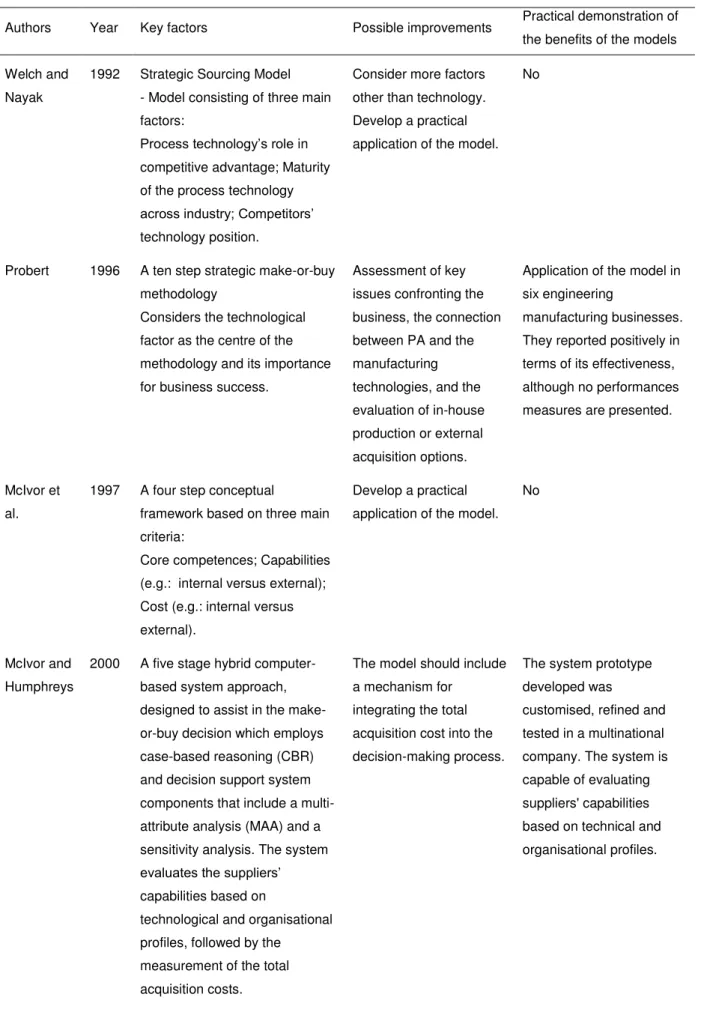
From the literature review, it was possible to assess the evolution of the make-or-buy approaches over the last two decades. The advances made have been substantial. Welch and Nayak (1992) suggested a conceptual framework that intended to enhance the traditional cost analysis by considering strategic and technological factors. Their model, the Strategic Sourcing Model (SSM), consists of three main dimensions:
i. Process technology’s role in competitive advantage – Assessing if outsourcing factors that are involved in the development and introduction of new products, such as research and development (R&D), design, engineering, manufacturing, or assembly, will be prejudicial to their firm's competitive position;
ii. Maturity of the process technology across industry – Companies should evaluate the maturity of the process technology across all industries;
iii. Competitors’ technology position – This analysis involves a structured benchmarking approach that should take into consideration the differences that may exist from industry to industry.
This model results in a three by nine matrix, which will allow deciding which strategy to adopt:
“make”, “marginal make”, “develop internal capability”, “buy”, “marginal buy”, or “develop suppliers”.
Later on, Probert (1996), describes the development of a ten step systematic approach to formulating a make-or-buy strategy. Similarly to Welch and Nayak (1992), Probert (1996) analyses the manufacturing technologies used by the business, as he considers the technological factor the centre of the methodology, namely the competitiveness with which they are deployed, and their importance to the success of the business. The methodology was reported to be applied to six engineering manufacturing businesses which reported positively in terms of its effectiveness, with projected business results improvements of 10% to 40% in return on capital employed (ROCE) and 30% to 60% stock/lead-time reductions. However, Probert (1996) stated that the determination of the key issues confronting the business, the relationship between product architecture (PA) and the manufacturing technologies, and the evaluation of make in/buy out options, are all areas for further development.
McIvor et al. (1997), with the intention of illustrating that the make-or-buy is a strategic decision and has implications for the general corporate strategy of the organization, propose a four stage conceptual framework for evaluating make-or-buy decisions based on three main criteria:
i. Core competences;
ii. Capabilities (e.g. : internal versus external); iii. Cost (e.g.: internal versus external).
necessary skills needed to continue future product leadership. They argue that sourcing decisions can have an impact on, among other factors, the core activities of the organization. In the second stage the appropriate value chain links are profiled. Through a structured benchmarking approach, similarly to what Welch and Nayak (1992) propose, companies should
assess their core activities capabilities in relation to potential suppliers’ and competitors’
capacity. In the third stage where the total cost analysis is processed, the traditional cost assessment is replaced by a careful measurement of all the actual and potential costs involved in outsourcing a given activity, internally or externally. The final stage, an analysis of potential suppliers for partnership is made. The company may decide to establish a partnership relationship with a supplier, as it is possible to develop core competences by learning from a partner. However, this involves the exchange of information, risks and rewards, thus the importance of a proper analysis.
McIvor and Humphreys (2000), present a five stage hybrid computer-based system approach, designed to assist in the make-or-buy decision, which employs both case-based reasoning (CBR) and decision support system components that include a multi-attribute
analysis (MAA) and a sensitivity analysis. The system evaluates the suppliers’ capabilities
based on technological and organisational profiles, followed by the measurement of the acquisition costs.
In the first stage the key performance categories that are required to specify the technical capability categories, are identified, while in the second stage the technical capability categories are analysed. The objective is to identify in rank order the suppliers that are technically competent in their ability to supply the item. The internal and external capabilities are compared in the third stage with the best-in-class on the range of criteria identified. The suppliers that have been identified in the third stage as being technically capable, have their organisations analysed in the fourth stage where the relevant characteristics used in establishing a close collaborative relationship with a supplier are analysed. The fifth and final stage (total acquisition cost analysis) considers all the current and potential costs involved in the purchasing process, from initial conception, such as collaborating with a supplier in the project phase, through to the use of the completed product by the final customer (McIvor and Humphreys, 2000).
Cáñez et al. (2000) developed a framework for the make-or-buy decision process where they suggested four areas to cluster relevant factors to be considered in make-or-buy decisions:
i. Technology and manufacturing processes; ii. Cost;
iii. Supply chain management and logistics; iv. Support systems.
It also identifies five performance measures: cost savings, capacity utilisation, time-to-market, quality and flexibility. These performance measures that are closely linked to the triggers or reasons for undergoing in a make-or-buy process, intend to allow the evaluation of the extent to which the targets suggested by the triggers are achieved (e.g., cost saving – cost saved).
In the case studies performed, Cáñez et al. (2000) observed that the companies which applied the framework demonstrated cost reduction and improved quality. Thus, a four phase implementation procedure was proposed. In the first phase, Preparation phase, a multi- -disciplinary team is selected and informed about the part or family of parts to be considered. The second phase, Data collection phase, consists of the data collection by means of three workshops where the principles of the multiple attribute decision making (MADM) are applied. The collected data is then, in the third phase (Data analysis phase), analyzed in order to score each of the choices, where the highest score indicates the best option. In the final phase, Feedback, a feedback session, between the researcher and the multi-disciplinary team is planned to discuss the process. The use of a questionnaire is also planned in order to ensure that key issues are taken into consideration.
Based on the framework and on the implementation procedure developed by Cáñez et al. (2000), Platts et al. (2002), described the development of a make-or-buy decision making process and reported on its application inside a manufacturing company. The make-or-buy process, which was conducted by a facilitator, is composed of three phases. In the first phase, Preparation, the multi-disciplinary project team is selected and the part or family of parts or process to be considered is identified and described. The second phase, Data collection, requires the specification, the gathering and the weighting of the factors influencing the performance of in-house and external suppliers. These weightings are, during the third phase, Analysis and Results, combined to give a score which gives an indication of the relative advantages of making or buying when considering several factors.
fields, operational excellence, product leadership and customer intimacy, are distinguished to which five performance objectives apply, e.g. speed, quality, cost, flexibility and reliability. In addition to the Financial area, as well as Supply Chain Management and Logistics, Support Systems and Technology & Manufacturing, which are considered by Platts et al. (2002), the areas of Engineering, R&D and Human Resources, are included in the second phase.
Water and Peet (2006) highlighted the fact that, after the decision to outsource is made, it is important to select the proper supplier relationship, as the company will no longer control the production process, the expected goals to be achieved are still the same. Although the AHP facilitates the structuring of the make-or-buy decision process, the issue of supplier choice still needs to be further investigated in terms of programming, as well as the lack of empirical evidence regarding its effectiveness.
Puranam et al. (2013) state that instead of making or buying, firms often make and buy the
same part or product, and argue that “explaining the mix of external procurement and internal
sourcing for the same input requires a consideration of complementarities across and
constraints within modes of procurement” (Puranam et al., 2013). Thus, they proposed an integrated framework that allows the decision maker to decide how much to make and how much to buy, given a set of external factors, by explaining how complementarities and constraints instigate plural sourcing and form the optimal combination of internal/external sourcing. In terms of complementarities, the ones that are considered in the model are incentive and knowledge complementarities. While incentive complementarities promotes competition by, e.g., the threat of backwards integration or outsourcing, and “increasing” performance, knowledge complementarities, promotes innovation between internal and external suppliers through collaboration and knowledge sharing. Regarding constraints, Puranam et al. consider scale diseconomies and lock-ins “constraints to external sourcing, like the bargaining power of
unions and government regulations”.
It is also suggested that while factors that confer a cost or benefit advantage to one of the modes of procurement (such as transactional hazards) push towards a pure sourcing model, constraints push firms away from corner solutions while complementarities pull towards equal usage of the two sourcing modes (Puranam et al., 2013).
This analysis offers an analytical basis for explaining how much firms make and buy, which is very useful in the work that will follow this literature review.
Table 2.1. Summary of the make-or-buy approaches described in this study
Authors Year Key factors Possible improvements Practical demonstration of the benefits of the models
Welch and Nayak
1992 Strategic Sourcing Model - Model consisting of three main factors:
Process technology’s role in competitive advantage; Maturity of the process technology
across industry; Competitors’
technology position.
Consider more factors other than technology. Develop a practical application of the model.
No
Probert 1996 A ten step strategic make-or-buy methodology
Considers the technological factor as the centre of the methodology and its importance for business success.
Assessment of key issues confronting the business, the connection between PA and the manufacturing technologies, and the evaluation of in-house production or external acquisition options.
Application of the model in six engineering
manufacturing businesses. They reported positively in terms of its effectiveness, although no performances measures are presented.
McIvor et al.
1997 A four step conceptual
framework based on three main criteria:
Core competences; Capabilities (e.g.: internal versus external); Cost (e.g.: internal versus external).
Develop a practical application of the model.
No
McIvor and Humphreys
2000 A five stage hybrid computer-based system approach, designed to assist in the make-or-buy decision which employs case-based reasoning (CBR) and decision support system components that include a multi-attribute analysis (MAA) and a sensitivity analysis. The system
evaluates the suppliers’
capabilities based on
technological and organisational profiles, followed by the
measurement of the total acquisition costs.
The model should include a mechanism for
integrating the total acquisition cost into the decision-making process.
The system prototype developed was
Authors Year Key factors Possible improvements Practical demonstration of the benefits of the models
Cáñez et al.
2000 A framework with four relevant make-or-buy areas: Technology and manufacturing processes; Cost; Supply chain management and logistics; and Support systems. It also identifies five performance measures: Cost savings, Capacity utilisation, Time-to-market, Quality and Flexibility.
The author states that feasibility, usability and utility are to be addressed during the implementation procedure.
Three in-company case studies were performed which showed a cost reduction and improved quality. An implementation procedure is proposed.
Platts et al. 2002 A three phases make-or-buy decision making process: Phase 1 - Preparation, the multi-disciplinary project team is selected and briefed; Phase 2 – Data collection, requires the specification, the gathering, and the weighting of the factors influencing the performance of in-house and external supply; Phase 3 – Analysis and results, the weightings of phase 2 are combined to give a score which gives an indication of the relative advantages of making or buying when considering several factors.
The facilitator should be replaced in order to guarantee that no implicit knowledge has been held. The authors also suggest that the way process stages fit together should be improved, the costing exercise developed and the ratings definitions made clearer. The spreadsheet macro should also be made more user friendly.
Application in an industrial case that allowed
Authors Year Key factors Possible improvements Practical demonstration of the benefits of the models
Water and Peet
2006 A three-phase model, consisting of a decision hierarchy of five levels, which allows the AHP to incorporate into the model. Phase 1 consists of the determination of the value the company wants to represent to its customers and markets (value discipline) and the performance objectives; In Phase 2 the relevant value-creation areas and their capability factors are defined. In the third and final phase, the type of relationship with the supplier(s) is defined. If the buy option is chosen, then the option can be buying directly from the supplier or of establishing a partnership with the supplier.
The supplier choice needs to be further investigated in terms of programming. The authors also mention the lack of strategic and purchasing
professionalism, the restrictions of AHP and lack of empirical evidence are areas that require possible improvements.
The model is illustrated by the example of a shipyard in the Netherlands that must decide whether to outsource the construction of hull components or continue to execute that task itself.
Puranam et al.
2013 Propose an integrated framework to explain how complementarities and constraints allow making empirical predictions about sourcing, i.e., to decide how much to make and how much to buy.
The mechanisms that generate
complementarities or constraints (e.g., knowledge transfer, administrative
diseconomies of scale, etc.), would benefit from
“independent formal treatment” (Puranam et
al., 2013, pp. 1158).
No
2.3. Make-or-buy attributes
Decision making in the manufacturing environment is a strategic issue (Chryssolouris, 1992). From the literature review (Welch and Nayak, 1992; Probert, 1996; McIvor et al., 1997; McIvor and Humphreys, 2000; Cáñez et al., 2000; Platts et al., 2002; Water and Peet, 2006), and taking into consideration the words of Chryssolouris (1992) who states that decisions regarding manufacturing systems, besides requiring a technical understanding and expertise, also require the ability to satisfy certain business objectives. Thus, it can be concluded that a combination of both engineering and management disciplines is required. The decision-making exercise can be put into practice in the manufacturing environment, if the appropriate procedures are made available to the decision makers (Chryssolouris, 1992).
Thus, there are four classes of manufacturing attributes that should be considered in a decision-making exercise, namely:
Cost;
Time;
Quality;
Flexibility.
For the make-or-buy decision making framework it was decided to consider, additionally, two more attributes –Variability and HumanCapital.
It is relevant to consider that those attributes can differ when the process space or the product space is considered. In Fig. 2.1. the interrelationship between the first four attributes when it comes to process attributes is demonstrated, while Fig. 2.2. demonstrates the same kind of interrelationship but, since it concerns product attributes, the fourth dimension – “Flexibility”, is replaced by
Figure 2.1. Process attributes space(adapted from Chryssolouris, 1992)
Figure 2.2. Product attributes space(adapted from Chryssolouris, 1992)
The attributes above mentioned, from now on referred to as objectives, will be briefly discussed and, in the next chapter, their respective indicators identified. Thus an objective is an attribute that will be maximized or minimized according to the strategy to be followed.
2.3.1. Cost
A company benefits from determining the cost of producing products or services provided that information will allow them to make pricing decisions to determine if a product should be discontinued or initiated, and other product related decisions. Costs related to manufacturing include a number of different factors which can be broadly classified into the three categories:
Direct materials – This cost includes the raw materials for producing the product, or that become Flexibility
Quality
Time
Variability
Quality
Time
part of the finished product, and can be easily be traced back to it.
Direct labour – The direct labour needed for operating the equipment and facilities – the cost of workers who are physically involved in converting raw materials into a finished product.
Overhead – This refers to indirect factory-related costs that incur during manufacturing. This can be divided into two additional categories:
o Variable overhead – Indirect production costs that vary as the quantity produced also varies:
The energy required for the performance of the different processes. Depending on the industry, this cost may be insignificant compared to other factors, while in others it may assume a financial burden of the manufacturing system.
o Fixed overhead – Indirect production costs that do not vary as the quantity produced varies:
Maintenance. This includes labour, spare parts, etc., needed to maintain the equipment, facilities and systems.
Equipment and facility costs. These include the cost related to the equipment necessary for the manufacturing processes, the facilities, and the factory infrastructure.
Salaries. Besides the production line workers, the salary cost of the remainder company workers must also be accounted for.
The investment cost, needed to assemble a new production line or adapt an existing one to a new product must also be accounted for.
This objective was, in the early make-or-buy models, the preponderant factor to choosing when
to make or when to buy, thus its inclusion in this study’s framework is unavoidable.
2.3.2. Time
According to Chryssolouris (1992), time objectives, in manufacturing systems, refer to:
The speed at which a manufacturing system can respond to changes, e.g., design, volume demand;
The speed at which a system can manufacture a given product – this is usually expressed as the production rate of the system.
sought out and the resort to automation is necessary, Chryssolouris (1992).
This objective is, in the author’s opinion, associated with the remainder, of extreme importance
and could not be left apart in the developed framework, as it affects all others.
2.3.3. Quality
The quality of a product, broadly related with customer satisfaction, is often difficult to define in quantitative terms, since customer satisfaction depends not only on the actual features of a product, but also on its feasibility, maintainability, and host of other factors that are often subjective and thus difficult to quantify. However, customer satisfaction can be traced back to two major factors at the origin of a product: its design and manufacture.
In manufacturing, quality typically refers to how well the production process meets the design specifications of a product, i.e., a given set of different characteristics and properties. The quality of a product is an aggregate of the quality of individual features and properties.
Since manufacturing quality reflects the meeting by the manufacturing process of established expectations within tolerances, it is important to note that such tolerances may be over- or under-estimated. An overestimation of tolerances leads to unnecessary cost during product manufacture and unnecessary pressure on the manufacturing system, while an underestimation of tolerances may lead to a malfunctioning product.
Measuring quality is critical for manufacturing, since it reflects the performance of the production process as a whole, and facilitates the establishment of trade-offs between quality and other manufacturing attributes.
2.3.4. Flexibility
Being recognised as one of the most useful tools, flexibility has become a critical component to
achieving a competitive advantage in today’s current market place (Jain et al., 2013). It is defined as the ability of a product or a production system to change or adapt with the lowest penalty in time possible, effort, cost and/or performance, thus, quickly and economically. This allows the creation of products that meet the demands of a diversified customer base.
Chryssolouris (1992) summarizes flexibility into three main forms:
Product flexibility: Enables the same equipment in a manufacturing system to produce a diversity of products in small lot sizes and to be used across several product life cycles.
Capacity flexibility: Allows a manufacturing system to adjust the production volumes of different products to changes in volume demand while, at the same time, remains profitable.
different machines, materials, operations and sequences of operations which, in turn, results from the flexibility of individual processes and machines (including the flexibility of
the manufacturing system’s structure itself).
However, in order to be properly considered in a make-or-buy decision making process, it should be properly defined in terms of its indicators.
2.3.5. Variability
Environmental uncertainty and increased competition are some of the main triggers that have led to changes both in products and in processes (Correa and Gianesi, 1994; Jain et al., 2013). Managing these changes, or variations, has proven to be one of the most important priorities, at all levels of manufacturing, if a company intends to provide the variety demanded by the market, while remaining profitable, maintaining the levels of quality, responsiveness and adaptability (ElMaraghy, 2005). The variability of both products and processes of a manufacturing system can be seen from two different perspectives:
i. Variation due to variety of parts or products produced;
ii. Variation in production volume, specifically lot-size variation.
In order to stay competitive, it is essential to manage the variability of products and processes,
in order to diminish the problems associated to the new products’ design and production, thus
similarly to the other attributes, variability will be included in the framework.
2.3.6. Human Capital
Most of the current models (Probert, 1996; McIvor et al., 1997; Cáñez et al., 2000; Platts et al., 2002, Puranam et al., 2013) ignore the importance of the Human Resources (HR) value in
influencing a company’s competitive position. However, Water and Peet (2006) recognize that
importance by agreeing with the conclusions of Lepak and Snell (1999). Lepak and Snell, by combining the arguments from transaction cost economics, human capital theory and the resource- -based view, argue that when the potential of the human capital is identified, developed, and then strategically deployed, a company may be able to gain a competitive advantage. Thus, employee skills related to core activities should be developed and maintained in-house. Prahalad and Hamel
(1990) have also recognized that people are a company’s most precious asset.
The author of this study agrees with the decision of Water and Peet (2006) and Prahalad and Hamel’s (1990) opinion, of including this attribute in their model and decided to include it also.
Both quantitative and qualitative elements play a role as well as uncertainty and incomplete
information” (Water and Peet, 2006, pp.259). Such complexity requires a model that can consider simultaneously, different levels of decision variables and multiple objectives in the analysis and solution of some problems.
When Padillo and Diaby (1999) first introduced the term multiple-criteria to a make-or-buy decision making model, they noted that the multiple criteria decision making (MCDM) methodology could be implemented into the model. In the next subchapter, the MCDM method is presented.
2.4. Multiple attribute decision making methods (MADM)
When it comes to decision making “there is a need for simple, systematic, and logical methods
or mathematical tools to guide decision makers in considering a number of selection criteria and their
interrelations” (Rao, 2006). The purpose of such tools is to find the most suitable combination of
criteria, after the identification of the selection criteria.
The multiple attribute decision making (MADM) methods fit in the category of the multiple
criteria decision making (MCDM), which “refers to making decisions in the presence of multiple, usually conflicting, criteria” (Hwang and Yoon, 1981).
As Hwang and Yoon state, there are four words that are widely used in the MCDM literature (attributes, objectives, goals and criteria). As there are no universal definitions of these terms, they made some distinctions which were adopted in this study, namely:
Criteria: A criterion is the basis for evaluation, as it is considered a measure of effectiveness. It can emerge in the problem as a form of attributes or objectives.
Goals: Goals, or targets, are a priori values or levels of aspiration. These are to be either achieved, surpassed or not exceeded, and can be referred to as constraints because they are designed to limit and restrict the alternative set.
Attributes: Performance parameters, components, factors, characteristics, and properties are all synonyms for attributes. An attribute should provide a means of evaluating the levels of an objective. A number of attributes can characterize each alternative, chosen by the decision
maker’s (DM) conception of criteria.
Objectives: An objective is something to be pursued to its fullest, and indicates the direction of the change desired.
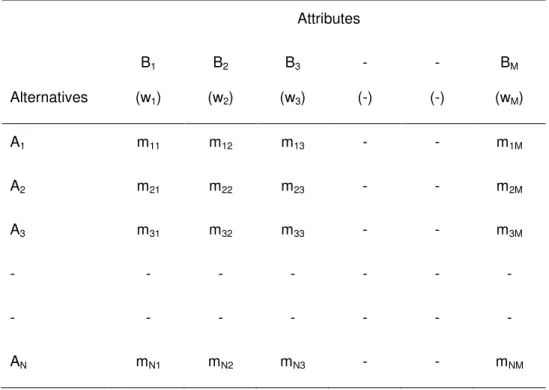
Decision matrix: A MADM problem can be expressed in a matrix format (also known as decision table). A decision matrix in MADM methods has four main parts, namely:
(a) Alternatives;
(b) Attributes;
(d) Measures of performance of alternatives with respect to the attributes.
In which each part is identified as follows (see Table 2.2.):
Alternatives, Ai(for i = 1, 2, …, N); Attributes, Bj(for j = 1, 2, …, M);
Weights of attributes, wj(for j = 1, 2, …, M); and
Measures of performance of alternatives, mij(for i = 1, 2, …, N; j = 1, 2, …, M).
Table 2.2. Decision table in MADM methods (extracted from Rao, 2006)
Attributes
Alternatives
B1
(w1)
B2
(w2)
B3
(w3)
-
(-)
-
(-)
BM
(wM)
A1 m11 m12 m13 - - m1M
A2 m21 m22 m23 - - m2M
A3 m31 m32 m33 - - m3M
- - - -
- - - -
AN mN1 mN2 mN3 - - mNM
Although the problems of MCDM are widely diverse, Hwang and Yoon (1981), state that they share some common characteristics:
Multiple objectives/attributes: Each problem has multiple objectives/attributes. A DM must generate relevant objectives/attributes for each problem setting.
Conflict among criteria: Multiple criteria usually conflict with each other. For example, in designing a car, the objective of higher gas mileage might reduce the comfort rating due to smaller passenger space.
Incommensurable units: Each objective/attribute has a different unit of measurement, e.g., safety may be indicated in a nonnumeric way and cost in Euros.
Design/selection: Solutions to these problems are either design the best alternative or to select the best among previously specified finite alternatives. The MDCM process involves designing/searching for an alternative that is the most attractive for all criteria (dimensions).
continuous and discrete. MCDM problems can be broadly categorized into two groups:
i. Multiple objective decision making (MODM), which have decision variable values to be determined in a continuous or integer domain, with either an infinitive or a large number of
alternative choices. The best alternative should satisfy the decision maker’s constraints, preference and/or priorities.
ii. Multiple attribute decision making (MADM), has a discrete and, usually, limited number of
predetermined alternatives. “The alternatives have associated with them a level of
accomplishment of the attributes (not necessarily quantifiable)” (Hwang and Yoon, 1981, pp. 3) based on which the final selection of the alternative is made, with the help of both inter- and intra-attribute comparisons. The comparisons may involve explicit trade-offs that are appropriate for the problem considered.
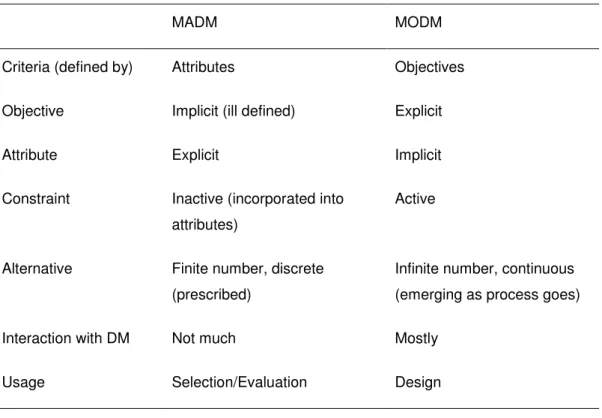
Table 2.3 shows the differences of the features between these two groups.
Table 2.3. MADM vs MODM (Hwang and Yoon, 1981)
MADM MODM
Criteria (defined by) Attributes Objectives
Objective Implicit (ill defined) Explicit
Attribute Explicit Implicit
Constraint Inactive (incorporated into
attributes)
Active
Alternative Finite number, discrete
(prescribed)
Infinite number, continuous (emerging as process goes)
Interaction with DM Not much Mostly
Usage Selection/Evaluation Design
“Given the decision table information and the selected decision-making method, the task of the DM is to find the best alternative and/or to rank the entire set of alternatives that maximizes his/her satisfaction, with respect to more than one attribute” (Rao, 1986, pp 27). All the elements in the decision table must be normalized to the same units, since, as mentioned above, each attribute may have a different unit of measurement. That will allow all possible attributes in the decision making process to be considered.
methods (e.g.: Elimination Et Choix Traduisant la Realité – ELECTRE, Technique for Order of Preference by Similarity to Ideal Solution – TOPSIS, Multiplicative Exponential Weighting – MEW, Simple Additive Weighting – SAW, Analytic Hierarchy Process – AHP, and Analytic Network Process
– ANP), are introduced for different decision situations, several authors have outlined procedures for selecting the most appropriate MADM method.
Thus, considering that a make-or-buy framework will have to consider objective and subjective attributes, it was decided to choose the Analytic Hierarchy Process, once it was designed to reflect the way a person thinks, and has the ability to deal with objective and subjective attributes, especially when these represent an important part of the decision making process. These characteristics are briefly presented in the next subchapter.
2.5. Analytic Hierarchy Process (AHP)
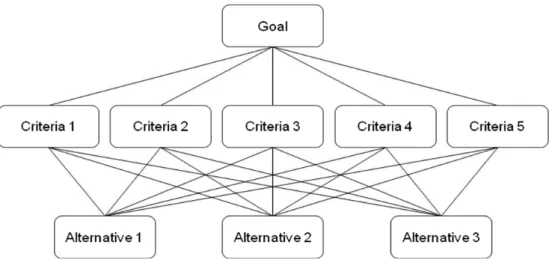
Developed by Thomas Saaty (1980), the AHP reduces the study of even formidably intricate systems to a sequence of pair-wise comparisons of properly identified components, by providing a simple multiple criteria methodology that allows the evaluation of alternatives (Saaty, 1990b). It breaks up a decision-making problem hierarchically, into a system of objectives, attributes (or criteria), and alternatives. An AHP hierarchy can have as many levels as needed to fully characterize a particular decision situation. Each level of hierarchy is analysed independently and the results combined as analysis progresses. The judgments made can be refined through a continuous application of a feedback process, where each application leads to a refinement of the judgments. The AHP includes and measures tangible, non-tangible, quantitatively measurable, and qualitative factors (Saaty, 1990b). The subjective judgements of different individuals also make up an important part of the decision making process.
The ability to handle real decision situations that involve subjective judgments, multiple decision makers, and the ability to provide measures of consistency, makes AHP a useful methodology. The basic procedure to carry out the AHP method consists of the following steps:
1. Structuring a decision problem and criteria selection
Figure 2.3. A generic AHP model
Arranging all the components in a hierarchical form provides a global overview of the complex relationships and helps the DM to assess whether the elements in each level can be compared
precisely. The elements in each group are assumed to be independent. “An element in a given level does not have to function as a criterion for all the elements in the level below. Each level may
represent a different cut at the problem so the hierarchy does not need to be complete” (Saaty, 1990a).
2. Priority setting of the criteria by pair-wise comparison
For each pair of criteria, the DM should respond to a question such as “Of the two criteria being
compared, which is considered more important by the DM with respect to the overall goal?” Rating
the relative “priority” of the criteria is done by assigning a weight between 1 (equal importance) and 9 (extreme importance) to the more important criterion, whereas the reciprocal of this value is assigned to the other criterion in the pair (refer to Table 3.2 for details). The relative weights are then normalized and averaged in order to obtain an average weight for each criterion.
3. Pair-wise comparison of alternatives on each criterion
For each pairing within each criterion the better option is awarded a score, again, on a scale between 1 (equally good) and 9 (absolutely better), as the other option in the pairing is assigned a rating equal to the inverse of this value. Afterwards, the ratings are normalized and averaged. Comparisons of elements in pairs require that they are homogeneous or close with respect to the common criterion; otherwise significant errors may be introduced into the process of measurement (Saaty, 1990a).
4. Obtaining an overall relative score for each option
alternatives in the bottom most level are obtained, for each element in the level below contributes with its weighed value to obtain the overall or global priority.
Chapter 3
Framework development
3.1. A two phase framework
As seen in Chapter 2, several authors, for over 20 years, have been developing models to support the make-or-buy decision that consider several factors such as cost, time/speed, technology, quality, flexibility, reliability, and human resources (Welch and Nayak, 1992; Probert, 1996; McIvor et al., 1997; McIvor and Humphreys, 2000; Cáñez et al., 2000; Platts et al., 2002; Water and Peet, 2006, Puranam et al., 2013). Probert (1996) highlights the importance of technology in influencing business key success factors such as quality, cost, delivery and flexibility. However, according to Water and Peet (2006), in order to arrive at a sound make-or-buy decision, many judgements and decisions have to be made, namely the definition of:
The strategic goals;
The objectives; and the objectives’ indicators;
The determination of the most suitable kind of relationship with a supplier when an activity or process is to be outsourced.
To note that, as the supplier selection process consists of a strategic choice, with specific aspects that need to be considered, it will not be addressed in detail in this work.
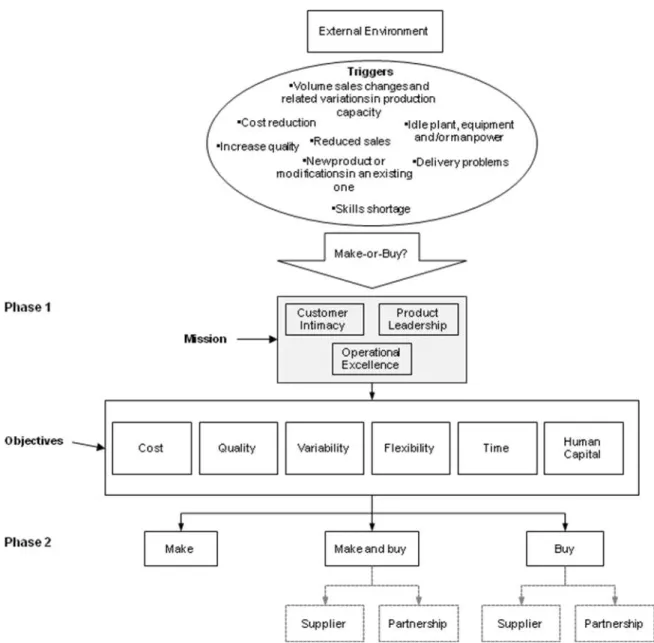
In addition, Miles et al. (2014) state that a framework should explain, graphically or in narrative form, the key factors, variables and the presumed interrelationships among them. Thus, it was decided that these three groups of decisions should be grouped in a two phase model, as can be seen in Fig. 3.1., which considers the external environment as the trigger for the make-or-buy analysis.
The two phases are defined as follows:
Phase 1: Determine the value discipline of the customer and the performance objectives
Figure 3.1. A two-phase model for the make-or-buy decision process
3.1.1. Phase 1:
Determine the value discipline of the customer and the
performance objectives
Probert (1996), in his model, considers the technological factor as the centre of the methodology and its importance for a competitive position, while McIvor et al. (1997), base their model on the assessment of the core competences, capabilities, and a broad cost analysis, that alerts the decision makers to the strategic issues of a make-or-buy decision. Later, Cáñez et al. (2000) developed a model in which the external environment activates the trigger for the make- -or-buy process. Despite the evolution of the make-or-buy models, Probert (1996), McIvor et al. (1997) and Cáñez et al. (2000), as Water and Peet, state, “do not recognise the company’s strategic position but especially focus on the value the company wants to represent to its customers and
Water and Peet (2006) recognised the importance of incorporating a company’s strategic position as they integrated, in their model, the ideas of Treacy and Wiersema (1997) that state that a company must find unique value that only it can present to a particular market. Thus, in this phase,
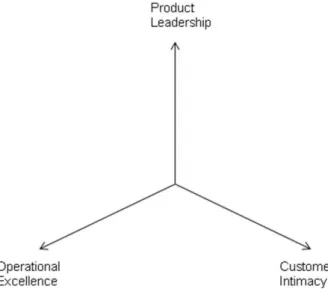
the concept introduced by Treacy and Wiersema, to which they called “value disciplines” (Fig. 3.2.),
refers to three ways in which a company can outperform their competition by producing a different kind of customer value, namely:
Operational excellence: Offers reliable low price products that can be obtained by the client with the least inconvenience;
Product leadership: Offers the latest product –it’s all about product performance;
Customer intimacy: The company knows their clients’ needs and buying habits and offers products that meet exactly their expectations, thus cultivating long term relationships.
Figure 3.2. The three value disciplines
Although Treacy and Wiersema (1997) argue that pursuing a value discipline is not the same as choosing a strategic goal, the selection of one will have a large impact on what a company does. However, instead of considering just one of the value disciplines at a time, Water and Peet (2006) argue that in order to survive, a company should consider all three value disciplines and not just one as Tracy and Wiersema (1997) defend. Thus, the strategic position of organisations will be a miscellany of the three value disciplines, which need to be ranked, as one of them will be more important than the other two (Water and Peet, 2006).
After the strategic position of the company, regarding the product under analysis is assessed, and its influence over the six objectives, the company will be able to decide whether to outsource, insource, or both.
3.1.2. Phase 2: Determine whether to outsource or in-source
The idea behind outsourcing the development of the design process, and/or of the production of a given product or part is, on one hand, to gain access to new knowledge, experience, and technology, and, on the other hand, to allow the company’s resources to become available, making possible to concentrate its efforts and capabilities on core activities. However, if it is decided to outsource a given activity (core or not), a company should previously address a number of issues concerning the maintenance of the knowledge and experience (design skills, management skills, production, etc.), as well as the fact that the company should maintain control over the new product development and design process, which will contribute to the maintenance of its competitive position.
In their model, Water and Peet, argue that the benefits of outsourcing are defined in accordance with the type of product that will be outsourced and with the value discipline of the customer. Kraljic (1983) identifies four types of products (Fig. 3.3.), which Olsen and Ellram (1997), describe and suggest how to manage the relationship associated to each type:
Leverage: These types of products, besides being easy to manage, are strategically important to the company. The goal is to create a supplier relationship based on mutual respect in order to communicate future requirements, and obtain a low total cost.
Non-critical: This category includes products that are easy to manage and have a low strategic importance. The goal is to reduce the number of suppliers and of duplicate products/services in order to reduce administrative costs. The supplier relationship should basically manage itself.
Strategic products: The products that fall into this category are difficult to manage and strategically important to the company. These products are better managed by establishing a close relationship with the suppliers, by promoting their involvement and joint development of products and services. In this situation, a supplier should be seen as an extension of the company.
Difficulty of
managing the product
type
10
Bottleneck Strategic
High
5
Non-critical Leverage
Low
1
1 Low 5 High 10
Strategic importance of the product
Figure 3.3. Portfolio model (adapted from Ollsen and Ellram, 1997)
The value discipline of the customer also needs to be taken into consideration when
establishing a relationship with a supplier, as these objectives influence the company’s strategic position and can allow the exploitation of the supplier’s capabilities.
Varadarajan and Cunningham (1995) argue that a strategic alliance promotes the partition of resources and skills by the cooperating companies in order to achieve common goals, linked to the strategic objectives, as well as particular goals of the individual partners. In Table 3.1, some of the reasons that motivate the establishment of a partnership are identified.
Table 3.1. Motives underlying entry of companies into partnerships (extracted from Varadarajan and Cunningham, 1995)
Product-related motives:
Fill gaps in present product line;
Broaden present product line;
Differentiate or add value to the product. Product-market-related motives:
Enter new product/market domains;
Enter or maintain the option to enter evolving industries whose product offerings may emerge as either substitutes for, or complements to, the firm's product offerings.
Market structure modification-related motives:
Resource use efficiency-related motives:
Lower manufacturing costs;
Lower marketing costs. Skills enhancement-related motives:
Learning new skills from alliance partners;
Enhancement of present skills by working with alliance partners.
Although one of the most common motives for establishing a partnership is of learning from their partners (i.e., internalizing over time the distinctive capabilities/skills of the alliance partners), Varadarajan and Cunningham (1995) point out that, at the same time, companies should safeguard their own distinctive skills from being internalized by their partner. The risk of losing market share should not be neglected. Strategic alliances can be seen as a new form of competition in which the partner that learns the fastest would be able to dominate the relationship as well as to renegotiate the terms of the alliance in its favour (Varadarajan and Cunningham, 1995).
From the above, it was decided to include, in this phase, three options: Make; Make and Buy; and Buy. Associated to the options of Make and Buy, and Buy the following options were introduced:
i. Selecting a supplier to whom a product or part of a product will be outsourced;
ii. Establishing a partnership with a supplier.