Pi-ta
in Invasive Weedy Rice in the USA
Seonghee Lee1,2, Yulin Jia3*, Melissa Jia3, David R. Gealy3, Kenneth M. Olsen4, Ana L. Caicedo5
1Rice Research Extension Center, University of Arkansas, Stuttgart, Arkansas, United States of America,2The Samuel Roberts Noble Foundation, Ardmore, Oklahoma, United States of America,3Dale Bumpers National Rice Research Center, Agricultural Research Service, United States Department of Agriculture, Stuttgart, Arkansas, United States of America, 4Department of Biology, Washington University, St. Louis, Missouri, United States of America,5Department of Biology, University of Massachusetts, Amherst, Massachusetts, United States of America
Abstract
ThePi-tagene in rice has been effectively used to control rice blast disease caused by Magnaporthe oryzaeworldwide. Despite a number of studies that reported thePi-tagene in domesticated rice and wild species, little is known about how thePi-tagene has evolved in US weedy rice, a major weed of rice. To investigate the genome organization of thePi-tagene in weedy rice and its relationship to gene flow between cultivated and weedy rice in the US, we analyzed nucleotide sequence variation at thePi-tagene and its surrounding 2 Mb region in 156 weedy, domesticated and wild rice relatives. We found that the region at and around thePi-ta gene shows very low genetic diversity in US weedy rice. The patterns of molecular diversity in weeds are more similar to cultivated rice (indicaandaus), which have never been cultivated in the US, rather than the wild rice species,Oryza rufipogon. In addition, the resistantPi-taallele (Pi-ta) found in the majority of US weedy rice belongs to the weedy group strawhull awnless (SH), suggesting a single source of origin forPi-ta. Weeds with Pi-tawere resistant to twoM. oryzaeraces, IC17 and IB49, except for three accessions, suggesting that component(s) required for thePi-tamediated resistance may be missing in these accessions. Signatures of flanking sequences of thePi-tagene and SSR markers on chromosome 12 suggest that the susceptiblepi-ta allele (pi-ta), notPi-ta, has been introgressed from cultivated to weedy rice by out-crossing.
Citation:Lee S, Jia Y, Jia M, Gealy DR, Olsen KM, et al. (2011) Molecular Evolution of the Rice Blast Resistance GenePi-tain Invasive Weedy Rice in the USA. PLoS ONE 6(10): e26260. doi:10.1371/journal.pone.0026260
Editor:Yong-Hwan Lee, Seoul National University, Republic of Korea
ReceivedJune 5, 2011;AcceptedSeptember 23, 2011;PublishedOctober 17, 2011
This is an open-access article, free of all copyright, and may be freely reproduced, distributed, transmitted, modified, built upon, or otherwise used by anyone for any lawful purpose. The work is made available under the Creative Commons CC0 public domain dedication.
Funding:This work was supported in part by the National Science Foundation Plant Genome Research Program under grant DBI-0638820 to Y. Jia, K. Olsen, and A. Caicedo. Additional funding for this project is from the United States Department of Agriculture-Agricultural Research Service (USDA-ARS) National Program NP301 project titled ‘Response of Diverse Rice Germplasm to Biotic and Abiotic Stresses’. The funders had no role in study design, data collection and analysis, decision to publish, or preparation of the manuscript.
Competing Interests:The authors have declared that no competing interests exist.
* E-mail: [email protected]
Introduction
Weedy rice is commonly found in cultivated rice fields and shares traits with both cultivated and wild rice. Weedy rice causes significant economic loss in rice producing areas of the Southern US and is the same species as cultivated rice (O. sativaL.) [1]. In the US, common weedy rice, strawhull awnless (SH), blackhull awned (BHA), and brownhull awned (BR) strains are believed to have been introduced to the US as seed contaminants during crop importation and subsequently evolved through natural outcrossing [2,3,4,5,6]. However, little is known about where US weedy rice has been originated from and how weedy population has been evolved in US rice growing area with other cultivated rice over 100 years. Recently, a few studies have been reported for more precise understanding the genomic diversity of US weedy rice and molecular evolution of important traits (shatter-ing, red pigmentation, and phenol reaction locus Ph1) in weedy rice [2,3,5,6]. In these studies, the research groups generated a large DNA sequence dataset for the target locus by sequencing at and flanking region of the locus. This approach for genome-wide survey of nucleotide polymorphisms has enhanced our under-standing of the molecular evolution and evolutionary origin of the gene in US weedy rice.
used to manage blast disease in the Southern US and worldwide [13,14,15]. Threeindicalandrace cultivars Tadukan (Philippines), Tetep (Vietnam), and Te Qing (China) are known as the sources of resistant Pi-taallele (Pi-ta) worldwide [15,16,17]. Tadukan is the common donor ofPi-tafor various Asianjaponicacultivars, but the presence ofPi-tain certainjaponicacultivars (ex. Japanese cultivar, Yashiro-mochi) was derived from unknown indica parent(s) different from Tadukan [17], suggesting multiple origins ofPi-ta
injaponicacultivars. Katy was the first US cultivar to containPi-ta
from Tetep and it has become the principal donor for subsequent development of numerous elite US resistant cultivars [14,15,18,19].
ThePi-tagene belongs to a NBS-LRR type of plant resistance (R) gene encoding a nucleotide binding site (NBS) and leucine-rich domains (LRD) [20,21]. The LRD of Pi-ta was demonstrated to directly interact with a putative product of AVR-Pita in triggering disease resistance [21]. The structural diversity of the Pi-ta protein and variants in cultivated and wild rice groups of AA genome Oryza species has been investigated [14,22,23,24]. These studies revealed that the LRD domain is highly conserved among cultivated and wild species of rice. In contrast, an excess of amino acid substitutions over neutral expectations was observed in the NBS region of both groups, consistent with positive selection. Within the LRD, a functional amino acid polymorphism (Serine to Alanine) at position 918 of Pi-ta is found in all cultivated resistant rice and wild relatives. In addition, two recent studies determined the relationship between the size of the
Pi-tagenomic block introgression and blast disease resistance; and at least 5 Mb of the Pi-tagenomic block with another required component Ptr(t) is found in resistant cultivars containing Pi-ta
[23,25,26].
Studying genome organization of thePi-tagene in weedy rice will not only help us gain more insight into the molecular mechanisms of blast resistance genes, but also will benefit the development of strategies to manage weedy species of rice in commercial rice fields. The objectives of the present study were to evaluate: i) natural variation at/around thePi-taregion in the US weedy rice population; ii) the origin of the Pi-ta alleles in US weedy rice, iii) essential genomic region for Pi-ta-mediated resistance and iv) gene flow at thePi-tagene between cultivated and weedy rice.
Results
Nucleotide variation at and around thePi-tagene in US weedy rice
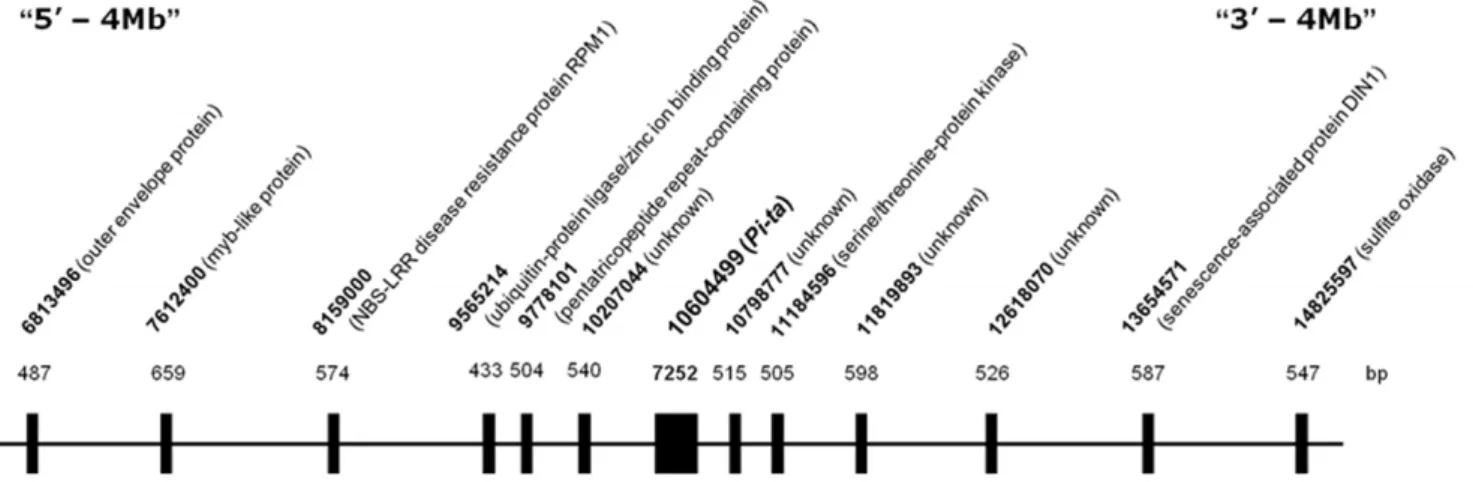
To determine nucleotide variation at thePi-tagene in US weedy rice, we sequenced 7252 bp of thePi-tagene including 59leader and 39 trailer regions (Figure 1). In general, most nucleotide variations were observed in the intron and the 59 and 39
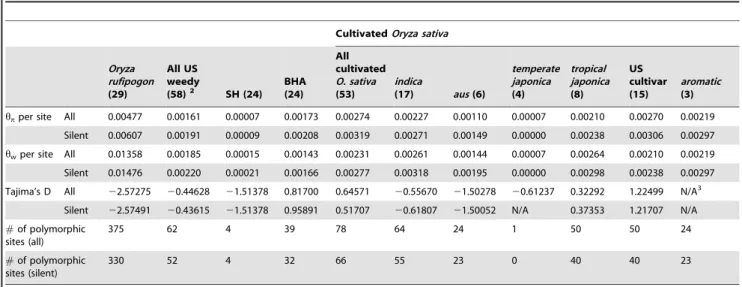
noncoding region of thePi-ta gene (Figure S1). The nucleotide variation for coding region in US weedy rice was substantially lower (hp= 0.00067) than that observed in non-coding region (hp= 0.00161) of the Pi-ta gene (Table 1). Within the coding region, the level of nucleotide diversity was substantially low in exon 2, which contains leucin rice domain (LRD), in all rice accessions. In US weedy rice,hpandhwfor exon 1 were 0.00114 and 0.00139, while both values were 0.00043 and 0.00047 in exon 2 respectively (Table 1). Most amino acid polymorphisms occurred in the N-terminal and LRD region of the Pi-ta protein (Table 2). Higher values of synonymous nucleotide diversity (psyn= 0.00080) than nonsynonymous nucleotide diversity (pnon= 0.00063) were found across the coding region of thePi-tagene in weedy rice. The average value ofpnon/psynfor coding region was 0.420 (Table 2), indicating purifying selection in weedy rice in the US.
Strawhull awnless (SH) and Blackhull awned (BHA) are the two major groups of weedy rice in the US. Among them, SH showed the lowest diversity values (hp= 0.00007 andhw= 0.00015), while hp and hw for BHA were similar with that in all US weedy accessions (Table 3). Tajima’sD values for US weedy rice and BHA did not significantly deviate from neutrality (D=20.44628) and (D= 0.81700) respectively. This is similar to indica (D=
20.55670) and temperate japonica (D=20.61237), suggesting balancing selection. However, Tajima’sDfor a weedy group SH was significantly negative (D=21.51378), consistent with selective sweep similar to what was observed in ausand O. rufipogon. As expected, the total and silent site (synonymous and non-coding) nucleotide diversities (p) were low for US weedy rice accessions (hp= 0.00161 andhw= 0.00185) compared with that in cultivated rice (hp= 0.00274 andhw= 0.00231) and wild speciesO. rufipogon (hp= 0.00477 andhw= 0.01358) (Table 3).
To determine if similar nucleotide sequence diversity exists around the Pi-ta gene, six flanking fragments from 9.6 Mb to
Figure 1. Schematic map showing location of the sequenced region.Numbers in base pair (bp) on the top of gene symbols indicate the length of sequences used for the analysis. The 7252 bp of thePi-tagene including 59leader, coding region and 39trailer sequences and 12 gene fragments within 8 megabases were shown.
11.8 Mb in all rice accessions were sequenced (Figure 1). From 137 single nucleotide polymorphisms (SNPs), the value of nucleotide diversity across the Pi-ta gene and flanking regions was very low in US weedy rice (p= 0.00152 andhw= 0.00159), compared to that in cultivated and wildOryzaspecies (Table 4). The weedy group SH showed the lowest value of nucleotide diversity (hw= 0.00025), but the diversity level of BHA (hw= 0.00141) was similar to that in US weedy rice. This result agrees with the diversity patterns at the Pi-ta gene shown in Table 2.
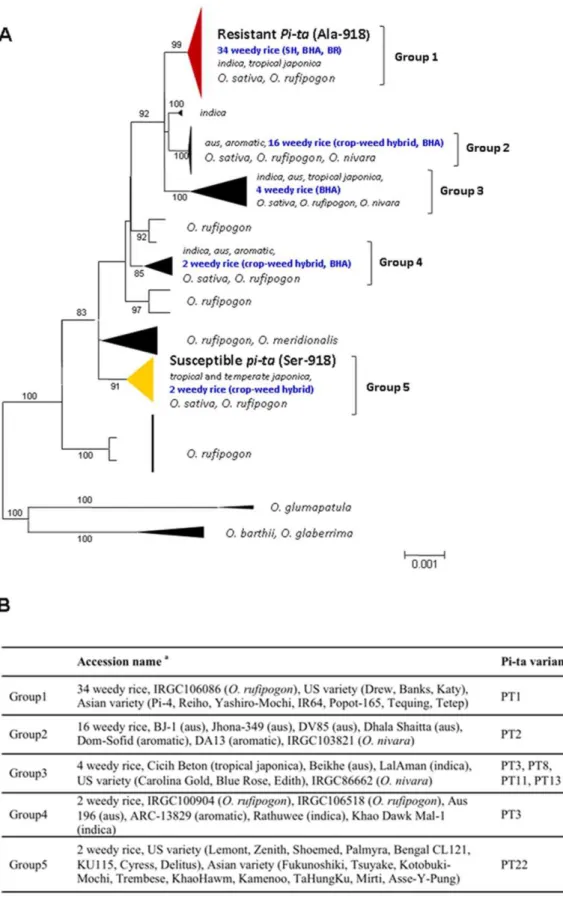
To group the US weedy rice, a neighbor-joining analysis was performed based on 11 Kb sequence data (excluding alignment gaps) including six gene fragments nearby thePi-tagene in diverse
Oryzaaccessions (Figure 2). The phylogenetic analysis showed that
US weedy rice belonged to five groups containing eight different Pi-ta variants.Pi-ta(Ala-918) was found in BHA, BR and most of SH, which were grouped with indica, tropical japonica (possessing
indica-derived Pi-ta) and O. rufipogon (Figure 2). Other BHA accessions without Pi-ta were grouped with aus and aromatic
landraces. In a previous study, it was shown that the group 1 (PT1) contains 3364-bp (Ac superfamily transposon) at the promoter region ofPi-ta. It was also found that all ofPi-tacontaining weedy accessions carries the same 3364-bp at thePi-tapromoter region, whereas susceptible pitaallele-carrying weedy accessions did not possess this fragment.
The sequence at and around the region of thePi-tagene was found to be nearly identical among 34 weedy rice accessions and 10 cultivated rice (Kay, Drew, Madison, IR64, Tetep, Taducan, Teqing, Reiho, Pi-4, and Yashiro-Mochi) possessing Pi-ta. To determine the extent of sequence homology, SNP, Indels and SSR marker files on chromosome 12 in Group 1 accession were analyzed using STRUCTURE (Figure 3). This analysis placed Yashiro-Mochi, Reiho, Katy, Drew, and Tetep in the same genetic group, most distant from the predominant weedy rice accessions containingPi-ta. This result indicates thatPi-tain US weedy rice is genetically different from the common Asian and US cultivated rice. Four weedy rice accessions StgS-95, LA3-95, 13-95, and 14-95 were separated from the major weedy rice group, suggesting a different source ofPi-tain these accessions.
Identification of essential genomic region for blast resistance
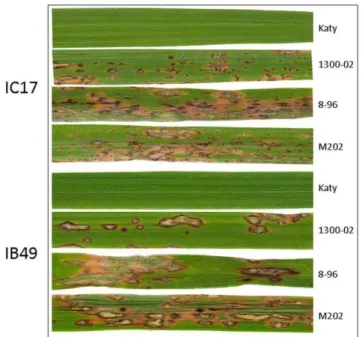
To identify essential genomic regions involved inPi-tamediated blast resistance, we inoculated all 34 weedy rice accessions and a US cultivated rice Katy containingPi-tawith two predominant US races of M. oryzae IB49 and IB17 (AVR-Pita). A high level of resistance was found in all accessions except three weedy rice accessions, 1111-01, 1300-02, and 8-96, which showed high degree of susceptibility to both pathogen races. Fifteen out of those 34 accessions showed the highest resistance to both blast races, similar to the resistance found in Katy, and the other 14 accessions Table 1.Nucleotide polymorphism and divergence of different regions of thePi-tagene including 59and 39region in US weedy rice and cultivated rice groups ofO. sativa, andO. rufipogon.
Oryza rufipogon US weedy US cultivar japonica1 indica aus aromatic
59leader hpper site 0.01314 0.00077 0.00225 0.00191 0.00192 0.00065 0.00065
hwper site 0.04689 0.00153 0.00180 0.00145 0.00265 0.00086 0.00065
Exon 1 hpper site 0.00328 0.00114 0.00275 0.00267 0.00159 0.00036 0.00071
hwper site 0.00891 0.00139 0.00197 0.00186 0.00158 0.00047 0.00071
Intron hpper site 0.00453 0.00262 0.00301 0.00299 0.00317 0.00158 0.00360
hwper site 0.01138 0.00219 0.00229 0.00185 0.00280 0.00207 0.00360
Exon 2 hpper site 0.00115 0.00043 0.00075 0.00068 0.00059 0.00000 0.00000
hwper site 0.00375 0.00047 0.00067 0.00054 0.00065 0.00000 0.00000
39trailer hpper site 0.00484 0.00256 0.00445 0.00412 0.00363 0.00232 0.00464
hwper site 0.01064 0.00322 0.00348 0.00281 0.00475 0.00305 0.00464
Coding hpper site 0.00186 0.00067 0.00142 0.00135 0.00092 0.00012 0.00024
hwper site 0.00547 0.00078 0.00111 0.00099 0.00096 0.00016 0.00024
Noncoding hpper site 0.00477 0.00161 0.00270 0.00253 0.00227 0.00110 0.00219
hwper site 0.00607 0.00185 0.00210 0.00173 0.00261 0.00144 0.00219
1US cultivar (tropical japonica) samples were not included injaponicagroup (temperateandtropical japonica) for this analysis.
hp: the average pairwise nucleotide diversity,hw: Watterson’s estimator nucleotide variation. doi:10.1371/journal.pone.0026260.t001
Table 2.Analysis of the molecular diversity at the Pi-ta variant in US weedy rice.
Gene and protein region S1 p
syn2 pnon3 pnon/psyn O. sativaUS weedy rice
(n = 58)4
Coding 10 0.00120 0.00050 0.420
52849 coding to NBS 6 0.00307 0.00123 0.401
NBS 0 0.00000 0.00000 n.a.5
NBS to LRD 0 0.00000 0.00000 n.a.
LRD 4 0.00121 0.00063 0.519
Intron 15 0.00265 n.a. n.a.
Entire gene 25 0.00080 0.00063 0.787
1Indicates number of polymorphic sites. 2Indicates nucleotide diversity at synonymous site. 3Indicates nucleotide diversity at nonsynonymous site. 4The number in parentheses indicates the sample size. 5Not applied.
were rated with disease resistance scores of 1 to 2 (Table 5). Two accessions, 1179-01 and 1141-01, showed moderated blast symptoms against both races. Two of the susceptible weed accessions, 1111-01 and 1300-02 were rated from 3 to 4. The accession 8-96 was the most susceptible to both races in all three replicated experiments (rating 4 for both blast races), which is comparable with the susceptible cultivar, M202 (Figure 4). We
didn’t find sequence polymorphism in thePi-tagene (including 39
and 59regions) in 34 weedy accessions with other known cultivated rice containingPi-ta(Kay, Drew, IR64, Tetep, Taducan, Teqing, Reiho, Pi-4, and Yashiro-Mochi). RT-PCR was used to determine ifPi-tawas expressed. The results showed that expression ofPi-ta
in the susceptible accessions was similar to that in a resistant cultivar Katy (Figure S2). This analysis suggests that blast susceptibility was not due to the promoter mutations. We then examined if any sequence changes in the flanking region of the Pi-ta gene, which carries additional critical genes needed for resistance, in these susceptible accessions comparing with other resistant weedy accessions. Interestingly, the presence of nucleo-tide polymorphisms was first detected at the flanking gene sequence of OS12g20260 (11.8 Mb) suggesting that Pi-ta intro-gressed block was 2.2 Mb in these susceptible accessions. The size of thePi-taintrogression block in resistant weeds and cultivars was at least 5 Mb suggesting that additional critical plant components needed for blast resistance may reside between 11.8 to 14.0 MB on chromosome 12.
Gene flow at thePi-talocus
Analysis of 629 SNPs (Pi-tagene and flanking region), one indel, and 13 SSRs on chromosome 12 revealed evidence of introgres-sion at the susceptiblepi-talocus from US cultivars to weedy rice. The sequences of thepi-talocus and six flanking gene fragments (1 Mb upstream and 1 Mb downstream of the pi-talocus) were identical between two weedy accessions 1188-01 and 1214-02 and three cultivars Carolina Gold, Edith, and Blue Rose, which are early cultivars grown in the Southern US susceptible to major US races ofM. oryzae. Thus, Carolina Gold was further selected for examining the introgression of pi-ta using SSR makers on chromosome 12. Structure analysis of combined SNP and SSR data showed that three accessions (1188-01, 1214-02, and Carolina Gold) were placed into one genetic cluster (Figure 4). Similarly, identical 2 Mbpi-ta regions were found in the weedy accession 2002-2-pot 21 and a popular US cultivar Cypress, which is also susceptible to major US races ofM. oryzae. These results were in agreement with the phenotypic description of the parent Table 4.Nucleotide diversity of flanking region (2 Mb) of
thePi-tagene in US weedy rice and cultivated rice groups ofO. sativa, andO. rufipogon.
Rice group1 N2 Nt3 S4 h
w5 p6
O. rufipogon 28 3524 63 0.00459 0.00355
All US weedy rice 58 3524 26 0.00159 0.00152
SH 24 3524 8 0.00061 0.00025
BHA 24 3524 16 0.00122 0.00141
All cultivatedO. sativa 53 3524 33 0.00202 0.00214
US culivars (tropical japonica)
15 3524 16 0.00140 0.00169
indica 17 3524 29 0.00243 0.00255
aus 6 3524 6 0.00075 0.00074
aromatic 3 3524 6 0.00114 0.00114
temperate japonica 4 3524 4 0.00062 0.00057
tropical japonica 8 3524 10 0.00109 0.00089
Total 3524 137 0.00690 0.00378
1BR and MIX of weedy rice and US cultivars were excluded fromtropical
japonicasamples in this analysis. 2Indicates sample size.
3Indicates number of sites, sequence align gaps were not included for analyzing polymorphisms of all sequences.
4Indicates number of polymorphic (segregating) site. 5Indicates silent nucleotide polymorphism. 6Indicates nucleotide diversity based on silent site. doi:10.1371/journal.pone.0026260.t004
Table 3.Nucleotide variation of thePi-tagene in US weedy rice and cultivated rice groups ofO. sativa, andO. rufipogon.1
CultivatedOryza sativa
Oryza rufipogon
(29)
All US weedy
(58)2 SH (24) BHA(24)
All cultivated
O. sativa
(53)
indica
(17) aus(6)
temperate japonica (4) tropical japonica (8) US cultivar (15) aromatic (3)
hpper site All 0.00477 0.00161 0.00007 0.00173 0.00274 0.00227 0.00110 0.00007 0.00210 0.00270 0.00219
Silent 0.00607 0.00191 0.00009 0.00208 0.00319 0.00271 0.00149 0.00000 0.00238 0.00306 0.00297
hwper site All 0.01358 0.00185 0.00015 0.00143 0.00231 0.00261 0.00144 0.00007 0.00264 0.00210 0.00219
Silent 0.01476 0.00220 0.00021 0.00166 0.00277 0.00318 0.00195 0.00000 0.00298 0.00238 0.00297
Tajima’s D All 22.57275 20.44628 21.51378 0.81700 0.64571 20.55670 21.50278 20.61237 0.32292 1.22499 N/A3
Silent 22.57491 20.43615 21.51378 0.95891 0.51707 20.61807 21.50052 N/A 0.37353 1.21707 N/A
#of polymorphic sites (all)
375 62 4 39 78 64 24 1 50 50 24
#of polymorphic sites (silent)
330 52 4 32 66 55 23 0 40 40 23
1Total number of sites within 7252 bp was analyzed using DnaSP 5.10.h
pindicates the average pairwise nucleotide diversity,hwindicates Watterson’s estimator
nucleotide variation. The number of accession for each group analyzed was marked in parenthesis. 2BR and MIX weedy accessions and accessions of
O. barthii, O. glaberrima, O. glumapatula, O. nivara, andO. meridionalis, were excluded for this analysis. 3N /A, tests were not performed because of lack of polymorphism.
Figure 2. Phylogenetic tree showing groups of US weedy rice among rice populations.(A) An evolutionary tree with genetic distance and group name shown. Red group indicates accession withPi-ta(Ala-918). Yellow group indicatespi-ta(Ser-918). Dark black group indicatespi-ta (Ser-918 with more amino acid polymorphisms at different positions). (B) Rice accessions classified in each group in the panel A.aGroup name for weedy
plant of accession 2pot21-02 including a dark purple stem, smooth leaves, and no awns, in addition to typical black hull and red seeds; phenotypes that can indicate hybridization between red rice and cultivated rice (data not shown). These traits were also consistent with phenotypes that we found in segregating F2 progeny in
crosses between ‘awned blackhull’ red rice and Cypress rice [8]. Taken together, we suggest that the identicalpi-taregion may be shuffled among rice cultivars and weedy accessions. Evidence of gene flow of the Pi-ta gene between weedy rice accessions and deployed cultivars that containPi-tain the US has not been found. We then performedFststatistic analysis to determine extent of nucleotide divergence and distance among rice populations. From theFststatistics, US weedy accessions showed the least differen-tiation from theindicaand greatest differentiation fromjaponicaat thePi-tagene (Table 6). This pattern was consistent with the gene flow estimator, Da. SH accessions were more closely related to
indica than any other accessions in the dataset. BHA accessions showed the least differentiation with ausand aromatic, while SH showed greatest differentiation withaus(Table 6). Two differen-tiation measures Fst and Da strongly indicate that US cultivars (tropical japonica) are very closely related to japonica, but greatly differentiated with SH weedy group.
Analysis of putative translated products revealed two major Pi-ta variants conPi-taining either Alanine or Serine at the position 918 in weedy rice populations. The extended haplotype homozygosity (EHH) analysis was then used to determine the extent of sequence diversity in these two haplotypes (Figure 4). More sequence diversity was detected around the haplotype Ser-918 than that with Ala-918 in all rice accessions. The patterns of EHH in US weedy rice were similar to that in Asian cultivated rice group containing indica and aus, but showed a slower degeneration of homozygosity for Pi-ta with Ala-918. In contrast, US cultivated rice group (tropical japonica) has very low EHH for Pi-ta with Ala-918 (0.188. In particular, US cultivated rice group showed high homozygosity at the Pi-ta locus and the breakdown of the homozygosity starts immediately in the flanking region, suggesting a simple source ofPi-tawas used for breeding. Not surprisingly, Ser-918 ofO. rufipogonhas the highest sequence variation (Figure 5). Please note that the EHH value for Ala-918 was near zero because only one accession ofO. rufipogonpossesses the Pi-ta variant with Ala-918 in this group (Fig. 5D). All patterns of EHH supports the hypothesis that Ala-918 (Pi-ta) in US weedy rice was recently derived from the ancestralPi-taallele carrying Ser-918 (pi-ta), and that it originated from Asian cultivated rice.
Figure 3. Structure diagram of rice accessions carryingPi-ta.Name of accessions and presumed crop-weedy hybrid progeny were indicated. doi:10.1371/journal.pone.0026260.g003
Table 5.Disease reactions of US weedy rice accessions carrying the resistantPi-taallele.
Name of weedy rice accession and cultivars Disease reaction1
IB49 IC17
LA3-95, 16B-94, 5-96, 1344-02, 14-95, 1134-01, 1092-02, 1135-01, 1091-01, 1073-02, 12-95, 1160-01, 1004-01, StgS-95, 1196-01 0–1 0–1
13-95, 1098-01, 1001-01, 1333-02, 1199-01, 1120-02, 1163-01, 1047-01, 15-95, 1210-02, 1002-02, 1202-2, 1190-01, 1183-01 1–2 1–2
1179-01, 1141-01 2–3 2–3
1111-01, 1300-02 3 3
8-96 4 4
Katy 0–1 0–1
M202 4 4
1Blast reaction was evaluated using a 0 to 5 scale where 0 to 2 indicates resistant and 3 to 5 indicates susceptible respectively. Disease was evaluated at 7 days after
Discussion
Weedy rice is one of the major problems in the rice growing areas of the southern US and it causes significant economic losses annually (Figure S3, Figure S4). Recently, genetic diversity of a few important agronomic traits in US weedy rice have been investigated [2,3,5,6]. In the present study, using a large sequence data set of thePi-tagene and its flanking region, we determined the genome organizations and origin of thePi-tagene in US weedy rice. We found that nucleotide diversity at and around thePi-ta
locus in US weedy rice is exceptionally low when compared with that in otherOryzaspecies. This result indicates the occurrence of genetic bottlenecks during the establishment of weedy rice in the US that is also consistent with a few other reports [2,3,5,6]. It has been known that LRD of thePi-tacoding region is functionally conserved in domesticated and wild rice [22,23]. We found that LRD region in US weedy rice is also under purifying selection. As described in previous studies, the Pi-ta gene has been evolved under recent directional selection in O. rufipogon [22,23]. Interestingly, directional selection is also found in SH weedy groups possessingPi-tain the present study. These findings suggest that Pi-tain US weedy rice has been recently derived from the ancestral origin, and has been evolving in the US weedy rice populations.
We have not found any evidence to say that the gene flow of Pi-tahas occurred between cultivated US rice cultivars and weedy rice in the US. ThePi-tagene in US cultivars was initially bred
Table 6.Number of net nucleotide divergence (Da) between populations (above diagonal) andFstgenetic distance between groups (below diagonal) at thePi-taregion1.
Population US cultivar All US weedy SH BHA aus indica japonica aromatic O. rufipogon
The Pi-taallele
US cultivar 0.00126 0.00203 0.00128 0.00158 0.00073 0.00001 0.00112 0.00056
All US weedy 0.39210 N/A2 N/A 0.00048 0.00012 0.00129 0.00027 0.00104
SH 0.61872 N/A 0.00091 0.00140 0.00057 0.00204 0.00120 0.00190
BHA 0.39408 N/A 0.53584 0.00005 0.00027 0.00135 0.00001 0.00092
aus 0.48584 0.28583 0.73857 0.03841 0.00053 0.00164 0.00001 0.00103
indica 0.23972 0.06375 0.33434 0.12891 0.25530 0.00079 0.00015 0.00045
japonica 0.00001 0.40912 0.63500 0.41710 0.50602 0.26160 0.00118 0.00063
aromatic 0.34328 0.14178 0.55608 0.00001 0.00001 0.06754 0.36346 0.00051
O. rufipogon 0.13376 0.25028 0.43951 0.22702 0.26523 0.11384 0.15202 0.13333
Flanking region
US cultivar 0.00058 0.00126 0.00057 0.00101 0.00033 0.00001 0.00144 0.00083
All US weedy 0.26655 N/A N/A 0.00070 0.00038 0.00065 0.00126 0.00082
SH 0.56603 N/A 0.00112 0.00186 0.00129 0.00129 0.00186 0.00135
BHA 0.26855 N/A 0.57499 0.00018 0.00021 0.00070 0.00018 0.00101
aus 0.45350 0.38288 0.79039 0.14663 0.00041 0.00103 0.00028 0.00105
indica 0.12583 0.14633 0.43234 0.09057 0.18519 0.00044 0.00058 0.00043
japonica 0.00001 0.30113 0.59687 0.32647 0.48062 0.16726 0.00130 0.00070
aromatic 0.50520 0.48715 0.77392 0.41399 0.22857 0.22466 0.49757 0.00058
O. rufipogon 0.23946 0.24474 0.41521 0.28903 0.32842 0.11769 0.21609 0.19756
1The lowest
Fstvalues between populations are indicated in bold font. More than one value was bolded if the values are closely similar. Levels of genetic differentiation
among population were estimated byDaandFstusing DnaSP 5.10 (www.ub.es/dnasp). Total nine populations were compared with each other. The value close to zero
means the least difference between populations. US cultivar (tropical japonica) accessions were not included in thejaponicagroup. 2Indicates not applied.
doi:10.1371/journal.pone.0026260.t006
from Tetep [15]. If thePi-tagene in weedy rice in the US is not from deployed cultivars an alternative origin of the Pi-ta gene should exist. Phylogenic analyses revealed that thePi-ta gene in weedy red rice was more similar to aus, aromatic landraces, and Asian indica (or japonica containing the indica-derived Pi-ta) (Figure 2). The pattern of genomic diversity and population differentiation at/around the Pi-ta gene in all US weedy rice revealed that the Pi-talocus in weedy rice was genetically more similar to that in Asian cultivated rice (indica) rather than US cultivars andO. rufipogon, respectively. US weedy accessions can be divided into two major subgroups, SH and BHA. Our sequence and marker data demonstrated that SH is similar to indicaand BHA is similar withaus. These findings suggest thatPi-tain weedy rice could be derived from Asian rice distinct from those used to introgress Pi-ta into US germplasm. In plants, some resistance genes show gene presence/absence polymorphisms (P/A). These P/A polymorphisms can be selectively maintained for long evolutionary periods with flanking regions bearing the molecular signatures of balancing selection [27]. We have identified a P/A polymorphism at 2 Mb downstream from Pi-ta. This polymor-phism was used to understand the origin of thePi-tagene in US red rice because this P/A polymorphism was found in majority of weedy accessions (48 of the 50 accessions tested). The same polymorphism was found in two Asian cultivars Yashiro-mochi and Te Qing andO. rufipogon.This result further supports thatPi-ta
in US red rice may have originated from Asian cultivars or/andO. rufipogonrather than from US cultivars.
Selective introgression of resistance genes has been an effective method in breeding blast resistant rice. However, the escape of
deployed resistance genes to weedy relatives may create new problems, and this has never been examined in the rice-farming ecosystem. Recent studies have shown that hybridization events have occurred between cultivated and weedy red rice [4,5,12,28,29,30]. The gene flow frequency between cultivated rice and weedy rice was estimated to be between 0.011 and 0.046 and can be up to 1% [10,31]. This rate of gene flow can potentially bring costly consequences to the advanced breeding of rice blast resistance [12]. In the present study, we found two lines of evidence that gene flow may occur at the susceptible
pi-ta-carrying locus from US cultivars to weed accessions 1188-01, 1214-02, and 2pot21-02. First, the identicalpi-tagenomic region was found in weedy accessions 1188-01 and 1214-02 and US cultivars Carolina Gold. These weedy accessions were also collected from East Carroll Parish, Louisiana where the cultivar was once grown. In a previous study by Reagonet al. [5], there was no evidence of introgression in these two weedy accessions. However, in the present study, we detected no sequence polymorphism at/around thepi-tagene (,2Mb) among 1188-01
and 1214-02 with Carolina Gold, Edith, and Blue Rose, that were once the leading US varieties in the South from 1910 to 1945. We have also shown a nearly identical SSR genotype in these two weedy accessions with Carolina Gold, indicating that the allele in the weedy rice may be due to shared ancestry. Secondly, accession 2002-02-pot21 was previously determined to be an admixture through hybridization using 48 sequence STS makers [5]. In the present study, we determined that 2pot21-02 collected from Lawrence County, AR, where Cypress once was grown, possesses the same pi-ta genomic region of the US cultivar Cypress. The
Figure 5. Extended haplotype homozygosity (EHH) at and aroundPi-ta.The EHH of two core haplotypes (alanine-918 for resistantPi-taallele and serine-918 for representing susceptiblepi-taallele) were compared in thePi-taregion of US weedy rice (A), Asian (B) and US cultivated rice (C), and wild speciesO. rufipogon(D).
susceptiblepi-taregion in the weedy accessions of presumed crop-weed progenies was genetically identical to that in US cultivars, while other weedy accessions were genetically more similar to
indica. However, direct evidence of gene flow of Pi-ta from cultivated to weedy rice has not been found in this study. A much larger number of weedy rice samples would be required for the verification of this phenomenon.
In the present study, we demonstrated that most weedy rice accessions containingPi-tawere highly resistance to the predom-inant US blast races IB49 and IC17. Among 34 weedy rice accessions possessingPi-ta, three weedy accessions 1111-01, 8-96, and 1300-02 showed susceptibility to IB49 and IC17. After analyzing sequences at and around thePi-talocus, we found that the susceptible weedy accessions have a shorter size of Pi-ta
introgression (2.2 Mb) than that in other resistant weedy and cultivated accessions (at least 5 Mb). It was recently reported that the size ofPi-taintrogression block is closely associated with the resistance specificity to races of blast pathogen [13,23]. Jia [13] recently reported that the largest linkage block of Pi-ta was identified in backcrossing and elite rice cultivars. A rice gene,Ptr(t)
required for thePi-ta-mediated resistance, was recently mapped within a 9 Mb region spanning thePi-tagene [25,17].Ptr(t)may reside within an 2.8 Mb genomic region beyond 11.8 MB on chromosome 12 because three weedy accessions without this region were susceptible to blast fungus.
In summary, we have demonstrated that genetic exchange can occur at a locus that is involved in blast disease resistance. Despite the widespread deployment ofPi-taover two decades in the US, introduction of a Pi-tagene in weedy rice and impact on blast management in weedy rice has not yet been characterized. Further studies of susceptible weedy accessions withPi-tashould help to develop effective strategies for managing rice blast disease and weedy species of rice.
Materials and Methods
Plant materials and DNA sequencing
A total of 58 US weedy rice accessions were collected from1994 to 2004 from rice fields in the Southern USA (Table S1). Those accessions were subsequently propagated via single seed descent in field plots at the USDA Dale Bumpers National Rice Research Center (DB NRRC). The weedy rice accessions consisted of four different groups, SH, BHA, BR, and crop-weed hybrids (MIX) [5]. Among them, SH and BHA were the most common ecotypes (Table S1). BR weedy ecotypes were hybrids of BHA and SH strains [5]. The rice accessions studied in Leeet al[23] from cultivated and wildOryzaspecies were included in the present study: O. sativa (38 Asian and 16 US cultivated varieties), the crop’s wild progenitor O. rufipogon (28 geograph-ically diverse accessions, two accessions of O. nivara), and accessions of other AA genomeOryzaspeciesO. meridionalis(2),
O. glumaepatula(2),O. glaberrima (4) andO. barthii(2) (Table S2). The same primers and sequence methods were used as in a previous study [20]. Sequences of thePi-tagene for all accessions used in this study are from GenBank accession GQ918334-GQ918489. Plants were grown in the greenhouses at Washing-ton University, University of Massachusetts, and in DB NRRC for DNA extraction.
DNA was extracted using a modified cetyltrimethylammo-nium bromide (CTAB) method. Fifteen primer pairs were designed using the Primer3 program to amplify the Pi-ta
genomic region including promoter and downstream sequences. All developed primers were compared by BLAST to theindica
(93-11) and japonica (Nipponbare) reference genomes to ensure
their target specificity. A fragment of 7252 bp of thePi-talocus including the intron and 59leader and 39trailer region, and 12 gene fragments spanning thePi-tagene within 8 megabases were sequenced.
Evaluation of disease reaction and expression ofPi-ta Two avirulent US races ofM. oryzae, IB49 (ZN61) and IC17 (ZN57) containingAVR-Pita1were used to inoculate US weedy rice that containedPi-ta[16]. Weedy rice was planted in three replicate pots with three to four seedlings per pot and grown in a greenhouse. A highly resistant (Katy withPi-ta) and susceptible (M202 without Pi-ta) rice varieties were used as positive and negative controls, respectively. Inoculation and disease assays were performed following the methods as described [23]. Disease reactions were rated on a semi-quantitative scale one week after inoculation as 0 to 2 for resistance and 3 to 5 for susceptibility.
RT-PCR was performed to examine the expression ofPi-tain the three US weedy rice accessions, 1111-01, 1300-02, and 8-96, that contained the resistant Pi-ta allele, but were susceptible to IB49 and IC17, US cultivar Katy carryingPi-ta was used as a positive control. A pair of primers (KG2: ATCAGCAACTAAC-GAGGCAT and YL88: TACAGGTTCAATTTCTGTTG) [25] were used for examining expression ofPi-ta.
DNA marker analysis
To determine the chromosome-wide introgression patterns around thePi-talocus, a total of 14 DNA markers including one SNLP (Pita) [18] and 13 Simple Sequence Repeat (SSR) markers (RM3483, RM5746, RM7003, RM3246, RM27941, XY121, XY196, RM27946, RM27973, RM7102, RM511, RM463, and RM1300; physical location from 1.61 Mb to 25.97 Mb) evenly distributed across rice chromosome 12 were analyzed in 36 US weedy rice and seven cultivated rice. The sequence for all SSR markers except for XW121 (F:CGACAGGAAAACTTGTTAG-GAA; R: AGTTGTGTGTCGCTTGCTGT) and XW196 (F:T-GTCATTAGCAGCTACGGTGGT and R: TGTTTGACCGT-GGTCTTGCT) can be located at www.gramene.org.
DNA Sequence analysis
Sequences were aligned and edited using the software DNASTAR, Lasergene 8 and Mega 4. The patterns of nucleotide polymorphisms and molecular evolution at and around thePi-ta
(indel) and 13 SSR marker genotypes from rice chromosome 12 were used for analysis. All STRUCTURE analyses were performed using the model of admixture with allele frequencies correlated forK(number of clusters) = 1220 and every run was repeated 10 times to obtain the run with the highest penalized log-likelihood score. The analysis was repeated 50000 times (10000 burn-in periods) on random subsets of the data for a range of different numbers of loci.
Supporting Information
Figure S1 DNA sequence polymorphism at the Pi-ta gene in US weedy rice.Sliding window analysis of 7275 DNA sequences of thePi-tagene analyzed using DNASP software. Sites with alignment gaps were not counted in the window length (and slide). Window length was 50 and step size was 10. Graphic presentation ofPi-tawas shown at the bottom.
(TIF)
Figure S2 Expression of thePi-tagene in US weedy rice accessions and cultivar Katy containing Pi-ta. Lane 1 Accession, 1111-01, lane 2, 1300-02, lane 3, 8-96, lane 4, Katy, and 5: Katy genomic DNA as a negative control.
(TIF)
Figure S3 Photograph of rice seeds of a US cultivar and a red rice.Seeds with/without hull were shown.
(TIF)
Figure S4 Weedy rice found in a commercial rice field, Stuttgart AR.Most of rice plants shown in the photo are weedy rice. Over 70% of field area was contaminated by the weedy rice population.
(JPG)
Table S1 Rice accessions of seven AA genome Oryza species used in the present study.
(DOC)
Table S2 Description of the US weedy rice accessions used in present study.
(DOC)
Acknowledgments
The authors thank Dr. Yuanhong Han for Structure analysis at The Samuel Roberts Noble Foundation, Drs. Stefano Costanzo and Guangjie Liu for valuable discussions throughout the research, Drs. Briana L. Gross and Michael Reagon, Mr. Michael Lin, Mr. Justin Owens, and other staff members of USDA-ARS Dale Bumpers National Rice Research Center for excellent technical support. USDA is an equal opportunity provider and employer.
Author Contributions
Conceived and designed the experiments: SL YJ KMO ALC. Performed the experiments: SL MJ DRG YJ KMO ALC. Analyzed the data: SL MJ. Contributed reagents/materials/analysis tools: SL MJ DRG YJ KMO ALC. Wrote the paper: SL MJ DRG YJ KMO ALC.
References
1. Webster TM (2000) The southern states 10 most common and troublesome weeds in rice. Proceedings Southern Weed Science Society 53: 247–274. 2. Gross BL, Reagon M, Hsu SC, Caicedo AL, Jia Y, et al. (2010) Seeing red: the
origin of grain pigmentation in US weedy rice. Molecular Ecology 19: 3380–3393.
3. Gross BL, Skare KJ, Olsen KM (2009) NovelPhr1mutations and the evolution of phenol reaction variation in US weedy rice (Oryza sativaL.). New Phytologist 184: 842–850.
4. Londo JP, Schaal BA (2007) Origins and population genetics of weedy red rice in the USA. Molecular Ecology 16: 4523–4535.
5. Reagon M, Thurber CS, Gross BL, Olsen KM, Jia Y, et al. (2010) Genomic patterns of nucleotide diversity in divergent populations of U.S. weedy rice.BMC
Evolutionary Biology 10: 180.
6. Thurber CS, Reagon M, Gross BL, Olsen KM, Jia Y, et al. (2010) Molecular evolution of shattering loci in U.S. weedy rice. Molecular Ecology 19: 3271–3284.
7. Ellstrand NC, Prentice HC, Hancock JF (1999) Gene flow and introgression from domesticated plants into their wild relatives. Annual Review of Ecology, Evolution, and Systematics 30: 539–563.
8. Lu BA, Snow AA (2005) Gene flow from genetically modified rice and its environmental consequences. Bioscience 55: 669–678.
9. Shivrain VK, Burgos NR, Moldenhauer KK, McNew RW, Baldwin TL (2006) Characterization of spontaneous crosses between Clearfield rice (Oryza sativa) and red rice (Oryza sativa). Weed Technology 20: 576–584.
10. Shivrain VK, Burgos NR, Rajguru SN, Anders MM, Moore JW, et al. (2007) Gene flow between ClearfieldTM
rice and red rice. Crop Protection 26: 349–356.
11. Gealy DR, Agrama HA, Eizenga GC (2009) Exploring genetic and spatial structure of U.S. weedy red rice (Oryza sativa) in relation to rice relatives worldwide. Weed Science 57: 627–643.
12. Chen LJ, Lee DS, Song ZP, Suh HS, Lu B (2004) Gene flow from cultivated rice (Oryza sativa) to its weedy and wild relatives. Annals of Botany 93: 67–73. 13. Jia Y (2009) Artificial introgression of a large chromosome fragment around the
rice blast resistance genePi-ta in backcross progeny and several elite rice cultivars. Heredity 103: 333–339.
14. Jia Y, Bryan GT, Farrall L, Valent B (2003) Natural variation at thePi-tarice blast resistance locus. Phytopathology 93: 1452–1459.
15. Moldenhauer KAK, Lee FN, Norman RJ, Helms RS, Wells BR, et al. (1990) Registration of ‘Katy’ rice. Crop Science 30: 747–748.
16. Jia, Y, Wang Z, Singh P (2002) Development of dominant rice blast resistance
Pi-tagene markers. Crop Science 42: 2145–2149.
17. Rybka K, Myamoto M, Ando I, Saito A, Kawasaki S (1997) High resolution mapping of the indica-derived rice blast resistance genes: II.Pi-ta2
andPi-taand a consideration of their origin. Molecular Plant Microbe Interaction 10: 517–524.
18. Jia Y, Redus M, Wang Z, Rutger JN (2004) Development of a SNLP marker for thePi-tablast resistance gene by tri-primer PCR. Euphytica 138: 97–105. 19. Moldenhauer KAK, Lee FN, Gibbons JW, Bernhardt JL, Norman RJ, et al.
(2007) Registration of ‘Ahrent’ rice. Crop Science 47: 446–447.
20. Bryan GT, Wu KS, Farrall L, Jia Y, Hershey HP, et al. (2000) A single amino-acid difference distinguishes resistant and susceptible alleles of the rice blast resistance genePi-ta. Plant Cell 12: 2033–2045.
21. Jia Y, McAdams SA, Bryan GT, Hershey HP, Valent B (2000) Direct interaction of resistance gene and avirulence gene products confers rice blast resistance. The EMBO Journal 19: 4004–4014.
22. Huang C, Hwang S, Chiang Y, Lin T (2008) Molecular evolution of thePi-ta
gene resistant to rice blast in wild rice (Oryza rufipogon). Genetics 179: 1527–1538. 23. Lee S, Costanzo S, Jia Y, Olsen KM, Caicedo AL (2009) Evolutionary dynamics of the genomic region around the blast resistance genePi-tain AA genomeOryza
species. Genetics 183: 1315–1325.
24. Wang X, Jia Y, Shu QY, Wu D (2008) Haplotype diversity at thePi-talocus in cultivated rice and its wild relatives. Phytopathology 98: 1305–1311. 25. Jia Y, Martin R (2008) Identification of a new locus,Ptr(t), required for rice blast
resistance genePi-ta-mediated resistance. Molecular Plant-Microbe Interactions 21: 396–403.
26. Jia Y, Wang X, Costanzo S, Lee S (2009) Understanding the coevolution of rice blast resistance genePi-taandMagnaporthe oryzaeavirulence geneAVR-Pita, pp. 137-147 in Advances in Genetics, Genomics and Control of Rice Blast Disease, edited by Wang GL, Valent B. Springer Science.
27. Shen JH, Araki L, Chen JQ, Chen, Tian D (2006) Unique evolutionary mechanism inR-genes under the presence/absence polymorphism in Arabi-dopsis thaliana. Genetics 172: 1243–1250.
28. Gealy DR, Mitten DH, Rutger JN (2003) Gene flow between red rice (Oryza sativa) and herbicide-resistant rice (O. sativa): implications for weed management. Weed Technology 17: 627–645.
29. Gealy DR, Yan W, Rutger JN (2006) Red rice (Oryza sativa) plant types affect growth, coloration, and flowering characteristics of first- and second-generation crosses with rice. Weed Technology 20: 839–852.
30. Rajguru SN, Burgos NR, Shivrain VK, Stewart JM (2005) Mutations in red rice ALS gene associated with resistance to imazethapyr. Weed Science 53: 567–577. 31. Messeguer J, Marfa V, Catala MM, Guiderdoni E, Mele E (2004) A field study of pollen-mediated gene flow from Mediterranean GM rice to conventional rice and the red rice weed. Molecular Breeding 13: 103–112.
32. Rozas J, Sa´nchez-DelBarrio JC, Messegyer X, Rozas R (2003) DnaSP, DNA polymorphism analyses by the coalescent and other methods. Bioinformatics 19: 2496–2497.
33. Hill WG, Robertson A (1968) Linkage disequilibrium in finite populations. Theoretical and Applied Genetics 38: 226–231.
35. Sabeti PC, Reich DE, Higgins JM, Levine HZP, Richter DJ, et al. (2002) Detecting recent positive selection in the human genome from haplotype structure. Nature 419: 832–837.
36. Tamura K, Dudley J, Nei M, Kumar S (2007) MEGA4: Molecular evolutionary genetics analysis (MEGA) software version 4.0. Molecular Biology and Evolution 24: 1596–1599.
37. Falush D, Stephens M, Pritchard JK (2003) Inference of population structure using multilocus genotype data: Linked loci and correlated allele frequencies. Genetics 164: 1567–1587.
38. Falush D, Stephens M, Pritchard JK (2007) Inference of population structure using multilocus genotype data: dominant markers and null alleles. Molecular Ecology Notes 7: 574–578.