Submitted21 April 2013 Accepted 21 July 2013 Published13 August 2013
Corresponding author Andrew Mark Griffiths, [email protected]
Academic editor Natasha de Vere
Additional Information and Declarations can be found on page 9
DOI10.7717/peerj.129
Copyright 2013 Griffiths et al.
Distributed under
Creative Commons CC-BY 3.0
OPEN ACCESS
DNA barcoding unveils skate
(Chondrichthyes: Rajidae) species
diversity in ‘ray’ products sold across
Ireland and the UK
Andrew Mark Griffiths1,4, Dana D. Miller2,3,4, Aaron Egan2, Jennifer Fox2, Adam Greenfield1and Stefano Mariani1
1School of Environment and Life Sciences, University of Salford, Greater Manchester, UK 2School of Biology & Environmental Science, Science Education and Research Centre-West,
University College Dublin, Belfield, Dublin, Ireland
3Fisheries Centre, University of British Columbia, Vancouver, British Columbia, Canada 4These authors contributed equally to this work.
ABSTRACT
Skates are widely consumed across the globe, but many large species are subject to considerable concern regarding their conservation and management. Within Europe such issues have recently driven policy changes so that, for the first time, reports of skate landings now have to be made under species-specific names. Total allowable catches have also been established for many groups, which have been set to zero for a number of the most vulnerable species (e.g.,Dipturus batis, Raja undulataand
Subjects Aquaculture, Fisheries and Fish Science, Conservation Biology, Ecology, Marine Biology, Molecular Biology
Keywords Elasmobranch, Species identification, Forensically informative nucleotide sequencing, Mislabelling, DNA barcoding, Skate, Ray
INTRODUCTION
Skates (batoid elasmobranchs of the family Rajidae, but colloquially referred to as rays) are consumed across the world with recent estimates of global total catch reaching approximately 720,000 tonnes per annum (Seafish, 2013). Whilst skates are rarely specifically targeted by fisheries, they form a significant by-catch and constitute an important commercial group for human consumption. The group also contains many species that are potentially vulnerable to even low levels of harvesting due to their large size, slow growth, late maturity and low fecundity (Dulvy & Reynolds, 2002). This has famously been demonstrated in the common skate species complex (Dipturus batis), which was the first fish to become locally extinct in parts of its former range through a clear link to commercial fishing (Brander, 1981). Of the 75 rajids assessed by the International Union for the Conservation of Nature (IUCN) red list of threatened species (excluding those defined as data deficient), 19 are listed as threatened (IUCN, 2012). In response to skate declines, the European Union (EU) has now established total allowable catches (TAC) for skates in most European waters, and currently it is ‘prohibited for EU vessels to fish for, to retain on board or to land’ three species;Raja undulata,Raja albaand theD. batis-complex (CEC, 2013).
Until recently, landings of different skate species were combined under a single category, such that serious declines in one species could effectively be masked by stable trends in more abundant groups (Dulvy et al., 2000). Therefore, to more easily assess trends in abundance of individual species, a recent EU Regulation (CEC, 2013) has been introduced to ensure that landings of many skates are recorded by species and not as an aggregated group. Identification remains problematic as skates are a morphologically conservative group, making the process of distinguishing between some species difficult. Furthermore, similarly to shark finning, skates are only commercially valued for their large pectoral fins (or ‘wings’), so prior to sale their bodies are usually discarded (i.e., “winged”) and often skinned, making morphological identification impossible. Molecular genetic techniques for species identification therefore represent the only methods for distinguishing between different skates, allowing for the protection of threatened species or populations, and also the recognition of groups with different commercial values. Indeed, previous studies utilising molecular approaches for species identification of skate species have proved highly effective, often helping to uncover previously cryptic diversity (D´ıaz de Astarloa et al., 2008;
Smith et al., 2008;Griffiths et al., 2010).
fishes; FISH-BOL (Ward, Hanner & Hebert, 2009). In fact, specific efforts have already been made to collect validated barcode sequences for skates both within Europe (Serra-Pereira et al., 2010), and globally (Ward et al., 2008;Coulson et al., 2011;Lago, Vietites & Espineira, 2012). These reference sequences have now facilitated numerous molecular studies of species identification and mislabelling, which have helped identify high levels of substitution in many commercial products (Marko et al., 2004;Wong & Hanner, 2008;
Cawthorn, Steinman & Witthuhn, 2012). Particular insights have also been gained through applications of DNA barcoding to elasmobranch products, which have demonstrated high levels of fraudulent substitutions in sales of sharks (Barbuto et al., 2010), identified endangered species in confiscated shark fins (Holmes, Steinke & Ward, 2009) and revealed the sale of endangered sawfish as “shark” fillets in markets in Brazil (Melo Palmeira et al., 2013).
Despite EU legislation regarding the correspondence of species/Latin names for landings, skates are still generally sold under the broad title of ray or skate wings (with skate wings typically originating from the larger fish). Therefore, little remains known about exactly which species are passed on to consumers. Beside the increasing number of studies reporting substantial levels of seafood mislabelling (Logan et al., 2008;Miller & Mariani, 2010), the importance of guaranteeing informed consumer choice has also been highlighted (Miller, Jessel & Mariani, 2012), which is particularly relevant to the sales of skate. Moreover, in recent years several large supermarket chains have consciously moved from stocking ‘skate’ to ‘ray’ wings, presumably reflecting a desire to sell smaller species from more sustainable sources (Waitrose, 2009). This study represents the first intensive investigation into the patterns of the sale of skate species in the North-east Atlantic, specifically the Republic of Ireland (ROI) and the United Kingdom (UK), with a particular focus on (a) whether those species that are prohibited to land within the EU appear on sale, and (b) if market variations can be detected between different retail sectors and/or regions.
MATERIALS & METHODS
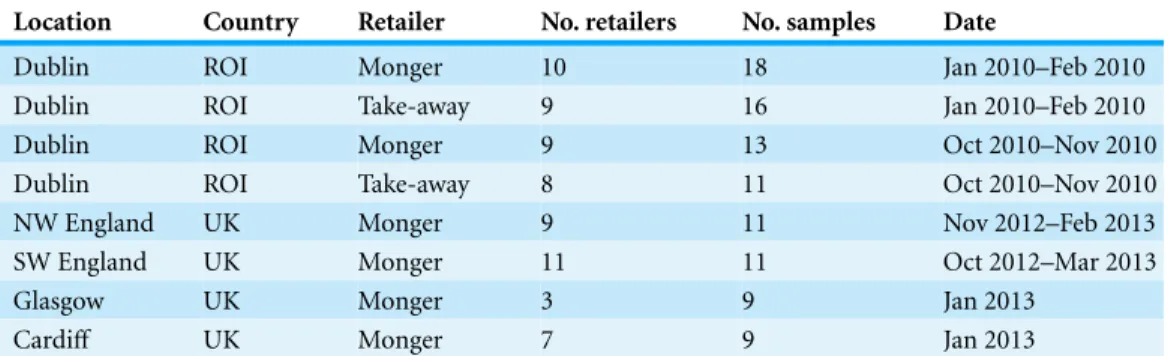
Sample collectionSamples labelled as ray or skate wings were initially purchased from fishmongers or fish counters within supermarkets and takeaway ‘fish and chips’ shops from across Dublin (ROI). The retailers were also visited in two distinct periods; January–February and October–November 2010. A total of 58 wings from 10 fish mongers/counters and 9 takeaways were analysed (Table 1andSupplemental Information). In order to provide a wider view of patterns of skate consumption, 40 additional fresh ray or skate wings were also collected between October 2012 and March 2013 from around the UK; sampling was focused in the south-west of England (i.e., counties of Devon and Cornwall), north-west England (largely in Greater Manchester and Liverpool), Glasgow (Scotland), and Cardiff
Table 1 Details of ray wing sampling, summarising the numbers of retailers, numbers of samples and dates of collection at each location.Further information is given in theSupplemental Information 1.
Location Country Retailer No. retailers No. samples Date
Dublin ROI Monger 10 18 Jan 2010–Feb 2010
Dublin ROI Take-away 9 16 Jan 2010–Feb 2010
Dublin ROI Monger 9 13 Oct 2010–Nov 2010
Dublin ROI Take-away 8 11 Oct 2010–Nov 2010
NW England UK Monger 9 11 Nov 2012–Feb 2013
SW England UK Monger 11 11 Oct 2012–Mar 2013
Glasgow UK Monger 3 9 Jan 2013
Cardiff UK Monger 7 9 Jan 2013
(but efforts were generally made to sample on different dates or from different sized wings;
Supplemental Information 1). Therefore, between January 2010 and March 2013 a total of 98 wings were collected from 49 different retailers across the ROI and UK.
Molecular analysis
Tissue samples were collected following Miller, Jessel & Mariani (2012)and DNA extractions were completed according to a modified chloroform extraction procedure (Petit, Excoffier & Mayer, 1999). DNA barcoding (specifically ofCOIgene) was selected as the species identification tool (Hebert et al., 2003). Approximately 648 base pairs (bp) of theCOIregion were amplified by polymerase chain reaction (PCR) using primers designed byWard et al. (2005): FishF2 (5′-TCGACTAATCATAAAGATATCGGCAC-3′) and
FishR2 (5′-ACTTCAGGGTGACCGAAGAATCAGAA-3′). Reaction conditions following
Data analysis
Principal component analysis (PCA) of the data was conducted in PRIMER-6 (Clarke & Warwick, 2001), with each retailer representing an individual data point in the ordination. The software was also used to conduct a non-parametric analysis of similarity (ANOSIM) with 999 permutations, and to calculate the contribution of variables to similarity (or similarity percentages; SIMPER). Both utilised the Bray-Curtis similarity measure during calculation. Otherwise, the program defaults were utilised.
RESULTS & DISCUSSION
DNA barcodingGood quality sequences were obtained for all 98 skate samples, these varied in length between 494 and 646 bp (average length 617.9 bp). Searches on BOLD and GenBank generally produced clear matches allowing for confident assignment of species and there was good agreement between databases. In fact, all the searches yielded matches that were within 98% similarity to database records, with one exception (Supplemental Information 1). In this case a 100% match on BOLD was made, but no results within the 98% similarity criterion were located in GenBank, so the BOLD identification was utilised. Additionally, in 24 cases a second close match (also with less than 2% divergence to the unknown samples) was also identified. These additional matches originated from closely related sister taxa, but in every case the species were not distributed around the British Isles (they included:Raja maderensisthat is restricted to Madeira and the Azores,Raja polystigma
that is restricted to the Mediterranean,Raja straeleniandLeucoraja walaceithat both have a primarily South African distribution). Therefore, the additional matches were deemed unlikely to be the true source of the samples and the species with the highest degree of similarity from the BOLD species level barcode database was upheld for the identification.
Across the entire study, six species of skate were identified in products sold for consumption (Table 2); 31 blonde rays (Raja brachyura), 28 spotted rays (Raja montagui), 19 thornback rays (Raja clavata), 14 cuckoo rays (Leucoraja naevus), five small-eyed rays (Raja microocellata) and one shagreen ray (Leucoraja fullonica).
Statistical support
Table 2 Frequency of the skate species identified in each of the sample collections, across the 98 samples analysed.
Location Country Retailer Date Thornback Blonde Spotted Small-eyed Cuckoo Shagreen
Dublin ROI Monger Jan 2010–Feb 2010 5 3 9 0 1 0
Dublin ROI Take-away Jan 2010–Feb 2010 6 8 1 1 0 0
Dublin ROI Monger Oct 2010–Nov 2012 1 5 5 0 2 0
Dublin ROI Take-away Oct 2010–Nov 2012 2 9 0 0 0 0
Various UK Monger Oct 2012–Mar 2013 5 6 13 4 11 1
TOTAL 19 31 28 5 14 1
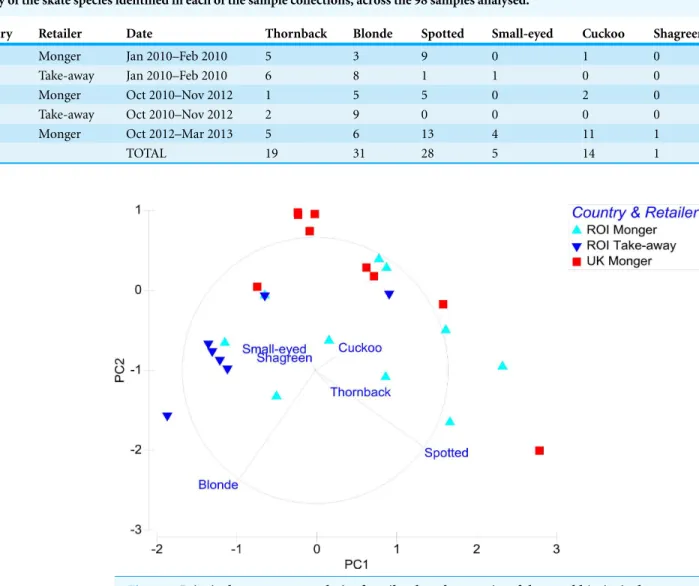
Figure 1 Principal components analysis of retailers based on species of skates sold (principal compo-nent 1 explains 40.2% and principal compocompo-nent 2 explains 28.4% of the observed variation).
The result of the ANOSIM when testing for a difference between the temporally replicated samples collected in January/February and October/November 2010 from Dublin was non-significant (R=0.073,p=0.052). As the result was close to the
95% confidence interval, tests were also made between the temporal replicates of the fishmongers (R=0.091,p=0.130) and takeaways(R=0.017,p=0.298)separately,
Conservation issues
Across the study, no species with a vulnerable status on the redlist (IUCN, 2012), or an EU zero TAC, was identified. Given the severe declines in abundance of these skate species, this may simply reflect the relatively modest sample collection assembled here, but considerable efforts across the British Isles have been made to emphasise the conservation status and TAC limits placed on many skates (e.g.,Seafish, 2013). Therefore, the complete absence of species of critical conservation concern may also reflect effective controls by the EU and efforts of fishermen and stakeholders to reduce landings of these groups. Perhaps a more stringent test of such action could be made in regions where threatened species are more locally abundant: e.g.,R. undulataremains relatively common around the Channel Isles (Ellis, McCully & Brown, 2012), and analyses focused on this area could form a more rigorous test of effective landing controls. Interestingly, the largest growing species identified (R. brachyura) also occurred most frequently in the study. Maybe more awareness should focus onR. brachyuraas size has been suggested as a good proxy for vulnerability to overexploitation (Dulvy & Reynolds, 2002).R. brachyura,R. clavataand
L. fullonica that were identified in the purchased wings are already included under the ‘near-threatened’ category in the IUCN redlist.R. brachyurais also listed under the red category in the Marine Conservation Society’s good fish guide (MCS, 2013), which suggests it should not be so extensively consumed. Perhaps guidelines on the maximum size of skate wings sold would increase consumer confidence that the products originate from sustainable sources and reinforce action to protect some of the vulnerable large growing species. This would certainly simplify consumer choice, but could potentially overlook trading or harvesting of juveniles from the large growing species that could go undetected due to their small size.
Variation in patterns of sale
This study represents a relatively intensive effort to collect samples from ray wings across multiple time-points, regions and countries, and goes beyond many previous investigations of seafood and mislabelling that focused on a single city, port or landing. Notwithstanding these efforts, it has resulted in a relatively modest sample collection. In part this reflects the fact that ray wings were not commonly available in some areas (particularly within the UK, where many retailers were visited that did not stock them), but it also reflects a desire to avoid high levels of repeat sampling from any one location or supermarket chain. It is hoped this approach gives the samples analysed a high degree of independence (not just repeatedly sampling from the same supply chains), producing a truly comprehensive examination of the sale of skates. Therefore despite the modest sample size, this study represents the first occasion that an investigation of the patterns of sale of ray wings can be made between retailer types, seasons and regions.
fishmongers. In recent years a number of supermarkets have also made a move towards selling wings from smaller skate species (Waitrose, 2009), marketing them as sustainably sourced ‘ray’ wings. As 28 of the ray wings sampled across the entire study in the fishmon-ger group originated from supermarket fish counters, this may help explain the difference in species sold. It is also interesting to note that whilst all the samples analysed were labelled as “ray” or “skate” (and all the species identified belonged to the Rajidae family, complying with broad expectations of the labels), one supermarket chain went further and specified its wings originated from three smaller growing species. In the six cases where wings were analysed from this chain two belonged toR. clavatathat was not included on the label, therefore, demonstrating a 33% level of mislabelling within this small subset of samples. Overall, the sale of skates under ambiguous names remains a challenge to the consumers’ ability to exercise a right to choose those from less vulnerable groups.
A somewhat surprising result from the data analysis was the failure to identify any significant difference in the patterns of species sold in the January/February and October/November sample collections from Dublin. Many elasmobranch species are highly migratory, particularly with reference to specific nursery areas, with marked seasonal movements between the North Sea and Thames estuary forR. clavatahaving already been observed (Hunter et al., 2005). Therefore, it may be expected that such seasonal movements would affect capture vulnerability in commercial fisheries, and hence patterns of availability to consumers. One explanation for this result is that retailers will freeze stocks of fish to ensure a steady supply. In the case of skates, previous work suggests this is not common, even within takeaway shops, as the wings do not freeze well so supply was dependent on local fisheries (Miller & Mariani, 2013). However, much remains unknown about the exact provenance of samples sold, behaviour of fisherman and even the movements of skate species (Ellis et al., 2005), such that interpreting patterns of sale of skates remains difficult.
The same problems for interpretation occur when comparing sales of skate species in the different countries (ROI and UK), which were also non-significant. Perhaps this reflects the fact that the sale of ray wings in both countries exploits similar species and stocks of skates. Although in this case the comparison is also confounded by the fact that sample collection was conducted approximately two years apart. The only other study to utilise genetic methods of species identification on skate products was recently conducted by
Lago, Vietites & Espineira (2012)in Spain. The 10 samples of whole or winged fresh skate analysed there originated not only from species found around Spain, but included groups restricted to other areas of Europe and even South America. This suggests patterns of sale could vary dramatically between countries or regions and they will not simply reflect levels of abundance in local fisheries.
CONCLUSIONS
the low abundance of many of these species further investigations may be required to accurately assess whether these groups may reach points of sale anywhere in Europe. Investigations at the point of landing, and throughout the supply chain, would also provide interesting insights into accuracy of identification and reveal if any species are landed, but withdrawn, before reaching retailers. The results also demonstrate significant differences between the retailers (fishmonger and takeaway) included in the study. Understanding why fishmongers also tended to sell smaller-growing species is challenging, but may relate to a desire to supply less vulnerable groups. This study also highlights that the use of ambiguous and amalgamated sales terms makes it extremely difficult for consumers to exercise a right to choose species of lesser conservation concern. Interestingly, analysis of six wings from the only retailer to label its ray wings as originating from three smaller growing species showed two (33%) actually originated fromR. clavata, a larger species with a decreasing population trend that is listed as near threatened on the IUCN redlist (IUCN, 2012).
ACKNOWLEDGEMENTS
Carlotta Sacchi, Jennifer Coughlan and Belgees Boufana are gratefully acknowledged for their technical support during this project. Thanks are also due to Phil Cannon, Mary Lane, Richard Cooper and Sam Cooper for their aid in supporting sample collection.
ADDITIONAL INFORMATION AND DECLARATIONS
Funding
This work was jointly funded by the European Union INTERREG Atlantic Area Program (‘LabelFish’, project 2011-1/163) and the Irish Research Council (IRC). Additional support also originated from The Department for Environment, Food and Rural Affairs (DEFRA), University College Dublin and the University of Salford. The funders had no role in study design, data collection and analysis, decision to publish, or preparation of the manuscript.
Grant Disclosures
The following grant information was disclosed by the authors:
European Union INTERREG Atlantic Area Program: ‘LabelFish’: project 2011-1/163. Irish Research Council (IRC).
University College Dublin. University of Salford.
Competing Interests
The authors have no competing interests to declare.
Author Contributions
• Andrew Mark Griffiths conceived and designed the experiments, performed the
• Dana D. Miller performed the experiments, contributed reagents/materials/analysis
tools, wrote the paper.
• Aaron Egan, Jennifer Fox and Adam Greenfield performed the experiments.
• Stefano Mariani conceived and designed the experiments, contributed
reagents/materials/analysis tools, wrote the paper.
DNA Deposition
The following information was supplied regarding the deposition of DNA sequences: BOLD - all sequences have been entered into the database and the sample IDs are included inSupplemental Information 1.
Supplemental Information
Supplemental information for this article can be found online athttp://dx.doi.org/ 10.7717/peerj.129.
REFERENCES
Brander K. 1981.Disappearance of common skate Raja batis from Irish Sea.Nature290:48–49
DOI 10.1038/290048a0.
Barbuto M, Galimberti A, Ferri E, Labra M, Malandra R, Galli P, Casiraghi M. 2010.DNA barcoding reveals fraudulent substitutions in shark seafood products: the Italian case of “palombo” (Mustelusspp.).Food Research International43(1):376–381
DOI 10.1016/j.foodres.2009.10.009.
Cawthorn DM, Steinman HA, Witthuhn RC. 2012.DNA barcoding reveals a high incidence of fish species misrepresentation and substitution on the South African market.Food Research
International46(1):30–40DOI 10.1016/j.foodres.2011.11.011.
CEC. 2013.COUNCIL REGULATION (EU) No 39/2013 of 21 January 2013 fixing for 2013 the
fishing opportunities available in EU waters and, to EU vessels, in certain non-EU waters for certain fish stocks and groups of fish stocks which are subject to international negotiations or agreements.Official Journal of the European CommunitiesL23:1–53. Available at
http://eur-lex.europa.eu/LexUriServ/LexUriServ.do?uri=OJ:L:2013:023:0001:0053:EN:PDF.
Clarke KR, Warwick RM. 2001.Change in marine communities: an approach to statistical analysis
and interpretation, 2nd edn. Plymouth: Plymouth Marine Laboratory.
Coulson MW, Denti D, Van Guelpen L, Miri C, Kenchington E, Bentzen P. 2011.DNA
barcoding of Canada’s skates.Molecular Ecology Resources11(6):968–978DOI 10.1111/j.1755-0998.2011.03034.x.
Dulvy NK, Metcalfe JD, Glanville J, Pawson MG, Reynolds JD. 2000.Fishery stability, local extinctions, and shifts in community structure in skates.Conservation Biology14:283–293
DOI 10.1046/j.1523-1739.2000.98540.x.
D´ıaz de Astarloa JM, Mabraga˜na E, Hanner R, Figueroa DE. 2008.Morphological and molecular evidence for a new species of longnose skate (Rajiformes: Rajidae: Dipturus) from Argentinean waters based on DNA barcoding.Zootaxa1921:35–46.
Dulvy NK, Reynolds JD. 2002.Predicting extinction vulnerability in skates.Conservation Biology
Ellis JR, Cruz-Mart´ınez A, Rackham BD, Rogers SI. 2005.The distribution of chondrichthyan fishes around the British Isles and implications for conservation.Journal of Northwest Atlantic
Fishery Science35:195–213DOI 10.2960/J.v35.m485.
Ellis J, McCully SR, Brown MJ. 2012. An overview of the biology and status of undulate
rayRaja undulatain the north-east Atlantic Ocean.Journal of Fish Biology80:1057–1074
DOI 10.1111/j.1095-8649.2011.03211.x.
Griffiths AM, Sims DW, Cotterell SP, El Nagar A, Ellis JR, Lynghammar A, McHugh M, Neat FC, Pade NG, Queiroz N, Serra-Pereira B, Rapp T, Wearmouth VJ, Genner MJ. 2010.Molecular markers reveal spatially segregated cryptic species in a critically endangered fish, the common skate (Dipturus batis).Proceedings of the Royal Society London B277:1497–1503
DOI 10.1098/rspb.2009.2111.
Hall TA. 1999.BioEdit: a user-friendly biological sequence alignment editor and analysis program for Windows 95/98/NT.Nucleic Acids Symposium Series41:95–98.
Hebert PDN, Cywinska A, Ball SL, deWaard JR. 2003.Biological identifications through DNA barcodes.Proceedings of the Royal Society London B270:313–321DOI 10.1098/rspb.2002.2218.
Holmes BH, Steinke D, Ward RD. 2009.Identification of shark and ray fins using DNA barcoding.
Fisheries Research95:280–288DOI 10.1016/j.fishres.2008.09.036.
Hunter E, Buckley AA, Stewart C, Metcalfe JD. 2005.Repeated seasonal migration by a thornback ray in the southern North Sea.Journal of the Marine Biological Association85:1199–1200
DOI 10.1017/S0025315405012300.
IUCN. 2012.The IUCN Red List of Threatened Species. Version 2012.2.
http://www.iucnredlist.org. Downloaded on 04/03/13.
Lago FC, Vietites JM, Espineira M. 2012.Development of a FINS-based method for the identification of skates species of commercial interest.Food Control24:38–43
DOI 10.1016/j.foodcont.2011.08.034.
Logan CA, Alter SE, Haupt AJ, Tomalty K, Palumbi SR. 2008.An impediment to consumer choice: overfished species are sold as Pacific red snapper.Biological Conservation141:1591–1599
DOI 10.1016/j.biocon.2008.04.007.
Marko PB, Lee SC, Rice AM, Gramling JM, Fitzhenry TM, McAlister JS, Harper JR,
Moran AL. 2004.Fisheries: mislabelling of a depleted reef fish.Nature430(6997):309–310
DOI 10.1038/430309b.
MCS. 2013.Marine Conservation Society’s Good Fish Guide: a guide to choosing sustainable seafood 2013.http://www.goodfishguide.co.uk/. Downloaded on 19/03/2013.
Melo Palmeira CA, da Silva Rodrigues-Filho LF, de Luna Sales JB, Vallinoto M, Schneider H, Sampaio I. 2013.Commercialization of a critically endangered species (large tooth sawfish, Pristis perotteti) in fish markets of northern Brazil: authenticity by dna analysis.Food Control
34:249–252DOI 10.1016/j.foodcont.2013.04.017.
Miller D, Jessel A, Mariani S. 2012.Seafood mislabelling: comparisons of two western European case studies assist in defining influencing factors, mechanisms and motives.Fish and Fisheries
13:345–358DOI 10.1111/j.1467-2979.2011.00426.x.
Miller DD, Mariani S. 2010.Smoke, mirrors, and mislabeled cod: poor transparency in the European seafood industry.Frontiers in Ecology and the Environment8:517–521
DOI 10.1890/090212.
Miller DD, Mariani S. 2013.Irish fish, Irish people: roles and responsibilities for an emptying ocean.Environment, Development and Sustainability15:529–546
Petit E, Excoffier L, Mayer F. 1999.No evidence of bottleneck in the postglacial recolonization of Europe by the noctule bat (Nyctalus noctula).Evolution53:1247–1258DOI 10.2307/2640827.
Ratnasingham S, Hebert PDN. 2007.BOLD: the barcode of life data system.Molecular Ecology
Notes7:355–364DOI 10.1111/j.1471-8286.2007.01678.x.
Serra-Pereira B, Moura T, Griffiths AM, Gordo LS, Figueiredo I. 2010.Molecular barcoding of skates (Chondrichthyes: Rajidae) from the southern Northeast Atlantic.Zoologica
Scripta40:76–84http://www.seafish.org/media/Publications/SeafishResponsibleSourcingGuide
SkatesRays 201301.pdf. Downloaded 01/07/2013DOI 10.1111/j.1463-6409.2010.00461.x.
Seafish. 2013.Responsible sourcing guide: skates and rays.
Smith PJ, Steinke D, Mcveagh SM, Stewart AL, Struthers CD, Roberts CD. 2008.Molecular analysis of Southern Ocean skates (Bathyraja) reveals a new species of Antarctic skate.Journal
of Fish Biology73:1170–1182DOI 10.1111/j.1095-8649.2008.01957.x.
Waitrose. 2009.The Very Useful Guide to Fish (downloaded 16/04/2013 and available online from; http://www.waitrose.com/content/dam/waitrose/pdf/inspiration/foodissuesandpolicies/2009%
20Guide%20to%20fish lo%20res.pdf).
Ward RD, Zemlak TS, Innes BH, Last PR, Hebert PD. 2005. DNA barcoding Australia’s fish species. Philosophical Transactions of the Royal Society B: Biological Sciences
360(1462):1847–1857DOI 10.1098/rstb.2005.1716.
Ward RD, Hanner R, Hebert PD. 2009.The campaign to DNA barcode all fishes, FISH-BOL.
Journal of Fish Biology74(2):329–356DOI 10.1111/j.1095-8649.2008.02080.x.
Ward RD, Holmes BH, White WT, Last PR. 2008.DNA barcoding Australasian chondrichthyans: results and potential uses in conservation.Marine and Freshwater Research59(1):57–71
DOI 10.1071/MF07148.
Ward RD. 2009.DNA barcode divergence among species and genera of birds and fishes.Molecular
Ecology Resources9(4):1077–1085DOI 10.1111/j.1755-0998.2009.02541.x.