Submitted30 May 2016 Accepted 30 July 2016 Published31 August 2016
Corresponding author Susana Pallarés, [email protected]
Academic editor Marta Sánchez
Additional Information and Declarations can be found on page 12
DOI10.7717/peerj.2382
Copyright 2016 Pallarés et al.
Distributed under
Creative Commons CC-BY 4.0
OPEN ACCESS
Aquatic insects dealing with dehydration:
do desiccation resistance traits differ
in species with contrasting habitat
preferences?
Susana Pallarés1, Josefa Velasco1, Andrés Millán1, David T. Bilton2and Paula Arribas3,4,5
1Department of Ecology and Hydrology, Universidad de Murcia, Murcia, Spain
2Marine Biology and Ecology Research Centre, School of Marine Science and Engineering,
University of Plymouth, Plymouth, United Kingdom
3Department of Life Sciences, Natural History Museum London, London, United Kingdom
4Department of Life Sciences, Imperial College London, London, United Kingdom
5Island Ecology and Evolution Research Group, IPNA-CSIC, La Laguna, Tenerife, Spain
ABSTRACT
Background. Desiccation resistance shapes the distribution of terrestrial insects at multiple spatial scales. However, responses to drying stress have been poorly studied in aquatic groups, despite their potential role in constraining their distribution and diversification, particularly in arid and semi-arid regions.
Methods. We examined desiccation resistance in adults of four congeneric water beetle
species (Enochrus, family Hydrophilidae) with contrasting habitat specificity (lentic
vs.lotic systems and different salinity optima from fresh- to hypersaline waters). We
measured survival, recovery capacity and key traits related to desiccation resistance (fresh mass, % water content, % cuticle content and water loss rate) under controlled exposure to desiccation, and explored their variability within and between species.
Results. Meso- and hypersaline species were more resistant to desiccation than freshwater and hyposaline ones, showing significantly lower water loss rates and higher water content. No clear patterns in desiccation resistance traits were observed between lotic and lentic species. Intraspecifically, water loss rate was positively related to specimens’ initial % water content, but not to fresh mass or % cuticle content, suggesting that the dynamic mechanism controlling water loss is mainly regulated by the amount of body water available.
Discussion. Our results support previous hypotheses suggesting that the evolution of desiccation resistance is associated with the colonization of saline habitats by aquatic
beetles. The interespecific patterns observed inEnochrusalso suggest that freshwater
species may be more vulnerable than saline ones to drought intensification expected under climate change in semi-arid regions such as the Mediterranean Basin.
SubjectsEcology, Entomology
INTRODUCTION
Maintaining water balance is fundamental for organismal survival, small animals such as
insects being especially vulnerable to dehydration (Addo-Bediako, Chown & Gaston, 2001).
Desiccation resistance therefore shapes the distribution of insect species at multiple spatial
scales, both ecologically and biogeographically (Kellermann et al., 2009), and will determine
the way insect taxa respond to increased temperatures and greater seasonal fluctuations in water availability in the face of climate change (Chown, Sørensen & Terblanche, 2011).
The role of desiccation resistance for insect vulnerability could be particularly important in arid and semiarid regions such as the Mediterranean Basin. In these areas, many lowland inland waters show spatial and temporal flow intermittency, because they are subjected to intense summer droughts (Hershkovitz & Gasith, 2013;Millán et al., 2011). During the dry period, some small and shallow lentic waterbodies can remain completely dry for months. In intermittent streams, flow connectivity is disrupted; some reaches dry out while others can retain water in receding pools. The predicted increase of the duration and frequency of droughts in Mediterranean-climate regions in the context of global change threatens the
persistence of many of their endemic aquatic organisms (Filipe, Lawrence & Bonada, 2013;
IPCC, 2013;Lawrence et al., 2010).
However, a large knowledge gap still exists in the way aquatic macroinvertebrates respond to droughts (Robson, Chester & Austin, 2011). In the case of aquatic insects, most studies are
focused on desiccation-resistant eggs or dormant larvae stages (e.g.,Benoit, 2010;Juliano
et al., 2002;Woods & Singer , 2001), but little is known on the effects of dryness on species which lack these resistant stages (e.g., most aquatic beetles, Strachan, Chester & Robson,
2015). Although some species of water beetles resist the dry phase of temporary waters
in microrefugesin situ,as adult or larvae stages (e.g.,Davy-Bowker, 2002;Stubbington et
al., 2016), winged adults of many species show a more resilient strategy, dispersing by
flying from drying sites to more favourable wet habitats (Bilton, 2014;Strachan, Chester
& Robson, 2015). The duration of exposure to drying stress during dispersal depends on specific biological traits (e.g., flight ability) and landscape configuration, i.e., the availability of suitable habitats that may serve as wet refuges and the distance and connectivity between
them (Datry et al., 2016;Larned et al., 2010). But even short exposures to drying stress
are challenging for flying aquatic insects, because flight activity is associated to a strong
dehydration (Dudley, 2000).
Studies of geographical variation in responses to desiccation stress in terrestrial insects have typically demonstrated that species and populations from xeric environments show
a greater ability to deal with dehydration than those from mesic areas (e.g.,Chown, 1993;
Gibbs & Matzkin, 2001;Le Lagadec, Chown & Scholtz, 1998;Schultz, Quinlan & Hadley,
1992). Different responses to desiccation have also been related to patterns of habitat
and microhabitat choice in arthropods (e.g.,Chown, 1993;De Vito et al., 2004;Gereben,
less variable across species (Chown, Le Lagadec & Scholtz, 1999;Hoffmann & Harshman,
1999). In inland water ecosystems, even congeneric macroinvertebrate species show
remarkable differences in the strategies and particular traits to deal with desiccation, and such variability is strongly associated with the frequency and duration of droughts in their habitats (Strachan, Chester & Robson, 2015).
In Mediterranean inland waters, a number of genera of water beetles belonging to different families contain species which are adapted to different parts of the fresh—
hypersaline gradient (Millán et al., 2011). Organisms dealing with osmotic stress in
saline waters face similar physiological challenges to those imposed by desiccation; i.e., maintaining water balance and compensating for the increase in the osmotic concentration of internal fluids (Bradley, 2009). In light of this, interspecific differences in desiccation resistance may correlate with salinity tolerance, so that species inhabiting saline waters are expected to be potentially more resistant to desiccation than those in lower salinity ranges (Arribas et al., 2014). In addition, species living in relatively short-lived small lentic water bodies, which are more unstable systems over evolutionary and
ecological time-scales than lotic systems (seeRibera, 2008for details), may also be expected
to have higher desiccation resistance compared to related lotic taxa. These predictable differences have already been found between lotic and lentic congeneric beetle species in other traits such as dispersal capacity (Arribas et al., 2012), behavioural responses to acute thermal stress (Pallarés et al., 2012) and salinity tolerance (Céspedes et al., 2013).
Together with behavioural responses (e.g., use of microrefuges, burrowing) or aestivation, invertebrates have evolved a variety of physiological adaptations to cope with desiccation stress (Hershkovitz & Gasith, 2013;Strachan, Chester & Robson, 2015).
These fall under two main strategies (Chown & Nicolson, 2004;Edney 1977): (1) avoiding
desiccation through the reduction of water loss and increases in body water content (desiccation resistance, e.g., Gray & Bradley, 2005) and (2) withstanding the loss of a significant proportion of body water (desiccation tolerance, e.g.,Benoit et al., 2007;Suemoto, Kawai & Imabayashi, 2004). In insects, mechanisms regulating cuticle permeability are the major component of desiccation resistance because the cuticle represents their main avenue for water loss (Benoit et al., 2010;Chown & Nicolson, 2004;Hadley, 1994). Cuticle
permeability is related with the cuticle thickness (Crowson, 1981;Harrison et al., 2012;
Reidenbach et al., 2014), but can be actively regulated through changes in the amount and composition of surface lipids (Gibbs & Rajpurohit, 2010;Stinziano et al., 2015). Water loss has shown to be non-linear following exposure to desiccation in a range of taxa (e.g., Benoit et al., 2007;Arlian & Staiger, 1979). Greater water loss rates occur during initial hours of exposure and decrease as body water content approaches lethal levels, suggesting that water loss is actively regulated by dynamic mechanisms. As a consequence, the water content of an individual at a particular moment could influence its water loss dynamics and ultimately its survival under drying stress. On the other hand, body size can affect desiccation resistance in arthropods in a number of ways. In general, larger body mass allows a higher proportion of water and lipid content (Lighton, Quinlan & Feener jr, 1994;
Schmidt-Nielsen, 1984;Williams & Bradley, 1998). Such effects of size on water loss rates have been seen both inter- (e.g.,Chown & Klok, 2003;Le Lagadec, Chown & Scholtz, 1998) and intraspecifically (e.g.,Renault & Coray, 2004).
Here we compared responses to desiccation stress in flying adults of four aquatic beetle species of the genusEnochrus. These species are specialists of either lentic or lotic waters of differing salinity, providing an ideal model to explore the potential relationship between specific desiccation resistance traits of aquatic insects and the main inland waters habitat types. We measured their survival and recovery ability following controlled exposure to drying stress and explored key traits related to desiccation resistance to: (i) determine whether congeneric species with different habitat preferences differ in desiccation resistance and (ii) explore the extent to which inter-individual differences in water loss rates are shaped by body size, cuticle thickness and/or water content in these insects. We predicted that species from most saline habitats would show higher desiccation resistance than less saline tolerant ones. Additionally, species living in lentic waters could have evolved a higher resistance to desiccation than lotic ones.
MATERIAL AND METHODS
Study species
The genusEnochrus(Coleoptera: Hydrophilidae) has representatives living across a wide
variety of inland waters of differing salinities (from 0.5 g/L to >80 g/L in the study area). The four species used in this study show different salinity ranges and optima both in laboratory (Pallarés et al., 2015) and nature (Arribas et al., 2014):E. halophilus (Bedel,
1878) (fresh-subsaline waters),E. politus(Kuster, 1849) (hyposaline),E. bicolor (Fabricius,
1792) (mesosaline) andE. jesusarribasiArribas and Millán, 2013 (hypersaline). All species
live in shallow water close to the margins of occupied water bodies, but differ in their
habitat preferences across the lentic-lotic divide, being found in lentic (E. halophilusand
E. bicolor) and lotic waters (E. politusandE. jesusarribasi) (seeTable 1for more detailed habitat information). These species do not show any resistant form to face desiccation in situat any stage of their life cycle. Therefore, their main strategy to deal with droughts in temporal and/or intermittent systems relies on the dispersal ability of adults, which move from drying to wet sites. These movements may occur between different or within the same waterbodies, depending on the landscape configuration and habitat availability (Datry et al., 2016;Larned et al., 2010).
Experimental procedures
Table 1 Habitat parameters ofEnochrusspecies, together with collection sites.
Species Habitat preferences Collection sites
Conductivity rangea (mS cm−1)
Conductivity optimumb (mS cm−1)
Habitat type Locality Latitude Longitude
E. halophilus 0.47–23.00 6.25 (subsaline) Temporary-lentic Pétrola pond, Albacete 38.8471 −1.5589 E. politus 1.50–133.40 19.32 (hyposaline) Intermittent-lotic Chícamo stream, Murcia 38.2175 −1.0511 E. bicolor 2.10–86.00 34.96 (mesosaline) Temporary-lentic Mojón Blanco pond, Albacete 38.8002 −1.4301
E. jesusarribasi 14.90–160.00 62.14 (hypersaline) Intermittent-lotic Rambla Salada stream, Murcia 38.1263 −1.1182
Notes.
aField conductivity data were obtained from Biodiversity database of the Aquatic Ecology Research Group, University of Murcia.
bRanges of conductivity of each category (mS cm−1): Freshwater: <1, Subsaline: 1–10, Hyposaline: 10–30, Mesosaline: 30–60, Hypersaline: >60 (Montes & Martino, 1987).
Specimens were maintained for 4–7 days in the laboratory at 20±1◦C in aerated tanks
with water from collection sites (i.e., at the same salinity of their habitat) and fed with macrophytes also collected in the source localities. For comparative purposes, insects were
kept 48 h before desiccation experiments in a dilute medium (ca. 0.1 mS cm−1) at 20±
1◦C and 12:12 light:day cycle in a climatic chamber (SANYO MLR-351; Sanyo Electric Co.,
Ltd., Moriguchi City, Osaka, Japan), without access to food. The medium was prepared by dissolving the appropriate amount of marine salt (Ocean Fish; Prodac, Cittadella, Italy) in distilled water.
The experimental protocol and variables recorded in controlled desiccation experiments
are showed inFig. S1. For each specimen studied we obtained the initial fresh mass (M0)
as a surrogate of size, initial water content (WC0; % wet mass to initial fresh mass), cuticle content as a surrogate of cuticle thickness (CC; % of cuticle mass to initial fresh mass), water loss rates (WLR; % of water lost to initial fresh mass per unit time) and total water loss after the corresponding treatment (WL; % of water loss to total water content). For this, groups of 20–25 individuals of each species were dried on blotting paper, weighed on a balance accurate to 0.01 mg and placed individually into clean 15 mL open glass vials. These were kept for 6 h in a glass desiccator containing silica gel (Sigma-Aldrich, Madrid, Spain) at
20±1◦C. Relative humidity, monitored with a hygrometer (OM-EL-USB-2-LCD; Omega
Engineering, Seville, Spain), dropped from approx 40% (laboratory humidity) to 20±5%
within the first 2 h and remained stable within this range until the end of the trial. The experimental conditions were optimized trough pilot trials in order to detect differences among species, within their tolerance limits and in a reasonable experimental time (to avoid
additional stress such as starvation). The remaining specimens (N=10–20 individuals per
species) were used as a control under no desiccation stress. They were kept in glass vials placed in a closed tank with deionized water in the base, producing a relative humidity
≥90%. After 6 h, surviving specimens from control and test groups were re-weighed for
estimation of water loss rates and allowed to recover for 24 h in 100 mL containers with 40 mL of the dilute solution. Some studies have shown that rehydration may result in an
excessive increase in specimens’ water content (overhydration stress, e.g.,Lopez-Martinez
the species here studied recovered their initial water content after rehydration, with no significant water gains. Mortality was monitored after desiccation exposure and after the
recovery period. Specimens were then dried at 50◦C for 48 h and re-weighed for estimation
of the initial water content. A subgroup of 20 individuals per species from the test group were also immersed in 4 mL of 2M NaOH(aq.) for 48 h at room temperature to allow tissue digestion, rinsed in distilled water, dried and weighed again for estimation of cuticle
content (Harrison et al., 2012). Specimens were sexed after the experiment by examining
genitalia under a Leica M165C stereomicroscope.
Data analyses
Interspecific comparison of desiccation traits
Fresh mass, water loss rate, water content and cuticle content were compared among species using generalized linear models (GLMs) with species as factor, followed by Bonferroni post-hoc tests. Gaussian error distribution and identity link function were used for fresh mass, water content and cuticle content models; and gamma distribution for water loss rate which showed a positively skewed distribution. To account for the potential effects of sex and body size in desiccation resistance, sex and the interaction of sex and species were included as predictors, as well as fresh mass in comparisons of water loss rate, water
content and cuticle content (e.g.,Addo-Bediako, Chown & Gaston, 2001;Terblanche et al.,
2005). Model residuals were checked for normality and homoscedasticity assumptions.
Relationships between desiccation resistance traits within species
To determine the possible effects of initial water content, cuticle content and size (fresh mass) on inter-individual variation in water loss rate, the relationship between water loss rate and each variable was explored for each species separately using GLMs. Gaussian error distribution and identity link function were used when data met a normal distribution. When this assumption was not met, different link functions (log) or different error distributions (Gamma) were implemented, and the model with the lowest AIC was selected.
All the statistical analyses were carried out using R v. 3.0.1 (R Core Team 2015).
RESULTS
Interspecific comparison of desiccation traits
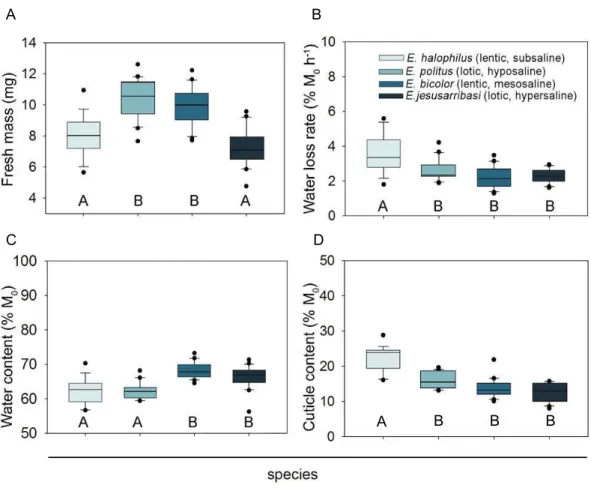
The water and cuticle contents of the four studied species ranged from 60 to 68% and 12–23% M0, respectively. Mean water loss rates of specimens exposed to desiccation ranged
from 2.22 to 3.57% M0 h−1, with a total water loss after 6 h of desiccation exposure of
19.3 –39.1% WC0. Specimens in the control group showed very little water loss (approx.
0.5% M0h−1anda maximum water loss of 6% WC0) (seeTable S1for species comparative
data).
All desiccation resistance traits differed significantly between species (Table 2). Females showed higher fresh mass and water content than males in all species (see sex and sex
×species effects inTable 2). Despite significant interspecific differences in mean fresh mass
Table 2 GLM results on interspecific differences in fresh mass (M0), water loss rate (WLR), water
con-tent (WC0) and cuticle content (CC) acrossEnochrusspecies (N=20 per species).
Trait Predictors df F-value/χ2a
(Explained deviance)b
P
M0(mg) Sp 3 37.627 <0.001
Sex 1 14.206 <0.001
Sp×Sex 3 0.607 0.613
(0.651)
WLR (% M0h-1) Sp 3 2.718 <0.001
M0 1 0.126 0.161
Sex 1 0.004 0.799
Sp×Sex 3 0.007 0.990
(0.397)
WC0(% M0) Sp 3 22.086 <0.001
M0 1 1.387 0.243
Sex 1 4.736 0.033
Sp×Sex 0.335 0.800
(0.519)
CC (% M0) Sp 3 27.019 <0.001
M0 1 3.067 0.085
Sex 1 0.027 0.870
Sp×Sex 3 1.629 0.192
(0.593)
Notes.
aF-value for GLMs with gaussian distribution (M
0, WC and CC);χ2for GLMs with gamma distribution (WLR). b(null deviance—residual deviance/null deviance).
The species living in fresh–subsaline waters (E. halophilus) showed a significantly
higher water loss rate, but this did not differ significantly amongst the other three species (Fig. 1B). Initial water content was higher in the meso and hypersaline species (E. bicolor andE. jesusarribasi) than in the subsaline and hyposaline ones (E. halophilusandE. politus) (Fig. 1C). The species showed similar cuticle contents, except forE. halophiluswhich had
the highest value (Fig. 1D). No consistent patterns between lotic and lentic species were
observed for any of the measured traits.
No mortality occurred during exposure to desiccation (except for one specimen of E. halophilus).Enochrus halophilusshowed a limited capacity to recover after desiccation
(44% of the tested specimens died during the recovery period vs.only one specimen in
each of the other species). The observed mortality can be mainly attributed to desiccation stress because 100% survival occurred in the control group in all species.
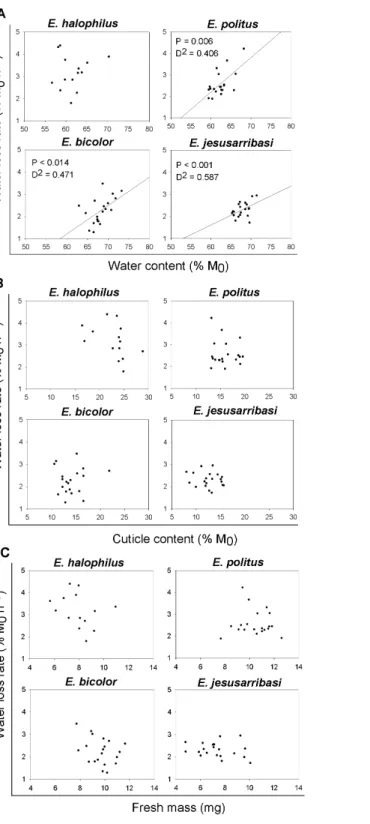
Relationships between desiccation resistance traits within species In general, the desiccation resistance traits showed high inter-individual variability in
all species studied (see Figs. 1and2). A significant positive relationship was found
between individual water loss rates and water content in all species except forE. halophilus
Figure 1 Interspecific comparison of desiccation resistance traits inEnochrusspecies. Letters below the boxes indicate significant differences between species (Bonferroni post-hoc tests,P<0.05). Boxplots represent Q25, median and Q75, whiskers are Q10 and Q90 and dots are outliers.
DISCUSSION
On the basis of our investigations, desiccation resistance inEnochruswater beetles appears to
be associated with habitat salinity, but does not differ between species occupying lotic and
lentic water bodies. The more saline-tolerant species studied (E. bicolor, E. jesusarribasi
and E. politus) showed lower water loss rates than the freshwater-subsaline species (E. halophilus). Furthermore, within these three saline species, the meso and hypersaline ones (E. bicolor andE. jesusarribasi) had significantly higher initial water content than the
hyposaline E. politus.Indeed, these interespecific differences in water control efficiency
seem to be relevant in terms of survival under drying stress, asE. halophiluswas also the most sensitive species to the conditions tested here. In consequence, assuming that the species may tolerate similar levels of water loss (Chown, Le Lagadec & Scholtz, 1999;Hoffmann & Harshman, 1999), the studied saline tolerant species showed a clear physiological advantage over freshwater ones under desiccation conditions.
Figure 2 Relationships between individual water loss rates (WLR) and initial water content (WC0),
lineages. The pattern found here of stronger desiccation resistance in aquatic species living in saline waters is clearly consistent with this hypothesis and emphasizes the important role that traits associated with coping with osmotic and desiccation stress could have
in shaping the ecological diversification ofEnochrus. Also, in line with the relationship
between desiccation and salinity tolerance seen across the beetles studied here, intraspecific
studies of corixid populations found similar responses to the two stressors (e.g.,Cannings,
1981), and salinity acclimation was showed to confer desiccation resistance in an Antarctic
midge (Elnitsky et al., 2009). Salinity imposes similar stress on aquatic organisms as that
resulting from desiccation during air exposure at the cellular level (i.e., water loss and
increase of the osmotic pressure) (Evans, 2008;Bradley, 2009). In consequence, shared
genetic and physiological mechanisms might underlie resistance to these two factors, as
found with other related stressors such as desiccation and cold (e.g.,Everatt et al., 2014;
Holmstrup, Hedlund & Boriss, 2002;Levis, Yi & Lee, 2012).
Our study found no direct association between desiccation resistance and the lotic/lentic habitat divide. Previous studies on water beetles have shown that lentic taxa have a higher colonization ability (i.e., the ability of a species to disperse and establish new populations) than lotic related species, resulting in larger geographical ranges and lower population genetic structure (Abellán, Millán & Ribera, 2009;Hof et al., 2012;Ribera, 2008). Dispersal capacity and thermal tolerance seem to be the main traits driving this lotic/lentic pattern
in water beetles (e.g.,Hjalmarsson, Bergsten & Monaghan, 2015) and particularly in two
of the species here studied, E. jesusarribasiandE. bicolor (Arribas et al., 2012;Pallarés et al., 2012). The two lotic species studied here are restricted to the Iberian Peninsula and Morocco whilst the lentic ones are distributed across larger areas, including northern Europe (Millán et al., 2014), but no clear patterns in desiccation resistance traits were found accordingly. Therefore, desiccation resistance could play a secondary role to differences in dispersal capacity in shaping the colonization ability of water beetles. In this point
it should be noted that Enochrusspecies’ occurrence across different habitat types will
be also constrained by the limited desiccation resistance of eggs and larvae, being the latter likely the most desiccation-sensitive stage because of their thinner cuticles. In
addition, desiccation resistance might show inter-population variability (e.g.,Hoffmann
& Harshman, 1999) as a result of physiological plasticity or local adaptations. Despite our study on adults from populations on similar climatic regimes but different habitats allows for a robust comparison across species, further studies on multiple stages and populations are needed to deeply understand the relationship between habitat occupation and resistance to desiccation in this group.
Beetles are one of the groups of arthropods best adapted to desiccation, with species from desert or semi-desert areas typically representing the extremes in tolerance to dehydration.
For example, the terrestrial spider beetleMezium affine shows daily water losses as little
as 0.3% per day and the ability to survive up to three months with no food or water (Benoit et al., 2005). Surprisingly, the highest tolerance to water loss (89% of the body
water content) has been reported for a fully aquatic beetle, the haliplid Peltodytes
strictly terrestrial beetles and those occupying deeper water such as many diving
beetles (Dytiscidae) (Beament, 1961; Holdgate, 1956; Wigglesworth, 1945). However,
it is difficult to establish a comparative framework because of the few existent data on desiccation resistance traits in adult aquatic insects and the multiple and contrasting approaches and/or experimental conditions used to measure them. The
water contents of the four Enochrusspecies (60%–68% of fresh mass) were consistent
with the typical 62% of most beetles (Hadley, 1994). Water loss rates, ranging from
2.2 to 3.6% of initial mass at 20% RH, appear to be comparable to those reported
for the extraordinary desiccation resistant P. muticus, which lost ca. 5.4% of initial
mass per hour under more severe conditions (0% RH) (Arlian & Staiger, 1979).
Nevertheless, the total water losses that the studied species reached after the desiccation treatment (Table S2) were close to the limit of dehydration tolerance of most insects
(20–30% of water content) (Hadley, 1994). Although such water loss was measured
under an unrealistic humidity in natural conditions (20% RH), a combination of high
temperatures (>30◦C) and low humidity (40%–50% RH) is frequent in the natural
habitats of these species. Prolonged exposures to such conditions in nature may result in extremely stressful conditions and high mortalities of local populations of the studied species, but further research is needed to identify desiccation level and duration thresholds under natural conditions for each particular species.
The analysis of traits at the individual level is essential for further exploration of the
mechanisms regulating water loss rate. InEnochrusspecies, water loss rates were positively
related to the specimens’ initial water content. These relationships were relatively weak
(D2=0.4–0.6) due to high inter-individual variation in both traits, which might be
associated to age, sex or the physiological state of the individuals (e.g.,Chown, Le Lagadec & Scholtz, 1999;Lyons et al., 2014;Matzkin, Watts & Markow, 2007). Despite this variability, resistance to water loss seems to be partly a function of individual water content, as beetles with a higher initial proportion of water lost it faster than those with lower values. This sug-gests that a critical level of water loss may induce active mechanisms for water conservation (e.g., changes in cuticular permeability), which might be ‘‘relaxed’’ when organismal water content rises above this threshold. Such regulation is concordant with the nonlinearity of water loss following exposure to desiccation found in many fully terrestrial insects (e.g.,Arlian & Staiger, 1979;Benoit et al., 2007).
Although we used cuticle content as a potential surrogate of cuticle permeability, since increased cuticle thickness is associated with desiccation resistance in insects adapted to
arid conditions (Crowson, 1981;Elias, 2010), this trait showed no relationship with water
loss rates in anyEnochrusspecies. In addition, in interspecific comparisons, the species with
Stinziano et al., 2015;Toolson, 1982). In aquatic insects, similar mechanisms may shape responses to dehydration occurring both in exposure to air or hyperosmotic aquatic medium but to date even basic cuticular properties in such taxa have received little study (but seeAlarie, Joly & Dennie 1998for an example).
Despite the fact that many previous studies suggest that body size affects water loss rate in arthropods (e.g.,Chown, Pistorius & Scholtz, 1998;Lighton, Quinlan & Feener jr, 1994;
Prange & Pinshow, 1994) our results suggest that both interspecific and inter-individual size differences do not significantly affect desiccation resistance in these water beetles. Although large size (lower area-to-volume ratio) might be expected to be beneficial for survival under desiccating conditions (Chown, Pistorius & Scholtz, 1998;Schmidt-Nielsen,
1984), important trade-offs could arise as a result of increases in body size (Chown &
Gaston, 2010;Chown & Klok, 2003). This could be particularly true in the case of aquatic insects living in fluctuating or temporary waters, such as the beetles studied here, where
rapid larvae development and small body size are common, alongside other r-selected
traits (Millán et al., 2011;Williams, 1985).
CONCLUSIONS
This study is the first to explore both interspecific and inter-individual variation in desiccation resistance traits within a group of closely related aquatic insects. Our results suggest that control of both water loss rate and water content may be key mechanisms for dealing with desiccation stress in adult water beetles and suggest an association between salinity tolerance and desiccation resistance. Further studies are required to evaluate the ecological and evolutionary consequences of interspecific variation in key desiccation resistance traits, but our results point to habitat-mediated differences (salinevs.freshwater) in the vulnerability of water beetle species to a higher frequency and intensity of droughts expected in semi-arid regions.
ACKNOWLEDGEMENTS
We thank F. Picazo, S. Guareschi and all members of the research group Aquatic Ecology of the University of Murcia for helping with beetle species field collection and M. Botella-Cruz for helping with experimental procedures. The manuscript was greatly improved by the suggestions of Tomas Ditrich and two other anonymous reviewers.
ADDITIONAL INFORMATION AND DECLARATIONS
Funding
Grant Disclosures
The following grant information was disclosed by the authors: I+D+i project: CGL2013-48950-C2-2-P.
FEDER funds. University of Murcia. Royal Society UK.
Spanish Ministry of Economy and Competitiveness.
Competing Interests
The authors declare that there are no competing interests.
Author Contributions
• Susana Pallarés conceived and designed the experiments, performed the experiments,
analyzed the data, contributed reagents/materials/analysis tools, wrote the paper, prepared figures and/or tables.
• Josefa Velasco and Andrés Millán conceived and designed the experiments, contributed
reagents/materials/analysis tools, reviewed drafts of the paper, field sampling.
• David T. Bilton conceived and designed the experiments, contributed
reagents/materi-als/analysis tools, reviewed drafts of the paper.
• Paula Arribas conceived and designed the experiments, analyzed the data, reviewed
drafts of the paper.
Data Availability
The following information was supplied regarding data availability:
The raw data has been supplied asData S1.
Supplemental Information
Supplemental information for this article can be found online athttp://dx.doi.org/10.7717/
peerj.2382#supplemental-information.
REFERENCES
Abellán P, Millán A, Ribera I. 2009.Parallel habitat-driven differences in the phylo-geographical structure of two independent lineages of Mediterranean saline water
beetles.Molecular Ecology18:3885–3902DOI 10.1111/j.1365-294X.2009.04319.x.
Addo-Bediako A, Chown SL, Gaston KJ. 2001.Revisiting water loss in insects: a large
scale view.Journal of Insect Physiology 47:1377–1388
DOI 10.1016/S0022-1910(01)00128-7.
Alarie Y, Joly H, Dennie D. 1998.Cuticular hydrocarbon analysis of the aquatic beetle Agabus anthracinusMannerheim (Coleoptera: Dytiscidae).The Canadian
Entomolo-gist 130:615–629DOI 10.4039/Ent130615-5.
Arlian L, Staiger T. 1979.Water balance in the semiaquatic beetle,Peltodytes muticus. Comparative Biochemistry and Physiology Part A: Molecular & Integrative Physiology
Arribas P, Andújar C, Abellán P, Velasco J, Millán A, Ribera I. 2014.Tempo and mode of the multiple origins of salinity tolerance in a water beetle lineage.Molecular Ecology 23:360–373DOI 10.1111/mec.12605.
Arribas P, Velasco J, Abellán P, Sánchez-Fernández D, Andújar C, Calosi P, Millán A, Ribera I, Bilton DT. 2012.Dispersal ability rather than ecological tolerance drives differences in range size between lentic and lotic water beetles
(Coleoptera: Hydrophilidae).Journal of Biogeography39:984–994
DOI 10.1111/j.1365-2699.2011.02641.x.
Beament JWL. 1961.The waterproofing mechanism of arthropods II. The permeability
of the cuticle of some aquatic insects.Journal of Experimental Biology38:277–290.
Benoit JB. 2010.Water management by dormant insects: comparisons between
dehydra-tion resistance during summer aestivadehydra-tion and winter diapause.Progress in Molecular
and Subcellular Biology49:209–229DOI 10.1007/978-3-642-02421-4_10.
Benoit JB, Lopez-Martinez G, Michaud MR, Elnitsky MA, Lee Jr RE, Denlinger DL. 2007.Mechanisms to reduce dehydration stress in larvae of the Antarctic midge, Belgica antarctica.Journal of Insect Physiology53:656–667
DOI 10.1016/j.jinsphys.2007.04.006.
Benoit JB, Patrick KR, Desai K, Hardesty JJ, Krause TB, Denlinger DL. 2010. Re-peated bouts of dehydration deplete nutrient reserves and reduce egg production
in the mosquitoCulex pipiens.Journal of Experimental Biology 213:2763–2769
DOI 10.1242/jeb.044883.
Benoit JB, Yoder JA, Rellinger EJ, Ark JT, Keeney GD. 2005.Prolonged maintenance
of water balance by adult females of the American spider beetle,Mezium affine
Boieldieu, in the absence of food and water resources.Journal of Insect Physiology
51:565–573DOI 10.1016/j.jinsphys.2005.03.001.
Bilton DT. 2014. Dispersal in Dytiscidae. In: Yee DA, ed.Ecology, systematics, and natural history of predaceous diving beetles (Coleoptera: Dytiscidae). New York: Springer, 387–407.
Bradley T. 2009.Animal osmoregulation. New York: Oxford University Press.
Cannings SG. 1981.The influence of salinity on the cuticular permeability ofCenocorixa bifida hungerfordiLansbury (Hemiptera: Corixidae).Canadian Journal of Zoology
59:1505–1509DOI 10.1139/z81-204.
Céspedes V, Pallarés S, Arribas P, Millán A, Velasco J. 2013.Water beetle tolerance to
salinity and anionic composition and its relationship to habitat occupancy.Journal of
Insect Physiology59:1076–1084DOI 10.1016/j.jinsphys.2013.08.006.
Chown SL. 1993.Desiccation resistance in six sub-Antarctic weevils (Coleoptera: Curculionidae): humidity as an abiotic factor influencing assemblage structure. Functional Ecology7:318–325DOI 10.2307/2390211.
Chown SL, Gaston KJ. 2010.Body size variation in insects: a macroecological
perspec-tive.Biological Reviews85:139–169DOI 10.1111/j.1469-185X.2009.00097.x.
Chown SL, Klok CJ. 2003.Water-balance characteristics respond to changes in body
size in subantarctic weevils.Physiological and Biochemical Zoology76:634–643
Chown SL, Le Lagadec MD, Scholtz CH. 1999.Partitioning variance in a physiological
trait: desiccation resistance in keratin beetles (Coleoptera, Trogidae).Functional
Ecology 13:838–844DOI 10.1046/j.1365-2435.1999.00373.x.
Chown SL, Nicolson S. 2004.Insect physiological ecology. Mechanisms and patterns. Oxford: Oxford University Press.
Chown SL, Pistorius PA, Scholtz CH. 1998.Morphological correlates of flightlessness in southern African Scarabaeinae (Coleoptera: Scarabaeidae): testing a condition
of the water conservation hypothesis.Canadian Journal of Zoology76:1123–1133
DOI 10.1139/z98-036.
Chown SL, Sørensen J, Terblanche J. 2011.Water loss in insects: an environmental
change perspective.Journal of Insect Physiology57:1070–1084
DOI 10.1016/j.jinsphys.2011.05.004.
Crowson RA. 1981.The biology of the Coleoptera. London: Academic Press.
Datry T, Pella H, Leigh C, Bonada N, Hugueny B. 2016.A landscape approach
to advance intermittent river ecology.Freshwater Biology61:1200–1213
DOI 10.1111/fwb.12645.
Davy-Bowker J. 2002.A mark and recapture study of water beetles (Coleoptera:
Dytisci-dae) group of semi-permanent and temporary ponds.Aquatic Ecology36:435–446
DOI 10.1023/A:1016550127986.
De Vito J, Meik JM, Gerson MM, Formanowicz Jr DR. 2004.Physiological toler-ances of three sympatric riparian wolf spiders (Araneae: Lycosidae) correspond
with microhabitat distributions.Canadian Journal of Zoology82:1119–1125
DOI 10.1139/z04-090.
Dudley R. 2000.The biomechanics of insect flight. Princeton: Princenton University Press.
Edney EB. 1977.Water balance in land arthropods. Berlin: Springer.
Elias SA. 2010.Advances in quaternary entomology. Developments in quaternary Sciences. Vol. 12. Amsterdam: Elsevier.
Elnitsky MA, Benoit JB, Lopez-Martinez G, Denlinger DL, Lee REJ. 2009.
Osmoreg-ulation and salinity tolerance in the Antarctic midge,Belgica antarctica: seawater
exposure confers enhanced tolerance to freezing and dehydration.Journal of
Experimental Biology 212:2864–2871DOI 10.1242/jeb.034173.
Evans DH. 2008.Osmotic and ionic regulation. Cells and animals. Boca Ratón: CRC Press.
Everatt MJ, Convey P, Worland MR, Bale JS, Hayward SAL. 2014.Contrasting strategies
of resistancevstolerance to desiccation in two polar dipterans.Polar Research33:
22963DOI 10.3402/polar.v33.22963.
Filipe AF, Lawrence JE, Bonada N. 2013.Vulnerability of stream biota to climate change in mediterranean climate regions: a synthesis of ecological responses and
conserva-tion challenges.Hydrobiologia719:331–351DOI 10.1007/s10750-012-1244-4.
Gereben BA. 1995.Co-occurrence and microhabitat distribution of sixNebriaspecies
(Coleoptera: Carabidae) in an alpine glacier retreat zone in the Alps, Austria.Arctic
Antarctic and Alpine Research27:371–379DOI 10.2307/1552030.
Gibbs AG, Rajpurohit S. 2010. Cuticular lipids and water balance. In: Blomquist GJ,
Bagnères AG, eds.Insect hydrocarbons: biology, biochemistry, and chemical ecology.
Cambridge: Cambridge University Press, 100–120.
Gray EM, Bradley TJ. 2005.Physiology of desiccation resistance inAnopheles gambiae andAnopheles arabiensis.American Journal of Tropical Medicine and Hygiene
73:553–559.
Hadley N. 1978.Cuticular permeability of desert tenebrionid beetles: correlations
with epicuticular hydrocarbon composition.Insect Biochemistry8:17–22
DOI 10.1016/0020-1790(78)90005-7.
Hadley NF. 1994.Water relations of terrestrial arthropods. San Diego: Academic Press.
Harrison JF, Woods HA, Roberts SP. 2012.Ecological and environmental physiology of insects. New York: Oxford Univeristy Press.
Hershkovitz Y, Gasith A. 2013.Resistance, resilience and community dynamics in
mediterranean-climate streams.Hydrobiologia719:59–76
DOI 10.1007/s10750-012-1387-3.
Hjalmarsson AE, Bergsten J, Monaghan MT. 2015.Dispersal is linked to habitat use
in 59 species of water beetles (Coleoptera: Adephaga) on Madagascar.Ecography
38:732–739DOI 10.1111/ecog.01138.
Hof C, Brandle M, Dehling DM, Munguia M, Brandl R, Araujo MB, Rahbek C. 2012.
Habitat stability affects dispersal and the ability to track climate change.Biology Letters8:639–643DOI 10.1098/rsbl.2012.0023.
Hoffmann AA, Harshman LG. 1999.Desiccation and starvation resistance inDrosophila:
patterns of variation at the species, population and intrapopulation levels.Heredity
83:637–643DOI 10.1046/j.1365-2540.1999.00649.x.
Holdgate MW. 1956.Transpiration through the cuticles of some aquatic insects.Journal of Experimental Biology33:107–118.
Holmstrup M, Hedlund K, Boriss H. 2002.Drought acclimation and lipid composition inFolsomia candida: implications for cold shock, heat shock and acute desiccation
stress.Journal of Insect Physiology 48:961–970DOI 10.1016/S0022-1910(02)00175-0.
IPCC. 2013.Stocker TF, Qin D, Plattner G-K, Tignor M, Allen SK, Boschung J, Nauels
A, Xia Y, Bex V, Midgley PM, eds.Climate change 2013: the physical science basis.
Contribution of working group I to the fifth assessment report of the intergovernmental panel on climate change. Cambridge, Cambridge,: Cambridge University Press, 1535 pp.
Juliano SA, O’Meara GF, Morrill JR, Cutwa MM. 2002.Desiccation and thermal
toler-ance of eggs and the coexistence of competing mosquitoes.Oecologia130:458–469
DOI 10.1007/s004420100811.
Kellermann V, Van Heerwaarden B, Sgrò CM, Hoffmann AA. 2009.Fundamental
evolutionary limits in ecological traits driveDrosophilaspecies distribution.Science
325: 1244DOI 10.1126/science.1175443.
Lapinski W, Tschapka M. 2014.Desiccation resistance reflects patterns of microhabitat
choice in a Central American assemblage of wandering spiders.Journal of
Larned ST, Datry T, Arscott DB, Tockner K. 2010.Emerging concepts in
temporary-river ecology.Freshwater Biology55:717–738DOI 10.1111/j.1365-2427.2009.02322.x.
Lawrence JE, Lunde KB, Mazor RD, Bêche LA, Mcelravy EP, Resh VH. 2010.Long-term macroinverebrate responses to climate change: implications for biological assessment
in mediterranean-climate streams.Journal of the North American Benthological
Society29:1424–1440DOI 10.1899/09-178.1.
Le Lagadec MD, Chown SL, Scholtz CH. 1998.Desiccation resistance and water balance in southern African keratin beetles (Coleoptera, Trogidae): the influence of body
size and habitat.Journal of Comparative Physiology Part B: Biochemical, Systemic, and
Environmental Physiology168:112–122DOI 10.1007/s003600050127.
Levis NA, Yi SX, Lee RE. 2012.Mild desiccation rapidly increases freeze tolerance of
the goldenrod gall fly,Eurosta solidaginis: evidence for drought-induced rapid
cold-hardening.Journal of Experimental Biology215:3768–3773DOI 10.1242/jeb.076885.
Lighton JRB, Quinlan MC, Feener Jr DH. 1994.Is bigger better? Water balance in
the polymorphic desert harvester antMessor pergandei.Physiological Entomology
19:325–334DOI 10.1111/j.1365-3032.1994.tb01059.x.
Lopez-Martinez G, Benoit JB, Rinehart JP, Elnitsky MA, Lee Jr RE, Denlinger DL. 2009.Dehydration, rehydration, and overhydration alter patterns of gene
ex-pression in the Antarctic midge,Belgica antarctica.Journal of Comparative
Phys-iology Part B: Biochemical, Systemic, and Environmental PhysPhys-iology179:481–491
DOI 10.1007/s00360-008-0334-0.
Lyons CL, Coetzee M, Terblanche JS, Chown SL. 2014.Desiccation tolerance as a function of age, sex, humidity and temperature in adults of the African malaria
vectorsAnopheles arabiensisandAnopheles funestus.Journal of Experimental Bology
217:3823–3833DOI 10.1242/jeb.104638.
Matzkin LM, Watts TD, Markow TA. 2007.Desiccation resistance in fourDrosophila
species.Fly1:268–273DOI 10.4161/fly.5293.
Millán A, Sánchez-Fernández D, Abellán P, Picazo F, Carbonell JA, Lobo JM, Ribera I. 2014.Atlas de los coleópteros acuáticos de España peninsular. Madrid: Ministerio de Agricultura, Alimentación y Medio Ambiente.
Millán A, Velasco J, Gutiérrez-Cánovas C, Arribas P, Picazo F, Sánchez-Fernández D, Abellán P. 2011.Mediterranean saline streams in southeast Spain: what do we know? Journal of Arid Environments75:1352–1359
DOI 10.1016/j.jaridenv.2010.12.010.
Montes C, Martino P. 1987. Las lagunas salinas españolas. In:Bases científicas para la protección de los humedales españoles. Madrid: Real Academia de Ciencias Exactas, Físicas y Naturales de Madrid, 95–145.
Nelson DR, Lee Jr RE. 2004.Cuticular lipids and desiccation resistance in overwin-tering larvae of the goldenrod gall fly,Eurosta solidaginis(Diptera: Tephritidae). Comparative Biochemistry and Physiology Part B: Biochemistry & Molecular Biology
138:313–320.
gradient in inland waters (Coleoptera: Dytiscidae, Hydrophilidae).PLoS ONE
10:e0124299DOI 10.1371/journal.pone.0124299.
Pallarés S, Arribas P, Céspedes V, Millán A, Velasco J. 2012.Lethal and sublethal behavioural responses of saline water beetles to acute heat and osmotic stress. Ecological Entomology 37:508–520DOI 10.1111/j.1365-2311.2012.01393.x.
Prange HD, Pinshow B. 1994.Thermoregulation of an unusual grasshopper in a desert
environment: the importance of food source and body size.Journal of Thermal
Biology19:75–78DOI 10.1016/0306-4565(94)90011-6.
R Core Team. 2015.R: a language and environment for statistical computing. Vienna: R
Foundation for Statistical Computing.Available athttp:// www.R-project.org/.
Reidenbach KR, Cheng C, Liu F, Liu C, Besansky NJ, Syed Z. 2014.Cuticular dif-ferences associated with aridity acclimation in African malaria vectors car-rying alternative arrangements of inversion 2La.Parasites & Vectors7: 176
DOI 10.1186/1756-3305-7-176.
Renault D, Coray Y. 2004.Water loss of male and femaleAlphitobius diaperinus
(Coleoptera: Tenebrionidae) maintained under dry conditions.European Journal
of Entomology101:491–494DOI 10.14411/eje.2004.069.
Ribera I. 2008. Habitat constraints and the generation of diversity in freshwater
macroinvertebrates. In: Lancaster J, Briers RA, eds.Aquatic insects: challenges to
populations. Wallingford: CAB International Publishing, 289–311.
Robson BJ, Chester ET, Austin CM. 2011.Why life history information matters: drought refuges and macroinvertebrate persistence in non-perennial streams subject to a
drier climate.Marine and Freshwater Research62:801–810DOI 10.1071/MF10062.
Schmidt-Nielsen K. 1984. Scaling: why is animal size so important?Cambridge: Cam-bridge University Press.
Schultz TD, Quinlan MC, Hadley NF. 1992.Preferred body temperature, metabolic
physiology, and water balance of adultCicindela longilabris: a comparison of
popu-lations from boreal habitats and climatic refugia.Physiological Zoology65:226–242
DOI 10.1086/physzool.65.1.30158248.
Stinziano JR, Sové RJ, Rundle HD, Sinclair BJ. 2015.Rapid desiccation hardening
changes the cuticular hydrocarbon profile ofDrosophila melanogaster.Comparative
Biochemistry and Physiology Part A, Molecular & Integrative Physiology180:38–42
DOI 10.1016/j.cbpa.2014.11.004.
Strachan SR, Chester ET, Robson BJ. 2015.Freshwater invertebrate life history strategies
for surviving desiccation.Springer Science Reviews3:57–75
DOI 10.1007/s40362-015-0031-9.
Stubbington R, Gunn J, Little S, Worrall TP, Wood PJ. 2016.Macroinvertebrate seedbank composition in relation to antecedent duration of drying and
mul-tiple wet-dry cycles in a temporary stream.Freshwater Biology61:1293–1307
DOI 10.1111/fwb.12770.
Suemoto T, Kawai K, Imabayashi H. 2004.A comparison of desiccation
toler-ance among 12 species of chironomid larvae.Hydrobiologia515:107–114
Terblanche JS, Sinclair BJ, Klok CJ, McFarlane ML, Chown SL. 2005.The effects of acclimation on thermal tolerance, desiccation resistance and metabolic rate in Chirodica chalcoptera(Coleoptera: Chrysomelidae).Journal of Insect Physiology
51:1013–1023DOI 10.1016/j.jinsphys.2005.04.016.
Toolson EC. 1982.Effects of rearing temperature on cuticle permeability and epicuticular
lipid composition inDrosophila pseudoobscura.Journal of Experimental Zoology
222:249–253DOI 10.1002/jez.1402220307.
Wigglesworth VB. 1945.Transpiration through the cuticle of insects.Journal of Experi-mental Biology21:97–114.
Williams WD. 1985. Biotic adaptations in temporary lentic waters with special reference
to those in semi-arid regions. In: Davies BR, Walmsley RD, eds.Perspectives in
southern hemisphere limnology. Dordrecht: Junk Publishers, 85–110.
Williams AE, Bradley TJ. 1998.The effect of respiratory pattern on water loss in
desiccation-resistantDrosophila melanogaster.Journal of Experimental Biology
201:2953–2959.
Wissinger SA, Brown WS, Jannot JE. 2003.Caddisfly life histories along permanence
gradients in high-altitude wetlands in Colorado (U.S.A.).Freshwater Biology
48:255–270DOI 10.1046/j.1365-2427.2003.00997.x.
Woods HA, Singer MS. 2001.Contrasting responses to desiccation and starvation by eggs
and neonates of two Lepidoptera.Physiological and Biochemical Zoology74:594–606
DOI 10.1086/322169.
Yoder JA, Benoit JB, Nelson BW, Main LR, Bossley JP. 2015.Behavioral correction to prevent overhydration and increase survival by larvae of the net-spinning
caddisflies in relation to water flow.Journal of Experimental Biology 218:363–369