JSCS–4775 547.211+547.759.32+546.47:537.872
Original scientific paper
QTAIM investigation of a dipyrazol-1-ylmethane derivative and
its Zn(II) complexes (ZnLX
2, X = Cl, Br or I)
MARYAM DEHESTANI and LEILA ZEIDABADINEJAD*
Department of Chemistry, Shahid Bahonar University of Kerman, 76169 Kerman, Iran (Received 24 February, revised 27 March, accepted 31 March 2015)
Abstract: Topological analyses of the electron density were performed on the bis(pyrazol-1-yl)methane derivative 9-(4-(di-1H-pyrazol-1-ylmethyl)phenyl)- -9H-carbazole (L) and its zinc(II) complexes: ZnLCl2 (1), ZnLBr2 (2) and ZnLI2 (3) using the quantum theory of atoms in molecules (QTAIM) at the B3PW91/6-31g(d) theoretical level. The topological parameters derived from the Bader theory were also analyzed; these are characteristics of Zn-bond cri-tical points and of ring cricri-tical points. The calculated structural parameters were the frontier molecular orbital energies, the highest occupied molecular orbital energy (EHOMO), the lowest unoccupied molecular orbital energy (ELUMO), hardness (η), softness (S), the absolute electronegativity (χ), the elec-trophilicity index (ω) and the fractions of electrons transferred (ΔN) from ZnLX2 complexes to L. Numerous correlations and dependencies between the energy terms of the symmetry adapted perturbation theory approach (SAPT), geometrical, topological and energetic parameters were detected and are des-cribed.
Keywords: ZnLX2; charge transfer; bond critical point; SAPT. INTRODUCTION
The coordination chemistry of di/poly-pyrazolylmethane has seen significant development during the past few years.1,2 One of the current interesting topics is
to rationally design and synthesize supramolecular structures based on di/poly- -pyrazolylmethane units, which are capable of multiple binding modes and have the potential to participate in important non-covalent interactions that direct their self-assembly into remarkable architectures.3 Compared with coordination bonds,
non-covalent forces are weaker, but they are common and play critical roles in the formation of supramolecular structures due to their significant contribution to the self-assembly process.4–6 More studies focused on the weak non-covalent
forces in the design and synthesis of supramolecular structures. Herein, the
dipyrazol-1-ylmethane derivative 9-(4-(di-1H-pyrazol-1-ylmethyl)phenyl)-9H-
-carbazole (L) and its zinc(II) complexes: ZnLCl2 (1), ZnLBr2 (2) and ZnLI2 (3)
are reported. The ligand L, ZnLBr2 and ZnLI2 were synthesized by Wang et al.7
In the solid state, each compound showed extensive non-covalent interactions, including weak hydrogen bonds and C…H…π interactions that organize the molecules into 2D and 3D structures. It could be stated that such interactions are common not only in the present compounds but also in a large number of known polypyrazolylborate and polypyrazolylmethane compounds.
QTAIM,8 the chemical bonds in both isolated species and molecular crystals
can be classified and quantified in terms of features of the bond critical points in the electron density, both theoretically and experimentally. The variety of the atomic interactions can be approximately divided into shared (or covalent) inter-actions, intermediate (partially covalent) interactions and closed-shell (van der Waals, ionic, metal, etc.) interactions.9–11 The fundamental differences between
the two limiting extremes in the interactions, i.e., closed-shell interactions and
shared ones, are the electron density features at the bond critical point. These are the value of electron density, ρb, and the sign of the Laplacian of the electron density, ∇2ρb, as well as the energy density He,b = Gb+Vb, where Vb and Gb are
the potential and kinetic energy densities, respectively.10,11 Shared interactions
exhibit ρb ≥ 0.14 au, ∇2ρb< 0 and Hb < 0, while closed-shell interactions show ρb≤ 0.05 au, ∇2ρb> 0 and Hb > 0. In the intermediate region, ∇2ρb( )r > 0 and
Hb(r) < 0.
The term non-covalent interaction may be ambiguous since covalency is attributed not only to typical chemical bonds. It is also connected with the hyd-rogen bond and with the other interactions, such as halogen or dihydhyd-rogen bonds. Covalency is usually attributed to charge transfer and polarization interaction energy contributions. It seems that there are meaningful differences between the interaction mentioned above, such as ionic bond and covalent bonds. The goal of this study was to apply density functional theory (DFT) calculations12 and the
QTAIM theory13 to analyze the properties of the N…Zn–X bonds in ZnLCl2,
ZnLBr2 and ZnLI2. The latter gives direct information on the presence and type
of chemical bonds in these structures.
COMPUTATIONAL DETAILS
All calculations, including optimizations were performed with Gaussian 03 sets of code13 using the B3PW91/6-31G(d) level of theory without any symmetry restrains. Quantum chem-ical calculations of L based on density functional theory was performed at the B3PW91/ /631G(d) level and calculations of complexes 1–3 were realized with B3PW91/6–31G(d) for
the C, H, N, Cl, Br and I atoms and the LANL2DZ basis set for the Zn atoms.
density and the kinetic electron energy density. The following relations are well known if all terms are expressed in atomic units:
2
b b b
1
2
4∇ ρ = G +V (1)
e,b Gb b
H = +V (2)
The symmetry adapted perturbation theory (SAPT) approach was applied to deepen the understanding of the nature of the interactions14 for complexes 1–3. The MOLPRO package15 was used to perform the calculations. SAPT is a well-established approach to calculate the interaction energy of two closed-shell moieties, whereby the interaction energy is obtained directly as the sum of defined contributions. Thus, it is different from the commonly applied approaches in which the binding energy is calculated as the difference between the energy of the complex and the sum of the energies of the monomers. In the SAPT approach, the inter-action energy consists of the following terms: the first-order electrostatics (1)
elst,
E the second-order induction (2)
ind
E and dispersion Edisp(2) energies, and their exchange counterparts: first-order exchange (1)
exch,
E second-order exchange–induction Eexch ind(2) − and exchange–dispersion (2)
exch disp.
E − The SAPT method up to the second order gives the main part of the interaction energy. The SAPT2 interaction energy is calculated according to Eq. (3):
(1) (2) (2) (1) (2) (2)
SAPT2
HF int elst ind disp exch exch-ind exch-disp
E =E +E +E +E +E +E +δE (3) RESULTS AND DISCUSSION
Structure of the ligand
Ligand L crystallizes in the monoclinic space group P21, selected bond
distances and angles are listed in Table I. The molecular structure of L and its 1D linear chain are shown in Fig. 1. The dihedral angles between the carbazole ring and the central phenyl unit are 44.3° in molecule a and 46.9° in molecule b. In
molecule a, the dihedral angles of the central phenyl unit and the pyrazole rings
(R1, R2) are 71.4 and 80.4°, respectively. The dihedral angle of the two pyrazole rings (R1, R2) is 54.9°. In molecule b, the dihedral angles of the central phenyl
unit and the pyrazole rings (R3, R4) are 71.8 and 80.0°, respectively. The dihed-ral angle of the two pyrazole rings (R3, R4) is 55.5°. There is no extended con-jugation among the carbazole, phenyl and pyrazole rings.
In the molecular structure of complexes 1-3, the Zn(II) ion is four
coordi-nated by two nitrogen atoms of the pyrazolyl groups (L) and two halogen ions to form a distorted tetrahedral geometry. The two pyrazole groups linked to Zn(II) lead to changes in the structure of the ligand. In the structure of ZnLCl2, shown
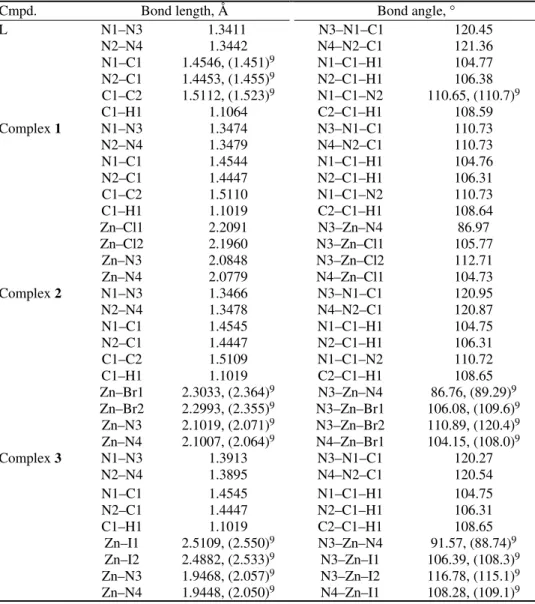
TABLE I. Calculated geometry parameters of L, ZnLCl2, ZnLBr2 and ZnLI2
Cmpd. Bond length, Å Bond angle, °
L N1–N3 1.3411 N3–N1–C1 120.45
N2–N4 1.3442 N4–N2–C1 121.36 N1–C1 1.4546, (1.451)9 N1–C1–H1 104.77 N2–C1 1.4453, (1.455)9 N2–C1–H1 106.38 C1–C2 1.5112, (1.523)9 N1–C1–N2 110.65, (110.7)9 C1–H1 1.1064 C2–C1–H1 108.59
Complex 1 N1–N3 1.3474 N3–N1–C1 110.73
N2–N4 1.3479 N4–N2–C1 110.73
N1–C1 1.4544 N1–C1–H1 104.76
N2–C1 1.4447 N2–C1–H1 106.31
C1–C2 1.5110 N1–C1–N2 110.73
C1–H1 1.1019 C2–C1–H1 108.64
Zn–Cl1 2.2091 N3–Zn–N4 86.97
Zn–Cl2 2.1960 N3–Zn–Cl1 105.77
Zn–N3 2.0848 N3–Zn–Cl2 112.71
Zn–N4 2.0779 N4–Zn–Cl1 104.73
Complex 2 N1–N3 1.3466 N3–N1–C1 120.95
N2–N4 1.3478 N4–N2–C1 120.87
N1–C1 1.4545 N1–C1–H1 104.75
N2–C1 1.4447 N2–C1–H1 106.31
C1–C2 1.5109 N1–C1–N2 110.72
C1–H1 1.1019 C2–C1–H1 108.65
Zn–Br1 2.3033, (2.364)9 N3–Zn–N4 86.76, (89.29)9 Zn–Br2 2.2993, (2.355)9 N3–Zn–Br1 106.08, (109.6)9 Zn–N3 2.1019, (2.071)9 N3–Zn–Br2 110.89, (120.4)9 Zn–N4 2.1007, (2.064)9 N4–Zn–Br1 104.15, (108.0)9
Complex 3 N1–N3 1.3913 N3–N1–C1 120.27
N2–N4 1.3895 N4–N2–C1 120.54
N1–C1 1.4545 N1–C1–H1 104.75
N2–C1 1.4447 N2–C1–H1 106.31
C1–H1 1.1019 C2–C1–H1 108.65
Zn–I1 2.5109, (2.550)9 N3–Zn–N4 91.57, (88.74)9 Zn–I2 2.4882, (2.533)9 N3–Zn–I1 106.39, (108.3)9 Zn–N3 1.9468, (2.057)9 N3–Zn–I2 116.78, (115.1)9 Zn–N4 1.9448, (2.050)9 N4–Zn–I1 108.28, (109.1)9
the planarity of ligand in complex 1 is worse than that for the free ligand. The Zn–N3 and Zn–N5 bond lengths are 2.0848 and 2.0779 Å, respectively. The bond distances of Zn–Cl1 and Zn–Cl2 are 2.2091 and 2.1960 Å, respectively. In complexes 2 and 3, the changes in the structure of ligand are similar to that of
complex 1. The planarity of coordinated ligand is also worse than that of the free
ligand. The corresponding angles and bond lengths for complexes 2 and 3 are
Fig. 1. a) The molecular structure of L and b) the 1D linear chain of ligandL. The bond lengths are in Å.
Fig. 2. a) The molecular structure of complex 1 and b) the 1D structure of complex 1 showing
the weak C–H…Cl bond in Å.
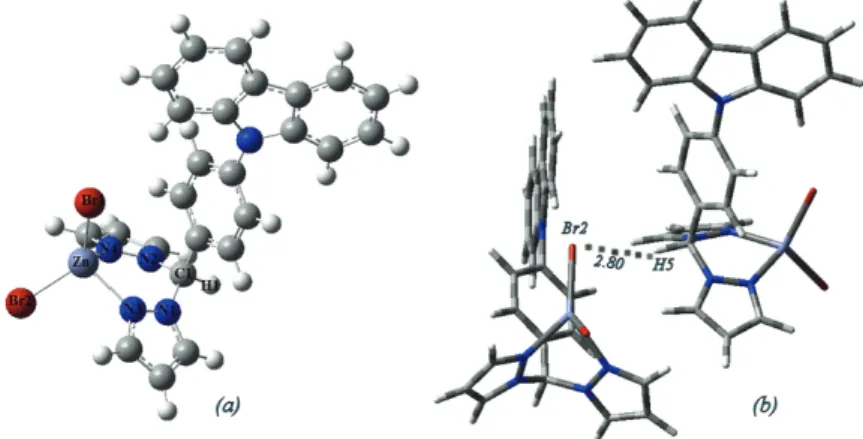
Fig. 3. a) The molecular structure of complex 2 and b) the 1D structure of complex 2 showing
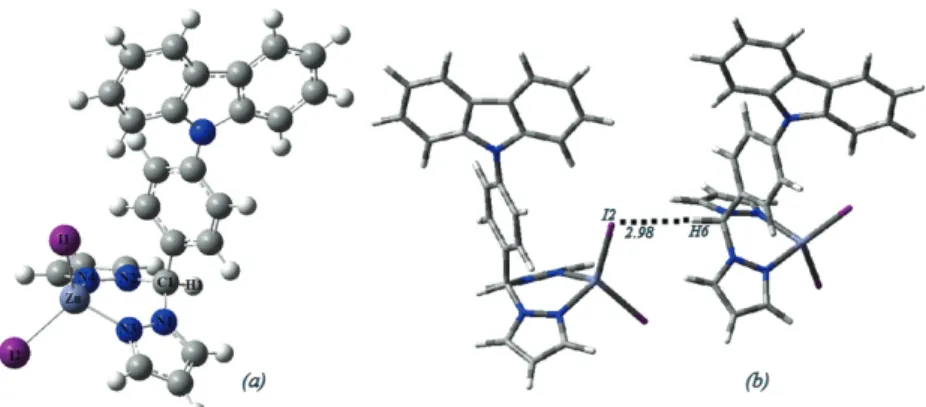
Fig. 4. a) The molecular structure of complex 3 and b) the 1D structure of complex 3 showing
the weak C—H…I bond in Å.
Global reactivity descriptors
A large part of theoretical chemistry related to reactivity is based on the concept of frontier molecular orbitals (FMO), especially the lowest unoccupied molecular orbital (LUMO) and the highest occupied molecular orbital (HOMO). The interaction between these orbitals often allows a good description of the reactivity of reactions. The FMO theory says that the attack of an electrophilic species will occur where there is more density of the HOMO, whereas the attack of a nucleophilic species will occur in a region with a higher density of the LUMO. Parr and coworkers demonstrated that nearly all the frontier molecular theory could be rationalized from the DFT.16
The µ and molecular η for an N-electron system with total energy Et and
external potential V(r) are defined respectively, as the first and second derivatives
of the energy with respect to N:17,18
( ) V r
E µ
N χ
∂
= = −
∂
(4)
and
2 2
( )
1 1
2 2
V r
E µ
N N
η= ∂ = ∂
∂ ∂
(5)
where χ (eV) in Eq. (4) is the electronegativity. In numerical applications, µ and
η are calculated using of the difference approximation:
(
A)
1 2
µ= − IP+E (6)
(
A)
1
2 IP E
The vertical ionization potential (IP) and the electron affinity (EA) can be
obtained from the energy of the neutral, anionic, and the cationic species at the geometry of the corresponding N electron neutral species, as follows:
(
1)
( )
IP=E N− −E N (8)
( )
(
)
A 1
E =E N −E N+ (9)
Equations (6) and (7) can be simplified using the Koopmans theorem,12
which approximates the electronic affinity and the ionization potential to the negative of the LUMO and HOMO energy, respectively.
(
LUMO HOMO)
1
2 E E
µ= − + (10)
(
LUMO HOMO)
1
2 E E
η= − (11)
The electrophilicity index (ω) and global softness (S) are defined as follows:
2
2 µ ω
η
= (12)
1 /
S= η (13)
According to Parr et al.,18ω is a global reactivity index similar to the
chem-ical hardness and chemchem-ical potential. This new reactivity index measures the stabilization in energy when the system reserves additional electronic charge (ΔN). The direction of the charge transfer is determined by the electronic
chem-ical potential of the molecule because an electrophile is a chemchem-ical species cap-able of accepting electrons from the environment; its energy must decrease upon accepting an electronic charge. Thus, its electronic chemical potential must be negative.
The calculated values of EHOMO, ELUMO, χ, µ, η, S and ω for L and its
complexes are listed in Table II.
In a reaction between two molecules, species can act as a nucleophile, which has a lower value of the electrophilicity index. The values of the electrophilicity index show that ZnCl2, ZnBr2 and ZnI2 are good nucleophiles; hence, these
nucleophiles can attack the ligand L. Electrophilic charge transfer (ECT)19 is
explained as the difference between the ΔNmax values of the interacting
mole-cules. Considering two molecules A (L) and B (ZnCl2, ZnBr2 and ZnI2)
approaching each other, two cases exist, i) ECT > 0, charge flow from B to A, ii) ECT < 0, charge flow from A to B. The ECT is calculated as follows:
(
max)
A–(
max B)
ECT = ΔN ΔN (14)
TABLE II. Calculated EHOMU, ELUMO, χ, µ, η, S and ω (in eV) for L, ZnCl2, ZnBr2 and ZnI2 Molecule EHOMO / eV ELUMO / eV χ / eV µ / eV η / eV S / eV ω / eV L –0.1999 –0.0271 0.1135 –0.1135 0.0864 0.0432 0.0746 ZnCl2 –0.3093 –0.1360 0.2226 –0.2226 0.0867 0.0433 0.2858 ZnBr2 –0.2877 –0.1224 0.2051 –0.2051 0.0826 0.0413 0.2546 ZnI2 –0.2699 –0.0678 0.1678 –0.1678 0.1010 0.0505 0.1394
The ECT was calculated as 1.253, 1.169 and 0.347 for complexes 1–3,
respectively. These results show that electrons are transferred from ZnX2 to L.
Therefore, the L was treated as an electron acceptor and, hence, ZnX2 was treated
as an electron donor. Thus, L has electrophilic behavior because the value of chemical potential is low. As shown in Table II, the high value of chemical potential and low value of electrophilicity index for these complexes 1–3 favor
their nucleophilic behavior.
Local reactivity descriptors
The Fukui function (FF)16,20 or frontier function (fk+, fk–) measures changes
in electron number (removing electrons from the HOMO or adding electrons to LUMO, respectively) in chemical reactions and has been used to predict the reactivity of sites in a molecule. This function is a local density functional des-criptor that is calculated using the proposed procedure based on a finite differ-ence method.21
In this work, the two functions f+ and f – were used to determine
electro-philic and nucleoelectro-philic attack, respectively. These functions can be given by:
(N 1) ( )N
k k k
f+=q + −q for molecule k as an electrophile
( )N (N 1)
k k k
f− =q −q − for molecule k as a nucleophile
where the parameters ( )N k
q , qk(N−1) and qk(N+1)are the charges of molecule k
cal-culated in the systems N, N–1 and N+1 electrons, respectively, at the optimized
geometry of the molecule with N electrons. In the past few years, the condensed
Fukui functions have been used to explain the regioselectivity in chemical reac-tions.22 It is a tool that allows the prediction of which electron or moiety of a
molecule will display more or less nucleophilic or electrophilic character. Elec-trophilic reactivity descriptors +
k
f and nucleophilic reactivity descriptors fk− for
all molecules are listed in Table III. The maximum values of the nucleophilic reactivity descriptors at Zn indicate that these sites are more prone to
electro-TABLE III. Selected reactivity descriptors indexes of ZnCl2, ZnBr2 and ZnI2
Molecule Atom q(N) q(N–1) q(N+1) fk+ fk−
ZnCl2 Zn 1.1269 1.2494 0.4060 –0.7208 –0.1226
ZnBr2 Zn 0.9693 1.0814 0.2835 –0.6858 –0.1121
philic attack in the ZnCl2 molecule. Thus, it can be stated that the Zn atom
attacked the N atom of L corresponding in all complexes. Relationship between geometrical and topological parameters
The calculations performed on the wide spectrum of related species enabled a deeper insight into the characteristics of intramolecular interactions to be obtained. Here, mainly relationships between the bond length and the character-istics of the corresponding bond critical point are considered. For the systems analyzed herein, a pseudo-ring containing the N3…Zn…N4 intramolecular bond is created and hence, an RCP also exist in complexes 1–3. The geometrical and
topological parameters of these interactions are presented in Table IV. Briefly summarizing, the greater is the electron density at the RCP of an intramolecular bond, the stronger is the interaction and the shorter is the bond. The Zn…N bond lengths are 2.2091, 2.3033 and 2.5109 Å for complexes 1–3, respectively. The
values of ∇2ρbfor complexes 1–3are –0.0201, –0.0388 and –0.0579 au,
respect-ively. As can be seen, the bond length is shorter and the value of ∇2ρb higher in
ZnLCl2 than in the other complexes. Relatively, the values of the ∇2ρb, and TABLE IV. Topological properties (in au) of the charge density at the bond critical point of L, ZnLCl2, ZnLBr2, and ZnLI2, ρ(r), ∇2ρ( ),r and Gb, Vb, He,b and |Vb|/Gb
Molecule Bond ρb ∇2ρ( )r Gb Vb He,b |Vb|/Gb
L N1–C1 0.2772 0.2120 0.1352 0.3472 –0.2120 2.568
N2–C1 0.2713 0.2030 0.1334 –0.4700 –0.3366 3.523 C1–H1 0.2744 0.2350 0.0331 –0.3011 –0.2680 9.0967 N1–N3 0.3748 0.1782 0.2132 –0.6046 –0.3914 2.8358 ZnLCl2 N1–C1 0.2741 0.2070 0.1514 –0.5097 –0.3583 3.3666 N2–C1 0.2688 0.1998 0.1413 –0.4823 –0.3410 3.4133 N1–N3 0.3703 0.1768 0.2027 –0.5822 –0.3795 2.8722 Zn–Cl1 0.0793 –0.0201 0.0829 –0.1157 –0.0328 1.395 Zn–Cl2 0.0810 –0.0207 0.0849 –0.1192 –0.0343 1.4040
Zn–N3 0.0722 –0.0620 0.0878 –0.1135 –0.0257 1.2927 Zn–N4 0.0712 –0.0617 0.0866 –0.1114 –0.0248 1.2863 ZnLBr2 N1–C1 0.2688 0.1998 0.1413 –0.4825 –0.3412 3.4147
N2–C1 0.2741 0.2073 0.3580 –0.5088 –0.1508 1.4212 N1–N3 0.3711 0.1775 0.2033 –0.5842 –0.3809 2.8735 Zn–Br1 0.0782 –0.0388 0.0722 –0.1056 –0.3340 1.4620 Zn–Br2 0.0779 –0.0393 0.0725 –0.1056 –0.3310 1.4566
Zn–N3 0.0684 –0.0596 0.0822 –0.1047 –0.0225 1.2737 Zn–N4 0.0683 –0.0593 0.0818 –0.1043 –0.0225 1.2751 ZnLI2 N1–C1 0.2379 0.0848 0.1232 –0.3313 –0.2081 2.6891
He,b, also the values of 1< |Vb|/Gb < 2 indicate that the Zn–X (X = Cl, Br and I)
and the Zn–N interactions in all complexes have a significant partially covalent component. For the N1–C1, N2–C1, C1–H1 and N1–N3 interactions, the values of the Laplacian are positive, which may mean that the ionic bond could not be classified as very strong one because all He,b values are negative, which may
indicate that such interactions are rather strong. With reducing electronegativity of the X atom connected to Zn(II), the bond strength decreases.
The SAPT calculations
The SAPT applied here seems to be a proper approach to analyze the closed-shell interactions. It was mentioned previously that the nucleophilic attack of Zn atom of ZnX2 (X = Cl, Br and I) molecules on the ligand L leads to the formation
of complexes 1–3. The SAPT2 interaction energy as well as the interaction
energy terms in Eq. (3) are given in Table V. If the attractive (negative) terms of the interaction energy are considered, the induction one, Eind(2), seems to be the most important, followed by the electrostatic term, Eelst(1), and the dispersive term. However, the induction and dispersive terms are strongly damped by their exchange counterparts, Eexch i(2) −nd andEexch-disp(2) , respectively. In the case of the
induction interaction energy, it is reduced by 70–82 % while for the dispersive energy, its reduction is of 29–30 %. On the other hand, the first order electro-static energy is outweighed by the first order exchange energy. This shows the role of the induction energy in spite of the fact that the latter one is strongly reduced by its counterpart. There are other observations; the absolute value of the dispersive energy is greater for the complex ZnLCl2 than for the complexes
ZnLBr2 and ZnLI2, even if the exchange counterpart of the dispersion energy is
taken into account. However all interaction energy terms are interrelated and thus for stronger interaction and consequently shorter intermolecular distance, the absolute values of all interaction energy terms increase.
TABLE V. SAPT interaction energies for the ZnLI2, ZnLBr2and ZnLCl2 complexes
Energy term, au ZnLI2 ZnLBr2 ZnLCl2
(1) elst
E –9595.54 –10084.66 –10205.6
(2) ind
E 11217.12 11786.44 11927.80
(2) disp
E –18535.24 –19475.99 –19709.57
(1) exch
E –3216.07 –3403.57 –3444.39
(2) exch ind
E − 14696.23 15442.13 15627.33
(2) exch disp
E − 959.7 1008.46 1020.56
HF E
δ –1524.66 –1575.72 –1594.07
SAPT2 int
CONCLUSIONS
The complexes of ligand L and the different non-covalent interactions were considered herein. It was found that for all interactions in which the Zn atom acts as a nucleophile, a relationship between the Zn…N distance and the Laplacian of electron density at the corresponding bond critical point exists. This indicates a region of partially covalent bonds where the Laplacian is negative and the elec-tron density is lower of 0.15 au. Electrophilic charge transfer confirms that the electrons are transferred from the ZnX2 to the ligand L; thus, the corresponding
ligand can be treated as an electron acceptor. The results of Fukui functions indicate Zn atom attack on the N atom of the ligand. The SAPT approach was also applied to analyze interactions in the zinc complexes. It was found that the induction energy is the most important attractive interaction energy term for the studied complexes, followed by electrostatic and dispersive terms. This means that for such strong interactions, the electron density shift is very important for the process of complexation but also that electrostatic interactions steer the arrangement of sub-units in the complexes.
И З В О Д
QTAIM ИСПИТИВАЊЕДЕРИВАТАДИПИРАЗОЛ-1-ИЛМЕТАНАИОДГОВАРАЈУЋИХ
Zn(II) КОМПЛЕКСА (ZnLX2, X = Cl, Br ИЛИ I)
MARYAM DEHESTANI1и
LEILA ZEIDABADINEJAD1
Department of Chemistry, Shahid Bahonar University of Kerman, 76169 Kerman, Iran
Применом квантне теорије атома у молекулима (QTAIM) на B3PW91/6-31g(d)
нивоутеоријеурађенајетополошкаанализаелектронскегустине 9-(4-(ди-1H-пиразол- -1-илметил)фенил)-9H-карбазола (L) иодговарајућих цинк(II) комплекса: ZnLCl2 (1),
ZnLBr2 (2) и ZnLI2 (3). АнализиранисутополошкипараметридобијениприменомБа
-дероветеоријекојисукарактеристичнизакритичнетачкекоординованогцинкаиаро
-матичног прстена. Израчунати су следећи структурни параметри: енергија највише
попуњене молекулске орбитале (EHOMO), енергија најниже непопуњене молекулске
орбитале (ELUMO), тврди (η) и меки (S) карактер, апсолутна електронегативност (χ),
индекселектрофилности (ω) ирасподелаелектронаукомплексу ZnLX2 (ΔN). Описане
су корелације између енергије добијенеприменом SAPT теорије (симетријски прила
-гођенапертурбационатеорија), геометријских, тополошкихиенергетскихпараметара.
(Примљено 24. фебруара, ревидирано 27. марта, прихваћено 31. марта 2015)
REFERENCES 1. S. Trofimenko, Chem. Rev.93 (1993) 943
2. J. Xia, Z.-J. Zhang, W. Shi, J.-F. Wei, P. Cheng, Cryst. Growth Des.10 (2010) 2323
3. D. L. Reger, R. P. Watson, M. D. Smith, P. J. Pellechia, Organometallics 1544 (2005) 24
4. F. Jin, F.-X. Zhou, X.-F. Yang, L.-H. Cheng, Y.-Y. Duan, H.-P. Zhou, L. Kong, F.-Y. Hao, J.-Y. Wu, Y.-P. Tian, Polyhedron43 (2012) 1
5. C. B. Aakeröy, M. Fasulo, N. Schultheiss, J. Desper, C. Moore, J. Am. Chem. Soc.129
6. M. Tuikka, M. Niskanen, P. Hirva, K. Rissanen, A. Valkonen, M. Haukka, Chem. Commun. 47 (2011) 3427
7. S.-C. Wang, Y.-C. Zhang, F. Jin, W.-D. Liu, H.-P. Zhou, J.-Y. Wu, Y.-P. Tian, Synth. React. Inorg., Met.-Org. Nano-Met. Chem. 45 (2015) 639
8. R.F. Bader, Atoms in molecules, Wiley Online Library, 1990
9. A. Ranganathan, G. Kulkarni, C. Rao, J. Phys. Chem., A107 (2003) 6073
10. T.-H. Tang, E. Deretey, S. Knak Jensen, I. G. Csizmadia, Eur. Phys. J., D37 (2006) 217
11. P. M. Dominiak, E. Grech, G. Barr, S. Teat, P. Mallinson, K. Woźniak, Chem. Eur. J.9
(2003) 963
12. R. G. Parr, W. Yang, Density-functional theory of atoms and molecules, Oxford University Press, New York, 1989, p. 220
13. Gaussian 09, Revision D.01, Gaussian, Inc., Wallingford, CT, 2008 14. B. Jeziorski, R. Moszynski, K. Szalewicz, Chem. Rev.94 (1994) 1887
15. H. J. Werner, P. Knowles, MOLPRO, University of Birmingham, 2012 16. R. G. Parr, W. Yang, J. Am. Chem. Soc.106 (1984) 4049
17. P. Geerlings, F. De Proft, W. Langenaeker, Chem. Rev.103 (2003) 1793
18. R. G. Parr, L. V. Szentpaly, S. Liu, J. Am. Chem. Soc.121 (1999) 1922
19. J. Padmanabhan, R. Parthasarathi, V. Subramanian, P. Chattaraj, J. Phys. Chem., A111
(2007) 1358
20. K. Senthilkumar, M. Ramaswamy, P. Kolandaivel, J. Quantum Chem.81 (2001) 4
21. W. Yang, W. J. Mortier, J. Am. Chem. Soc.108 (1986) 5708