Simple Technical Trading Rules on the JSE
Securities Exchange of South Africa, Part 2
H.M. Campbell,
Abstract—In part 1 of this study, it was suggested that technical trading systems were capable of out performing the market. Part 2, of this empirical study, now being discussed, is based on the JSE All Share Index over the period of April 1988 to April 2007. The over-all data series is broken down and tested in four non-overlapping sub-periods. The results show that excess returns over a buy-and-hold strategy are possible using technical analysis, even in the presence of transactional costs. However, the statistical significance tests of the results obtained in this research are inconclusive as they fail to reject the null hypothesis that daily technical trading returns are equal to or less than zero. The VMA trading rule was found to outperform the other simple rules tested and shorter moving average time lengths were found to yield better results, even in the presence of transaction costs.
Index Terms—Technical analysis; Variable Moving averages; Trading Range Breakout; Fixed Moving Averages; Relative Strength Indicator; Moving Average Convergence Divergence.
I. INTRODUCTION
T
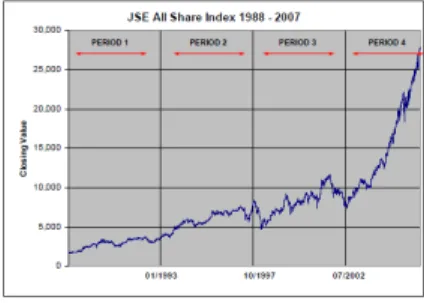
HE entire data series shows [5] an overall upward trend over the full 20-year sample, with an exponential upward trend in the final period, Period 4. See Figure 1.Fig. 1. ALSI Closing Value 1988 -2007
This is an expected trend for an emerging market like South Africa. The empirical study [27] also requires a daily measure of the risk free interest rate. The risk free rate of return is assumed to be equal to the 10-year South African Government Bond Yield. Monthly yield data from 1988 to 2007 was obtained from the South African Reserve Bank1, for the period under consideration.
A. Technical Trading Rules
Moving average oscillator and trading range breakout (re-sistance and support) are two of the simplest and most widely used technical trading rule types. As per the methodology
Manuscript received April 16, 2011.
H.M. Campbell is with the Department of Industrial Engineering and Operations Management, Vaal University of Technology, Vanderbijlpark, Gauteng, 1900 South Africa e-mail: [email protected]
1http://www.reservebank.co.za/
followed by Brock et al [3], and Vassiloudil [27], this study examines the following simple technical trading rules:
• Variable length moving average (VMA) rules; • Fixed-length moving average (FMA) rules, and • Trading range breakout (TRB) rules.
Brock et al [3] emphasize the danger of data-snooping biases resulting in lack of objective empirical results if trading rules are both discovered and tested in the same data set. To avoid this common pit-fall of empirical analysis, the exact same set of 26 technical trading rules as Brock et al. [3] are tested. This includes ten VMA rules, ten FMA rules and six TRB rules.
The option of expanding the set of rules to be tested to include other moving average and momentum rules was con-sidered. However, as stated in the previous section research has shown weighted and exponential moving average rules yield poor results when compared to simple moving averages. Most momentum rules do not generate buy and sell signals and need to be used in conjunction with other trading rules. The stochastic momentum indicator does generate signals but requires additional data in the form of daily highs and lows in addition to closing prices - this data could not be obtained from the JSE. Therefore, it was decided to investigate only the trading rules tested by Brock et al. [3] rather than expand the set of technical rules to be tested. The trading rules are expressed as Technical trading rule =(S,L,B), where
• S= Number of days in the short-term moving average; • L= Number of days in the long-term moving average; • B= percentage band to be exceeded for a signal to be
generated.
For both VMA and FMA rules, a signal is generated by comparing the value of the short-term moving average of price to a long term moving average. A buy/sell signal is generated when the short-term moving average exceeds/falls below the long-term moving average by at least a specified percentage band. When a one percent tolerance band is applied, unless the short-term moving average exceeds or falls below the long-term moving average by at least one percent, no signal will be generated. The introduction of a tolerance band is to eliminate whiplash signals as highlighted by Brock et al. [3] which occurs when short term and long term moving averages are very similar in value.
The same ten moving average rule variations tested by Brock et al. [3] are evaluated for VMA and FMA namely (1,50,0); (1,50,0.01); (1,150,0); (1,150,0.01); (5,150,0); (5,150,0.01); (1,200,0); (1,200,0.01); (2,200,0) and (2,200,0.01), respectively.
signals within this period will be ignored. A holding period of ten days will be used for this study, and has been set as it is the same period used in other similar international studies. After the 10 day period, new signals are generated on which the investor can act.
The final technical trading rule to be tested is trading range breakout (TBR). The TRB rules emit buy/sell signals when the current price moves above the recent maximum/below the recent minimum. These signals are generated as the rule implies that the resistance or support level has been pene-trated. The resistance level is defined as the local maximum and the support level as the local minimum. Brock et al. [3] evaluated TRB rules with recent maxima and minima based on the past 50,150 and 200 days. Each rule is evaluated with and without a 1% tolerance band, resulting in six TRB rules being tested in total. The TRB rules tested are therefore (1,50,0); (1,50,0.01); (1,150,0); (1,150,0.01); (1,200,0) and (1,200,0.01), respectively. The FMA and TRB rules will be discussed in Part 3 of this study.
The actual buy or sell trade is assumed to occur the day after a signal is generated, introducing a 1-day time lag. This makes the model more realistic as it would be impossible in reality to execute a trade on the same day a signal is generated as the signal is based on that day’s closing price. The above rules are used to build a financial model. The results are illustrated in Figures 2, 3 and 4, which show, the
BuyandSellSignals generated by a 10 day (1, 50, 0) VMA Rule ( see Figure 2), the BuyandSell Signal generated by a 10 day (1, 50, 0) FMA Rule (see Figure 3), and the Buy
andSellSignal generated by a 10 day (1, 50, 0) TRB Rule, (see Figure 4), respectively.
Fig. 2. Buy and Sell Signals generated by (1,50,0 VMA Rule
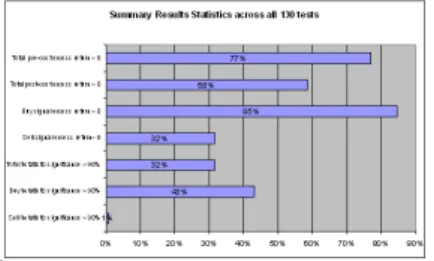
Figure 5 gives a summary of the results statistics across all rules and sub-periods.
B. Profit Measurement
1) Daily Returns: If a technical indicator is to fulfill its function, it should yield a return exceeding the sum of
Fig. 3. Buy and Sell Signals generated by (1,50,0 FMA Rule
Fig. 4. Buy and Sell Signals generated by (1,50,0 TRB Rule
Fig. 5. Buy and Sell Signals generated by (1,50,0 TRB Rule
transaction costs plus the negative return given by its own false signals.
Brock et al. [3] report results based on percentage changes in the daily DJIA. This study uses a similar result measure-ment framework, all returns are expressed as a percentage of initial values rather than Rand amounts. In order to achieve the research objective, for each scenario tested, two key values are calculated using a financial model:
• The percentage return according to the technical trading
decision rules discussed in 1.2.
• The percentage return according to a buy and hold
strategy.
The empirical study also requires a daily measure of the risk free interest rate. The risk free rate of return is assumed to be equal to the 10-year South African Government Bond Yield. Monthly yield data from 1988 to 2007 was obtained from the South African Reserve Bank [24], for the period under investigation.
For the purpose of this research, it will be assumed that the borrowing and investing interest rate is the same, and needs to be accounted for when calculating the profitability of the investment decisions.
A buy or sell signal will be executed on day(t)when day (t−1)moving average exceeds or falls below the long term moving average on day(t−1). The ALSI returns on day(t)is computed as the difference of the natural logarithm of closing price on day(t)and closing price on day(t−1). Therefore, the daily return formula can be expressed as follows:
Rt= ln( Pt Pt−1
) (1)
Where:
Rt = Dayt return on the JSE ALSI, Pt = JSE ALSI closing price on dayt Pt−1 = JSE ALSI closing price on dayt−1
earned by an investor who passively holds the ALSI. The double or out strategy as used by Brock et al. [3] and Bessimbinder and Chan [1], is employed. This means that when a buy signal is generated, an investor will borrow at the risk free interest rate to double equity investment in the market. In response to sell signals, the investor will sell shares and invest in the risk free interest rate. Therefore, during buy signals the technical trader earns a return of 2Rt−it, and hence the excess return over and above the buy and hold return strategy is:
πmt=Rt−it (2)
During sell signals the technical trader earns a return of it which exceeds the return from passively holding the ALSI portfolio by:
πmt=it−Rt (3)
Let (πm)B denote the sum of πmt across the subset of sample days for which rulememits buy signals and(πS)
m denote the sum ofπmt across the subset of sample days for which rulem emits sell signals.
Therefore, the total improvement (before deducting transaction costs) is the investor’s return over the sample period due to using technical trading rule m, instead of a buy-and-hold strategy is:
πm= (πmB+ (πm)S (4)
Whether technical trading rulemhas the power to improve pre-trading cost returns is evaluated by testing whether πm differs significantly from zero.
C. Research Hypothesis
The conditional mean and standard deviation of the daily return of each of the technical trading rules in this study are calculated to determine the statistical significance.
The student t-statistic is used to test the null hypothesis and to obtain a measure of the statistical significance of the pre-trading cost results. The null hypothesis tested in this paper is:
• H0:The excess returns generated by technical trading
rules over and above a buy-and-hold trading strategy are zero.
While the alternate hypothesis, is:
• H1:The excess returns generated by technical trading
rules over and above a buy-and-hold strategy are greater than zero.
T-statistics are calculated for three separate technical anal-ysis excess returns measurement in this paper:
• Excess returns achieved through technical analysis buy
signals
• Excess returns achieved through technical analysis sell
signals
• Excess returns achieved through all technical analysis
signals
As described by [19] the student t-statistic that tests the null hypothesis that the excess returns generated by technical trading rules are zero is calculated as follows:
T = N
1 2µR
σR (5)
where:
T = Student t-statistic for the total technical trading returns
µR = mean daily return generated by all the signals of the technical trading ruleR:
σR = standard deviation of the daily returns of rule R
N = number of daily observations
The equation above is applied to the entire result set, including both buy and sell signals. The equation is applied in a similar fashion to test the statistical significance of the subset of excess returns earned by buy signals:
TBuy= (N B)1
2(µB)R
σB R
(6)
where:
TBuy = Student t-statistic for returns generated by: (µ)B
R = mean daily return generated by buy signals of the technical trading ruleR
(σ)B
R = standard deviation of the daily returns resulting from buy signals of ruleR
NB = number of daily buy signal observations.
The t-statistic equation for buy signals can be applied in a similar manner to determine the t-statistic for sell signals. A standard two-tail t-distribution value for statistical significance above 90% and 95% was determined using a t-distribution table.
1) Transaction Costs: In order to conduct a realistic assessment of whether excess profits are achievable by technical trading rules as opposed to a na¨ıve buy-and-hold strategy, trading costs need to be taken into account.
The excess return calculated in this paper [27], is therefore adjusted for transaction costs as follows:
πAf tercost=πm−C×Nm (7)
πAf tercost = Excess profit from technical trading rule m less transaction costs
πm = Excess profit from technical trading rule m before transaction costs
C = one-way percentage trading cost per trade
Nm = Number if trades executed due to signals emitted by technical rulem.
study. The cost of internet placed trades, the Standard Bank Online trading [26], is broken down as follows, based on the value of the amount traded:
• Brokerage charged at a flat rate of 0.7% • Uncertificated Securities Tax of 0.25% • STRATE clearing fee of 0.005459% • Investor protection levy of 0.0003%
Therefore, summing all the above components the esti-mated value of transaction costs (C) is 0.955759% per trade executed. A trade is assumed to have been executed when a signal changes from a ”BUY” to a ”SELL” or the reverse
occurs. When a technical trading rule does not emit a signal, the last signal emitted is assumed to continue until a new signal is emitted.
2) Aggregating across trading rules: As per the method-ology followed by [1], and [27], this paper reports empirical results reflecting collective evidence from all 26 rules tested. A portfolio approach is adopted, with four separate portfolios considered - one each devoted to the VMA rules, FMA rules, TRB rules and one allocated across all 26 rules. Results are considered for each portfolio where it is assumed that an equal portion of the initial investment capital is allocated to each component technical trading rule in that portfolio. Therefore, results are simply reported by averaging the returns across each component technical trading rule in that portfolio, in other words the VMA result across all 10 trading rules tested is calculated as the average re-turn across the (1,50,0); (1,50,0.01); (1,150,0); (1,150,0.01); (5,150,0); (5,150,0.01); (1,200,0); (1,200,0.01); (2,200,0) and (2,200,0.01) rules tested.
D. Assumptions
A number of simplifying assumptions were made in this study [27]:
1) Measurement errors in portfolio returns arising due to non-synchronous trading have been accounted for by introducing a one day lag between the day the trading signal is generated and the day the trade actually occurs.
2) Dividend returns are omitted from this study, which means that actual returns are understated. This study assumes that these effects are negligible and hence dividend returns are not considered in the empirical model.
3) The JSE All Share Index is calculated based on com-ponent share prices that are averaged according to specific rules which are impacted by stock splits and dividends. This study does not correct for this, but assumes impact of changing weighting of shares in the ALSI has negligible impact on this study.
4) The risk free rate of return is assumed to be equal to the 10-year South African Government Bond Yield. Monthly yield data was sourced from the South African Reserve Bank2 for the period under investigation. As daily yield data was unavailable, it was assumed in this study that the daily yield remained constant during each month.
5) Trading days available in a trading year excluded weekends, but the trading periods considered were not
2http://www.reservebank.co.za/
correct for public holidays or other exceptional non-trading days.
6) Trading costs are assumed to be constant over the period under investigation and equal to the present day cost per trade as stated on the Standard Bank online trading site. Trading cost variations due to the value of the amount traded are neglected
7) Compounding effects are ignored - this assumption is based on the finding by [1] that the impact of considering continuously compounding returns using this methodology changed the final results negligibly. 8) It is assumed that the borrowing and lending rates are
the same and equal to the risk free rate proxy and that the risk during buy and sell periods is the same. 9) If no buy or sell signal is generated, the investment
po-sition associated with the last trading signal is assumed to be maintained until a new signal is generated.
E. Financial Model
All the data and equations discussed in the preceding sections were employed to define a model [27] using Microsoft Excel. Separate models were defined for each of the rules to be tested, using Excel functions to determine whether buy and sell signals are emitted, and hence the excess returns due to technical trading rules.
II. EMPIRICAL RESULTS: TRADITIONAL TEST
A. Summary statistics for buy-and-hold returns
Table I contains summary statistics for the entire series and four sub-periods for 1- and 10-day returns on the ALSI. The return volatility is largest for sub-period 3, which also represented the period with the lowest mean returns. The skewness is a measure of the asymmetry of the probability distribution, period 1 1-day return shows the greatest negative skewness, while the full sample and period 3 1-day returns are moderately skewed. The rest of the data show symmet-rical distribution. Kurtosis is a measure of the ”peakedness” of the probability distribution. All 1-day return periods are strongly leptokurtic, while the 10-day returns are closer to a mesokurtic normal distribution. Therefore a t-test is suitable to apply to this data.
B. Results for VMA technical trading rule
TABLE I
SUMMARYSTATISTICS FORDAILYRETURNS,AND10-DAYBUY-AND-HOLDRETURNS
Panel A: Daily Returns
Full Sample Period 1 Period 2 Period 3 Period 4 1998 - 2007 1998 - 1993 1993 - 1997 1997 - 2002 2002 - 2007
N 4753 1188 1188 1188 1186
Mean 0.00063 0.00053 0.00068 0.00038 0.0091
Standard Deviation 0.0110 0.0108 0.0076 0.0136 0.0111
Skewness -0.6874 -1.0717 0.1138 -0.8161 -0.1804
Kurtosis 8.37 12.97 1.81 7.21 2.29
Panel B: 10 Day Returns
Full Sample Period 1 Period 2 Period 3 Period 4 1998 - 2007 1998 - 1993 1993 - 1997 1997 - 2002 2002 - 2007
Mean 0.00585 0.00643 0.00531 0.00154 0.00826
Standard Deviation 0.0366 0.0383 0.0270 0.0470 0.0325
Skewness -0.3885 1.0979 0.0231 -0.0795 -0.3673
Kurtosis 1.74 0.33 0.64 0.43 0.21
TABLE II
RESULTS FORVMATESTS OVER FULL PERIOD
Annual Excess Returns (%)
VMA Rule N %NBuy %NSell %NBuy>0 %NSell>0 πBuy πSell πT otal Trades πAf terCost
9.8% 2.7% 12.5% 13 −0.1%
(1,50,0) 4705 66% 34% 52.5% 50.7%
(3.57) (0.94) (3.15)
8.2% 1.0% 9.2% 6 3.0%
(1,50,0.01) 3982 68% 32% 52.8% 51.3%
(2.77) (0.33) (2.13)
7.8% 1.3% 9.1% 6 3.1%
(1,150,0) 4605 72% 28% 52.1% 50.3%
(2.63) (0.48) (2.29)
6.6% 0.0% 6.6% 3 3.8%
(1,150,0.01) 4254 74% 26% 52.3% 49.9%
(2.11) (0.01) (1.60)
5.9% −0.6% 5.3% 3 2.1%
(5,150,0) 4605 72% 28% 51.9% 49.9%
( 1.94) ( -0.24) (1.35 )
4.7% −1.8% 2.8% 3 0.4%
(5,50,0.01) 4263 73% 27% 52.1% 49.3%
(1.49) ( -0.69) (0.71)
6.8% 0.9% 7.8% 5 3.0%
(1,200,0) 4555 74% 26% 52.0% 50.3%
(2.23) (0.38) (1.98)
5.7% −0.3% 5.4% 3 2.8%
(1,200,0.01) 4301 75% 25% 52.1% 49.8%
(1.81) (-0.10) (1.34)
5.7% −0.2% 5.5% 4 1.3%
(2,200,0) 4555 74% 26% 51.8% 49.6%
(1.86) (-0.09) (1.40)
4.3% −1.6% 2.7% 2 0.3%
(2,200,0.01) 4313 75% 25% 51.7% 49.2%
(1.37) (-0.63) (0.67)
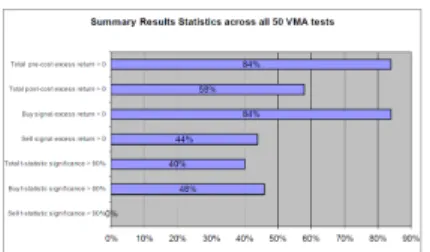
Fig. 6. Summary results statistics across all VMA tests
(1,50,0) rule yield positive excess returns when corrected for trading costs.
III. CONCLUSION ANDRECOMMENDATION
A. Summary of Research Findings
The primary objective of this research was to determine whether applying the simple technical trading rules of mov-ing average oscillator and tradmov-ing range breakout to past JSE All Share Index closing values yields excess returns when compared to a fundamental buy-and-hold strategy, by using the methodology of Brock et al. [3]. Secondary objectives included evaluating whether a specific rule or moving average duration tested outperforms the others and comparison of findings to past research.
1) Comparison to a fundamental buy-and-hold strategy:
Brock et al. [3] and numerous other international studies demonstrate that the identical set of simple technical trading rules possess significant forecast power for changes in the local stock exchange index. This research does provide some evidence of the predictive ability of simple technical trading rules on the South African Stock Exchange (JSE), however the standard Student-t tests conducted failed to confirm the statistical significance of the results conclusively as the null hypothesis could not be rejected.
In this research for the full sample period and aggregated across all 26 rules,the excess return (excluding trading costs) achieved by technical trading is shown to be 4.6% per annum. This is a significant improvement in return as the average annual buy-and-hold return is 16.3% in total. Excess returns achieved by simple technical trading rules after trading costs have been deducted is found to be on average 1.5% per annum.
Positive excess returns (before trading costs) are observed in all sub-periods tested except for sub-period 3, which is the period with the greatest price volatility and more of a side-ways rather than upward price trend 1. Sub-period 4, which showed an exponential positive trend, resulted in the highest technical trading returns. Both sub-period 2 and 3 showed negative returns when compared to a buy-and-hold strategy once transaction costs were taken into account. Therefore, we can conclude that excess profits are achievable in positively trending markets rather than highly volatile markets or bear markets, and that excess profits are not always achieved using simple technical rules once transaction costs are deducted.
Results also showed that the shorter time length moving average employed, the higher the pre- and post transaction cost technical trading returns. The VMA (1,50,0) rule yielded the highest pre-trading cost excess return of 12.5% while the TRB (1,50,0) rule yielded the highest post-trading profit of 5.9% over buy-and-hold.
Introduction of a 1% tolerance band reduced the number of trades, but was not found to consistently improve post-transactional cost returns and in many cases yielded worse results than not have a tolerance band on the rule. Overall, the VMA trading rules were found to outperform the other rule categories tested pre-trading cost however there was no clear ”superior” rule once trading costs were are taken into account. Certain other observations in the results re-enforce the conclusions made by Brock et al. [3]. Buy signals are found to consistently generate higher returns than sell signals. Further, the majority of returns generated by sell signals are negative, which cannot be readily explained using existing equilibrium models.
Based on the efficient market hypothesis, any indication that excess returns are possible through technical trading rules is considered an indication of market inefficiency. Therefore, this investigation provides evidence of market inefficiency in the local context however the findings in this study do not provide sufficient evidence to conclude that the JSE [15] is inefficient as a whole.
B. Research Implications
Future research opportunities to extend this research in-clude:
• the application of these simple technical trading rules
to individual shares rather than a share index;
• inclusion of additional technical trading rules such as
the stochastic indicator and the MACD;
• a combination various other technical trading rules into
a trading system, rather than the simple technical trading rules, which were tested in isolation, could be tested to improve returns;
• simple technical trading rules applied to different asset
classes (e.g. currencies, derivatives, etc) could also be researched using a similar methodology;
• the use of different statistical significance tests. Though
some of the international research emulated in this research used standard Student’s T analysis, others used a bootstraps p-methodology to determine statistical significance of results, and to validate that results are not due to serial dependence.
Part 3, of the of the study will show the results for the ten fixed moving average tests for different MA lengths for the full sample period from 1988 - 2007. The results will show that the number of buy signals are again far greater than the number of sell signals generated. All ten tests have shown positive buy-signal and total annual excess returns over a buy-and-hold strategy, however, only eight of the buy signal-return and two of the total-return t-tests reject the null hypothesis at the 90% significance level. Sell-signals returns were all negative when compared to the buy-and-hold return for those days. The FMA (1,50,0) and (1,50,0.01) rules yield the highest pre and post-transaction cost returns. All tests except the FMA (2,200,0.01) rule yield positive excess returns even once corrected for trading costs.
buy-signal returns, but only 4 of the total annual excess returns show positive returns over a buy-and-hold strategy. Four of the buy signal-return and two of the total-return t-tests reject the null hypothesis at the 90% significance level. Sell-signals returns were again mostly negative when compared to the buy-and-hold return for those days. The TRB (1,50,0) rule yields the highest pre and post-transaction cost returns. Four of the six tests yield positive excess returns even once corrected for trading costs
Overall, this research shows that excess returns over a na¨ıve buy-and-hold strategy can be earned on the JSE using simple technical trading rules, however the statistical signifi-cance of the results obtained in this research are inconclusive. Nevertheless, the evidence demonstrate that technical trading rules do have forecasting ability is intriguing and remains an interesting and unresolved issue for further research.
REFERENCES
[1] Bessembinder, H. and Chan, K., ”Market Efficiency and the Returns to Technical Analysis”,Financial Management, 1998, Vol 27, No.2, pp. 5-17.
[2] Boshoff, J. H., ”A critical Appraisal of Technical Analysis on the JSE”, 1984, Pretoria: UNISA,
[3] Brock, W. Lakonishok, J. and Lebaron, B., ”Simple Technical Trading Rules and the Stochastic Properties of Stock Returns”,The Journal of Finance, 1997, December, Vol.XLVII, No.5, pp. 1731-1764.
[4] Brown, D.J., ”An investigation into the Efficacy of Technical Analysis with Particular reference to Point and Figure Charts”, Johannesburg: University of the Witwatersrand, 1977.
[5] Campbell, H. M. ”Simple Technical Trading Rules on the JSE Securities Exchange of South Africa, Part 1,” in Prodccedings of the 2011 In-ternational Conference on Financial and Management Science (IFCMS 2011), Zengzhou, May 2011.
[6] Colby, R. and Meyers, T., ”The Encyclopedia of Technical Market Indicators”, 1988, Dow Jones-Irwin, Homewood, Illinois.
[7] Detry, P. J. and Gregoire, P., ”Other evidences of the predictive power of technical analysis: the moving averages rules on European indexes”, Belgium: University of Namur, 2000.
[8] Du Toit, G. S., ”Technical Analysis and Market Efficiency on the JSE”, Pretoria: UNISA, 1986.
[9] Fama, E. F., ”Efficient capital markets: a review of theory and empirical work”,Journal of Finance, 1970, 25, pp. 383-417.
[10] Goodspeed, I., ”The Equity Market”,South African Institute of Finan-cial Management, 2006.
[11] Gunasekarage, A. and Power, D.M., ”The profitability of moving average trading rules in South Asian stock markets”,Emerging Markets Review2, 2001, pp. 17-33.
[12] Heakal, R., ”What is Market Efficiency? , Investopedia Online Arti-cles”, 2002, http://www.investopedia.com/articles/02/101502.asp [13] Hudson, R., Dempsey, M., Keasey, K., ”A note on the weak form
efficiency of capital markets: the application of simple technical trading rules to UK stock prices 1935 to 1994”,J. Banking Finance, 1996, 20, pp. 1121-1132.
[14] Jefferis, K. and Smith, G., ”The changing efficiency of African Stock Markets”,South African Journal of Economics, 2005, Vol. 73:1. [15] ”Johannesburg Stock Exchange website”, www.jse.co.za, 2009. [16] Kahn, M.N., ”Technical Analysis - Charting the markets in you
language”,Financial Times, Prentice Hall, 1999.
[17] Laschinger, K., ”The Advantages of Technical Analysis”,Finweek, 31, August 2006, p.62.
[18] McAdam, A., ”Technical Analysis in the commodity, currency and share markets”, . Johannesburg: University of the Witwatersrand, 2001. [19] Ming, L. M., ”Technical Analysis in the Malaysian Stock Market: An
Empirical Evidence”, Malaysia: University Kebangsaan, 2001. [20] Parisi, F. and Vasquez, A., ”Simple technical trading rules of stock
returns: evidence from 1987 to 1998 in Chile”, Emerging Markets Review, 2000, 1, pp.152-164.
[21] Plummer, T. (1993), ”The psychology of technical analysis”, 1993, 2nd Edition, McGraw-Hill.
[22] Pring, M., ”Technical Analysis Explained: The Successful Investor’s Guide to Spotting Investment Trends and Turning Points”, 1980, McGraw-Hill.
[23] Ratner, M. and Leal, R.P.C., ”Test of Technical Trading Strategies in the Emerging Markets of Latin America and Asia”,Journal of Banking and Finance, 1999, 23, pp.1887-1905.
[24] http://www.reservebank.co.za/
[25] Rom, Y, ”A basic guide to technical analysis, trading and implemen-tation of trading systems”, 2006, 3rd Edition, The Winning Edge Pty Ltd.
[26] ”Standard Bank Online Trading website”, www.standardbank.co.za, 2009.
[27] Vassiloudis, D., ”Simple Technical Trading Rules on the JSE Securities Exchange of South Africa”,MEng Dissertation, 2007, University of the Witswatersrand, South Affrica.