UDC: 3.33 ISSN: 0013-3264
* University of Belgrade, Serbia
** Centre on Global Economic Governance, SIPA, Columbia University, New York, USA *** University of Perugia, Italy
1 An earlier version of the paper was presented at the 17th Conference of the International Association for the Economics of Participation (IAFEP) held at the Universidad de la República in Montevideo, Uruguay on 16-18 July, 2014. he authors are grateful to the participants of the conference for useful comments and suggestions. he authors would also like to thank Aleksandra Nojkovic for her helpful advice regarding probit estimates. JEL CLASSIFICATION: J54, J83, O52, P31
ABSTRACT: It is well known that Serbia – along with the other Southeast European successor states of former Yugoslavia – emerged from a country recognized for its speciic labour-managed institutional arrangement. he paper recalls the main premises of the literature on the labour-managed irm and the theoretical contributions on participatory forms of management that seem most relevant to a transition economy like Serbia’s. It proceeds to analyze the main changes that occurred in Serbia during transition to a market economy, illustrating some of its speciic features and how privatization led to the conversion of workers self-management into property rights. In order to analyze the role of employees in decision-making, and more generally their current position in privatized and newly established private irms, a survey was undertaken in 2013 based on a questionnaire for managers in 69 Serbian irms. he survey suggests that internal relations in enterprises are relatively
undeveloped, particularly regarding the distribution of responsibilities in decision making at various organisational levels, hampering the eicient fulilment of irms’ objectives. It appears that decision-making processes are usually designed in such a way as to give an excessive role to the owner as the exclusive decision-maker. he position of workers seems to be particularly poor regarding their rights to be informed, to make proposals, and/or to participate in decision-making in general. Moreover, even traditional workers’ rights are neglected (unionization, collective bargaining etc.). he survey also suggests that in those irms with a more active role of workers, there is a higher degree of workers’ satisfaction and loyalty to the irm.
KEY WORDS: Workers’ participation, Transi-tion, Serbian economy, Workers’ rights, Work-ers’ satisfaction and loyalty.
DOI:10.2298/EKA1505007C
Božidar Cerović*
Jan Svejnar**
Milica Uvalić***
WORKERS’ PARTICIPATION IN A FORMER
LABOUR-MANAGED ECONOMY:
1. INTRODUCTION
Fity-ive years ater Benjamin Ward’s (1958) seminal paper that marked the start of labour-management theory and twenty-ive years into the transition process in Eastern Europe, this paper ofers some insights regarding the role of workers in enterprise decision-making in Serbia, the largest successor state of former Yugoslavia. It is well known that Serbia and other countries born ater the disintegration of socialist Yugoslavia emerged from a country that for decades had been distinguished for its speciic labour-managed institutional arrangement. Yugoslavia’s unique economic system stimulated considerable academic interest for several reasons (Estrin and Uvalic 2008: 665). First, the Yugoslav model was of great interest as an example of a potential “third way” between capitalism and socialism. Second, the extension of the principles of democracy in decision-making was viewed by many as an objective for an economic system in its own right, combining the eiciency properties of a competitive market economy with the ethical and moral superiority derived from democratic workplace decision-making. Academic interest in self-managed socialism was swept away with the fall of the Berlin Wall in 1989, which brought radical transformation of the economic system in Eastern Europe, including former Yugoslavia, through transition to a market economy. he demise of the communist experiment came ater a decade of sharply deteriorating economic performance and rising political unrest in Yugoslavia, directly contributing to the country’s break-up in 1991 and damaging the credibility of the labour-managed variant of socialism (Estrin and Uvalic 2008: 667).
he paper is structured as follows. Ater this brief introduction, in section 2 we consider some of the contributions to the theoretical literature on the labour-managed irm, particularly those that explore workers involvement in the process of decision-making which are most relevant in the present Serbian context. Section 3 describes Serbia’s delayed transition, economic reforms and the new institutional arrangements introduced over the past twenty-ive years, drawing attention to the key systemic changes. Sections 4 and 5 give a detailed account of the survey of Serbian irms based on a questionnaire for managers, which explored internal relations, the presence of practices of employee involvement and the degree of worker satisfaction and loyalty. Section 6 presents the conclusions.
he paper focuses on Serbia, a country that has changed its statehood ive times over the last twenty-ive years. Ater the Socialist Federal Republic of Yugoslavia broke up in 1991, two of its six republics, Serbia and Montenegro, formed the Federal Republic (FR) of Yugoslavia in April 1992. In 2003 the FR Yugoslavia changed its name to the State Union of Serbia and Montenegro. In May 2006 Montenegro voted for independence in a referendum, so in June 2006 Serbia and Montenegro became two independent states. he inal change occurred when Serbia’s southern province of Kosovo unilaterally declared independence in February 2008 (although Kosovo remains unrecognized by 45% of UN members). Serbia is the primary focus of this paper, but occasionally we will also need to refer to the country Serbia was part of previously.
2. THEORY: WHY INVOLVE WORKERS?
to workers’ short time horizons. Speciic problems of inancewill also be present, since the labour-managed irm will have to borrow funds on the capital market, which is likely to lead to its high dependence on external inance. his in turn may cause the principal agent problem, i.e., conlict between the owner of capital and its user; and the moral hazard problem, arising from the risk associated with debt inance.
Subsequent developments of the theory have suggested, however, that under alternative assumptions many of the alleged short-term ineiciencies could be avoided. In the practice of workers cooperatives – in Italy, France, or Spain’s Mondragon cooperatives – many problems have been successfully overcome through speciic institutional arrangements. Moreover, a growing empirical literature has shown that the most important theoretical propositions have oten not been veriied in practice (Bartlett and Uvalic 1986; Estrin and Uvalic 2008).
he literature has further evolved to include various forms of workers participation in capitalist enterprises, encompassing employee participation in decision-making, in ownership and in enterprise results. Forms of employee participation in decision-making range from information disclosure and consultation to minority or full parity codetermination. Employee participation in enterprise results, also referred to as inancial participation or PEPPER schemes (Promotion of Employee Participation in Proits and Enterprise Results) include both proit-sharing and employee share ownership. Ever since the early 1990s, when the irst PEPPER Report (Uvalic 1991) was prepared and when, in July 1992, a European Council Recommendation on PEPPER was adopted, the European Union (EU) has actively promoted these schemes. Among the main reasons for the EU’s active support of PEPPER schemes is the conviction that they are likely to have beneicial efects, particularly on workers’ productivity and enterprise competitiveness (Uvalic 2006).
of shareholders’ utility, managers’ utility and workers’ utility. In “model I” the utilities are speciied as the simple unit prices of the relevant factor input, net of reservation prices. he utilities are deined exactly over the equilibrium sets of factor inputs, so that only the interests of those agents actually employed in the irm are taken into account; the system of participation is company-speciic. his is held to be relevant for the German system of Mitbestimmung where employee representatives on the board of directors and works councils represent the interest of employees. he solution to the maximization problem indicates that factors are employed up to the point at which their marginal productivity is equal to the sum of the reservation wage and a share in the enterprise proits determined by the participants’ relative bargaining power. his is an ineicient equilibrium, since factor input use is restricted relative to the benchmark case of a perfectly competitive proit-maximizing private irm, so the short-run behaviour of the codetermined irm is similar to that of the labour-managed irm, unless a mechanism exists such as unrestricted entry and exit of irms into an industry to ensure zero proits (Bartlett and Uvalic 1986: 19).
An alternative formulation, Svejnar’s “model II” (Svejnar 1982a), recognizes that it would oten be unrealistic to limit the interests which are represented in the codetermination process to those currently employed or associated with the irm. he wider constituency of union members both in and outside the irm, for example, might be regarded as interested parties in the codetermined process. In this model the utilities which are the subject of model I are augmented by an amount x/x, where x is the irm’s equilibrium employment level of a factor, and
x the membership of the broader constituency. In this case the solution to the maximization problem gives equality between the factor marginal product and its reservation price, and codetermination is allocatively eicient. In the German case there are important institutional features that might make model II more applicable (Barlett and Uvalic 1986: 20). In the early 1980s there was apparently consistent support for the view that workers’ participation in management causes higher productivity. his result was supported by a variety of methodological approaches using diverse data and for disparate time series (Jones and Svejnar 1982: 11), though some evidence from Germany suggests that codetermination had no signiicant efect on productivity (Svejnar 1982c).
and public sector bargaining in western countries. Estimating the model on Yugoslav irm-level data from the 1970s and the 1980s indicated that the perverse behaviour predicted by the Ward-Domar-Vanek model of labour-managed irms is not supported by the data, as irms place emphasis on both wages and employment (Prasnikar, Svejnar, Mihaljek, Prasnikar 1994: 728).
he above theoretical model in its diferent variants seems to depict quite well the Serbian enterprise during transition in the late 2000s, for several reasons. he multi-party framework is relevant for analyzing enterprise behaviour in a transforming socialist economy in general, and therefore the Serbian enterprise during transition as well. In addition, various forms of workers involvement practices in Serbia correspond roughly to those analyzed in the above-described models, including workers consultation, participation in some enterprise decisions, their presence on company boards or indirect inluence through trade unions – as will be seen in our later analysis of internal relations within Serbian irms today (sections 4 and 5). he described models ofer a sound theoretical framework for this paper, but could also be used for future research on the behaviour of the Serbian irm in transition.
3. SERBIA’S TRANSITION: CONVERTING SELF-MANAGEMENT INTO PROPERTY RIGHTS
Serbia’s transition to a market economy has been particularly complex and in many ways unique (Uvalic, 2010). he pro-market economic reforms introduced in late 1980s by the last Yugoslav government were short-lived, since the political events of the early 1990s – the break-up of the Yugoslav federation, military conlict and international sanctions – brought reversal in many areas. Ater the creation of the new Federal Republic of Yugoslavia in 1992, consisting of two republics, Serbia and Montenegro, some institutional arrangements, such as a new privatization law adopted in 1992, were implemented to replace the previous economic system, despite high political and economic instability. However, the priority of political over economic objectives, inconsistencies in the economic policies of the Serbian government throughout most of the decade, frequent changes in legislation and lack of willingness to implement radical reforms in certain important areas crucially inluenced reversals in the initiated reforms and the slowing down of the transition to a market economy (see Cerovic 1999, 2000).
system of workers self-management. Among all the successor states of former Yugoslavia, Serbia preserved certain institutions of the former self-management system for the longest (at least on paper). In part, this was due to political instability that caused delays in transition-related reforms such as privatization, but it was also due to the ideological continuity of Milosevic’s Socialist Party (the winner at the irst multi-partyelections in Serbia in January 1990) with the League of Communists of Serbia, as well as reform reversals such as increasing the share of state ownership (see Cerovic 1999). hese factors strongly inluenced the earlier privatization legislation - laws adopted in 1992 and 1997 were based on privileged sales on a voluntary basis to primarily employed workers and managers - with only modest results.
It ought to be recalled that in 1989 the initial conditions regarding the property regime were somewhat diferent in socialist Yugoslavia than elsewhere in Central and Eastern Europe. he speciic features of the Yugoslav economic system crucially inluenced the privatization process in all its successor states ater the country disintegrated in 1991. Under the system of “social property” that was introduced in Yugoslavia in the early 1950s, no one had property rights over enterprise assets, which oicially belonged to society as a whole (Uvalic, 1992). Enterprises had the right to use socially owned assets and to appropriate their product, but were never given full property rights, since some important rights remained irmly in state hands. Nevertheless, because self-management had ensured workers ample decision-making rights and the property regime was ambiguous, many workers felt they were the real owners of their enterprise, in line with the frequently held view that with the passing of time “group” property - namely property of the employed workers - had unoicially replaced social property.
to new laws adopted in 1992 and 1997. he prevailing position of the Serbian government until 2001 was that social property should remain one of the main property forms, although under a more direct state control than before.
Since social property survived much longer in Serbia than elsewhere, workers self-management, essentially their participation in enterprise decision-making, formally also remained present somewhat longer in Serbian enterprises than in surrounding countries, primarily in those enterprises that were not partially or fully privatized or re-nationalized. According to the provisions of the 1994 Serbian Company Law, a socially owned enterprise is managed by its workers while a mixed ownership enterprise is managed by both its shareholders, proportional to the share of invested capital, and employed workers, proportional to the share of social property. Although a new Company Law was adopted in 1996 which substantially reduced these rights, this law and subsequent changes to the law still envisaged the existence of a socially owned enterprise assuring workers concrete rights. Moreover, in the early 2000s ater the fall of the old regime, many enterprises had efectively not implemented the 1996 regulations but still operated according to the provisions of the 1994 Company Law. In Serbia, for longer than in the other countries of former Yugoslavia, the property rights of a socially owned enterprise remained ambiguous, divided among three collective agents – employed workers, the enterprise, and the state – where none of them had full control and ownership over the whole bundle (Uvalic 2004, 2010).
4. RECENT FEATURES OF WORKERS’ PARTICIPATION IN SERBIA
A survey of Serbian irms was undertaken in 2013 in order to explore whether workers in Serbia were active in the decision-making process and which were the main forms of their involvement in enterprise policies. Data was collected through a questionnaire for managers in 74 Serbian irms; once those that had provided incomplete or inconsistent data had been excluded the number remaining was 69. In selecting the irms we had to stick to the “snow-ball” method due to limited resources for the research, but tried to cover the most representative industries and irm types in terms of size and ownership. he survey was based on a more general questionnaire developed by Prasnikar et al. (2012) on various issues regarding intangible capital, among which the most relevant to our topic were the analysis of internal relations, workers’ involvement in making, and general decision-making practices. hese issues will be analyzed from several perspectives:
• To what extent are strategic decisions recognized and separated from operative decisions?
• What level of cohesion in decision-making has been achieved in terms of harmonious relations between owners, managers, and workers?
• What kind of loyalty do workers exhibit towards their irms and are they ready to undertake risks that their irms could face?
We have tried to investigate how these elements afect employee satisfaction and/ or how much they add to a irm’s internal cohesion and/or its overall social capital as a factor for potentially improving business performance.
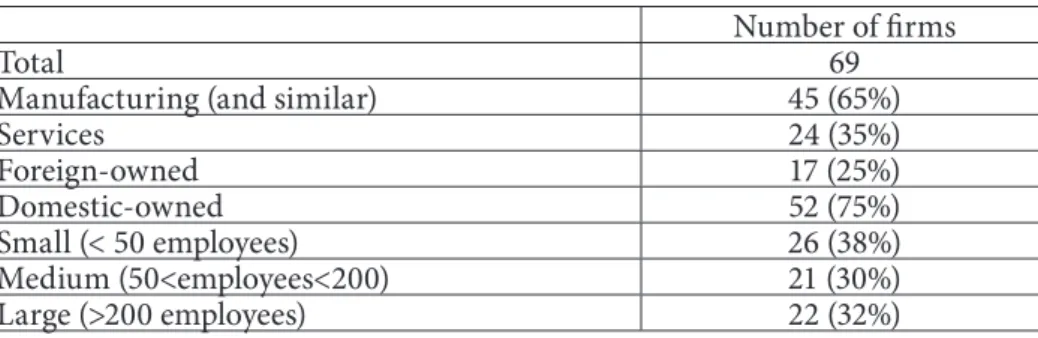
he enterprise sample structure is reported in Table 1. Within the sample a distinction was made between irms in manufacturing and services, domestic and foreign-owned irms, and small, medium, and large irms.
Table 1. Serbian enterprises: sample structure
Number of irms
Total 69
Manufacturing (and similar) 45 (65%)
Services 24 (35%)
Foreign-owned 17 (25%)
Domestic-owned 52 (75%)
Small (< 50 employees) 26 (38%)
Medium (50<employees<200) 21 (30%)
In order to discover whether irms were able to recognize speciic features of strategic decision-making the irst question managers were asked concerned their general approach to management. he question was whether their irms systematically separate strategic from current operative decisions at various levels of decision-making. Forty-four irms (63%) conirmed that they separate strategic from current operative decisions; among them medium-sized and large irms mostly conirmed this management practice (86% and 91% respectively), while the majority of negative answers came from small irms (20 or 77% of irms with less than 50 employees), which is understandable to a certain extent. A remarkable diference appears between the group of Foreign Owned Firms (FOF) (14 or 82% positive answers) and Domestically Owned Firms (DOF) (30 or 58%), suggesting better management practices in foreign companies.
Similar results were obtained from managers’ responses to the question regarding harmony and coordination between owners and managers in strategic decision-making over a ive-year period (2008-2012). Forty-twoirms (60%) declared that their managers and owners acted harmoniously, including 27% of small irms, 71% of medium irms, and 91% of large enterprises. hus a clear diference was again found according to irm size, in favour of larger irms. In addition, there was a notable diference between FOF and DOF: 13 or 77% of FOF reported harmonious relations as opposed to 29 or 56% of DOF.
Finally, the managers were asked whether strategic decisions are coordinated between owners, managers, and workers, namely along the entire agency chain. hirty-four respondents (49%) conirmed such practices, but again with a net distinction between FOF and DOF. Positive responses to this question were obtained from 11 FOF (or 65%), and from 23 DOF (44%). he size of irms also makes a diference: 23% of small, 57% of medium, and 73% of large irms conirmed such practices.
In our research we were particularly interested in exploring the relations between managers and workers, the general position of employees, and workers’ attitudes in the new environment of private irms during transition. In essence, we investigated three groups of questions:
• Is there any form of workers’ participation in decision-making? • Are there trade unions in the irm?
• Are workers ready to participate (or averse to participation) in their irms’ risks?
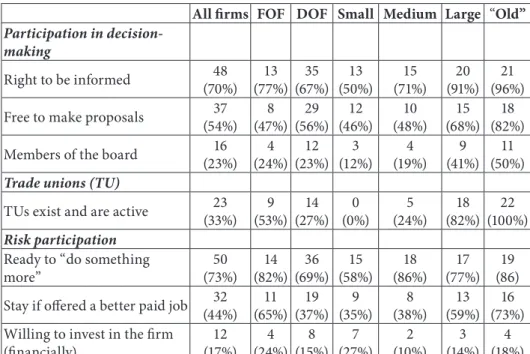
In Table 2 the surveyed irms have been classiied according to type of ownership (foreign or domestic) and size (small, medium, large). We additionally present the results for “old” irms that existed in former Yugoslavia and have mostly been privatized (with few exceptions).
Table 2. Workers’ participation and risk aversion (number of firms and in %)
All irms FOF DOF Small Medium Large “Old”
Participation in decision-making
Right to be informed 48 (70%) 13 (77%) 35 (67%) 13 (50%) 15 (71%) 20 (91%) 21 (96%) Free to make proposals 37
(54%) 8 (47%) 29 (56%) 12 (46%) 10 (48%) 15 (68%) 18 (82%) Members of the board 16
(23%) 4 (24%) 12 (23%) 3 (12%) 4 (19%) 9 (41%) 11 (50%) Trade unions (TU)
TUs exist and are active 23 (33%) 9 (53%) 14 (27%) 0 (0%) 5 (24%) 18 (82%) 22 (100%) Risk participation
Ready to “do something more” 50 (73%) 14 (82%) 36 (69%) 15 (58%) 18 (86%) 17 (77%) 19 (86) Stay if ofered a better paid job 32
(44%) 11 (65%) 19 (37%) 9 (35%) 8 (38%) 13 (59%) 16 (73%) Willing to invest in the irm
information ranged from “publicly presented decisions” (usually on the board or sometimes in internal bulletins with no previous consultation with workers) to regular meetings and discussions with employees (nine examples) regarding new products, ofered projects, business plans, investment etc. However, a notable number of managers stressed the pointlessness of these forms of information, arguing that owners are the only ones that ought to be in charge (thus excluding even managers).
As to more developed practices that involve workers in decision-making, only slightly more than half of the irms in the sample (54%) ofer employees the opportunity to make suggestions and/or concrete proposals. his practice is somewhat more developed among manufacturing irms (56%), which could be explained by the fact that they are predominantly larger irms, usually more open to workers’ participation. FOF lead in the practice of informing workers, but are more reserved when it comes to workers’ rights to make suggestions and particularly when it comes to their participation on boards. However, irm size seems to be an important factor regarding workers’ participation rights: in all three forms of participation we investigated the percentage of irms exercising such practices increases with irm size.
he data on trade unions (TU) presents an interesting and rather unusual picture. It seems that the existence of trade unions in Serbian irms is a neglected and even ignored practice.2 Indeed, there are 23 (mostly large) irms (33%) with active TUs, while in 12 of them more than one TU organisation is active. Only 7 irms (10%) report that trade unions concern themselves with the irm’s economic performance. It is also noticeable that twice as many FOFs have active trade unions (53%) than do DOFs (27%).
Deeper analysis can further clarify some of the issues regarding TU activity. A irst review of the data might lead to the conclusion that TUs are predominantly active in joint stock companies, and only partially within limited companies; or, alternatively, mainly in large companies and sometimes in medium-sized irms. However, although more frequently found in large irms, TU activity actually has little to do with the legal status or size of the irm. More in-depth analysis shows an astonishing fact: 22 of the 23 irms that report active TUs are irms that existed
in the pre-transition period (former Yugoslavia) and/or were bought by irms with a similar history (and legacy). here is only one medium-sized new private irm that reports the existence of TU activity. It is also important to note that among the group of “old” irms, TUs exist and act regardless of whether these irms were privatized (18) or not (4). We may therefore conclude that TUs act predominantly on the basis of habituated practices inherited from the previous system rather than on the basis of the irms and the TUs’ willingness and/or readiness to actively support workers and their rights during transition.
Alternatively, this could be attributed to employees’ values inherited from old institutional arrangements (regardless of what the real role and position of the “socialist” trade unions were under the communist-led self-management system). his conclusion is supported by the data on workers’ participation in irms that existed in the former Yugoslavia. As can be seen from Table 2, in the majority of “old” irms there is a more difused practice of various forms of worker participation in comparison with other irms. Within the group of “old” irms, 96% report the presence of workers’ right to be informed, 82% report workers’ right to make proposals, while 50% actually have worker participation on company boards. It is remarkable that three of the companies that have worker participation on the company board are under government control, in two companies there is a relatively high percentage of employee/management (internal) shareholding, while in the remaining four cases the owners are two foreign and two domestic proprietors.
In addition to more developed participation practices, in “old” irms the workers seem to exhibit a much higher level of loyalty. Eighty-six per cent of irm managers claim workers are ready to “do something more” for the company and 73% expect workers to stay with the irm even if they are ofered a better paid job elsewhere. his is particularly remarkable if we consider that three of these irms are in poor economic conditions. If we exclude these poor performers, the percentage is even higher than previously reported for the whole group.
5. WORKERS’ SATISFACTION AND LOYALTY TO THE FIRM
in separate parts of the questionnaire and are not necessarily answered by one person only, we can obtain more balanced responses, while “desirable” answers are less possible. hirdly, any positive interrelationship in managers’ answers regarding workers’ satisfaction and the rights they enjoy should be understood as an important guideline for developing managerial practice, despite the reluctance concerning workers’ rights found in the observed irms and presented in the previous section.
In trying to relate data on workers rights and participation to their loyalty to the irm, we introduced two corresponding indicators. he indicator of Workers Rights (WR) sums positive answers to ive questions on the existence of a TU, TU involvement in the issues of irm’s productivity, competitiveness and performance, workers’ right to be informed, their right to make proposals (without compulsory acceptance of their proposals by management), and workers’ representation on company boards. hus the WR indicator has values from 0 to 5. he indicator of Workers Loyalty (WL) which is related to the irst indicator, sums positive answers to three questions: whether workers are ready to “do something more” for their irm, whether they will stay with the irm if ofered a better paid job, and whether they are ready to invest inancially in the irm. Hence the WL indicator takes values from 0 to 3.
Two-thirds of all irms in our sample – 46 out of 69 (66.67%) – have a WR score of between 0 and 2, with an average below 1 (0.96). In these irms the average assessed score for WL is 1.11, and only ive irms in the group report the existence of a TU. If these irms are further divided into two sub-groups, one with a zero score for WR (20 irms do not recognize any WR as deined above) and the other with WR scores between 1 and 2, the WL average score values are 0.75 and 1.4 respectively for each sub-group.
managers assess workers’ loyalty as stronger when the irms have more workers’ rights.
A similar result is obtained if we classify irms according to size. In general, higher workers’ rights are anticipated in bigger irms, as well as higher levels of WL, and this was conirmed in our sample. In large irms (over 200 employees) the average level of WR is 2.9 and in medium-sized irms (51-200 employees) it is 1.67, whereas in small enterprises it is only 1.08. Correspondingly, the level of assessed WL diminishes from 1.6 in large irms to 1.33 in medium-sized irms and to 1.19 in small irms.3
We continued our analysis by adding to the WL indicator positive answers to the question whether managers consider workers in their irms to be at least as content as in other enterprises that are their competitors in the same market. hus we constructed a composite indicator on workers satisfaction and loyalty (WSL) that takes values from 0 to 4.
Applying the WSL indicator to the analysis only conirms the already reported basic results. In the group characterized by lower WR scores (0-2) the average WSL score is also below average (1.84), and it is even lower in the group with zero WR score (1.4). In the group with higher WR scores (3-5) the average WSL score reaches 2.65, while ater exclusion of the two irms undergoing restructuring it moves up to 2.81. Similarly, the level of assessed WSL diminishes from 2.39 in large irms to 2.14 in the medium-sized irms and to 1.92 in small irms.
he results for all groups clearly demonstrate that a higher level of workers’ job satisfaction and a higher level of loyalty to the irm can be expected if internal relations are more favourably organized regarding labour, and in particular if there are some elements of worker participation. Such a conclusion is related to the fact that sometimes we ind irms that do not have an active TU, but nevertheless report certain forms of worker participation (at least regarding the right to be informed or to advance proposals regarding the irm’s business), which undoubtedly points to participation practices as an important element of a irm’s internal relations, resulting in the superior behaviour of employees regarding irms’ objectives and on-job tasks.
However, when introducing notions like worker satisfaction in our analysis we have to check for another and even more recognized factor of worker satisfaction in the economic literature (as an objective of rational economic behaviour): wages. At irst sight, our previous conclusion regarding the link between WSL and WR could be in question if we introduce the level of wages corresponding to our groups of irms in regard to WR. Indeed, in the group with zero WR we also ind the lowest number of irm managers that report high wages: only six, or 30%, in the group (the question asked was whether workers in the irm are among those that are better paid in the economy as a whole). his percentage becomes higher in subsequent groups with an increasing WR score. hus, in the second group (WR between 1 and 2) there are 9 irms (36%) that report high wages, while the highest percentage is found in the third group (WR score 3-5): 12 irms or 50% in the group. his could suggest that worker satisfaction and loyalty come primarily from better-paid jobs, rather than from better-developed WR, which would agree with theoretical propositions on rational economic agents.
In order to check this hypothesis, we started with an analysis of 27 irms that reported high wages. Within the group there are as many as 9 irms (33.33%) with a low WSL score (0 or 1) and another 4 irms (14.82%) with WSL score 2, which is below the average value (2.12). Only 14 (51.85%) managers of the irms with high wages assess WSL as being high (3 or 4). he distribution of answers is also interesting: managers that assess lower levels of WSL usually state that their workers are content but assess their loyalty with low grades (they rarely expect workers to “do something more” for the irm and never expect them to invest or remain if ofered a better paid job elsewhere), conirming indirectly the belief that only high wages make workers happy. However, in the group of 13 irms with a lower WSL score, 9 irms (69.23%) also exhibit a lower level of WR (0-2). On the other hand, among the remaining irms that pay lower wages we ind 13 irms with a high WSL score (3 or 4). In this group there are 7 irms with relatively high WR scores (3-5), 3 irms at the upper low level (WR score 2), and only one with a zero WR score. hese data once again draw attention to the role of WR: the mere fact that workers earn more does not seem to ensure their satisfaction and loyalty to the irm, unless it is supported by better-developed internal relations that recognize workers traditional rights (TU) and the importance of participation.
decision-making practices (DM) summing up positive answers to these questions that takes values from 0 to 3. We suppose that a higher DM score represents a better and more harmoniously organised decision-making process within a irm. It appeared that WSL was also related to the quality of decision-making: the higher the score for the three characteristics regarding decision-making practices, the higher the level of WSL. hus, for example, the group of irms with a higher WSL (3 or 4) demonstrates a higher average value of DM (2.0), while the group of remaining irms with lower WSL (0-2) exhibits a lower DM average score of 1.56. Alternatively, irms with the highest scores for DM (3.0) have a noticeably higher score for WSL (2.38 on average) than the remaining irms with a lower value of DM (average WSL equals 1.92).
Similarly, and in agreement with the results from the previous section, small irms seem to have the least developed decision-making systems (they are particularly lacking harmony along the agency chain; average DM=0.73), followed by a low average score for WSL (1.92). Decision-making is advanced in medium-sized irms (DM=2.18) and WSL is also higher (2.14), while in the large irms DM reaches 2.52 with the highest score for WSL of 2.33. However, it should be noted that this interrelationship between DM and WSL is also linked to the previously discussed indicator of workers rights (WR), since higher DM scores are connected with higher WR values4.
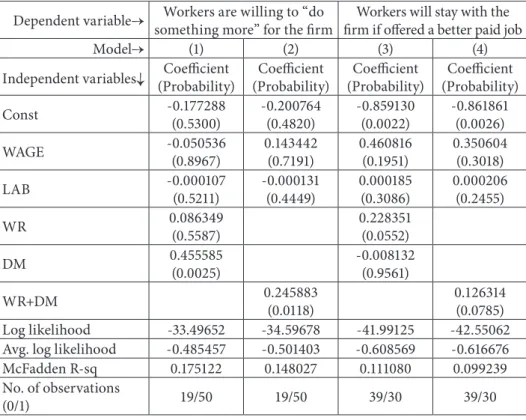
In order to further clarify our indings and make them more precise we tested several probit models. We irst tested two binary probit models (1 and 2) where the dependent variable was a positive answer to the question whether workers are ready to “do something more” for the irm. he independent variables in model 1 were: (a) WAGE indicating wage level (positive answers to the question whether the workers are among the better paid in the economy), (b) LAB for number of employed, to represent the size of the irm, (c) WR as deined before, (d) DM as deined before. In model 2, instead of variables (c) and (d) we included as a new variable the simple sum of these two variables (WR+ DM).
We also tested another two probit models (3 and 4) where the dependent variable was a positive answer to the question whether workers will stay with the irm if ofered a better-paid job, while the independent variables remained the same
as those used in models 1 and 2 respectively. he results for the four models are reported in Table 3.
Table 3. Binary probit models for the sample of Serbian firms
Dependent variable→ Workers are willing to “do something more” for the irm
Workers will stay with the irm if ofered a better paid job
Model→ (1) (2) (3) (4)
Independent variables (Probability)Coeicient (Probability)Coeicient (Probability)Coeicient (Probability)Coeicient
Const -0.177288
(0.5300)
-0.200764 (0.4820)
-0.859130 (0.0022)
-0.861861 (0.0026)
WAGE -0.050536
(0.8967)
0.143442 (0.7191)
0.460816 (0.1951)
0.350604 (0.3018)
LAB -0.000107
(0.5211)
-0.000131 (0.4449)
0.000185 (0.3086)
0.000206 (0.2455)
WR 0.086349
(0.5587)
0.228351 (0.0552)
DM 0.455585
(0.0025)
-0.008132 (0.9561)
WR+DM 0.245883
(0.0118)
0.126314 (0.0785) Log likelihood -33.49652 -34.59678 -41.99125 -42.55062 Avg. log likelihood -0.485457 -0.501403 -0.608569 -0.616676 McFadden R-sq 0.175122 0.148027 0.111080 0.099239 No. of observations
(0/1) 19/50 19/50 39/30 39/30
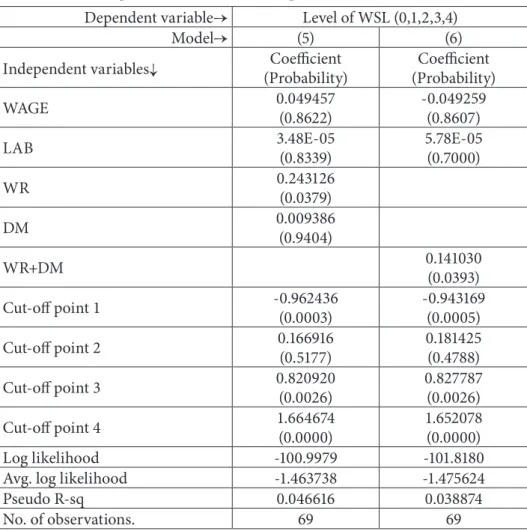
We also tested two ordered probit models where the dependent variable was WSL as deined before, while the sets of independent variables remained identical to the previously tested binary models. he results are reported in Table 4.
Table 4. Ordered probit models for the sample of Serbian firms Dependent variable→ Level of WSL (0,1,2,3,4)
Model→ (5) (6)
Independent variables Coeicient (Probability)
Coeicient (Probability)
WAGE 0.049457
(0.8622)
-0.049259 (0.8607)
LAB 3.48E-05
(0.8339)
5.78E-05 (0.7000)
WR 0.243126
(0.0379)
DM 0.009386
(0.9404)
WR+DM 0.141030
(0.0393)
Cut-of point 1 -0.962436
(0.0003)
-0.943169 (0.0005)
Cut-of point 2 0.166916
(0.5177)
0.181425 (0.4788)
Cut-of point 3 0.820920
(0.0026)
0.827787 (0.0026)
Cut-of point 4 1.664674
(0.0000)
1.652078 (0.0000)
Log likelihood -100.9979 -101.8180
Avg. log likelihood -1.463738 -1.475624
Pseudo R-sq 0.046616 0.038874
No. of observations. 69 69
with higher wage levels only, and may not relate it to a higher level of worker loyalty (discussed earlier). It is also noticeable that similar to the other models tested (1-4), variables like wage level and/or irm size remain clearly insigniicant with no important efect on the level of WSL.
Summarizing all the indings, we can conclude that there is an evident and positive connection between WSL (including some of its constituent elements) and harmonious decision-making practices, with a irm’s compliance with workers rights taking irst place, and including various forms of participation. It is particularly important to stress that all the results obtained are based on managers’ opinions, despite the fact that when asked directly they are not particularly in favour of workers’ participation. Such an attitude has resulted in a relatively low level of workers’ rights within the analyzed sample of Serbian irms.
6. CONCLUDING REMARKS
Our analysis based on a recent managers’ survey of 69 Serbian irms suggests that managers underestimate the relative importance of internal relations, thus hampering the eicient fulilment of enterprise objectives. It appears that decision-making processes are frequently not properly designed, leaving an excessive role to the owner as the exclusive decision-maker and inducing discrepancies in task-fulilling along the agency chain. In addition, the position of workers is frequently poor, particularly regarding their right to be informed, to make proposals, and to participate in decision-making in general. Moreover, even traditional workers’ rights are oten neglected (unionization, collective bargaining, etc.). However, when these aspects of internal relations are more developed, a higher level of worker satisfaction and loyalty to the irm was identiied. he problem of workers’ non-involvement is particularly evident within smaller and domestically owned irms, whereas in foreign owned irms internal relations are usually developed with more care. We conclude that inadequately established processes of decision-making and unsuitable internal relations in general result in a lower probability of improving cohesion within the irm, something that eventually can hamper economic performance.
some countries like Slovenia the desire to maintain some continuity with the past legacy led to the adoption of a co-determination law and to a privatization model based on partial employee share ownership. In the other successor states of former Yugoslavia, ater the country had disintegrated and the transition to a market economy had begun in the newly created independent states, much of the blame for the demise of the Yugoslav federation and the failure of its speciic model of market socialism was put on its self-management features, disregarding other important factors that have undoubtedly played a more fundamental role. hese include socialist features of the Yugoslav economic system that were present throughout Eastern Europe (including sot-budget constraints and state paternalism); complicated procedures introduced by the Associated Labour Act in the early 1970s (e.g., social compacts and self-managed agreements which, instead of further developing the self-management model, efectively reduced the freedom of enterprises to take decisions independently); the 1974 Yugoslav Constitution, which introduced extreme decentralisation in almost all areas of economic policy, giving rise to “economic nationalism” and fuelling a divergence of interests among its constituent parts; and increasing reliance on foreign loans to inance economic growth and development, which eventually led to a serious debt crisis in 1982. All of these factors and still others - primarily the deep political crisis - are undoubtedly more important in explaining the demise of the Yugoslav socialist market model than its self-management features (Uvalic 1992). Moreover, a number of socialist features of the Yugoslav economic system continuously suppressed self-management, efectively never allowing its full development (Cerovic 1992; Prasnikar and Svejnar 2007; Uvalic 1992).
REFERENCES
Bartlett, W. and M. Uvalic, (1986). “Labour-managed Firms, Employee Participation and Proit-sharing - heoretical Perspectives and European Experience”, Special Issue of Management Bibliographies & Reviews, vol. 12, no. 4, Bradford
Cerovic, B., (1992). “Labour-managed Firm in a Transition Process – a sketch for economic analysis”, in: he Man in the Socio-economic System, General Confederation of Trade Unions, Academy of Science of Russia et al., Moscow, pp. 373-390.
Cerovic, B., (1999). “Costs of the Delay: Comparing Yugoslavia with Other Transition Economies”, in: Recent Developments and Problems in the Transition Economies, St. Cyril and Methodius University, Faculty of Economics, Skopje, pp. 55-66.
Cerovic, B., (2000). “Economy of FR Yugoslavia: Transition or Pre-transition Economy”, Ljubljana University, Faculty of Economics, Working Paper Series, No. 97, 2000.
Cerovic, B., S. Mitic, A. Nojkovic, (2014). “Improving Competitiveness of Serbian Firms: the Role of Intangible Capital”, in: Proceedings of the 10th International Conference of ASECU, Towards Post-Crisis Prosperity: Alternative Economic Policies and Institutional Reforms in Southern and Eastern Europe, Cluj-Napoca, pp. 264-294.
Domar, E. D., (1966). “he Soviet collective farm as a producer cooperative”, American Economic Review, Vol. 56, no 4, pp. 737-57.
Estrin, S. and M. Uvalic (2008). “From Illyria towards Capitalism: Did Labor-Management heory Teach Us Anything about Yugoslavia and Transition in its Successor States?” 50th Anniversary
Essay, Special Issue of Comparative Economic Studies, vol. 50, pp. 663-696.
Jones, C. D. and J. Svejnar (1982). “he economic performance of participatory and self-managed irms: A historical perspective and review”, Chapter 1 in D. Jones and J. Svejnar (1982), Participatory and Self-Managed Firms: Evaluating Economic Performance, Lexington Books.
Prasnikar, J., J. Svejnar, D. Mihaljek and V. Prasnikar, (1994). “Behavior of Participatory Firms in Yugoslavia: Lessons for Transforming Economics,” Review of Economics and Statistics, LXXVI(4), pp. 728-741 November.
Prasnikar, J. and J. Svejnar (2007). “Investment, wages and corporate governance during the transition: Evidence from Slovenian irms”, in S. Estrin, G. W. Kolodko and M. Uvalic (Eds.) (2007), Transition and Beyond, Basingstoke, Palgrave Macmillan, pp. 149-173.
Svejnar, J. (1982a). “On the heory of a Participatory Firm,” Journal of Economic heory, 27(2), pp. 313-330.
Svejnar, J. (1982b). “Employee Participation in Management, Bargaining Power and Wages”, European Economic Review, 18(3), pp. 291-303.
Svejnar, J. (1982c). “Codetermination and productivity: Empirical evidence from the Federal Republic of Germany”, Chapter 10 in D. Jones and J. Svejnar (1982), Participatory and Self-Managed Firms: Evaluating Economic Performance, Lexington Books.
Uvalic, M. (1991). he PEPPER Report - Promotion of Employee Participation in Proits and Enterprise Results, Commission of the European Communities & European University Institute, Florence & Brussels (published in English, French and German), Social Europe, Supplement 3/91, Oice of Oicial Publications of the EC, Luxembourg.
Uvalic, M. (1992). Investment and Property Rights in Yugoslavia - he Long Transition to a Market Economy, Cambridge, Cambridge University Press. Reprinted in paperback in 2009.
Uvalic, M. (2004). “Privatisation in Serbia: he diicult conversion of self-management into property rights”, inVirginie Pérotin and Andrew Robinson (Eds.), Advances in the Economic Analysis of Participatory and Labor-Managed Firms,Volume 8, pp. 211-237.
Uvalic, M. (2005). “Labour Movement in Serbia: Seeking Representation, Struggling for Acceptance” in D. Dimitrova and J. Vilrokx (Eds.), Trade Union Strategies in Central and Eastern Europe: Towards Decent Work, Budapest, International Labour Oice, pp. 153-200.
Uvalic, M. (2006). “Employee ownership – Western lessons for the Eastern new EU member states”, in J. Lowitzsch (Ed.), he PEPPER III Report: Promotion of Employee Participation in Proits and Enterprise Results in the New Member and Candidate Countries of the European Union, Berlin: Inter-University Centre, pp. 46 – 68.
Uvalic, M. (2010). Serbia’s Transition – Towards a Better Future,Basingstoke, Palgrave Macmillan and New York, St. Martin’s Press. Expanded edition in Serbian: Tranzicija u Srbiji – Ka boljoj buducnosti,Belgrade: Zavod za udzbenike, 2012.
Vanek, J. (1970). he General heory of Labor-managed Market Economies, Ithaca and London: Cornell University Press.
Ward, B. (1958). “he irm in Illyria – Market syndicalism”, American Economic Review, Vol. 48, no. 4, pp.566-89.