Marta Regina Cezar-Vaz
I, Clarice Alves Bonow
II,
Marlise Capa Verde Almeida de Mello
I, Mara Regina Santos da Silva
II Universidade Federal do Rio Grande, Nursing School. Rio Grande, Rio Grande do Sul, Brazil. II Universidade Federal de Pelotas, Nursing School. Pelotas, Rio Grande do Sul, Brazil.
How to cite this article:
Cezar-Vaz MR, Bonow CA, Mello MCVA, Silva MRS. Socio-environmental approach in nursing: focusing on rural labor and the use of pesticides. Rev Bras Enferm [Internet]. 2016;69(6):1114-21. DOI: http://dx.doi.org/10.1590/0034-7167-2016-0364
Submission: 06-22-2016 Approval: 08-26-2016
ABSTRACT
Objective: to apply a socio-environmental approach to the relationship between human health and rural labor through a link verifi cation/association between health disorders and the use of pesticides. Method: this is a quantitative, cross-sectional, observational and exploratory study with 331 inhabitants of two cities in the state of Rio Grande do Sul, Brazil. Data analysis was conducted by Poisson regression. Results: reported health disorders included: mental (62.2%); circulatory (49.8%); dermatologic (45%); respiratory (41%); and gastric (36.2%). Workers who apply pesticides showed a 90% higher prevalence of dermatological alterations when compared to those who did not. Conclusion: the socio-environmental approach, comprising elements of the rural environment, of workers, and of the use of pesticides in the work process in connection/association with potential health disorders has shown that rural workers who apply pesticides present a higher prevalence of dermatological alterations.
Descriptors: Agrochemicals; Working Environment; Occupational Diseases; Rural Workers; Practical Nursing.
RESUMO
Objetivo: aplicar uma abordagem socioambiental na relação entre saúde humana e trabalho rural por meio da verifi cação de nexo/associação entre distúrbios de saúde e uso de agrotóxicos. Método: estudo quantitativo, transversal, observacional e exploratório, realizado com 331 trabalhadores rurais de dois municípios do estado do Rio Grande do Sul, Brasil. Realizou-se análise dos dados por regressão de Poisson. Resultados: os distúrbios de saúde referidos incluíram: distúrbios mentais (62,2%), circulatórios (49,8%), dermatológicos (45%), respiratórios (41%) e gástricos (36,2%). Trabalhadores que aplicam agrotóxicos apresentam prevalência 90% maior de alterações dermatológicas quando comparados aos que não aplicam. Conclusão: o uso da abordagem socioambiental constituída por elementos do ambiente rural, do trabalhador e do uso de agrotóxicos no processo de trabalho no potencial nexo/associação com os distúrbios de saúde permitiu verifi car que os trabalhadores rurais que aplicam agrotóxicos apresentam maior prevalência de alterações dermatológicas.
Descritores: Agroquímicos; Ambiente de Trabalho; Doenças Profi ssionais; Trabalhadores Rurais; Enfermagem Prática.
RESUMEN
Objetivo: aplicar un abordaje socioambiental en la relación entre salud humana y trabajo rural mediante verifi cación del nexo/asociación entre disturbios de la salud y uso de agrotóxicos. Método: estudio cuantitativo, transversal, observacional y exploratorio, realizado con 331 trabajadores rurales de dos municipios de Rio Grande do Sul, Brasil. Datos analizados por regresión de Poisson. Resultados: los referidos disturbios de salud incluyeron: disturbios mentales (62,2%), circulatorios (49,8%), dermatológicos (45%), respiratorios (41%) y gástricos (36,2%). Los trabajadores que aplican los agrotóxicos presentan una prevalencia 90% mayor de alteraciones dermatológicas en comparación con los que no los aplican. Conclusión: el uso del abordaje socioambiental constituido por elementos del ámbito rural, del trabajador y del uso de agrotóxicos en el proceso
Socio-environmental approach in nursing:
focusing on rural labor and the use of pesticides
INTRODUCTION
The socio-environmental approach to human health in rela-tion to labor requires a continuous and engaging process in the construction and evaluation of care and prevention strategies as a way of understanding and managing the social and environ-mental situations(1-3) that influence workers’ health conditions and diseases. The constitution of socio-environmental objects in this case, the work environment and the worker requires an understanding of the links to/associations with between the pro-duction of health/disease and the work process, with reference to rural workers and the use of pesticides at work.
The rural labor that makes excessive use of pesticides for agri-cultural development is associated, directly and indirectly, with the health conditions of people, the work environment, and na-ture. According to the World Health Organization(4), pesticides constitute an acute health risk due to single or multiple expo-sures during handling. This exposure is the cause of morbidity and mortality worldwide, especially in developing countries(5) such as Brazil, where the situation is worsening because of the use of increasing amounts of pesticides per hectare(6).
Knowledge of the links to/associations with between rural labor and the use of pesticides is most evident in the literature through dermatological, respiratory, gastric, mental, and circu-latory disorders. Research carried out in Bangladesh with rural workers points to dermatologic disorders (pruritus and irritation), eye disorders (pain, pruritus, irritation, cataracts, and decreased vision), and gastric disorders (stomach pain, digestive problems, loss of appetite, and vomiting)(7) related to the use of pesticides. Also, a study conducted with rural workers in India who used pesticides in plantation showed that the exposure time signifi-cantly increases the number of respiratory problems and decreas-es lung function of workers(8). In addition, the link/association between hypertension, cognition in the elderly, and exposure to pesticides was suggested in a study of 644 elderly in the USA(9).
An apparently simply strategy to reduce the exposure of work-ers during application of and throughout the rural labor process with pesticides is the use of personal protective equipment (PPE). A study carried out in South Africa showed that workers have low adherence to the use of PPE during the application of pesticides, despite knowing the risks of unprotected exposure(10). It is important to note that rural workers who apply pesticides are the most exposed, although those who work in the plantation after the application of these products and the families of those who apply them, even with PPE/recommended clothing, are also exposed to the risks. In this way, exposures may vary accord-ing to the worker’s contact with the chemical component of the pesticide(11). In the examples cited, the presence of two important factors is evident: the working environment and the worker as an individual who follows the social requirement to apply pesticides
on the plantation to increase productivity, for the development of a product more acceptable on the market.
Thus, the excessive use of pesticides and either inadequate protection or even no use of PPE makes health disorders related to this practice a socio-environmental health problem. In this sense, nursing in primary care can use the theory of risk communica-tion(12) with rural workers to educate them about the consequenc-es of exposure to pconsequenc-esticidconsequenc-es. However, to start this procconsequenc-ess of com-munication, nursing needs to identify signs or symptoms of these health disorders as possible links to/associations with exposure to pesticide use, to know the toxicity of chemicals used and apply dialogic strategies for greater adherence to the use of PPE.
Understanding the relationship between rural labor and the use of pesticides allows the expansion of spaces for the construction of nursing knowledge. It is believed that the foray into this socio-environmental object provides a consid-erable contribution to and impact on the area of nursing in public health, especially for the care of rural populations, in the sense of increasing the theoretical, practical, and method-ological knowledge of the rural working environment, rural workers, and the use of pesticides regarding the possible link to/association with the production of health/disease.
Given the above, the aim is to apply a socio-environmental approach to the relationship between human health and rural labor through the verification of links/associations between health disorders and the use of pesticides.
METHOD
Ethical aspects
The project was approved by the Research Ethics Commit-tee of the university performing the study, and developed ac-cording to the guidelines of Resolution No. 466 of 2012 of the National Health Council. All participants signed a Free and Informed Consent Form.
Design, study site, and period
This was a quantitative, cross-sectional, observational, and exploratory study conducted with rural workers of two munici-palities in the state of Rio Grande do Sul, Brazil, about the link/ association between health disorders (mental and nervous sys-tem, respiratory, gastric, circulatory, and dermatological) and pesticide use at work. Municipality 1 is located in the extreme south of the state, and Municipality 2 is on the western border.
The research was structured through a nursing socio-environ-mental approach in order to comprehend the object constituted of the rural environment, the workers, and the use of pesticides in the work process and the potential link to/association with health disorders. To operationalize this approach, two munici-palities were chosen that, in addition to having extensive rural
Marta Regina Cezar-Vaz E-mail: [email protected]
CORRESPONDING AUTHOR
laboral buscando el potencial nexo/asociación con los disturbios de salud permitió verificar que los trabajadores rurales que aplican agrotóxicos presentan mayor prevalencia de alteraciones dermatológicas.
areas, have records of environmental contamination in water. In both municipalities(13-14) the situation is worrisome because this water can be used for irrigation of plantations and/or as a supply for urban areas(14). Thus, they were selected and characterized a priori, due to the excessive use of pesticides. The study was conducted from March 2013 to April 2014.
Sample and inclusion and exclusion criteria
There is no record of the total number of rural workers in official sources, that is, state and municipal bodies related to assistance for rural workers (Rural Workers’ Union, Technical Assistance and Rural Extension Company, and Municipal Ag-riculture Secretariat). Thus, the sample calculation was done through the EpiInfo 6.04 StatCalc tool, considering the total number of inhabitants of the municipalities and a 95% confi-dence level, which resulted in 369 participants: 179 for Mu-nicipality 1, and 190 for MuMu-nicipality 2.
For convenience, the sample selection was non-probabilis-tic, based on the following inclusion criteria: resident of the rural area of the municipalities included in the survey; mini-mum age of 18 years; working in horticultural farming; and applying/being in contact with pesticides in planting. Rural workers who did not apply or who were not in contact with pesticides in planting during the study period were excluded.
After searching the homes of the participants, the sample constituted 393 rural workers: 243 from Municipality 1; and 150 from Municipality 2. In Municipality 1 there were 17 loss-es and 25 refusals; and in Municipality 2 there were 19 lossloss-es and one refusal. It is emphasized that losses were considered after at least five attempts were made to contact the workers at their residence. Refusals were accounted for by the expression of the workers’ disinterest in participating in the study.
Study protocol
For data collection, first, a structured questionnaire was ap-plied in the period from March to December 2013.
The questions were divided into characterization (age, home town, skin color, marital status, and education level); health disor-ders described by the Ministry of Health(15): mental disorders and disorders related to the nervous system (generalized anxiety der, depressive episodes, acute stress reaction, non-organic disor-der of the sleep-wake cycle, and panic disordisor-der); respiratory dis-orders (tonsillitis, pharyngitis, laryngitis, allergic rhinitis, chronic rhinitis, sinusitis, asthma, and pneumonia); gastric (heartburn, gas-tritis, stomach pain, malaise, nausea, vomiting, esophagitis, and gastric ulcer); circulatory (systemic arterial hypertension, cardiac arrhythmia, angina, atherosclerosis, varicose veins, and edema of the lower limbs); and dermatological (pruritus, allergy, mycoses, skin cancer, rash, dermatitis, and chemical burns). Lastly, any links with health services (Basic Health Units, hospital, public, or pri-vate health insurance) were determined.
In addition, the rural working environment was charac-terized by operating time, daily working hours, type of rural property(16), property size, and monthly income; pesticide use (type and number of pesticides used(4)); rural living, through the worker’s relationship with the family and close individuals (colleagues, neighbors). For this last variable, a derivation of a
theory to assist in the investigation was used: the International Classification of Functioning, Disability and Health (ICF)(17), proposed by the World Health Organization, in order to in-clude the activities, social participation, and environmental context in which individuals are inserted.
The ICF makes it possible to classify environmental factors by identifying barriers and environmental facilitators that interfere with the ability and performance of actions and tasks of daily life. In the specific case of the relationship of workers with fami-ly and close individuals, based on the items of barriers and facil-itators of ICF, workers were asked to choose, from a Likert scale of four points (no barrier/facilitator, barrier/light facilitator, mod-erate, substantial or complete), which support and relationship they maintain with family members/individuals next to them, and identify the attitudes of these people. This questionnaire has been used in other studies(18-19) and adapted to this study through the conduction of a pilot study with 10 employees from two municipalities other than the ones from this research.
Concomitant with this stage, there was systematic observa-tion of the participants, in order to know the rural work firsthand. This stage occurred during the period of August 2013 to Febru-ary 2014 and was done through a checklist of activities carried out by workers on the plantation, that is, those requiring contact with pesticides: cultivation; harvesting of agricultural products; soil preparation; and planting. The use of the following PPE was also being investigated: mask with respirator; lab coat and water-repellent pants; facial visor; Arab cap; rubber boots; waterproof gloves; helmet; mask; brimmed hat; ear protector; and sunscreen. This step was performed without previous scheduling, always in the presence of two observers. The average observation time per employee was 50 minutes. Due to the unavailability of financial resources, observation was performed with 30% of the sample.
The last step, risk communication for workers who apply and are in contact with pesticides, was based on dialogic ex-planation by the researchers to rural workers.
It is noteworthy that risk communication theory is an interac-tive process of information and opinion exchange involving mes-sages about events that represent risks and ways to identify and manage them(12). For the communication to be effective, it is nec-essary to know the characteristics of the event that represents the risk to be communicated. For this reason, the dialogic explanation was built on the basis of clinical evidence on the prevention of health disorders when pesticides are used during rural work(4,10).
Analysis of results and statistics
For data analysis, quantitative variables were expressed as mean and standard deviation or median and interquartile range, and categorical variables as absolute and relative frequencies. To compare means between groups, the Student t-test was ap-plied for independent samples. In case of asymmetry, the Mann-Whitney test was used. When comparing proportions, Pearson’s chi-squared tests or Fisher’s exact tests were used. To control confounding factors, Poisson regression analysis was carried out.
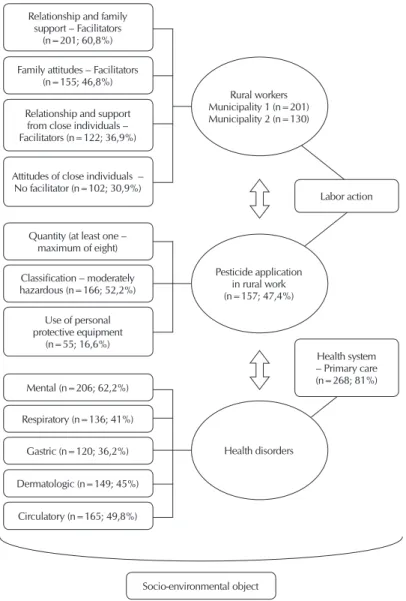
A criterion for the entry of the variable into the model was p <0.20(20) in the bivariate analysis. The significance level was 5% (p ≤0.05), and analysis occurred using SPSS version 21.0. The socio-environmental approach adopted in this study groups the set of elements described above, namely: rural workers of Municipalities 1 and 2; relationship of workers in the rural living environment (family and close individuals); pesticide use at work (amount and classification); use of PPE; link/association expressed based on health disorders (mental, circulatory, dermatologic, gastric, and respiratory); and use of public and private health systems (Figure 1).
RESULTS
Rural workers’ characterization data are presented in Ta-ble 1. The age ranged from 18 to 81 years, with a mean of 50.58 (standard deviation of ±13.97). Most of the partici-pants belonged to Municipality 1 (n = 201, 60.7%), were fe-male (n = 182; 55%), white (n = 304, 91.8%), married (n = 273, 82.5%), with incomplete primary education (n = 220, 66.5%), and average monthly income of R$1,827.97. Most respondents (n = 268; 96.8%) were small rural producers (had less than 50 hectares), and 54 respondents (16.3%) were unable to inform interviewers of the extent of their properties.
Relationships with and support from families and close individuals, and also family attitudes, were shown to be posi-tive, and most of the participants indicated complete facilita-tors and no barrier. However, the attitudes of close individu-als did not represent facilitators for the majority (n = 102, 30.9%) (Table 2).
Regarding the use of pesticides, all rural workers made use of them: 157 (47.4%) applied them in the workplace and 174 (52.6%) assisted in the application. The pesti-cides applied by the interviewed rural workers were composed of active ingredients belonging to various groups, according to the WHO classification(4), and most of them (n = 166, 52.20%) used products clas-sified as moderately hazardous (acephate, deltrame-thrin), 114 (35.84%) slightly dangerous (glyphosate), four (1.25%), extremely dangerous (methyl parathi-on), and three (0.9%) highly hazardous (cyperme-thrin). The majority (n = 97; 57.1%) also made use of more than one type of pesticide on the plantation. The average of pesticide use was 2.36 (standard de-viation ± 1.57), ranging from one to eight products. As for the PPE used by rural workers during ap-plication of pesticides, the majority used masks with respirator (n = 55, 16.6%), water-repellent coats (n = 28, 8.5%), facial visors (n = 23, 6.9%), water-repellent pants (n = 23, 6.9%), Arab caps (n = 20, 6%), rubber boots (n = 19, 14.6%), gloves (n = 15, 11.5%), helmets (n = 10, 3%), masks (n = 09, 6.9%), brimmed hats (n = 06, 4.6%), and ear protec-tors (n = 03, 0.9%).
When analyzing the links to/associations with pesticide use, adjusted to rural workers’ profile data, there was a significant association between such use and the municipality, sex, marital status, education, hours of work in agriculture, and the robust vari-able time x hours. Rural workers from Municipality 2 (p =0.027), men (p <0.001), single (p =0.045), with higher education (p =0.040), working for more hours (p <0.001), and longer time in agriculture (p =0.022), were more likely to use pesticides.
Regarding health disorders, the majority reported presenting mental disorders (n = 206, 62.2%), fol-lowed by circulatory disorders (n = 165, 49.8%), dermatologic (n = 149, 45%), respiratory (n = 136, 41%), and gastric (n = 120, 36.2%).
Socio-environmental object
Labor action Relationship and
family support
Relationship and support from close individuals
Family attitudes
Attitudes of close individuals
Rural workers (municipalities 1 and 2)
Quantity
Classification
Use of personal protective equipment
Pesticide application in rural work
Circulatory Mental
Respiratory
Gastric
Dermatologic
Health disorders
Health system
In the link/association between health disorders and the use of pesticides, rural workers who used them had fewer circula-tory problems (p =0.018) and greater dermatologic alterations (p =0.005). When the effect of pesticide use in the prevalence of disorders due to possible confounders was adjusted (Table 3), only the item dermatologic alterations remained significant (p <0.001). Rural workers who applied pesticides showed 90% higher prevalence of dermatologic alterations when compared to those who did not (PR = 1.90; 95% CI: 1.36–2.65).
When asked about the relationship with the health system, most participants reported using the Unified Health System (SUS) through the Basic Health Units (n = 268, 81%), followed by the use of SUS in hospitals (n = 170, 51.4%), private insur-ance (n = 125, 37.8%), and health plans (n = 86; 26%).
In the second stage of the study, there were 109 observations of rural work, with a total duration of 170 hours and the participa-tion of 85 workers in Municipality 1 and 24 in Municipality 2. The observed activities included conducting crop treatment (n = 42, 38.5%), harvesting of agricultural products (n = 37, 34%), soil preparation (n = 17, 15.6%) and plantation of crops (n = 12, 11%), all while exposed to pesticides. PPE used by workers during the course of these activities were: rubber boots (n = 62, 56.8%); waterproof gloves (n = 25, 22.9%); straw hats (n = 22, 20.1%), and sunscreen (n = 04, 3.66%).
Table 2 – Relationship of rural workers of two municipalities of Rio Grande do Sul, Brazil with family and close individuals, 2014
Marks awarded
Facilitators Barriers
None n (%)
Light n (%)
Moderate n (%)
Substantial n (%)
Complete n (%)
None n (%)
Leve n (%)
Moderate n (%)
Severe n (%)
Complete n (%)
Close family 20 (6.0) 30 (9.1) 23 (6.9) 57 (17.2) 201 (60.8) 278 (84.0) 36 (10.9) 12 (3.6) 03 (0.9) 02 (0.6) Attitudes of close
family 43 (13.0) 35 (10.6) 28 (8.5) 70 (21.1) 155 (46.8) 265 (80.1) 45 (13.6) 13 (3.9) 03 (0.9) 05 (1.5)
Close individuals 55 (16.6) 47 (14.2) 48 (14.5) 59 (17.8) 122 (36.9) 258 (78.0) 35 (10.6) 13 (3.9) 14 (4.2) 11 (3.3)
Attitudes of close
individuals 102 (30.9) 47 (14.3) 41 (12.5) 56 (16.9) 84 (25.4) 271 (82.1) 34 (10.3) 12 (3.4) 07 (2.1) 07 (2.1) Table 1 – Characterization of the rural workers of two
mu-nicipalities of Rio Grande do Sul, Brazil, 2014
Variables Categorization n %
Site Municipality 1 201 60.7 Municipality 2 130 39.3
Sex Female 182 55.0
Male 149 45.0
Skin color White 304 91.8
Black 08 2.4
Mixed 18 5.4
Indigenous 01 0.3
Marital status Married 273 82.5
Single 36 10.9
Widowed 11 3.3
Separated 11 3.3
Education Non-alphabetized 23 6.9 Incomplete primary education 220 66.5 Complete primary education 32 9.7 Incomplete secondary education 19 5.7 Complete secondary education 25 7.6 Technical course 04 1.2 Incomplete higher education 05 1.5 Complete higher education 02 0.6 Postgraduate 01 0.3
Extent of property (hectares)
0.5 to 10.00 186 67.1 10.01 to 20.00 41 14.7
20.01 to 30.00 25 9.0 30.01 to 40.00 08 2.9 40.01 to 50.00 08 2.9 More than 50 09 3.4 Were unable to inform 54 16.3
Table3 – Poisson regression analysis to evaluate the link/ association between health disorders and use of pesticides for rural workers in two municipalities of Rio Grande do Sul, Brazil, 2014
Disorders PRbruta (CI95%) PR ajustada (CI95%) p value
Mental and
nervous system (0.92 – 1.29)1.09 (0.88 – 1.50)1.15 0.310
Respiratory (0.74 – 1.24)0.96 (0.69 – 1.48)1.01 0.965
Gastric (0.86 – 1.53)1.15 (0.53 - 1.23)0.81 0.318
Circulatory (0.61 – 0.95)0.76 (0.65 – 1.29)0.92 0.611
Dermatologic (1.13 – 1.82)1.43 (1.36 – 2.65)1.90 <0.001
One worker (0.9%) in Municipality 1 applied pesticides by spraying near homes and other plantations for 25 minutes. During the application, he wore everyday clothes, rubber boots, and a straw hat. It is important to mention that the in-tention is not to compare the results obtained in the first stage (structured interview) with the second (systematic observa-tion), because the first focuses on broader behavior and the second on more specific positions.
The results of the third stage (risk communication) showed that most workers knew the protective measures for the use of pesticides as well as the symptoms of contamination. About the need to use PPE during application, the majority indicated in the pre- and post-test, respectively, that they need to be used during the handling of full or empty containers (n = 30; n = 31); when preparing the pesticides (n = 31; n = 31); when applying them (n = 30; n = 32) and when they enter freshly treated areas (n = 27; n = 28). When asked about the symptoms of contamination after the use of pesticides, the majority also indicated knowledge on the subject (n = 29; n = 30).
Socio-environmental object Circulatory (n=165; 49,8%)
Relationship and family support – Facilitators
(n=201; 60,8%)
Labor action
Health system – Primary care (n=268; 81%) Relationship and support
from close individuals – Facilitators (n=122; 36,9%) Family attitudes – Facilitators
(n=155; 46,8%)
Quantity (at least one – maximum of eight)
Classification – moderately hazardous (n=166; 52,2%)
Mental (n=206; 62,2%)
Respiratory (n=136; 41%)
Gastric (n=120; 36,2%)
Dermatologic (n=149; 45%) Use of personal protective equipment
(n=55; 16,6%) Attitudes of close individuals –
No facilitator (n=102; 30,9%)
Rural workers Municipality 1 (n=201) Municipality 2 (n=130)
Pesticide application in rural work (n=157; 47,4%)
Health disorders
Figure 2 -Scheme of presentation of the synthesis of the results
The main results are summarized below (Figure 2).
DISCUSSION
Different studies show that pesticides are related to the illnesses of workers handling them(7-9,21). In this study, it was shown that men from Municipality 2 who were single, with higher education, working for longer hours, and who had more time in agriculture are more likely to use them. The need to develop a subsequent longitudinal study is immedi-ately identified, in order to enable an approach to such links to/associations with other characteristics of workers, for ex-ample, age. This recommendation comes from the results of this study, which did not statistically prove significant associa-tions with age.
With regard to the support and respect of rural workers toward family and close people (neighbors, for example), the results indicate that the majority identify these relations as facilitators of workers’ welfare. Although these results did not remain in the regression model, the impor-tance of family is known to be a positive element of support in rural populations. This wide and socio-environmental study identified that the integrated family presents more favorable conditions for the absence of health disorders(22). However, different results can be observed in studies conducted along to other lines, which investigated the support and family relationships in the various stages of human development.
At the time these workers were asked about the attitudes of close individuals, a barrier was observed, because they did not consider that this relationship was a facilitator. This means that, in relation to work, there is conflict, possibly due to the proximity of the land and the dispersal of pesticides, depending on the wind direction, to neighboring properties during applications. This situation can generate a barrier and lead to worker exhaustion which, in turn, contributes to the onset of health disorders.
Regarding the use of PPE, most individuals do not make use of them, a result found in the first and second stage of the research. Although not present-ing a statistical association, this may be related to in-creased health disorders presented by the workers, as evidenced by a study with rural workers from Korea to investigate the application of pesticides, the use of PPE, and the health symptoms that pesticides pre-sented(23). This shows that workers should be warned about the risks of exposure to pesticides.
It is important to consider that workers who deal directly with pesticides (i.e., who apply them), and also those who do not have direct contact with these products, are exposed. A study con-ducted in Argentina with workers who applied pesticides directly and those who did not apply, but were present at the application site, showed that these first group presented disorders (inhibition of acetylcholinesterase) at levels similar to the others(25).
In this sense, the environment takes on the meaning of social space a social ecosystem(1-3) in the structure of relationships es-tablished between living beings and physical and social environ-ments with natural and human built features, such as the work space itself. This last is part of the creative process of human be-ings and is, therefore, able to result in healthy or unhealthy effects for the vital process, in this case, to the rural workers.
Regarding the pesticides used, the most frequent, such as acephate, chemically considered an organophosphate, were classified as moderately hazardous(7). These products have neurotoxicity, which means that their excessive and cumula-tive use is associated with the occurrence of neurological ef-fects such as: numbness of the limbs; loss of muscle strength; and decreased reflexes(21). Another pesticide used is glypho-sate. In Brazil, it is applied in different environments in ad-dition to rural areas, such as in urban and domestic areas, which is worrisome, because workers can be exposed at the time they apply this substance in plantation and again when they meet in other environments. It is important to note that the harmful effect of such pesticides on the health of workers involves potential carcinogens(26).
Another important result is the link/association between dermatological disorders and the use of pesticides. This result corroborates the literature, which indicates dermal exposure as important when working with pesticides, relating it to der-matologic disorders. For these reasons, the use of PPE is the main prevention strategy to minimize exposure of rural work-ers to pesticides(27).
CONCLUSION
This research enabled the identification after a socio-en-vironmental approach to the relationship between human health and rural labor through verification of the link/asso-ciation between health disorders and use of pesticides of the fact that the rural workers who apply these products present a 90% higher prevalence of dermatologic alterations when compared to those who do not.
The use of the socio-environmental approach involved ele-ments of the rural environment, of the workers, and of the use of pesticides in the work process and the link/association with health disorders. As analyzed in this study, it allows nursing to visualize ways to structure strategies for care and prevention, in the case of this study, through the risk communication held, or even the health system itself, especially in primary health care. In the specific case of primary care, the need to seek new evidence through the expansion of the study to the scope of this level of attention should be emphasized with respect to the health of the rural population and the use of pesticides.
REFERENCES
1. Cezar-Vaz MR, Soares MCF, Martins SR, Sena J, Santos LR, Rubira LT, et al. Environmental knowledge as inter-disciplinary instrument for the production of health. Texto Contexto Enferm [Internet]. 2005[cited 2016 Jun 21];14(3):391-7. Available from: http://www.scielo.br/ pdf/tce/v14n3/v14n3a10.pdf
2. Forget G, Lebel J. An ecosystem approach to human health. Int J Occup Environ Health [Internet]. 2001[cited 2016 Jun 21];7(2Suppl):S3–38. Available from: https://unites.uqam.ca/ neuro/design/Documents/Forget_Lebel_Ecosystem.pdf
3. Orozco F, Cole DC, Ibrahim S, Wanigartne S. Health promotion outcomes associated with a community based project on pesticide use and handling among small farm households. Health Promot Int [Internet]. 2011[cited 2016 Jun 21];26(4):432-46. Available from: http://heapro. oxfordjournals.org/content/early/2011/02/16/heapro. dar006.full.pdf+html
4. World Health Organization (WHO). The WHO recom-mended classification of pesticides by hazard and guide-lines to classification [Internet]. World Health Organization: Geneva; 2009[cited 2016 May 28]. Available from: http:// www.who.int/ipcs/publications/pesticides_hazard/en/
5. Thundiyil JG, Stober J, Besbelli N, Pronczuk J. Acute pesti-cide poisoning: a proposed classification tool. In: Bulletin of the World Health Organization [Internet]. 2008[cited 2016
May 28];86(3):161-240. Available from: http://www.who. int/bulletin/volumes/86/3/07-041814/en/
6. Carneiro FF, Pignati W, Rigotto RM, et al. Dossiê ABRAS-CO: um alerta sobre os impactos dos agrotóxicos na saúde. Parte 1 - Agrotóxicos, segurança alimentar e nu-tricional e saúde [Internet]. Rio de Janeiro: ABRASCO, 2012[cited 2016 Jun 21]. 88p. Available from: aao.org.br/ aao/pdfs/publicacoes/Dossie_Abrasco_01.pdf
7. Miah SJ, Hoque A, Paul A, Rahman A. Unsafe use of pes-ticide and its impact on health of farmers: a case study in Burichong Upazila, Bangladesh. J Environ Sci, Toxicol Food Technol [Internet]. 2014[cited 2016 Jun 21];8(1):57-67. Available from: http://iosrjournals.org/iosr-jestft/papers/ vol8-issue1/Version-5/J08155767.pdf
8. Fareed M, Pathak MK, Bihari V, Kamal R, Srivastava AK, Ke-savachandran CN. Adverse respiratory health and hemato-logical alterations among agricultural workers occupational-ly exposed to organophosphate pesticides: a cross-sectional study in North India. Plos One [Internet]. 2013[cited 2016 May 28];8(8). Available from: http://journals.plos.org/ plosone/article?id=10.1371/journal.pone.0069755
May 28];10(12). Available from: http://journals.plos.org/ plosone/article?id=10.1371%2Fjournal.pone.0144205
10. Andrade-Rivas F, Rother H-A. Chemical exposure reduc-tion: factors impacting on South African herbicide spray-ers’ personal protective equipment compliance and high risk work practices. Environ Res [Internet]. 2015[cited 2016 Jun 21];142:34-45. Available from: http://ac.els-cdn.com/ S0013935115001747/1-s2.0-S0013935115001747-main. pdf?_tid=cd78d4bc-7e08-11e6-aa42-00000aacb35f&acdn at=1474248875_8024bcf222fc0607314dd1df74575403
11. Kamel F, Hoppin JA. Association of pesticide exposure with neurologic dysfunction and disease. Environ Health Perspect [Internet]. 2004[cited 2016 Jun 21];112(9):950-8. Available from: http://www.ncbi.nlm.nih.gov/pmc/ar-ticles/PMC1247187/pdf/ehp0112-000950.pdf
12. U.S. Department of Health and Human Services Public Health Service. Communicating in a crisis: risk communica-tion guidelines for public officials. Center for mental health services, substance abuse and mental health services admin-istration [Internet]. Washington- DC; 2002[cited 2016 May 30]. Available from: http://www.orau.gov/cdcynergy/erc/cont ent/activeinformation/resources/HHSRiskCommPrimer.pdf
13. Cabrera L, Costa FP, Primel EG. Risk estimate of water contamination by pesticide in South of Brazil. Quím Nova [Internet]. 2008[cited 2016 Jun 21];31:1982-6. Available from: http://www.scielo.br/pdf/qn/v31n8/12.pdf
14. Mattos MLT, Martins JFS, Nunes CDM, Moura Neto FP, Ma-galhães Jr A, Petrini JA, et al. Monitoramento de agrotóxicos em áreas piloto de produção de arroz irrigado na planície costeira externa e fronteira oeste do Rio Grande do Sul. Co-municado Técnico, 197 [Internet]. 2008[cited 2016 May 24]. Available from: https://www.agencia.cnptia.embrapa. br/Repositorio/comunicado_197_000fz19jvhs02wx5ok0ej lyhdfcjyzh9.pdf
15. Brasil. Ministério da Saúde. Organização Pan-Americana da Saúde (OPAS). Doenças relacionadas ao trabalho: ma-nual de procedimentos para os serviços de saúde [Inter-net]. Brasília, DF: Ministério da Saúde; 2001[cited 2016 May 26]. Available from: http://bvsms.saude.gov.br/bvs/ publicacoes/doencas_relacionadas_trabalho1.pdf
16. Brasil. Lei nº 11.428, de 22 de dezembro de 2006. Dispõe sobre a utilização e proteção da vegetação nativa do Bioma Mata Atlântica, e dá outras providências [Internet]. 2006[cit-ed 2016 May 21]. Available from: http://www.planalto.gov. br/ccivil_03/_ato2004-2006/2006/lei/l11428.htm
17. Organização Mundial da Saúde. Classificação Interna-cional de FunInterna-cionalidade, Incapacidade e Saúde. Lisboa: 2004[cited 2016 May 31]. Available from: http://www.inr. pt/uploads/docs/cif/CIF_port_%202004.pdf
18. Cezar-Vaz MR, Bonow CA, Borges AM, Almeida MCV, Ro-cha LP, Severo LO. Dermatological alterations in women working on dairy farm: a case study. Cienc Rural [Internet]. 2013[cited 2016 May 21];43:1623-28. Available from: http://www.scielo.br/pdf/cr/v43n9/a26513cr2012-1017.pdf
19. Cezar-Vaz MR, Bonow CA, Silva MRS. Mental and physical symptoms of female rural workers: relation between house-hold and rural work. Int J Environ Res Public Health [Inter-net]. 2015[cited 2016 May 21];12:11037-49. Available from: http://www.ncbi.nlm.nih.gov/pmc/articles/PMC4586660/ pdf/ijerph-12-11037.pdf
20. Cho S, Moreno A. The forward method as a solution refinement in rational expectations models. J Econ Dyn Control [Internet]. 2011[cited 2016 Aug 25];35;257-72. Available from: http://www.sciencedirect.com/science/ article/pii/S0165188910002113
21. Li Y, Zhang C, Yin Y, Cui F, Cai J, Chen Z, et al. Neurologi-cal effects of pesticide use among farmers in China. Int J Environ Res Public Health [Internet]. 2014[cited 2016 Jun 21];11(4):3995-4006. Available from: http://www.ncbi.nlm. nih.gov/pmc/articles/PMC4025041/pdf/ijerph-11-03995.pdf
22. Ohashi A, Higuchi M, Labeeb SA, Mohamed AG, Chiang C, Aoyama A. Family support for women’s health-seeking behavior: a qualitative study in rural southern Egypt (upper Egypt). Nagoya J Med Sci [Internet]. 2014[cited 2016 Jun 21];76(1-2):17-25. Available from: http://www.ncbi.nlm.nih. gov/pmc/articles/PMC4345735/pdf/2186-3326-76-0017.pdf
23. Kim MH. Safety observance when spraying pesticide and pesticide related symptoms among Korean farmers. Adv Sci Technol Lett [Internet]. 2014[cited 2016 Jun 21];72:89-92. Available from: http://onlinepresent.org/proceedings/ vol72_2014/22.pdf
24. Veiga MM, Duarte FJC, Meirelles LA, Garrigou A, Baldi I. Contamination by pesticides and Personal Protec-tive Equipment (PPE). Rev Bras Saúde Ocup [Internet]. 2007[cited 2016 Jun 21];32(116): 57-68. Available from: http://www.scielo.br/pdf/rbso/v32n116/08.pdf
25. Simonello MF, Kleinsorge EC, Scagnetti JA, Mastandrea C, Grigolato RA, Paonessa AM, et al. Biomarkers of cellular reaction to pesticide exposure in a rural population. Bio-markers [Internet]. 2010[cited 2016 Jun 21];15(1):52-60. Available from: https://www.researchgate.net/publication/ 26878016_Biomarkers_of_cellular_reaction_to_pestici de_exposure_in_a_rural_population
26. Mesnage R, Defarge N, Vendômois JS, Séralini GE. Potential toxic effects of glyphosate and its com-mercial formulations below regulatory limits. Food Chem Toxicol [Internet]. 2015[cited 2016 Jun 21];84: 133-53. Available from: https://www.researchgate. net/publication/280977513_Potential_toxic_ef-fects_of_glyphosate_and_its_commercial_formulati ons_below_regulatory_limits