Download details:
IP Address: 186.217.234.103
This content was downloaded on 10/10/2014 at 17:48
Please note that terms and conditions apply.
Analytical Prediction of the
Spin Stabilized Satellite’s Attitude
Using The Solar Radiation Torque
G B Motta1, M V Carvalho2 and M C Zanardi3
1,2,3
Group of Orbital Dynamic and Planetology. São Paulo State University, Av. Ariberto Pereira da Cunha, Guaratinguetá, São Paulo, BR
1
2
3
Abstract. The aim of this paper is to present an analytical solution for the spin motion
equations of spin-stabilized satellite considering only the influence of solar radiation torque. The theory uses a cylindrical satellite on a circular orbit and considers that the satellite is always illuminated. The average components of this torque were determined over an orbital period. These components are substituted in the spin motion equations in order to get an analytical solution for the right ascension and declination of the satellite spin axis. The time evolution for the pointing deviation of the spin axis was also analyzed. These solutions were numerically implemented and compared with real data of the Brazilian Satellite of Data Collection – SCD1 an SCD2. The results show that the theory has consistency and can be applied to predict the spin motion of spin-stabilized artificial satellites.
1. Introduction
The mission accuracy of artificial satellite depends on the position and orientation in a coordinate system fixed in Earth. However the environmental forces and torques acting on the satellite affect the attitude and the orbit of the satellite. The rotational motion is described by the Euler’s dynamic equations, which depend on the external torques. Then it is essential to study the influence of the torques in the satellite mission.
The goal of this paper is to analyze the rotational motion dynamics of spin stabilized Earth artificial satellites, through an analytical attitude prediction. Emphasis is given to modeling the solar radiation torque (SRT) and its influence on the spin axis of the spin-stabilized satellite. The direction of the spin axis in relation to the inertial system is specified by the right ascension () and the declination ().
The Solar Radiation Pressure is created by the continuous photons collisions with the satellite surface, which can be able to absorb or reflect on this flow. The total change of the momentum of all the incident photons on the satellite surface originates from the Solar Radiation Pressure Force, which can cause considerable disturbances in spacecraft orbits when the satellite has a great ratio area/mass. This force can produce a torque.
equations.
Two approaches were chosen and used to examine the influence of SRT acting during the evolution of rotational motion of the satellite. In the first approach, the attitude and orbit data were updated every 24 hours. In the second approach, the computed attitude and orbit data weren’t updated in order to determine the analytical solution period of validity. In all numerical simulations the orbital elements were updated taking into account the main influence of the Earth oblateness.
Numerical simulations performed with data of Brazilian Satellites SCD1 and SCD2 show the period in which the analytical solution could be used to the attitude propagation, within the dispersion range of the attitude determination system performance of Brazilian Institute for Space Research - INPE.
2. Solar Radiation Torque
A Direct Solar Radiation Torque model was developed in Zanardi and Vilhena de Moares [1] for the case which the illuminated surfaces of the satellite are a circular flat surface, and a portion of the cylindrical surface. It is given by:
⃗⃗ ̂ ̂ ̂ (1)
( ) (2)
( ) (3)
(4)
(5)
( ) (6)
(7)
where k is a solar parameter with assumed value given by 1,01x10¹⁷kgm/s,
a
s is Sun-Earth distance and here assume the value 1,49597870x10¹¹m,r
is the satellite geocentric distance, R is the Sun-satellite distance,
i ,
i ,i1,2, are specular and has total reflection coefficients, respectively, for each satellite surface ( which assume constant values), a1, a2 e a3 are direction cosines which relate theOrbital System and the Satellite System (given in terms of orbital elements, right ascension and declination of the spin axis [2]), Rx, Ry e Rz give the Sun direction in the Satellite System and are
obtained by:
(8)
(9)
(10)
being b1, b2, …, b9 the direction cosines which relate the Equatorial System and the Satellite System
(given in terms of satellite’s rotation angle, right ascension and declination of the spin axis [2]) and
s s
,
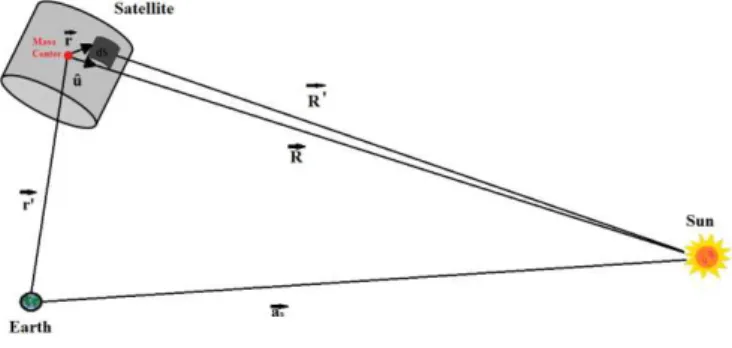
the Sun's right ascension and declination, respectively.Figure 1. Satellite and Area Element Position
The Sun-satellite distance is represented in Fig. 1 and can be obtained by:
( ) (11)
By the equation (4) it is possible to observe that the component of the satellite axis "Oz" is zero, due to the satellite geometric symmetry (cylindrical shape [1]). Then, the satellite oscillates around this axis.
3. Analytical Solution for the Equations of Rotational Motion
The variations of the spin velocity, the declination and the right ascension of the spin axis for spin stabilized artificial satellites are given by the Euler equations in spherical coordinates [3,4]:
(12)
(13)
(14)
where Izis the mean moment of inertia along the spin axis, Nx, Ny, Nz are the components of solar
radiation torque.
At first moment it is hard to get the analytical solution for the equations (12) – (14), because the torque components depend on the time. Then in order to solve these equations, in this paper the SRT mean are the components which were used, and obtained by the integration of the instantaneous torque over one orbit period. Now the equations (12) – (14) can be integrated assuming that the orbital elements (I, e ) were held constant over one orbital period, with the SRT mean components being constant for one orbit. The spin velocity is also constant because the z-torque components are zero:
(15)
where W0 is the initial value for spin velocity.
Then the analytical solution for the declination of the spin axis is given by the
[
(
) (
)
] (17)
where is the initial value for right ascension of spin axis.
The solutions presented in the equations (15), (16) and (17), for the spin velocity magnitude, declination and right ascension of the spin axis respectively, are valid for one orbital period. Thus, for every orbital period, the orbital data must be updated, taking into account at least the main influences of the Earth oblateness. With this approach, the analytical theory will be close to the real attitude behaviour of the satellite.
4. Applications
The theory developed has been applied to the spin stabilized Brazilian Satellites SCD1 and SCD2 for verification and comparison of the theory against data generated by the Satellite Control Center (SCC) of INPE. Two approaches were presented [3,5]. In the first one the propagated attitude is daily updated with the help of real satellite data, supplied by INPE. In the second approach daily updates of the attitude data were not performed in the propagation process.
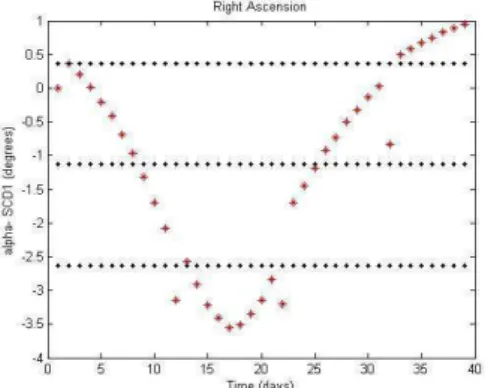
The figures (1) – (4) show the results for the first approach during 40 days. The pointing deviation is the angle between computed and provided spin axis, and its evolution time is presented in the figures (5) and (6). The results show that the region where the analytical solution is closer to the real data corresponds to the smallest decay of the spin velocity [2]. Over the test period the difference between theory and real data has a mean error deviation in right ascension and in declination of -1,0812° and -0,0092° respectively for the SCD1, and the SCD2 presents a mean error deviation of 0,1666° in right ascension and 0,0584° of mean error deviation in declination. The mean pointing deviation for the period test was 0,3704° for SCD1 and 0,145033° for SCD2 which is within the dispersion range of the attitude determination system performance by SCC (0.5o).
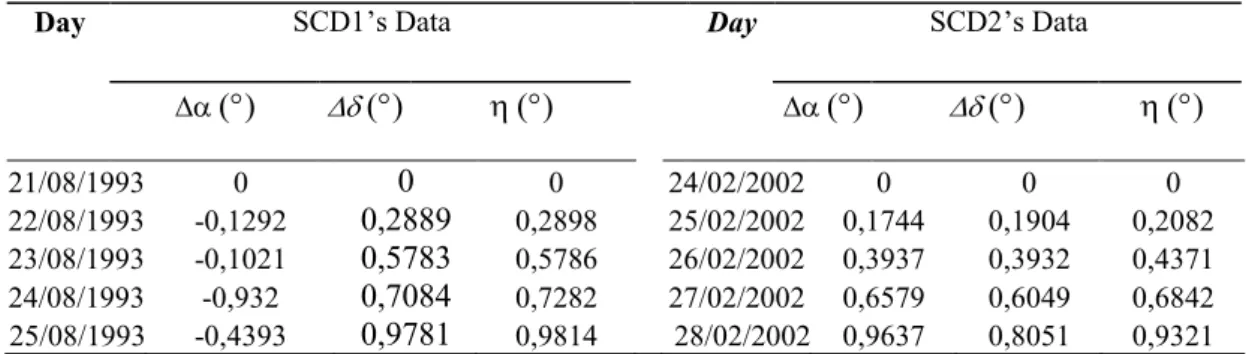
Table 1 presented the results for the second approach. The simulations were interrupted in the 5th day for SCD1 and SCD2 because the mean deviations errors between the computed values and real values for all variables were bigger than INPE’s required precision for both satellites.
Table 1.Brazil Satellite’s Data.
Day SCD1’s Data Day SCD2’s Data
21/08/1993 0 0 0 24/02/2002 0 0 0
22/08/1993 -0,1292 0,2889 0,2898 25/02/2002 0,1744 0,1904 0,2082 23/08/1993 -0,1021 0,5783 0,5786 26/02/2002 0,3937 0,3932 0,4371 24/08/1993 -0,932 0,7084 0,7282 27/02/2002 0,6579 0,6049 0,6842 25/08/1993 -0,4393 0,9781 0,9814 28/02/2002 0,9637 0,8051 0,9321
Figure 1. Time evolution for the difference between computed and provided right ascension to SCD1.
Figure 2. Time evolution for the difference between computed and provided right ascension to SCD2.
Figure 3. Time evolution for the difference between computed and provided declination to SCD1.
Figure 4. Time evolution for the difference between computed and provided declination to SCD2.
Figure 5. Time evolution for pointing deviation to SCD1.
Figure 6. Time evolution pointing deviation to SCD2.
In this paper an analytical approach for the spin-stabilized satellite rotational motion was presented taking into account the influence of the solar radiation torque.
The analytical solution shows that the effect of the radiation torque does not cause variation in the spin velocity magnitude because of the satellite’s symmetry.
The theory was applied to the spin stabilized Brazilian’s satellites SCD1 and SCD2. Results have shown the agreement between the analytical solution and the real satellite behaviour for specific time simulation and two approaches were presented.
In the first one the attitude and orbital data were daily updated with real attitude data supplied by INPE. The results showed a good agreement between the computed and real data during all simulation. The mean pointing deviation was of 0,3704° for the SCD1 and 0,1450° for the SCD2, which are within the dispersion range of the attitude determination system used for this satellite. In the second approach the attitude and orbital data are not daily updated. The results presented a good agreement between the analytical solution and the actual satellite behaviour only for a five days simulation for SCD1 and SCD2. For more intervals the mean deviation of the right ascension, declination and pointing deviation were higher than the precision required by the SCC/INPE (0.5º). For both approaches it is possible to note the influence of the declination of the spin axis in the calculation of the pointing deviation. In order to improve the results it is important to include the other external torques. However the procedures are useful for modelling the dynamics of spin stabilized satellite attitude disturbed by solar radiation torque.
6. Acknowledgments
This present paper was supported by CAPES and FAPESP (Proc. n. 2012/21023-6).
7. References
[1] Zanardi M C F P S, Vilhena de Moraes R, Analytical and Semi-Analytical Propagation of Artificial an Satellite's Rotational Motion, Celestial Mechanics and Dynamical Astronomy, 75, 227-250, 1999.
[2] Motta G B, Satélites Estabilizados por Rotação e Torque De Radiação Solar Direta. Trabalho de Graduação – Faculdade de Engenharia do Campus de Guaratinguetá, Universidade Estadual Paulista, Guaratinguetá, 2011.
[3] Zanardi M C F P S, PEREIRA, Anderson José . Spin stabilized satellite s attitude analytical propagation.. Proceeding of the 22nd International Symposium on Space Flight Dynamics, 2011, São José dos Campos: INPE, 2011. p. 1-14.
[4] Kuga H K, Silva W C C, Guedes U T V, Dinâmica de atitude para satélites estabilizados por rotação. São José dos Campos – SP, Relatório Técnico do INPE, INPE-4403-NTE/275. INPE – 1987.
[5] Garcia R V, Zanardi M C F P S, Kuga H K . Spin-Stabilized Spacecrafts: Analytical Attitude Propagation Using Magnetic Torques. Mathematical Problems in Engineering (Print), v. 2009, p. 1-19, 2009.