ESCOLA DE ADMINISTRAÇÃO DE EMPRESAS DE SÃO PAULO
ROMAIN PAUL MARTIGNIER
PRIVATE EQUITY REGULATION: WHAT ARE THE CONSEQUENCES OF THE ALTERNATIVE INVESTMENT FUND MANAGERS DIRECTIVE (AIFMD) ON
PRIVATE EQUITY MANAGERS?
FUNDAÇÃO GETULIO VARGAS
ESCOLA DE ADMINISTRAÇÃO DE EMPRESAS DE SÃO PAULO
ROMAIN PAUL MARTIGNIER
PRIVATE EQUITY REGULATION: WHAT ARE THE CONSEQUENCES OF THE ALTERNATIVE INVESTMENT FUND MANAGERS DIRECTIVE (AIFMD) ON
PRIVATE EQUITY MANAGERS?
Thesis presented to Escola de Administração de Empresas de São Paulo of Fundação Getulio Vargas, as a requirement to obtain the title of Master in International Management (MPGI).
Knowledge Field: Gestão e
Competitividade em Empresas Globais
Advisor: Prof. Dr. Servio Tulio Prado Junior
Martignier, Romain Paul
Private Equity Regulation: What are the consequences of the Alternative Investment Fund Managers Directive (AIFMD) on Private Equity Managers? / Romain Paul Martignier. – 2015. 98f.
Orientador: Prado Junior, Servio Tulio
Dissertação (MPGI) - Escola de Administração de Empresas de São Paulo.
1. Private equity. 2. Regulamentos. 3. Fundos de investimento. I. Servio Tulio Prado Junior. II. Dissertação (MPGI) - Escola de Administração de Empresas de São Paulo. III. Private Equity Regulation: What are the consequences of the Alternative Investment Fund Managers Directive (AIFMD) on Private Equity Managers?
ROMAIN PAUL MARTIGNIER
PRIVATE EQUITY REGULATION: WHAT ARE THE CONSEQUENCES OF THE ALTERNATIVE INVESTMENT FUND MANAGERS DIRECTIVE (AIFMD) ON
PRIVATE EQUITY MANAGERS?
Thesis presented to Escola de Administração de Empresas de São Paulo of Fundação Getulio Vargas, as a requirement to obtain the title of Master in International Management (MPGI).
Knowledge Field: Gestão e Competitividade em Empresas Globais
Approval Date ____/____/_____
Committee members:
_______________________________ Prof. Dr. Servio Tulio Prado Junior _______________________________ Prof. Dr. Antonio Gelis Filho
Acknowledgments
Abstract
The recent global financial crisis brought significant regulatory changes in the worldwide financial industry. In Europe and in the alternative asset sector specifically, a new regulation by the name of Alternative Investment Fund Managers Directive saw the daylight in 2010. This far-reaching and complex Directive with the main goal of regulating and overseeing alternative investment funds has triggered many discussions and represents an industry game-changer. Thus, this research will focus on the impact and consequences of the Directive on private equity fund managers and the role of regulators. In other words, what are the effects, what does that mean in a quantitative and qualitative sense, and how is it likely to influence the outlook of this asset class? In order to provide the reader with an extensive view on the topic, the paper will first discuss relevant theory and literature, using mix-methods and legal-dogmatic approaches. Further, descriptive case studies, analysis of existing surveys, and interviews with industry experts will supplement the paper in order to understand primary implications of the Directive with the goal of providing useful insights for further private equity regulation research.
Resumo
A recente crise financeira global trouxe mudanças regulatórias significativas no setor financeiro em todo o mundo. Na Europa e no setor de ativos alternativos especificamente, um novo regulamento com o nome de Directiva Gestores de Fundos de Investimento Alternativos viu a luz do dia em 2010. Este abrangente e complexa directiva, com o principal objetivo de regulamentar e fiscalizar os fundos de investimento alternativos provocou muitas discussões. Assim, esta pesquisa vai se concentrar sobre o impacto e as consequências da directiva relativa aos gestores de fundos de private equity e o papel dos reguladores. Em outras palavras, quais são os efeitos, o que isso significa em um sentido quantitativo e qualitativo, e como ele é susceptível de influenciar as perspectivas de esta classe de activos? A fim de fornecer ao leitor uma ampla visão sobre o tema, o papel vai primeiro discutir teoria e literatura relevante, usando mix-métodos e abordagens jurídico-dogmático. Além disso, estudos descritivos de caso, análise de inquéritos existentes e entrevistas com especialistas da indústria irá complementar o papel de forma a compreender as implicações principais da directiva com o objetivo de fornecer informações úteis para pesquisas futuras private equity regulamento.
List of Figures
Figure 1 Luxembourg's Legal Framework ... 19
Figure 2 Global AuM (in $tn) End 2013 and Growth Index (Base year: 2008=100) ... 21
Figure 3 European AuM (in €tn)... 22
Figure 4 Discretionary Mandates vs. Investment Funds and Evolution of the two (in EURbn and as of 2013)... 24
Figure 5 Asset Allocation and Other Assets (End 2013) ... 25
Figure 6 Asset Allocation by Country (End 2013) ... 26
Figure 7 European Regulatory Agencies ... 32
Figure 8 Private Equity Fund Structure ... 34
Figure 9 Risk Assessment and Market Participants ... 38
Figure 10 AIFMD Timeline ... 46
Figure 11 Exclusion and Exemption Criteria ... 50
Figure 12 Full Exemption Criteria ... 52
Figure 13 Partial Exemption Criteria ... 52
Figure 14 Case Study - In or Out of Scope? ... 54
Figure 15 Marketing of AIFs for EU AIFMs ... 62
Figure 16 Marketing of AIFs for non-EU AIFMs ... 64
Figure 17 AIFMD Transposition Status in the EU (as of 2015) ... 69
Figure 18 PE Exits, Fund-raising, and Investments (End 2014) ... 71
List of Abbreviations and Acronyms
AIF Alternative Investment Fund
AIFM Alternative Investment Fund Manager
AIFMD Alternative Investment Fund Manager Directive
AuM Assets under Management
CAGR Compound Annual Growth Rate
CaIPERS California Public Employees Retirement System CSSF Comité de Surveillance du Secteur Financier
EFAMA European Fund and Asset Management Association
EU European Union
FCP Fond Commun de Placement
GP General Partner
HNWI High Net Worth Individual
IRR Internal Rate of Return
LBO Leverage Buy-Out
LP Limited Partner
ManCo Management Company
NPPR National Private Placement Regime
PE Private Equity
SBA Swiss Banking Association
SFA Swiss Fund Association
SFAMA Swiss Fund & Asset Management Association SICAR Société d’Investissement en Capital à Risque SICAV Société d’Investissement en Capital Variable
SIF Specialised Investment Fund
SPV Special Purpose Vehicle
TER Total Expense Ratio
UCI Undertakings for Collective Investment
Table of Content
1. INTRODUCTION ... 13
1.1. Introduction, Research Gap and Analysis ... 13
1.2. Objectives ... 13
1.3. Structure of the Paper ... 14
1.4. Methodology ... 14
1.4.1. Explanation of Methodology ... 14
1.4.2. Sample and Selection Criteria ... 15
1.4.3. Research Method Design and Interpretation of Findings ... 17
2. THE FUND INDUSTRY ... 18
2.1. What is an Investment Fund? ... 18
2.2. The Fund Industry Today... 20
2.2.1 Asset Allocation ... 25
2.3. The Role of Governments and Regulators ... 27
2.4. History of Regulation and Roots of AIFMD ... 30
2.5. Private Equity Regulation ... 37
2.5.1 Private Equity Funds ... 37
2.5.2. Characteristics and Risks ... 41
2.5.3. The Regulation of Private Equity ... 43
3. THE ALTERNATIVE INVESTMENT FUND MANAGERS DIRECTIVE ... 48
3.1. Introduction ... 48
3.2. Provisions of AIMD ... 54
3.2.1. Authorization ... 55
3.2.2. Organizational Aspects ... 59
3.3. AIFMD Transposition Status ... 69
4. ANALYSIS AND DISCUSSION... 70
4.1. Overview of the Private Equity Industry ... 70
4.1.1. The Private Equity Activity Post-Crisis ... 70
4.2. AIFMD Research by BNY Mellon ... 74
4.3. Interview Findings ... 79
4.3.1 Participants Overview ... 79
4.3.2. Participant 1: Sophie Charles ... 80
4.3.3. Participant 2: Yves Martignier ... 83
4.3.4. Participant 3: David Martin ... 84
4.4. Analysis... 87
5. CONCLUSION ... 92
6. REFERENCES ... 94
7. ANNEX... 98
1.
INTRODUCTION
1.1. Introduction, Research Gap and Analysis
Triggered by the global financial crisis of 2008/2009, bank scandals, Madoff’s Ponzi scheme, and a general negative perception of the financial sector, several new laws were issued by worried politicians and regulators in order to prevent future crises of this dimension and to convey a message of change. Thus, the Alternative Investment Fund Managers Directive (AIFMD) is one of them, and intends to tighten the regulatory framework under which alternative funds operate. This paper will focus on the Directive, which has been a hot topic for years in the investment management world, and specifically its impact on the private equity industry. It is an interesting topic insofar that there is only little academic documentation on the Directive and its quantitative and qualitative effects on private equity funds, although it represents the most comprehensive and far-reaching regulation for alternative investment funds issued as of today. Moreover, it is important to mention that this paper will try to convey the perspective of the private equity industry rather than the point of view of regulators.
1.2. Objectives
1.3. Structure of the Paper
The paper will be based on five main chapters. First, the fund industry, and in particular the regulation of this sector, will be discussed. In fact, different types of fund will be explained, followed by a brief overview of the fund industry today. Then, the role of governments and regulators of the financial industry will be discussed before deep-diving into the history and roots of the AIFM Directive. In the second part of the paper, the structure, characteristics and risks of private equity funds will be explained, as well as typical regulatory provisions aimed at this asset class. Next, the AIFM Directive and its main provisions will be thoroughly presented in a pragmatic, but comprehensive way in order to provide the reader with a sound knowledge of how the Directive represents a game-changer in the alternative fund industry. At the end of this chapter, a recent implementation status update will also be given. The fourth chapter will then focus on an analysis of the Directive based on primary and secondary research. Thus, results of interviews with industry experts and secondary survey results will be analyzed in order to find out what are the real impacts and challenges for the future for the private equity industry. Finally, in the fifth chapter, a conclusion will be reached based on the theory and the performed analysis, whether AIFMD is indeed a real game changer in the industry, and if yes, what is the outlook and next steps for private equity funds managers.
1.4. Methodology
1.4.1. Explanation of Methodology
exploratory qualitative research, namely a mixed-methods approach (Starr, 2012). Thus, the combination of qualitative and quantitative methods characterizing this approach are considered optimal in order find out the “why” and “how” on the one side, and the “by how much” on the other. Further, this research will follow a type of mixed-methods approach characterized by first a survey, then in-depth interviews to round out and enrich the findings (Starr, 2012). The difference in this paper, however, is that the survey will come from a secondary source as primary (quantitative) information in the private equity industry is difficult to obtain. Other sources will include existing literature on regulatory issues, academic journals and professional documents issued from third-party providers, specialized newspaper articles, and of course European law for instance.
For the chapter about the Directive itself, a legal dogmatic approach was considered the most appropriate. This method is mainly used in legal science in order to understand that the law and its application are two different components, which complement or compete with each other (Varga, 2011). Accordingly, these two components are studied as the parts of a unified and integral system. In this context, the author uses this approach in order to interpret the Directive and make comments on the norms discussed. Further, in order to better explain specific provisions of the law, descriptive case studies will be used as a tool to describe an intervention and the real-life consequences in which it occurs (Yin, 2003 as cited in Baxter & Jack, 2008). To sum up, the methodology used by this paper consisted in a qualitative research, specifically focused on a mixed-methods approach, and using a legal dogmatic method coupled with descriptive case studies for the part concerning the analysis of the Directive itself.
1.4.2. Sample and Selection Criteria
prepared the latter are to face increased compliance requirements. Second, it provided a quantification aspect regarding costs of the implementation. In fact, the alternative fund industry is known for being discrete and relatively opaque, meaning that finding quantitative data is difficult without significant effort or tight links to the industry. Lastly, the survey gained insights from a large pool of respondents with aggregate AuM over USD 4tn, thus representing an important sample of the industry and hence benefiting the significance of the results.
Concerning the primary source, the study involved three participants who are based in Luxembourg and Switzerland. For the purpose of this paper, it was important that all three have both, extensive experience in the private equity sector and a legal background. Thus, one of the participants works in a mega private equity fund, and the other two are working or worked in a leading Swiss bank (mainly in its Luxembourg branch) and were heavily exposed, as fund managers or investors, to alternative funds, specifically private equity, and legal and risk management matters. Further, it was ideal that the participants were active in those two jurisdictions as especially Luxembourg is the main platform for investment funds in the world after New York, making it the most important one in Europe. Conducting these interviews was helpful for the following reasons. First, it provided first-hand qualitative information from industry experts, which was not possible to take out of the aforementioned survey. Thus, it was important for the analysis to also gather subjective opinions of professionals in the industry concerning the “real” development and implementation status of the Directive, especially because the survey was published one year ago. Second, it allowed the author to ask specific questions that were of high interest for the paper and that permitted to make links to existing theory.
1.4.3. Research Method Design and Interpretation of Findings
As mentioned above, the two sources for the analysis were BNY’s survey results and the interviews performed between July and September 2015. Confidentiality being considered crucial in the private equity sector, it was unlikely that the author would obtain first hand documentation from a broad set of fund managers, hence the importance of the survey. Further, the interviews were based on a relatively small sample, but allowed the author to gain sufficient insights to perform an analysis and comparison with the survey and with existing theory.
2.
THE FUND INDUSTRY
2.1. What is an Investment Fund?
Investment funds are pool of assets with specified risk levels and asset allocations, into which one can buy and redeem shares. By pooling savings from various sources, they offer investors a number of advantages, particularly in terms of risk diversification and lowered costs through economies of scale (EFAMA, 2015). Further, investment funds can be open-ended or closed-ended. The main difference is that shares in an open-ended fund can be redeemed at any time, normally every day, but that in a closed-ended fund investors are locked-in for a certain period of time ranging from months to several years. Private equity is a typical example of a type of close-ended fund for instance. Based on this categorization, coupled with differences in investor protection and in the restrictiveness of investment policies, funds can also generally be divided in “Undertakings for Collective Investment in Transferable Securities” (UCITS) or alternative investment funds. As of 2014, UCITS represented 70% of the European fund market in terms of net assets, amounting to EUR 7.1tn. On the other side, alternative funds, or non-UCITS funds made up the residual 30%, or EUR 3.1tn (EFAMA, 2015). UCITS are normally open-ended and have strict requirements in terms of investor protection. In fact, as the name indicates, these funds can mainly only invest in transferable or so-called liquid assets, with of course a few exceptions, thus considerably minimizing risk. On the other hand, alternative funds can be open or closed-ended, but have special investment policies and are generally thought to be targeted at professional investors due to their higher risk and often complex investment strategies. Thus, alternative funds, such as hedge funds, real estate, and private equity funds for instance, enjoy a large liberty in terms of investment spectrum and are less regulated than UCITS.
execute transactions on behalf of the client (EFAMA, 2015). The investment strategy is defined with the client, including risk profile and asset allocation.
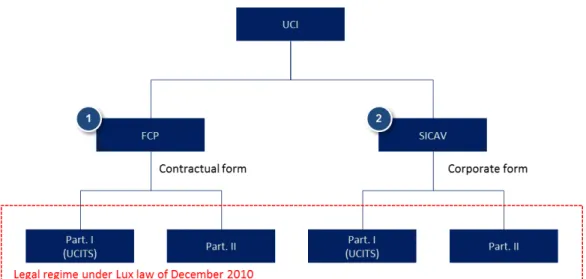
In order to better understand the different types and where alternative investment funds, such as private equity funds for instance, are situated in the legal framework, the paper will use the Luxembourgish system as example (see Figure 1). In fact, Luxembourg is the largest fund administration platform in Europe (and the second largest in the world after the U.S.), and thus
one can assume that the majority of investment firms, no matter what type, will have a presence
in the country.
The Luxembourgish legal framework described above is based on the “2010 Law”. In general, funds, no matter what type, be it open or closed-ended, alternative or UCITS, are found under the umbrella term “Undertakings for Collective Investment” or UCI. On the second layer, an UCI can be managed in two different forms. First, under a contractual form called “Fonds Commun de Placement”or simply FCP, or second, under a corporate form called “Société d’Investissement à Capital Variable” or short SICAV. A FCP fund is a type of fund that has no legal personality. Thus, it is an investment vehicle run by a management company on behalf of joint owners, who are liable only up to the amount contributed by them and whose rights are represented by units intended for placement with the public by means of a private offer (CSSF, 2015). In other words,
Figure 1 Luxembourg's Legal Framework
investors in this type of funds are not shareholders, but simply holders of units in the funds. In contrast, SICAVs referred in the law are legal entities (companies) which must have their registered offices in Luxembourg (Deloitte, 2012). Investors are shareholders of the company and their rights are represented by their shareholdings in the SICAV. Further, as indicated in the name, a SICAV has variable capital, meaning that its capital is always equal to its net assets. Consequently, unlike for other companies, a change in its articles is not required each time the level of capital issued changes (Deloitte, 2012). On the third layer, each legal form (situations 1 and 2 in Figure 1) can have funds registered under two categories. First, Part I of the law, namely UCITS, and second, Part II, namely all other funds such as hedge funds, private equity funds, real estate funds, commodity funds, infrastructure funds, and institutional funds just to mention the most important ones. Part I funds or UCITS are, as mentioned above, open-ended funds, which can sell their shares anywhere in the European Union through a so-called EU Passport. They typically have more restrictive investment policies and high investor protection. By contrast, Part II funds are all other funds that do not qualify under Part I due to some or all of the following (negative definition) (CSSF, 2015):
o Funds that are closed-ended
o Funds that raise capital outside the EU
o Funds for which restrictions on UCIs do not apply (e.g. hedge funds)
o Funds that have a special investment policy and do not invest in transferrable securities or assets eligible under the UCITS framework
Further, Part II funds are not eligible for distribution in more than one EU Member State. In other words, they have to apply separately in each EU country they wish to sell their fund (in contrast to UCITS’ EU Passport). All this is important to understand as it represents the legal framework on which we will discuss AIFMD more in details later in this paper.
2.2. The Fund Industry Today
All information mentioned in this section concerning quantitative and qualitative data of the fund
comprehensive and most respected source among industry actors concerning investment fund
information.
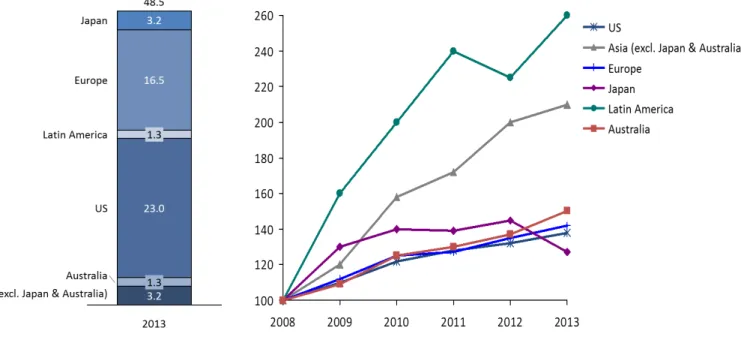
The global fund industry has never been as strong as today. According to EFAMA (2015) and industry experts, the global asset management industry managed around EUR 48.5 trillion in net assets at the end of 2013. The asset management industry represents about a quarter of total worldwide financial assets. The world’s largest market is still the United States with EUR 23 trillion in assets under management (hereafter referred as “AuM”) or 46% of global AuM, followed by Europe with EUR 16.5 trillion or around 33% of all assets at the end of 2013.
Also, it is interesting to note as observed on Figure 2 that the growth of worldwide AuM was largely fueled by Latin America and Asia (excl. Japan and Australia). Thus, the latters have seen their AuM more than double over the years. The developed economies of Europe, the US, Japan and Australia have all enjoyed strong growth in assets of between 20% and 50%. In contrast, Europe and the US have registered almost identical growth in terms of AuM over the six years period despite the significant differences in economic performances across these two regions.
In Europe, professionally managed assets rose by 8.6% in 2013. This growth was mainly achieved through improved confidence that the worst of the euro area financial crisis had passed,
and through relatively effective monetary policies implemented by European leaders. This paved the way towards gradual economic recovery, which got under way during the second quarter of 2013. The situation continued to improve in 2014, even if the pace of economic recovery remained very moderate. Thus, increased investor protection and low interest rates pushed investors to allocate more resources to investment funds in order reach return goals. According to EFAMA (2015), total AuM in Europe increased by approximately 15% in 2014 to reach an all-time high of EUR 19 trillion. This represents an impressive compound annual growth rate (CAGR) of 9.7% since the financial crisis of 2008/2009.
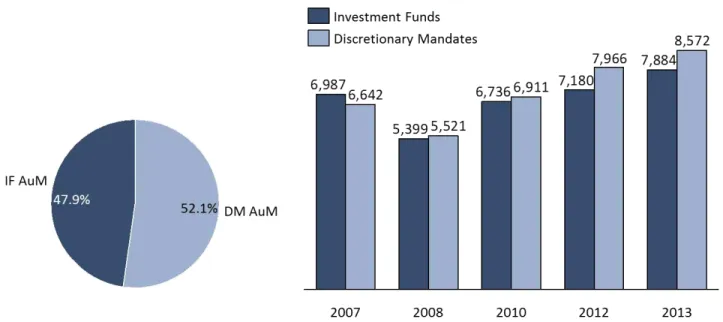
The main players in this industry are the UK, France, and Germany, with market shares in terms of AuM in 2013 of 37%, 20%, and 10% respectively. Further, in 2013, all countries registered growth in AuM, although the growth varied significantly across countries. The UK registered a healthy growth of 13%, and countries such as Hungary, Turkey and even Greece showed growth in the 13-20% range. This could be explained by the fact that, as already mentioned above, investors are looking for assets generating higher returns in our current low interest rates environment.As concerns the split between European discretionary mandates and retail investment funds, both have been growing in past post-crisis years and have surpassed end 2007 levels. Thus, discretionary mandates represented almost EUR 9 trillion or just over 52% of total
Figure 3 European AuM (in €tn)
AuM at the end of 2013. Conversely, AuM in investment funds stood just under 48% and amounted to almost EUR 8 trillion (see Figure 4). On a country basis, major differences can be observed. Thus, for instance, the share of AuM in Netherlands, Portugal, and Italy managed discretionarily is between 85% and 70%, whereas in Germany, Turkey, and Romania, the share is only between 18% and 0%. It is further interesting to observe that assets under discretionary mandates have outgrown assets in investment funds since the 2008 crisis. This can be explained by the fact that discretionary mandates tend to be more risk averse than investment funds as they invest a higher proportion of assets into fixed-income securities than investment funds. They also depend primarily on the institutional client segment of the market, which has grown at a faster pace than the retail market over the past five years. It will be interesting to observe the evolution of this split as investment funds for retail clients are become increasingly investor-friendly, benefiting from increased protection and availability of information. This will indirectly be discussed later in this paper.
institutional investors, however, it is of course less relevant as they have better access to information and are able to choose adequate funds irrespective of the brand name. Another key competitive factor is the reach of the fund. Thus, especially nowadays, investors are increasingly looking for high diversification potential, not only in asset classes, but also geographically. Therefore, funds with global reach or fund managers with a broader spectrum of funds covering many asset classes and geographies might have advantages. Last but not least, performance is always an important and obvious factor. Thus, even though past results are not always a good indicator for future results, actual returns on investment, internal rate of returns and the likes are important measures that investors look at when selecting funds. One important factor that was not mentioned until now, which as we will see later in this paper might change somehow the critical success factors of the asset management industry, is compliance to a broad set of new regulations that have seen the daylight in the last years.
2.2.1 Asset Allocation
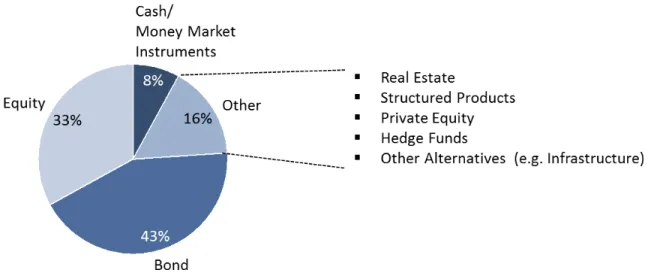
Depending on the type of clients and their respective preferences in terms of risk level, time horizon and outcome target, the asset management industry can adjust the proposed asset allocation to meet the expectations of its diverse range of clients. This has as a goal an optimal diversification, which occurs through investing in different economic sectors, geographies, and asset classes. If we have a look at Figure 5, we can see that fixed-income assets or in other words bonds represent the main asset class.
Concerning the evolution of the different asset classes, allocation to bonds increased during and after the crisis, benefitting from extreme levels of risk aversion on financial markets. Thus, it grew from 40% to 46% in the period 2007-2013Q2, but declined to 43% by the end of 2013 after the Federal Reserve in May 2013 announced that it might reduce the size of its bond-buying programme known as quantitative easing, and thus led to substantial turmoil in the markets and slowed down considerably the demand for bond funds. In parallel, the improvement in economic conditions, combined with rising stock markets (most main market indexes standing currently at record highs), increased the attractiveness of equity funds, triggering a rebalancing of asset managers’ asset allocation towards equity. However, one can observe that this phenomenon applies more to “retail” investment funds than to discretionary mandates, the latter having historically been rather focused on bonds. Different causes can explain the de-equitization in this
segment, including the growing maturity of pension liabilities due to population ageing and changes in regulatory and accounting rules encouraging institutional investors to avoid volatile assets. Further, the share of money market instruments has steadily declined since 2008, as the low interest rate environment made this product type less attractive. Other assets or mainly alternative assets share of total assets on the other hand, stood at 16% in 2013, a 6% increase when compared with 2010. In fact, investors increasingly search for risk-adjusted returns that are uncorrelated to the market, and, in a high-liquidity environment, tend to invest more in long-term, locked assets that ultimately deliver higher returns than traditional assets, such as private equity for instance.
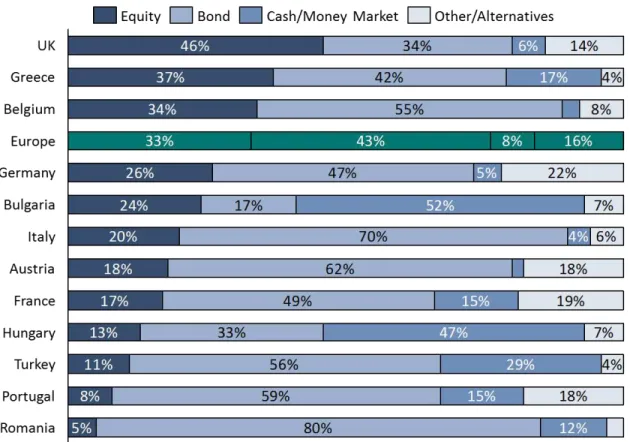
After having seen the European average asset allocation, it is important to mention that substantial differences exist between EU countries. In fact, having a look at investment behaviour of different countries will allow for better understanding of the dynamics and implications of AIFMD later in the analysis part of this paper.
Looking at Figure 6 on the previous page provides interesting insights on allocation tactics in different European countries. According to the data, the UK allocates a considerable portion of its total assets to equities (46%), which can attributed to a long established culture of equity investing in the Anglo-Saxon world. The equity exposure in other large markets, such as in France (17%), Germany (26%), and Italy (20%) for instance, remain significantly lower. Conversely, asset managers from Italy, Belgium, Romania, and Austria for instance seem to allocate a big chunk of their portfolio to fixed-income instruments, reflecting different cultures and needs from investors. Also, Germany, France, UK, Austria, and Portugal seem to represent important markets concerning alternative investments in terms of % of total assets. This is relatively true for absolute values as well, especially for the UK, Germany, and France. Thus, as we will see later in this paper, these three countries have influential roles in the European investment fund industry.
2.3. The Role of Governments and Regulators
According to Tanzi (2011), there is no more fundamental question in economics than what role the governments should play in a country’s economy. In other words, the search for the optimal economic role of the state is difficult but crucial, and it cannot be assumed that the current role is necessarily optimal. Thus, that role may have been promoted by events that required state interventions no longer considered necessary or even by mistake (Tanzi, 2011). Similarly, it cannot be assumed that the role of the state in the past would be optimal today because the economy and the society may have changed, requiring different interventions. It must be seen as an evolutionary role that adjusts to the changing ecology of the market, and, at the same time, influence that ecology (Tanzi, 2011). It is often argued that the guiding principle that should justify state intervention in the economy should be market failure (Tanzi, 2011). Thus, when
markets fail or are expected to fail, the state must intervene. This clearly makes sense as the
modern state is responsible to protect the weakest (economic actors) and avoid any collapse or
major damage to its economy. The difficult part, though, is to find the right cost-benefit balance.
In other words, what are the advantages of additional regulation versus the marginal costs on
regulations) would result in lost competitiveness of the economy on the one hand, but too few
could lead to an economic collapse on the other, resulting in turn in significant costs for
governments and society as a whole. If markets worked perfectly, there would be no need for an
economic role for the state, beside of course its important political and social functions for which
it would need some financial resources (Tanzi, 2011). As the markets are far from being
efficient, regulations are of course in place, but are unfortunately not always effective. Thus, the
absences of global and efficient regulations over this global financial activity and of regulatory
institutions are thought to have significantly contributed to the crisis of 2008-2009. This is
especially true in our increasingly interconnected world, in which spill overs across countries are
becoming more important and visible at all time. According to Tanzi (2011), some economists
have referred to it as casino capitalism, fueled by international speculation, herd instincts,
contagion, and pressure to conform and generate competitive short-run profits. O’Brien (2012)
also argues that apparent success was measured by short-term objective efficiency criteria (e.g.
lower transaction costs, expansion of corporate profits, increased shareholder returns for
instance), and that potential negative externalities or risks such as excessive leverage, inflating
asset bubbles, or deteriorating quality of balance sheets were self-consciously ignored. In fact,
the focus on short-term gains is an important point that we are going to discuss more in detail
when talking about certain provisions of AIFMD. Tanzi (2011) also argues that there is clearly a
large misallocation of regulations in most countries and that some participants in the financial
market that had strong political power had been able to prevent the introduction of needed
regulations in their activities. Thus, George Stigler (1975), a Nobel Prize winner in Economics
who focused most of his work on regulations, believed that the regulators are often captured by
the regulated and that the regulations rarely or never make a market more efficient. A significant
problem according to them and many others is that governmental interventions to deal with all
these well-identified failures, such as the global financial crisis, require an apolitical state. And
as we all know, this is unfortunately non-existing. Further, Tanzi (2011) argues that as financial
stability is a clear example of an important global public good, governments should concentrate
their activity on prevention, much more than ex-post repair or correction. Similarly, O’Brien
(2012) states that in order to reform regulation agenda by adding the normative criteria of
permissibility, responsibility, and legitimacy, which will be explained more in detail in the next
with Tanzi’s (2011) thoughts on prevention, extending responsibility and accountability to those
involved in financial product design rather than clarifying the enabling conditions that govern
marketing and sale would constitute a drastic shift in the structure of the financial services
industry. Further, regulators should also focus on creating ongoing dialogues with professionals
that should be linked to definable agreed objective and measurable outcomes (O’Brien, 2012). In
other words, it is crucial for governments to emphasize and possibly change business ethics
rather than adding rules, which are too easily transacted around. Of course, as we will see later,
the interference of politics and lobbyism makes it difficult. We will see later to what extend these
ideas have been taken into account in the development of the AIFM Directive.
When talking about increased interventions from the state in the form of additional regulation,
other important questions arise – what are the costs of regulation and what are the unintended
consequences on target and related sectors? According to Littrell and Thompson (1997), costs of
government regulation cannot satisfactorily be estimated, let alone its benefits. They argue that
most countries perform regulatory cost-benefit analyses, but that they revealed themselves to be
flawed and inaccurate. One of the reasons is simply the fact that costs tend to be underestimated
and numbers used for costs as well as for benefits are most of time unreliable (Littrell and
Thompson, 1997). In fact, regulators, market actors, and associations for instance might have
different views and diverging estimates concerning additional costs and benefits of new
regulation. Littrell and Thompson (1997) suggest a two-step model in order to better forecast
costs. The first step is to accurately measure cost of completed projects. For instance, in the
context of AIFMD, European regulators might have tried to measure cost of similar laws already
implemented in the fund industry, in particular the UCITS law, in order to forecast the costs of
the new Alternative Directive. Step two involves using measured costs to specify and refine
regulatory should-cost models. Further, Littrell and Thompson (1997) suggest that cost
measurement is an accounting problem. Quarles (1995) takes it further and argues that the
utilization of a cost-accounting technique known as activity-based costing is the best way to find
out how much regulations actually costs at corporate level. However, many studies confirm the
weakness of existing accounting systems for purposes of measuring regulatory expense (Littrell
and Thompson, 1997). According to them, existing systems tend to focus mainly on direct labor
costs, but tend to forget transaction costs that arise out of the regulatory process. This can be
directive are easily quantifiable, but what about opportunity costs? In the chapter 4 of this paper,
we will discuss cost issues of AIFMD more in details.
Concerning unintended consequences of regulatory oversight and control, Militello (2014) wrote
an interesting article published in Ernst & Young’s Global Financial Service Institute. According
to him, regulators are largely problem solvers who seek intended consequences. However,
observations demonstrate that regulatory intentions and outcomes frequently do not coincide as
financial managers, the targets of new regulations, face increased regulatory induced business
dilemmas and are forced to rethink their strategy (Militello, 2014). In other words, unintended
consequences are the results of how these dilemmas are managed from an industry,
organizational, and professional perspective. Thus, in every industry, additional regulation will
spur strategic thinking on how 1) to avoid it or 2) to cope with it in the best possible way.
Militello (2014) mentions as one unintended consequence an increasing interconnectivity of
financial organizations. Thus, regulation brings actors closer as new services, new types of
businesses, new partnerships are created in order to cope with regulation. This in turn can
logically lead to an increased systemic risk and self-perpetuating regulatory reach. He calls it the
paradox of regulation. In chapter 4, the paper will further discuss this topic.
2.4. History of Regulation and Roots of AIFMD
This section of the paper will focus on the regulatory environment of investment funds in general, how it is formed, and how oversight and control functions are performed. It will first focus on the period right before and after the crisis until today, and further describe generic theory on financial regulation with a focus on investment funds. This will be useful in order to understand the regulatory implications of the crisis, and later in this paper, what are the roots and consequences of AIFMD.
developments took place starting in the late 1970s. On the one hand, she argues that regulation and supervision were strengthened and tended to become integrated, and standards claiming compliance internationally were developed. On the other hand, however, in the financial markets, both market actors and transactions were increasingly deregulated (Mayntz, 2012). As a result, liberalized financial markets continued to change without commensurate changes in the regulatory framework, creating a regulatory gap which became manifest in the 2007/2008 crisis. Concretely, banks had not been required to retain on their books part of certain securities they issued, hedge funds and private equity firms were not required to comply with capital standards of Basel II, and the market saw the rise of asset backed securities and credit default swaps to name just a few of the regulatory gaps and events that permitted the financial markets to become bloated with toxic assets (Mayntz, 2012). Further, innovation in this sector was mainly driven by the motivation of avoiding compliance with existing rules – a prominent example for this is the creation of SPVs by banks and investment firms. In other words, the crisis is seen as being an aggregate of many events that took place in past decades.
Acharya, Cooley, Richardson, and Walter (2010), financial intermediaries and the structure of the financial architecture cannot be allowed to impose politically unacceptable costs on society, either by failing individuals deemed worthy of protection in financial matters, or by permitting firm-level failure to contaminate other financial institutions and, ultimately, the system as a whole. In other words, protecting the financial system from misconduct and instability is fundamentally in the public interest, and thus explains the sudden increased involvement of politicians in the aftermath of the crisis. Of course, the latters are inevitably facing difficult policy trade-offs between financial efficiency and innovation on the one hand, and institutional and systemic safety and stability on the other (Acharya and all. 2010). Measures that assure greater financial robustness may make financial intermediation less efficient or innovative for instance. Similarly, efforts to promote financial innovation may erode transparency, safety, and soundness. Competitive pressure among financial centres may also trigger a race to the bottom in terms of systemic robustness to internal and external shocks (Acharya and all. 2010). All this to make clear that choosing the adequate policy is difficult and never short of conflicts. We know that excessive regulation involves costs, but cannot quantify them properly, and we know that underregulation or laxness can unleash disaster, which can only be retrospectively observed. So optimal regulation is the art of balancing the immeasurable against the unknowable (Acharya and all. 2010). According to what the paper just mentioned, it is not surprising that financial literature in general considers financial crisis as a recurrent phenomenon.
Although the worst of the financial crisis has passed, the defects of the dominant institutions remain, and continue to pose grave risks to future financial stability (Acharya and all. 2010). Thus, the same authors (2010) argue that a new regulatory architecture, based on four aspects; (1) encourage innovation and efficiency, (2) provide transparency, (3) ensure safety and soundness, and (4) promote competitiveness in global markets, has become inevitable and it is crucial to understand how it will perform. Regulatory architecture is critical to resource allocation and economic growth. In fact, economies with inefficient financial systems demonstrably waste more economic resources and grow more slowly than otherwise comparable economies with efficient capital systems. Good financial architecture has to be robust to shocks that emanate from the financial system and the real economy, both domestically and
internationally (Acharya and all. 2010). According to O’Brien (2012), however, the root cause of
unless accompanied by effective mechanisms to integrate ethics and accountability in regulatory
design, reform is likely to fail because the belief system that facilitated the crisis remains
resilient. Interestingly, and conversely to other authors cited in this paper, O’Brien (2012)
considers efficiency criteria alone as insufficient bulwark for authority and legitimacy. Thus, the
regulatory reform agenda should not only address solely efficiency (i.e lower transaction costs),
but should also apply three additional distinct but overlapping criteria. First, permissibility or the
question whether a particular product can be sold, and if so, to whom and on what basis? Second,
responsibility or who carries the risk if the investment sours and on what terms? Lastly,
legitimacy or does the product serve a legitimate purpose and who should determine it? If we
compare O’Brien’s idea (2012) with the proposed regulatory architecture of Acharya and all. (2010) one can distinguish significant differences on what the focus should be. Although a
common point would be the need for increasing transparency. In fact, O’Brien (2012) argues that
deficiencies in shared commitments to rules, principles or norms were particularly apparent in
the design, marketing, sale and regulation of complex financial products, which in turn
demonstrated the limits of disclosure. In other words, he believes that professional and/or
sophisticated investors trading as individual or institutional investors were aware of the risks, but
transacted around as the search for yield trumped reason. Stein (2011) would go so far and
explain this fact as resulting from a culture of mania, in which denial, omnipotence,
triumphalism and over-activity prompt individuals to take on extreme risks. This rather
psychoanalytical view of the reasons behind the crisis is helpful to understand the rationale
behind human actions that led to the crisis, but are out of scope of this paper. So what has been
initiated so far?
According to Mayntz (2012), governance structures have changed most at the national and least
at the international level. Thus, at the international level there were changes in the mandate,
composition, and weight of some agencies in the overall process of regulation. For instance, the
former Financial Stability Forum, a group consisting of major national financial authorities such
as finance ministries, central bankers, and international financial bodies, changed into the
Financial Stability Board, and additional resources were given to the IMF. In other words, some
institutions were renamed and/or were given additional tasks for the future, but no new agencies
were created at the international level, nor were these existing bodies given the competence to
still restricted to monitoring, recommending, and trying to coordinate (Mayntz, 2012). More
substantial change took place at the level of the European Union, where a new agency, the
European Systemic Risk Board, was created and where the three previously existing committees
that were supposed to coordinate national supervisors were transformed into European
supervisory agencies with greater power. In fact, these agencies have some decisions-making
power and the competence to intervene, under certain conditions, in areas hitherto under
exclusive national jurisdiction (Quaglia, 2012) (see Figure 7). The most relevant European
agency for the sake of this paper will be ESMA, which amongst others oversees the European
asset management sector. Thus, as we will see later EMSA is the main regulator dealing with the
AIFM Directive.
The European Commission and these new agencies with their greater power did not wait long
until making use of their new structure and responsibilities. In fact, between 2007 and today,
more than 30 new regulatory reforms (AIFMD included) saw the daylight, and 5 have been
proposed by the Commission and are currently being reviewed (European Commission, 2015).
This represents an impressive regulatory performance, and the trend is growing. Among these
implemented regulations, one can find many game-changing laws such as EMIR (derivatives),
CRD III (remuneration and prudential requirements for banks), MiFID (securities markets),
Figure 7 European Regulatory Agencies
MAD (market abuse), and of course AIFMD. Thus, the next paragraphs will focus on the
development of alternative fund regulation and on how the AIFM Directive came to life.
Concerning alternative investment fund regulation, it is important to emphasize the role of hedge
funds. In fact, these funds were the primary target of politicians in the aftermath of the crisis as,
even though some argue that they are providers of liquidity (Aragon & Strahan, 2010), they were
generally considered to be highly leveraged, and thus posing serious threat to systemic stability.
Prior to the financial crisis, two different approaches in terms of policy discussions existed
concerning the regulation of hedge funds: one in favour of regulations, sponsored by Germany
and France, and one resisting regulation, championed by the US and the UK (Woll, 2012). It is
during the preparation of the G20 summit in April 2009 that the split over how to regulate hedge
funds and other alternative investment funds re-surfaced. Several countries, led by France and
Germany with the support of Italy, pushed for a tougher regulatory regime and wanted the funds
to be overseen similarly to banks (Woll, 2012). Thus, they argued that Europe should play an
instrumental role in shaping global regulatory regime. By contrast, the US and the UK, known
for their financial laissez-faire tradition, favoured more disclosure over more regulation. The
G20 summit that year resulted in the agreement that additional regulation and oversight to
systematically important hedge funds and other alternative funds would be implemented. Two
months later, in June 2009, the European Commission presented its first draft Directive of
AIFM. As we will see in more details later in this paper, this directive intended to include a
broad range of financial entities, mainly private equity funds, hedge funds, and real estate funds.
During the second semester of 2009, and under the Swedish presidency of the EU, the draft
directive was partly revised, due mainly to intense lobbying from the US and the UK. Sweden,
having a relatively important private equity industry as well, was seen as also having a vested
interest in the revision of the Directive (Woll, 2012). At that time, European Commission
President Jose Manuel Barroso also faced re-election, and France and Germany jumped on the
occasion and indicated that progress on a hedge funds directive was important in order to obtain
their support (Woll, 2012). Eventually, after highly politicized members states negotiation
rounds that lasted for 18 months, and that pitted most notably France against the UK, an
agreement between the Council of Ministers and the European Parliament was reached in late
This new regulation, among others, was seen by the some countries (e.g. Luxembourg, Ireland,
UK, and the Nordics) as over-prescriptive and costly to implement, creating potential regulatory
arbitrage vis-à-vis countries outside the EU. Also, since even the Commission’s original proposal
acknowledged that hedge funds were not responsible for the financial crisis, the battle seemed to
represent rather an ideological commitment to supranational regulation on the one hand (cf.
France), and national autonomy and a continued lack of intervention on the other (cf. UK) (Woll,
2012). In fact, numerous industry experts were wondering if AIFMD did not simply arise from
mere opportunism, from politicians exploiting the momentum of the financial crisis, and the
general delicate image of the financial sector, to drive a pro-regulatory agenda. This represents a
very interesting point as never before in the European Union politicians were so involved in the
development of financial regulation. In other words, AIFMD was one of the most-disputed
post-crisis regulations, which really showed political confrontations between France and the UK.
Thus, as Woll (2012) describes it - understanding the stakes and the evolution of the regulatory
efforts requires a study of the interests and coalitions within the EU that led to the current
regulatory framework.
All in all, AIMFD not only represents an issue to the hedge fund industry, but also for all
non-UCITS investment funds. Thus, one of the most central and most controversial decisions of the
initial proposal was to address hedge funds through a directive that covers all investment funds
that were previously left outside the realm of EU legislation. In other words, AIFMD is a
negative definition of the Law. This will be explained further in part 3 of this paper. The key
takeaway at this point is that this new regulation was a cold shower for the private equity
industry as they were never considered as primary target and because they had done their utmost
to insist on being exempted from investment regulation, fact that characterized their success in
2.5. Private Equity Regulation
In general, the private equity industry has often been subject to debate. Some people see the
business as fundamental to the growth of an economy, as it generates jobs for workers and taxes
for the government, and others see private equity firms and other involved parties as greedy
institutions whose only goal is to benefit themselves and strip companies of their assets (Heed,
2010). One thing is sure, the private equity sector has been significantly growing since the
mid-1970s when it became a separate (alternative) asset class. Further, private equity firms play an
important role in merger and acquisition activity when the goal is to transform under-performing
companies to capital-efficient and profit-generating companies (Heed, 2010). In other words,
private equity investments are important for an efficient capital allocation on the markets. They
provide intermediation between sources of funds and private companies seeking risk capital
(Fleming, 2010). The rapid growth of this industry has been fueled by the strong development of
financial markets around the globe, but especially in developed markets such as the U.S. or in
Europe. Thus, financial innovations, development of stock markets, a large development of
pension funds systems, pension funds being a major type of (institutional) investor in private
equity funds, and other factors such as new rules and standards of management like shareholder
value, all directly or indirectly contributed to the private equity sector’s growth (Bedu &
Montalban, 2013).
2.5.1 Private Equity Funds
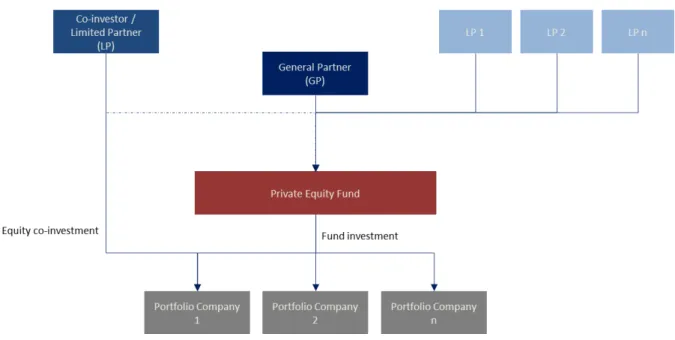
The main actors identifiable on the graph above are the General Partner, the Limited Partners,
the Co-Investor, the fund itself, and the portfolio companies. The General Partner, commonly
referred to as GP is the private equity firm/manager. GPs are responsible for setting up the fund,
finding capital, managing and monitoring investments, and liaising with investors, regulators,
and third parties. In addition, GPs are required by Limited Partners (LPs) to invest their own
money in the fund in order to show that they believe in their strategy, thus reducing conflicts of
interest and risk for investors. This commitment will be in aggregate between 1% and 5% of the
fund (Gilligan & Wright, 2008). Concerning the remuneration of GPs, two main sources exist –
management fees and carried interest. During the investment phase, management fee will
typically be 1.5%-2% of the committed fund size, and will gradually decline during the
post-investment phase when it is more about monitoring the performance of the fund. Further, the
bigger the fund, the larger the management fee (albeit at a lower percentage than for smaller
funds) and the more funds under management the greater the fee income (Gilligan & Wright,
2008). Originally, the management fee was intended to pay for the operating costs of employing
staff and other expenses associated with the fund manager’s business. It is also important that
fund managers find the right balance concerning the use of fee income, between reinvesting in
growing the personnel, infrastructure and assets of the business, and recruiting and retaining the
best employees and partners by offering competitive remuneration. The second and most
important GP revenue stream is the carried interest. The share of capital profits is shared among
the fund managers and their staff according to whatever arrangements they have agreed among
themselves and with their limited partners (Gilligan & Wright, 2008). These arrangements
regarding the distribution of capital profits are commonly referred to as the waterfall. In fact, the
share of profits for the private equity firm is the residual profits after deduction of several
payments to LPs from the net positive cash flows obtained. Thus, when portfolio investments are
sold, the fund will normally return to the LPs 100% of their contributed capital. In addition, a
so-called hurdle rate exists. This preferred return is the Internal Rate of Return (IRR). For
example, a hurdle rate of 8% (8%-10% being considered as standard) means that the fund must
achieve a minimum IRR of 8% before receiving an interest in the proceeds of the fund (CACEIS,
2010).This gives the fund manager the incentive to achieve returns higher than the hurdle, and in
turn reduces the impact of poor performance on the return on investment for LPs. After the
capital contribution and the hurdle rate are received by the LPs, the next and last distribution
made by the fund manager is typically allocated between the GP and the LPs (CACEIS, 2010).
Industry standards are talking about an 80/20 split, meaning that 80% are distributed to LPs and
the residual 20% go to the GP. There are also differences between the European and the US
waterfall model, but this will not be discussed in this paper.
Investors, or so-called LPs as mentioned above, are the ones providing the majority of capital to
a private equity fund. Their main motivation to invest in this asset class is often to diversify their
portfolio, and so spread their risk, and generate higher returns. Thus, Neerza & Tripathi (2014)
argue that institutional investors invest in private equity for financial reasons because it yield
higher risk adjusted returns as compared to other alternatives and there exist a greater scope for
diversification. LPs are in most cases institutional investors or at least well-informed investors as
alternative funds such as private equity represent complex investments with significant risk.
Thus, typical investors are pension funds, banks, insurance companies, corporates, governments,
HNWI, and even sometimes academic institutions (e.g. endowment funds). Their remuneration is
composed of dividends, interest and capital gains as already explained in the previous paragraph.
Further, once the so-called subscription agreement is signed, the investor irrevocably commits
himself to invest substantial amount of money, called on in partial payments during the first few
years of the fund’s life cycle, into the chosen private equity fund (Gilligan & Wright, 2008). This
Alternatively, a LP can also be a co-investor of the GP. In fact, it can co-invest directly into a
target company, taking a minority ownership in the latter. Of course, the co-investor might at the
same time be a regular investor in the private equity fund. Similarly, on a GP level, private
equity firms may invest in enterprises in a syndicate with other private equity firms. Syndicates
are a form of interfirm alliance in which two or more private equity firms co-invest in an
investee firm and share a joint pay-off (Lerner, 2004). This has happened relatively often in
recent years as private equity houses tend to be increasingly involved in bigger deals, acquiring
companies with high valuations. Other common factors are risk sharing and access to deal flow
(Lockett, Meulemann & Wright, 2009).
Further, there is the private equity fund itself. The fund is the collective investment vehicle
through which GPs make their investment in a portfolio of target companies. These structures
can be set up under different legal forms and often benefit from attractive tax treatments.
According to Gilligan & Wright (2008), private equity funds will be structured to achieve a
balance between maximum tax efficiency to the investors and the managers, managing
regulatory costs and benefits, controlling and managing potential liabilities to the investors and
the managers, and maintain confidentiality regarding its partners and investors. Private equity
funds typically have a finite lifetime of around ten years. However, exceptions exist such as
so-called evergreen funds, which have investors with rolling annual commitments. For simplicity,
these funds will not be discussed here. Finally, the fund itself takes majority position in the target
companies it invests in.
Before ending this section it is important to mention that Figure 8describes a simplified version
of a private equity structure, which appears to be more complex in reality. Thus, additional layers
of complex investment vehicles, sometimes in different jurisdiction, are very common. However,
the proposed structure is enough to understand the main actors and their interaction, which in
2.5.2. Characteristics and Risks
A main characteristic of private equity funds is the use of leverage. Thus, since the late 1980s,
the use of leverage has accelerated, mainly as a result of low interest rates and innovative
financial engineering, raising concerns about financial stability. In fact, according to Kohn et al
(2008), the amount of leveraged loans and high yield bonds outstanding tripled between 1999
and 2007. Even though the use of leverage in buyout transaction for instance has been drastically
reduced over the last years (GPs nowadays putting significantly more equity in transactions than
in the past), recent events such as the sub-prime market crash in the U.S., the global credit crisis,
and Madoff’s Ponzi scheme, led to an increased scrutiny of all types of alternative funds from regulators, investors, and politicians. Thus, McCahery & Vermeulen (2010) argue that until then,
the alternative asset sector successfully avoided this very scrutiny of regulators and lawmakers
which arguably contributed to its success in attracting investors. Beside concerns arising from
overleveraged transactions as mentioned above, potential costs to investors from insider trading
and price fixing arising from “club deals” by mega funds capturing the largest amount of net
capital flows also nourished the trend of increasing regulation of private equity funds and their
managers (McCahery & Vermuelen, 2010). According to Heed (2010), risks associated with
private equity activity can be split in two categories – external and internal risks. External risks
come mainly from the fact that private equity-backed companies have less of a cushion to rely on
in case of a rapid economic downturn such as a deep recession for instance. Thus, these portfolio
companies are often highly leveraged, and a failure could severely impact the private equity fund
at the top of the pyramid. Now, the failure of large private equity companies could negatively
impact other fund managers’ ability to raise new funds from debt investors, although the latters
were still doing well (Heed, 2010). This, in turn, would affect existing and future investors, who
could be concerned and thus incentivized to reduce their risk exposure. Further, he also identifies
(2010) two additional triggers for external risks, all potentially leading to increased systemic
risk, namely concentration of debt and refinancing needs. On the internal side, Heed (2010)
identifies excessive leverage, asset striping and tax treatment, conflicts of interest, and
transparency as the main risks. The internal risk of excessive leverage is similar to the one
explained above, with the difference that Heed (2010) illustrates two schools of thoughts. One is
and flexible financing options, and the other is arguing that leverage levels are increasingly close
to the limits of prudence. Asset stripping and tax treatment are two other aspects that have often
been discussed. Workers unions in many countries are worried that debt-finance means that jobs
have to be cut to generate short-term returns and repay loans. In fact, Walker (2008) explains that
private equity firms are often accused of asset stripping when they sell valuable corporate
property, land and machinery or other assets that allow them to meet performance targets and
cover their fees. A famous example of bad press provided by Teather & Treanor (2007) is when
Permira, a leading European private equity fund acquired Birds Eye from Unilever. Permira
pledged to keep workers’ employment terms for at least three years, but had within five months
closed down plants and cut nearly 500 jobs. On the other hand, Heed (2010) argues that there
must be a levelling between corporate efficiency, profitability, and social responsibility. He also
throws in the uncomfortable question: What is better – the badly performing private
equity-backed company that sees its assets stripped off and people laid off in order to redress the
situation or the badly performing company without backing that will eventually go bankrupt and
where all employees will lose their jobs? As we can see, there is no black or white. Another
criticism is the tax treatment of private equity firms’ profit extraction (Heed, 2010). In fact, they
use complex fee structures that allow them to bypass or minimize taxes on carried interest. Thus,
the carried interest is upon the realisation of the investment taxed on a pass-through basis as
long-term capital gains and the tax rate for long-term capital gains are less than income tax
(Private Equity Council, 2009). Thus, critics argue that carried interest should be treated as
income and not as capital gains. As concerns conflicts of interest, the main risks are agency costs
or situations in which an employee or partner of the fund manager has a seat at the board of a
company owned by the fund. Finally, a major issue in the private equity sector is the fact that
there are no standardised methodologies for disclosure, valuation and performance reporting
(Heed, 2010). Thus, private equity firms are under no legal obligation to make further market
disclosures of their operations or interests in private portfolio companies other than general
public company reporting requirements. This, in turn, results in little transparency and limited
availability of comparable data, and on broader level may increase systemic risk (FSA, 2006).
As a next step, this paper will discuss the rationale and actual regulation of private equity