Escola de Pós-Graduação em Economia - EPGE
Fundação Getulio Vargas
On the Limits of Cheap Talk for Public Good
Provision
Dissertação submetida à Escola de Pós-Graduação em Economia
da Fundação Getulio Vargas como requisito de obtenção do
título de Mestre em Economia
Aluno: Francisco Junqueira Moreira da Costa
Orientador: Humberto Luiz Ataide Moreira
Rio de Janeiro
Escola de Pós-Graduação em Economia - EPGE
Fundação Getulio Vargas
On the Limits of Cheap Talk for Public Good
Provision
Dissertação submetida à Escola de Pós-Graduação em Economia
da Fundação Getulio Vargas como requisito de obtenção do
título de Mestre em Economia
Aluno: Francisco Junqueira Moreira da Costa
Banca Examinadora:
Humberto Luiz Ataide Moreira (EPGE/FGV)
Carlos Eugenio Ellery Lustosa da Costa (EPGE/FGV)
Joisa Campanher Dutra Saraiva (ANEEL)
Rio de Janeiro
Palavra chave:
Comunicação, bem público, teoria de contratos, economia
Contents
1 Introduction 2
1.1 Literature . . . 4
2 The model 5
2.1 Contribution game without communication . . . 6 2.2 Contribution game with cheap talk . . . 7
3 Experimental design 12
3.1 No communication treatment . . . 13 3.2 Binary communication treatment . . . 13 3.3 Re…ned communication treatment . . . 14
4 Results 15
4.1 Hypotheses test and e¢ciency . . . 16 4.2 Strategic pro…le . . . 18
On the Limits of Cheap Talk for Public Good
Provision
Francisco Junqueira Moreira da Costa1
EPGE/FGV
Advisor
Humberto Luiz Ataide Moreira
EPGE/FGV
24/06/2008
Abstract
This article studies a model where, as a consequence of private information, agents do not have incentive to invest in a desired joint project, or a public good, when they are unable to have prior discussion with their partners. As a result, the joint project is never undertaken and ine¢ciency is observed. Agastya, Menezes and Sengupta (2007) prove that with a prior stage of communication, with a binary message space, it is possible to have some e¢ciency gain since "all ex-ante and interim e¢cient equilibria exhibit a simple structure". We show that any …nite message space does not provide e¢ciency gain on the simple structure discussed in that article. We use laboratory experiments to test these results. We …nd that people do contribute, even without communication, and that any kind of communication increases the probability of project implementation. We also observed that communication reduces the unproductive contribution, and that a large message space cannot provide e¢ciency gain relative to the binary one.
1
Introduction
This article studies a model where, as a consequence of private information, agents do not have incentive to invest in a desired joint project, or a public good, when they are unable to have prior discussion with their partners. As a result, the joint project is never undertaken and ine¢ciency is observed. Agastya, Menezes and Sengupta (2007) prove that with a prior stage of communication, with a binary message space, it is possible to have some e¢ciency gain since "all ex-ante and interim e¢cient equilibria exhibit a simple structure". We show that any …nite message space does not provide e¢ciency gain on the simple
1I am very pleased by the discussions with Humberto Moreira, Joisa Saraiva, Carlos
structure discussed in that article when the message space is binary and players truthfully reveal themselves. The idea is that there is no strategy pro…le that supports a Pareto dominant truthful equilibrium in more re…ned message spaces, because, since agents have incentive to understate their types to free-ride in their partners investment, the gains of communication are very limited. We test all propositions in the laboratory.
In the economic relations, rarely agents do commit e¤orts in a joint relation without prior discussion with his partner. For example, it is di¢cult to imagine that two countries will engage to reduce their carbon emissions without any kind of prior argumentation or without any sign of willingness to cooperate with the other country. In the same way, no investor would spend money in a project without discussing his intentions with the entrepreneur. In all these situations, the action would be too risky, and communication can arise as a coordination device to reduce this risk. Once it is too complex to model the real world message space2, we suppose that communication is not costly and
happens in a one shot game where agents simultaneously choose their messages in a …nite message space, and where there is no commitment.
The model studied here belongs to the strategic communication literature that follows Crawford and Sobel (1982) seminal paper. This work presented a model where, even self interested agents, may choose to reveal information through costless and nonbinding communication, also known bycheap talk. It is a principal-agent model where just the principal has decision power, only the agent has private information, and where the preferences are di¤erent, but correlated.
The model we study here is an extension of this model with two agents, pri-vately informed, both with decision power and independent preference. We use the model of Agastyaet al (2007) and try to make two additional contributions: answer a theoretical point, and test in laboratory the two key propositions. We also test our theoretical result.
The basic environment of the model is a game where two agents have to invest in a joint project. Each of them has private information about his utility of the project implementation. We are interested in the speci…c situation where anyone individually cannot …nance the project. Agastyaet al(2007) prove that, without communication, the unique equilibrium is the project be completed with zero probability. The authors claim that, with a prior stage of communication, there exist equilibria where the project is implemented with positive probability and the players truthfully reveal their types. They prove that, with binary message space, this truthful equilibrium is sustained by a simple cuto¤ rule. We experimentally test these two results.
The authors, then, ask in the article: "can simple equilibria (...) be dom-inated by other equilibria" of the two stage communication game with binary message space? In Proposition 2, we prove that it cannot be dominated by other truthful equilibrium in a two stage communication game with any …nite
2Actually parties can discuss in di¤erent time periods, change messages, sign pre-contracts,
message space.
Using laboratory experiments, we reject the two results of Agastya et al
(2007) and we do not reject Proposition 2. We …nd, however, that communica-tion may improve e¢ciency through a variable not predicted by the model: it reduces the unproductive contribution.
1.1
Literature
After Crawford and Sobel (1982) , a series of extensions and applications of their model came up in the literature. Our base model (i.e., Agastya et al (2007)) is a recent extension of the original model, but some previous works are very useful to understand the limits and extents of communication.
Close to the original results, Austen-Smith (1990) …nds that the informa-tion can be fully aggregated by communicainforma-tion when preferences are su¢ciently close. Dessein (2002) studies the delegation and communication trade-o¤ be-tween an employer, the decision power holder, and an employee, with private information. Dessein obtained a very interesting result showing that, when pref-erences do not extremely di¤er, delegation dominates communication because the preferences bias is lower than the cheap talk noise. Previously, Gilligan and Krehbiel (1987) used a similar communication model to study informational theory of legislative rules.
Doraszelskiet al (2003) stand in a di¤erent strand of the literature that ex-tended the original model using an environment where both players have decision power and private information. In their article, communication and decision are both binary, and they analyze the substitutability between communication and voting. The authors …nd that the both are perfect substitutes, what makes the communication game a one replay version of the game where agents have zero payo¤ in the …rst round. Their model is similar to the one by Palfrey and Rosenthal (1991), who show that perfect coordination is not Bayesian incentive compatible and that agents have weak incentives to free-ride.
Our base model departs from a similar structure, with binary message space, but with decision being made in an interval3. Agastya et al (2007) suggests
that there exist equilibria in this communication game that Pareto dominate the equilibria of the game without communication.
Indeed, this cheap talk result is not limited to the voluntary contribution mechanism literature. Farrel and Gibbons (1989) introduce cheap talk in a two stage bargain game with endogenous participation. The authors show that cheap talk equilibria sustain bargain behavior that could not be sustained by a bargain equilibrium. A similar result is found by Forges (1990) in a job market application. Baliga and Sjöström (2004) study communication in a stag hunt game (more precisely, in an arms race context), and …nd that the introduction of a binary cheap talk raises agents expected payo¤s.
Given the di¢culty to test these theories with …eld data, several laboratory tests were made to help the understanding of the cheap talk role. Cai and
3Actually, the authors start using a general message space, but their principal results are
Wang (2006) test the Crawford and Sobel (1982) model in a discrete setting (states, messages, and action). Their results support that communication leads to e¢ciency gain and that the closer the preferences of principal and agent, more information is transmitted. Dickhautet al (1995) also present this result. Cai and Wang also observe that subjects overcommunicate as message senders, and that these messages are more informative to receivers than expected.
Palfrey and Rosenthal (1991) test their theoretical …ndings with an experi-ment where messages and actions are both binary. In this sense, the public good threshold is not on the contributed amount, as in our case, but on the num-ber of contributing subjects. Their experiments support the no communication equilibrium, and that subjects use cuto¤ decision rule when it is optimal to do so. However, they …nd that communication fails to provide e¢ciency gain. A very non systematic behavior in the communication stage was observed.
Much closer to our article, Menezes and Saraiva (2005) test Agastya et al
(2007) predictions and study the relevance of refund in the model. They observe that a refund rule provide more e¢ciency than communication. The hypothesis that communication enhances e¢ciency is not rejected at 5% of signi…cance, but it is at 1% of signi…cance.
Other articles that study public good issues with cheap talk is Belianin and Novarese (2005), who made a cross-cultural experiment through internet, and observed a high level of cooperation in all nationalities, concluding that communication raises contributions. Cason and Khan (1999) study the role of communication and imperfect monitoring in a voluntary contribution mecha-nism. They …nd that communication provides e¢ciency gains, and that im-proved monitoring is not relevant without cheap talk. It is important to note, however, that they used face-to-face communication, which is a much bigger message space than the modeled in the other articles above. Indeed, Bochet
et al (2006) treated this issue using three types of communication in the same
VCM model: face-to-face communication, anonymous chat room, and numer-ical communication. They found that the verbal communication, face-to-face and chat room, strongly contribute to e¢ciency gain, but that the numerical messages did not a¤ect neither e¢ciency or contributions.
Experiments also have studied cheap talk in other contexts, as bargain and coordination problem. A good survey of the behavior in games with communi-cation is Crawford (1998).
2
The model
We model the investment choice of two players in a joint project, as Agastya
et al (2007). In this model, players have an initial endowment w, and each
player contributes privately ci to the project that is undertaken if the sum of
the contributions is greater than the cost of the project k, e.g. c1+c2 k.
Subjects payo¤ is given by U(vi; ci). Without loss of generality, we assume
U(vi; ci) =
vi+wi ci
wi ci
, ifc1+c2 k
, ifc1+c2< k
The project value for each player is a random variable with continuous dis-tribution function Fi supported in the interval [vi; vi]. The values are private
information, with independent distribution. We normalize the game so that the bene…t of not undertaking the project is zero. We represent this Bayesian game by{(F1; F2).
We assume that it may be advantageous for the players to undertake the project, otherwise the problem would not make sense, so that v1+v2 > k.
As our interest is to study the relation between the players, we want that each player to be pivotal for the project, e.g., each agent should not have the incentive to individually implement the project, so we assume that
vi< k, fori= 1;2: (1)
2.1
Contribution game without communication
First we look to the case where there is no communication. Each player observes his project value and must decide how much to invest. An equilibrium of this game would be (C1; C2), where Ci : [vi; vi] !R. To analyze these equilibria
where the project is implemented with positive probability, we de…ne thecost
sharing equilibrium as Agastyaet al (2007).
De…nition 1 An equilibrium(C1; C2)is said to be a Cost Sharing Equilibrium
if fori= 1;2,
Ci(vi) =
xi
0
, ifvi bvi,
, otherwise
for some non-negativexi such that x1+x2=k and for somebvi2[vi; vi).
As present in Agastyaet al (2007), a necessary and su¢cient condition for the existence of a cost sharing equilibrium is that, given{(F1; F2), there exists
b
vi2[vi; vi)such that
H(bv1;vb2) = (1 F2(bv2))bv1+ (1 F1(bv1))bv2 k:
The authors give some intuition about this expression: "a pair of marginal types whose total expected bene…t is at least as high as the cost of completing the project". Note that, ifv1+v2 k, it is always ex post e¢cient to implement
the project. In this case, a strategy where Agent 1 contributes v1 and Agent
2 contributes k v1 support a cost sharing equilibrium where the project is
completed with probability one. Hence we are interested in the cases where the support of the player’s valuation satis…es
v1+v2< k: (2)
Proposition 1 Suppose that Fi( ) is concave for i = 1;2 and that (2) holds.
Then, in the unique equilibrium of the contribution game each player makes a zero contribution. The project is never completed.
Proof. See Proposition 6 of Agastyaet al (2007).
2.2
Contribution game with cheap talk
As Proposition 1 shows, without communication there is a large class of cases where the only equilibrium is totally ine¢cient. We try to solve this problem introducing a prior communication stage to the game. This new stage expands the equilibrium set, allowing us to look for e¢cient equilibria.
The communication stage is introduced after players have observed their types, and before they make their contribution decision. The communication follows Crawford and Sobel (1982), where the communication space is a parti-tion of the interval [vi; vi], and, consequently, an equilibrium is, as they call,
a partition equilibrium. The communication consists in each player sending a message to his partner that belongs to the …nite message space
1
= f n=f[ai 1; ai]g n
i=1 ; n2Nandv1=a0< a1< ::: < an=v1g 2
= n m=f[bj 1; bj]g m
j=1 ; m2Nandv2=b0< b1< ::: < bn =v2
o
We assume that any interval[ai 1; ai]2 n and[bj 1; bj]2 m has zero
mea-sure4. The idea is that each player can signal his type by communicating an
interval, for example Player 1 sends a message m1 = [ai 1; ai] 2 n, i n,
and Player 2 sends a message m2 = [bj 1; bj] 2 m; j m. Observe that
this communication is cheap talk, so players may communicate any interval independently of his real valuation. The timing of the game is:
1. Nature plays andvi is realized,i= 1;2;
2. Players observe their typevi and communicatemi,i= 1;2;
3. Players observe their partner’s messagem i and contributeci,i= 1;2;
4. Players receive their payo¤.
Note that at …rst we had a single stage game, and now we have a multistage game with observed actions, denoted by { F1; F2;
1
; 2
(see Fundenberg and Tirole (1991)). The equilibrium concept of{ F1; F2; 1; 2 is the
Per-fect Bayesian Equilibrium. We say that an equilibrium { F1; F2; 1
; 2
is
truthful if the players reveal themselves truthfully in the communication stage,
i.e., Player 1 communicates Ai = [ai 1; ai] 2 n only if v1 2 [ai 1; ai], and
Player 2 communicateBj = [bj 1; bj]2 m only ifv2 2[bj 1; bj]. To help us
in the analysis of these equilibria, we de…ne a strategy pro…le that, despite its simplicity, is very important.
De…nition 2 (n-Simple Strategy Pro…le of{ F1; F2; 1; 2 )5 A strategy
pro-…le in{ F1; F2;
1
; 2
is said to be n-simple if
1. At the communication stage
Player 1 announces Ai = [ai 1; ai] 2 n, i n, only if his type
v12Ai;
Player 2 announces Bj = [bj 1; bj] 2 m, j m, only if his type
v22Bj;
2. At the contribution stage, neither player makes a positive contribution
unless both have previously announcedAn; Bmsuch thatan 1+bm 1=k.
In this case,
Player 1 contributesc1=ai 1 if he communicatedAi;
Player 2 contributesc2=bj 1 if he communicatedBj;
We say that an equilibrium is an-simple equilibrium if it is supported by a n-simple strategy pro…le. The next Lemma support our main result.
Lemma 1 Suppose thatFi( )is concave fori= 1;2. Any truthful equilibrium
of{ F1; F2;
1
; 2
is supported by a strategy pro…le only if is a n-simple
strategy pro…le.
Proof. Proposition 1 shows that the project is not completed and that neither player makes a positive contribution when the messages in the communication stage are Ai 2 n, and Bj 2 m such that ai 1+bj 1 < k. So, the players
contribute non-zero values only if their communication is such thatai 1+bj 1
k. Consequently, if the communication space is such that it does not existi n
andj msuch thatai 1+bj 1 k, the project is never completed. Though
it is still a possible case, it it is less interesting, so from now on we assume that
nand mare such that there existi nandj msuch thatai 1+bj 1 k.
By backward induction, given that{ F1; F2; 1
; 2
is a truthful equilib-rium, Player 1 communicatesAi = [ai 1; ai] 2 n only if v1 2 [ai 1; ai], and
Player 2 communicates Bj = [bj 1; bj] 2 m only if v2 2 [bj 1; bj].
Proposi-tion 1 says that the only equilibrium of the continuaProposi-tion game(Ai; Bj), where
ai 1+bj 1 < k, is the strongly ine¢cient equilibrium. So, take a
contribu-tion rule given byc1(Ai; Bj) =ai 1+"1;iand c2(Ai; Bj) =bj 1+"2;j, where
"1;i; "2;j 2 R and c1(Ai; Bj) +c2(Ai; Bj) k, when ai 1 +bj 1 k, and
c1(Ai; Bj) =c2(Ai; Bj) = 0, otherwise. Without loss of generality, we analyze
the strategy of Player1.
Suppose that "1;i >0. In this case, a player that values the projectv1 2
[ai 1; ai 1+"1;i) Ai would have an incentive to not truthfully reveal his type
in the communication stage, or, even if he truthfully communicates his type,
5Note that this de…nition is exactly the same as the simple strategy pro…le of Agastyaet
he would not have incentive to contributec1(Ai; Bj) =ai 1+"1;i> v1 in the
contribution stage. So,{ F1; F2; 1; 2 is not a truthful equilibrium.
Suppose that "1;i < 0. Just to highlight our point, let i; j be such that
ai 1+bj 1 k and ai 2+bj 2 < k. A player that values the projectv1 2
[ai 1 "1;i; ai 1) A1[A2[:::[Ai 1would have an incentive to communicate
Ai = [ai 1; ai], because contributing c1(Ai; Bj) gives him positive utility. So,
again,{ F1; F2; 1
; 2
is not a truthful equilibrium.
Consequently, the contribution rule of a strategy pro…le that supports a truthful equilibrium{ F1; F2;
1
; 2
must have"1;i="2;j = 0.
Take the continuation game(Ai; Bj), whereai 1+bj 1> k. By the
contri-bution rule, since the communication is truthful, Player1believes that Player
2will contributec2(Ai; Bj) =bj 1. As Player1 is pivotal, he has the incentive
to deviate fromc1(Ai; Bj) =ai 1 and to contribute only the necessary to
im-plement the project cd
1 =k c2(Ai; Bj): The same happens to Player 2 that
contributescd
2=k c1(Ai; Bj). So, the total contributed is
cd
1+c
d
2=k bj 1+k ai 1=k+ (k ai 1+bj 1)< k:
As players are rational,c1(Ai; Bj) =c2(Ai; Bj) = 0.
Now, take the continuation game(Ai; Bj), whereai 1+bj 1=k. As Player
1 believes that Player2 will contributec2(Ai; Bj) = bj 1, his best response is
to contributec1(Ai; Bj) =ai 1=k bj 1. This is analogous for Player2, and
we have an equilibrium in the second stage.
Next, we look at the communication stage. The individuals with values equal the cuto¤s have to be indi¤erent between the two possible truthful messages. So, the following conditions must be satis…ed
u(ai 1; Ai) = u(ai 1; Ai 1); 8i n (3)
u(bj 1; Bj) = u(bj 1; Bj 1); 8j m;
where u(v; Ai)is the expected utility of an agent with value v when he sends
the messageAi. We can rewrite these conditions as m
X
j=1
Pr (Bj):(Ai; Bj):[ai 1 c1(Ai; Bj)] =
=
m
X
j=1
Pr (Bj):(Ai 1; Bj):[ai 1 c1(Ai 1; Bj)]; 8i n
n
X
i=1
Pr (Ai):(Ai; Bj):[bj 1 c2(Ai; Bj)] =
=
n
X
i=1
where (Ai; Bj) = 1when ai 1+bj 1=k, and (Ai; Bj) = 0 otherwise. From
the contribution rule, we can simplify these conditions to:
Pr (Bj 1):[ai 1 ai 1] = Pr (Bj) [ai 1 ai 2]; for allis.t. ai 1+bj 1=k
Pr (Ai 1):[bj 1 bj 1] = Pr (Ai) [bj 1 bj 2]; for allj s.t. ai 1+bj 1=k:
As the left side of the equations is zero, when Pr (Bj);Pr (Ai) > 0, the
condition is not satis…ed. So, when there exist Ai 2 n; Bj 2 m such that
ai 1+bj 1 =k, as the message space n;m is …nite and the intervals do not
have zero measure, the unique intervals that satisfy the condition areAn and
Bm.
In equilibrium, condition(3)is satis…ed, so nand mare such thatan 1+
bm 1 k. As { F1; F2; 1
; 2
is being supported by a n-simple strategy pro…le, it is a n-simple equilibrium.
Figures 1 and 2 help us to understand the proof. Without loss of generality, take " > 0. Consider a Player 1 whose value is v 2 A0
3, shown in Figure 1.
If he reveals his type, he does not have incentive to contribute a2+" to the
project because it worths more than his value. Now, consider a Player 1 whose value isv02A0
1. He would have incentives to announce that his type isA2and
contributea1 "in case Player 2 sends the messageB3.
Figure 1
a0 a2- e a1 a2 a2+ e a3
A’1 A’3
A1 A2 A3
B3
Now, suppose players have values v12A3 andv22B3, as in Figure 2. We
know that they truthfully communicate their types, so in the contribution stage, Player 1 expects that Player 2 contributesb2. So, his best response is not to
optimal to Player 2, so their contribution would be the pointC. AsC is under the cost line, the project would not be implemented. Since players are rational, they contribute zero and the contribution zone is the shaded area.
Figure 2
a0 a1 a2 a3
A1 A2 A3
b3
b2
B1
B3
B2
b1
b0
C
The intuition for the communication part of the proof follows the idea of Crawford and Sobel (1982). In their model, players’ values are correlated and to make non-costly communication informative we have to let the bound agents indi¤erent between the two communication sets, giving the incentives for truth-ful revelation. Here, in order for agents to have the incentive to deviate from the truthful revelation, or we are in the strongly ine¢cient equilibrium, e.g., the mes-sage space is not informative, or the mesmes-sage space is such thatan 1+bm 1=k.
Proposition 2 There exists a truthful equilibrium of{ F1; F2; 1
; 2
where
the project is completed with positive probability if and only if n and m are
such thatan 1+bm 1=k.
Proof. For the necessity we only need that players use a n-simple strategy pro…le to have a truthful equilibrium of{ F1; F2;
1
; 2
. We just use Propo-sitions 1 and Lemma 1 to prove the su¢ciency. If{ F1; F2; 1; 2 is a truthful
equilibrium, by Lemma 1, we have thatan 1+bm 1 k. As Proposition 1
guar-antees that, ifan 1+bm 1 < k, the unique equilibrium is strongly ine¢cient,
we have thatan 1+bm 1=k.
Note that, despite how many communication possibilities we have, the rel-evant player’s strategy may be summarized by two messages "Yes, I intend to contribute", An or Bm, and "No, I do not intend to contribute", nnAn or mnBm. This is exactly the binary message space of Agastyaet al (2007) who
3
Experimental design
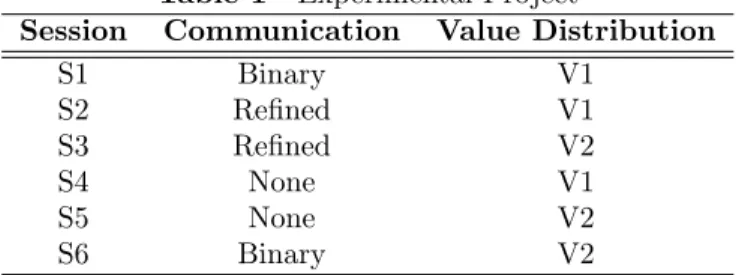
We ran two sessions for each of the three treatments: no communication, cheap talk with binary message space, and cheap talk with re…ned message space. To avoid randomness in the distribution value between the sessions, we used two value distribution, V1 and V2, and one group matching along the sessions. The experimental project is summarized at Table 1. The sessions were computer based6. Each session consisted of 25 decision rounds without practicing periods7.
Thestrangersprotocol was used to randomly form the new groups each period,
in a manner that the agents never knew who was their partner. This protocol is an e¤ort to simulate one-shot game’s actions.
Table 1- Experimental Project
Session Communication Value Distribution
S1 Binary V1
S2 Re…ned V1
S3 Re…ned V2
S4 None V1
S5 None V2
S6 Binary V2
In each session, we had 16 subjects, summing 96 subjects. The subjects recruitment was made through the Experimental Economic Center’s website. All participants were unexperienced undergraduate students of Getulio Vargas Foundation. We had subjects majoring in courses like Economics, Business, Law, Social Science, and History. Each participant received R$8.00 to show up plus the experiments’ gains. The total average payment is R$17.00.
All sessions were ran in a similar way. Just after all participants took their places, participants were given some time to read the instructions8, and then
the researcher read it aloud. Once individual doubts were answered, the game began. A detailed payo¤ table was presented on the individual computer screen in all decision stages to help players estimate their potential gains as a function of their private information and his possible actions9.
During the experiment, the investment decision in a joint project was pre-sented as an allocation decision. The subject’s problem was to choose the amount of his initial endowment he would like to allocate to a Group Account, and how much of this endowment he would like to keep with him.
The game timing is as follow. Each period, the subjects are randomly allo-cated into new groups of two. Each subject receives an endowment of100tokens,
and his Group Account valuation,vi, is informed on the computer screen. This
6We used the Ztree program at http://www.iew.unizh.ch/ztree/ .
7There exists evidence of learning in the initial period, but, as we did not previously know
how many periods it longs, we opted to not settle a …xed number of practice periods. We discard the initial periods later along our analysis.
8The instructions are available under request.
9This practice is standard in the literature and follows Saijo and Nakamura (1995) and
value is a private information and the subject only knows that the Group Ac-count value of the other player is uniformly distributed between0and 100. In the communication treatments, subjects …rst decision is to send a message to his partner. After receiving the message sent to him by his partner, each subject decides how much to allocate to a Group Account,ci, the amount not allocated
is kept with him, 100 ci. Subjects payo¤ is given by (??), with threshold
k= 10010.
After all participants had taken their decision, a result screen was presented informing: (i) if the total allocation to the Group Account was greater or equal to k, (ii) the amount allocated by the agent to the Group Account, (iii) the two messages, and (iv) his pro…ts. The history of these informations was also available. Once the round was over, the program randomized the groups and the next round could begin. Each session lasted around 75 minutes, including the payment time.
3.1
No communication treatment
This is the base treatment. Each round, subjects play a one stage game where they observe their Group Account value, vi, and simultaneously type on the
computer the amount to be allocated to the Group Account,ci.
The following Hypothesis concerns about Proposition 1.
Hypothesis 1 The only possible equilibrium is the strongly ine¢cient one, e.g., the total allocated to the Group Account never exceeds the threshold.
3.2
Binary communication treatment
The participants now play a two stage game, so each round has two stages. In the …rst stage, each subject observes his Group Account value,vi, and sends one
of two possible messages to his partner: "Yes, I intend to allocate tokens to the Group Account" or "No, I do not intend to allocate tokens to the Group Ac-count"11. Note that this message space does not have a common communication
technology, because it does not have an explicit cuto¤ rule saying "If your type isvi v, communicateY , otherwise, communicateN". This cheap talk allows
players to communicate their type, but mainly it let them to communicate their intentions, as it is common in the literature. It is important to enforce that this message is cheap talk, e.g., it is unrelated with the player decision in the second stage.
In the second stage, each subject observes the message their partner sent to him and, then, chooses the amount he would like to allocate to the Group Account,ci. Again, the message sent by the subjects in the …rst stage does not
restrain his decision in the second stage.
1 0This terminology is the voluntary contribution mechanism’s standard, where any reference
to social contribution is avoided, not to bias the agent’s decisions.
Next Hypothesis concerns about Proposition 2 whenn=m= 2, and Propo-sition 11 of Agastyaet al (2007).
Hypothesis 2 The probability that the total allocated to the Group Account exceeds the threshold is greater in the cheap talk game than in the no communi-cation game.
3.3
Re…ned communication treatment
This treatment consists of a two stage game analogous to the binary communica-tion treatment, with the only di¤erence that the message space in the …rst stage is not binary. The message space here is =f[0;25];[25;50];[50;75];[75;100]g, so players should send one of four possible messages, mi, to their partners:
mi= [0;25],[25;50],[50;75], and[75;100]. In order to follow the binary
treat-ment, the players should communicate their intentions, not their types, so the subjects were asked "How much do you intend to invest?" and they would have to choose to send the following message: "I intend to allocate an amount inmi
tokes to the Group Account". Note that, now, there is a common communica-tion technology, because, even the communicacommunica-tion being cheap talk, there are explicit cuto¤s for each of the four possible messages12.
In order to test our hypotheses, we had to choose a message space con-sidering three points. First, the re…ned partition should permit e¢ciency gains relatively to the binary one. Indeed, a continuation game of a pair of messages
[25;50]and[75;100], as shown in the shaded area of Figure 3, is a situation that is not possible in the binary treatment, and that may lead to the project com-pletion. Second, the message space cannot support a truthful equilibrium. As
a3+b3> k, it was demonstrated in the last section that this kind of equilibrium
does not exist. Third, the message space should support a non-truthful equi-librium13. So, the subjects may have the possibility to play a strategy pro…le
that is strategically equivalent to a binary one, e.g., they may be able to use the re…ned message space as a binary space. The following strategy pro…le satis…es this condition: in the communication stage, subjects communicate [50;75] if their value are greater that50, and truthfully communicate otherwise; in the contribution stage, players allocate 50 to the Group Account if they follow the history([50;75];[50;75]), and allocate zero otherwise.
1 2We opted not to use a communication technology without explicity cuto¤s, analog to the
one in the binary treatment, because it could lead to erratic behavior.
1 3A message space that does not support any equilibrium could lead to too erratic behavior,
Figure 3
0 25 50 75 100
25 75
50 100
Next Hypothesis concerns about Proposition 2 whenn=m= 4:
Hypothesis 3 The probability that the total allocated to the Group Account exceeds the threshold in the cheap talk game with re…ned message space is not greater than in the cheap talk game with binary message space.
4
Results
Along this section we use two e¢ciency measures: the probability of the joint project to be implemented when it is socially optimum,P, e.g., the probability of the project to be implemented when the aggregate project value is greater than his cost; and the contribution excess(4)that we de…ne as the unproductive amount invested:
CE= c1+c2
c1+c2 k
, ifc1+c2< k
, ifc1+c2 k:
(4)
Note that the theoretic model does not mention contribution excess14, so we
study this e¢ciency measure using an hypotheses analogous to the ones in the model.
We observed evidence of learning in the eight …rst periods, where investment was decreasing in time15. As the model tested is an one-shot game, we discarded
the data from the eight …rst periods.
1 4Actually, the game theory approach states that in equilibrium the contribution excess is
equal zero, otherwise players would have a pro…table desviation by reducing their contribution.
1 5We regressed contribution on period, value, treatments dummy and value distribution
4.1
Hypotheses test and e¢ciency
We begin by looking to the e¢ciency measure discussed in the model: the probability of the joint project to be implemented when it is socially optimum,
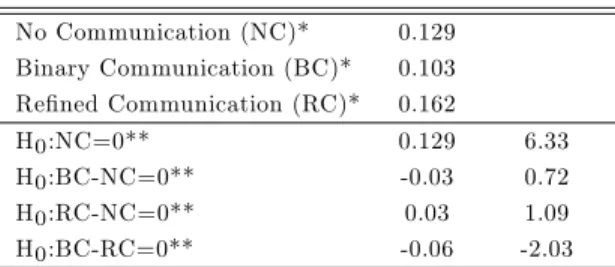
P. The base treatment is the no communication game, where we observe that the joint project is implemented in 12.7% of the groups, meaning that a lot of people do not play the zero contribution Nash Equilibrium strategy. Indeed, through a mean equality test, we reject Hypothesis 1 at 1% signi…cance, Table 1 presents the statistics. This result was also observed by Menezes and Saraiva (2005).
Two possible behavior patterns could explain this result. One is that people overestimate the conditional distribution function of his partner contribution given his own contribution, which makes contribution more attractive, e.g., the bias on the expected distribution function may support an equilibrium with non-zero contribution in some states. The other possibility is that people behave naïvely and contribute without estimating his expected payo¤.
Even if the base treatment does not exhibit the strongly ine¢cient equi-librium, the introduction of a communication stage increases the equilibrium set, which contains more e¢cient equilibria, as it was proved. The idea of Hy-pothesis 2 is that the multi-stage communication game would allow players to coordinate in a more e¢cient equilibrium. Next result, however, shows that players were not able to do so. Using a mean equality test, Hypothesis 2, which states that the binary communication increases the probability of the project implementation, is rejected at 1% signi…cance. Palfrey and Rosenthal (1991) and Bochet et al (2006) also obtained this result, which does not agree with the …ndings of Menezes and Saraiva (2005) and Cai and Wang (2006). As we are going to discuss next, a very non systematic behavior in the communication stage was observed, what may have introduced more noise in the cheap talk, lowering the messages credibility.
Table 1 -P Mean Equality Test
Mean t statistic No Communication (NC)* 0.129
Binary Communication (BC)* 0.103 Re…ned Communication (RC)* 0.162
H0:NC=0** 0.129 6.33 H0:BC-NC=0** -0.03 0.72 H0:RC-NC=0** 0.03 1.09 H0:BC-RC=0** -0.06 -2.03
Note: Numb er of observations: *272, **542.
and in fact, using a mean equality test, we reject the third hypothesis at 5% of signi…cance. However, we cannot reject the hypothesis at 1% of signi…cance.
As discussed in the previous section, there exists a non-truthful equilibrium in the re…ned treatment that is strategically equivalent to a truthful equilib-rium in the binary message space. Next, when we discuss players’ strategies, we argue that people use this non-truthful strategy pro…le to some extent. These strategies, however, are not easily identi…ed because, similarly to the binary communication treatment, the re…ned message space increased subject’s mis-communication possibility, which led to higher noise and lowered the messages credibility. Bochet et al (2006) used a communication technology that is richer than ours, but that allowed comparisons, and found that numerical communi-cation had no e¤ect on e¢ciency.
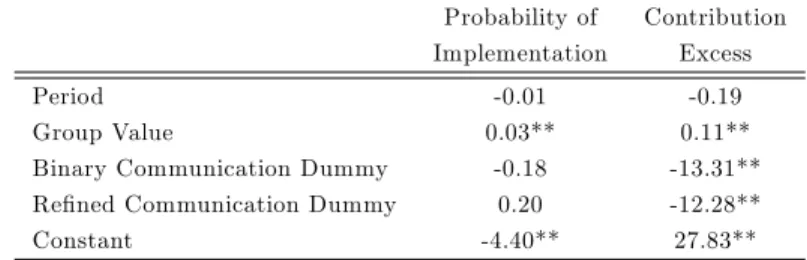
What can be said when the re…ned communication treatment is directly compared with the no communication one? We have seen that the binary com-munication does not increase the probability of project implementation relative to the base treatment, neither the re…ned message space relative to the binary message space. With this two results together we can test a new hypothesis: the probability of the project to be completed in the re…ned communication treatment is not greater than in the no communication treatment. This new hypothesis is not rejected at 1% of signi…cance by a mean equality, see Table 1. So, in this model, both communication technologies do not provide e¢ciency gain when e¢ciency is measured by the probability of the project implementa-tion. This result can be better enforced by a probit regression of probability of project implementation on period, group value and treatment dummies, see Table 2. It can be seen that both treatment dummies are insigni…cant at 1%. This is not an intuitive result, but agrees with some literature …ndings, specially when communication is not verbal.
Table 2- Regressions
Probability of Contribution Implementation Excess
Period -0.01 -0.19
Group Value 0.03** 0.11** Binary Communication Dummy -0.18 -13.31** Re…ned Communication Dummy 0.20 -12.28**
Constant -4.40** 27.83**
Note: Signi…cance of **1%, *5%. 863 observations.
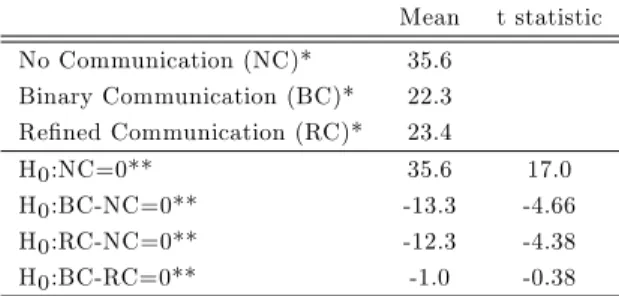
The idea of Hypothesis 2 that communication allows e¢ciency gains in re-lation to the base treatment is not rejected here. Using the mean equality test, we reject two null hypotheses at 1% of signi…cance: that the contribution excess in the no communication treatment is equal to the one in the binary treatment, and that the contribution excess in the base treatment is equal to the one in the re…ned treatment (see Table 3). In both cases, the null hypothesis is rejected in detriment to the alternative hypothesis that the mean contribution excess in the no communication game is greater than the communication one.
Table 3 - Contribution excess mean equality test
Mean t statistic No Communication (NC)* 35.6
Binary Communication (BC)* 22.3 Re…ned Communication (RC)* 23.4
H0:NC=0** 35.6 17.0 H0:BC-NC=0** -13.3 -4.66 H0:RC-NC=0** -12.3 -4.38 H0:BC-RC=0** -1.0 -0.38
Note: Numb er of observations: *272, **542.
When we compare the re…ned and the binary communication treatments we observe that in neither e¢ciency measurement - probability of project com-pletion and contribution excess - the re…ned message space provides e¢ciency gain relative to the binary one. Using a mean equality test, we cannot reject at 1% of signi…cance that the two communication treatments have the same mean contribution excess (see Table 3). This result is strengthened by the regression of contribution excess in constant, period, total group value, treatment dum-mies and value distribution dummy. As can be seen in Table 2, both treatment dummies are signi…cant and, more, using an F test we cannot reject at 1% of signi…cance the equality of the two dummies coe¢cients.
So, communication indeed increases e¢ciency in relation to the one stage game, but this e¢ciency gain is not observed by higher probability of project implementation, as usual in the literature, but it is measured by a lower level of ine¢cient contribution. With this new reference in mind, we believe that our result adds to the literature that sees communication as an useful mechanism to enhance e¢ciency. Note, however, that this communication e¢ciency gain seems to be very limited, as a more re…ned communication space could not support a more e¢cient equilibrium.
4.2
Strategic pro…le
The …rst issue to understand subjects strategy pro…le is to check if strictly dom-inated strategies are being used. In our case, the strictly domdom-inated strategy is to invest in the joint project an amount higher than the project value16. In 9.9%
1 6As we don’t know players beliefs about their partners behavior, the zero contribution or
of the total 1632 observations, the subjects played strictly dominated strategies. This number may seem too high, but if compared with the literature …ndings, it is quite reasonable. Daweset al (1985) and Issacet al (1985) observed 20% and 30% of this kind of rationality violation in their experiments. Using a mean equality test, we reject at 1% of signi…cance that 20% of the strategies were strictly dominated in favor of the alternative hypothesis that our fraction of violation was lower.
Now, we can look with more attention to the individual behavior that can help us to understand the last subsection results. Following the sequence of the game, we …rst analyze the behavior in the communication stage.
As discussed in the last section, the message space on the binary treatment does not have an explicitly threshold to de…ne which message is more appropri-ate. The "Yes, I intend to contribute" and "No, I do not intend to contribute" messages are somewhat loose in this sense, and it is interesting to estimate the threshold that makes the "Yes" message more likely? Using a probit regres-sion of message on value, we observe that when subject’s value is equal 67.1 the "Yes" message is sent with 50% chances. Theoretically, any two-thresholds such that their sum are equal to the project cost is optimum. So, the only symmetric threshold that sustains a 2-simple equilibrium is 50. This is not the case here, and the 2-simple strategy pro…le with threshold 67.1 observed is dominated by the theoretical threshold. This means that in the binary treatment, at least 13.4% of e¢ciency was lost in the communication stage. This high threshold accuses a reluctance of people to communicate, that may be motivated by a free-riding behavior or by their risk aversion.
We can observe a similar behavior when we look to the re…ned treatment. There is evidence of bunching of the lower types in the message[0;25]and of the higher types in the message[50;75], see the histogram in Graph 1. Observe that in all the cases, except the lowest one, most of the people underrevealed their value. More, the overcommunication pattern is quite similar to all value range, except the highest one, what accuses that people indeed under revealed their types. The free-riding and risk aversion motivations …t here.
Graph 1 - Message histogram by value
Binary Communication
0 20 40 60 80 100 120 140 160 180 200
[0,25] [25,50] [50,75] [75,100]
Yes No
Refined Communication
0 20 40 60 80 100 120
[0,25] [25,50] [50,75] [75,100]
[0,25] [25,50] [50,75] [75,100]
We can look to the non-truthful strategy of players when they try to mimic the binary message space in the re…ned treatment. Bunching the messages[0;25]
with[25;50], and[25;50] with[75;100], and running a probit model analogous to the one in the binary treatment, we …nd that the analogous threshold of the "Yes" message, in the re…ned treatment, is much higher than the one in the binary treatment, equal 99. So, people reveal more their values in the binary message space than in the bigger message space, or, at least, there were more miscommunication in the re…ned treatment.
The non systematic behavior in the communication stage can be better seen in the three dimension message histogram, Graph 2. Palfrey and Rosenthal (1991) also observed this non systematic behavior, however, the undercommu-nication pattern was not observed by Cai and Wang (2006) and Blume et al
Graph 2 - Message histogram given subject’s value
Binary Treatment
012,5
2537,550
62,575 87,5 0 25 50 75 0 0,5 1 1,5 2 2,5 3 3,5 4 4,5 5 (No,No) 0 25 50 75 0 37,5 75 0 2 4 6 8 10 12 (Yes,No)
012,525 37,55062,5
75 87,5 0 25 50 75 0 2 4 6 8 10 12 (Yes,Yes) Re…ned Treatment
012,525 37,550 62,575 87,5 0 25 50 75 0 2 4 6 8 10 12 14 16 Com<6
012,525 37,55062,5
75 87,5 0 25 50 75 0 1 2 3 4 5 6 7 Comm>=6
However, the ‡at pattern observed can support the two conjectures made when we discussed the …rst hypothesis in the last subsection, e.g., that people over-estimate the conditional distribution function of his partner contribution given his own contribution, and do not update their believe, or that people behave naïvely and contribute without estimating the real distribution function of the other player contribution.
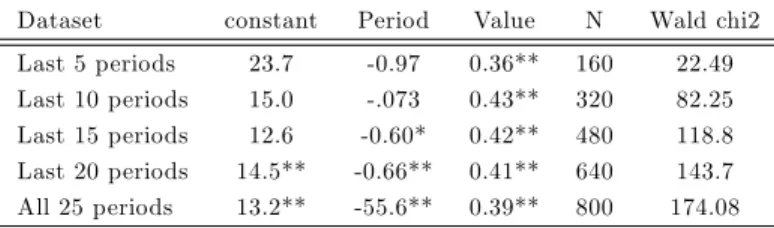
Table 4- Random E¤ects Regression (No communication treatment)
Dataset constant Period Value N Wald chi2 Last 5 periods 23.7 -0.97 0.36** 160 22.49 Last 10 periods 15.0 -.073 0.43** 320 82.25 Last 15 periods 12.6 -0.60* 0.42** 480 118.8 Last 20 periods 14.5** -0.66** 0.41** 640 143.7 All 25 periods 13.2** -55.6** 0.39** 800 174.08 Note: Signi…cance of **1%, *5%.
When we look to the two communication treatment, the contribution stage is a continuation game that fallows the history of the communication stage. In this case, it is useful to look the contribution truncated by the previous information set, e.g., to look to the continuation game. In the binary treatment, the mean contribution, given that the message history is (Y es; Y es), is equal to 33.8. Using a t test, we reject at 1% of signi…cance that this mean is equal 50. Then, it can be inferred that people do free-ride in the contribution stage. The same can be observed in the re…ned treatment, where the mean contribution given the history ([50;100];[50;100]) is equal 42.2. Again, a t test rejects at 1% of signi…cance that the mean contribution is equal to50. Table 5 presents the tests values.
Table 5- Mean contribution
Mean t statistic N Binary Communication (BC)
H0:Contributionj(Yes,Yes) = 50 33.8 -9.1 290 Re…ned Communication (RC)
H0:Contributionj([50,100],[50,100]) = 50 42.1 -3.36 160
The three dimension contribution histogram helps us understand subjects behavior (see Graph 3). In both treatment, the "bad state of the world mes-sages"17 are informative, and people do coordinate on the double zero
contri-bution. However, the continuation game that follows the (Y es; Y es) history, present a much bigger dispersion. Although the mode contribution is 50, very few contributions were made in the area([50;100];[50;100]). The dispersion is even higher in the re…ned treatment, and, again, very few observations are found
1 7We call a "bad state of the world message" the communication history containing a
in the([50;100];[50;100]) area. So, the behavior seems to be: "If the message brings good news, I contribute 50 or less, in an e¤ort to free-ride my partner’s contribution. Otherwise, if the message is not good, I contribute zero."
Graph 3- Contribution histogram given communication history
Binary Treatment 0 20 40 60 80 100 0 40 80 0 10 20 30 40 50 60 (No,No) 0 20 40 60 80 100 0 40 80 0 20 40 60 80 100 120 (Yes,No) 0 20 40 60 80 100 0 40 80 0 5 10 15 20 25 30 35 (Yes,Yes) Re…ned Treatment 0 20 40 60 80 100 0 40 80 0 20 40 60 80 100 120 140 160 180 Comm<6 0 20 40 60 80 100 0 30 60 90 0 2 4 6 8 10 12 14 16 Comm>=6
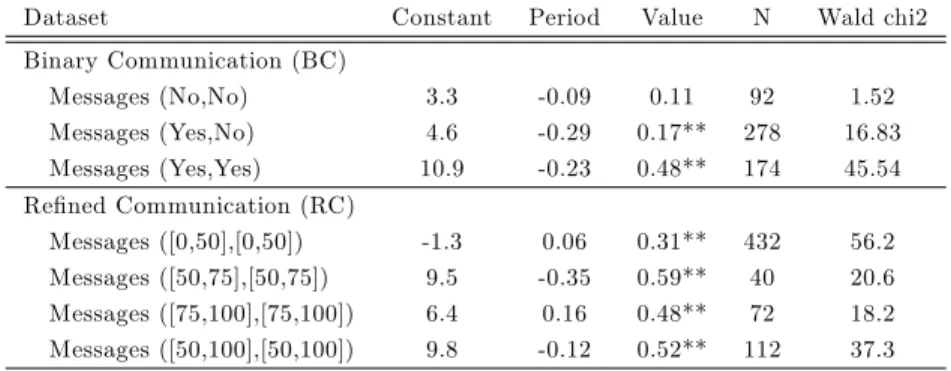
messageY es, value is signi…cant at 1% and, the more interesting, his sensitivity is monotonic in the number ofY esmessages. This result is observed by Palfrey and Rosenthal (1991).
Table 6- Random E¤ects regression truncated by communication history
Dataset Constant Period Value N Wald chi2 Binary Communication (BC)
Messages (No,No) 3.3 -0.09 0.11 92 1.52 Messages (Yes,No) 4.6 -0.29 0.17** 278 16.83 Messages (Yes,Yes) 10.9 -0.23 0.48** 174 45.54 Re…ned Communication (RC)
Messages ([0,50],[0,50]) -1.3 0.06 0.31** 432 56.2 Messages ([50,75],[50,75]) 9.5 -0.35 0.59** 40 20.6 Messages ([75,100],[75,100]) 6.4 0.16 0.48** 72 18.2 Messages ([50,100],[50,100]) 9.8 -0.12 0.52** 112 37.3 Note: Signi…cance of **1%, *5%.
When we look to the re…ned treatment, however, not much can be said about contribution sensitivity to the value. Value is always a signi…cant explanatory variable, but its coe¢cients are not monotonic and have a more di¢cult inter-pretation.
5
Conclusion
This article is an attempt to model the behavior of two persons in situations where non costly communication could lead to welfare gain. We take Agastya, Menezes and Sengupta (2007) model and prove that even when players have several messages possibilities, they cannot do better than when they only have the "Y es" and "N o" messages. In other words, a bigger message space supports a bigger equilibrium set, that does not Pareto denominate the equilibrium set supported by a binary message space.
Laboratory experiments were performed to test our result and two propo-sitions of Agastyaet al (2007). We …nd that when there is no communication people make blind contributions, and the project is implemented with positive probability. The observations do not support the results that communication in-creases the probability of the project implementation. We found, however, that communication a¤ects e¢ciency in another way, by reducing the overcontribu-tion, e.g., the nonproductive contribution. In both aspects, the re…ned message space does not outperform the binary one. We found evidence of free-riding in both stages.
References
[1] Agastya, M.; Menezes, F.; and Sengupta, K. (2007), "Cheap talk, e¢ciency and egalitarian cost sharing in joint projects", Games and Economic
Be-havior, Vol. 60.
[2] Austen-Smith, D. (1990), "Information transmission in debate",American
Journal of Political Science,34, 124–152.
[3] Baliga, S; Sjöström, T. (2004), "Arms Races and Negotiations",Review of
Economic Studies, 71, 351–369.
[4] Belianin, A.; Novarese, M. (2005), "Trust, communication and equlibrium behaviour in public goods", working paper.
[5] Cai, H.; Wang, J. T. (2006), "Overcommunication in strategic information transmission games", Games and Economic Behavior, 56, 7–36.
[6] Cason, T.; Khan, F. (1999), "A laboratory study of voluntary public goods provision with imperfect monitoring and communication",Journal of
De-velopment Economics, 58, 533–552.
[7] Bochet, O.; Page, T.; Putterman, L. (2006), "Communication and punish-ment in voluntary contribution experipunish-ments",Journal of Economic
Behav-ior & Organization, Vol. 60, 11–26.
[8] Crawford, V.; Sobel, J. (1982), "Strategic Information Transmission",
Econometrica, Vol. 50, No. 6 .
[9] Crawford, V. (1998), "A Survey of Experiments on Communication via Cheap Talk",Journal of Economic Theory, 78, 286-298.
[10] Dawes, R.; Orbell, J.; Van de Kragt, A. (1985), "A Great Society or a Small Society? The threshold of the Room E¤ect in Social Dilemmas", presented at the Western Psychological Association meetings, San Jose (CA).
[11] Dessein, W. (2002), "Authority and Communication in Organizations",
Review of Economics Studies, 69, 811-838.
[12] Dickhaut, J.; McCabe, K.; Mukherji, A. (1995), "An experimental study of strategic information transmission",Economic Theory, 6, 389-403.
[13] Doraszelski, U.; Gerardi, D.; Squintani, F. (2003), "Communication and Voting with Double-Sided Information",Contributions to Theoretical
Eco-nomics, Vol. 3, Issue 1.
[14] Farrel, J.; Gibbons, R. (1989), "Cheap Talk Can Matter in Bargaining",
Journal of Economic Theory, 48, 221-237.
[16] Fudenberg, D.; Tirole, J. (1991), "Game Theory",The MIT Press.
[17] Gilligan, T.; Krehbiel, K. (1987), "Collective Decision-Making and Stant-ing Committees: An Informationale Rationale for Restrective Amendments Procedures",Journal of Law, Economics, and Organization, 3, 287-335.
[18] Issac, R. M.; McCue, K.; Plott, C. (1985), "Public Goods Provision in an Experimental Market", Journal of Public Economic, 26, 51-74.
[19] Menezes, F.; Saraiva, J. (2005), "Cheap Talk, Egalitarian Cost Sharing and Refunds in the Voluntary Provision of Public Goods: An Experimental Analysis", presented at the ESA North American meeting, Tucson (AZ).
[20] Palfrey, T.; Rosenthal, H. (1991), "Testing for E¤ects of Cheap Talk in a Public Goods Game with Private Information", Games and Economic Behavior, Vol. 3, No. 2, 183-221.