Submitted5 October 2015 Accepted 17 February 2016 Published21 March 2016
Corresponding author Marta Borgi, [email protected]
Academic editor Juliane Kaminski
Additional Information and Declarations can be found on page 9
DOI10.7717/peerj.1775
Copyright 2016 Borgi and Majolo
Distributed under
Creative Commons CC-BY 4.0
OPEN ACCESS
Facial width-to-height ratio relates to
dominance style in the genus
Macaca
Marta Borgi1,2and Bonaventura Majolo1
1School of Psychology, University of Lincoln, Lincoln, United Kingdom
2Department of Cell Biology and Neurosciences, Istituto Superiore di Sanità, Rome, Italy
ABSTRACT
Background. Physical, visual, chemical, and auditory cues signalling fighting ability have independently evolved in many animal taxa as a means to resolve conflicts without escalating to physical aggression. Facial width-to-height ratio (fWHR, i.e., the relative width to height of the face) has been associated with dominance-related phenotypes both in humans and in other primates. In humans, faces with a larger fWHR are perceived as more aggressive.
Methods. We examined fWHR variation among 11 species of the genus Macaca. Macaques have been grouped into four distinct categories, from despotic to tolerant, based on their female dominance style. Female dominance style is related to intra-and inter-sexual competition in both males intra-and females intra-and is the result of different evolutionary pressure across species. We used female dominance style as a proxy of intra-/inter-sexual competition to test the occurrence of correlated evolution between competitive regimes and dominance-related phenotypes. fWHR was calculated from 145 2D photographs of male and female adult macaques.
Results.We found no phylogenetic signal on the differences in fWHR across species in the two sexes. However, fWHR was greater, in females and males, in species characterised by despotic female dominance style than in tolerant species.
Discussion. Our results suggest that dominance-related phenotypes are related to differences in competitive regimes and intensity of inter- and intra-sexual selection across species.
SubjectsAnimal Behavior, Zoology
Keywords Aggression, Dominance style, fWHR, Facial structure, Competition, Sexual selection, Phenotype
INTRODUCTION
In humans, facial phenotype, specifically the facial width-to-height ratio (fWHR), is a cue of aggression, dominance and fighting ability: fWHR is positively related to the acquisition of status and resources, antisocial tendencies, dominance status and propensity to be aggressive (Carré & McCormick, 2008;Carré, McCormick & Mondloch, 2009;Haselhuhn & Wong, 2012;Lefevre et al., 2014a;Sell et al., 2009). Preliminary evidence on the association between circulating testosterone and fWHR in men (Lefevre et al., 2013), as well as the association between individual differences in amygdala reactivity, fWHR and self-reported aggression (Carré, Murphy & Hariri, 2013), suggests a possible path through which fWHR may have evolved to signal aggressive attitude. The association between facial phenotype and aggression might reflect the common influence of pubertal testosterone on cranial growth and the development of neural circuitry underlying aggressive behaviour (Carré & McCormick, 2008;Carré, Murphy & Hariri, 2013). High fWHR may thus work as a marker of ‘‘masculine’’ tendencies, in particular in species with a sex-biased frequency of aggression. Previous studies on humans indicate that the correlation between fWHR and dominance-related behaviours, as well as the modulator effect of fWHR on the relationship between amygdala reactivity and self-reported aggression, are either specific to or more robust in men (Carré & McCormick, 2008;Carré, Murphy & Hariri, 2013;Geniole et al., 2014;Goetz et al., 2013;Haselhuhn & Wong, 2012;Stirrat & Perrett, 2010; but see:Lefevre et al., 2014a).
Similarly to what happens in humans, human primates rely extensively on non-verbal communication and on a variety of facial displays to signal aggression/submission and to modulate social interactions (Maestripieri, 1997). Therefore, facial phenotypes, such as the fWHR, can have a homologous function and a shared phylogenetic history in non-human primates and in the human lineage. In support to this hypothesis, two recent studies have shown that, in brown capuchin monkeys (Sapajus apella) fWHR is positively related to alpha status and to a dominance-related personality trait (Lefevre et al., 2014b;
Wilson et al., 2014).
To date, research on the relationship between fWHR and behaviour has rarely been conducted on non-humans and it has mostly focused on within-species variation. If fWHR is a signal of aggression and fighting abilities, we predict correlated evolution between fWHR and social traits at the species level. In other words, we predict different evolutionary pressure on fWHR depending on the species-specific differences in aggressiveness, competitive regime and dominance style. We tested this hypothesis in the genusMacaca, comprising 22 species with similar group composition (i.e., multimale-multifemale social groups) but differing in female dominance style and intra-group social relationships, according to a four-grade scale ranging from despotic (grade 1) to tolerant (grade 4) (Balasubramaniam et al., 2012a;Balasubramaniam et al., 2012b;Thierry, 2000;Thierry et al., 2008;Thierry, Iwaniuk & Pellis, 2000). Despotic, grade 1, species are characterised by steep linear dominance hierarchies among females, whereby the outcome of dyadic competitive interactions, as well as access to resources, strongly depend on the dominance rank of the contestants (Balasubramaniam et al., 2012a;Balasubramaniam et al., 2012b;
hierarchies are shallow among females, that is, the outcome of dyadic competitive interactions depends on context as much as it does on the dominance rank of the contestants (Balasubramaniam et al., 2012a;Balasubramaniam et al., 2012b;Thierry, 2000). Low-intensity aggressive interactions and counter-aggression are more frequent in tolerant species than in despotic species, but conflicts less frequently result in injuries, and access to resources is less rank-dependent (Balasubramaniam et al., 2012a;Balasubramaniam et al., 2012b;Thierry, 2000;Thierry et al., 2008;Thierry, Iwaniuk & Pellis, 2000). Species in-between the two extremes of this grading system (grade 2 and 3), show a mixture of dominance style traits of tolerant and despotic species (Balasubramaniam et al., 2012a). Differences in dominance style across macaque species have a strong phylogenetic signal (Balasubramaniam et al., 2012a;Balasubramaniam et al., 2012b).
In female macaques, we predict correlated evolution between dominance-related phenotypes and species-specific differences in dominance style: fWHR should be greater in females from despotic species than in those from tolerant species. In despotic species, displays of dominance, aggression and submission among females should be more important than in tolerant species, as in the former the risk of escalated aggression is expected to be higher. Over evolutionary time, therefore, there should have been stronger pressure for the evolution of dominance-related phenotypes in female macaques in despotic species than in tolerant species, other things being equal (relative dominance rank of the individuals). We predict a significant relationship between fWHR and female dominance style across species in male macaques. However, we cannot predict whether such relationship is positive or negative, as it is currently not known if male macaques show a similar or opposite pattern of inter-specific differences in dominance style as observed in females. Our prediction for male macaques is based on the fact that competitive regimes among females are related to male-male competition and dominance style (Schülke & Ostner, 2008;Schülke & Ostner, 2012) and can affect intra- and inter-sexual selection in both sexes. For example, male reproductive skew is more pronounced in female tolerant species (Schülke & Ostner, 2008;Schülke & Ostner, 2012;Van Noordwijk & Van Schaik, 2004). To test our predictions we used the four-grade scale of dominance style in female macaques as a proxy of differences across species in the level of inter- and intra-sexual selection in the two sexes. We calculated fWHR from 145 two-dimensional images (a measure previously shown to correlate with 3D scans and facial anthropometry,Kramer, Jones & Ward, 2012) of male/female faces of macaques from 11 species representing the four grades of female dominance style—as inThierry’s classification (2000). We analysed the correlation between fWHR and female dominance style using phylogenetic-controlled analyses and standard (i.e., without phylogenetic control) multiple regression.
MATERIALS & METHODS
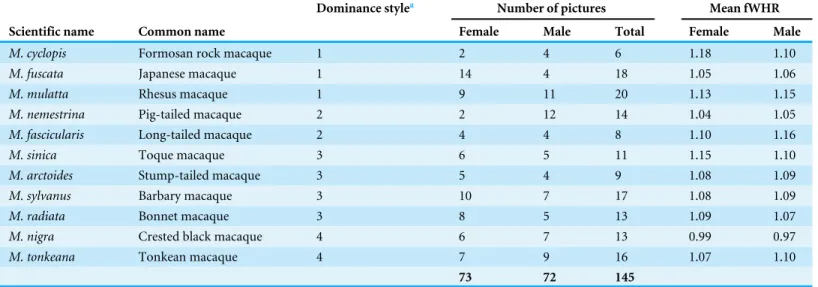
Images and measurementsTable 1 Images used for the analyses.Number of images and mean fWHR (square root transformed) divided by species, sex and dominance style.
Dominance stylea Number of pictures Mean fWHR
Scientific name Common name Female Male Total Female Male
M. cyclopis Formosan rock macaque 1 2 4 6 1.18 1.10
M. fuscata Japanese macaque 1 14 4 18 1.05 1.06
M. mulatta Rhesus macaque 1 9 11 20 1.13 1.15
M. nemestrina Pig-tailed macaque 2 2 12 14 1.04 1.05
M. fascicularis Long-tailed macaque 2 4 4 8 1.10 1.16
M. sinica Toque macaque 3 6 5 11 1.15 1.10
M. arctoides Stump-tailed macaque 3 5 4 9 1.08 1.09
M. sylvanus Barbary macaque 3 10 7 17 1.08 1.09
M. radiata Bonnet macaque 3 8 5 13 1.09 1.07
M. nigra Crested black macaque 4 6 7 13 0.99 0.97
M. tonkeana Tonkean macaque 4 7 9 16 1.07 1.10
73 72 145
Notes.
aCategory #1 defines female despotic species—grade #1 in Thierry’s classification (Thierry, 2000)—and category #4 defines female tolerant species—Grade #4 in Thierry’s
classifi-cation.
order to expand our sample size in terms of number of pictures and species, we searched for images on the Google Images web search engine by submitting the scientific name of each species as a key-word. In order to be included in our dataset, images had to be frontal, full-faced photographs depicting male and female adult macaques (i.e.,≥5 years old for females and≥7 years old for males) with a neutral expression (closed mouth) and with
a resolution of at least 400×300 pixels per inch. For the images collected from the web, information on the sex and age of the animal in the image was often not available (sex and age of the animals was known for images taken by BM or obtained from colleagues). Therefore, these images were independently scored for age and sex by one of us (BM) and an expert on macaques (who was unaware of the aims of the study). Correlation between the two scores was positive and significant (Spearman correlation; age rho =
0.70,p<0.001; sex: rho=0.57,p<0.001). However, we discarded all of the images for
which scores for sex and/or age were in disagreement between the two scorers in order to avoid biasing the analyses due to incorrect data on the sex/age of the animals. Moreover, since macaques often present individual physical traits which are easily identifiable, all images taken from the web were checked for independence by two researchers, in order to reduce the risk that the same animal could be depicted in two or more images included in the dataset (if that was the case, we only kept one image, with the highest resolution). Following this procedure, our dataset comprised a total of 145 images from 11 species of genusMacaca, 73 images of adult female macaques (40 images collected from the web) and 72 of adult male macaques (41 images collected from the web;Table 1).
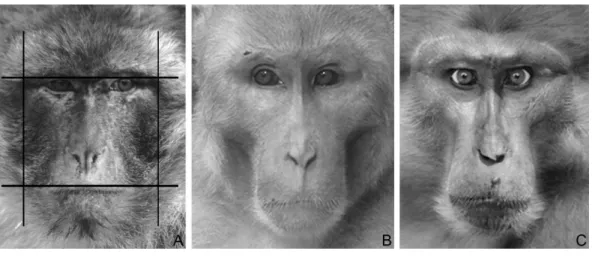
Figure 1 Macaque faces.(A) An example illustrating how fWHR was calculated from images (Barbary macaque). Bizygomatic width was measured as the horizontal distance between the left and right zygion (vertical lines); upper-face height as the vertical distance between the highest point of the eyelids and the highest point of the upper lip (horizontal lines). The fWHR was calculated as width divided by height. (B) A male rhesus macaque (dominance style 1). Photo by Lauren Brent (modified). (C) A male Tonkean macaque (dominance style 4). Photo by Bernard Thierry (modified).
Facial measurements were taken using the ruler tool with pixels as a unit. In accordance with previous work (Kramer, Jones & Ward, 2012;Lefevre et al., 2014b;Wilson et al., 2014), fWHR was calculated by dividing the bi-zygomatic width (maximum horizontal distance from the left to the right zygion) by the upper-face height (vertical distance from the highest point of the eyelids to the upper-lip) (Fig. 1). One of us (MB) took all of the measures; at the time of taking the measures MB was blind to the dominance style of the different macaque species in the dataset. In order to test the consistency of the facial measures taken across time, MB re-took the measures for the bi-zygomatic width and the upper-face height for a subset of images (N=39), randomly selected for each species (2.4 images per species), six months after the same measures were first taken on those images. Consistency across the two measures was very high (Spearman correlation; bizygomatic width: rho=
0.93,p<0.001; upper-face height: rho=0.99,p<0.001).
Data analysis
Figure 2 Relationship between female dominance style and fWHR (data averaged per species).Scatter plot and line of best fit for the relationship between dominance style (yaxis) and fWHR (xaxis) in female (A) and male (B); grade 1 defines despotic species and grade 4 tolerant species (Thierry, 2000).
comparing the estimated lambda to the upper (lambda=1) and lower bounds (lambda=
0). We ran these two PGLSs in R 3.1.0 (R Development Core Team, 2011), using the CAPER 0.4 package (Orme et al., 2012). We downloaded a consensus phylogenetic tree, with the chronogram branch option using the Genbank taxonomy, from the 10ktree primate phylogeny version 2 (http://10ktrees.fas.harvard.edu,Arnold, Matthews & Nunn, 2010). Second, since no phylogenetic signal was detected in the two PGLSs (see ‘Results’), we ran a standard (i.e., without phylogenetic control) linear mixed model on the two sexes together. The fWHR values of each image (our dependent variable) were our data points (N=145); dominance style and sex (females or males) were entered as fixed factors, species ID was our random factor. We ran this linear mixed model using Stata v.12.1 (Stata Corp, 2011).
RESULTS
We had no significant result for the predicting variables in the two PGLSs run separately on females and males; the two full models were also not significant (PGLS on females:
F(2,8)=2.01, adjusted R-squared=0.17,N=11,p=0.20; PGLS on males:F(2,8)=3.21,
adjusted R-squared=0.31,N=11,p=0.10). Dominance style was negatively related to
fWHR in the two sexes (i.e., fWHR was greater in despotic than in tolerant species) but this relationship was not significant (females: coefficient±SE= −0.02±0.01,t= −1.69, p=0.13; males: coefficient±SE= −0.02±0.01,t= −1.71,p=0.13;Fig. 2). The number
of images available for each species and sex did not have a significant effect in any of the two PGLSs (females: coefficient±SE= −0.01±0.01,t= −1.20,p=0.26; males: coefficient
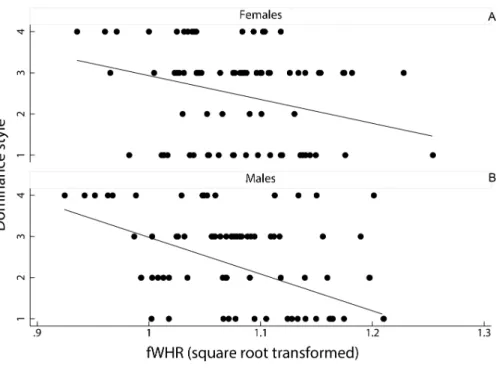
Figure 3 Relationship between female dominance style and fWHR (data points represent each image in the dataset).Scatter plot and line of best fit for the relationship between dominance style (yaxis) and fWHR (xaxis) in female (A) and male (B); grade 1 defines despotic species and grade 4 tolerant species
(Thierry, 2000).
zero in the two PGLSs on males (likelihood ratio test: upper boundp=1.00; lower bound p=0.12) and females (upper boundp=1.00; lower boundp<0.01), indicating a weak
phylogenetic signal for the relationship between fWHR and female dominance style. A linear mixed model on the effect of female dominance style and sex of the animal, as fixed factors, on fWHR (species ID entered as a random factor) showed that fWHR was significantly greater in despotic species than in tolerant species (coefficient±SE= −0.20
±0.01,z= −1.90,p<0.05;Fig. 3). However, fHWR did not significantly differ between
female and male macaques (coefficient±SE= −0.00±0.01,z= −0.09,p=0.93).
DISCUSSION
Our study is the first to analyse the relationship between species-specific differences in dom-inance style and fWHR. The four-grade scale of female domdom-inance style was significantly re-lated to fWHR (female despotic species having greater fWHR than tolerant species) in male and female macaques, but not when fWHR was averaged per species and sex. Moreover, we found no phylogenetic signal for differences in fWHR across macaque species.
2009;Blanchard et al., 2011). In humans, fWHR predicts aggressive behaviour (e.g.,Carré & McCormick, 2008;Goetz et al., 2013), especially in males, and it may operate as a signal of physical dominance evolved under sexual selection (Weston et al., 2004;Weston, Friday & Lio, 2007). Our study suggests that fWHR may have a similar function and be related to sexual selection and sexual dimorphism in non-human primates (Lefevre et al., 2014b;
Leutenegger & Kelly, 1977;Plavcan & Van Schaik, 1992;Wilson et al., 2014).
Analyses on female macaques support our prediction that species-specific differences in dominance style are related to fWHR, possibly because physical and behavioural traits have been under similar evolutionary pressure (Balasubramaniam et al., 2012a;
Balasubramaniam et al., 2012b;Thierry, 2000;Thierry et al., 2008). We found a similar pattern in male macaques. However, the interpretation of our findings in males is difficult, since scarce data are available on dominance style difference across species in male macaques and on how such differences are related to female dominance style. Male reproductive skew is thought to be higher in species where female–female relationships are classified as being tolerant than in species where female–female relationships are despotic (Schülke & Ostner, 2008;Schülke & Ostner, 2012), other things being equal (e.g., operational sex ratio). Male reproductive skew is positively related to the degree of paternal relatedness in a species (Ostner, Nunn & Schülke, 2008;Widdig, 2013) but negatively related to female oestrous synchrony and mate choice (Dubuc et al., 2011;Soltis et al., 1997). Because of the limited data on male-male relationships, a parsimonious interpretation of our findings is that differences in female dominance style are related to species-specific differences in intra-and inter-sexual selection in the two sexes. Female dominance style can be used as a proxy of inter-specific differences in selection and competitive regimes. However, the exact nature of the cause–effect relationship between male fWHR and dominance style differences in males and females cannot be analysed until data are available. Because of the scarcity of data on males, since our results from phylogenetic analyses and multiple regression differed in their significance level (this could be due, at least partially, to the small number of species available in our dataset) and given that we cannot completely rule out the possibility that we had in the dataset more than one image for each animal (see ‘Methods’), our findings have to be interpreted with caution.
Second, intra-species variance across populations/groups in dominance style is expected to be high but the causes of behavioural flexibility are still little understood (Kamilar & Baden, 2014). The scarcity of images of macaque faces for which data were also available on the dominance rank of each animal, as well as on individual- and group-specific social traits (e.g., conciliatory tendency, steepness of the hierarchy or frequency of counter-aggression), forced us to enter in the analyses the four-grade system of dominance style instead of more specific measures of social style. Ideally, additional data are needed to analyse the relative role of each social trait contributing to the species/population/individual dominance style, the degree of inter- and intra-species variation in fWHR, and to what extent such variation is explained by shared phylogenetic history or current socio-ecological factors (e.g., level of competition in a group).
A third limitation of our study, and an area that requires further investigation, is whether two-dimensional images used to calculate facial measurements reliably ‘represent’ how non-human primates see faces of their conspecifics, especially in the case of pictures taken in the absence of controlled conditions.
CONCLUSIONS
In conclusion, our research makes a novel contribution to the study of dominance-related phenotypes, by showing that fWHR is related with female dominance style in male and female macaques. This study has to be considered as one of the first steps towards understanding whether and how sexual selection, socio-ecological variables, reproductive strategies and life-history variables affect dominance-related phenotypes.
ACKNOWLEDGEMENTS
We would like to thank Rebecca Ayre for help to collect the images used in this study. We are extremely grateful to Simone Giancontieri and Christopher Young for their help with the fWHR measures and data analysis, and to friends and colleagues who shared their images of macaques with us, in particular to Lauren Brent, Emily Bethell, Jerome Micheletta, Sandra Molesti, Bernard Thierry, the Parco Faunistico Piano dell’Abatino and the Caribbean Primate Research Center (supported by the National Center for Research Resources and the Office of Research Infrastructure Programs of the National Institutes of Health, grant 8-P40 OD012217-25). We would like to thank James Higham, Juliane Kaminski, Jerome Micheletta and Gabriele Schino for useful comments on previous drafts of our manuscript.
ADDITIONAL INFORMATION AND DECLARATIONS
Funding
The authors received no funding for this work.
Competing Interests
Author Contributions
• Marta Borgi conceived and designed the experiments, performed the experiments, wrote the paper, prepared figures and/or tables, reviewed drafts of the paper.
• Bonaventura Majolo conceived and designed the experiments, analyzed the data, contributed reagents/materials/analysis tools, wrote the paper, prepared figures and/or tables, reviewed drafts of the paper.
Data Availability
The following information was supplied regarding data availability: Raw data can be found in theSupplemental Information
Supplemental Information
Supplemental information for this article can be found online athttp://dx.doi.org/10.7717/ peerj.1775#supplemental-information.
REFERENCES
Arnold C, Matthews L, Nunn C. 2010.The 10k trees website: a new online resource for primate phylogeny.Evolutionary Anthropology: Issues, News, and Reviews19:114–118
DOI 10.1002/evan.20251.
Arnott G, Elwood R. 2009.Assessment of fighting ability in animal contests.Animal
Behavior 77:991–1004DOI 10.1016/j.anbehav.2009.02.010.
Balasubramaniam K, Dittmar K, Berman C, Butovskaya M, Cooper M, Majolo B, Ogawa H, Schino G, Thierry B, De Waal F. 2012a.Hierarchical steepness and phy-logenetic models: phyphy-logenetic signals in Macaca.Animal Behavior83:1207–1218
DOI 10.1016/j.anbehav.2012.02.012.
Balasubramaniam KN, Dittmar K, Berman CM, Butovskaya M, Cooper MA, Majolo B, Ogawa H, Schino G, Thierry B, De Waal FB. 2012b.Hierarchical steepness, counter-aggression, and macaque social style scale.American Journal of Primatology
74:915–925DOI 10.1002/ajp.22044.
Blanchard DC, Griebel G, Pobbe R, Blanchard RJ. 2011.Risk assessment as an evolved threat detection and analysis process.Neuroscience and Biobehavioral Reviews
35:991–998DOI 10.1016/j.neubiorev.2010.10.016.
Carré JM. 2014.Social status, facial structure, and assertiveness in brown capuchin monkeys.Frontiers in Psychology5:Article 567DOI 10.3389/fpsyg.2014.00567. Carré JM, McCormick CM. 2008.In your face: facial metrics predict aggressive
behaviour in the laboratory and in varsity and professional hockey play-ers.Proceedings of the Royal Society B: Biological Sciences275:2651–2656
DOI 10.1098/rspb.2008.0873.
Carré JM, McCormick CM, Mondloch CJ. 2009.Facial structure is a reliable cue of aggressive behavior.Psychological Science20:1194–1198
DOI 10.1111/j.1467-9280.2009.02423.x.
Carré JM, Murphy KR, Hariri AR. 2013.What lies beneath the face of aggression?Social
Crockford C, Wittig RM, Whitten PL, Seyfarth RM, Cheney DL. 2008.Social stressors and coping mechanisms in wild female baboons (Papio hamadryas ursinus).
Hormones and Behavior53:254–265 DOI 10.1016/j.yhbeh.2007.10.007.
Dubuc C, Muniz L, Heistermann M, Engelhardt A, Widdig A. 2011.Testing the
priority-of-access model in a seasonally breeding primate species.Behavioral Ecology
and Sociobiology65:1615–1627DOI 10.1007/s00265-011-1172-8.
Geniole S, Keyes A, Carré J, McCormick C. 2014.Fearless dominance mediates the relationship between the facial width-to-height ratio and cheating.Personality and
Individual Differences57:59–64DOI 10.1016/j.paid.2013.09.023.
Goetz SM, Shattuck KS, Miller RM, Campbell JA, Lozoya E, Weisfeld GE, Carre JM. 2013.Social status moderates the relationship between facial structure and aggression.Psychological Science24:2329–2334DOI 10.1177/0956797613493294. Haselhuhn MP, Wong EM. 2012.Bad to the bone: facial structure predicts unethical
behaviour.Proceedings of the Royal Society B: Biological Sciences279:571–576
DOI 10.1098/rspb.2011.1193.
House JS, Landis KR, Umberson D. 1988.Social relationships and health.Science
241:540–545DOI 10.1126/science.3399889.
Kamilar J, Baden A. 2014.What drives flexibility in primate social organization?
Behavioral Ecology and Sociobiology68:1677–1692
DOI 10.1007/s00265-014-1776-x.
Kramer RS, Jones AL, Ward R. 2012.A lack of sexual dimorphism in width-to-height ratio in white European faces using 2D photographs, 3D scans, and anthropometry.
PLoS ONE7:e42705DOI 10.1371/journal.pone.0042705.
Lefevre C, Lewis G, Perrett D, Penke L. 2013.Telling facial metrics: facial width is asso-ciated with testosterone levels in men.Evolution and Human Behavior34:273–279
DOI 10.1016/j.evolhumbehav.2013.03.005.
Lefevre CE, Etchells PJ, Howell EC, Clark AP, Penton-Voak IS. 2014a.Facial width-to-height ratio predicts self-reported dominance and aggression in males and females, but a measure of masculinity does not.Biology Letters10:Article 20140729
DOI 10.1098/rsbl.2014.0729.
Lefevre CE, Wilson VA, Morton FB, Brosnan SF, Paukner A, Bates TC. 2014b.Facial width-to-height ratio relates to alpha status and assertive personality in capuchin monkeys.PLoS ONE9:e93369DOI 10.1371/journal.pone.0093369.
Leutenegger W, Kelly JT. 1977.Relationship of sexual dimorphism in canine size and body size to social, behavioral, and ecological correlates in anthropoid primates.
Primates18(1):117–136DOI 10.1007/BF02382954.
Maestripieri D. 1997.Gestural communication in macaques: usage and meaning of non-vocal signals.Evolution of Communication1:193–222 DOI 10.1075/eoc.1.2.03mae. Orme D, Freckleton R, Thomas G, Petzoldt T, Fritz S, Isaac N. 2012.Caper: comparative
analyses of phylogenetics and evolution in R. R Package version 0.5.Available at
Ostner J, Nunn CL, Schülke O. 2008.Female reproductive synchrony predicts skewed paternity across primates.Behavioral Ecology 19:1150–1158
DOI 10.1093/beheco/arn093.
Pagel M. 1999.Inferring the historical patterns of biological evolution.Nature
401(6756):877–884DOI 10.1038/44766.
Parker G, Rubenstein D. 1981.Role assessment, reserve strategy, and acquisition of information in asymmetric animal conflicts.Animal Behavior29:221–240
DOI 10.1016/S0003-3472(81)80170-4.
Plavcan JM, Van Schaik CP. 1992.Intrasexual competition and canine dimorphism in anthropoid primates.American Journal of Physical Anthropology 87(4):461–477
DOI 10.1002/ajpa.1330870407.
Preuschoft S, Van Schaik C. 2000. Dominance and communication: Conflict man-agement in various social settings. In: Aureli F, De Waal FBM, eds.Natural conflict resolution. Berkeley: University of California Press, 106–128.
R Development Core Team 2011.A language and environment for statistical computing. Vienna: R Foundation for Statistical Computing.
Schülke O, Ostner J. 2008.Male reproductive skew, paternal relatedness, and female social relationships.American Journal of Primatology70:695–698
DOI 10.1002/ajp.20546.
Schülke O, Ostner J. 2012. Ecological and social influences on sociality. In: Mitani J, Call J, Kappeler P, Palombit R, Silk J, eds.The evolution of primate societies. Chicago: University of Chicago Press, 193–219.
Sell A, Cosmides L, Tooby J, Sznycer D, Von Rueden C, Gurven M. 2009.Human adaptations for the visual assessment of strength and fighting ability from the body and face.Proceedings of the Royal Society B: Biological Sciences276:575–584
DOI 10.1098/rspb.2008.1177.
Soltis J, Mitsunaga F, Shimizu K, Nozaki M, Yanagihara Y, Domingo-roura X, Tak-enaka O. 1997.Sexual selection in Japanese macaques II: female mate choice and male-male competition.Animal Behavior 54:737–746DOI 10.1006/anbe.1997.0568. Stata Corp. 2011.Stata statistical software: release 12. College Station: Stata Press. Stirrat M, Perrett DI. 2010.Valid facial cues to cooperation and trust: male facial width
and trustworthiness.Psychological Science21:349–354
DOI 10.1177/0956797610362647.
Thierry B. 2000. Covariation of conflict management patterns across macaque species. In: Aureli F, De Waal FBM, eds.Natural conflict resolution. Berkeley: University of California Press, 106–128.
Thierry B, Aureli F, Nunn CL, Petit O, Abegg C, De Waal F. 2008.A comparative study of conflict resolution in macaques: insights into the nature of trait covariation.
Animal Behavior75:847–860DOI 10.1016/j.anbehav.2007.07.006.
Thierry B, Iwaniuk AN, Pellis SM. 2000.The influence of phylogeny on the social behaviour of macaques (Primates: Cercopithecidae, genus Macaca).Ethology
Van Noordwijk M, Van Schaik C. 2004. Sexual selection and the careers of primate males: paternity concentration, dominance-acquisition tactics and transfer decisions. In: Kappeler P, Van Schaik C, eds.Sexual selection in primates: new and comparative
perspectives. Cambridge: Cambridge University Press, 208.
Welker K, Goetz S, Carré J. 2015.Perceived and experimentally manipulated status moderates the relationship between facial structure and risk-taking.Evolution &
Human Behavior36(6):423–429DOI 10.1016/j.evolhumbehav.2015.03.006.
Weston EM, Friday AE, Johnstone RA, Schrenk F. 2004.Wide faces or large canines? The attractive versus the aggressive primate.Proceedings of the Royal Society B:
Biological Sciences271(Suppl 6):S416–S419DOI 10.1098/rsbl.2004.0203.
Weston EM, Friday AE, Lio P. 2007.Biometric evidence that sexual selection has shaped the hominin face.PLoS ONE2:e710DOI 10.1371/journal.pone.0000710.
Widdig A. 2013.The impact of male reproductive skew on kin structure and sociality in multi-male groups.Evolutionary Anthropology: Issues, News, and Reviews22:239–250
DOI 10.1002/evan.21366.
Wilson VAD, Lefevre CE, Morton FB, Brosnan SF, Paukner A, Bates TC. 2014. Personality and facial morphology: links to assertiveness and neuroticism in capuchins (Sapajus [Cebus] apella).Personality and Individual Differences58:89–94