Vol-7, Special Issue3-April, 2016, pp737-742 http://www.bipublication.com
Research Article
Evaluation and Interpretation of Laboratory Methods Effectiveness in Blood
Parameters for Diagnosis of Invasive Fungal Pulmonary Disease and
Comparison of Changes in Healthy Persons
Roghayeh Babaei1, ParisaAriamloo1, Javad Babaei2*, Abdolreza Amouei3
And Mohammad Reza Jabbari Amiri4
1
MSc Student Research Committee,
Department of Medical Mycology and Parasitology, Faculty of Medicine, Mazandaran University of Medical Sciences, Sari, Iran
2
Department of Pharmacology and Toxicology, School of Pharmacy and Toxicology Research Center,
Ahvaz Jundishapur University of Medical Science, Ahvaz, Iran.* Corresponding Author
3
MSc Student Research Committee, Department of Managment,
Islamic Azad University E-Campus, Tehran,Iran
4
MSc in Medical Mycology Invasive Fungi Research Center , Student Research Committee,
Department of Medical Mycology and Parasitology, Faculty of Medicine,
Mazandaran University of Medical Sciences,Sari,Iran *Corresponding Author name:Javad Babaei,
E-Mail:[email protected]
ABSTRACT:
Complete blood count (CBC), important information about the volume, number of cells and components of blood cells could diagnose of many diseases provided. In patients Infected with invasive pulmonary fungal disease (IFD) some of the changes in them occurs, blood index somewhat warning and of them can be used to diagnose the treatment of disease.The study was cross-sectional. In this study, 26 patients with pulmonary IFD has had an underlying medical condition referring to Shariati Hospital in Tehran during the period a year were admitted due to respiratory failure. In the control group of 26 healthy volunteers who agreed to cooperate were studied. Blood samples to count test, RBC, WBC, hematocrit and hemoglobin was performed by the Sysmex device,then calculated and compared. The data were analyzed using the software SPSS v20.The average RBC, WBC, in patients with pulmonary IFD, respectively, 3.7, 4.4 thousand per milliliter of bloods naturally, the average of hematocrit and hemoglobin 27.8% and 10.6% was calculated. But the average index in healthy people, 4.6, 8.2 thousand per milliliter of blood naturally, 43.6% and the 14.2% were calculated. However, the interpretation of this indicator is the best sensitivity (90%) and specificity (7/85%), were calculated.The study showed that changes in the other blood factors, may be an effective tool to show IFD lung in patients with underlying conditions should be considered, even though more studies to accurately assess the quantities of other blood components and the amount of sediment blood cells for many of the abnormalities is necessary.
Key words:Complete blood count-Invasive fungal disease pulmonary-White blood Red blood cells-Hematocrit- Hemoglobin
INTRODUCTION
Invasive fungal lung disease one of the most common and increasing causes of inability in general health is raised (2).This phenomenon is
divided into two major groups, the first group of pathogen early that can cause infections in healthy people such as the Histoplasma capsulatum, Coccidioidesimmitis and Blastomyces dermatitidis that can be seen in certain geographical areas. Acute or chronic lung disease early with or without systemic dissemination occasionally can be cause death and in all geographical areas are found. The second group contains of opportunistic fungi Such as some of Aspergillus and Candida species and Mucoral in patients who are immunocompromised and/ or with systemic underlying disease or lung disease, creating disease them(10). Some of fungus can cause the hypersensitivity reaction and finally Respirators some of the mass fungi can cause a reaction non-allergic cause lung toxic such as a pulmonary Mycotocycosis(1). In recent years, fungal lung disease is increasing due to consumption of antibiotics, corticotherapy, immunosuppressive therapy, bone marrow transplant and/or immunodeficiency, organ transplant, and finally the advent of HIV(9). World Health Organization (WHO) estimated that by 2020 the amount of lung fungus infections (aspergillosis and candidiasis) will reach one-third of the world population and will account for 7% of total cases of infection(12). The actual amount of lung fungal infection has been reported from 4% to 20% in adults(5) Among the causes of the increased incidence of fungal lung disease the aging of the population and fungal spores, which spread through the air, remains suspended for a long time, sit on different surfaces and contaminate them (6). In fungal lung infections, especially in saprophytic infections, predisposing factors and clinical symptoms of the disease are important. Clinical symptoms and trials should be considered
together in the diagnosis
(http://www.goldcopd.org, 2014). The problem still exists in the diagnosis and treatment of fungal infections. Evaluated of immune cell is the most important test that can provide the ground for diagnosing many diseases. In patients with fungal lung disease, the number of such immunity indices, including White blood cell (WBC), red blood cells (RBC), hematocrit
(HCT), hemoglobin (Hb), etc. changes. Therefore, the current study aimed to interpret immunocompetent parameters and indices, examine the function of the in vitro method used to evaluate the indices of immune cells for diagnosing invasive fungal lung disease and compare the changes with healthy subjects.
MATERIALSAND METHODS
2.1. Methodology and Population under Study
The current study followed a descriptive cross-sectional method. Altogether 156 people into two groupswere evaluated. In this study, 156 patients, including 81 women and 75 men in a period of one year, from13 January 2013 to 13 January 2014 were studied. Their age ranged from 16 years to 90 years. The control group consisted of 26 healthy volunteers who agreed to participate in the study. The age range of the subjects was 16-90. All these patients with respiratory diseases or any other clinical pulmonary infection or a sinus infection, which was confirmed by specialist’s lung Shariati Tehran Hospital.
2.2. Sample and SamplingMethod
The test specimens for the diagnosis of fungal agents, including bronchial lavage fluid, and bronchoalveolar lavage, washing sinuses and sputum that has been homogenized by Pancreatin 5%. Samples by Specialists lung of patients were obtained by bronchoscopy.
2.3. Lab Diagnostic Test
Laboratory diagnosis of fungal pathogens included direct examination with KOH, CFW staining, and culture. Also blood samples of patients were performed by hospital personnel to count test, RBC, WBC, hematocrit and hemoglobin.The best indicator to differentiate isusing Sysmex device within the K1000 model were calculated and compared.
2.4. Direct Examination and Culture
CalcoFluor white, patient specimens in tubes Falcon head bolts sterile 50 ml contains of 2 ml ethanol 70 ° (in order to save the samples of the virus HIV) with the above-mentioned safety rules in the Center are collected and until transferred to the laboratory is maintained in the refrigerator. For transferring the sample to the laboratory of mycology of the Sari Medical University of the flask ice is used. Also with the help of centrifuges, different samples of patients with suspected pulmonary fungal infection with 3000 rpm for 15 minutes and the supernatant sediment were prepared, sediment for serologic test and coloring CalcoFluorWhite. In this way did a drop of soluble potash 10% to add a drop of sample onto the slide fix cluttered with plates covered it and then examined by immunofluorescence microscopy. In case of the growth of yeast fungus Candida albicans from other yeast method for detecting germ tube formation or phenomenon Reynols- Braud Using serum and incubated at 37 ° C for two hours was used. Theculture of the samples was performed on series two media Sabrodexstrozeagar and Sabrodexstrozeagar with antibiotics Chloramphenicol and Cyclohexamide at two different temperatures, one in 25 and another at 35 degrees Celsius placed inside the incubator. Cultures regularly for 3 weeks were examined for seeing fungal growth. In order to future studies the molecular analysis of samples in 200 µL was added PBS buffer until DNA extraction should be kept in the freezer at -80 ° C.
2.5. The Experimental Group and the Control Group
Two groups were studied. The experimental group included 26 positive fungal lung disease patients with or without predisposing factor. The control group included 26 healthy individuals
with no diseases who agreed to participate in the study. Another inclusion criterion was that blood samples should be collected from patients, who referred to the Shariati Tehran Hospital By laboratory personnel. RBC, WBC, hematocrit, hemoglobin and other blood indices were counted and tested by Cell Counter and K1000 flow cytometer device made in the USA. Afterwards, the sensitivity and specificity were calculated for each index.
2.6. Data Analysis
The results obtained from the samples collected from patients under study were recorded in tables and forms using SPSS v20 and pad graph v4 for the analysis of descriptive statistics.
RESULTS
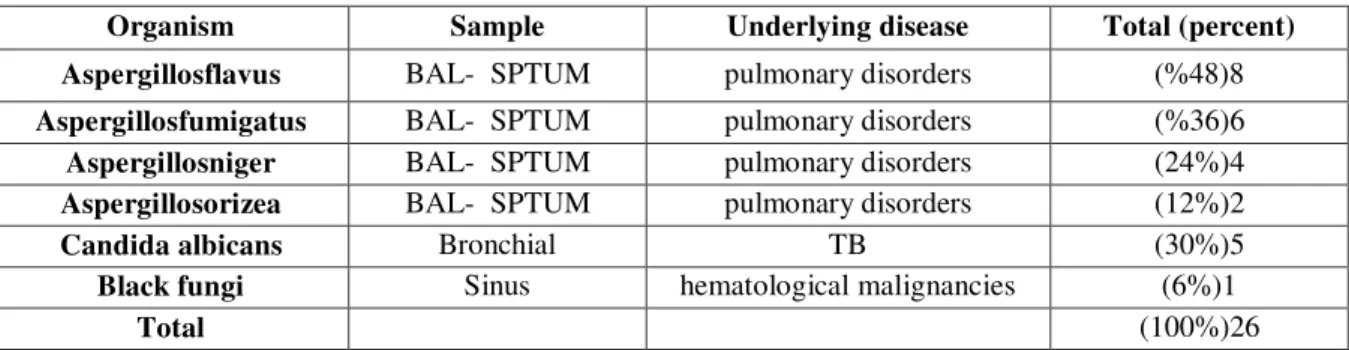
From 156 samples,clinical lungs, sinus, and bronchial sputum with suspected fungal infections, 26 (17.98%) patients with clinical diagnosis by laboratory methods like direct examination and culture were reported positive. Patients included 75 male and 81 female, average ages of patients was 53 years. The most common organism isolated in culture, Aspergillus species in 18 cases (5.13%), 5 cases (2.3%) Candida albicans and the prevalence of other organisms isolated from cultured 1 (0.65%) were black fungi. Table 1 shows the Frequency Percent of fungi isolated from the respiratory tract in patients with underlying diseases. Of the total cases, 17.98% fungal infections occurred in patients with underlying diseases, including pulmonary disorders (75.6%), tuberculosis (14.7%) and hematological malignancies (9.6%) were investigated, the most common underlying disease, pulmonary disorders were observed in 118 patients.
Table 1: organisms isolated from the respiratory tract
Total (percent) Underlying disease
Sample Organism
(%48)8 pulmonary disorders
BAL- SPTUM
Aspergillosflavus
(%36)6 pulmonary disorders
BAL- SPTUM
Aspergillosfumigatus
(24%)4 pulmonary disorders
BAL- SPTUM
Aspergillosniger
(12%)2 pulmonary disorders
BAL- SPTUM
Aspergillosorizea
(30%)5 TB
Bronchial
Candida albicans
(6%)1 hematological malignancies
Sinus
Black fungi
(100%)26
In addition to research on observation percent frequency of fungi isolated from the respiratory tract in patients with underlying disease, to examine 4 parameters, in two groups of patients and control as well. The best indicator for comparison diagnoses between healthy people and invasive fungal lung patients,counting tests,blood cells as RBC, WBC, hematocrit and hemoglobin. According to Table 2 presents results obtained from the interpretation of these entire 4 parametersbloody ratiobetween individualpatients suffering to invasive fungal pulmonary infection to individuals Healthy Lower than normal range wasreported.
Table 2: dates distribution, mean difference and t-test of blood cells
mean difference T-test
Experimental Group Control Group
Blood cells
4.2±1 1.47
3.7 4.6
RBC
6.3±1 2.32
4.4 8.2
WBC
35.4±1 13.7
27.8 43.6
HCT
12.6±1 8.98
10.6 14.2
Hb
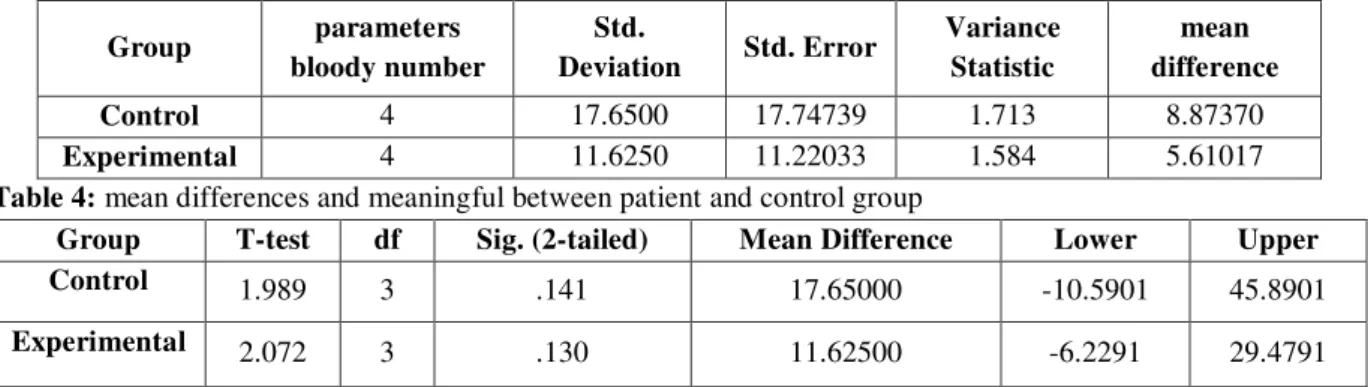
According to Table 3 also to check each index, a statistical analysis t-test (T =3.56) for describing dates and the mean difference between the two groups (SD ± 1) was used and according to Table 4 that for all indexes blood descriptive statistics were significant (P <0.05).
Table 3: Data Distribution patient and control group of blood cells
mean difference Variance
Statistic Std. Error
Std. Deviation parameters
bloody number Group
8.87370 1.713
17.74739 17.6500
4
Control
5.61017 1.584
11.22033 11.6250
4
Experimental
Table 4: mean differences and meaningful between patient and control group
Group T-test df Sig. (2-tailed) Mean Difference Lower Upper
Control 1.989 3 .141 17.65000 -10.5901 45.8901
Experimental 2.072 3 .130 11.62500 -6.2291 29.4791
The highest rate of study groups based on gender, in men with mean 46.6 and standard deviation 16.63 and confidence p = 0.514 , the lowest level in women with mean 44.45 and SD =14.6 and confidence p = 0.514 was measured (table 5).
Table 5: The mean and standard deviation of the experimental group and the control group presented based on gender
Group Men Women
Mean SD Mean SD P- value
Control 47.7 17.5 45.1 14.7 0.536
Experimental 45.5 15.8 43.8 14.5 0.635
Total 46.6 16.63 44.45 14.6 0.514
CONCLUSION
For control clinical status or Evaluation of response to treatment in patients with tract respiratory fungal infections requires a certain laboratory method. Lack of knowledge in of many hematology laboratory methods, especially methods that are considered in the Iran Causes distinction between simple colonization of tissue invasion is problem and interpretation of is test results Mycological worthless. These are among the reasons that can
sputum. They concluded that the clinical situational analysis the patient along with laboratory studies in the acceleration of diagnosis and recovery seem necessary.These results obtained in our study are similar investigations (4). In a study by F. Malek and et al, with title investigated the relationship between CBC to the severity of COPD in patients referred to SemnanKosar hospital, 84 patients with COPD were taken and the results of blood cell count (CBC) in COPD patients were significantly higher than the control group and with the results of our study were significantly different (3). As well as in other studies F. Malek and et al, with title to investigate the relationship between blood cell counts with the severity of disease in patients with COPDKosar Hospital of Semnan concluded that rateWBC in patients with COPD was significantly higher than the control group (P = 0.012), But in the early stages of COPD compared to later stages of disease were not significant (P = 0.449). Amounts absolute and relative neutrophils also significantly higher in COPD patients than the control group (respectively, P =0.035 and P =0.005). Compare the lower stages of the disease stages of COPD, this relationship was significant only in the relative number of neutrophils (P = 0.004). The mean difference in Hb between COPD patients and the control group was not significant and relationship with the severity of COPD is that in contrast to other studies. The previous studies report different results in COPD patients with present study were consistent in the Rate obtained Hb(7). Including the limitations of previous studies, lack of patients with invasive fungal infections along with the number the underlying disease at the same time is low and also the indicators in this study of cases is not known. Though all of these indicators are designed to evaluate patients with iron deficiency and reference values have not been studied in healthy subjects. However, with the interpretation of this indicator is the best sensitivity (90%) and specificity (85.7%) in the present study was calculated that present study would be of benefits. It is clear that both types of fungal infections in hospital and community
acquired infections are becoming increasingly more significant. The number of individuals who are at risk of having fungal infections is increasing compared to previous years. As a result related to fungal infections common and pathogenicity fungus that previously ambiguous and or were unusual both in hospitals and in the community today can be seen more frequently. Due to the high prevalence of pulmonary diseases, study of fungi in patients with underlying problems and interference tests between them is of great importance.Therefore, among the variety invasive methods for the diagnosis of lower respiratory tract infections cannot be used in the study of thenimmunological and hematological indices can be a suitable replacement. So far, similar research has been done in Iran and the current study is considered the first step in this direction. Epidemiologic and laboratory investigations continue to be opportunistic and endemic fungal pathogens increasing spectrum needs are better identified. Since similar studies have not been carried out in Iran, the current study is the first step in this direction. It is essential to conduct epidemiologic and laboratory investigations to detect the increasing range of opportunistic and endemic fungal pathogens. In terms of methodology, it was attempted to benefit from a non-invasive method to accelerate the diagnosis.
ACKNOWLEDGMENTS
The current study wasa part of a research project conducted atMazandaran University of Medical Sciences, carrying out of which was undoubtedly impossible without the friendly cooperation of the staff of Shariati Hospital in Tehran.
REFERENCES
1. Bui
2. Fra ser P, Gener E, editors,( 1988), Diagnosis of diseases of the chest3rd edition. New York: W.B. Saunders Co.P.940-1022.
3. Far
hadMalek, JafarAlaaviToussy,
TayebehKhajeali, (2015), Relationship between complete blood count indices with the severity of disease in patients with chronic obstructive pulmonary disease. 16 (2); 143 – 148.
4. Haj
ialiakbar V, Emami M, Eskandari A, Frequency of fungal pathogens in bronchoalveolar lavage and biopsy specimens of patients hospitalized in Chamran and Amir al momenin Hospitals, (2007), Journal of IRIAF Health Administration. Vol. 10:2, Serial 26; 50(9):333-6.
5. Kib
bler CC, Mackenzie DWR, Odds FC, editors,(1996), Principles and practice of clinical mycology. John Wiley & Sons Ltd.
6. Ko
rdbacheh P, Zaini F, Kamali P, Ansari K, Safara M, (2005), Study on the siurces of nosocomial fungal cnfections at intensive care unit and transplant wards at a teaching hospital in Tehran. Iranian J publ Health; 34 (2): 1-8.
7. Ko
ch A, Gaczkowski M, Sturton G, Staib P, Schinkothe T, Klein E, et al., (2007), Modification of surface antigens in blood CD8+ T- lymphocytes in COPD: effects of smoking. EurRespir J; 29: 42-50.
8. Lu
ndback B, Lindberg A, Lindstorm M, RonmarkE,Jonsson AC, Jonsson E, et al.,(2003), Not 15 but 50% of smokers develop COPD - report from the obstructive lung disease in northern Sweden studies. Respir Med; 97: 115-122.
9. Rei
lly JJ, Silverman EK, Shapiro SD, (2011), chronic obstructive pulmonary disease. In: Longo T’ Fauci AS’ editors. Harrison’s
principles of internal medicine. 18thed. Newyork: McGrouHill;.P: 245-248.
10. Rip
pon JW. Medical mycology, (1988), 3rd edition. New York: W.B. Saunders Co.
11. Ve
stbo J, Hurd SS, Agustí AG, Jones PW, Vogelmeier C, Anzueto A, Barnes PJ, Fabbri LM, , et al.,(2014), From the Global strategy for diagnosis, management, and prevention of COPD, Global initiative for Chronic Obstructive Lung Disease (GOLD), Available from:http://www.goldcopd.org.
12. Ya