M. C. B. Abdalla,1,*R. L. S. Farias,2,†J. A. Helaye¨l-Neto,3,‡Daniel L. Nedel,4,§and Carlos R. Senise, Jr.5,k 1Instituto de Fı´sica Teo´rica, UNESP-Universidade Estadual Paulista, Rua Doutor Bento Teobaldo Ferraz 271, Bloco II, Barra-Funda,
Caixa Postal 70532-2, 01156-970 Sa˜o Paulo, SP, Brazil 2
Departamento de Cieˆncias Naturais, Universidade Federal de Sa˜o Joa˜o del Rei, 36301-000 Sa˜o Joa˜o del Rei, MG, Brazil 3Centro Brasileiro de Pesquisas Fı´sicas, Rua Doutor Xavier Sigaud 150, Urca, 22290-180 Rio de Janeiro, RJ, Brazil
4Universidade Federal do Pampa, Rua Carlos Barbosa S/N, Bairro Getu´lio Vargas, 96412-420 Bage´, RS, Brazil 5Universidade Federal do Pampa, Avenida Pedro Anunciac¸a˜o S/N, Vila Batista, 96570-000 Cac¸apava do Sul, RS, Brazil
(Received 21 June 2012; published 11 October 2012)
In this work, we adopt the simplest model that spontaneously breaks supersymmetry, namely, the minimal O’Raifeartaigh model. The effective potential is computed in the framework of the linear delta expansion approach up to the order2, conjugated with superspace and supergraph techniques. The latter can be duly mastered even if supersymmetry is no longer exact, and the efficacy of the superfield approach in connection with the linear delta expansion procedure is confirmed according to our investigation. That opens up a way for a semi-nonperturbative superspace computation that allows us to deal with spontaneously broken supersymmetric models and encourages us to go further and apply this treatment to the minimal supersymmetric Standard Model precision tests.
DOI:10.1103/PhysRevD.86.085024 PACS numbers: 12.60.Jv, 11.10.Gh
I. INTRODUCTION
The thrilling times of the LHC physics we are living in open up a great deal of issues connected to fundamental mechanisms and theories, especially, supersymmetry (SUSY) and its possible breaking mechanisms [1–10]. Considering fundamental principles of quantum fields the-ory, SUSY seems to be fairly well motivated as a very fundamental symmetry of the high-energy regime. At our accessible energies, it does not show up; it has to be broken at some scale much above our reachable energies, and its possible evidences at accelerator energies must be commu-nicated by means of some mechanism connecting this (higher energy) breaking scale to our low-energy world.
The present and the near-future LHC outcomes are crucial for the interplay between SUSY and the Standard Model parameters. The focus is not on SUSY itself, once we understand that SUSY is very likely to show up at very high-energy scales; the actual matter with SUSY relies on its possible breaking mechanisms and the ways the latter are driven down to the cutoff region of the Standard Model, namely, the tera-electron-volt scale. In this framework, the quest for possible new SUSY viola-tion mechanisms and a broader exploitaviola-tion of the already known models to break down the fermion/boson symme-try are self-justifiable [11].
On the other hand, LHC physics is also refining the precision tests and the level of accuracy of the
measurements of the Standard Model’s parameters. Since perturbative quantum field-theoretic calculations are the way we get the phenomenological results for Standard Model processes to be compared with experiments, we are face to face with the need to go further in perturbation theory, so as to incorporate higher order corrections into the calculation of physical processes.
Placed in this scenario, we are motivated to reassess SUSY breaking models by computing higher order correc-tions to their corresponding effective potentials, so as to probe the effects of SUSY breaking in connection with the improvement of precision tests at the LHC. It is clear that LHC is a collider for new discoveries rather than a preci-sion machine; but, anyhow, it increases the level of the precision tests of the previous LEP. It becomes a manda-tory task to ascertain how much loop corrections affect the pattern of SUSY breaking once we start off from a viola-tion that takes place at the classical level.
In connection with the discussion of SUSY breaking to account for the splitting of the masses of supersymmetric partners, we would like to point out that, very recently, a new proposal of a model based on SUSY has been pro-posed by Alvarez et al. [12], in which a structure of partners do not show up, although SUSY is locally realized. So, there is no need of SUSY breaking to split masses, and the (fermionic) matter fields acquire mass through their coupling with some background geometry.
In a series of previous works [13,14], we have adopted the minimal O’Raifeartaigh model [1], which realizes SUSY violation by means of the so-called F terms, and we have devised a technique to approach the problem with the use of superfield and supergraph techniques. To get a richer perturbative series, we have chosen the so-called
linear delta expansion (LDE)1 and we have coupled this method to our superfield methods. The outcome was en-couraging and, in view of the efficacy of the conjugating supergraph techniques with the LDE, here we propose to carry out a computation of the effective potential up to
Oð2Þ. Owing to a particularity of the LDE, calculations at
this order require one to take into account vacuum dia-grams up to two loops.
The LDE is a nonperturbative method that automatically resums large classes of terms in a self-consistent way, to avoid possible dangerous overcounting of diagrams. This is achieved by combining perturbation theory with an opti-mization procedure. It has a long history of successful applications, describing phenomenological models using quantum field theory at zero temperature and under ex-treme conditions. It has been shown that the LDE results go beyond the standard mean-field or large-N approximation by explicitly including finite-N effects. Some very inter-esting results can be found in Refs. [15–23] and in refer-ences therein, and strong signals of the convergence of the method can be found in Refs. [24,25].
Usually, when two (or more) loops are present in the perturbation series, we need to implement a numerical calculation to perform the optimization procedure. In this case, it was shown in all applications cited above that the numerical results of the LDE can go beyond the usual resummation methods. Here we further develop the super-space applications of the LDE, by taking into account
Oð2Þterms in the effective potential expansion and
solv-ing numerically the optimization procedure. In particular, we study the convergence of the method, where we contrast the numerical results with our analytical results obtained at
Oð1Þusing two different optimization procedures.
The general structure of our paper is as follows: in Sec. II, we briefly review the application of the LDE to supersymmetric field theories, while working in super-space. In Sec. III, we employ supergraph techniques to compute the one- and two-loop diagrams that contribute to the Oð2Þ to the effective potential. All the perturbative
calculations of Sec.IIIand the numerical results we work out are collected in Sec. IV. Finally, our concluding re-marks are cast in Sec.V. The Appendix follows, where we list all the superspace integrals of the supergraphs eval-uated in Sec.III.
II. CATCHING-UP OF SUPERSPACE LINEAR DELTA EXPANSION
The purpose of this section is a warming-up with a general presentation of the LDE in the frame of (matter) supersymmetric field theories. We adopt a superfield
approach and follow Refs. [13,14,26]. Building up our superspace action in terms of chiral and antichiral super-multiplets, we start off from what we call the interpolated LagrangianL:
L¼Lð;Þ þ ð1 ÞL
0ð;Þ; (1)
where is an arbitrary parameter, L0ð;Þ is the free
sector of the Lagrangian, and , are mass parameters. Notice that, whenever ¼1, we recover the original Lagrangian. The parameter appears in connection with the interaction terms and is so chosen to be the perturbative expansion parameter; this means that we do not perturba-tively expand in terms of the coupling constant itself. The mass parameters appear in L0 andL0. The ð;Þ
de-pendence of L0 is summed up into the propagators, whereas L0 is regarded as an insertion and is taken as a quadratic interaction.
Let us now state our methodology. We carry out a usual perturbative expansion in and, at the very end of the calculations, we take¼1. At this stage of our approach, ordinary perturbation theory is applied and a finite number of Feynman diagrams is calculated; the results are essen-tially perturbative. However, quantities evaluated at a finite order in explicitly depend on the parameters and. Therefore, it is necessary to fix them up. To do this, we adopt the principle of minimal sensitivity (PMS) [27]. In this framework, the effective potentialVðkÞ
effð;Þ,
pertur-batively evaluated to order k, must be taken at a point where it is less sensitive to the parameters,. Invoking the PMS, ¼0 and ¼0 appear as solutions to
the equations
@VðkÞ
effð;Þ
@
¼0;¼1 ¼0;
@VðkÞ
effð;Þ
@
¼0;¼1 ¼0;
(2)
and will come out as functions of the original coupling and fields. We then insert 0, 0 in the expression for our
effective potentialVðeffkÞ, obtaining a nonperturbative result, once our propagators depend on,.
Our method is based upon the calculation of all the diagrams up to a given order in , including the vacuum diagrams. In ordinary quantum field theory, for the calcu-lation of the effective potential, we do not in general worry about vacuum diagrams, since they do not depend on the fields. In our approach, the vacuum superdiagrams do depend on and and become important to the LDE, once the arbitrary mass parameters will now depend on fields by virtue of our optimization procedure. Thus, in the LDE, an order-by-order calculation of the vacuum dia-grams becomes mandatory. On the other hand, vacuum diagrams in superspace are identically zero, owing to the Berezin integrals. In view of this undesirable feature, we take, from the onset, the parameters , as constant 1In recent studies in the literature some authors have called the
LDE method optimized perturbation theory; since the method is not only an expansion in the parameter, there is an optimiza-tion procedure on the method.
clearer, let us give below the expression for the superfield generating functional in the presence of the sourcesJandJ
(chiral and antichiral, respectively): ~
Z½J;J ¼exp
iSint 1
i
J;
1
i J
exp
i
2ðJ;JÞG
ðM;MÞJ
J
;
(3) with m being the original mass, M¼mþ, and M ¼ mþ.GðM;MÞis the matrix form of the propagator, and, in
addition to the original interaction terms, one has new bilinear chiral and antichiral interaction terms proportional toand. We are then led to the following expression for the superfield effective action:
½; ¼ i
2ln½sDetðG
ðM;MÞÞ iln ~Z½J;J
Z
d6zJðzÞðzÞ Z d6zJðzÞðzÞ; (4)
where sDetðGðM;MÞÞ is the superdeterminant ofGðM;MÞ. It
is, in general, equal to one, but here we keep it, since
GðM;MÞ depends on and . Besides, in view of the
and dependence, the generating functional of the vac-uum diagrams, Z~½0;0, is not identically one. We can define a normalized functional generator as ZN ¼ZZ~~½½J;J
0;0
and set the effective action as written in the expression below:
½; ¼ i
2ln½sDetðGÞ iln ~Z½J0;J0 þ N½;; (5) where the sourcesJ0 andJ0 are defined by the equations
W½J;J JðzÞ
J¼J0
¼W½J;J JðzÞ
J¼J0¼
Z~½J;J JðzÞ
J¼J0
¼Z~½J;J JðzÞ
J¼J0¼0: (6)
In (5), the first two terms (usually equal to zero) stand for the vacuum diagrams, and N½; is the ordinary con-tribution to the effective action.
Let us now work out the interpolated Lagrangian and the new super-Feynman rules for the O’Raifeartaigh model. The minimal O’Raifeartaigh model is specified by the Lagrangian,
L¼Z d4 ii
Z
d2ð
0þm12
þg021Þ þH:c:
; (7)
wherei¼0, 1, 2.
we apply the LDE with the matrix mass parametersijand
ij. By adding and subtracting these mass terms to a general O’Raifeartaigh-type action, we obtain
Lð;Þ ¼L0ð;Þ þLintð;Þ; (8) with
L0ð;Þ ¼ Z
d4 ii
Z
d2
iiþ
1
2Mijij
þH:c:
; (9)
Lintð;Þ ¼ Z
d21
3!gijkijk 1
2ijij
þH:c:
; (10)
where Mij¼mijþij and i,j,k¼0, 1, 2 are symme-trized indices.
We now cast the superfield expansions for the arbitrary mass parameters as follows:
ij¼ijk’k ¼ijkðkþ2
kÞ ¼ijkkþijkk2
¼ijþbij2; (11)
so that
Mij¼mijþij¼ ðmijþijÞ þbij2¼a
ijþbij2: (12) The interpolated Lagrangian (1) takes the form
L¼L
0 þLint; (13)
where the free and the interaction Lagrangians are given by
L 0 ¼
Z
d4 ii
Z
d2
iiþ
1
2aijij
þ1
2bij 2
ij
þH:c:
; (14)
L int¼
Z
d2
3!gijkijk
2ijij
þH:c:
:
(15) Notice that the interaction Lagrangian now displays soft SUSY-breaking terms proportional to the components. We treat these terms perturbatively in as for normal interaction terms.
0 ¼; M01¼a01¼01¼a;
M11¼b112 ¼b2;
M12¼a12¼m12þ12¼mþ¼M; g011¼g;
(16) and all otheriandMijset to zero. With these choices, we obtain
L 0 ¼
Z
d4 ii
Z
d2
0þM12þa01
þ1
2b 22
1
þH:c:
;
L int ¼
Z
d2
g021 12 a01
2b 22
1
þH:c:
: (17)
This O’Raifeartaigh model possesses an (Abelian) R
symmetry. TheR charge assignments of the chiral super-fields 0, 1, and 2 are R0 ¼2, R1 ¼0, and R2¼2,
respectively. To keep theR symmetry of the interpolated Lagrangian, the Rcharges of the parameters aandbare
Ra¼0andRb¼0; they are to be left the same after the optimization procedure.
The new set of modified propagators can be read off from the free Lagrangian, which also has explicit depen-dence onandthroughand. Using the techniques developed in Ref. [28], the new superfield propagators read as follows:
h00i ¼ ðk2þ jMj2ÞAðkÞ412þ jaj2jbj2BðkÞ2121412;
h01i ¼abC ðkÞ 1 16D
2
1D2121412;
h02i ¼ MaA ðkÞ412þMajbj2BðkÞ2121412;
h11i ¼EðkÞ412þ jbj2BðkÞ 1 16D
2
12121D21412;
h12i ¼ MbF ðkÞ21412;
h22i ¼ ðk2þ jaj2ÞAðkÞ412þ jMj2jbj2BðkÞ2121412;
h00i ¼ jaj2bC ðkÞ 1 4D
2 121412;
h01i ¼aA ðkÞ 1 4D
2
1412 ajbj2BðkÞ 1 4
2
121D21412;
h02i ¼ M ab C ðkÞ 1 4D
2 121412;
h11i ¼bF ðkÞ 1 4
2 1D21412;
h12i ¼MA ðkÞ 1 4D
2
1412 Mjbj2BðkÞ 1 4D
2
12121412;
h22i ¼ jMj2bC ðkÞ 1 4D
2
121412; (18)
where
AðkÞ ¼ 1
k2ðk2þ jMj2þ jaj2Þ; (19)
BðkÞ ¼ 1
ðk2þ jMj2þ jaj2Þ½ðk2þ jMj2þ jaj2Þ2 jbj2;
CðkÞ ¼ 1
k2½ðk2þ jMj2þ jaj2Þ2 jbj2;
EðkÞ ¼ 1
k2þ jMj2þ jaj2;
FðkÞ ¼ 1
ðk2þ jMj2þ jaj2Þ2 jbj2: (20)
It is noteworthy to highlight the nontrivial dependence of the propagators on the parameters a and b: the opti-mized parameters are present at the poles of the propaga-tors, as if they were typical mass terms.
The new super-Feynman rules for the vertices are
021vertex:2g Z
d4;
12vertex: Z
d4;
01vertex: a Z
d4;
11vertex:
b
2
Z
d42:
(21)
We are now ready to start calculating the perturbative effective potential in powers of . To do that, we use the vertex functions defined in the expansion of the effective action and consider the compatible vacuum diagrams. In Ref. [13], after the optimization procedure, it is seen that the order-0 contribution accounts for the sum of all
one-loop diagrams. It was then possible to derive analytical solutions to the optimization procedure before calculating the superspace and loop momentum integrals. Nevertheless, in second order, we are not able to exhibit analytical solu-tions; so, we must renormalize the theory before the appli-cation of the optimization procedure. To do that, a numeric calculation is required.
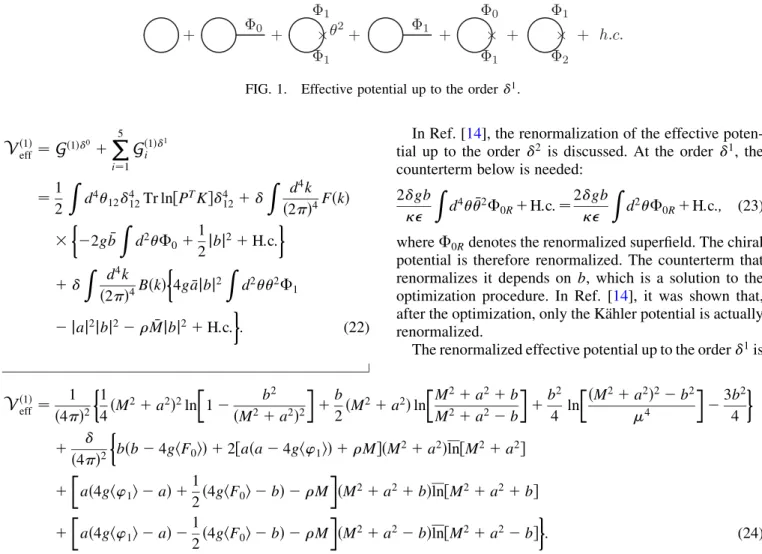
In Fig.1, we depict the diagrammatic sum of the effec-tive potential up to the order1 (Vð1Þ
eff).
Notice that, because of the -dependent propagators, tadpole diagrams do not vanish any longer, as it usually happens in superspace. The first diagram is of order0, and
we can see that it corresponds to the first term of the effective action, as given in (5). The third graph is a vacuum-type superdiagram with a quadratic insertion that stems from the2 component of theexpansion.
With our super-Feynman rules and the results of Ref. [13], the effective potential up to the order 1 reads
Vð1Þ
eff ¼G
ð1Þ0
þX
5
i¼1 Gð1Þ1
i
¼1
2
Z
d4
12412Tr ln½PTK412þ Z d4k
ð2Þ4FðkÞ
2gbZ d2 0þ
1 2jbj
2þH:c:
þZ d
4k
ð2Þ4BðkÞ
4gajbj2Z d22 1
jaj2jbj2 Mjbj2þH:c:
: (22)
In Ref. [14], the renormalization of the effective poten-tial up to the order 2 is discussed. At the order1, the
counterterm below is needed: 2gbZ
d42
0RþH:c:¼ 2gbZ
d2
0RþH:c:; (23) where0Rdenotes the renormalized superfield. The chiral potential is therefore renormalized. The counterterm that renormalizes it depends on b, which is a solution to the optimization procedure. In Ref. [14], it was shown that, after the optimization, only the Ka¨hler potential is actually renormalized.
The renormalized effective potential up to the order1is
Vð1Þ
eff ¼ 1
ð4Þ2 1
4ðM
2þa2Þ2ln
1 b
2
ðM2þa2Þ2
þb
2ðM
2þa2Þln
M2þa2þb
M2þa2 b
þb
2
4 ln
ðM2þa2Þ2 b2
4
3b2
4
þ
ð4Þ2
bðb 4ghF0iÞ þ2½aða 4gh’1iÞ þMðM2þa2Þln½M2þa2
þ
að4gh’1i aÞ þ 1
2ð4ghF0i bÞ M
ðM2þa2þbÞln½M2þa2þb
þ
að4gh’1i aÞ 1
2ð4ghF0i bÞ M
ðM2þa2 bÞln½M2þa2 b
: (24)
For the time being, what we have is a perturbative result for the effective potential. To actually obtain a nonperturbative result, we apply the optimization procedure. We had to break the parametersMijinto-independent (aij) and-dependent (bij) parts and, with the help of (16), the optimized parameters turn out to be a01¼a, b11¼b, and 12¼. Upon application of the PMS, to find the optimized parametersa,b, and, we have to solve the three coupled equations
@Vð1Þ
eff
@a
a¼a0
¼@V
ð1Þ
eff
@b
b¼b0
¼@V
ð1Þ
eff
@
¼0
¼0; (25)
at¼1, and plug the optimized valuesa0,b0, and0 into (24). The following analytical solutions are encountered:
a0 ¼4gh’1i ¼a0; b0¼4ghF0i ¼b0; 0 ¼0¼0: (26)
The optimized parameters appear now as functions of the original coupling and fields, as expected. By plugging these results into (24), all the1 terms vanish and the optimized potential can be cast under the form below:
Vð1Þ
eff¼G
ð1Þ0
¼ 1
ð8Þ2
ðm2þ16g2h’ 1i2Þ2ln
1 16g 2hF
0i2
ðm2þ16g2h’ 1i2Þ2
þ8ghF0iðm2þ16g2h’1i2Þln
m2þ16g2h’
1i2þ4ghF0i
m2þ16g2h’
1i2 4ghF0i
þ16g2hF 0i2ln
ðm2þ16g2h’
1i2Þ2 16g2hF0i2
4
48g2hF 0i2
: (27)
The above result represents the Coleman-Weinberg–type potential [29,30] for the O’Raifeartaigh model [13,28], and it accounts for the sum of all one-loop diagrams. It is a nonperturbative result in that it takes into account all orders (actually infinite orders) in the original coupling constant.
III. EFFECTIVE POTENTIAL IN THE LDE ATOð2Þ
We now present the order-2 results. At this order, we
have one- and two-loop diagrams. Since the purpose of the present work is to be as clear as possible, the main part of this section is rather technical. All the results of this section are summarized in Sec.IV.
A. One Loop
To analyze the one-loop diagrams, we adopt the follow-ing strategy: there are 42 diagrams (plus some Hermitian conjugates), and we separate them in distinct sets; each diagram belonging to a certain set has the same propagator structure in the loop and differs from the other diagrams of the set only by the external classical superfields or by insertions ofa,b, or . Below, we show the expressions for these diagrams, set by set. We are going to use the notationJið;Þfor superspace integrals, which are listed in the Appendix.
The first set (Fig.2) is
Gð1Þ2
1 ¼42g2
Zd4kd4 12
ð2Þ4 0ð1Þ0ð2Þ
1
4D 2
1ðkÞh11i
1
4D 2
2ð kÞh11i
þH:c:
¼4
2g2
ð16Þ2b 2Z d
4k
ð2Þ4FðkÞFðkÞJ1ð;Þ þH:c:
¼2
2g2hF 0i2
b ð
2lnþ 2ln 2bÞ: (28)
Gð1Þ2
2 ¼ 22gb
Zd4kd412
ð2Þ4 0ð1Þ 2 2
1
4D 2
1ðkÞh11i
1
4D 2
2ð kÞh11i
þH:c:
¼ 2
2g
ð16Þ2bjbj
2Z d4k
ð2Þ4FðkÞFðkÞJ2ð;Þ þH:c:
¼
2gbhF 0i
b ð
2lnþ 2ln 2bÞ: (29)
Gð1Þ2
3 ¼
1 4
2b2Z d 4kd4
12
ð2Þ4 2 122
1
4D 2
1ðkÞh11i
1
4D 2
2ð kÞh11i
þH:c:
¼
2
4ð16Þ2jbj 4Z d
4k
ð2Þ4FðkÞFðkÞJ3ð;Þ þH:c:
¼
2b2
8 bð
2lnþ 2ln 2bÞ: (30)
The second set (Fig.3) is
Gð1Þ2
4 ¼162g2
Zd4kd4 12
ð2Þ4 0ð1Þ1ð2Þ
1
4D 2
1ðkÞh11i
1
4D 2
2ð kÞh01i
þH:c:
¼16
2g2
ð16Þ2 ab Z d4k
ð2Þ4FðkÞfAðkÞJ4ð;Þ
jbj2BðkÞJ
5ð;ÞgþH:c:
¼ 8
2g2ahF 0ih’1i
ðlnþ ln Þ: (31)
Gð1Þ2
5 ¼ 42ga
Z d4kd412
ð2Þ4 0ð1Þ
1
4D 2
1ðkÞh11i
1
4D 2
2ð kÞh01i
þH:c:
¼ 4
2g
ð16Þ2jaj
2bZ d4k
ð2Þ4FðkÞfAðkÞJ6ð;Þ
jbj2BðkÞJ
2ð;Þg þH:c:
¼2
2ga2hF 0ið
lnþ ln Þ:
(32)
Gð1Þ2
6 ¼ 42gb
Z d4kd4 12
ð2Þ4 1ð1Þ22
1
4D 2 1ðkÞ
h11i
1
4D 2
2ð kÞh10i
þH:c:
¼ 4
2g
ð16Þ2ajbj
2Z d4k
ð2Þ4FðkÞfAðkÞJ7ð;Þ
jbj2BðkÞJ
8ð;Þg þH:c:
¼2
2gabh’ 1i
ðlnþ ln Þ: (33)
Gð1Þ2
7 ¼2ab
Z d4kd4 12
ð2Þ4 2 1
1
4D 2
1ðkÞh11i
1
4D 2
2ð kÞh01i
þH:c:
¼
2
ð16Þ2jaj
2jbj2Z d 4k
ð2Þ4FðkÞfAðkÞJ9ð;Þ
jbj2BðkÞJ
3ð;Þg þH:c:
¼ a
2b
2 ðln
þ ln Þ: (34)
FIG. 2. DiagramsGð1Þ1 2,G ð1Þ2
2 , andG ð1Þ2
The third set (Fig.4) is
Gð1Þ2
8 ¼82g2
Zd4kd4 12
ð2Þ4 1ð1Þ1ð2Þ
1
4D 2
1ðkÞh11i
1
4D 2
2ð kÞh00i
þH:c:
¼ 8
2g2
ð16Þ2jaj
2b2Z d4k
ð2Þ4FðkÞCðkÞJ10ð;Þ þH:c:
¼4
2g2a2h’ 1i2
b ð
2lnþ 2ln 2bÞ: (35)
Gð1Þ2
9 ¼ 42ga
Z d4kd4 12
ð2Þ4 1ð1Þ
1
4D 2
1ðkÞh11i
1
4D 2
2ð kÞh00i
þH:c:
¼4
2g
ð16Þ2ajaj
2b2Z d4k
ð2Þ4FðkÞCðkÞJ7ð;Þ þH:c:
¼ 2
2ga3h’ 1i
b ð
2lnþ 2ln 2bÞ: (36)
Gð1Þ2
10 ¼ 1 2
2a2Zd4kd412
ð2Þ4
1
4D 2
1ðkÞh11i
1
4D 2
2ð kÞh00i
þH:c:
¼
2
2ð16Þ2a
2jaj2b2Z d 4k
ð2Þ4FðkÞCðkÞJ9ð;Þ þH:c:
¼
2a4
4 bð
2lnþ 2ln 2bÞ: (37)
The fourth set (Fig.5) is
Gð1Þ2
11 ¼82g2
Z d4kd4 12
ð2Þ4 1ð1Þ1ð2Þ
1
4D 2
1ðkÞh10i
1
4D 2
2ð kÞh10i
þH:c:
¼8
2g2
ð16Þ2 a 2Z d
4k
ð2Þ4fAðkÞAðkÞJ11ð;Þ 2jbj2AðkÞBðkÞJ10ð;Þ þ jbj4BðkÞBðkÞJ12ð;Þg þH:c:
¼4
2g2a2h’ 1i2
b
4bln2 ð2þ2bÞlnþþ ð2 2bÞln þ2b
: (38)
Gð1Þ2
12 ¼ 42ga
Z d4kd4 12
ð2Þ4 1ð1Þ
1
4D 2
1ðkÞh10i
1
4D 2
2ð kÞh10i
þH:c:
¼ 4
2g
ð16Þ2jaj
2aZ d4k
ð2Þ4fAðkÞAðkÞJ13ð;Þ 2jbj
2AðkÞBðkÞJ
7ð;Þ þ jbj4BðkÞBðkÞJ8ð;Þg þH:c:
¼ 2
2ga3h’ 1i
b ½4bln
2 ð2þ2bÞlnþþ ð2 2bÞln þ2b: (39)
Gð1Þ2
13 ¼
1 2
2a2Z d 4kd4
12
ð2Þ4
1
4D 2
1ðkÞh10i
1
4D 2
2ð kÞh10i
þH:c:
¼
2
2ð16Þ2jaj 4Z d
4k
ð2Þ4fAðkÞAðkÞJ14ð;Þ 2jbj2AðkÞBðkÞJ9ð;Þ þ jbj4BðkÞBðkÞJ3ð;Þg þH:c:
¼
2a4
4 b
4bln2 ð2þ2bÞlnþþ ð2 2bÞln þ2b: (40)
The fifth set (Fig.6) is
FIG. 4. DiagramsGð1Þ2
8 ,G ð1Þ2
9 , andG ð1Þ2
10 . FIG. 3. DiagramsGð1Þ4 2,G
ð1Þ2
5 ,G ð1Þ2
6 , andG ð1Þ2
Gð1Þ2
14 ¼82g2
Z d4kd4 12
ð2Þ4 0ð1Þ0ð2Þ
1
4D 2
1ðkÞh11i
1
4D 2
2ð kÞh11i
¼8
2g2
16
Z d4k
ð2Þ4
EðkÞEðkÞJ15ð;Þ þ2
jbj2
16 EðkÞBðkÞJ16ð;Þ þ
jbj4
ð16Þ2BðkÞBðkÞJ17ð;Þ
¼8
2g2hF 0i21
ln
2
þ2
2g2hF 0i2
b ½4bln
2 ð2þ2bÞlnþþ ð2 2bÞln þ2b: (41)
Gð1Þ2
15 ¼ 22gb
Z d4kd4 12
ð2Þ4 0ð1Þ 2 2
1
4D 2
1ðkÞh11i
1
4D 2
2ð kÞh11i
þH:c:
¼ 2
2g
16 b
Z d4k
ð2Þ4
EðkÞEðkÞJ18ð;Þ þ2
jbj2
16 EðkÞBðkÞJ2ð;Þ þ
jbj4
ð16Þ2BðkÞBðkÞJ19ð;Þ
þH:c:
¼ 4
2gbhF 0i1
ln
2 2gbhF0i
b ½4bln
2 ð2þ2bÞlnþþ ð2 2bÞln þ2b: (42)
Gð1Þ2
16 ¼
1 2
2jbj2Z d4kd412
ð2Þ4 2 122
1
4D 2
1ðkÞh11i
1
4D 2
2ð kÞh11i
¼
2
2ð16Þjbj
2Z d4k
ð2Þ4
EðkÞEðkÞJ20ð;Þ þ2
jbj2
16 EðkÞBðkÞJ3ð;Þ þ
jbj4
ð16Þ2BðkÞBðkÞJ21ð;Þ
¼
2b2
2
1
ln
2
þ
2b2
8 b½4bln
2 ð2þ2bÞlnþþ ð2 2bÞln þ2b: (43)
The sixth set (Fig.7) is
Gð1Þ2
17 ¼162g2
Z d4kd4 12
ð2Þ4 0ð1Þ1ð2Þ
1
4D 2
1ðkÞh11i
1
4D 2
2ð kÞh01i
þH:c:
¼16
2g2
ð16Þ2 ab Z d4k
ð2Þ4CðkÞ
EðkÞJ22ð;Þ þ
jbj2
16 BðkÞJ23ð;Þ
þH:c:
¼ 8
2g2ahF 0ih’1ið
lnþ ln Þ: (44)
Gð1Þ2
18 ¼ 42ga
Z d4kd412
ð2Þ4 0ð1Þ
1
4D 2
1ðkÞh11i
1
4D 2
2ð kÞh01i
þH:c:
¼ 4
2g
ð16Þ2jaj 2bZ d
4k
ð2Þ4CðkÞ
EðkÞJ6ð;Þ þ
jbj2
16 BðkÞJ24ð;Þ
þH:c:
¼2
2ga2hF 0ið
lnþ ln Þ: (45)
Gð1Þ2
19 ¼ 42gb
Z d4kd4 12
ð2Þ4 1ð1Þ22
1
4D 2
1ðkÞh11i
1
4D 2
2ð kÞh10i
þH:c:
¼ 4
2g
ð16Þ2ajbj
2Z d4k
ð2Þ4CðkÞ
EðkÞJ25ð;Þ þ
jbj2
16 BðkÞJ26ð;Þ
þH:c:
¼2
2gabh’ 1i
ðlnþ ln Þ: (46)
FIG. 5. DiagramsGð1Þ112,G ð1Þ2
12 , andG ð1Þ2
13 . FIG. 6. DiagramsGð1Þ
2
14 ,G ð1Þ2
15 , andG ð1Þ2
Gð1Þ2
20 ¼2ab
Z d4kd4 12
ð2Þ4 2 1
1
4D 2
1ðkÞh11i
1
4D 2
2ð kÞh01i
þH:c:
¼
2
ð16Þ2jaj
2jbj2Z d 4k
ð2Þ4CðkÞ
EðkÞJ9ð;Þ þ
jbj2
16 BðkÞJ27ð;Þ
þH:c:
¼
2a2b
2 ðln
þ ln Þ:
(47) The seventh set (Fig.8) is
Gð1Þ2
21 ¼162g2
Z d4kd4 12
ð2Þ4 1ð1Þ1ð2Þ
1
4D 2
1ðkÞh11i
1
4D 2
2ð kÞh00i
¼16
2g2
16
Z d4k
ð2Þ4
ðk2þ jMj2ÞEðkÞAðkÞJ
28ð;Þ þ jaj2jbj2EðkÞBðkÞJ29ð;Þ
þ ðk2þ jMj2Þjbj2
16 BðkÞAðkÞJ30ð;Þ þ
jaj2jbj4
16 BðkÞBðkÞJ31ð;Þ
¼4
2g2h’ 1i2
b f4bð2
2 M2Þln2þ ½a22þ2þðM2 þÞlnþ
½a22þ2 ðM2 Þln 2bða2þ2M2 22Þ
: (48)
Gð1Þ2
22 ¼ 42ga
Z d4kd412
ð2Þ4 1ð1Þ
1
4D 2
1ðkÞh11i
1
4D 2
2ð kÞh00i
þH:c:
¼ 4
2g
16 a
Z d4k
ð2Þ4
ðk2þ jMj2ÞEðkÞAðkÞJ
13ð;Þ þ jaj2jbj2EðkÞBðkÞJ32ð;Þ þ ðk2þ jMj2Þ
jbj
2
16 BðkÞAðkÞJ7ð;Þ þ
jaj2jbj4
16 BðkÞBðkÞJ8ð;Þ
þH:c:
¼ 2
2gah’ 1i
b f4bð2
2 M2Þln2þ ½a22þ2þðM2 þÞlnþ ½a22þ2 ðM2 Þln
2bða2þ2M2 22Þg: (49)
Gð1Þ2
23 ¼2jaj2
Z d4kd4 12
ð2Þ4
1
4D 2
1ðkÞh11i
1
4D 2
2ð kÞh00i
¼
2
16jaj
2Z d4k
ð2Þ4
ðk2þ jMj2ÞEðkÞAðkÞJ
33ð;Þ þ jaj2jbj2EðkÞBðkÞJ34ð;Þ þ ðk2þ jMj2Þ
jbj
2
16 BðkÞAðkÞJ35ð;Þ þ
jaj2jbj4
16 BðkÞBðkÞJ36ð;Þ
¼
2a2
4 bf4bð2
2 M2Þln2þ ½a22þ2þðM2 þÞlnþ
½a22þ2 ðM2 Þln 2bða2þ2M2 22Þg: (50)
FIG. 7. DiagramsGð1Þ172,G ð1Þ2
18 ,G ð1Þ2
19 , andG ð1Þ2
20 .
FIG. 8. DiagramsGð1Þ212,G ð1Þ2
22 , andG ð1Þ2
23 . FIG. 9. DiagramsG ð1Þ2
24 ,G ð1Þ2
25 , andG ð1Þ2
The eighth set (Fig.9) is
Gð1Þ2
24 ¼162g2
Zd4kd4 12
ð2Þ4 1ð1Þ1ð2Þ
1
4D 2
1ðkÞh10i
1
4D 2
2ð kÞh10i
¼16
2g2
ð16Þ3 jaj
2jbj2Z d 4k
ð2Þ4CðkÞCðkÞJ37ð;Þ
¼4
2g2a2h’ 1i2
b ð
2lnþ 2ln 2bÞ: (51)
Gð1Þ2
25 ¼ 42ga
Zd4kd4 12
ð2Þ4 1ð1Þ
1
4D 2
1ðkÞh10i
1
4D 2
2ð kÞh10i
þH:c:
¼ 4
2g
ð16Þ3jaj
2ajbj2Z d 4k
ð2Þ4CðkÞCðkÞJ38ð;Þ þH:c:
¼ 2
2ga3h’ 1i
b ð
2lnþ 2ln 2bÞ: (52)
Gð1Þ2
26 ¼2jaj2
Z d4kd4 12
ð2Þ4
1
4D 2
1ðkÞh10i
1
4D 2
2ð kÞh10i
¼
2
ð16Þ3jaj
4jbj2Z d 4k
ð2Þ4CðkÞCðkÞJ39ð;Þ
¼
2a4
4 bð
2lnþ 2ln 2bÞ: (53)
The ninth set (Fig.10) is
Gð1Þ2
27 ¼ 42g
Z d4kd4 12
ð2Þ4 0ð1Þ
1
4D 2
1ðkÞh12i
1
4D 2
2ð kÞh11i
þH:c:
¼ 4
2g
ð16Þ2M b Z d4k
ð2Þ4FðkÞfAðkÞJ6ð;Þ
jbj2BðkÞJ
2ð;Þg þH:c:
¼2
2gMhF 0ið
lnþ ln Þ: (54)
Gð1Þ2
28 ¼2b
Z d4kd4 12
ð2Þ4 2 1
1
4D 2
1ðkÞh12i
1
4D 2
2ð kÞh11i
þH:c:
¼
2
ð16Þ2Mjbj
2Z d4k
ð2Þ4FðkÞfAðkÞJ9ð;Þ
jbj2BðkÞJ
3ð;Þg þH:c:
¼
2Mb
2 ðln
þ ln Þ: (55)
The tenth set (Fig.11) is
Gð1Þ2
29 ¼ 42g
Z d4kd412
ð2Þ4 1ð1Þ
1
4D 2
1ðkÞh12i
1
4D 2
2ð kÞh10i
þH:c:
¼ 4
2g
ð16Þ2M a Z d4k
ð2Þ4fAðkÞAðkÞJ13ð;Þ 2jbj
2AðkÞBðkÞJ
7ð;Þ þ jbj4BðkÞBðkÞJ8ð;Þg þH:c:
¼ 2
2gMah’ 1i
b ½4bln
2 ð2þ2bÞlnþþ ð2 2bÞln þ2b: (56)
Gð1Þ2
30 ¼2a
Z d4kd412
ð2Þ4
1
4D 2
1ðkÞh12i
1
4D 2
2ð kÞh10i
þH:c:
¼
2
ð16Þ2Mjaj 2Z d
4k
ð2Þ4fAðkÞAðkÞJ14ð;Þ 2jbj2AðkÞBðkÞJ9ð;Þ þ jbj4BðkÞBðkÞJ36ð;Þg þH:c:
¼
2Ma2
2 b ½4bln
2 ð2þ2bÞlnþþ ð2 2bÞln þ2b: (57)
The eleventh set (Fig.12) is
FIG. 10. DiagramsGð1Þ2
27 andG ð1Þ2
Gð1Þ2
31 ¼ 42g
Z d4kd4 12
ð2Þ4 1ð1Þ
1
4D 2
1ðkÞh11i
1
4D 2
2ð kÞh20i
þH:c:
¼4
2g
ð16Þ2M ab 2Z d
4k
ð2Þ4FðkÞCðkÞJ7ð;Þ þH:c:
¼ 2
2gMah’ 1i
b ð
2lnþ 2ln 2bÞ: (58)
Gð1Þ2
32 ¼2a
Z d4kd4 12
ð2Þ4
1
4D 2
1ðkÞh11i
1
4D 2
2ð kÞh20i
þH:c:
¼
2
ð16Þ2Mjaj
2b2Z d4k
ð2Þ4FðkÞCðkÞJ9ð;Þ þH:c:
¼
2Ma2
2 b ð
2lnþ 2ln 2bÞ: (59)
The twelfth set (Fig.13) is
Gð1Þ2
33 ¼ 42g
Z d4kd4 12
ð2Þ4 0ð1Þ
1
4D 2
1ðkÞh12i
1
4D 2
2ð kÞh11i
þH:c:
¼4
2g
16 M b
Z d4k
ð2Þ4FðkÞ
EðkÞJ18ð;Þ þ
jbj2
16 BðkÞJ2ð;Þ
þH:c:
¼2
2gMhF 0i
ðlnþ ln Þ: (60)
Gð1Þ2
34 ¼2b
Z d4kd412
ð2Þ4 2 1
1
4D 2
1ðkÞh12i
1
4D 2
2ð kÞh11i
þH:c:
¼
2
16M jbj 2Z d
4k
ð2Þ4FðkÞ
EðkÞJ20ð;Þ þ
jbj2
16 BðkÞJ36ð;Þ
þH:c:
¼
2Mb
2 ðln
þ ln Þ: (61)
The thirteenth set (Fig.14) is
Gð1Þ2
35 ¼ 42g
Z d4kd4 12
ð2Þ4 1ð1Þ
1
4D 2
1ðkÞh12i
1
4D 2
2ð kÞh10i
þH:c:
¼4
2g
ð16Þ2M ajbj 2Z d
4k
ð2Þ4FðkÞCðkÞJ7ð;Þ þH:c:
¼ 2
2gMah’ 1i
b ð
2lnþ 2ln 2bÞ: (62)
Gð1Þ2
36 ¼2a
Z d4kd412
ð2Þ4
1
4D 2
1ðkÞh12i
1
4D 2
2ð kÞh10i
þH:c:
¼
2
ð16Þ2M jaj
2jbj2Z d 4k
ð2Þ4FðkÞCðkÞJ9ð;Þ þH:c:
¼
2Ma2
2 b ð
2lnþ 2ln 2bÞ: (63)
FIG. 12. DiagramsGð1Þ312 andG ð1Þ2
32 . FIG. 11. DiagramsGð1Þ292 andG
ð1Þ2
30 . FIG. 13. DiagramsGð1Þ
2
33 andG ð1Þ2
34 .
The fourteenth set (Fig.15) is
Gð1Þ2
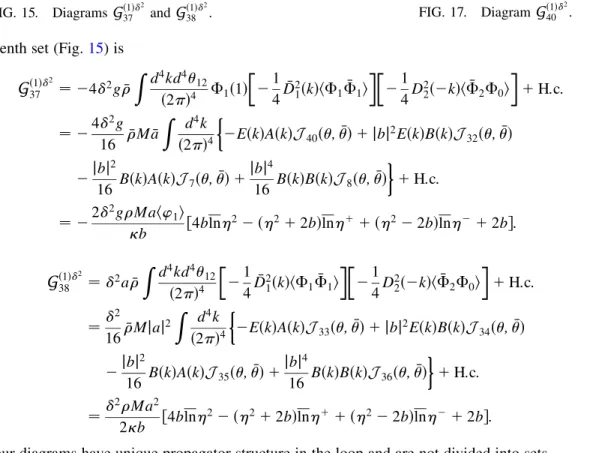
37 ¼ 42g
Z d4kd4 12
ð2Þ4 1ð1Þ
1
4D 2
1ðkÞh11i
1
4D 2
2ð kÞh20i
þH:c:
¼ 4
2g
16 M a
Z d4k
ð2Þ4
EðkÞAðkÞJ40ð;Þ þ jbj2EðkÞBðkÞJ32ð;Þ
jbj2
16 BðkÞAðkÞJ7ð;Þ þ
jbj4
16 BðkÞBðkÞJ8ð;Þ
þH:c:
¼ 2
2gMah’ 1i
b ½4bln
2 ð2þ2bÞlnþþ ð2 2bÞln þ2b: (64)
Gð1Þ2
38 ¼2a
Z d4kd4 12
ð2Þ4
1
4D 2
1ðkÞh11i
1
4D 2
2ð kÞh20i
þH:c:
¼
2
16M jaj
2Z d4k
ð2Þ4
EðkÞAðkÞJ33ð;Þ þ jbj2EðkÞBðkÞJ34ð;Þ
jbj2
16 BðkÞAðkÞJ35ð;Þ þ
jbj4
16 BðkÞBðkÞJ36ð;Þ
þH:c:
¼
2Ma2
2 b ½4bln
2 ð2þ2bÞlnþþ ð2 2bÞln þ2b: (65)
The last four diagrams have unique propagator structure in the loop and are not divided into sets. The thirty-ninth diagram (Fig.16) is
Gð1Þ2
39 ¼
1 2
22Z d4kd412
ð2Þ4
1
4D 2
1ðkÞh22i
1
4D 2
2ð kÞh11i
þH:c:
¼
2
2ð16Þ2
2jMj2b2Z d4k
ð2Þ4CðkÞFðkÞJ9ð;Þ þH:c:
¼
22M2
4 b ð
2lnþ 2ln 2bÞ: (66)
The fortieth diagram (Fig.17) is
Gð1Þ2
40 ¼2jj2
Zd4kd4 12
ð2Þ4
1
4D 2
1ðkÞh22i
1
4D 2
2ð kÞh11i
¼
2
16jj 2Z d
4k
ð2Þ4
ðk2þ jaj2ÞAðkÞEðkÞJ
33ð;Þ þ ðk2þ jaj2Þ
jbj2
16AðkÞBðkÞJ35ð;Þ
þ jMj2jbj2BðkÞEðkÞJ
34ð;Þ þ
jMj2jbj4
16 BðkÞBðkÞJ36ð;Þ
¼
22
4 bf4bð2
2 a2Þln2 ½2þðþ a2Þ M22lnþ
þ ½2 ð a2Þ M22ln þ2bð22 2a2 M2Þg: (67)
FIG. 15. DiagramsGð1Þ2
37 andG ð1Þ2
38 .
FIG. 16. DiagramGð1Þ392.
FIG. 17. DiagramGð1Þ2
40 .
The forty-first diagram (Fig.18) is
Gð1Þ2
41 ¼
1 2
22Z d 4kd4
12
ð2Þ4
1
4D 2
1ðkÞh21i
1
4D 2
2ð kÞh21i
þH:c:
¼
2
2ð16Þ2
2M2Z d 4k
ð2Þ4fAðkÞAðkÞJ14ð;Þ 2jbj
2AðkÞBðkÞJ
9ð;Þ þ jbj4BðkÞBðkÞJ3ð;Þg þH:c:
¼
22M2
4 b ½4bln
2 ð2þ2bÞlnþþ ð2 2bÞln þ2b: (68)
Finally, the forty-second diagram (Fig.19) is
Gð1Þ2
42 ¼2jj2
Z d4kd412
ð2Þ4
1
4D 2
1ðkÞh21i
1
4D 2
2ð kÞh21i
¼
2
16jj
2jMj2jbj2Z d 4k
ð2Þ4FðkÞFðkÞJ20ð;Þ
¼
22M2
4 b ð
2lnþ 2ln 2bÞ: (69)
The diagrams Gð141Þ2, G15ð1Þ2, andGð161Þ2 of the fifth set give divergent contributions, and we will discuss their renormalization later.
B. Two Loops
The two-loop diagrams are shown in Fig.20.
To calculate the two-loop diagrams, we use the tech-nique developed in Ref. [31]. The contribution of the first diagram is given by
Gð2Þ2
1 ¼42g2
Zd4pd4kd4 12
ð2Þ8
1
4D 2
1ðpÞh00i
1
4D 2
2ðkÞh11i
1
16D 2
1ðqÞD22ð qÞh11i
¼
2g2
ð16Þ3a 2b3Z d
4pd4k
ð2Þ8 CðpÞFðkÞFðqÞI1ð;Þ;
(70) withq¼ ðk pÞ, and the integralI1ð;Þis given in the
Appendix. PluggingI1ð;Þinto (70), we obtain
Gð2Þ2
1 ¼ 42g2a2b3
Z d4pd4k
ð2Þ8 CðpÞFðkÞFðqÞp
2: (71)
To handle with the integral above and the other mo-mentum space integrals that will appear in the following, we have adopted the following strategy: for each of them, we split the integrand with the help of the method of partial fraction decomposition and write each integral as the sum of other integrals with just three terms in the denominator. The remaining integrals are well known in the literature, and we use the results of Refs. [32–34] to compute them.
From now on, we define 2¼m2þa2,
¼m2þa2b and adopt the same notation of
Refs. [32–34] for the integrals Iðx; y; zÞ, Jðx; yÞ, andJðxÞ:
JðxÞ ¼ x
þxðlnx 1Þ; (72)
2Jðx; yÞ ¼xy 1
2þ
1
ð2 lnx lnyÞ
þ ð1 lnx lnyþlnxlnyÞ
; (73)
2Iðx; y; zÞ ¼ c 22
1
3c
2 L1
1
2fL2 6L1
þ ðyþz xÞlnylnzþ ðzþx yÞlnzlnx
þ ðyþx zÞlnylnxþðx; y; zÞ
þc½7þð2Þg; (74)
where FIG. 19. DiagramGð1Þ2
42 .
¼ ð4Þ2;
c¼xþyþz;
lnX¼ln
X
2
þ ln4;
Lm¼xlnmxþylnmyþzlnmz;
ðx; y; zÞ ¼S
2 lnzþx y S 2z ln
zþy x S
2z ln
x zln
y
z 2 Li2
zþx y S
2z
2 Li2
zþy x S
2z
þ
2
3
;
S¼qffiffiffiffiffiffiffiffiffiffiffiffiffiffiffiffiffiffiffiffiffiffiffiffiffiffiffiffiffiffiffiffiffiffiffiffiffiffiffiffiffiffiffiffiffiffiffiffiffiffiffiffiffiffiffiffiffiffiffiffiffiffiffiffiffiffiffiffix2þy2þz2 2xy 2yz 2zx;
Li2ðzÞ ¼ Zz
0
lnð1 tÞ
t dtðdilogarithm functionÞ:
So, the total contribution of the first two-loop diagram is
Gð2Þ2
1 ¼
2g2a2 2 ½Ið
þ; þ; þÞ 3Iðþ; þ; Þ þ3Iðþ; ; Þ Ið ; ; Þ: (75)
The contribution of the second diagram is given by
Gð2Þ2
2 ¼82g2
Z d4pd4kd4 12
ð2Þ8
1
4D 2
1ðpÞh01i
1
4D 2
2ðkÞh01i
1
16D 2
1ðqÞD22ð qÞh11i
¼2
2g2
ð16Þ3 a 2bZ d
4pd4k
ð2Þ8 fAðpÞAðkÞFðqÞI2ð;Þ 2b2AðpÞBðkÞFðqÞI3ð;Þ þb4BðpÞBðkÞFðqÞI4ð;Þg: (76)
PluggingI2ð;Þ,I3ð;Þ, andI4ð;Þinto (76), we obtain
Gð2Þ2
2 ¼ 82g2a2b3
2Z d 4pd4k
ð2Þ8 AðpÞBðkÞFðqÞp
2þb2Z d 4pd4k
ð2Þ8 BðpÞBðkÞFðqÞ
: (77)
Decomposing the momentum space integrals, we get the contribution
Gð2Þ2
2 ¼2g2a2½ 4Ið2; 2;
þÞ þ4Ið2; 2; Þ þIðþ; þ; þÞ þIðþ; þ; Þ
Iðþ; ; Þ Ið ; ; Þ: (78)
The contribution of the third diagram is given by
Gð2Þ2
3 ¼162g2
Zd4pd4kd4 12
ð2Þ8
1
4D 2
1ðpÞh10i
1
4D 2
2ðkÞh11i
1
16D 2
1ðqÞD22ð qÞh01i
¼
2g2
ð16Þ3a 2b2Z d
4pd4k
ð2Þ8 CðpÞCðqÞ
EðkÞI5ð;Þ þ 1
16b
2BðkÞI6ð;Þ
: (79)
PluggingI5ð;ÞandI6ð;Þinto (79), we obtain
Gð2Þ2
3 ¼162g2a2b2
Z d4pd4k
ð2Þ8 CðpÞEðkÞCðqÞp
2q2þb2Z d 4pd4k
ð2Þ8 CðpÞBðkÞCðqÞp 2q2
: (80)
Decomposing the momentum space integrals, we have
Gð2Þ2
3 ¼22g2a2½Iðþ; þ; þÞ Iðþ; þ; Þ Iðþ; ; Þ þIð ; ; Þ: (81)
¼8
2g2
ð16Þ2a 2b2Zd
4pd4k
ð2Þ8 BðqÞ
EðpÞEðkÞI7ð;Þþ 1 8b
2EðpÞBðkÞI
8ð;Þþ 1
ð16Þ2b
4BðpÞBðkÞI 9ð;Þ
þ8
2g2
ð16Þ2
Zd4pd4k
ð2Þ8 AðqÞðq 2þm2Þ
EðpÞEðkÞI10ð;Þþ 1 8b
2EðpÞBðkÞI
11ð;Þþ 1
ð16Þ2b
4BðpÞBðkÞI 12ð;Þ
: (82)
PluggingI7ð;Þ–I12ð;Þinto (82), we get Gð2Þ2
4 ¼82g2b2
a2Z d 4pd4k
ð2Þ8 EðpÞEðkÞBðqÞ þ2a 2b2Z d
4pd4k
ð2Þ8 EðpÞBðkÞBðqÞ
þa2b4Z d 4pd4k
ð2Þ8 BðpÞBðkÞBðqÞ 2
Z d4pd4k
ð2Þ8 EðpÞBðkÞAðqÞk
2q2 b2Z d 4pd4k
ð2Þ8 BðpÞBðkÞAðqÞq 4
2m2Z d 4pd4k
ð2Þ8 EðpÞBðkÞAðqÞk
2 m2b2Z d 4pd4k
ð2Þ8 BðpÞBðkÞAðqÞq 2
: (83)
Decomposing the momentum space integrals, we obtain the total contribution of the fourth diagram:
Gð2Þ2
4 ¼2g2
8a2
Ið2; 2; 2Þ þ b
2Ið
2; 2; þÞ b 2Ið
2; 2; Þ
þ8m2
2Ið2; 2;0Þ þ
þ
2 Ið
2; þ;0Þ
þ
2 Ið
2; ;0Þ
þa2½Iðþ; þ; þÞ þ3Iðþ; þ; Þ þ3Iðþ; ; Þ þIð ; ; Þ
þ2½ 4Jð2; 2Þ þ4Jð2; þÞ þ4Jð2; Þ Jðþ; þÞ 2Jðþ; Þ Jð ; Þ: (84)
Unlike the first three two-loop diagrams, Gð2Þ2
4 gives a
divergent contribution; however, its renormalization is trivial, since it is a vacuum diagram.
C. Regularization and renormalization
The divergent diagrams of order2 are Gð1Þ2
14 ¼
82g21
ln
2
þ2
2g2
b ½4bln
2 ð2þ2bÞlnþ
þð2 2bÞln þ2bZd4
00; (85)
Gð1Þ2
15 ¼
22gb1
ln
2
2gb
2 b ½4bln
2
ð2þ2bÞlnþþ ð2 2bÞln þ2b
Z d42
0þH:c:; (86)
Gð1Þ2
16 ¼ 2b2
2
1
ln
2
þ
2b2
8 b½4bln
2 ð2þ2bÞlnþ
þ ð2 2bÞln þ2b Zd422: (87)
The diagramGð161Þ2 is a vacuum diagram, and thus its renormalization is trivial. To renormalize the divergent term inGð141Þ2, we introduce the counterterm
82g2 Z
d4
0R0R; (88) and, for the divergent term in Gð151Þ2, we introduce the counterterm
22gb Z
d42
0RþH:c:¼
22gbZ
d2
0RþH:c:
(89) As mentioned in the previous section and shown in Ref. [14], plugging the solution for the optimized parame-ter bin (89), only the Ka¨hler potential is actually renor-malized, in agreement with the nonrenormalization theorem.
IV. SUMMARY OF THE RESULTS AND NUMERICAL ANALYSIS
In this last section we summarize the perturbative results for the effective potential up to the order 2. We
also derive nonperturbative corrections to the effective potential by implementing the PMS criterion numerically. Up to this order, the renormalized effective potential can be written as
Veff ¼Vtreeeff þV
0
effþV
1
effþV
2
eff: (90)
The tree level potential is given by
Vtree
eff ¼Vð’1Þ ¼ ðþg’12Þ2þm2’21; (91)
with <0.
The vacuum diagram of order0 is V0
eff ¼ 1
ð4Þ2 1
4ðM
2þa2Þ2ln
1 b
2
ðM2þa2Þ2
þb
2ðM
2þa2Þln
M2þa2þb
M2þa2 b
þb
2
4 ln
ðM2þa2Þ2 b2
4
3b2
4
:
(92) The one-loop contribution for the effective potential atOð1Þis given by
V1
eff ¼
ð4Þ2
bðb 4ghF0iÞ þ2½aða 4gh’1iÞ þMðM2þa2Þln½M2þa2
þ
að4gh’1i aÞ þ 1
2ð4ghF0i bÞ M
ðM2þa2þbÞln½M2þa2þb
þ
að4gh’1i aÞ 1
2ð4ghF0i bÞ M
ðM2þa2 bÞln½M2þa2 b: (93)
AtOð2Þ, we separate the contributions of one- and two-loop diagrams: V2
eff ¼V
2
effðIÞþV 2
effðIIÞ; (94)
where
V2
effðIÞ¼ 2
ð4Þ2
½ða 4gh’1iÞ2ðM2þ3a2Þ þaMða 4gh’
1iÞ þ2ð3M2þa2ÞlnðM2þa2Þ
1 2
ða 4gh’1iÞ½ða 4gh’1iÞðM2þ3a2þbÞ þ2aðb 4ghF0iÞ þ4aM
þ1
2ðb 4ghF0iÞ½ðb 4ghF0iÞ þ4M þ
2ð3M2þa2þbÞlnðM2þa2þbÞ
1 2
ða 4gh’1iÞ½ða 4gh’1iÞðM2þ3a2 bÞ 2aðb 4ghF0iÞ þ4aM
þ1
2ðb 4ghF0iÞ½ðb 4ghF0iÞ 4M þ
2ð3M2þa2 bÞ
lnðM2þa2 bÞ
; (95)
and
V2
effðIIÞ¼ 2g2
ð4Þ4
4
ðM2þa2Þ½4ðM
2þa2Þ3þbðM2þa2 bÞðM2 2a2Þln2ðM2þa2Þ ðM2þa2þbÞ
ðM2þa2Þ ½ðM 2þa2Þ
ð6M2þ17a2Þ þ2bðM2þ3a2Þln2ðM2þa2þbÞ 3ðM2þa2 bÞð2M2þ3a2 2bÞln2ðM2þa2 bÞ
þ8ðM2þa2þbÞð2a2 bÞlnðM2þa2ÞlnðM2þa2þbÞ þ8a2bðM2þa2 bÞ
ðM2þa2Þ lnðM
2þa2ÞlnðM2þa2 bÞ
2ðM2þa2þbÞð2M2þ3a2 2bÞlnðM2þa2þbÞlnðM2þa2 bÞ þ 8M2b
ðM2þa2Þ
bln
ðM2þa2Þ2
ðM2þa2Þ2 b2
ðM2þa2ÞlnM2þa2þb
M2þa2 b
lnb 24ðM2þa2Þð2M2þ3a2ÞlnðM2þa2Þ þ12ðM2þa2þbÞð2M2þ3a2þ2bÞ
lnðM2þa2þbÞ þ12ðM2þa2 bÞð2M2þ3a2 2bÞlnðM2þa2 bÞ þa2½4ðM2þa2;M2þa2;M2þa2Þ
3ðM2þa2þb;M2þa2þb;M2þa2þbÞ ðM2þa2þb;M2þa2 b;M2þa2 bÞ
þ4a
2ðM2þa2 bÞ
ðM2þa2Þ ½ðM
2þa2;M2þa2;M2þa2þbÞ ðM2þa2;M2þa2;M2þa2 bÞ þ 8M 2b
ðM2þa2Þ
ðM2þa2þbÞLi 2
M2þa2
M2þa2þb
þ ðM2þa2 bÞLi 2
M2þa2 b
M2þa2
56b2 4 3b
2ð2M2þbÞ
: (96)