.... セfundaᅦᅢo@
.... GETULIO VARGAS EPGE
Escola de Pós-Graduação em Economia
66Extre:an.e Observations and
Diversification in Latin
Anl.erican E01erging Equity
Markets"
RAUL SUSMEL
(
U
niversity of
H
ou ston )
LOCAL
Fundação Getulio Vargas
Praia de Botafogo, 190 - 10° andar - Auditório
DATA
06/08/98 (5
afeira)
HORÁRIO
16:00h
...
EXTREME OBSERVATIONS AND DIVERSIFICATION IN LATIN AMERICAN EMERGING EQUITY MARKETS
Raul Susmer
University of Houston Department of Finance College of Business Administration
Houston, TX 77204-6282 (713) 743-4763 FAX: (713) 743-4789 e-mai\: [email protected]
March 1998
ABSTRACT
In this paper, we focus on the tails of the unconditional distribution of Latin American emerging markets stock returns. We explore their implications for portfolio diversification according to the safety tirst principIe, tirst proposed by Roy (1952). We tind that the Latin American emerging markets have signiticantly fatter tails than industrial markets. especially, the lower tail of the distrihution. We consider the implication of the safety tirst principIe for a U .S. investor who creates a diversitied portfolio using Latin American stock markets. We tind that a U.S. investor gains by adding Latin American equity markets to her purely domestic portfolio. For different parameter specitications. we finu a more realistic asset allocation than the one suggested by the Iiterature haseu on the traditional mean-variance framework.
JEL: C53, G 15
funcAGHGセG@
AセセセセG@
/qí··
..
\:'l -
セカ@
\lJ
セQQ@ oセ@
セLOMLOGQ@
-/
/ { ./ I' ' , /,. r .... " セ@
-.-...!
_ ,.'
Lセj|[@
L_セGiLaセG@
.,s.Eli--,
,
Title: Extreme Observations and Diversification in Emerging Equity Markets
-ABSTRACT
In this paper, we focus on the tails of the unwnditional distrihution of Latin American emerging
markets stock returns. We explore their implications for portfolio diversitication according to the
safety frrst principie, tirst proposed hy Roy (1952). We tind that the Latin American emerging markets
have signiticantly fatter tails than industrial markets. especially, the lower tail 01' the distribution. We
consider the implication 01' the safety tirst principie for a U.S. investor who creates a diversified
portfolio using Latin American stock markets. We tind that a U.S. investor gains by adding Latin
American equity markets to her purdy domestic portfolio. For different parameter specifications, we
find a more realistic asset allocation than the one suggested hy the literature based on the traditional
•
1.- INTRODUCTION
The well documented high average stock returns and their low correlations with industrial markets
-seem to make emerging equity markets an attractive choice for diversifying portfolios. De Santis
(1993) finds that adding asset<; from emerging markets to a henchmark portfolio consisting of U.S.
assets creates portfolios with a considerahle improved reward-to-risk performance. Harvey (1995a)
finds that adding equity investments in emerging market<; to a portfolio of industrial equity markets
significantly shifts the mean-variance efticient frontier to the left. Within the context of a traditional
mean-variance context, Harvey (1994) provides a detailed analysis of conditional and unconditional
asset allocation that includes emerging markets. He finds that the optimal unconstrained weights for
emerging markets increase over time from 40% in 1980 to almost 90% in 1992. Using the Latin
American markets used in these papers, the optimal unconstrained weights for the Latin American
markets is close to 50%. The ahove result<; seem to contrast with the also well documented "home
bias," see French and Poterha (1991) and Tesar and Werner (1994, 1995). In particular, Tesar and
Werner (1995) study U.S. equity tlows to emerging stock markets and find that the U.S. portfolio
remains strongly biased toward domestic equities. For example, Chuhan (1992) tinds that investment in
emerging markets was roughly 2 to 3.5 percent of the international portfolio held hy U.S. pension
funds from 1988 to 1991.
In this paper, we explore the implications of the sufet)' first criterion in an international asset
allocation contexto Roy (1952) introduced the safety tirst criterion, which was further developed by
Arzac and Bawa (1977). Under the safety tirst criterion, an investor minimizes the chance of a very
large negative return, a return that, if realized, would reduce the investor's portfolio value below some
threshold leveI. A safety tirst investor might he worried ahout a (me-time large event that might drive
her or her tirm out of husiness. The safety first rule might he more appropriate for investors investing
,
are greatly intluenced hy extreme returns. I As sh\l\\'n in this paper. one of the ditft:rences hetween
emerging and industrial market<; is the hehavior of extreme returns. These ohserved extreme returns
'produce a fatter tailed empirical distrihution for emerging markets stock returns than for the industrial
markets.
Fat tails for stock returns in industrial markets have heen extensively studied. Mandelbrot (1963)
and Fama (1965) point out that the distrihution of stock returns has fat tails relative to the normal
distribution. Mandelbrot (1963) proposes a non-normal stahle distrihution for stock returns, in which
case the variance of the distrihution does not exist. Blattherg and Gonedes (1974) and, later, Bollerslev
(1987), in an ARCH contexto propose the Student-t distrihution for stock returns, which has the appeal
of a tinite variance with fat tails. Jansen and de Vries (1991) and Loretan and Phillips (1994) use
extreme value theory to ana1yze stock return in the U.S. Their results indicate the existence of second
moments and possihly third and fourth moments. hut nor much more than the fourth momento Jansen,
Koedijk and de Vries (1996), JKV thereafter, use extreme value theory to operationalize the safety first
rule in portfolio selection. They show that using extreme value theory allows calculations of the
probability of extreme event<;, even for an event for which there is no in-sample observation. This
approach is very useful for decision makers that worry ahout the possible occurrence of an extreme
evento
In this paper. we focus on Latin American emergmg markets. These markets are of particular
interest to U.S. investors. Among emerging markets. they have heen the largest recipient<; of U.S. net
purchases of foreign equity from 1978 till 1991. see Tesar and Werner (1995). De Santis (1993) finds
that the Latin American market<; are assOl:iated with the largest gain in portfolio performance to a U.S.
1 Harvey (1995a, 1995h) and Claessens et a!. (1995) document that emerging markets returns
,
..
investor who want'i to diversify a purely domestic portfolio. In addition, these market<; have undergone
substantial changes in tinancial regulations and macroeconomic policies. We tind that emerging
.. markets have fatter tails than industrial markets. The fail estimates suggest that the distrihution of Latin
American emerging markets might not have second m oments. We also tind that a U. S. investor gains
by adding Latin American equity markets to her purely domestic portfolio. For different parameter
specifications, however, we tind a Latin American portfol io weight of 15 %, which is a more realistic
asset allocation than the one suggested in the literature hased on the traditional mean-variance
framework.
This paper is organized as follows. Section 11 hrieíly introduces the safety tirst principIe and the
JKV approach to operationalize it. Section IJ] descrihes the data and performs a preliminary analysis of
the series. Section IV summarizes the result'i. Section V conc1udes the paper.
11. SAFETY FIRST ANO EXTREME VALUE THEORY
II.A Safety Firsr
Suppose an investor's initial wealth and initial value of asset j are Wo and Vo,j' respectively, This
investor can invest in the risky assets with weight'i üJj' s or horrow and lend an amount h at the free-risk
rate r (b
>
O represents borrowing). A safety tirst investor specities a disaster levei of wealth, s, andthe maximal acceptable prohability of this d isaster, Ú. Let W I.i be the random tina I value of asset j and
let 11 be the expected return of the portfolio. i.e .. Il =E(R). Arzac and Bawa (1977) study the
implications of the following lexicographic form of the safety tirst principIe:
'I
...
where
7t = I, ifP = Prob(Lj Ü).' Wl.í - hr セ@ s) セ@
o.
7t = I-P, otherwise.
The safety tirst condition can be written as
(2) Prob(R :5 qô(R» :5 Õ,
where R is the return ofthe investor's portfolio, and '16 = (r + (s-Wo r)/(Wo+b). The return ofthe
portfolio can only be below the quantile 46 with probahility Õ. The safety tirst principie is violated
whenever
(3!1 / アッャセカ\イK@ /1)1 s-Wor .
Wo-,-b
Note that a safety tirst investor will exhihit risk aversion if the criticai wealth levei s is smaller than
his/her secure final wealth W of. Arzac and Bawa (1977) show that a risk averse safety first investor
can solve the optimization problem in two stages. First, the investor maximizes the ratio of the risk
premium to the return opportunity loss that she can incur with probability Õ,
E(R)-r
(4) max
Wjr
_
q,,(R)
and determine the optimal weights, the Wí' s. In the seco no stage, the investor determines the amount to
be borrowed from the budget constraint ano the scale of the risky part of his/her portfo]jo from
In order to derive testable implications for the safety tirst theory. it is necessary to specify the
õ-fractile of the portfolio in terms of estimable characteristics of the risky assets. Roy (1952) and Arzac
portfolio distribution from ahove. That is.
,
(6) P{(R -E(R) / ? (E(R) -
q
/
J
<So ,CJ- "fE(R)-q
r
OI
for E(R) > q. As shown by JKV, the Tchehychev hound may he a poor approximation to the exact
bound. They improve the bound by using extreme value theory.
II.BExtreme value theory'
Consider a stationary sequence of XI, xセL@ .. XI1 of i.i.d random variahles with distribution function
F(.). We want to tind the prohability that Mn , the maximum of the tirst n random variahles, is below a
certain value x (Mn could be multiplied hy -1 if one is interested in the minimum). We denote this
probability by P(Mn <x) =F"(x).The distrihution tunction F"(x), when suitably normalized ana for
large n, converges to a limiting distrihution G(x). where G(x) is one of three asymptotic distributions,
see Leadbetter, Lindgren and Rootzen (1983). Since returns on tinancial asset"i are fat tailed, Koedijk
et aI. (1990) and JKV consider the limiting distrihution of G(x) which is characterized by a lack of
some higher moments:
(7) G(x)
=
O, if x<SoO.= exp(-xrl/y = exp(-xrU
, ifx>O.
where y=l/a>O and ais the tail indexo Leadhener. Lindgren and Rootzen (1983) show that when the
dependence among the Xi's is nm too strong. this limiting distrihution is valid. The Student-t.with
tinite degrees of freedom, the stahle distrihution. and the ARCH process are included in the above
G(x) distribution. For the Student-t distrihution. a is the degrees of freedom. The symmetric stable
distribution requires a to he lower than twO. The tail index a can he estimated and indicates the
number of moment<; that exist.
To estimate a we use Hill's (1975) moment estimatm. We first ohtain the mder statistics X(n)' X(Jl .
.. 1)"", X(1) from our sample, where X(n»X(I1-I)
> .,. >
X(I)' etc. Then, the Hill estimator is given hy:•
A 1 I=m
(8)
r
= -L
ln( xョセiMLI@ -In( XI1-m),m
1=1where m is the number of upper order statistics included. The Hill estimator can he applied to either
tai! of a distribution by calculating order statistic.:s from the opposite tail and multiplying the data by -1.
We can also combine the tail observations (hy taking ahsolute values) to estimate a common a. Goldie
and Smith (1987) show that (1/_ - ャO。Iュャゥセ@ is asymptotically normal nHoLケセI@ ifm increases suitable as n
tends to infinity. The asymptotit: normality of 11_ makes testing hypotheses ahout the tai!s of the
distribution very easy.
One criticai aspect of the H ilI estimator is the choic.:e of m. We use a hootstrap procedure proposed
by Hall (1990), which is also used hy JKV. After c.:alc.:ulating a we estimate the quantiles
qp
using thefollowing formula:
(9)
q
p = X,n.ml(m/pn
j.
This formula estimates the quantiles qp that will only he exceeded with prohahility p.
Tail estimates using extreme value theory have heen estimated for exchange rates hy Hols and de
Vries (1991) and Koedijk et aI. (1990). and for stock returns hy Jansen and de Vries (1991), Longin
(1993) and JKV.
I1I.- DATA
Data of weekly returns of stoc.:k indexes trom six industrial and four emerging Latin American
..
from the last week of August 1989 10 the third week of Apri] 1996. We take 1989 as our starting date
because prior to 1989 equity markets in Latin America werealmost inaccessible for direct investments
'by foreign investors. They were accessihle primarily through country funds. The return on each market
is computed based on a value-weighted portfolio of securities that trade in that market. Since Latin
American countries have experienced high intlation and high intlation volatility. we use returns
expressed in U.S. dollars.4 Ali indexes are constructed so as not
to double count those stocks
multiple-listed on foreign stock exchanges. Stocks are selected for inclusion on the basis of liquidity and market
value.
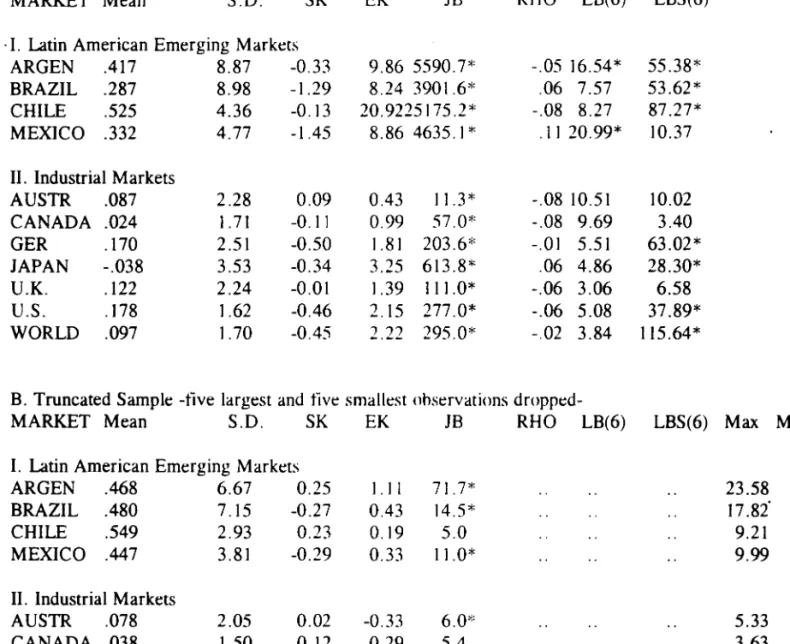
Table 1, Pane I A shows univariate statistics for the data. We note the usual high return-high
standard deviation characteristic of emerging markets. We test for normality using the Jarque-Bera
(1980) test, JB, which follows a chi-squared distribution with two degrees of freedom. Although for
both series normality is rejected by the 18. in emerging market<; the rejection is stronger. 5 This
stronger rejection arises mainly from higher kurtosis. Pane I A also shows the tirst autocorrelation
coefficient, RHO, and Ljung-Box (1978), LB(q), autocorrelation tests. The LB test follows a
chi-squared distribution with q degrees of freedom. The tirst order autocorrelation coefficient'i and the LB
tests, for mean returns, for both Latin American emerging markets and industrial markets are quite
similar, and, with the exception of Argentina and Mexico. there is no evidence for autocorrelation. For
4 McFarland, Pettit and Sung (1982) argue that week]y exchange rates also follow a non-normal
stable distribution. Therefore. since the hehavior of the fattest tai] dominates the tail behavior of a sum of variables, our tail estimates might capture the tai] hehavior of exchanges rates instead of local stock prices. We estimated the tail estimate in local currencies and the result<; were very similar to the results obtained in U.S. dollars. Later. we tested if the structural reforms enacted in the Latin American countries during our sample. affected the tai] estimate. These structural reforms have had a stabilizing influence on exchange rates. We could not. however. reject the null hypothesis of no change after the reforms.
..
the squared returns. however, the LB test reject<.; the no autocorrelation null hypothesis in ali the
markets with the exception of the U.K .. Australia.ó and Canada. Latin American emerging market<;
. ·tend to show even higher squared autocorrelations. In Tahle I. Panel B. we analyze the impact of large
positive and negative observations in our sample hy Ieaving out 01' the analysis the tive largest and tive
smallest observations. Ali the industrial markets. with the exception 01' Japan and Australia, pass the
lB normality test, while among the Latin American emerging market<;. only Chile passes the JB
normality test. The source 01' non-normalities in Argentina, Brazil. and Mexico does not seem to be
driven solely by a few extreme ohservations.
Table 2 focuses on the extreme ohservations In our sample. Four our purposes, extreme
observations are detined as observations which are outside 01' two standard deviations. Under
normality, the expected total numher should he around 17. Tahle 2 shows that the Latin American
emerging markets tend to have a lower total numher of extreme ohservations than the industrial
markets, although they are not statistically ditlerent. For portfolio managers, it would be useful to
know how clustered are these extreme ohservations. For example. a interesting question for portfolio
managers is: once an extreme ohservation has happened, is the prohability 01' ohserving another
extreme observation higher'! Tahle 2 also addresses this issue. Tahle 2 shows the number of single
extreme observations, where a single extreme ohservation is detined as an extreme observation not
followed or preceded by another extreme ohservation in four weeks. Again. with the exception of
Germany. this number is smaller for the emerging markets than for the industrial markets. This result
shows that the Latin American emerging markets tend to have the extreme ohservations more clustered
than the industrial markets. For example. in Argentina out 01' eighteen extreme ohservations only three
are single extreme ohservations. In contrast. in the U.K .. eleven extreme ohservations out 01' eighteen
•
are single extreme observations. Finally. the las! eigh! columns of Tahle 2 show the two largest
returns, the 95% percentile. the 90% percemile. the two smallest returns. the 5% percentile, and the
··10% percentile from each series. We find that. in ahsolute value. the two smallest returns tend to be
larger than the two largest returns. This hehavior of the extreme observations seems to reverse faster in
emerging markets than in industrial markets. as the percemile in Table 2 show. We also tind that the
two largest returns tend to be closer than the two smallest returns. Of particular relevance to investors
is the behavior of large negative returns. In the Latin American emerging markets, we tind that the
second smallest return is at least 40% larger than the minimum returno In industrial markets, however.
the second smallest return is on average 14% larger than the minimum returno We conclude that one of
the main differences between Latin American emerging markets and industrial markets is given by the
behavior of the returns on the tails of the distrihution. especially on the lower tai!.
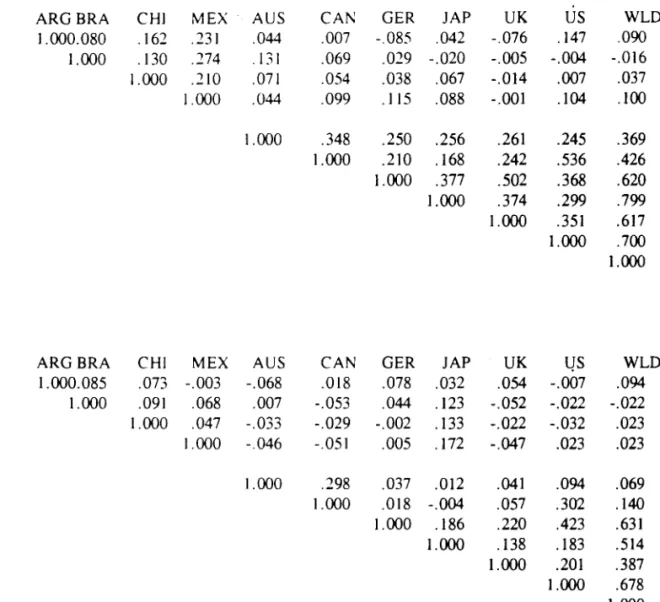
Table 3 shows the correlation matrix for returns and squared returns. Panel A, shows the typical
low correlation of stock returns in emerging markets and industrial market'\. The regional correlations
are on average larger than the correlations with developed markets. These low correlations are usually
interpreted as an indication of potential bendit for international portfolio diversitication. With few
exceptions. Pane I B. shows consistently lower correlations for squared returns. Engle and Susmel
(1993) show that higher correlations for the squared returns than correlations for the levei returns
might be indicating the existence of common time-varying component'\ in the variance. From that
perspective. the results in Pane I B show no evidence of common time-varying volatility in Latin
American emerging markets or in the industrial markets.
IV. TAIL ESTIMATES ANO THEIR IMPLlCATIONS TO INVESTORS
IV.A Tail estimates
•
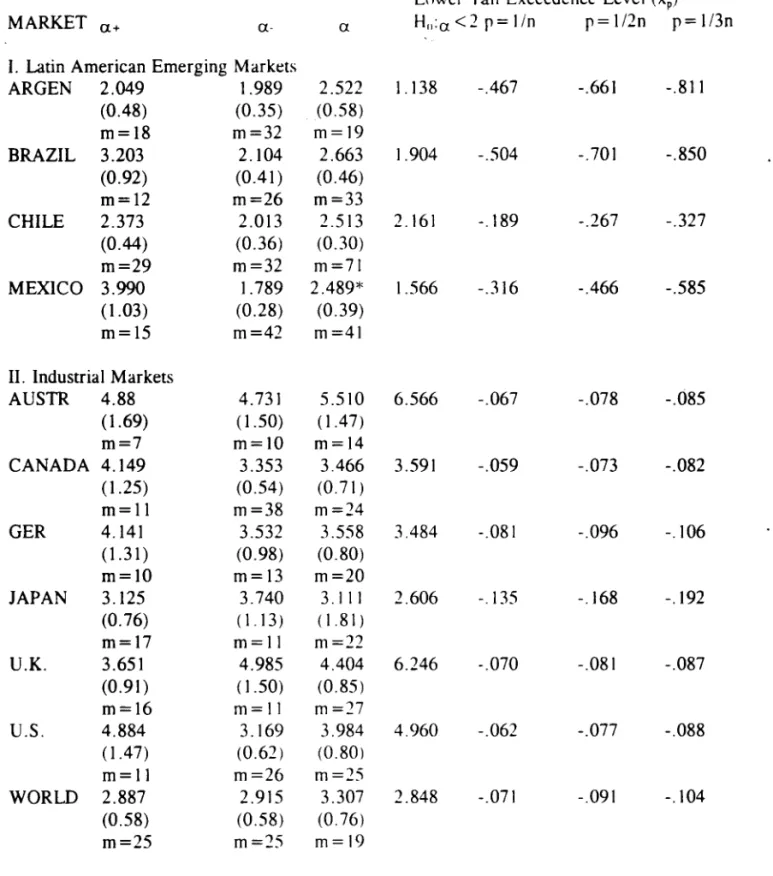
lower tail. u_. and the common tai!. u. are rerorted in the first. second and third columns.
respectively. Below each point estimate. we report standard errors and the numher of order statistics
. 'used to estimate the tail indexo m .
The lower tail tends to he fatter (smaller) than the uprer tai!. This is especially true for ali Latin
American emerging markets. With the exception of Mexico. the equality of hoth tails, however, cannot
be rejected. More important. hoth tails tend to he fatter for the Latin American emerging markets than
for the industrial markets. This result is true for the lower tail and common tai!. We also test for the
existence of second moments. If u is signiticantly lower than two, the equity returns do not have
second moments. The test is a one-sided test and follows a standard normal distrihution under the null
hypothesis. The null hypothesis is clearly rejected for industrial market<; and for Brazil and Chile. It
cannot be rejected for Mexico and Argentina.
We calculate exceedence leveis for ditlerent prohahilities. Recall that exceedence leveis are returns
that can only be achieved with a given prohahility. We use as prohahilities for the exceedence leveis
multiples of the inverse of the sample size. n
=
346. In the last three columns of Table 4 we report these calculations. For example, focusing on Argentina, the tifih column indicates that with probability1/346 we can observe a negative return of -46.7 %. That is, in the Argentinean case, there is a 1 in 346
chance that an investor will oh serve a weekly return of -46.7% or less. Similarly, for Argentina, the
last column indicates that there is an almost .001 chance that an investor would experience a weekly
return of -81.1 % or less. From these last three columns. we ohserve that the exceedence leveis are
quite disperse from Latin American emerging markets. hut they are quite concentrated for industrial
markets.
We want to test the structural stahility of the tail estimates for Latin American equity markets.
These markets have experienced suhstantial deregulation and liheralization during the past six years.
we have enough observations to do a sensihle estimarion. For Argemina. the tail index is 2.63 before
liberalization and 2.99 after liheralization. For Brazil. the tail index is 2.60 hefore liheralization and
. '2.80 after liberalization. Even though rhere is a mild -decrease in the fatness of the tail, a formal test
cannot reject the equality of the indexes hefore and after economic reform. These results complement
previous results, using monthly data, that do nO[ ohserve any significam change in volatility, see De
Santis and lmrohoroglu (1995) and Bekaerr and Harvey (1995). However, they seem to contradict
Hargi-; (1994), who aIs o uses weekly stock returns for the same Latin American markets. Hargis
(1994) reports a decrease in volatility after liheralization.
IV. B Safety tirst porrfolio diversitkation
In this section, we study the diversitication possihilities which the Latin American emerging
markets afford a U.S. safety tirst investor. Assume that the U. S. investor is considering investing in a
Latin American portfolio. For simplicity, we use an equally weighted Latin American portfolio. In the
U.S., the investor can lend or horrow ar the risk-free rate. r. which we take as the weekly 9O-day
LIBOR.7 We construct 21 portfolios, increasing the percentage of the investment in the Latin American
portfolio fiom 0% to 100% hy increments of 5 % (for hrevity we do nO[ report ali the portfolios). As
pointed out hy JKV. the tail index. a. is unatlected hy forming these P ortfo li os , since the fattest tail
dominates the portfolio. In Tahle 5, however. we estimate ali the tail indexes for ali portfolios. As it
can be seen, for portfolios composed of 25 % or more of the Latin American portfolio, the lower tail
estimates are dominated hy the Latin American markets. i.e .. the tail index is close to two. For
portfolios composed of 20% or less of the Latin American porrfolio. the wntrihution of the Latin
American market'i is too small to dominate the U.S. Index. and therefore, the tail of the portfolio is
•
very similar to the U. S. tai I.
In order to study the implications of the safety first principie for the U.S. investor. we need to
"specify the parameter values of 8 and s. We assume that 8 takes on two values: .0029 (once every 6.7
years, or a 1 in 346 chance) and .0014 (a ! in 692 cham:e).' We use two conservative values of s: .9W
and .95W. For both leveIs of 8, the optima! investment in the Latin American portfolio is 15%, which
is a substantial reduction from the 50% reported in the introduction.9 The return on this risky portfolio
is .002239% a week. The exceedence leveis for the safety first optima! risky portfolio are -.05.7 for
8=.0029 and -.072 for 8=.0014. Finally. we have 10 determine h, which depends on s. For exampIe,
for 8=.0029 and s=.95, h=-.128W. that is. the U.S. investor will he lending at the risk free rate
12.8% of her initial wealth. The return on the total portfo)jo is (.872 x 1.002239)
+
(.128 x 1.(01) = 1.00209. If the worst happens, the U.S. investor's tinal wealth is (.872 x .943)W+
(.872 x1.(02239)W = . 949W, or 95 percent of the initial wealth as expected.
V. CONCLUSIONS
In this paper, we analyze Latin American emerging market<; from a different perspective. We focus
on the tails of the unconditional distrihution of stock returns. We also explore the implications for
portfolio diversification of the safety tirst principie. First. we tind that the Latin American emerging
markets have signiticantly faner tails than industrial markets. This result is especially true for the
lower tail of the distrihution. Second, we consider a simple exercise to analyze the implication of the
safety first principIe for a U.S. investor who want<; to diversify his/her domestic portfolio using Latin
American market<;. For different parameter specitications, we tind that the safety tirst principie obtains
セ@ We use different values for 8. The resu Its do not change suhstantially.
9 This percentage is consitent with the caps used in several glohal investment funds and with. the
TABLE 1. UNIVARIATE STATISTICS A. Full Sample
MARKET Mean S.O.
.. I. Latin American Emerging Markets
SK EK 18
ARGEN .417 8.87 -0.33 9.86 5590.7*
BRAZIL .287 8.98 -1.29 8.24 3901.6*
CHILE .525 4.36 -0.13 20.9225175.2*
MEXICO .332 4.77 -1.45 8.864635.1*
11. Industrial Markets
AUSTR .087 2.28 0.09 0.43 11.3*
CANADA .024 1. 71 -0.11 0.99 57.0*
GER .170 2.51 -0.50 1.81 203.6*
JAPAN -.038 3.53 -0.34 3.25 613.8*
U.K. .122 2.24 -0.01 1.39 111.0*
U.S. .178 1.62 -0.46 2.15 277.0*
WORLO .097 1.70 -0.45 2.22 295.0*
RHO LB(6) LBS(6)
-.05 16.54* 55.38* .06 7.57 53.62* -.08 8.27 87.27* .11 20.99* 10.37
-.08 10.51 10.02 -.08 9.69 3.40 -.01 5.51 63.02*
.06 4.86 28.30* -.06 3.06 6.58 -.06 5.08 37.89* -.02 3.84 115.64*
B. Truncated Sample -tive largest and tive smallest ohservations
dropped-MARKET Mean S.O. SK EK 18 RHO LB(6) LBS(6) Max Min
I. Latin American Emerging Markets
ARGEN .468 6.67 0.25 1.1 I
BRAZIL .480 7.15 -0.27 0.43
CHILE .549 2.93 0.23 0.19
MEXICO .447 3.81 -0.29 0.33
11. Industrial Markets
AUSTR .078 2.05 0.02 -0.33
CANADA .038 1.50 0.12 0.29
GERM .196 2.18 -0.28 0.01
JAPAN -.022 2.95 -0.23 0.46
U.K. .119 1.96 -0.10 0.11
U.S. .145 1.40 -0.16 0.09
WORLO .105 1.46 -0.30 0.10
Notes:
* signiticant at the 5 % leveI. SK: Skewness coeftlcient. EK: Excess kurtosis coefticient. JB: Jarque-Bera (1980) normality test. RHO: First order autocorrelation coefticient. LB(6): Ljung-Box statistic with 6 lags for leveis.
71.7* 14.5* 5.0 11.0* 6.0'" 5.4 4.4 14.6* 1.2 1.1 5.6
LBS(6): Ljung-Box statistic with 6 lags for squareu series.
23.58 -19.35 17.82" -22.68 9.21 -8.20 9.99 -12.14
TABLE 2. EXTREME OBSERVATIONS
MARKET Total sゥャャセj・@ m .. x! m;,x.:::' llldX) f/f 1l1;'x!O',; minlO';7 min5'ii min.:::' minI
L Latin American Emerging Markets
.. ARGEN 18 3 42.84 41.02 12:18 8.57 -8.08 -11.99 -32.12 -61.75
BRAZIL 15 4 31.32 27.52 13.28 10.11 -9.58 -13.47 -38.24 -66.81 CHILE 11 4 33.79 18.71 6.18 4.62 -3.33 -4.50 -18.40 -33.40 MEXICO 17 5 14.57 13.44 7.39 5.69 -4.64 -6.45 -18.74 -34.54
11. Industrial Markets
AUSTR 18 6 8.24 6.17 3.85 2.98 -2.84 -3.91 -6.21 -7.12
CANADA 16 12 5.58 4.95 2.95 2.28 -2.07 -2.54 -6.16 -6.27
GER 16 4 8.10 7.49 3.87 3.02 -2.87 -4.39 -8.55 -11.74
JAPAN 20 7 14.92 10.94 5.56 3.96 -3.88 -6.32 -12.37 -18.06
U.K. 18 11 8.62 8.04 3.83 2.59 -2.71 -3.93 -6.34 -7.99 .
U.S. 19 9 5.70 4.31 2.91 2.18 -1.90 -2.69 -5.72 -7.82
WORLD 19 6 5.28 5.23 2.72 2.01 -2.14 -2.76 -4.88 -8.51
Notes:
Total: total number of observations larger (in absolute value) than two standard deviations.
Single: number of extreme ooservations not followed nor preceded oy another extreme observation in four weeks.
max 1: largest observation.
max2: second largest observation.
max5 %: 5 % fractile of the 1argest observatiol1s. max 10%: 10% fractile of the largest observations. minI: smallest observation.
min2: second smallest observation.
TABLE 3. CORRELATIOl'\ MATRIX
A.- Leveis
ARG BRA CHi MEX AUS CAl\: GER JAP UK US WLD
ARGENTINA 1.000.080 .162 .231 .044 .007 -.085 .042 -.076 .147 .090
\ BRAZIL i.OOO .130 .274 .131 .069 .029 -.020 -.005 -.004 -.016
CHILE 1 .000 .210 .071 .054 .038 .067 -.014 .007 .037
MEXICO 1 .000 .044 .099 .115 .088 -.001 .104 .100
AUSTRALIA 1.000 .348 .250 .256 .261 .245 .369
CANADA 1.000 .210 .i68 .242 .536 .426
GERMANY 1.000 .377 .502 .368 .620
JAPAN 1.000 .374 .299 .799
U.K. 1.000 .351 .617
U.S. 1.000 .700
WORLD 1.000
B.- Squared Series
ARGBRA CHI MEX AUS CAN GER JAP UK l!S WLD
ARGENTINA i.OOO.085 .073 -.003 -.068 .018 .078 .032 .054 -.007 .094
BRAZIL 1.000 .091 .068 .007 -.053 .044 .i23 -.052 -.022 -.022
CHILE i.OOO .047 -.033 -.029 -.002 .133 -.022 -.032 .023
MEXICO 1.000 -.046 -.051 .005 .i72 -.047 .023 .023
AUSTRALIA 1.000 .298 .037 .012 .041 .094 .069
CANADA 1.000 .018 -.004 .057 .302 .140
GERMANY 1.000 .186 .220 .423 .631
JAPAN 1.000 .138 .183 .514
U.K. 1.000 .201 .387
U.S. 1.000 .678
TABLE 4. TAIL ESTIMATES A. FulI Sample
Lower Tail Exceedence LeveI (xp)
MARKET u+ a- a H,,:a <2 p= IIn p = 1/2n p = 113n
•
I. Latin American Emerging Markets
ARGEN 2.049 1.989 2.522 1.138 -.467 -.661 -.811
(0.48) (0.35) (0.58)
m=18 m=32 m=19
BRAZIL 3.203 2.104 2.663 1.904 -.504 -.701 -.850
(0.92) (0.41) (0.46)
m=12 m=26 m=33
CHILE 2.373 2.013 2.513 2.161 -.189 -.267 -.327
(0.44) (0.36) (0.30)
m=29 m=32 m=71
MEXICO 3.990 1.789 2.489* 1.566 -.316 -.466 -.585
(1.03) (0.28) (0.39)
m=15 m=42 m=41
11. Industrial Markets
AUSTR 4.88 4.731 5.510 6.566 -.067 -.078 -.085
(1.69) ( 1.50) (1.47)
m=7 m=1O m=14
CANADA 4.149 3.353 3.466 3.591 -.059 -.073 -.082
( 1.25) (0.54) (0.71 )
m=11 m=38 m=24
GER 4.141 3.532 3.558 3.484 -.081 -.096 -.106
(1.31) (0.98) (0.80)
m=1O m=13 m=20
JAPAN 3.125 3.740 3.111 2.606 -.135 -.168 -.192
(0.76) (1. 13) (1.81 )
m=17 m=11 m=22
U.K. 3.651 4.985 4.404 6.246 -.070 -.081 -.087
(0.91) ( 1.50) (0.85)
m=16 m=11 m=27
U.S. 4.884 3.169 3.984 4.960 -.062 -.077 -.088
(1.47) (0.62) (0.80l
m=11 m=26 m=25
WORLD 2.887 2.915 3.307 2.848 -.071 -.091 -.104
(0.58) (0.58) (0.76)
m=25 m=25 m=19
Notes:
T ABLE 5. Lower tail estimates for Ditferent PllrttO!iOS
Proportion of Exceedem:e Leveis and Returns
• LA in port a. SE(a.) m XIi .m 1)= 1/11 (R-r)/(r-q)8 = 1/2n (R-r)/(r-q)
..
'·0% 3.169 0.622 26 -0.022-.062 .0146 -.077 .01185% 2.991 0.556 29 -0.020-.061 .0166 -.077 .0133
10% 2.945 0.676 19 -0.022-.059 .0188 -.074 .0149
15% 3.070 0.704 19 -0.022-.057 .0211 + -.072 .0169+
20% 2.884 0.721 16 -0.024-.063 .0201 -.080 .0166
25% 2.145 0.405 28 -0.018-.085 .0167 -.118 .0121
30% 2.183 0.476 21 -0.022-.089 .0171 -.123 .0124
40% 2.339 0.585 16 -0.030-.098 .0177 -.131 .0132
50% 1.969 0.464 18 -0.031-.135 .0144 -.192 .0101
60% 1.725 0.396 19 -0.033-.182 .0118 -.272 .0079
70% 1.747 0.276 40 -0.025-.209 .0113 -.311 .0076
75% 1.818 0.291 39 -0.028-.212 .0116 -.310 .0079
80% 1.632 0.385 18 -0.044-.257 .0100 -.394 .0065
85% 1.641 0.398 17 -0.048-.272 .0098 -.415 .0064
90% 1.834 0.315 34 -0.037-.252 .0110 -.368 .0075
95% 1.774 0.292 37 -0.037-.280 .0103 -.414 .0069
100% 1.680 0.269 39 -0.036-.322 .0093 -.486 .0061
Notes:
+:
preferred ponfolio .•
•
..
References
Arzac, E.R. and V.S. Bawa (1977). "Portfolio Choice and Equilihrium in Capital Markets with Safety-First Investors," Journal of Financiai Ecol1omics. 4. 277-288 .
Baillie, R.T. and R.P. DeGennaro (1990). "Stllck Returns and Volatility." Journal of Financia'l and Ouantitative Analysis, 25. 203-214.
Bekaert, G. and C.R. Harvey (1995). "Time-Varying World Market Integration." Journal of Finance, 50, 403-444.
Bekaert, G. and C.R. Harvey (1996). "Emerging Equity Market Volatility," Department of Finance. Duke University, manuscript.
Blattberg, R.C. and N.J. Gonedes (1974). "A Comparison of the Stahle and Student Distribution as Statistical Models for Stock Prices," Journal of Business. 244-280.
Bollerslev, T.P. (1987), "A Conditional Time Series Model for Speculative Prices and Rates of Returns," Review of Economics and Statistics. 69. 524-54.
Cho, D.C, C.S. Eun and L.W. Senhet (1986). " lnternatiol1al Arhitrage Pricing Theory: An Empirical Investigation," Journal ofFinance, 41. 313-329.
Chuhan, P. (1992), "Sources of Portfolio Investment in Emerging Markets." manuscript.
Claessens, S., S. Dasgupta and l. Glen (1995). "Return Behavior in Emerging Stock m。イォ・エセNB@ World Bank Economic Review, 9. 131-15 I .
De Santis, G. (1993), "Asset Pricing and Portfolio Diversitication: Evidence from Emerging FinanciaI Markets," Department of Finance and Business Economics. University of Southern California, unpublished manuscript.
De Santis, G. and S. Imrohoroglu (1995). "Stock Returns and Volatility in Emerging Financiai Markets," Department of Finance and Business Economics. lJniversity of Southern California, unpublished manuscript.
Engle. R.F. and R. Susmel (1993). "Col11l11on Volatilitv In International Equity Markets." Journal of
Business and Economic Statistics. 11.2. 167-176.
Fama, E. (1965), "The Behavior of Stock Market Prices." lournal of Business. 38. 34-105.
Goldie C.M. and R.L. Smith. "Slow Variation with Remainder: Theory and Applications," Ouarterly Journal of Mathematics. 38. 45-71.
•
•
..
•
Hargis, K. (1994), "Time-Varying Transm ission of Priees ano V olatil it)' Latin American Equity Markets 1988-1994." Department of Eeonomies. University of IlIinois at Urhana-Champaign. unpublished manuscript.
··Harvey, C.R. (1993), "Portfolio Enhaneement with Emerging Markets and Conditioning lnformation," in S. Claessens and S. Gooptu (eds.): Portfolio Investment in Developing Countries, World Bank, Washington, D.C.
Harvey, C.R. (1994), "Conditional Asset Alloeation in Emerging Markets." Departmem of Finance, Duke University, manuscript.
Harvey, C.R. (1995a), "Predictable Risk and Returns In Emerging m。イォ・エセNB@ Review of FinanciaI Studies, 8, 773-816.
Harvey, C.R. (1995b), "The Risk Exposure of Emerging Equity Market<;," World Bank Economic Review, 9, 19-50.
Hill, B.M. (1975) " A Simple General Approaeh to Inferenee Ahout the Tail of a Distribution," The Annals of Statistics, 3, 1163-1173.
Hols, M. and C.G. de Vries (1991), "The Limiting Distrihution of ExtremaI Exchange Rate Returns," Journal of Applied Econometrics. 287-302.
Jansen, D.W.and C.G. de Vries (1991), "On the Frequency of Large Stock Returns: Puning Booms and Busts imo Perspective, " The Review of Economies and Statistics, 18-24.
Jansen, D.W., K.G. Koedijk, and c.G. oe Yries (1996). "Operationalizing Safety First Portfolio Selection using Extreme Value Theory." Department of Economics. Texas A&M University, manuscript.
Koedijk, K.G, M.M.A. Schafgans and c.G oe Vries (1990). "The Tail lndex of Exchange Rate Returns," Journal of lnternational Econom ies. 19. 93-108.
Leadbener, M.R .. G. Lindgren and H. Rootzen (1983). Extreme and Related Properties of Random Sequences and Processes. Berlin. Germany: Springer-Yerlag.
Longin, F. (1993). "Booms and Crashes: Appliearion of Extreme Value Theory to the U.S. Stock Market," London Business Sehoo\. manuseript.
Loretan, M. and P.C.B. Phillips (1994). "Testing the Covarianee Stationarity of Heavy-Tailed Time Series: An Overview of the Theory With Applieations to Severa I FinanciaI Datasets." Journal of Empirical Finance, 1. 211-248.
Mandelbrot. B.B. (1963), "The Variation llfCertain Speeulative Prices." Journal ofBusiness, 36,
394-419. .
•
Changes: Trading Day Effects and Risk Measurement." lorunal ot Finance. 38. 693-715.
Roy, A.D. (1952), "Safety First and the Ho1ding of Assets." Econometrica. 431-449 .
•
セ@ . Tesar, L. and LM. Werner (1994). "International Securities Transaction and U.S. Portfolio Choice,"
li
in The Internationalization of Equit), Markets. Chicago. 111.: The University of Chicago Press.
FUNDAÇÃO GETULIO VARGAS
BIBLIOTECA
ESTE VOLUME DEVE SER DEVOLVIDO A BIBLIOTECA NA ÚLTIMA DATA MARCADA
セN@ '''' I
l\.Cham. P/EPGE SPE S964ex
Autor: Susmel, Raul.
Título: Extreme obsenations and di\'ersificatlon in Latin
1111111111111111111111111111111111111111
086183
49993
FGV - BMHS NU 1'''1.1'84,98
"