...
,... #"FUNDAÇÃO ,... GETULIO VARGAS
EPGE
Escola de Pós-Graduação em Economia
SEMINÁRIOS
DE PES,QUISA
ECONOMICA
-"I.AROR SUPPLY, RISK
AVERSION Al\TD
ECONOMIC REFORM IN
CHINA "
J
DIANA WEINHOLD
( V ANDERBIL T UNIVERSITY )
LOCAL
Fundação Getulio Vargas
Praia de Botafogo, 190 - 10° andar - Auditório
DATA
05/02/98 (53 feira)HORÁRIO
16:00hLabor
Supply,
Risk Aversion
and Economic Reform in China
*
DIAI\A "·EII\HOLD
Vanderbilt Uni'llersity
A~D
PAFL
J.
ZAKClaremont Graduate Uni'versity
THIS \'ERSJO~ DECEMBER 1. 1997
·We thank Boqing Wang for insightful discussions on this project and for graciously providing his data to uso
Correspondence to: Paul J. Zak, Department of Economics. Claremont Graduate University.
r
LABOR SUPPLY. RISK AVERSIO~ AND ECONOMIC REFORM IN CHINA
Abstract
Economic reform in China has created a small, but fast-growing private sec-tor that has spurred rapid productivity growth. Growth of the private secsec-tor is predicated upon continued labor movements away from state-run industries and into private firms. This paper presents a theory of labor market sectoral choice demonstrating that three factors determine private sector labor supply-the dif-ference in wages between the state and private sectors, private sector wage risk and risk aversion. Estimation of the model using survey data provides strong support for the theory. We find that the riskiness of private sector earnings has a greater effect in discouraging workers from taking jobs in private firms than the wage premi um has in attracting workers.
KEYWORDS: Labor Market. China. Private Sector. Risk Aversion. Economic Devel-opmenL Transitional Economies.
JOGRNAL OF ECONOMIC LITERATURE Classification Number: J23 Employment
I
1
INTRODUCTION
A new wave of privatization has recently begun in China as the state cedes control of more than 10.000 firms to private ownership (\\:'all Street Journal (1996)). Though private and joint venture public-private companies still only account 5% of total employment in China. more than half of new entrants to the urban labor force take positions with non-state sector firms, as compared to 28% going to the non-state sector firms in 1978 (Maurer-Fazio (1995)).1 vVhile reforms have introduced a great deal of uncertainty into the labor market. productivity gains from the increased competition have been spectacular. Li (1997) estimates that the marginal productivity of labor increased 54% from 1980 to 1989. China's gradual reform of the state sector and concomitant growth of the private sector can be credited with a substantial portion of the productivity gains that are fueling output growth.
This paper presents a theory specifying the process through which individuaIs choose to supply labor to either the state sector or the private sector. Our purpose is to characterize the factors that drive private sector employment growth. Privatization increases the number of private firms. but this may not result in large numbers of private sector workers if most employees are re-absorbed into state-run firms.2 The
theory developed here shows that it is not only the wage differential that determines the rate at which individuaIs move from the state sector to the private sector. but the wage risk inherent in pri vate sector jobs as well as individuaIs' tolerance for risk. Using a uni que survey-based dataset of Chinese workers and firms, we test the theory empirically by constructing measures of the riskiness of each worker's private sector wage and his or her risk aversion. The empirics demonstrate that the most important factor affecting the ftow of employees to the private sector is wage risk.
There are two novel aspects to the present analysis. The first is that we derive a very general relationship between employment in the private sector and the first
and second moments of the sectoral difference in wages. The model uses a variant of portfolio theory to determine an individual's sectoral employment choice as a function of the expected wage differential and the variance of the private sector wage. The second novelty of this paper is the manner in which the theory is tested. We use on a survey of workers and firms as the basis for our empirical work rather than aggregated national data. The empirics substantiate the model's prediction that private sector wage risk and an individual's risk aversion affect the ftow of workers into the private sector.
1 Maurer-Fazio (1995) defines the non-state sector to include collectives. public-private ventures
and private firms. In 1994, 73% of employment was in the state sector, 21.6% in collectives and 5%
in private firms or joint ventures.
2Excellent discussions of the effects of reform on the Chinese labor market can be found in Korzec
1
THE LABOR MARKET li' CHIl'iA
3
This paper proceeds as fo11ows. A theory of sectoral labor supply choice is set out in section 2 where empirically testable implications of the model are derived. In Section 3. the empirical methodology is described and variables are constructed that are used to test the mo deI. This section also presents the empirical findings. Section 4 discusses the implications of the results for policy-setting and Section 5 concludes.
2
LABOR SUPPLY TO THE STATE
AND PRIVATE SECTORS
In China. prior to the 1986 reforms. the government assigned almost alI individuaIs to lifelong employment in state-owned firms. Health care and housing benefits were included in these assignations. with benefits increasing with seniority as part of the
baoxialai. or "taking care of everything" system.3 After reforms. a new type of job appeared. renewable term positions in the new private and hybrid public-private sectors.4 Called the "Shenzhen model.'· contract jobs in the private sector have
grown steadily as individuaIs seek higher wages than those available in the state sector. Private sector jobs generally do not include benefits. and these positions entail some risk as they do not guarantee lifetime employment and wages vary with market forces.5 An attempt at tying state-sector wages to the performance of particular work-units was briefly experimented with in 1985. but this practice soon ceased because the "iron rice bowl" system was preferred by state-sector employees (Korzec (1992)). This indicates some self-selection by workers when choosing the sector within which to work. Such self-selection is partially attributable to differences in risk tolerance.6
There are several risks inherent in taking a job in the private sector. The first. private sector wages often depend on the profitability of the firm and to the supply and demand for various types of workers. which adds volatility to labor earnings. Second, private sector employees risk spells of unemployment when they are between contract positions or if the firm at which they work doses. Third, as mentioned above. is that one foregoes generating state-sector seniority upon which benefits are based. In an effort to determine why some workers stay in the state sector and others move to private sector. we began looking at worker characteristics in survey data of nearly
3For the most part, benefits are retained upon retirement.
4For expositional simplicity, we will call private and joint public-private firms the "private sector" and collectively owned and state-run firms the "state sector'·.
5Private sector jobs may also be sought for the experience they provi de which can be used to obtain future private-sector employment or to start one's own firmo
6We do not model the growth of the private sector here. for this see Brixiova & Kiyotaki (1997)
•
THE LABOR MARKET IN CHI:\A 4
10,000 Chinese workers in 438 enterprises sampled in 26 cities collected in 1992.';" vVorkers in private firms are typically younger. more educated and, on average. earn 58% more than workers in the state sector. Interestingly, workers of both types live in households in which there are. on average, about four family members with three of these being adults.8 Standard models of sectoral labor supply show that workers move among sectors until the expected wage differential (inclusive of the value of benefits) disappears.9 Veto this does not appear to be happening in China where state sector employment is relatively ossified.
The facts above give us a clue as to the conditions that lead workers to select to work in the state sector versus the private sector. In particular, families with several adults may be able to insure the consumption of the entire household via intra-family risk-sharing. Such risk sharing permits the household as a whole to have a higher income by sending one or more household members to the private sector. while overall consumption (including benefits) is insured by other members who remain in the state baoxialai system. Such intra-family risk-sharing is of particular importance in developing countries that lack the mechanisms (either publicly or privately provided) to insure consumption against risk.lO Rosensweig (1988). has found that spatially
distributed families in rural India provide partial insurance against consumption risks. In related work. Hayashi. Altonji & Kotlikoff (1996) reject full intra-family risk-sharing in the D.S.
In this paper, we assume that families will act to reduce household consumption risk through sectoral job diversification. C nder this assumption, we derive the optimal sectoral labor supply choice for family members. The choice a family makes is the distribution of its members between jobs in the state sector and the private sector in order to maximize end-of-period household wealth.
2.1
THE ~loDELThe labor supply decision for a household is an allocation of household members to jobs in the state and pri\'ate sectorsY Households vary by their overall earning potential because of the education. location. gender and ethnicity of its members.
'The data are described in Section 3.
BThe in come of a typical surveyed adult accounts for 45% of household labor earnings.
9Models of sectoral employment choices are surveyed in Parsons (1986).
10 An institution called dingti in which state-sector workers who retire or die can "pass" their
position to a family member so that benefits are retained within the family, is an incentive for young
workers to stay in the state sector. Though this practice was officially banned in 1986. there is
evidence that it is still being used. see Freeman (1994) and Korzec (1992).
11 An alternative view of the mode!. that individuais choose a division of their time between state
jobs and private-sector jobs. was suggested by Renata Sahagian. Though many Chinese workers do
•
THE LABOR MARKET I\" CHI\"A
Identifying households by the index i. a household of type i solves the following utility maximization problem to determine labor supply to each sector.
( 1 )
s. t.
ai =
where U(·) is a strictly increasing. continuous and concave representation of prefer-ences over ai. end-of-period wealth. In order to focus the analysis on sectoral labor supply, we model households as end-of-period wealth maximizers. disregarding con-sumptionj savings decisions. The budget constraint (1) shows that final wealth is the sum of initial wealth.
a?
and income earned in both the state and private sectors. Let 1Vi denote the number of employed household members who are distributed amongthose working in the state sectoL
Nt.
earningwi.
and those working in the private sectoLNr
earningwf.
~ote that wages and the number of working members in each sector are household specific.12Employment in the state sector is considered free of earnings risk as such assig-nations generally guarantee lifetime employment. Conversely, we have argued above that private sector wages are fundamentally risky. By assumption. households know the distribution of wages which are (truncated) normaL with mean 11
>
O and variance(72.13
The necessary and sufficient condition for an optimum is
E[["(ad(wf - u'nJ =
o.
(2)which is equivalent to
E[["(adJE[wf - w;] = -COY[C'(a;).wf]. (3)
where
COV[x.
yJ
is the covariance between random variablesx
and y. Applying Stein' s lemma 14 and simplifying. we can write (3) asE[wf -
lL'f]
= (}i~rAR[wf]. (4)12We also ignore the integer constraint on the choice variable for the time being.
13\\'ages must be nonnegative. but the truncation at zero can be ignored as a practical matter if
J1 is sufficiently above zero and ( j is not too large. We will proceed under these assumptions.
14Stein's lemma states that for bivariate normal random variables x and y and a differentiable
function g, E[g(x), y]
=
E[g'(x)]Cov(x, y) when 9 satisfies standard regularity conditions. See. forwhere
THE LABOR MARKET Il'" CHI:'\A
o _
-E[U"(a;)]I - E[C'( ai)]
6
(5)
is the a measure of absolute risk aversion and l/ AR[U'P] IS the variance of private
sector wages.
The mo deI above is a portfolio choice problem where one chooses between a risky and risk-free "asset", in this case, a riskless state sector job or risky private employ-ment. Equation (4) shows that the labor supplied to the private sector depends on the difference between the expected private wage and the state wage, the variance of the private wage. and the household's leveI of risk aversion (which may depend on household wealth).
Assuming a competi tive labor market and a large number of households, integrat-ing equation (4) over these households produces an aggregate labor supply function for the private sector. It is straightforward to show using equation (4) that labor supplied to the private sector increases when (i) the expected difference between the private-sector wage and the state wage rises: (ii) the variance (risk) of the private-sector wage is reduced: and (iii) households become less risk adverse.
3
EMPIRICS
If household members make labor supply decisions jointly. then each member of a household wiU have the same leveI of absolute risk aversion. To see this, suppose the household utility function has the constant relative risk aversion (eRRA) formo
U(a) = aI-li - 1,
1 - v ( 6)
for v
=I-
1. Then. risk aversion for each household member IS a function of thehouseholds' characteristics.15
(7 )
Since the data which show that almost every worker lives in a multi-adult household. the individual
wiH
inherit the risk aversion of the household when decisions are made jointly.The relationship between household characteristics and individual characteristics is important because the data we use surveys individuaIs. not households. i\evertheless, the model can be tested by examining if wage risk and risk aversion affect labor supply decisions on an individual basis. Our empirical studies will proxy risk aversion, Oi.
THE LABOR 11ARKET I:\" CHI:XA
using a number of individual-specific characteristics. including education. geographic location. gender and ethnicity which may account for variations across individuaIs in initial wealth
a?
and labor earnings in (7).In order to translate the mo deI from the household leveI to the individual leveI. we define a new variable Zi which takes the value 1 if an individual chooses a
private-sector job. and O otherwise.16 Taking logs of equation (4), leads to the estimable private sector labor supply equation
Zi = A
+
In(E[wf -wt])
-ln(FAR[wf]) -ln((}i). (8)where A = In v. This labor supply equation forms the basis for our empirical analyses.
3.1
DATA AND ESTIMATION METHODOLOGYThe data set includes 7.884 complete survey responses from workers conduced by the Chinese Academy of Social Sciences in 1992 under supervision by a D.S. team of economists.1 i The survey samples employees of state-owned. colIective-owned
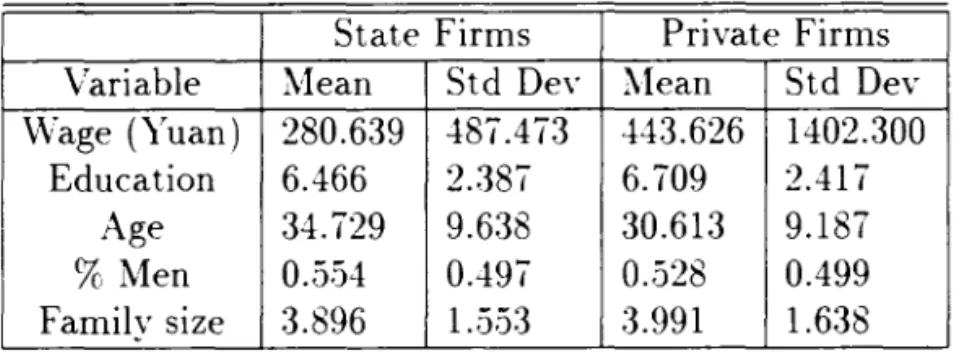
and joint venture firms. As the statistics in Table 1 illustrate. the average monthly earnings (in yuan) of workers in the private sector is 58% higher than those in the state sector. The standard deviation of monthly earnings in the private sector is about twice that in the state sector. \Vorkers in the private firms are on average younger and slightly better educated than those in the state firms. but the differences between the two groups in family size and ratio of men to women are quite small.
Before beginning the empirical analysis, it is worth pointing out several uni que characteristics of this data set. First. due to the smalI number of private firms in China in 1992. there is little likelihood that the education decisions of interviewees were made in order to prepare for a private job and thus can be thought of as exogenous to the labor supply decision. A second feature of this dataset is that employees were interviewed: that is. there are no unemployed individuaIs in the sample. Thus. our analysis is conditional upon a current state of employment and does not address entry into or exit from the labor force or the risk of unemployment. Since our goal is to estimate the private sector labor supply and almost alI adults worked in China in
1992. this should induce little or no bias in the results.
The theory in Section 2 shows that there are three primary factors that determine whether an individual will take a job with a state or private firm, namely the difference in expected wages. the risk of private sector wages. and the individuars leveI of risk aversion. In order to test these implications of the mo deI empiricalIy, we augment
16This construct restores NP to be integer-valued.
THE LABOR ~lARKET I:\' CHI~A 8
State Firms Private Firms Variable Mean Std Dev Mean Std Dev Wage (Yuan) 280.639 487.473 443.626 1402.300
Education 6.466 2.387 6.709 2.417 Age 34.729 9.638 30.613 9.187
%
Men 0.5.54 0.497 0.528 0.499 Family size 3.896 1.5.53 3.991 1.638Table 1: Summary Statistics for State and Private Firms
equation (8) with a set of control variables. Furthermore, while data on a worker's sex and age are directly observable, variables for the expected difference in wages and wage riskiness will have to be constructed.
Table 1 shows that on average private wages are both higher and riskier than state wages. However. these are unconditional statistics estimated over the entire sample. A worker's decision regarding whether he or she will supply labor to a private firm depends on the particular (conditional) wage and risk that is specific to lhe individual
worker. In order to estimate worker-specific wages and risks. simple wage regressions are estimated for both state firm and private firm workers,
lrAGEs
=QjCIT}js
+
31AGEs
+
32
EXPERs
+
33EDUCs
+
;34SEXs
+
Es (9)H:AGEp
=""'jC IT}jp
+
"')1AGEp
+
12EXPERp
+
/3ED['Cp
+
/4SEXp
+
Ep (10)where s = 1 ...
-"statE
are state workers in the sample and p = 1 ... J\~privatE are private firm workers. The variableslFAGE
i •AGE
i .EXPER. EDFCi
are the logs of totalwage income. age, years of work experience. and years of education for each worker. \:Ve also control for the city j where the employee works. C
IT}'j.
and the sex of the worker.SEXo
Using the estimated parameters<lj.
3's.
":j. andi's.
we construct an estimated state and private wage for each worker. regardless of their true place of employment. The expected wage differential facing workeri
is the estimated difference between his or her state sector and private sector wages.4
IV
DI F Fi
= (":j -<lj)C IT}ji
+
L(I\ -
3
k )[k (11)k=l
where [k corresponds to the explanatory variables from the wage regressions (9) and (10) and
i
= 1 ...Stotal
=Sstate
+
SprivatE'
THE LABOR ~v1ARKET I~ CHIr\A 9
error term from these regressions is squared and a second set of regressions are run regressing the squared error terms against the same set of explanatory variables, again allowing the estimated coefficients to vary by whether the individual works for a state or private firmo
f2p =
\jCITYjp
+
()lAGEp
+
()2EXPERp
+
()3EDFCp
+
()4SEXp
+
vp.
(13)The estimated regression coefficients to are used to generate a predicted (2 for both a private firm wage and a state firm wage for each worker. The private wage risk.
RI S K.
is thus calculated for each worker as,4
RISKi
= (\j -Ôj)CITYji
+
2:(ê
k - Pk)r k. (14)k=l
That is. we estimate the private sector wage risk for workers in both the state and private sectors in order to determine risk both types of workers face if there are in. or are considering moving to. the private sector.
:\"ext. we turn to risk aversion. ()i. Although each individual's leveI of risk aversion is unobserved. we can proxy for this variable with a number of measures of the worker's taste for risk. The first of these proxy variahles is iUOV
ED
which takes the value 1 if a worker has moved into the city from elsewhere. and O otherwise. A second proxy variable isTe
RS.
for turnover. which is constructed by dividing the number of job changes an individual has experienced by the number of years he or she has been in the workforce. A third proxy variable isTRAIS
which takes the value 1 if a worker has engaged in self-financed technical training. and O otherwise.Finally. we consider the role of family size which may influence a worker's risk aversion via the ability to diversify risk across household members in the labor force. A larger number of family members may make it easier to insure consumption. In order to test this hypothesis we include a variable for family size.
FAMSIZE.
in the regression 183.2
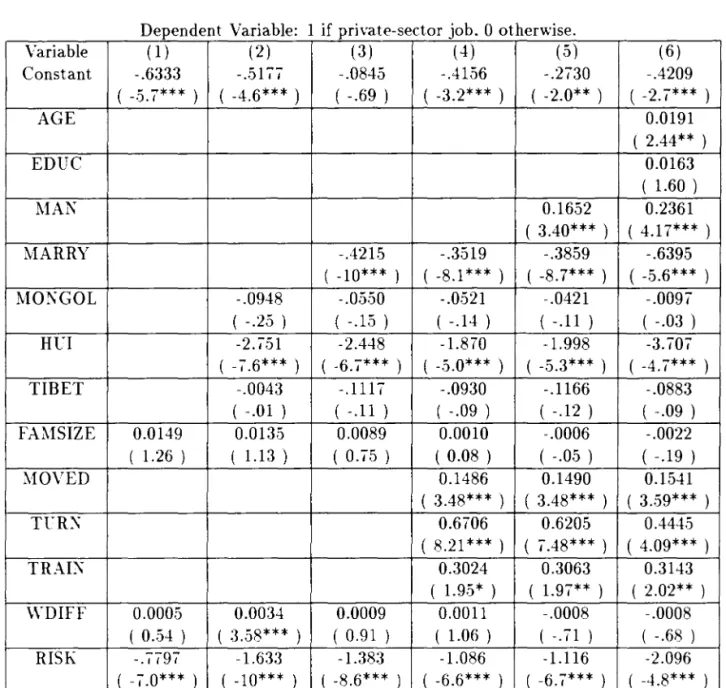
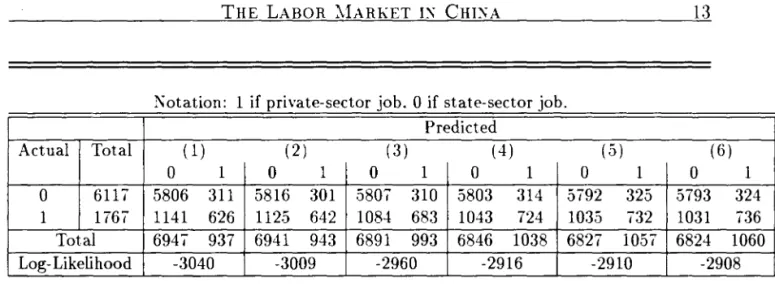
EMPIRICAL FIl'\DI~GSTable 2 presents the results of six probit regressions estimated the augmented private labor supply equation (8). while Table 3 summarizes the predictive capability of each regression and log-likelihood of the each.
18 Alternative measures of family size. including the number of working adults and the dependency
•
THE LABOR ivIARKET I~ CHI~A 10
The dependent variable of the probit regressions in Table 2. Zi~ takes the value 1 if a worker is employed by a private-sector firm and O otherwise. In alI six regressions we have included among the regressors a full set of city dummies (suppressed in the table to save space but available upon request). to control for city-specific effects. The regressions are also used to estimate coefficients for the constructed variables
lV
D I F F and RIS 1\. and at least one proxy variable for the worker ~s levei of risk aversion. Regression (1) includes only family size (F AM 5 I Z E) as a proxy for risk aversion. As predicted by the theorYl the higher the risk premium (RIS 1\) for private wages, controlling for the difference between expected wage leveis, the less likely that worker will take a job with a private firmo AIso. the larger the family size the more likely the worker wilI be employed with a private firm. although this effect is statisticalIy insignificant. Likewise. while the difference in wages has the expected positive sign (the greater the difference between the expected private wage and the state wage the more likely a worker is to take the private job). this coefficient is not statistically significant.Regression (2) adds additional set of control variables measuring the worker's eth-nicity. There are four primary ethnic groups in China-the majority of the country is Han. with the primary minority groups being Mongois. Hui (Muslims) and Tibetans. Among the ethnic groups (Han is the control group). only the Hui have a statistically significant (and reduced) probability of taking a private-sector job; all other ethnic identifiers are insignificant.19 In regression (2). lVDIFF is statistically significant and positive. However. in regression (3) we also control for whether a worker is mar-ried (M ARRY ) as an additional proxy for risk aversion. Married individuais are consistently less likely to take jobs in the private sector which may be attributed to their higher aversion to consumption risk. In this regression. the statistical signifi-cance of H'
D I F F
disappears. In regressions (4). (5) and (6) we include an expanded set variables to proxy for risk aversion. Al0\/ ED. TU RN and T RAIN. Agents who have moved to new cities. have higher job turnover rates or have self-funded techni-cal training exhibit behaviors that suggest that they are less risk adverse than those who do not engage in these activities. In all three regressions these variables are statistically significant and carry the expected positive signo In other words. the less risk averse an individual"s behavior has been in the past. the more likely they are to choose a job with a private-sector firmoIn addition to the proxy risk aversion variables. several other control variables are included in the regressions. These include 1\1 AN (1 for male. O otherwise), AGE. and
19The negative sign on the Rui does not have a c\ear interpretation as Rui are historically traders
•
•
THE LABOR ;"IARKET 11'\ CHll\'A 11
Dependent Variable: 1 if private-sector job. O otherwise.
Variable (1) (2) (3) (4) (5) (6)
Constant -.6333 -.5177 -.0845 -.4156 -.2730 -.4209 ( • -.). / ~*** ) ( -4.6*** ) ( -.69 ) ( -3.2*** ) ( -2.0** ) ( -2.7*** )
AGE 0.0191
( 2.44** )
EDU C 0.0163
( 1.60 )
MAl\' 0.1652 0.2361
( 3.40*** ) ( 4.17*** )
MARRY -.421.5 -.3519 -.3859 -.6395
( -10*** ) ( -8.1 *** ) ( -8.7*** ) ( -5.6*** ) MO~GOL -.0948 -.0550 -.0521 -.0421 -.0097
( -.25 ) ( -.15 ) ( -.14 ) ( -.11 ) ( -.03 )
HCI -2.751 -2.448 -1.870 -1.998 -3.707
( -7.6*** ) ( -6.7*** ) ( -5.0*** ) ( -5.3*** ) ( -4.7*** )
TIBET -.0043 -.1117 -.0930 -.1166 -.0883
( -.01 ) ( -.11 ) ( -.09 ) ( -.12 ) ( -.09 )
FÂ~ISIZE 0.0149 0.013.5 0.0089 0.0010 -.0006 -.0022
( 1.26 ) ( 1.13 ) ( 0.75 ) ( 0.08 ) ( -.05 ) ( -.19 )
.MOVED 0.1486 0.1490 0.1541
( 3.48*** ) ( 3.48*** ) ( 3.59*** )
TrR:\" 0.6706 0.6205 0.4445
( 8.21 *** ) ( 7.48*** ) ( 4.09*** )
TRAI:\" 0.3024 0.3063 0.3143
( 1.9.5* ) ( 1.97** ) ( 2.02** ) WDIFF 0.0005 0.0034 0.0009 0.0011 -.0008 -.0008
( 0.54 ) ( 3.58*** ) ( 0.91 ) ( 1.06 ) ( -.71 ) ( -.68 ) RIS!\: -.7/97 -1.633 -1.383 -1.086 -1.116 -2.096
( -7.0*** ) ( -10*** ) ( -8.6*** ) ( -6.6*** ) ( -6.7*** ) ( -4.8*** )
Coefficient estimates are presented with their corresponding t-statistics in parentheses. Three
s-tars indicates significance at 1%. two at 5% and one star indicates statistical significance at 10%.
Coefficient estimates for C ITY variables are not shown to conserve space.
•
THE LABOR l\1ARKET I~ CHI~A
12
EDf/C (leveI of education achieved). Men are more likely to take a private-sector
job, while married workers are less likely to take a job with a private firmo ewn after controlling for age and education leveI. Once wage differentials. risk aversion. sex and education have been controlled for. older workers are more likely to take a private job than younger workers20 Lastly. education enters with a positive. but insignificant
coefficient.
Throughout regressions (1) through (6) several variables are consistently statisti-cally significant. The negative and significant coefficient estimate on
RIS I{
is ex-tremely robust to different specifications. lt}'DI F F
is not robusto but carries the correct sign in two thirds of the regressions. In addition. except for family size, alI of the measures of low risk aversion (A10F ED. TURN
and TRA1N)
are statisticaUy significant and carry the expected positive signs.Table 3 provides some indication of model performance by reporting the log-likelihood and predictive power of each regression. As Table 3 reports, there are 6.117 workers in state jobs (77.6% of the sample) and 1.767 workers in private firms (22.4% of the sample) in the data set. Of those workers who are employed in state jobs, regression (6) correctly predicts that 5.793 wilI be in state firms. and incorrectly predicts that 324 of them wiU take private jobs. The mo deI has a more difficult time accurately predicting the behavior of workers who have taken private sector jobs. Of those individuaIs who are actualIy employed in private firms. regression (6) incorrect-ly predicts that 1.031 of them wilI be in state firms (or 58.4% of the private workers) and correctly predicts that 736 (41.6% of private workers) of them \ViU be in private firm jobs. This suggests that there are some important characteristics of private firm workers that motivated their labor supply choice that are not captured in the modeI. :\"ote. however. that 41.6S7c is still almost twice the rate of the occurrence of private sector workers in the total sample.
4
DISCUSSION
The theory. with strong support in the empirics. show that an important imped-iment to movement of labor from the state sector to the private sector is the risk inherent in private sector employment.21 Though this result is intuitive. the present
paper is the first to the authors' knowledge to demonstrate that the second moment affects labor supply decisions both in theory and by constructing explicit risk
mea-2°;'ll"ote that this positive conditional relationship is the opposite of the unconditional negative
relationship between age and private sector jobs seen in Table l.
21This result would be quantitatively larger if our dataset measured wage variance due to
•
•
,
THE LABOR :;'IARKET 11'\ CHI~A
Notation: 1 if private-sector job. O if state-sector job. Predicted
Actual Total (1) (2) (3) ( 4) (5) (6)
O 1 O 1 O 1 O 1 O 1 O 1
O 6117 5806 311 5816 301 5807 310 5803 314 5792 325 5793 324 1 1767 1141 626 1125 642 1084 683 1043 724 1035 732 1031 736
Total 6947 937 6941 943 6891 993 6846 1038 6827 1057 6824 1060
Log-Likelihood -3040 -3009 -2960 -2916 -2910 -2908
Table 3: Summary statistics for probit regressions
sures from the data. One reason we were able to do this was the availability of high quality data.
There are several policy lessons to be drawn from this analysis. The first is that labor flows to the private sector could be hastened by extra-familial risk-reducing in-stitutions such as unemployment insurance or modem employment offices. Freeman (1994). using the same dataset. finds t hat only 27% of the labor force obtain jobs through modem methods (e.g. through employment agencies). Risk reduction insti-tutions are particularly important in light of the empirical evidence in Dunn (1996) showing that L .S. workers appear to exhibit the phenomenon of loss aversion, as de-scribed by Kahneman &: Tversky (1979). where. for equivalently sized income losses and gains. losses induce a larger reduction of utility than the utility increases from gains. If this were true in China. the least risk averse agents (or risk lovers) will enter the private sector first. followed by less risk averse agents. The remaining state-sector employees are unlikely to move to the private sector because of a strong aversion to consumption risk. If the size of the state sector in China is to be reduced through market incentives, state employees will have to be induced to move to the private sector. Institutions that reduce private sector wage risks are an important policy too1 that can acce1erate the reform of the state sector.
A second implication shown by the empirics is that intra-fami1y insurance of house-ho1d consumption is imperfect in China. If it were possib1e to perfect insure one's consumption. the estimated coefficient on the risk variab1e wou1d be zero. Rather, the estimated coefficient on risk ranges in value from -0.78 to -2.10 in regressions (1)
to (6), dominating almost every other variab1e in the regressions. Using C.S. data, Hayashi. Altonji &: Kotlikoff (1996) also find imperfect intra-fami1y risk-sharing by examining consumption data. The resu1ts here are a1so consistent Rosensweig (1988). who finds that spatially distributed rural families in India provi de partial insurance against consumption risks.
..
..
THE LABOR ::-"IARKET Il\' CHI~A 14
individuaIs into the higher wage private sector while others remain in the lo\\" wage state sector. As the private sector grows. this wiH produce a Kuznet"s inverted l" in the distribution of income. Zak (1997a.b) shows that a widening of the distribution of income increases socio-political instability (i.e. demonstrations. strikes. and the destruction of property). The gradual pace of privatization in China may be one rea-son that movements of employees to the private sector have had fewer socio-political impacts than in other reforming countries. such as Russia.
5
CONCLUSION
This paper has presented a model of labor supply to the growing private sector in China. ~'e show that the supply of individuaIs working in private firms depends not only on the expected wage differential between the private sector and the state sector. but on the risk of private sector wages and an individual's leveI of risk aversion. The rationale behind this result is that households seek to insure their consumption by diversifying working members of the household between the state and private sectors. An innovation of the theory is that we derive the relationship between labor suppl)' and both the first and second moments of the sectoral wage differential.
•
•
OI
•
A,
THE LABOR ~lARKET I:"> CHI:">A 1.5
REFERENCES
DLNN, L.F .. (1996), Loss Aversion and Adaptation in the Labor l\larket: Empiri-cal Indifference Functions and the Labor Supply. ThE Economics and Statistics.
78:441-4.50.
FREEMAN. RICHARD B .. (1994). How Far Has China Reformed its Labor ~larket?
Harl'ard Unil'ersity Working Paper.
HAY, DONALD. MORRIS, DEREK. LIL. GLY AND YAO. SHUJIE. 199-1. Economic Rf}orm and State-OU'ned Enterprises in China. 1979-1987, Clarendon Press. HARRELL. STEVAN, 199.5. Introduction: Civilizing Projects and the Reaction to
Them. in Cultural Encounters on China's Ethnic Frontiers. Stevan Harrell. ed .. University of Washington Press.
HAYASHI. FL~no, ALTONJI. JOSEPH A:">D KOTLlKOFF. LAI:RE~cE. (1996). Risk-Sharing Between and Within Families. Econometrica. 64(2):261-294.
HLANG, CHI-FI: A~D LITZENBERGER. ROBERT H .. 1988. Foundations for Financiai Economics. North-Holland.
KAHNEMA~. DA~\HEL AND TVERSKY . ...\.\IOS. (1979). Prospect Theory: An Analysis of Decision under Risk. Economtfrica. 47 :263- 291.
KORZEC. )'lICHAEL. 1992. Labour and thE Failure of Reform in China. St. Martin's Press.
LI. '\'EI. (1997). The Impact of Economic Reform on the Performance of Chinese State Enterprises. 1980-1989. Journal of Political Economy. 10.5(.5):1080-1106.
~lALRER-FAZIO. !vlARGARET. (199.5). Labor Reform in China: Crossing the River by Feeling the Stones. Comparative Economic Studies. 37(4):111-123.
PARSO~S. DO:'\ALD
O ..
1986. The Employment Relationship: Job Attachment, Work Effort. and the ~ature of Contracts. in Handbook of Labor Economics. ~iol. /I.Orley Ashenfelter and Richard Layard. eds .. :'\orth Holland.
ROSE~S\\'EIG. MARK R .. (1988). Risk. Implicit Contracts and the Family in Rural Areas of Low-Income Countries. The Economic Journal, 98:1148-1170.
\VALL STREET JOURNAL. 1996. China Plans Shareholder Firms. vForld lFire. Septem-ber
:3.
pA16.ZAK. PALL J.. (1997a). Institutions. Property Rights and Growth. AdvanCEs in International Macroeconomics. d. forthcoming.
(
C.
l
t
,
(
r
,.
( !
1
•
•
J
- '. ' r . ,,... . .,.. C r !~
DidLu;L ..
i;
•
I, M~hIO r.E:.-l~'~= S :." ~·!S,:·~
"
~\
/f
".,~~:/
'''- .. ~ _ ..
_.-N.Cham. P/EPGE SPE W423L
Autor: Weinhold. Diana.
Título: Labor supply. risk aversion and cconomic reform
11111111111111111111111111111111 11111111
O~9047