Perspective
Genome Elimination: Translating Basic Research into a
Future Tool for Plant Breeding
Luca Comai*
Plant Biology and Genome Center, University of California Davis, Davis, California, United States of America
Abstract:During the course of our history, humankind has been through different periods of agri-cultural improvement aimed at enhancing our food supply and the performance of food crops. In recent years, it has become appar-ent that future crop improvemappar-ent efforts will require new approaches to address the local challenges of farmers while empowering discov-ery across industry and academia. New plant breeding approaches are needed to meet this challenge to help feed a growing world population. Here I discuss how a basic research discovery is being translated into a potential future tool for plant breeding, and share the story of researcher Simon Chan, who recognized the potential ap-plication of this new approach— genome elimination—for the breeding of staple food crops in Africa and South America.
This article is part of the PLOS Biology Collection ‘‘The Promise of Plant Translational Research.’’
Introduction
Humanity exists in a precarious balance between bounty and famine, and the long-term sustainability of current human society is dependent on our ability to breed crop varieties adapted to our changing environment. We have made considerable progress towards this end, as reflected in the recent history of crop improvement. This history can be divided into three periods that are characterized by different technological approaches: 1940–1980, crop modification through
the breeding of yield-enhancing traits (a strategy that underpinned the green revo-lution) [1]; 1980–2000, the use of trans-genesis to introduce single-gene traits and to facilitate weed and pest control [2–4]; 2000–present, the use of whole genome sequence data [5–7], as well as a deeper understanding of genetic and epigenetic mechanisms [8], to facilitate new technol-ogies and approaches to yield another leap forward in agricultural productivity.
These periods of crop improvement have taken place against a backdrop of different socio-economical climates. The green revolution addressed an impending Malthusian catastrophe in the developing world by rationalizing the means of agricultural productivity. This entailed combining optimized agronomic practices with crop varieties that being shorter and stiffer tolerated higher nitrogen without lodging (when the stalk of a plant bends). Success required the acceptance and sharing of this technological platform between scientists, local government, and farmers. The introduction of genetically modified (GM) crops, on the other hand, was largely enabled by the efforts of selected agricultural biotechnology com-panies, which saw the advantages that could be reaped by introducing into plants genes encoding herbicide and pest toler-ance [4]. While the cultivation of GM crops has brought considerable benefits to some farmers in terms of efficient weed and pest control [2], their development
comes with the large costs of regulatory compliance, combined with widespread public diffidence and frequent opposition [9]. This social context requires that each transgenic modification crosses a critical threshold of economic value. In addition, given the regulatory cost of implementing a new transgenic trait [10], farmers and plant breeders have limited ability to explore and to develop new transgenic resources to address localized problems concerning agriculture and cultural pref-erences for staple foods.
Over recent years, it has become clear that future crop improvement efforts will require approaches that are easy to access and that lend themselves to addressing local challenges, while empowering dis-covery across industry, academia, and the farming community. Plant breeding meets these criteria. Its successes are awe-inspir-ing: consider the difference between maize and its wild form, teosinte, or between polyploid bread wheat and its parental species. They are as remarkable as the difference between a chihuahua and its wild wolf ancestor (although perhaps in the opposite way). Notably, selective plant breeding can be practiced with success by a Neolithic analphabet human ancestor or by a PhD-toting scientist, and the former has clearly the edge in achievement. Given time, plant breeding can yield miracles. Time, however, we do not have in the face of our growing population, dwindling resources, and changing climate. We need
The Perspective section provides experts with a forum to comment on topical or controversial issues of broad interest.
Citation: Comai L (2014) Genome Elimination: Translating Basic Research into a Future Tool for Plant Breeding. PLoS Biol 12(6): e1001876. doi:10.1371/journal.pbio.1001876
Academic Editor:Jeffery L. Dangl, The University of North Carolina at Chapel Hill, United States of America
PublishedJune 10, 2014
Copyright: ß2014 Luca Comai. This is an open-access article distributed under the terms of the Creative
Commons Attribution License, which permits unrestricted use, distribution, and reproduction in any medium, provided the original author and source are credited.
Funding:The work of Simon Chan is funded by the Howard Hughes Medical Institute and the Gordon and Betty Moore Foundation (through Grant GBMF3068, currently to L.C.). Work on cassava and banana is funded by NSF-BREAD award 1109882 previously to S.W. Chan, currently to A. Britt. The funders had no role in study design, data collection and analysis, decision to publish, or preparation of the manuscript.
Competing Interests:The author has declared that no competing interests exist.
Abbreviations:GM, genetically modified..
* E-mail: [email protected]
to re-invent plant breeding now to make it more efficient, more powerful, and faster.
Genome Elimination
An important contribution to this en-deavor was made by Simon Chan and colleagues in 2010 [11], 2011 [12], and 2012 [13,14]; notwithstanding the fact that his training in basic biology had little to do with plant breeding. Chan had studied telomerase function in yeast for his graduate work, DNA methylation in plants for his postdoctoral work, and, while starting a faculty career at the University of California at Davis, decided to explore centromere determination and function in the model plant, Arabidopsis. Centromeres are DNA regions on which kinetochores are formed. These are the handles to which, during mitotic and meiotic cell divisions, spindle fibers are attached to drag chromosomes through the mother cell and partition them to the daughters. While most regulatory DNA regions are determined by specific nucle-otide sequences, centromeres depend on an epigenetic signal, that is, a persistent DNA modification that does not depend on sequence. This largely mysterious epigenetic signal requires a variant histone H3, called CENP-A or CENH3. CENH3 is found in the centromeric nucleosomes with the other histones instead of regular histone H3 and is thought to contribute to both centromeric identity and, through kinetochore formation, to spindle fiber attachment to the chromosome [15].
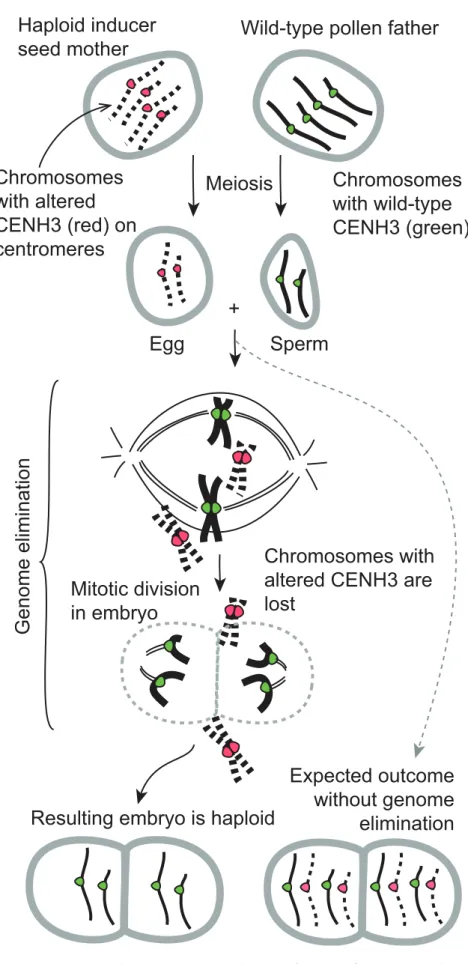
With his postdoctoral researcher Ravi Maruthachalam, Simon Chan discovered that a process called genome elimination could be experimentally manipulated in plants [11]. Genome elimination refers to the selective loss of one set of chromo-somes from the cell, analogous to the rejection of an organ after transplant. In plants, genome elimination resulting from certain interspecific crosses was described decades ago [16–18], but it is limited to occasional, natural occurrences. During genome elimination, the zygote (the prod-uct of pollen sperm and egg fusion), inherits both parental chromosome sets but one of the two parental genomes is lost upon the following mitotic divisions. The breakthrough in the Chan lab was the discovery that the experimental alteration of CENH3, by swapping its amino-termi-nal region and fusing it to green fluores-cent protein (GFP) to produce ‘‘Tailswap CENH3,’’ can lead to genome elimination [11]. Chan and colleagues found that genome elimination only occurred when a plant strain with the altered CENH3,
referred to as the ‘‘Tailswap’’ haploid inducer, was crossed to a wild-type plant, leading to the elimination of all the Tailswap chromosomes (see Figure 1). Interestingly, the Tailswap genome was stable upon selfing (i.e., when the Tailswap plant fertilized itself), indicating that com-petition between Tailswap and wild-type centromeres in the hybrid embryo resulted in defective spindle attachment to Tails-wap centromeres. Thus, the defective CENH3 mark induces a ‘‘weak’’ state in the genome that results in the failure of Tailswap chromosome segregation when in the presence of a wild-type plant genome. Because there is no change in DNA sequence, this phenotype must result from an epigenetic effect. To date, this event has only been reported inArabidopsis, but given the conserved nature of the perturbed mechanism it is likely to also apply to crop plants.
Potential Tool for Plant Breeding
Simon Chan and Ravi Maruthachalam realized that genome elimination could prove to be a highly useful tool for plant breeders as it would enable haploid production through a standardized ap-proach. Currently, haploid induction by previously established methods, while de-sirable, is greatly constrained by genotype and only applicable in selected varieties of certain species [19]. Breeders use hybrid-ization of different accessions and sexual recombination to combine valuable traits. Why would the easy creation of haploid plants by genome elimination be useful? Because the chromosomes of a haploid plant can be doubled by treating it with a spindle apparatus inhibitor or this dou-bling can occur spontaneously to make a ‘‘dihaploid,’’ which is endowed with com-plete homozygosity (where the two alleles of each gene are identical). The ability to gain homozygosity in one generation translates into much easier plant breeding [13,19,20]. Consider the consequences of self-pollinating an inbred pea line, such as that used by Mendel, versus self-pollinat-ing the highly heterozygous grape strain, Pinot Noir. In the first example, there are no different alleles to assort into new combinations, and the progeny share virtually identical genotypes and pheno-types. In the second, many gene loci carry different alleles, and meiosis reshuffles the allele combinations to result in a variety of phenotypes and genotypes. Efficient agri-culture, as well as the analysis of pheno-types, is greatly favored by uniformity, and so most of the crops we propagate by seed
are inbred. The only way to propagate the exceptional quality of a heterozygous plant, such as the Pinot Noir grape, is to clone it, that is, to propagate it through cuttings. Indeed, the self-pollination of Pinot Noir takes the ideal combination of alleles in the parent and reshuffles it, resulting in a range of preponderantly agriculturally inferior progeny types.
Many of our annual crops such as pea, soybean, wheat, rice, and peanut are inbred and can be easily propagated via sexual fertilization and seed. Conversely, crops propagated by cuttings or by tubers, such as grapes, banana, fruit trees, potato, and cassava, are highly heterozygous. It is better to reproduce these crops clonally because heterozygosity endows them with hybrid vigor, while inbreeding, in addition to being slow or laborious, is often associated with inferior yield and adapt-ability.
Based on the known advantages of haploids [19,20], Chan saw with clarity the gains that could be made by using his genome elimination system as a plant breeding tool. Together with plant breed-ers and scientists from Africa and South America, Chan and his collaborators conceived a plan to apply genome elimi-nation to cassava and banana. The plan was funded by a joint program between the Bill and Melinda Gates Foundation and the National Science Foundation Plant Genome Program, Basic Research to Enable Agricultural Development (BREAD). This team of researchers pro-posed that inbred (i.e., dihaploid) cassava or banana is desirable. The reasons for this are well exemplified by the breeding strategy employed for maize. Breeders have developed maize inbred lines that can be cultivated, but are mediocre performers. However, when these lines are hybridized in a favorable combination, the F1 progeny display hybrid vigor and greatly improved adaptability, stress toler-ance and increased yield. Thus the inbred lines’ desirable traits are combined through hybridization to produce uniform, stress tolerant crops with high yield characteristics [21]. Another advantage of inbreds is easy gene-trait association, because inbreeding enables the genotype to be altered at a specific locus, while keeping the rest of the genome uniform [22–24]. Once a gene is connected to a desirable trait, breeding can rely on the use of molecular markers, enabling selec-tion at the seedling stage and in the absence of environmental conditions that may be expensive or difficult to establish. Currently, the breeding of new banana and cassava varieties is largely empirical
and entails crossing two highly heterozy-gous individuals and selecting desirable types in their progeny to cultivate through clonal propagation. Little is known about which loci determine key agronomic and quality traits. Due to their long reproduc-tive cycle, the inbreeding of these crops is difficult and lengthy at best, most often impossible. Facile haploid induction would also enable plant researchers to exploit the recent genome sequences for these staple food species [25,26] to connect gene to trait, facilitating the use of molecular markers and thus rapid and efficient breeding cycles. Additionally, new varieties could be produced through the hybridiza-tion of selected inbreds: since all resulting F1s are identical these varieties could also be stored and distributed as seed, overcom-ing storage and distribution problems currently affecting banana and cassava.
Simon Chan’s Legacy
Unfortunately, in the middle of this project, on August 22, 2012, Simon Chan died from complications caused by a long-standing illness. Upon his return from an enthusiastic trip to visit collaborators in Africa and to explore the possible applications of genome elimination, his health rapidly dete-riorated. Throughout his illness, Simon remained optimistic about the possible appli-cations of his work to the breeding and propagation of staple food crops. Looking beyond the development of dihaploid strains, Simon envisaged genome elimination as a multipurpose genetic ‘‘powertool’’ that could facilitate basic plant biology research, as well as help to engineer applied crop traits, particularly for the benefit of developing world agriculture and of food security in Africa. The potential of this technology has been demonstrated by the production of clonal seeds (seeds that reproduce the genotype of the hybrid parent) [12]; the rapid construction of mapping resources (recombinant inbred lines) [14]; and the rapid assembly of chromosome substitution lines (molecular breeding) [13]. While these
Haploid inducer
seed mother
Wild-type pollen father
Egg
Sperm
Mitotic division
in embryo
Chromosomes with
altered CENH3 are
lost
Resulting embryo is haploid
Genome elimination
Expected outcome
without genome
elimination
Meiosis
+
Chromosomes
with altered
CENH3 (red) on
centromeres
Chromosomes
with wild-type
CENH3 (green)
Figure 1. Genome elimination induced by modification of centromeric histone H3(CENH3). An Arabidopsis plant becomes a haploid inducer if the native CENH3 gene is knocked out and complemented with one encoding an altered CENH3. While the chromosomes of the haploid inducer are inherited efficiently upon self-crosses, they are unstable in crosses to a
wild-type plant. In the early embryonic mitotic divisions of a hybrid derived from this cross, the chromosomes marked by the defective CENH3 (red) are lost, resulting in a haploid plant of which the nuclear genome derives from the wild-type parent. Diploidiza-tion ensues spontaneously or after treatment with spindle inhibitors to produce a fertile dihaploid plant, which is characterized by complete homozygosity. In the lower right, the diploid hybrid produced without genome elimination is depicted. Not shown is the relatively simple step entailing the spontane-ous or induced diploidization of the haploid. doi:10.1371/journal.pbio.1001876.g001
potential applications have been initially demonstrated in the model plantArabidopsis, there is confidence that their translation to economic crops should be forthcoming.
The collaborating project on cassava and banana continues under the direction of Anne Britt (University of California at Davis). The application of this technology beyond Arabidopsiswill need CENH3 to be manipu-lated in the target crop. Because the altered CENH3 acts in a recessive fashion [11], engineering a haploid inducer requires knocking out the endogenousCENH3gene (or, rarely,CENH3genes), and then comple-menting the endogenous gene with one
encoding an altered CENH3. The small size of the CENH3 gene makes it hard to find variants in mutagenized populations. Silenc-ingCENH3by RNAi or altering its function through mutation or through the expression of dominant-negative forms of the gene may be effective, but have not yet been reported. However, recent progress with targeted nucleases [27,28] may facilitate the task of producing haploid inducers in cassava, banana, and other crops by allowing the targeted manipulation of theCENH3gene.
The rewards connected to implement-ing this technology makes overcomimplement-ing these hurdles a relatively small price to
pay. The community of tropical crop scientists looks forward to success in this project, not least because it would allow Simon Chan’s example of successfully addressing a challenging problem in basic science, then leveraging it into practical methods likely to benefit the large fraction of humanity that remains unprivileged, to become his legacy.
Acknowledgments
I thank Ek Han Tan and Mohan Marimuthu, for critical reading and editing of the manu-script.
References
1. Evenson RE, Gollin D (2003) Assessing the impact of the Green Revolution, 1960 to 2000. Science 300: 758–762.
2. Qaim M (2009) The economics of genetically modified crops. Annual Review of Resource Economics 1: 665–694.
3. Qaim M, Zilberman D (2003) Yield effects of genetically modified crops in developing coun-tries. Science 299: 900–902.
4. Gasser CS, Fraley RT (1989) Genetically engi-neering plants for crop improvement. Science 244: 1293–1299.
5. Khush GS (2001) Green revolution: the way forward. Nat Rev Genet 2: 815–822. 6. Moose SP, Mumm RH (2008) Molecular plant
breeding as the foundation for 21st century crop improvement. Plant Physiol 147: 969– 977.
7. McCouch S, Baute GJ, Bradeen J, Bramel P, Bretting PK et al. (2013) Agriculture: feeding the future. Nature 499: 23–24.
8. Varshney RK, Nayak SN, May GD, Jackson SA (2009) Next-generation sequencing tech-nologies and their implications for crop genet-ics and breeding. Trends Biotechnol 27: 522– 530.
9. Wolfenbarger LL, Phifer PR (2000) The ecolog-ical risks and benefits of genetecolog-ically engineered plants. Science 290: 2088–2093.
10. Bradford KJ, Van Deynze A, Gutterson N, Parrott W, Strauss SH (2005) Regulating trans-genic crops sensibly: lessons from plant breeding, biotechnology and genomics. Nat Biotechnol 23: 439–444.
11. Ravi M, Chan SW (2010) Haploid plants produced by centromere-mediated genome elim-ination. Nature 464: 615–618.
12. Marimuthu MP, Jolivet S, Ravi M, Pereira L, Davda JN et al. (2011) Synthetic clonal repro-duction through seeds. Science 331: 876. 13. Wijnker E, van Dun K, de Snoo CB, Lelivelt CL,
Keurentjes JJ et al. (2012) Reverse breeding in Arabidopsis thaliana generates homozygous pa-rental lines from a heterozygous plant. Nat Genet 44: 467–470.
14. Seymour DK, Filiault DL, Henry IM, Monson-Miller J, Ravi M et al. (2012) Rapid creation of Arabidopsis doubled haploid lines for quantitative trait locus mapping. Proc Natl Acad Sci U S A 109: 4227–4232.
15. Black BE, Bassett EA (2008) The histone variant CENP-A and centromere specification. Curr Opin Cell Biol 20: 91–100.
16. Kasha KJ, Kao KN (1970) High frequency haploid production in barley (Hordeum vulgare L.). Nature 225: 874–876.
17. Tunner HG, Heppich S (1981) Premeiotic genome exclusion during oogenesis in the com-mon edible frog, Rana esculenta. Naturwis-senschaften 68: 207–208.
18. Clausen RE, Mann MC (1924) Inheritance in Nicotiana tabacum: V. The occurrence of haploid plants in interspecific progenies. Proc Natl Acad Sci U S A 10: 121.
19. Forster BP, Heberle-Bors E, Kasha KJ, Touraev A (2007) The resurgence of haploids in higher plants. Trends Plant Sci 12: 368–375.
20. Morrison RA, Evans DA (1988) Haploid plants from tissue culture: new plant varieties in a shortened time frame. Nat Biotechnol 6: 684– 690.
21. Duvick DN (2005) The contribution of breeding to yield advances in maize (,i.Zea mays L.). Adv Agron 86: 83–145.
22. Swank RT, Bailey DW (1973) Recombinant inbred lines: value in the genetic analysis of biochemical variants. Science 181: 1249–1252. 23. Monforte AJ, Tanksley SD (2000) Development
of a set of near isogenic and backcross recombi-nant inbred lines containing most of the Lyco-persicon hirsutum genome in a L. esculentum genetic background: a tool for gene mapping and gene discovery. Genome 43: 803–813. 24. Tuinstra MR, Ejeta G, Goldsbrough PB (1997)
Heterogeneous inbred family (HIF) analysis: a method for developing near-isogenic lines that differ at quantitative trait loci. Theor Appl Genet 95: 1005–1011.
25. Prochnik S, Marri PR, Desany B, Rabinowicz PD, Kodira C et al. (2012) The cassava genome: current progress, future directions. Trop Plant Biol 5: 88–94.
26. D’Hont A, Denoeud F, Aury JM, Baurens FC, Carreel F et al. (2012) The banana (Musa acuminata) genome and the evolution of mono-cotyledonous plants. Nature 488: 213–217. 27. Burgess DJ (2013) Technology: a CRISPR
genome-editing tool. Nat Rev Genet 14: 80. 28. Voytas D, Gao C (2014) Precision genome
engineering and agriculture: opportunities and regulatory challenges. PLoS Biol 12: e1001877.