230 www.hrmars.com/journals
Factors Affecting Isfahanian Mobile Banking Adoption
Based on the Decomposed Theory of Planned Behavior
Dr.Ali Kazemi
Assistant professor , Department of management, University of Isfahan, Isfahan, Iran
Dr.Akbar Nilipour
Assistant Professor, Malek Ashtar University of Tecnology, Isfahan, Iran
Nastaran Kabiry
Master of business administration of management, University of Isfahan, Isfahan, Iran
Mahnaz Mohammad Hoseini
Department of management, Najafabd branch, Islamic Azad University, Isfahan, Iran
DOI: 10.6007/IJARBSS/v3-i7/29 URL: http://dx.doi.org/10.6007/IJARBSS/v3-i7/29
Abstract
Mobile banking is considered a new era in banking, in which banks are spending considerable amount of money to have it available to their customers and to cut their operations costs. The
u e t e plo ato stud is a atte pt to i estigate the fa to s that i flue e Isfaha ia ’
intention to adopt mobile banking by extending the renowned framework of Decomposed Theory of Planned Behavior model (DTPB) by additionally examining the effects of trust and perceived risk as components of attitude on behavioral intention. A self-administrated questionnaire had been developed and distributed in Isfahan city. Out of 400 questionnaires that have been distributed, 315 are returned (78.0%). Of these, five (5) responses had to be discarded due to invalid or incomplete data entries. Thus the sample comprising of a total of 310 respondents was used for analysis. The data was analyzed by AMOS software. Results of the study discovered that the decisive or crucial factors influencing mobile banking adoption are attitude and perceived behavioral control, However, social norms were the only factor found insignificant. The perceived usefulness, perceived ease of use ,compatibility, and trust under 'behavioral attitude' have positive effect on behavioral attitude; while perceived risk under 'behavioral attitude' has negative effect on behavioral attitude. the influence of the interpersonal influence under 'subjective norms' was also evident, while self-efficacy and facilitating condition under 'perceived behavioral control' are significant influential factors.
231 www.hrmars.com/journals 1.introduction
Technology has become an increasingly vital element in the competitive landscape of the financial services industry. Recent innovations in telecommunications have enabled the launch of new access methods for banking services; one of these is mobile banking; whereby a customer interacts with a bank via mobile phone (Barnes and Corbitt, 2003). In service use, mobile phones are no longer used as they have typically been used before. Talking and text messaging (SMS) will remain, but extensive service use is expected to grow. Mobile Bank is a service provided by the bank that enables the user to receive information on the accounts and make monetary payments based on orders sent via mobile phone and sms service. It allows its customers to receive information on: account balances of the customer; transactions on the customer's accounts and currency exchange rates. The opportunity to use advanced technologies in service delivery have created challenges to developers of financial services; competitive advantage can be gained in form of costs reduction or customer satisfaction increase or lost investing in wrong technologies. In order to rise to the challenges service providers are even more interested to enhance their understanding of consumer behavior patterns (Salim khraim et al, 2011). Mobile banking has a long way to go as majority of customers prefer banking in the traditional ways (Ashta, 2010;Wang et al , 2003). Key question
is h usto e s a e ot adopti g o ile a ki g. Va ious fa to s a i flue e usto e s’
adoption. There is a need, therefore, to understand users' acceptance and adoption of mobile banking and to identify the factors affecting their intentions to use mobile banking. This information can assist developers in the building of mobile banking systems that consumers want to use, or help them to discover why potential users avoid using the existing system. Therefore, with the aim of identifying factors related to customers' behavioral intentions to use mobile banking services, this paper attempts to study the expanded model of Decomposed Theory of Planned Behavior.
2. Literature Review
2.1. Mobile banking
Mobile Commerce (m-commerce) is defined as a business transaction conducted through mobile communication networks or the Internet (Siau and Shen, 2003). M-commerce can offer value to consumers through convenience and flexibility by enabling time and place independence (Kim et al, 2009; Venkatesh et al, 2003). Mobile banking is an application of m-commerce which enables customers to access bank accounts through mobile devices to conduct and complete bank-related transactions such as balancing cheques, checking account statuses, transferring money and selling stocks (Kim et al, 2009; Tiwari and Buse, 2007). Luoet al (2010), defined mobile banking as an innovative method for accessing banking services via a channel whereby the customer interacts with a bank using a mobile device (e.g. mobile phone or personal digital assistant (PDA)).
232 www.hrmars.com/journals not familiar with the way using these services and most important is the lack of confidence to electronic systems( Pedersen, 2005). Obviously, if customers not welcome mobile banking systems, providing these services will fail. Today, despite the late acceptance of mobile banking in Iran, the banks seem to be aware of opportunities that the technology is provided for them. In fact, they are moving very fast towards a modern mobile banking and providing services to customers in higher levels (Fishbein and Ajzen, 1975). On the other hand, despite the great investments made in the field of mobile banking, reports indicate that some users not use this technology, though they have access to it So, studying behavioral factors influencing customer adoption of mobile banking will make the banking system to identify factors related to adoption of the technology and to strengthen relevant factors in order to encourage customers to use this service and thus develop the electronic banking. This reveals the need to perform investigations to identify factors determining adoption of the mobile banking system and customers attitude toward it (Laukkanan, 2007). Several theories are offered in order to identify factors that cause people accept new technologies and information systems and use them (Rao and Troshani, 2007), such as Theory of Reasoned Action (Fishbein and Ajzen, 1975), Theory of Planned Behavior (Ajzen, 1991), and Decomposed theory of Planned Behavior (Taylor and todd, 1995).
2.2. Theory of Reasoned Action (TRA)
This theory which is developed by Fishbein and Ajzen(1975), perhaps is one of the most important theories that are used to explain the human behaviors (Puschel and Mazzon, 2010). According to their theory, behavioral intention (use technology), is explained by people's attitudes toward that behavior and subjective norms. People's attitude toward a behavior includes behavioral beliefs; assess the consequences of behavior, subjective norms, normative beliefs and motivations that must be answered Riivari, 2005). This theory, as long as the behavior is voluntarily controlled by the individual, can accurately explain the factors influencing technology adoption (Laukkanen and Cruz, 2009). This model is shown as in figure 1.
Figure 1: Theory of Reasoned Action (TRA)
2.3.Theory of Planned Behavior (TPB)
Ajzen (1991) developed the theory of reasoned action through adding construct "perceived behavioral control" into the model as a determinant of behavioral intention and behavior, and called it as "theory of planned behavior". This social-psychological theory with regard to perceptions of performance control, attempts to predict involuntary behaviors, too. It determines the Impacts of three factors, i.e. "attitude", "subjective norms" and "perceived
Attitudinal Belief
Normative Belief
Subjective Norm Attitude
Behavioral Intention
233 www.hrmars.com/journals behavior control" on tend to behave (Riivari, 2005). In fact, attitude is the general feeling of people about the desirability or undesirability of a particular issue or behavior (Ajzen, 1991). Subjective norm refers to individual's perception of important people's opinions about doing or not doing the behavior. In other words, subjective norm is the perceptions related to opinions of society about doing or not doing the behavior by individual (Taylor and Todd, 1995). The construct "perceived control of behavior" is the individual's perception about ease or difficulty of doing behavior and indicates the individual's perceptions about required skills, resources, and opportunities in doing the behavior (Ajzen, 1991). This model is shown as in figure 2.
Figure 2: Theory of Planned Behavior (TPB)
2.4.Decomposed Theory of Planned Behavior
Decomposed theory of Planned Behavior was raised by Taylor and Todd in 1995. They developed the theory of planned behavior through breaking down structure of attitude, subjective norm and perceived behavioral control (Luarn and Lin, 2005). This resulted in increased power to explain behavioral intentions and accurate understanding of behavioral events (Pedersen, 2005). According to the decomposed theory of planned behavior, the behavior is determined by "intention to use". "Intention to use", in turn, is determined by the attitude toward behavior, subjective norm and perceived behavioral control. Perceived usefulness is an extent to which a person believes using a particular technology will improve his or her job performance (Laukkanen and Cruz, 2009). Perceived ease of use refers to the degree to which a person believes using a particular system does not require a lot of effort (Taylor and Todd, 1995). Perceived compatibility is an extent that an innovation is consistent with existing values, past experiences and current needs of potential adopters (Puschel and Mazzon, 2010).
Control Belief Normative
Belief Attitudinal
Belief
Perceived Behavioral
Control Subjective
Norm Attitude
Behavioral Intention
234 www.hrmars.com/journals While the theory of planned behavior simply explains the relationship between structure of beliefs and the prerequisite of intention, in brief, decomposed theory of planned behavior, offers a comprehensive approach to understanding the factors affecting a person's decision to use technology information (Suoranta and Mattila, 2004). This model is shown as in figure 3.
Figure 3: Decomposed Theory of Planned Behavior
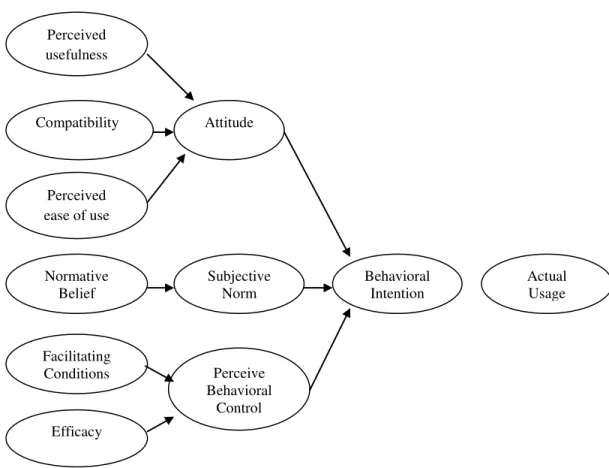
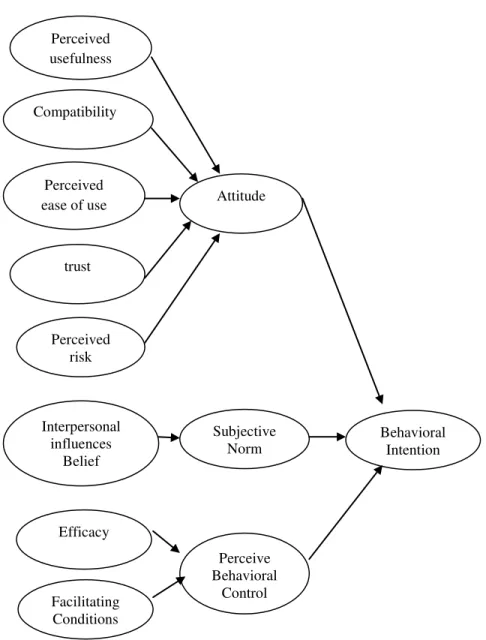
Fig.4 illustrates a research model for mobile banking adoption, a comprehensive theoretical
model is proposed based on the DTPB with addition of trust and perceived risk as components of attitude. This model decomposes the perceived behavioral control component into self-efficacy and Facilitating Conditions, the subjective norms component into interpersonal influences, and the attitude component into perceived usefulness, perceived ease of use, compatibility, trust, and perceived risk. Eleven hypotheses and their supporting studies are summarized in Table 1. The rationale for choosing DTPB as theoretical foundation is as follows:
the adoptio of o ile a ki g is ot e ti el u de itize s’ o t ol. The o dition satisfies core assumption of the DTPB that the presence of constraints can inhibit both the intent to perform a behavior and the behavior itself; (2) Social influence is an important determinant of
Compatibility
Perceived ease of use
Normative Belief
Facilitating Conditions
Efficacy
Perceive Behavioral
Control Subjective
Norm Attitude
Behavioral Intention
Actual Usage Perceived
235 www.hrmars.com/journals
eha io ; i di idual’s self-efficacy and facilitating resources are possible barriers to user adoption of mobile banking; and (4) This model is an appropriate model for providing concrete managerial implications for practitioners. This model can effectively elicit mobile banking
use s’ salie t elief st ucture and acquire stable, easily understood, and managerially relevant factors.
Figure 4: Research Framework
Compatibility
Perceived
ease of use Attitude
Subjective Norm
Perceive Behavioral
Control Interpersonal
influences Belief
Facilitating Conditions
Efficacy
Behavioral Intention trust
236 www.hrmars.com/journals 2.5. Trust in mobile banking
Customer trust is recognized as a critical factor for the success of mobile banking. With the surge of both electronic commerce (e-commerce) and mobile commerce (m-commerce), more studies have been conducted on the conceptual structure, formation of the mechanisms of trust and effects of trust ( Kim et al, 2009). In a study by Kim et al (2009) which examined the effect of initial trust in mobile banking user adoption, trust was defined as a psychological expectation that a trusted party will not behave opportunistically.
2.6. Perceived Risk
Pe ei ed isk is the u e tai t a out the out o e of the use of the i o atio Ge a d a d
Cunningham, 2003). In fact, perception of risk among individuals has been proved in technology adoption literature as an important element in acquiring new technology or services (Laforet and Li, 20 . A e e t studies o du ted Luo et al fou d that use ’s pe eptio of risk is a crucial driver to determine innovative technology acceptance. The findings show that perceived risk has negative significant relationship towards behavioral intention on mobile banking adoption.
Table 1: Summary of research hypotheses and supporting studies
Supporting studies Hypotheses
Davis (1989); Taylor and Todd (1995)
Per eived Useful ess → attitude H1
Taylor and Todd (1995); Mathieson (1991)
Compatibility → attitude H2
Davis (1989); Taylor and Todd (1995)
Per eived ease of use → attitude H3
Gefen et al. (2002) Trust → attitude
H4
Gefen et al. (2002) Per eived risk → attitude
H5
Fishbein and Ajzen (1975); Ajzen (1991); Taylor and Todd (1995); Bhattacherjee (2000) I terperso al i flue e → su je tive or s
H6
Ajzen (1991); Taylor and
Todd (1995);
Bhattacherjee (2000) Self-effi a y → per eived ehavioral o trol
H7
Bandura (1986); Ajzen (1991); Taylor and Todd (1995); Bhattacherjee (2000)
237 www.hrmars.com/journals Ajzen (2001); Taylor and
Todd (1995);
Bhattacherjee (2000); Mathieson (1991)
Attitudes→ ehavioral i te tio H9
Ajzen (2001); Taylor and
Todd (1995);
Bhattacherjee (2000); Mathieson (1991) Su je tive or s → ehavioral i te tio
H10
Ajzen (2001); Taylor and
Todd (1995);
Bhattacherjee (2000); Mathieson (1991) per eived ehavioral o trol → ehavioral i te tio
H11
3.Methodology
3.1. Research Population and Sample
This research, from the viewpoints of practical purposes and methods of data collection is a descriptive survey research. The objective of this study is to identify significant factors in the adoption of mobile banking. For the purposes of this study, the population was a mobile phone owner with a bank account in Isfahan city. Approximately 400 questionnaires were prepared and circulated. A total of 315 responses were received. Of these, five (5) responses had to be discarded due to invalid or incomplete data entries. Thus the sample comprising of a total of 310 respondents was used for analysis. This exceeded the minimum required sample size of 306 to achieve a 95% confidence level for a population greater than 500,000 (Zikmund, 2003).
3.2. Research Variables Measurement
238 www.hrmars.com/journals measured using a five-point Likert-type scale with anchors ranging from "strongly agree" to "strongly disagree".
4.findings
4.1. Analytical findings of the research conceptual model
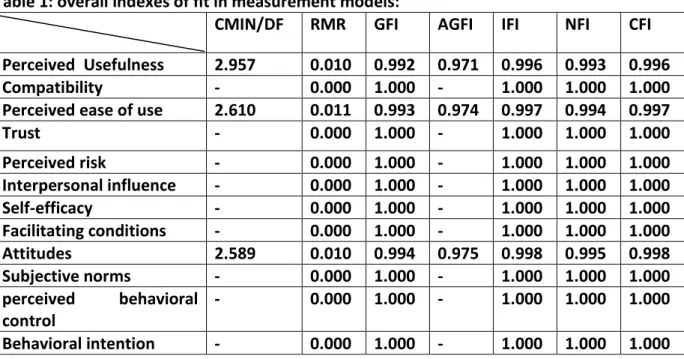
In the first step, measurement models get fitted. Models' fit indexes are listed in Table 1:
Table 1: overall indexes of fit in measurement models:
CMIN/DF RMR GFI AGFI IFI NFI CFI
Perceived Usefulness 2.957 0.010 0.992 0.971 0.996 0.993 0.996
Compatibility - 0.000 1.000 - 1.000 1.000 1.000
Perceived ease of use 2.610 0.011 0.993 0.974 0.997 0.994 0.997
Trust - 0.000 1.000 - 1.000 1.000 1.000
Perceived risk - 0.000 1.000 - 1.000 1.000 1.000
Interpersonal influence - 0.000 1.000 - 1.000 1.000 1.000
Self-efficacy - 0.000 1.000 - 1.000 1.000 1.000
Facilitating conditions - 0.000 1.000 - 1.000 1.000 1.000
Attitudes 2.589 0.010 0.994 0.975 0.998 0.995 0.998
Subjective norms - 0.000 1.000 - 1.000 1.000 1.000
perceived behavioral control
- 0.000 1.000 - 1.000 1.000 1.000
Behavioral intention - 0.000 1.000 - 1.000 1.000 1.000
Measurement models have a good fit, in other words, overall indexes confirm that models are clearly supported by data.
4.2. The results of structural equation modeling analysis
After evaluating and verifying the measurement models in the first step, in the second step, to test hypotheses, structural equation model is fitted and analyzed. Overall indexes of model fitness are presented in Table 2.
Table 2: model fitness indexes
CMIN df
CMIN/df RMSEA
GFI AGFI
NFI CFI
IFI RMR
91.965 36
2.8 0.064
0.983 0.97
0.978 0.979
0.979 0.020
Reception area 1>
3< 0.08<
0.90> 0.90>
0.90> 0.90>
0.90> Close
to zero
239 www.hrmars.com/journals Amos output results in estimating the standard model indicates that path analysis model is an appropriate model. The normal Chi-square value is 2.8 which stands between two values of 1 and 3. RMSEA value is 0.064 which is appropriate, also the values of GFI, AGFI, NFI, CFI and IFI are all above 90%; and finally RMR value is close to zero. All the values of model fitness indexes are in the reception area and these indexes indicate that model has a goodness-of-fit which is obtained by data and model is well supported by collected data. Hypotheses and regression coefficients as well as partial indexes values for each hypothesis are shown in table 3.
Table3: hypotheses testing results
Test result Critical ratio Corroboration coefficient Significance number Sample size Hypotheses accepted 10.59 0.44 0.000 310 Perceived Useful ess → attitude accepted 8.04 0.36 0.000 310 Co pati ility → attitude
accepted 2.40
0.09 0.000
310 Per eived ease of use → attitude accepted 12.76 0.34 0.000 310 Trust → attitude
accepted -6.24
-0.16 0.000
310 Per eived risk → attitude
accepted 10.63
0.42 0.000
310
I terperso al i flue e →
subjective norms accepted 20.77 0.75 0.000 310 Self-effi a y → per eived behavioral control accepted 7.24 0.25 0.000 310
Fa ilitati g o ditio s →
perceived behavioral control
accepted 18.22
0.69 0.000
310
Attitudes→ ehavioral
intention Not accepted 0.91 0.34 0.508 310 Su je tive or s → ehavioral intention Test result Critical ratio Corroboration coefficient Significance number Sample size Hypotheses accepted 5.92 0.20 0.000 310 perceived ehavioral o trol → behavioral intention
In the significance level of 0.05, if the table's significance number is smaller than 0.05, relationship between each pair of variables is confirmed
5. Discussion , conclusion and limitations
240 www.hrmars.com/journals demonstrated that mobile banking adoption can be explained in terms of attitude and perceived behavior control. However, social norms were the only factor found insignificant. for banks, service developers, and software engineer with better strategic insights to design and implement mobile banking services to yield higher consumer acceptance towards mobile banking in Isfahan city, this study provides the following Recommendations :
1- The observation that perceived usefulness had positive effects on attitude toward m-banking adoption has a number of implications for banks. Therefore banks should emphasize the benefits in the aspects of cost savings, ubiquity, flexibility, and mobility by using mobile banking services. Eventually, banks might educate users the benefits of using mobile banking services through promotional mix such as personal selling, advertisements, sales promotions, and public relations.
2- The observation that compatibility had positive effects on attitude toward m-banking adoption has a number of implications for banks. It demonstrates that if consumers perceive m-banking as consistent with their existing beliefs, values, lifestyle and past experience, they are more likely to use these services. In particular, companies have to emphasize that m-banking fits with customers' lifestyles and that m-m-banking would work on their mobile phones. 3- The observation that perceived ease of use had positive effects on attitude toward m-banking adoption has a number of implications for banks. Therefore banks should simplify the usage of mobile banking services and continue to design more user-friendly system interface. In addition, banks should provide adequate information and clearer guidance to encourage user to use the service.
4- The esults sho that Custo e ’s t ust of o ile a ki g se i e p o ide s had positive effect on attitude toward m-banking adoption and intention to use m-banking for adopters. Therefore customers will adopt mobile banking services when the mobile banking service providers (both the banks and mobile network provider) are perceived to be trustworthy
5- The observation that perceived risk had negative effects on attitude toward m-banking adoption has a number of implications for banks. it is important for banks and service providers to project higher security when providing mobile banking services in order to yield higher
o su e s’ a epta e. I fa t, a ks a d se i e p o ide s should o ti uousl i o ate a d offe ette se u it a d elia le appli atio s to e ha e use s’ o fide e to a ds o ile
banking services.
6- The self-efficacy hypothesis also received positive support and implies the importance of educating consumers.
7- Results show that the increase of facilitating condition towards m-banking services will result in a positive increase of perceived behavioral control and intention to use m-banking for adopters. Therefore banks must increase the availability of necessary hardware and software for m-banking service use.
Finally, in order to enhance m-banking adoption intention, banks must try to build favorable attitude through enhanced perceived usefulness, perceived ease of use, compatibility, and trust as well as security. Perceived behavioral control should also be improved, specifically by enhancing self efficacy and facilitating condition, access to technological facilities and resources, and training.
241 www.hrmars.com/journals gender and culture on adoption of mobile banking was not intensively explored. Some demographic variables may have indirect interrelation effects between the variables, for example according to Lee (2009), the cognitive propensity of individuals to risk differs across cultu e. This ea s that the usto e s’ a epta e of o ile a ki g a e i flue ed cultural differences. This phenomenon may require further investigation on a wider scale across various racial groups with cultural differences. Secondly, the measures of constructs are
olle ted at the sa e poi t of ti e i this stud . The efo e, i di iduals’ pe eptio s a d
intention to use mobile banking may change over time as an unremitting process due to greater experience and advancement of mobile technologies for the time being. As a result, it is recommended to conduct a longitudinal research to examine the mobile banking adoption at multiple points of time during decision adoption process. Thirdly, this research has a significant limitations shared by many studies of consumer adoption in that it only measured behavioral intention, rather than actual behavior. This is not a serious limitation as there is substantial empirical support for the causal link between intention and behavior (Taylor and Todd, 1995; Venkatesh and Davis, 2000; Venkatesh and Morris, 2000).
References
Aga al, R. a d P asad, J. , A o eptual a d ope atio al defi itio of pe so al i o ati e ess i the do ai of i fo atio te h olog , I fo atio “ ste s Resea h, ,
pp. 204-215.
Aga al, R. a d Ka aha a, E. , O the ulti-dimensional nature of compatibility beliefs
i te h olog a epta e , DIGIT, a aila le at: http://disc-nt.cba.uh.edu/chin/digit98/first.
Ajzen, I. , The theo of pla ed eha io , O ga izatio al Beha io a d Hu a Decision Processes,50, pp. 197-211.
A i , H. A. Ha id, M. R. Lada, “. a d A is, ). , The adoptio of o ile a ki g i
Malaysia: The case of Bank Islam Malaysia Berhad BIMB , I te atio al Jou al of Busi ess and Society,9(2), pp.45-53.
Ashta, A. (2010). Evolution of Mobile banking Regulations. Retrived from http://
www.arraydev.com/commerce/JIBC/0306-04.htm.
Barnes, S. J., and Corbitt, B. (2003). Mobile banking: concept and potential. International Journal of Mobile Communications, 1, pp. 273-288.
Bhattacherjee, A. (2000). Acceptance of e-commerce services: The case of electronic brokerages. IEEE Transactions on Systems, Man, and Cybernetics: Part A. Systems and Humans, 30(4), pp. 411–420.
Che , L.D. , A odel of o su e a epta e of o ile pa e t , I te atio al Jou al
242 www.hrmars.com/journals Chen, L.D., Gillenson, M.L. a d “he ell, D.L. , E ti i g o li e o su e s: a e te ded
te h olog a epta e pe spe ti e , I fo atio & Ma age e t, , pp. -19.
Chu g, N. a d K o , “. J. , The effe ts of usto e s’ o ile e pe ie e a d te h i al
support on the i te tio to use o ile a ki g , C e Ps holog a d Beha io , , pp. 539-543.
Chu g, N.a d K o , “. J. , The effe ts of usto e s’ o ile e pe ie e a d te h i al suppo t o the i te tio to use o ile a ki g , C e Ps holog a d Behavior, 12(5), pp. 539-543.
Cohen, G. S.(2008). Mobile banking: Lessons from the field, Bank Technology News.
C espo, A. H. a d Bos ue, I. R. D. , The effe t of i o ati e ess o the adoptio of B C e
commerce: A model based on the Theory of Planned Beha io , Co pute s i Hu a Beha io , 24(6), pp. 2830-2847.
Da is, F.D., Bagozzi, R.P., Wa sha , P.R . , Use A epta e of Co pute Te h olog : A Co pa iso of To Theo eti al Models , Ma age e t “ ie e, , PP. -1003.
Davis, F. D. (19 , Pe ei ed useful ess, pe ei ed ease of use, a d e d use a epta e of
i fo atio te h olog , MI“ Qua te l , , pp. -340.
Do e , J. a d, Tellez, C. A. , Mo ile a ki g a d e o o i de elop e t: Li ki g adoptio i pa t a d use , Asian Journal of Communication, 18(4), pp. 318-332.
Fish ei , M. a d, Ajze , I. , Belief, Attitudes, I te tio a d Beha io : A I t odu tio to Theo a d Resea h , Readi g, MA: Addiso -Wesley.
Gefen, D., Pavlou, P. A., Warkentin, M., and Rose, G. M. (2002). E-government adoption. Proceedings of the Eighth Americas Conference on Information Systems, pp. 569–576.
Ge a d, P. a d, Cu i gha , J. , The diffusio of i te et a ki g a o g “i gapo e o su e s , I te atio al Jou al of Ba k Marketing, 21(1), pp. 16-28.
Hsu, C. L. a d Lu, H. P. , Wh do people pla o -line games? An extended TAM with
so ial i flue es a d flo e pe ie e , I fo atio & Ma age e t, , pp. -868.
Ki , G., “hi , B. a d Lee, H.G. , U de sta ding dynamics between initial trust and usage
i te tio s of o ile a ki g , I fo atio “ ste s Jou al, , pp. -311.
243 www.hrmars.com/journals
Laukka e , T. a d C uz, P. , Co pa i g o su e esista e to o ile a ki g i Fi la d a d Po tugal , i Filipe, J. a d O aidat, M.“. Eds , e-Business and Telecommunications, Springer, Berlin, pp. 89-98.
Laukkanan, T. , I te et s. o ile a ki g: o pa i g usto e alue pe eptio s , Business Process Management Journal,13 (6), pp. 788-97.
Laukka e , T. a d Lau o e , J. , Co su e alue eatio i o ile a ki g se i es ,
International Journal of Mobile Communications, 3(4), pp. 325-338.
Lee, M. , Fa to s i flue i g the adoptio of i te et a ki g: A i teg atio of TAM a d TPB ith pe ei ed isk a d pe ei ed e efit , Ele t o i Co e e Resea h a d
Applications, 8(3), pp. 130-141.
Lee, Y. K. Pa k, J. H. a d Chu g, N. , A e plo ato stud of fa to s affe ti g usage i te tio to a d o ile a ki g: A u ified pe spe ti e usi g st u tu al e uatio odeli g ,
Society for Marketing Advances Proceedings.
Lee, Y. Kozar, K. A. and Larsen, K. R. T. (2003). The technology acceptance model: Past, present, and future, Communications of the Association for Information Systems, 12, pp. 752-780.
Liu, ). Mi , Q. a d Ji, “. , A e pi i al stud o o ile a ki g adoptio : The role of
t ust , “e o d I te atio al “ posiu o Ele t o i o e e a d “e u it , Na ha g,
China.
Lide´ , “.B. a d “ka°le´ , P. , The effe t of se i e gua a tees o se i e e o e
International Journal of Service Industry Management, 14 ( 1), pp. 36-58.
Luo, X., Li, H., Zhang, J., & Shim, J. P. (2010). Examining dimensional trust and multi-faceted risk in initial acceptance of emerging technologies: An empirical study of mobile banking services. Decision Support Systems, 49(2), pp. 222-234.
Lua , P .a d, Li , H. H. , To a d a u de sta di g of the eha io al i te tio to use o ile a ki g , Co pute s i Hu a Beha io , , pp. -891.
Mathieso , K. , P edi ti g use i te tio s: Co pa i g the te h olog acceptance
odel ith the theo of pla ed eha io , I fo atio “ ste Resea h, , pp. -136.
Mit hell, V. W. , Co su e pe ei ed isk: Co eptualizatio s a d odels , Eu opea
244 www.hrmars.com/journals Pedersen, P.E. , Adoptio of o ile i te et se i es: a e plo ato stud of o ile
o e e ea l adopte s , Jou al of O ga izatio al Co puti g,. , pp. -22.
Pus hel, J, Mazzo , J, A. , Mo ile a ki g: p opositio of a i teg ated adoptio i te tio f a e o k. I te atio al Jou al of Ba k Ma keti g , , pp. -409.
Rao, “. a d T osha i, I. , A o eptual f a e o k a d p opositio s fo the a epta e of o ile se i es , Jou al of Theo eti al a d Applied Ele t o i Co e e Research, 2(2), pp.61-73.
Rii a i, J. , Mo ile a ki g: a po e ful e a keti g a d CRM tool fo fi a ial se i e o pa ies all o e Eu ope , Jou al of Fi a ial “e i es Ma keti g, ,pp. -20.
Ri uel e, H. E. a d Rios, R. E. , The moderating effect of gender in the adoption of
o ile a ki g , The I te atio al Jou al of Ba k Ma keti g, , pp. -341.
Siau, K., and Shen, Z. (2003). Building customer trust in mobile commerce. Communications of the ACM, 46(4), pp.91-94.
kh ai , H. “., Al sha aki, Y. “. a d kh ai , A., , Fa to s affe ti g Jou da ia
o su e s' adoptio of o ile a ki g se i es , International Journal of Business and Social Science 2(20), pp.96.
“uo a ta, M. a d Mattila, M. , Mo ile a king and consumer behaviour: new insights
i to the diffusio patte , Jou al of Fi a ial “e i es Ma keti g, , pp. -66.
Ta lo , “. a d Todd, P. , Assessi g IT usage: the ole of p io e pe ie e , MI“ Qua te l ,
19(4), pp. 561-70.
Taylor, “. a d Todd, P.A. , U de sta di g i fo atio te h olog usage: a test of
o peti g odels , I fo atio “ ste s Resea h, , pp. -176.
Ta lo , “. a d Todd, P. , De o positio a d osso e effe ts i the theo of pla ed
behavior: a stud of o su e adoptio i te tio s , I te atio al Jou al of Resea h i Marketing, 12, pp. 137-55.
Tiwari, R. and Buse, S. (2007). The Mobile Commerce Prospects: A Strategic Analysis of opportunities in the Banking Sector. Hamburg: Hamburg University Press.
Ve katesh, V., Mo is, M. G., Da is, G. B. a d Da is, F. D. , Use a epta e of i fo atio te h olog : To a d a u ified ie , MI“ Qua te l , , pp. -478.
Ve katesh V, a d Da is, F. D. , A theo eti al extension of the technology acceptance
245 www.hrmars.com/journals
Ve katesh, V. a d Mo is, M.G. , Wh do ’t e e e stop to ask fo di e tio s? , MI“
Quarterly, 24 (1), pp. 115-39.
Wang, Y., Wa g, Y., Li , H., a d Ta g, T. , Dete i a ts of use a epta e of i te et
a ki g: a e pi i al stud , I te atio al Jou al of Ba k Ma keti g, , pp. -519.
Wu, J., a d Wa g, “. , What d i es o ile o e e?: A e pi i al evaluation of the
e ised te h olog a epta e odel , I fo atio & Ma age e t, , pp. -729.
Ye , D. C., Wu, C., Che g, F., & Hua g, Y. . Dete i a ts of use s’ i te tio to adopt
wireless technology: An empirical study by integrating TTF with TAM. Computers in Human Behavior, 26(5), pp. 906-915.
Zhang, N., Guo, X., and Chen, G. (2008). IDT-TAM integrated model for IT adoption. Tsinghua Science & Technology, 13(3), pp.306-311.