JOHN ROGGAN
MOTIVATION OF GERMAN ENTREPRENEURS TO SEEK EQUITY
VIA CROWDFUNDING: AN EXPLORATORY STUDY
JOHN ROGGAN
MOTIVATION OF GERMAN ENTREPRENEURS TO SEEK EQUITY VIA CROWDFUNDING: AN EXPLORATORY STUDY
SÃO PAULO 2015
Thesis presented to Escola de Administração de Empresas de São Paulo of Fundação Getulio Vargas, as a requirement to obtain the title of Master in International Management (MPGI).
Knowledge Field: Gestão e Competitividade em Empresas Globais
Roggan, John.
Motivation of German Entrepreneurs to Seek Equity Via Crowdfunding: An
Exploratory Study / John Roggan. - 2015.
278 f.
Orientador: Gilberto Sarfati
Dissertação (MPGI) - Escola de Administração de Empresas de São Paulo.
1. Financiamento coletivo. 2. Empresas novas. 3. Motivação. 4. Equidade. I.
Sarfati, Gilberto. II. Dissertação (MPGI) - Escola de Administração de Empresas
de São Paulo. III. Título.
JOHN ROGGAN
MOTIVATION OF GERMAN ENTREPRENEURS TO SEEK EQUITY VIA CROWDFUNDING: AN EXPLORATORY STUDY
Dissertação apresentada à Escola de Administração de Empresas de São Paulo da Fundação Getúlio Vargas, como requisito para obtenção do título de Mestre Profissional em Gestão Internacional.
Campo do Conhecimento: Gestão e Competitividade em Empresas Globais
Data de Aprovação: 10/03/2015.
Banca Examinadora:
_________________________________ Prof. Dr. Gilberto Sarfati (Orientador) EAESP - FGV
_________________________________ Prof. Dr. Tales Andreassi
EAESP - FGV
Preface
The author of this thesis participates in a Double Degree Program jointly organized by the Fundação Getúlio Vargas (FGV-EAESP) in São Paulo, Brazil and the University of St. Gallen (HSG) in St. Gallen, Switzerland. Therefore this master thesis is to be submitted to both of these institutions. The master thesis has therefore to meet the requirements of the Master in International Management program of FGV-EAESP as well as the requirements of the Master in Strategy and International Management (SIM).
Abstract:
Equity crowdfunding, so financing a project or venture through many small investments of a large group of investors, has received growing attention from the media and scholars. The discussion is about whether crowdfunding could generally transform the way people collect funding for their projects or ventures. Whereas research has so far focused on exploring, why crowdinvestors are motivated to fund ventures, this study focuses on what motivates entrepreneurs to crowdfund. To do so, the study researched the motivation of 11 entrepreneurs to use German equity crowdfunding platforms. Because existing research on the motivation of entrepreneurs stayed largely superficial, this study uses a research approach novel in the field of venture financing, the means-end approach. With this approach the entrepreneurs’ reasoning to use equity crowdfunding was explored holistically, uncovering the entire thought processes leading to the decision to crowdfund. One of the findings is that entrepreneurs use equity crowdfunding to successfully collect funds from rather emotionally investing crowdinvestors to finance their ventures’ future growth and to signal investment viability to follow-up investors. Furthermore, entrepreneurs expect crowdinvestors to be engaged in and help the venture with marketing and feedback. Crowdfunding also allows entrepreneurs to keep decision-making power over the venture better than by using traditional sources of funding. The findings indicate that crowdfunding attracts entrepreneurs who could not secure funding from other sources of capital as well as entrepreneurs who see the additional benefits it can provide over other sources.
Keywords:
Resumo:
Equity crowdfunding, ou financiamento de um projeto ou empreendimento através de diversos pequenos investimentos ou um grande grupo de investidores, tem recebido uma crescente atenção da mídia e acadêmicos. A discussão questiona se crowdfunding pode de uma forma geral transformar a maneira como as pessoas captam capital para os seus negócios. Enquanto que pesquisas tem até então focado em explorar porque crowdinvestors têm motivação em financiar empreitadas, este estudo foca em revelar o que motiva empreendedores a procurar soluções de crowdfund. Para isso, o estudo investigou a motivação de 11 empreendedores que usaram plataformas alemãs de crowdfunding. Como estudos existentes sobre a motivação de empreendedores são na sua grande maioria superficiais, este estudo utiliza uma nova abordagem de pesquisa na área de financiamento de projetos, a abordagem de means-end. Sob essa abordagem a forma de pensar dos empreendedores em relação ao uso de equity crowdfunding foi estudada de forma holística, revelando todo o processo de raciocínio até a decisão final de optar por uma estratégia de crowdfunding. Uma das descobertas é que empreendedores usam equity crowdfunding para arrecadar fundos de crowdinvestors consideravelmente não-racionais (emocionais) para financiar o crescimento futuro de seus negócios e também sinalizar viabilidade de investimento para futuros investidores. Além disso, empreendedores esperam que crowdinvestors sejam engajados e ajudem tanto a promover o negócio como a dar feedback. Crowdfunding também possibilita que empreendedores mantenham o poder de decisão sobre a empresa mais facilmente se comparado a outras fontes tradicionais de financiamento. As descobertas indicam que crowdfunding atrai empreendedores que não conseguiriam arrecadar investimentos a partir de outras fontes de capital assim como empreendedores que entendem os benefícios adicionais que esta oferece em relação à outras fontes.
Palavras-chave:
Content
Preface ... 5
Abstract: ... 6
Resumo: ... 7
Content ... 8
List of Figures ... 10
List of Tables ... 10
List of Abbreviations ... 11
1 Introduction ... 12
2 Literature Review ... 15
2.1 Crowdfunding ... 15
2.1.1 Players in Crowdfunding ... 15
2.1.2 Different Types of Crowdfunding ... 16
2.1.3 Global Crowdfunding Market ... 18
2.1.3.1 German Crowdfunding Market ... 20
2.2 The Research Object: Entrepreneur ... 24
2.3 Venture Funding ... 25
2.3.1 Funding Stages ... 25
2.3.2 Funding Sources ... 26
2.4 Possibly Beneficial Factors of Equity Crowdfunding ... 32
2.4.1 Push Factors ... 33
2.4.1.1 Equity Gap ... 33
2.4.1.1.1 High Investment Risks ... 34
2.4.1.1.2 High Transaction Costs ... 40
2.4.1.2 Geographic Distance ... 43
2.4.2 Pull Factors ... 44
2.4.2.1 Signalling ... 45
2.4.2.2 Funding and Planning Safety ... 46
2.4.2.3 Management Control ... 47
2.4.2.4 Feedback 48 2.4.2.5 Marketing Effects ... 49
2.4.3 Excursion: Possibly Deterring Factors ... 51
3 Research Methodology ... 54
3.1 Crowdfunding Platform Selection ... 56
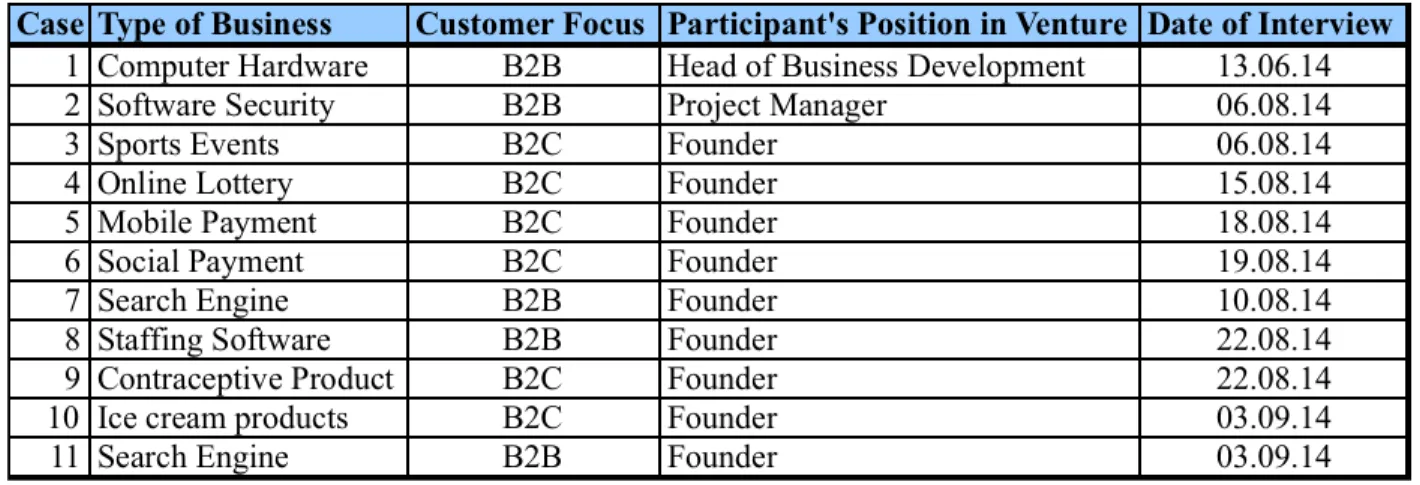
3.2 Case Selection ... 58
3.3 Research Approach ... 60
3.3.1 Shortcomings of Other Research Methods ... 60
3.3.2 Background of the Means-End Approach ... 61
3.4 Interview Transcription ... 66
3.5 Data Analysis ... 66
3.5.1 Interview Coding ... 66
3.5.2 Analysis Based on the Means-End Approach ... 69
4 Discussion of Results ... 71
4.1 Collection of Capital ... 73
4.2 Signalling to Follow-Up Investors ... 79
4.3 Marketing Effects ... 80
4.4 Product and Business Model Feedback ... 82
4.5 Inciting Product or Service Use ... 83
4.6 Ability to Involve Other Investors ... 84
4.7 Keeping Decision-Making Power ... 86
4.8 Demotivating Factors ... 87
4.8.1 Threat of Business Espionage ... 87
4.8.2 High Communication Effort and Costs ... 87
4.8.3 Costly Due Diligence Required ... 87
5 Limitations and Areas of Further Research ... 89
6 Conclusion ... 93
References ... 97
Appendix 1: Interview Guideline ... 113
Appendix 2: Transcripts of 11 Interviews (Case 1 – 11) ... 116
Appendix 3: Data Analysis Results ... 275
List of Figures
Figure 1: Financing Stages and Respective Sources of Venture Funding ... 30
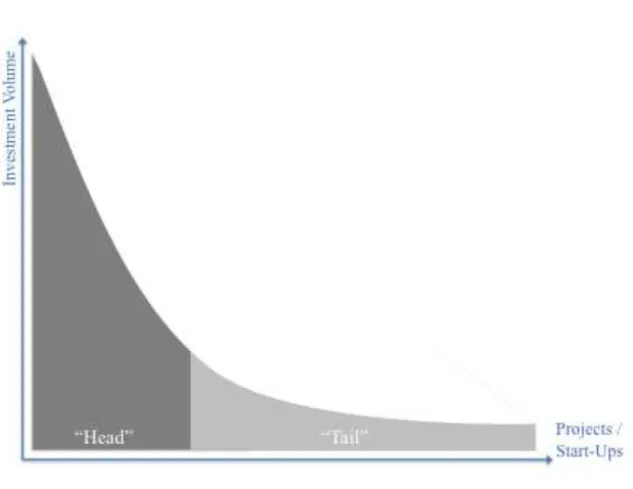
Figure 2: Equity Crowdfunding for the Long Tail (adapted from Blohm et al., 2013) ... 41
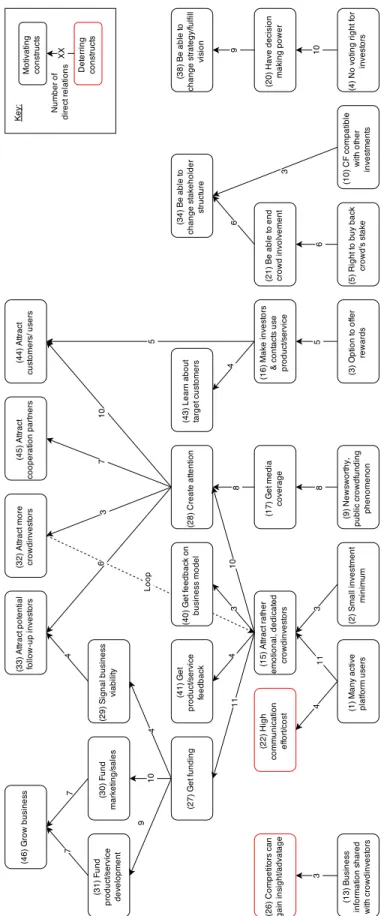
Figure 3: Hierarchical Value Map ... 72
List of Tables
Table 1: Sampled Cases ... 60Table 2: List of Attributes, Consequences, and Values ... 275
Table 3: All Elicited Ladders (Grouped by Case) ... 276
List of Abbreviations
bn Billion
B2C Business To Consumer B2B Business To Business FAQ Frequently Asked Questions FFF Family, Friends, and Fools GDP Gross Domestic Product HVM Hierarchical Value Map MEC Means-End-Chain
m Million
1
Introduction
Crowdfunding is a way for individuals with ideas to collect capital from a large number of people, typically online (Belleflamme et al., 2014), which experiences growth rates of over 80% per year since 2012 (Massolution, 2013). People who give money either receive an equity stake, interest for a loan or a reward, e.g. a consumer product, in return or they simply donate the money without a material return. Thus, crowdfunding is typically segmented into four different types: equity, lending, reward, and donation based crowdfunding (ct. Massolution, 2012).
This study will focus on why entrepreneurs are motivated to use equity crowdfunding to finance their ventures in Germany. This is a first step in order to better understand if crowdfunding could potentially be a “big bang disruption” (Downes, 2013) in the financially large market for entrepreneurial finance (Schwienbacher & Larralde, 2010; De Buysere et al., 2012). In this market the investments of the entrepreneurs themselves, their families and friends, and business angels alone typically represent around 4% of the annual GDP of North American and European countries (Bygrave, 2007). Furthermore, this study concentrates on equity crowdfunding conducted via crowdfunding platforms and neglects individual, platform-independent crowdfunding, due to several, growing advantages of this form of crowdfunding (see chapter 2.1.1).
This study will take an inductive approach, exploring the motivation of entrepreneurs qualitatively and open ended in case interviews with the aim of building theory. This serves to fill the existing research gap, where there is no specific research on what motivates for-profit entrepreneurs to use platform based equity crowdfunding so far and only very little research on what motivates project initiators (i.e. people creating a crowdfunding campaign, not necessarily entrepreneurs) in general to use crowdfunding.
crowdfunding, over resulting positive (or negative) consequences for the entrepreneurs to the more abstract values or goals that the entrepreneurs can satisfy by using equity crowdfunding. For example, instead of simply identifying that an certain entrepreneur is motivated to use equity crowdfunding to collect capital for his venture, this study will go further by also identifying why he reasons he will be successful as collecting the funds from the crowd and also what goal he intends to achieve with the funds. Identifying also the relationship between different elements in the chains of thought and different chains altogether, the study will finally aggregate data from different interviews and yield a holistic map of the entrepreneurs’ thought processes, a hierarchical value map, following the means-end approach.
actual interviews, the process of transcription of the interviews is briefly stated. Finally, the procedures of the two-step data analysis process are illustrated, i.e. the coding of the raw interview data followed by further aggregation and analysis using operations specific to the means-end approach.
In the fourth chapter, the study’s results are discussed and triangulated with proposed motivating factors from the literature review in chapter three.
2
Literature Review
The following chapter covers three broad areas. Firstly, the field of crowdfunding is described in subchapter 2.1. Secondly, the market for entrepreneurial finance, consisting of the sources of funding available to entrepreneurs, is explained in subchapter 2.3. Thirdly, possible motives of entrepreneurs to use equity crowdfunding instead of other sources of funding are collected from literature in subchapter 2.4.
2.1
Crowdfunding
By one of the most popular definitions of Belleflamme, Lambert, and Schwienbacher (2014) crowdfunding is an open call for funding, usually via the Internet, which is provided for by many investors in the form of rather small investments.
2.1.1 Players in Crowdfunding
This open call is made by a project initiator, also referred to as project owner or creator by Zhang (2012) or Gerber and Hui (2013), who raises capital for his project via crowdfunding (Ordanini et al., 2011). Project initiators could for example be artists or charitable projects (Hemer et al., 2011), yet, in the focus of this study project initiators are entrepreneurs who crowdfund their ventures (ct. Belleflamme et al., 2014; Collins & Pierrakis, 2012).
The funding for projects is provided for by the crowd, which consists mostly of private individuals but can also include organizations or investment funds (Hemer et al., 2011).
The project initiators usually approach the crowd for funds online on a website. This can be done independently or by using a platform operated by a third party, a so called crowdfunding platform, a virtual hub bringing together project initiators and individual investors (Ordanini et al., 2011; Berglin & Strandberg, 2013). A crowdfunding platform connects investors and initiators as an intermediary (Powers, 2012) and matches the initiators’ ideas with the crowd’s funds with the help of social media (Lynn, 2012; Lynn & Sabbagh, 2012). Thus, a large crowd can be reached rather easily online communicating one-to-many via the interactive Web 2.0 through channels like Facebook and Twitter. The crowdfunding platforms, as multi-sided platforms, facilitate such network effects in general (ct. Osterwalder & Pigneur, 2010). Furthermore, network effects usually increase with every extra user (Parker & van Alstyne, 2005), enabling crowdfunding platforms to harness these network effects employing their large crowd and their social networks for their users (Gerber & Hui, 2013).
initiators do not possess (Hemer, 2011). Furthermore, many initiators only crowdfund once or twice (Hemer, 2011). Thus the use of a crowdfunding platform as an intermediary with the needed skills, experience, and resources is the optimal choice for many project initiators (Hemer, 2011). In addition, when crowdfunding on a platform, project initiators can benefit from the publicity of the particular platform (Belleflamme et al., 2014). Moreover, the platforms’ offers often go further than just connecting initiators with the platform users. Platforms sometimes offer services such as conducting due diligence, consulting on marketing, organizing investor relations events, providing standardized investment contracts and payment processing, or finding follow-up investors (Hemer, 2011). Often platforms pre-select projects eligible to fundraise on them (this is especially common in “return oriented” crowdfunding, see next chapter (Blohm et al., 2013)), which can be beneficial for entrepreneurs, as a platform’s reputation for selecting valid business projects can strengthen the potential investors’ trust in the offered projects and thus increase the entrepreneurs’ chances to crowdfund successfully. In the same direction, Agrawal et al. (2013) argue that crowdfunding platforms will benefit from the large amount of data that they constantly accumulate about entrepreneurs, investors, and the investment deals, as interactions happen online and can more easily be saved, unlike traditional offline deals of business angels and venture capitalists. Consequently, platforms will be able to analyse this data to serve as a more effective matchmaker between investors and entrepreneur in the future, further improving the probability of successfully securing funding for the entrepreneurs (Agrawal et al., 2013).
Even though advancements in software and technology might make independent online crowdfunding easier to execute in the future, platforms will still provide the above-mentioned additional benefits. Furthermore, benefits from experience curve effects, from growing platform reputation, and from network effects resulting from their established and growing user bases will probably continue to increase in the future, setting platform based crowdfunding apart from independent crowdfunding even more. Thus, this study focuses on crowdfunding employing a platform as opposed to independent crowdfunding.
2.1.2 Different Types of Crowdfunding
identified based on the legal connection or funding contract through which projects receive capital.
Following this definition of crowdfunding, in donation based crowdfunding donations are often pledged by donors due to an ideological motive (Blohm et al., 2013) and donors receive no financial gains but only reputational ones for their donations (Hemer, 2011). In reward based crowdfunding people receive products or services or a discount on these in return for their money, thus this type also yields no monetary reward for the crowd (Forster, 2013). It could rather be perceived as a form of pre-selling or pre-ordering of a product or service (Hemer et al., 2011). On the other hand, lending based crowdfunding, where investors collectively give capital in the form of debt, yields a financial return for investors in the form of interest (Massolution, 2013). With equity based crowdfunding investors expect a return on their equity stake in the funded project (Massolution, 2013).
The term equity crowdfunding, this study’s focus, also encompasses equity-like investments, such as certain types of mezzanine capital, which offer similar payoffs as equity but also share characteristic with debt (De Buysere et al., 2012; Massolution, 2013; Ahlers et al., 2012). Hence, the differentiation between lending and equity based crowdfunding is not completely mutually exclusive. Furthermore, many platforms allow for multiple types of crowdfunding to be used simultaneously (Blohm et al., 2013). For example, Seedmatch and Companisto, the two German equity crowdfunding platforms on which the participants of this study were sampled (see chapter 2.1.3.1 and 3.1), offer equity crowdfunding with the option to also pre-sell products or services along with a certain investment sums, thus to effectively combine equity with reward based crowdfunding.
private investors targeted in the other two clusters, also institutional investors are targeted. Yet, the investors usually have no management influence. Half of the crowdfunding projects in this cluster are for for-profit start-ups, the focus of this study.
“Return oriented” crowdfunding is a cluster that is very similar to equity crowdfunding as defined by Massolution. The projects in this cluster are funded via equity (9%) and via mezzanine capital (66%) (Blohm et al., 2013), which is also mostly included in the definition of equity based crowdfunding by Massolution. Only 25% of the projects in this cluster are funded with debt and would thus be categorised as lending based crowdfunding by Massolution.
This study focuses on entrepreneurs of only for-profit ventures who use platform based equity crowdfunding (including equity-like crowdfunding, following Massolution’s definition) yielding a financial return to investors. Thus, it concentrates on subcategories of the classifications “return oriented” crowdfunding as defined by Blohm et al. (2013), excluding debt financed ventures covered in this cluster, and equity crowdfunding as defined by Massolution.
2.1.3 Global Crowdfunding Market
The combined global market for all four types of crowdfunding in 2012 was $2,7 bn according to Massolution (2013), which conducted a study covering 362 of the supposed 813 active crowdfunding platforms in 2013. The market is expected to have already reached $5.1 bn in 2013 (Massolution, 2013). Growth rates increase more slowly, from 61% in 2010 (Massolution, 2012), 72% in 2011 (Massolution, 2012), and 81% in 2012 (Massolution, 2013) to an estimated 89% in 2013 (Massolution, 2013), indicating that growth rates might not grow much higher in the future. North America and Europe together represent 96% of the global crowdfunding market in 2012 and an estimated 98% in 2013, with North America being the largest regional market, making up 60% of the global market, or $1,6 bn, and Europe constituting 36%, or $945 m. In 2013 it was estimated that due to a faster growth in North America, its dominance would increase to 72% market share, or $3,7 bn, whilst Europe’s significance was estimated to shrink to 26% of the global market volume, or $1,3bn. (Massolution, 2013)
Other regions, though only marginally important today with mostly Asia and Australia making up the remaining 4% in market volume, experienced the strongest growth rates of 125% in 2012 (Massolution, 2013).
closely followed by reward, which was expected to experience with the strongest growth to 27%, and equity crowdfunding even diminishing in share to 3%. In absolute terms there were $116 m of equity crowdfunding raised in 2012, a 30% increase from 2011, and an estimated $166 m in 2013. The estimated growth to $166 m resembles an expected 43% increase – the slowest growth rate compared to the three other forms, mostly due to legal hurdles in the form of investor protection in the equity market in the USA, which will be discussed below in chapter 2.1.3. (Massolution, 2013)
Yet, setting the overall equity crowdfunding market into perspective to the overall start-up capital market and comparing the estimated $166 m crowdfunded globally in 2013, as mentioned above (Massolution, 2013), equity crowdfunding today is dwarfed.
The international research network Global Entrepreneurship Monitor (Bygrave, 2007), estimated that in the 42 countries covered by their 2006 Financing Report, including North America and most of Europe, informal investors, so family, friends, fools and business angels, provided $600 bn in funding to new ventures. This resembles about 1,5% of the combined GDP of these 42 countries. Together with the considerable funds that the entrepreneurs themselves invest into their businesses, about 3,9% of the combined GDP was invested into entrepreneurial businesses from informal sources. (Bygrave, 2007)
At the same time only $37,3 bn were invested by venture capitalists in start-ups, resembling only 6% of the sum provided by family, friends, fools and business angels (Bygrave, 2007). Since 2006, venture capital investment has grown steadily to $48,5 bn in 2013, according to the professional service firm Earnest and Young’s report Global Venture Capital Insights and Trends 2014 (2014), with informal investment possibly growing along and still providing the much larger share of venture funding. Overall, only less than one venture in 1.000 receives venture capital at any time in its existence (Bygrave, 2007).
previously did not invest into young ventures and are now given the chance to invest in them with ease (Caldbeck, 2013).
2.1.3.1 German Crowdfunding Market
In Germany the crowdfunding market excluding donation based crowdfunding was €36 m in 2012 and €63 m in 2013, according to Blohm (as cited in Sieber, 2014).
The total sum raised via equity crowdfunding was €4,3 m in 2012, €15 m in 2013, and will be an estimated €20 m in 2014, according to a study of the German start-up news portal Für-Gründer.de (Crowdfinanzierung in Deutschland, 2014). Growth is slowing down dramatically from about 250% in 2013 to an estimated 33% in 2014 (Crowdfinanzierung in Deutschland, 2014). A study of the German equity crowdfunding market by Hölzner et al. (2014) delivered similar results, estimating that the German equity crowdfunding market grew at 8% per month between October 2011 and August 2014, so at about 150% per year, and reaches the annual volume of €22 m in 2014.
The growth in volume in 2014 did not result from more projects being funded, but from the average investment sum per project rising to €264.000 (as of September 30th 2014), from just €173.000 in the same timeframe in 2013 (Crowdfinanzierung in Deutschland, 2014). This is similar to the global median sum raised per project in equity crowdfunding of $190.000 in 2013 (Massolution, 2013).
In aggregate figures €32 m were invested as equity crowdfunding in Germany until the third quarter of 2014 (Crowdfinanzierung in Deutschland, 2014), since the first project received equity crowdfunding in Germany in late 2011 (Hölzner et al., 2014). The German Crowdfunding Network, or short GCN (Crowdfunding-Markt (November 2014), 2014) also includes small platforms and platform-independent crowdfunding in its estimates, which are not considered in the Für-Gründer.de numbers. They state a higher amount of around €50 m raised with equity crowdfunding in Germany since 2011 until October 2014, compared to €20 m for reward based crowdfunding and €150 m for lending based crowdfunding. They do not provide an estimate for donation based crowdfunding.
donation based crowdfunding, was quite comparable 23% since the start of the crowdfunding phenomenon in 2011 until October 2014. This is a rather high share of equity crowdfunding in Germany compared to worldwide figures, where the share of equity crowdfunding compared to the overall crowdfunding market excluding donations is only about 6% in 2012 and 2013 based on data from Massolution (2013).
The German equity crowdfunding market represented 4,6% of the global equity crowdfunding market in 2012 and even 11,5% in 2013, using the figures of Massolution (2013) and Für-Gründer.de (Crowdfinanzierung in Deutschland, 2014) and also the respective yearly average exchange rates provided by the Department of the Treasury of the USA (Yearly Average Currency Exchange Rates, n.d.). Accordingly, as stated by to the German Crowdfunding
Network, Germany has the biggest crowdfunding market worldwide next to the UK (Stellungnahme des German Crowdfunding Network, 2014). Hölzner et al. (2014) explain the relatively large popularity of equity crowdfunding in Germany with comparatively good regulatory conditions for equity crowdfunding in Germany and/or a less effective private equity market compared to other countries such as the USA, creating a higher demand for crowdfunding to substitute for missing other sources.
Similarly in Europe, De Buysere et al. (2012) propose a harmonisation of the respective national laws and regulation in the European Union regarding equity crowdfunding below a €5 m maximum funding sum.
So far, the German equity crowdfunding market with its large share of the global equity crowdfunding market and the above average proportion in the overall German crowdfunding market, appears to foreshadow developments soon to come in other markets currently in the process of liberalization. Furthermore, due to its currently comparatively far developed state, the German equity crowdfunding market seems apt for testing the motives of entrepreneurs to use equity crowdfunding. Therefore it seems to be the adequate focus of this study.
Yet, it has to be mentioned that there is a chance that the currently comparatively good legal conditions for equity crowdfunding in Germany could worsen. So far the collection of even large sums of mezzanine capital in the form of participation loans and subordinated loans was exempted from the costly obligation to publish an investment prospectus in Germany. Thus, participation loans and subordinated loans are the most commonly used contracts for equity crowdfunding in Germany to lower funding costs, not necessarily because they are always best suited for every venture in the context of crowdfunding, according to the GCN (Stellungnahme des German Crowdfunding Network, 2014). However in July 2014 the German Federal Ministry
of Finance and Federal Ministry of Justice and Consumer Protection published a draft of a law for investor protection, open for public debate (Entwurf eines Kleinanlegerschutzgesetzes, 2014). With this new law the investment prospectus exemption would remain for these two types of loans, yet would not encompass other potentially useful forms like equity or silent partnerships. Furthermore, closing some legal gaps regarding the two types of loans, investors would in the future be required to physically sign and postally send an information leaflet, if they invest in excess of €250. Furthermore, investment per investor would be limited to €10.000, effectively stopping large investments of business angels and venture capitalists on crowdfunding platforms. A maximum sum of only €1 m, not €5 m as proposed in the European context, would be introduced, and marketing, especially through social media, would effectively be illegal. (Stellungnahme des German Crowdfunding Network, 2014) The draft of the law is currently heavily criticized by many crowdfunding platforms and entrepreneurs and could potentially threaten the future of equity crowdfunding in Germany (Räth, 2014).
(Crowdfunding-Monitor 2012, 2013) found, that a bankruptcy of a popular crowdfunded venture and a possible
resulting lawsuit is perceived as the biggest threat for equity crowdfunding in Germany. So far until August 2014 eight ventures, representing 5.4% of the overall sum invested via crowdfunding since 2011, bankrupted (Hölzner et al., 2014). According to Für-Gründer.de, until September 30th 2014 nine start-ups bankrupted putting €1,5 m in crowdinvestments at risk. Yet, not before 2016, when the first investment contracts can be terminated by investors (see following chapter), the risks and returns of crowdfunding investments in Germany can truly be assessed. On the upside Für-Gründer.de (Crowdfunding-Monitor 2012, 2013) found, that platform staff sees a large exit as the biggest chance for boosting equity crowdfunding’s success in Germany.
Overall, the crowd in Germany’s crowdfunding market shows signs of professionalization, with more investors emphasising return over emotional factors such as enthusiasm for the project’s idea, according to a study of crowdinvestors by Hölzner et al. (2014). Furthermore, equity crowdfunding platforms show a trend of focussing on a certain investment type, e.g. Econeers, a partner platform of Seedmatch, concentrating on renewable energy investments, a trend also visible in other markets like the USA with e.g. AngelMD focusing on health care products and targeting doctors as investors (Hölzner et al., 2014).
In addition, the German equity crowdfunding platform market is already rather consolidated. Out of 24 active platforms on the German equity crowdfunding market in the timeframe after late 2011, only 13 are still operating today (Hölzner et al., 2014). In the first quarter of 2014 Seedmatch and Companisto dominated the market with a share of 45,4% and 43,6% respectively, followed by Innovestment with 7,4%, and small platforms comprising the remaining 3,6% (Hölzner et al., 2014). Consistently, according to Für-Gründer.de (Crowdfinanzierung in Deutschland, 2014), Seedmatch and Companisto had a market share of 87% in the first three quarters of 2014, with Seedmatch alone holding 59% of the market.
As Seedmatch and Companisto constitute up to 90% of the German equity crowdfunding market and are the platforms this study acquires its interview participants from, they serve as examples for the dominant procedures in equity crowdfunding in Germany.
FAQ, n.d.; Companisto FAQ, n.d.): As mentioned above there is no obligation to publish an otherwise costly investment prospectus, funding sums are unlimited, investors have no decision-making rights but only information rights to quarterly and annual reports, and stock will be diluted in eventual consecutive rounds pending legal changes in the future (see chapter 2.1.3). After a pre-selection by the platforms according to the platform’s investment focus fit and some formal criteria, Seedmatch establishes a valuation together with the venture, Companisto values the ventures themselves. A funding threshold, a minimum required sum, has to be reached in order for a campaign to be successful and money being paid out to the entrepreneur. Seedmatch charges 5-10% of the collected sum (plus transaction costs) for the payment provider, Companisto charges 10% flat. Additional costs are incurred through content production, especially of an investor pitch video. Investors receive 1% interest per annum. In addition they receive: In the case of an exit, their share of the exit value; In the case of earlier cancellation (investors can cancel earliest after 5 years on Seedmatch and 8 years on Companisto, ventures can cancel earliest after 8 years on both platforms), the investors receive a multiple on the current revenue or earnings before interest and tax, short EBIT, on Seedmatch and Companisto, or have the additional option of receiving a share of the current value of the venture, only on Companisto. Thus, crowdinvestors can be divested after a certain time frame, either by the venture or by follow-up investors buying back the crowd’s shares. (Seedmatch FAQ, n.d.; Companisto FAQ, n.d.)
2.2
The Research Object: Entrepreneur
After having established the type of crowdfunding (equity crowdfunding on platforms) and the particular market (Germany) this study focuses on, the research object of this study, the entrepreneurs motivated to initiate an equity crowdfunding project for their for-profit start-ups, will be defined.
When founding a new venture, entrepreneurs might have motives such as low salary, harsh work schedules, general job dissatisfaction, or unemployment, the so called “push” factors, and/or they might have motives such as wealth accumulation, independence, or self fulfilment, the so called “pull” factors according to Segal et al. (2005) (also see Kirkwood, 2009).
When looking for funding for their venture, entrepreneurs might be motivated by sheer necessity. As costs are often not matched by sufficient or any revenues, typically in the early stages in a venture’s lifecycle, external funds are eventually needed to fill this gap (Brettel, Jaugey, & Rost, 2000). Thus, most entrepreneurial ventures have the need to raise capital sometime during their lifecycle in order to for example tackle cash flow challenges, take on capital investments and finance lengthy product development cycles (Barringer & Ireland, 2010).
Yet, when entrepreneurs are motivated to seek external capital – out of necessity or for other reasons – they have to choose from a range of possible sources of funding. Thus, in order to better understand why some entrepreneurs are motivated to use equity crowdfunding, the context in which they make this decision will be outlined in the following.
2.3
Venture Funding
2.3.1 Funding Stages
As a venture develops, it goes through certain development stages, e.g. first revenues are generated, the break even point is reached, etcetera, similar to the famous example of the product life cycle describing the development of revenue growth over time for a certain product (ct. Polli & Cook, 1969). Also, when focusing on just the funding of a new venture, distinct stages can be identified, usually matching with some milestones or certain risks that are characteristic for a certain phase of business development (Ruhnka & Young, 1987).
With further progress the venture usually develops a corporate organization, produces prototypes or generates early revenues, which marks entering the start-up stage (Schreter, 2012). The main risk in this stage is whether cost effective manufacturing can be achieved (Smith et al., 2011). Ventures in the three stages up to this point have a higher risk and more volatile returns compared to ventures in the following stages (Parhankangas, 2007).
When revenue growth accelerates, the start-up is said to be in the expansion and later stages (Parhankangas, 2007). Main risks in this phase are marketing risk, i.e. investors are unsure whether the venture can generate enough revenue in the future to adequately compensate investors, and also uncertainty about the ultimate profitability. (Smith et al., 2011)
Finally, a venture eventually reaches the exit stage, where founders and investors materialize a return on their investments through e.g. an initial public offering or a buyout (Smith et al., 2011). As this study focuses on entrepreneurs’ motivations acquiring crowdfunding, only the investing phase and not the divesting phase, the exit stage, is relevant for this work.
2.3.2 Funding Sources
Securing financing for their venture is one of the most serious problems entrepreneurs have to face, according to many scholars (Virtanen, 1996; Denis, 2004). Venture funding is highly risky, yet also bears the potential for high growth rates (Virtanen, 1996). As mentioned above, the investment risk is not constant over time, but usually decreases with the maturity of the venture (Gompers & Lerner, 2004). Capital requirements and management needs of the venture change with time as well and different types of investors with different risk preferences, different target investment sums, and different management foci specialise in certain venture development stages (Gompers & Lerner, 2004).
At the very beginning of a venture, during the pre-seed and seed stages, the founders themselves usually invest some equity in the venture (Barringer & Ireland, 2010). By taking a financial risk themselves, entrepreneurs also signal commitment to other potential external investors and encourage their investments (Brettel et al., 2000). To avoid taking in external equity or debt for as long as possible, entrepreneurs can use a bootstrapping approach, cutting costs and being thrifty creatively (Barringer & Ireland, 2010; Virtanen, 1996). Yet, because costs are usually not offset by sufficient or sometimes even any revenues in the seed stage, and sometimes beyond, funds are eventually needed to fill this gap (Brettel et al., 2000).
family, friends and so called fools as very risk taking investors with no personal relationship to the entrepreneurs, together short “FFF” as termed by Cumming (2006) (ct. Parhankangas, 2007; Barringer & Ireland, 2010; Volkmann & Tokarski, 2006). This “FFF” funding can take the form of equity or debt (Fueglistaller et al., 2012), but also the form of gifts, free rent, sweat-equity, or delayed compensation. Entrepreneurs usually keep decision-making control, however also receive little additional benefits like management or legal support from family, friends, and fools (Brettel et al., 2000). “FFF” capital is relatively easy to access, as e.g. information asymmetries between the investors and the entrepreneurs are low in the case of family and friends (Brettel et al., 2000). Yet, the investment volume is limited and strongly dependent on the affluence of the social network of the entrepreneurs, just as the funds from the entrepreneurs themselves are limited by the entrepreneurs’’ personal wealth (Fueglistaller et al., 2012). Thus, as Brettel et al. (2000) point out, the sums available here are often not sufficient, especially in the case of technology-focused ventures.
In this early phase debt is usually only limitedly available often in the form of over drafting personal credit cards or financing operations through trade credit (Leach & Melicher, 2011). Another source of funding in the seed phase are initial grants (Virtanen, 1996), such as government and research grants, which are typical awarded to technology ventures (Barringer & Ireland, 2010). Receiving grants can function as a positive signal to follow-up investors (Gompers & Lerner, 2004). Nevertheless, access to public funds is generally scarce, according to Nathusius (2003).
and the investment process is professional and diligent, yet not very bureaucratic, especially compared to venture capitalists (see below) (Fueglistaller et al., 2012). Research is unclear about the typical sums invested by business angels, which range from €100.000 to €200.000 according to Guggemoos (2012) or from €150.000 to €500.000 according to Fueglistaller et al. (2012) and can sometimes be more than €1.000.000 according to Brettel et al. (2000). Business angels typically expect a return of about 20% per year (Fueglistaller et al., 2012) and hold their stakes for five to six years, according to Grichnik and Koropp (2010), or even up to ten years according to Guggemoos (2012). However, business angel funding is scarce and thus difficult to get access to, according to Lehner (2013).
subsequent bad experiences with failed start-up investments, which lead to more careful investment behaviour of venture capitalists (Beck, 2012).
Figure 1: Financing Stages and Respective Sources of Venture Funding
Based on Lasrado (2013) and Earnest and Young’s Global Venture Capital Insights and Trends 2014 (2014), the graphic above summaries the different financing stages and the respective sources of venture funding active in them, including equity crowdfunding.
Lasrado (2013) and Earnest and Young’s Global Venture Capital Insides And Trends 2014 (2014) both see equity crowdfunding overlapping with family, friends and fools, grants, business angels, and early stage venture capitalists. Furthermore, including the other types of crowdfunding, donation, reward, and lending, Lasrado locates crowdfunding to cover even the pre-seed phase. Also Fueglistaller et al. (2012) perceive crowdfunding to compete with “FFF”, public grants, business angels, and venture capitalists.
Blaseg (2013) found equity crowdfunding to rather be a supplement than an alternative back in 2012.
Since then several equity crowdfunding records have been broken and ventures can secure much higher funding sums in Germany, which are typically needed in later stages, with the average sum per project rising from only around €96.000 in 2012 (Crowdfunding-Monitor 2012, 2013) over €173.000 in 2013 to €264.000 in 2014 (averages over the first three quarters of the respective years) (Crowdfinanzierung in Deutschland, 2014). Thus, from today’s perspective investments in the German equity crowdfunding market encompass more than just the seed and start-up stages, but rather concentrate on phases right before the later stage, so on the expansion and start-up stages, according to a study of 116 successful equity crowdfunding projects in Germany until July 2014 by Hölzner et al. (2014).
Furthermore, there are some other indicators, that equity crowdfunding overlaps with other sources of funding. For example, the Israeli crowdfunding platform OurCrowd connects established business angels with the crowd on their platform (Hölzner et al., 2014). A group of business angels invested into the start-up “chocri” via the German crowdfunding platform Innovestment (Hölzner et al., 2014). Seedmatch and Companisto both self report to have several business angels investing in start-ups through their platforms (ct. Seedmatch Blog Entry, 2010; Companisto Glossar, n.d.). Additionally, some business angels themselves state having invested into ventures through crowdfunding on these platforms (ct. Schweiger, 2014).
Blohm et al. (2013) found that in the cluster “return oriented” crowdfunding, that 97,4% of the platforms address institutional investors. Institutional investors are investors arranged in same-interest groups that often pass on the returns to third parties. Thus venture capitalists fall under this category of investors targeted by “return oriented” crowdfunding platforms.
Moreover, with the emergence of crowdfunding, some family members and friends give at least some capital via crowdfunding instead of giving it to the entrepreneurs through other previously used routes, according to Ordanini et al. (2011). They found in their explorative study of three projects, that the first half of the collected capital from the crowd often comes from family and friends (Ordanini et al., 2011). Concordantly, in Germany the first fifth of the investors, often family and friends, invests 45,5% of the total crowdfunded sum (Hölzner et al., 2014).
Consequently, equity crowdfunding is a possible alternative source of funding for entrepreneurs or at least an alternative way of approaching family, friends, and fools, business angels and venture capitalists.
So the question is: What motivates entrepreneurs to use equity crowdfunding out of all the options available?
2.4
Possibly Beneficial Factors of Equity Crowdfunding
As will be discussed in this chapter, scholars propose a wide array of different reasons why entrepreneurs could be motivated to use (equity) crowdfunding. Compiling these possibly motivating reasons here serves to increase the quality of this study.
For example, this chapter will be used as a basis to code and compare the findings of this study’s interviews to, in order to create a replication logic and strengthen the validity of findings (ct. Yin, 1994).
In detail, triangulating the primary data collected, i.e. the first hand interview data from entrepreneurs about their motivation to use equity crowdfunding, with secondary sources of data, such as the information in this chapter and data from the respective crowdfunding campaigns and crowdfunding platforms in general, serves to increase the reliability of this study according to Eisenhardt (1989).
Moreover, data triangulation also helps to increase the internal validity of this study during data analysis, as comparing emergent theory form the interview data with the theories explained in this chapter, leads to a more reliable interpretation of constructs and relationships, following Gibbert et al. (2008).
Lastly, in the case of this qualitative study, external validity is not achieved through empirical generalization, i.e. quantifying phenomena in a population, as it would be with quantitative research, but through analytic generalization, i.e. forming theory, according to Tellis (1997). Analytic generalisation is strengthened by comparing the findings from the interview data with previously postulated explanations given in this chapter (ct. Tellis, 1997).
they might be driven towards equity crowdfunding out of necessity. Second, proposed pull factors in the form of additional benefits equity crowdfunding might offer to entrepreneurs will be discussed, such as risk diversification, keeping management control, product and market feedback, and marketing effects.
2.4.1 Push Factors 2.4.1.1 Equity Gap
As explained in chapter 2.2 almost all entrepreneurs need external capital to finance their operations at one point. Out of this necessity (and possibly also to receive other benefits from the investors, such as management or network support) they have to approach some external investor(s) for funding. Theoretically, entrepreneurs could approach any of the alternative sources of funding described in previous chapter instead of crowdfunding. So what motivates entrepreneurs to choose equity crowdfunding?
In some cases, ventures with viable business concepts remain unfunded, especially in the seed and early stage. After funds from family, friends, and fools have been exhausted and before business angels, venture capitalists, and banks are willing to invest, there appears to be an “investment creep” or “early-stage equity gap”, the most prominent venture capital market imperfection according to Heger et al. (2005). In general, this lack of typically small sums of risk capital during the seed, start-up, and expansion stage is described as the “equity gap” (Mason, 1996, cit. in van Osnabrugge & Robinson, 2000).
Although the term “equity gap” was already coined in the early 20th century, in 1931 by the British Prime Minister Harold Macmillan (Clarysse, Roure, & Schamp, 2007), the problem still exists today (Cosh, Cummuing, & Hughes, 2009). Worse yet, the gap even seems to be increasing. As a consequence of the last financial crisis, banks nowadays provide even less capital to risky start-ups without sufficient collateral (Wilson & Silva, 2013) and venture capitalists focus more on ventures in the later stage, largely ignoring the seed and start-up stages (Wilson & Testoni, 2014). Thus, the importance of business angels in filling the funding gap has increased lately (Wilson, 2011).
According to Sohl (2003), the equity gap is even the number one problem in the venture capital market, possibly leading to less innovation and a bottleneck of viable start-ups in later stages to invest in.
market success of its innovations by investing into their commercialization (Clarysse et al., 2007).
Overall, problems to collect capital are the second or third most important reason that leads to entrepreneurial business discontinuation in most regions of the world. In Europe alone about 13% to 18% of the businesses fail due to funding problems, according to the Global Entrepreneurship Monitor (Amorós & Bosma, 2014). Only in North America getting financed is a minor problem, leading to discontinuation of only about 4% of the entrepreneurial businesses (Amorós & Bosma, 2014).
Yet, several scholars believe that crowdfunding can help to overcome the equity gap (Schwienbacher & Larralde, 2010; Van Wingerden & Ryan, 2011; Bechter et al., 2011; Belleflamme et al., 2014; De Buysere et al., 2012; Sigar, 2012). Some even argue that it can act as a source of funding of last resort, supplying those entrepreneurs with capital, who failed to secure funding from the traditional sources like business angels and venture capitalists (Valanciene & Jegeleviciute, 2013; Hemer et al., 2011; Lambert & Schwienbacher, 2010). Consequently Lambert and Schwienbacher (2010) suggest that the motivation of these entrepreneurs to use crowdfunding is rather necessity driven. They are motivated to use equity crowdfunding by the ‘push’ factor of simply needing capital.
In the following, some specific causes of the equity gap, such as high perceived investment risks, proportionally high transaction costs, or large geographic distances between investors and ventures are explained and theories about why crowdfunding, as opposed to other sources of funding, could help in overcoming these problems are discussed.
2.4.1.1.1 High Investment Risks
One of the causes of the equity gap are high risks associated with new ventures (Clarysse et al., 2007; Collins & Pierrakis, 2012). According to Pfennigsdorf (2006), this is even the main reason for the existence of the gap, as the risks of investments into start-ups in early stages are often not matched by assumed required rates of return (measured as an internal rate of return), which keeps venture capitalists, business angels, and banks from investing.
second group reasons that the crowdinvestors can collectively more accurately assesses ventures’ risks and invest ‘wisely’, as will be explained below.
The first group of scholars argues that crowdfunding can possibly attract those investors that are willing to invest into new ventures regardless of the high risks. According to De Buysere et al. (2012), crowdinvestors typically might not possess the competencies for evaluating ventures with the same accuracy as an expert investor. Mollick (2014) and Agrawal et al. (2013) could show that the crowd is often overoptimistic about the developments of funded ventures in the beginning and thus might be willing to provide ventures with capital that were unable to secure funding from business angels, venture capitalists, or banks. Also, according to Collins and Pierrakis (2012), crowdinvestors might be more willing to invest in ventures with higher risks and lower return than more professional and financial return maximizing investors. This perception of crowdinvestors as being less rational is in accordance with Shane’s findings (2008) that the average investor typically underestimates success rates, risks, and returns from start-ups. Furthermore, investors might be tolerating more risk than usual, when they invest only small sums through crowdfunding. This lower risk aversion while dealing with small stakes is termed the peanut effect (Chapman & Weber, 2006) and might be an important factor in crowdfunding (Blohm et al., 2013). Consequently, even ventures that business angels or venture capitalists perceive as too risky might therefore be able to secure funding from the less rational crowd. Moreover, people are more likely to invest into a venture on a crowdfunding platform if many investors have already invested in the venture before (Agrawal et al, 2011; Kuppuswamy & Bayus, 2013; Burtch, Ghose, & Wattal, 2013) or if only little money is missing to reach the funding target (Kuppuswamy & Bayus, 2013; Yum, Lee, & Chae, 2012). For example in Germany the earliest fifth of the investors invests 45,5%, the last fifth, when funding success is quite probable, another 20,1% of the total crowdfunded sum (Hölzner et al., 2014). Here, crowdinvestors behave similarly to irrational investors in other financial markets. They do not want to miss a popular investment opportunity and move in a herd, according to Ordanini et al. (2011) and Berglin and Strandberg (2013). Consequently, even though good due diligence leads to better returns on investments (Wiltbanks & Boeker, 2007), the crowd appears to systematically underinvest in due diligence and instead to free ride on the due diligence of others by following their investment decisions, according to Agrawal et al. (2013).
do not invest strictly rationally but based on emotional relationships with the entrepreneurs (Agrawal, Catalini, & Goldfarb, 2011). And frequently FFF are the initiators of a herd movement by investing heavily during the initial phase of the crowdfunding campaign (Ordanini et al., 2011), thus encouraging the rest of the crowd to follow their behaviour. Especially those people who share the same social network with early investors are likely to follow, as they trust more in the recommendations of friends (Blechter et al., 2011). Consequently, following early investors might often be based on non-financial, not strictly rational motives of these family members and friends.
Furthermore, not just family and friends amongst the crowdinvestors tend to invest out of non-financial motives. For example, Gerber et al. (2013) identified, that crowdinvestors on donation and reward based crowdfunding platforms had mostly non-financial investment motives. They strive for being a part of a community or just for being recognised, and give their support to a cause in accordance with their own beliefs or to a founder to whom they have a personal relationship. Moreover, Schwienbacher and Larralde (2010) state that beyond financial motives, crowdinvestors are strongly driven by intrinsic motivation, wanting to support a particular business to receive social reputation for their investment. They might also seek emotional returns by helping to realize projects personally, which are important to them or are geographically close by (De Buysere et al., 2012).
Concluding, if crowdinvestors are indeed often inexperienced and exhibit an irrational, more risk taking behaviour like over-optimism, the peanut effect, or herd behaviour, or if they are indeed motivated mostly by non-financial motives such as personal relationships with the entrepreneurs or social reputation, then entrepreneurs, who are unable to secure funding for their risky ventures from traditional and more professional sources of funding, might be able to finance their ventures via the crowd.
Nevertheless, as mentioned above, there is a second group of scholars, which disagrees with the perception of the crowdinvestors being emotional or even irrational. Instead they argue that the crowd collectively behaves “wise” when investing in start-ups, as it can more accurately assess the true market success and risks of a business idea.
therefore often simply avoid markets unknown to them (Zider 1998, cit in Wüstenhagen & Teppo 2006, p. 69) or only invest in later stages, when a product’s potential can be better assessed with more information at hand, thus creating an equity gap. Moreover, venture capitalists often focus on technology-based ventures with possibly very high returns (Wilson & Testoni, 2014). Also business angels typically require high returns and thus high growth from new ventures to compensate for high risks taken by them (Sohl, 1999; Wong et al., 2009). This excludes ventures with a limited growth potential, i.e. focused on lifestyle products or services, from receiving funding form business angels, according to Macht and Weatherston (2014). Consequently, also business angels are rather limited in terms of the sectors they invest in and avoid unknown markets, though to a lesser degree than venture capitalists (Wilson, 2011). In sum, traditional sources of funding might turn down ventures simply because they perceive them as too risky in relation to the growth rates they expect or just because they have a business focus different to theirs.
The crowd on the other hand might consist of investors with many different, heterogeneous investment foci and motives, thus being open towards a wider range of investment sectors, according to Wilson and Testoni (2014). Consequently, the crowd might collectively assess the market potential and risks of a venture differently compared to traditional sources of funding, thus deeming ventures as good investments which traditional sources of funding turned down. For example, a venture could possibly even find potential (future) customers who believe in the venture and win them as investors (ct. e.g. Mollick, 2012; Hölzner et al., 2014; Agrawal et al, 2013; Hornuf & Schwienbacher, 2014), even if these potential customers are only a few and geographically dispersed (Harzer, 2013), with the help of the Internet, as will be further explained in the next sub-chapter. As more individuals invest into a particular start-up, the market potential of the start-up is proven, the risk of the investment decreases, and the venture can collect the desired capital.
predict the market potential and the chance of success for a business idea. Thus, the wisdom of the crowd is a form of collective intelligence and the result of the mostly unintentional, yet beneficial collaboration of the crowd online (Hettler, 2010), implicitly assessing a business idea by interpreting the crowd’s collective investment actions. As opposed to the herd behaviour of a rather irrational crowd as explained above (following the first group of scholars’ assessment), here, the collective decision of a large group of individuals is interpreted as a rather rational investment decision, assuming that investors do not blindly free ride on the due diligence of others but collectively produce a very strong assessment of the venture by adding up the many individual assessments. Furthermore, the “wise” crowd might be very quick and efficient in assessing the mass appeal of an idea, according to De Buysere et al. (2012).
Meanwhile the traditional sources of funding have realised this potential of the crowd. Large business angel communities, such as the Heartland Angels in Chicago, are already using the wisdom of the crowd to more efficiently assess the market potential of their start-ups on their very own crowdfunding platforms (Worldbank, 2013). Some crowdfunding platforms, as in particular the two platforms Seedmatch and Companisto this study focuses on, actively support the evaluation mechanism of the wisdom of the crowd by employing the all or nothing principle. According to this principle, the capital is only actually transferred to the venture, if and after the investment sum requested in the campaign is pledged in full by the crowd (Hemer, 2011). Thus, according to Blechter et al. (2011), a business idea is only successfully crowdfunded if a consensus has been reached and enough investors out of the crowd see potential in it.
Yet, the wisdom of the crowd might have boundaries. According to Hölzner et al. (2014), the wisdom of the crowd might be considerably better at evaluating B2C (business-to-consumer) ventures rather than B2B (business-to-business) ventures. In case of B2C ventures the crowd often consists of potential customers of the venture, thus they themselves constitute the venture’s market whose potential they have to assess as investors. In B2B settings the crowd typically cannot evaluate the target market and thus might have less precision in predicting its market potential.
In conclusion, although the two groups of scholars are in contradiction, they both indicate that equity crowdfunding could have the potential to overcome the equity gap and to step in when traditional sources of funding are unwilling to invest in two different ways. One group perceives rather irrational or emotionally motivated crowdinvestors to provide funding to businesses, deemed too risky by traditional, more professional sources of funding. The other group perceives the crowdinvestors as collectively wise investors, investing in ventures outside of the common knowledge or comfort zone of traditional sources of funding.
Which perception of the crowdinvestors is scientifically correct, though an interesting question, is not the main concern for this study. What is important for the purpose of this study is to answer the following: If the entrepreneurs are indeed motivated to use equity crowdfunding to collect capital from the crowd, why do they reason to be successful in collecting it from the crowd, i.e. why do they expect the crowd to be willing to invest in them?
In order to determine the reasoning of the entrepreneurs to use equity crowdfunding, this study therefore aims at identifying how entrepreneurs actually perceive the crowdinvestors’ behaviour and, how that perception of the potential investors motivates them to approach the crowd for funding. Following the two outlined rivalling positions of the two groups of scholars, entrepreneurs could either perceive crowdinvestors to possess irrational characteristics, or entrepreneurs could be motivated to use crowdfunding as they hope to find investors, who also believe in their idea, a ‘wise’ crowd, opposed to more conservative business angels and venture capitalists.
Therefore, this study aims at uncovering the entrepreneurs’ reasoning in detail using the means-end approach (see chapter 3.3) because only by exploring the reasoning why entrepreneurs think the crowd could provide them with capital, interesting conclusions about issues such as the following can be drawn.
For example, Agrawal et al. (2013) point out that if crowdinvestors would indeed be rather irrational, this would encourage an adverse self-selection of entrepreneurs of predominantly low-quality ventures to approach the crowd for funding, whereas entrepreneurs of high-low-quality ventures would continue to seek capital from business angels and venture capitalists. Thus, crowdfunding’s potential to transform the entrepreneurial finance sector in the long term would be low.
Firstly, as will be further explained in chapter 2.4.2.1, entrepreneurs could be motivated to raise some of the needed capital via the ‘wise’ crowd to use this positive assessment of the venture’s market potential to signal to business angels and/or venture capitalists, that a significant market potential exists and hence encourage them to invest in following investment rounds. Secondly, entrepreneurs could be motivated to approach the ‘wise’ crowd, because they too could benefit from a test of their product’s or service’s potential through the crowd and so learn more about the viability of their idea. As Van Wingerden and Ryan (2011) suggest, the crowd’s action of investing into the venture acts as a form of implicit feedback here. This is especially interesting as entrepreneurs are often themselves overly optimistic about the outcomes of their ventures (Mollick, 2014; Agrawal et al., 2013).
2.4.1.1.2 High Transaction Costs
Another cause of the equity gap is that small investment sums, typical for earlier stages, are unattractive to some traditional sources of funding due to proportionately high transaction costs. According to Collins and Pierrakis (2012), the traditional sources of funding, e.g. business angels, venture capitalists, and banks, do not only focus on safer, less risky investments in later stages, but also on larger ones, thus largely ignoring the smaller investment sums in earlier stages. Transaction costs which occur in the investment process are largely fixed, which favours big investment sums in later stages, because in this case the costs can be spread over bigger expected returns, thus creating an economy of scale (ct. Mason & Harrison, 2004).
Figure 2: Equity Crowdfunding for the Long Tail (adapted from Blohm et al., 2013)
Due to the generally lower transaction costs online (Gehring, 2004), crowdfunding platforms can target the “long tail” and provide relatively small investment sums that are otherwise unattractive to the larger intermediaries operating (partly) offline (Blohm et al., 2013). Transaction costs consist of costs such as contracting and negotiation costs and search or due diligence costs (Walker & Weber, 1984; Williamson, 1981). How exactly online crowdfunding can help in reducing these transaction costs will be explained in the following.
Entrepreneurs as well as investors incur high search costs in a fragmented market, trying to find each other (Mason, 2007). (Social networks play an important role in the funding of new ventures in general (Hsu, 2007; Shane and Cable, 2002).)