Introduction
Starch is a raw material of different botani-cal origins, and the most important storage reserve carbohydrate in plants. It is used by the food, paper, chemical, pharmaceutical and textile industries, among many others. More than 80% of the world starch market originates from corn [1]. Corn starch is a valuable ingredient to the food industry, being widely used as a thickener, gelling agent, bulking agent and water retention agent [2].
Starch, a semi-crystalline polymer, is com-posed of two polysaccharides: amylose and amy-lopectin. Amylose, a mostly linear chain, typically consists up to 3000 glucose molecules interconnect-ed primarily by α-1,4 glycosidic linkages and is reported to contain a few branched networks [3].
Amylopectin is a large branched polymer with link-ages of α-1,4 that serve as the backbone and α-1,6 bridges at the branching points [4]. When starch is heated in the presence of enough water, its crys-talline organization decomposes to form amorphous regions [5]. This molecular disordering is called ge-latinization and is frequently observed as endother-mic phenomenon using differential scanning calorimetry (DSC) [6]. Thermogravimetry (TG) can be helpful to show the behaviour of starch granules when heating leads to depolymerization [7].
Hydrolytic starch transformations are made by several methods such as chemical, thermal and by enzymatic processes. Acid modification has been applied to improve the physicochemical prop-erties of starch, particularly in food industry, were they are used in gum candies. Acid modification www.scielo.br/eq
www.ecletica.iq.unesp.br Volume 33, número 3, 2008
Thermal behavior of corn starch granules modified
by acid treatment at 30 and 50°C
C. Beninca1, I. M. Demiate1, L. G. Lacerda2, M. A. S. Carvalho Filho3, M. Ionashiro4and E. Schnitzler1*
1Universidade Estadual de Ponta Grossa – UEPG. Av. Carlos Cavalcanti, 4748. CEP 84030-000 – Ponta Grossa – PR, Brazil. 2Universidade Federal do Paraná – UFPR. Curitiba – PR. Brazil
3Universidade Positivo – UNICENP. Curitiba – PR. Brazil 4Universidade Estadual Paulista – UNESP. Araraquara – SP – Brazil
Abstract: Unprocessed native starches are structurally too weak and functionally too restricted for application in today’s advanced food technologies. Processing is necessary to engender a range of functionality. Naturals or natives starches can be modified by using several methods physical, chemi-cal, enzymatic or combined, according industrial purposes. In this work, native corn starch was hydrolyzed by hydrochloric acid solution and investigated by using thermoanalytical techniques (ther-mogravimetry – TG, differential thermal analysis – DTA and differential scanning calorimetry – DSC), as well as optical microscopy and X-ray diffractometry. After acid treatment at 30 and 50°C, a decrease of gelatinization enthalpy (∆Hgel) was verified. Optical microscopy and X-ray diffractometry allowed us to verify the granules contorn and rugosity typical of cereal starches.
allows the starch to be used at a higher solids con-centration for quick gelling and it provides gum or jelly with shorter texture and flexible properties. It has also been used extensively in textile and paper industries. In acid modification, the hydroxonium ion attacks the glycosidic oxygen atom and hydrol-yses the glycosidic linkage. Acid modification changes the physicochemical properties of starch without destroying its granule structure [8].
Experimental Samples
Commercial grade granular corn starch (Maizena) Unilever Bestfoods, Mogi Guaçu,
SP, Brazil was acquired in the local trade. Other chemicals used in this study were analytical reagent grade. Modified starch by acid treatment was produced in the laboratory by following the procedure described at literature [8]. One hun-dred grams of native starch were added to 500 mL of hydrochloric acid solution 0.15 mol L-1 and maintained under continuous stirring by 8 hours at 30°C. The same procedure was followed while the temperature maintained at 50°C. After this time, each solution was filtered and washed with distilled water until complete elimination of chloride ions, dried at room temperature (20°C) and kept in a desiccator over anhydrous calcium chloride until constant mass.
Methods
TG and DTA curves were recorded using a simultaneous TG 60 system (Shimadzu) under an air flow at 100 mL min-1and at a heating rate of 10°C min-1. The initial sample mass was about 9 mg. Alumina crucibles were used for the TG and DTA experiments. DSC curves were recorded using a DSC 60 (Shimadzu) under an air flow at 100 mL min-1, heating rate of 5°C min-1. A 4:1 (water:starch w/w) mixture was prepared and left for two hours in order to equilibrate the moisture content. Sealed aluminum crucibles were used and the studies were carried out in order to study the gelatinization.
Microscopy analysis was carried out using an SZX 9 stereo microscope (Olympus), with polarization filter and Cybernetic’s Cool Snap Pro color camera. The photographs were
identified and scaled using Image Pro Plus with N = 1000 X magnification.
X Ray diffraction powder patterns were obtained by using a D-5000 X Ray diffractome-ter (Siemens), with CuKα radiation (λ = 1.544 Å) and a setting of 40kV and 20 mA.
Results and discussion
According to Aggarwal and Dollimore [9], thermal treatment of starches normally leads to their degradation when the applied temperature exceeds
300°C. The second major breakdown process does not occur under inert atmosphere and is therefore considered to be the oxidation of the partially decomposed organic material [10].
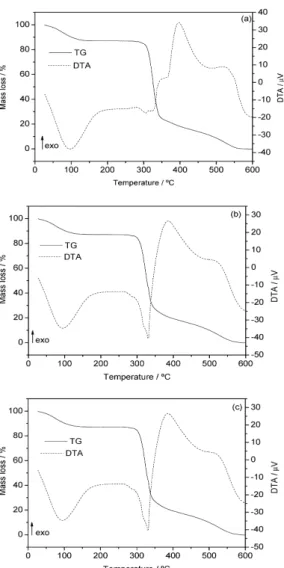
Simultaneous TG-DTA curves of corn starch granules untreated and treated with acid at 30ºC or 50ºC are shown in Figure 1.
These curves show mass losses in three steps and thermal events corresponding to these losses. A great similarity is observed in the TG-DTA profiles, both for corn starch granules untreat-ed and treatuntreat-ed with acid at 30°C or 50ºC. In all the TG-DTA curves, the first mass loss that occurs between 30 and 116°C, corresponding to endother-mic peaks at 96, 95 and 93°C, respectively is attrib-uted to the dehydration, that occurs in a single step. Once dehydrated, the compounds are stable up to 305, 295 and 293°C, and above these temper-atures the thermal decomposition of amylose and amylopectin occurs in two consecutives steps up to 553, 554 and 570°C, corresponding to endothermic and exothermic peaks, respectively. These curves also show that the first mass loss occurs through a fast process, followed by a slow process for the sec-ond one, and significant difference in the DTA pro-files between the corn starch untreated and treated with hydrochloric acid solution. In all the TG curves the final residue was smaller than 0.1%.
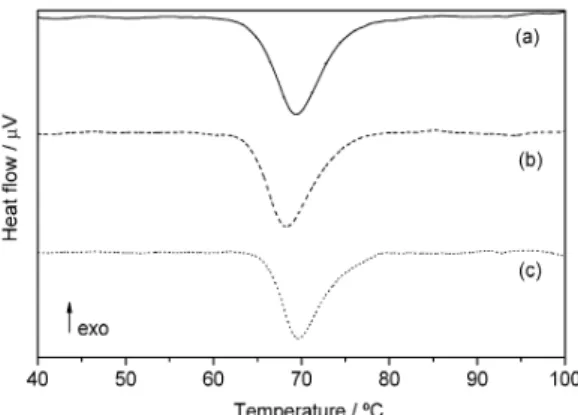
The temperature ranges θ, mass losses and peak temperatures observed for each step of the TG-DTA curves of the samples, are shown in Table 1. DSC curves of the samples are shown at Figure 2. The instrument was calibrated with indium, and an empty pan was used as reference. The character-istics of the transitions, including onset temperature (To), peak temperature (Tp) and enthalpy of gela-tinization (∆H) were calculated.
The energy required for the molecular order disrupture differs with the realized treatment, being
Table 1.Temperature ranges, mass losses and peak temperatures observed for each step of the TG-DTA
curves of the samples.
Dehydration Decompositions
Sample ∆T1(°C) ∆m1(%) peak (°C) ∆T2(°C) ∆m2(%) Peak (°C) ∆T3(°C) ∆m3(%) Peak (°C)
Untreated starch (a) 30 – 116 12,8 96 305 – 342 63,8 310, 330 342 – 553 23,3 400 Acid modified at 30°C (b) 30 – 115 13,5 95 295 – 341 63,0 330 341 – 564 23,4 390 Acid modified at 50°C (c) 30 – 115 12,7 93 293 – 344 62,0 330 344 – 570 25,3 390
larger for untreated corn starch (∆H = 19.92 J g-1), followed by acid modified starch at 30°C (∆H = 15.99 J g-1) and by acid modified starch at 50 oC (∆H = 13.41 J g-1). Onset and peak temperatures of each sample are shown in Table 2.
Native starch granules of corn observed in Figure 3 (a) shows differences in their shape and size. Corn presented irregular polyhedral morphol-ogy, with diameters between 5 and 20 µm approx-imately, confirming what was previously reported in [11, 12, 13]. During the acid treatment the gran-ules gradually underwent morphologic alterations as it can be observed in Figures 3 (b) and (c).
Figure 2. DSC curves of corn starch granules: (a) untreated; (b) acid modified at 30°C; (c) acid mod-ified at 50°C.
Table 2.Onset temperature (To), peak temperature
(Tp) and gelatinization enthalpy (∆Hgel) obtained by DSC: (a) untreated; (b) acid modified at 30°C; (c) acid modified at 50°C.
Sample T0(°C) Tp(°C) DHgel(J/g)
Starches tend to present pertinent crys-talline arrangements depending on their botanical origin [11]. According to Cereda and Vilpoux [12], the intensity of few diffraction peaks can suggest different crystallinity patterns. For corn starch (type A pattern), these peaks appear predominant-ly as one doublet at 2θ = 18° and only a peak occurring at 2θ= 23° as can be seen in Figure 4(a) and (b). When the sample was treated with HCl 0.15 mol L-1at 50°C - Figure 4(c), the peak at 2θ = 18°is not observed. Probably it can be explained
(a) (b) (c)
Figure 3. Photomicrograph of: (a) untreated corn starch granules; (b) treated with HCl 0.15 mol L-1at 30°C; (c) treated with HCl 0.15 mol L-1at 50°C. (magnification 1000 X).
Figure 4. X-ray diffraction powder patterns of the compounds: (a) untreated corn starch granules; (b) treated with HCl 0.15 mol L-1at 30°C; (c) treated
with HCl 0.15 mol L-1at 50°C.
that upon hydrolysis, crystallinity alterations were observed, once α-amylase acts mainly in the amorphous region the granules [6, 11, 12].
Conclusions
In spite of the similarity between the TG curves, significant difference is observed in the DTA profiles of the corn starch untreated and treated with hydrochloric acid solution.
DSC curves permitted to determine the gelatinization enthalpy, which decreases accord-ing with the temperature employed.
Optical microscopy confirms morpholog-ical characteristics of cereal starch granules, and the acid treatment acts initially on its surface, especially in imperfections.
X-ray diffraction confirmed the character-istic of native pattern and the increase of intensi-ty of main peaks suggesting that the crystalline part was not influenced by acid treatment or tem-perature.
Acknowledgements
Authors thanks for CAPES for financial support and for Universidade Positivo.
References
[1] S. Jobling, Plant Biotech, 7, (2004), 210.
[2] N. Singh, J. Singh, L. Kaur, N.S. Sodhi and B. S. Gill, Food Chem, 81, (2003), 219.
[3] Y. Takeda, S. Tomooka and S. Hizukuri, Carbohydr. Res, 246, (1993), 267.
[4] H. Zobel, Starch/Stärke, 40, (1988), 44.
[5] W. A. Atwell, L. F. Hood, D. R. Lineback, E. Varriano-Marston and H. F. Zobel, Cereal Food Worlds, 33, (1988), 306. [6] C. G. Biliaderis. Canadian J. Physiol. Pharmacol, 69, (1991), 60.
[7] E. Rudnik, G. Matuschek, N. Milanov and A. Kettrup, J. Therm. Anal. Cal, 85, (2006), 267.
[8] O. S. Lawal, K. O. Adebowale, B. M. Ogunsanwo, L. L. Barba and N. S. Ilo, Int. J. Biol. Macromol, 35, (2005), 71. [9] P. Aggarwal and D. Dollimore. Thermochim. Acta, 319, (1998), 17.
[10] P. Aggarwal, D. Dollimore and K. Heon, J. Therm. Anal, 50, (1997), 7.
[11] G. Zhang, Z. Ao and B. R. Hamaker. Biomacromol. 7, (2006), 3252.
[12] M. P. Cereda and O Vilpoux. Tecnologia, Usos e Potencialidades de tuberosas amiláceas Latino Americanas, Fund. Cargill, São Paulo, 2003.
[13] C. G. Mothé, D. Z. Correia, F. P de França and A. T. Riga, J. Therm. Anal. Cal. 85, (2006), 31.
C. Beninca, I. M. Demiate, L. G. Lacerda, M. A. S. Carvalho Filho, M. Ionashiro and E. Schnitzler. Comportamento térmico de grânulos de amido de milho modificados por tratamento ácido a 30 e a 50ºC.
Resumo: Os amidos nativos são estruturalmente fracos e pouco resistentes para aplicações tecnológi-cas na indústria alimentícia. O processamento é necessário para conferir aos amidos maior aplicabili-dade. Os amidos nativos podem ser modificados por vários processos como: físicos, químicos, enzi-máticos ou até combinações dos mesmos, dependendo da finalidade industrial. Amostras de amido de milho nativo foram submetidas à hidrólise por solução de ácido clorídrico e investigadas através das técnicas termoanalíticas: termogravimetria (TG), análise térmica diferencial (DTA) e calorimetria exploratória diferencial (DSC), bem como microscopia óptica e difratometria de raios X pelo método do pó. Após tratamento com ácido clorídrico a 30 e a 50 oC, foi verificado um decréscimo na entalpia de gelatinização (∆Hgel). A microscopia óptica e difratometria de raios X permitiram verificar os con-tornos de grão e rugosidade típica dos amidos de cereais.