Int. J. Advanced Networking and Applications
Volume: 6 Issue: 5 Pages: 2452-2454 (2015) ISSN: 0975-0290
2452
An Introduction of E-learning based on Social
Networks
K.M. Aslam Uddin
K.M. Aslam Uddin, student, CSE Dept. Jahangirnagar University, Savar, Dhaka, Bangladesh Email: [email protected]
Moha. Yusuf harun Khan
Moha. Yusuf harun Khan, Programmer, Ministry of Water Resources,Bangladesh Secretariat, Dhaka, Bangladesh Email: [email protected]
---ABSTRACT--- Social networks contribute a good portion of Internet traffic nowadays and thus attract tremendous research interests. Among social networking services, Facebook has become most popular for communication with familiar and also with unfamiliar persons. Many people at different levels use social network. The impact of the use of social network on students is very high. We have conducted a survey on various students from several universities of Bangladesh.The result has revealed that most of the students use Internet for social networking rather than studying. Our point of view is this part of information. Our concern is to propose an option where students can study from several pages regarding learning with the all other facilities of social network. It will help a student to learn through the use of social network.
Keywords - E-learning, Facebook, Social network.
--- Date of Submission: November 30, 2014 Date of Acceptance: February 15, 2015 ---
I. INTRODUCTION
T
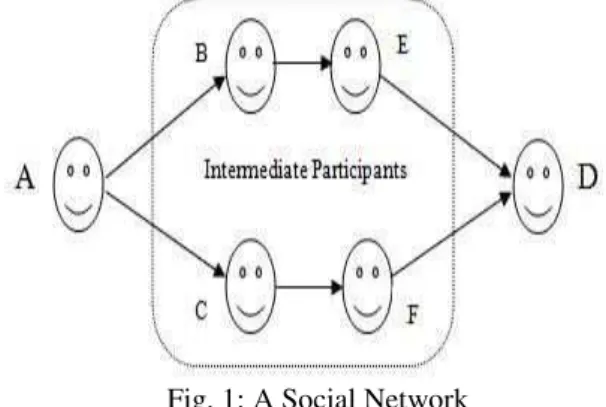
he history of the Internet began with the development of electronic computers in the 1950s. Like many developed and developing countries, the Internet in Bangladesh has witnessed phenomenal growth. Although facing many constraints in expanding internet access and use, development of the internet and information technology are high government priorities. In present ears, social networking websites, such as MySpace and Facebook have been attracting a large number of participants. In 2013, Internet users in Bangladesh increased to 33 million [1].Fig. 1: A Social Network
In social networks, each node represents a participant and each link between participants corresponds to real-world interactions or online interactions between them (e.g., A→ B and A → C in Fig. 1). One participant can give a trust value to another based on their interactions [2].Online social networking sites have been attract in a large number of participants and are being used as the means for a variety of rich activities. For example, participants carry out business, and share photos and movies on the first generation (e.g., ebay.com) and second generation (e.g.,
facebook.com) social networking sites respectively [3]. Spatiotemporal data often exhibits other structure. There are several papers based on spatiotemporal data. Theodoros Lappas et al. discussed on the Spatiotemporal Burstiness of Terms. In this paper focus on two different types of spatiotemporal burstiness patterns: i) Combinatorial pattern, these patterns ignore the geographical proximity among streams and ii) Regional pattern, these patterns consider the geographical proximity among document streams [4]. Balakrishna Gokaraju et al. discussed on comprehensive performance analysis of spatiotemporal data mining approach o multi temporal costal remote sensing data sets. They studied on an elaborative analysis to extend their fast results presented in Machine Learning based Saptio-Temporal Data Mining approach for HAB detection. They used to additional textural features Wavelet and GLCM which helped in improving the performance up to an accuracy of 0.9259
‘k’ using SeaWiFS sensor data this was an significant
improvement of all most 17% compared to their first results with an accuracy of(.7513k) [5].
Our paper is organized as follows: Section II gives a brief historical idea about Facebook. Section III describes our data collection approach. In section IV, we have given our proposed architecture. Section V includes the conclusion with our future plan.
II. SOCIAL NETWORKING
Int. J. Advanced Networking and Applications
Volume: 6 Issue: 5 Pages: 2452-2454 (2015) ISSN: 0975-0290
2453
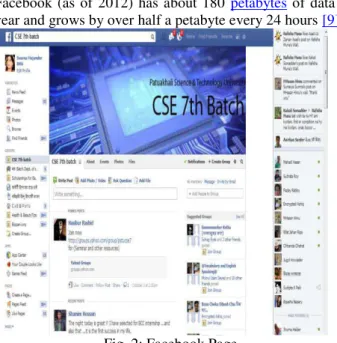
February 2004 by Mark Zuckerberg with his college roommates. As of September 2012, Facebook has over one billion active users, [7] of which 8.7% are fake[8]. Facebook (as of 2012) has about 180 petabytes of data a year and grows by over half a petabyte every 24 hours [9].
Fig. 2: Facebook Page
III. DATA COLLECTION
We have conducted an online survey [10] on the basis of Internet access among several students of different educational institutions throughout Bangladesh. We have divided the total area of Bangladesh into three regions (Urban, suburban and rural). For the simplicity of our survey we have considered the capital of Bangladesh as urban area. Then divisional areas have been considered as suburban area and very small towns have been also considered as rural areas. We have collected necessary data on the basis of ten questions from students of corresponding regions. In our survey, we have taken responses from 85 students of various universities out of which we have 56 male students and 29 female students. All of the participants use Internet at different time and space for various purposes.Number of participants with their corresponding institute is shown in the following table.
Table I: Regional categorization of different universities
After getting all the answers of the respective questions we have found that technical departments like CSE, EEE, and Mechanical etc. use Internet most for different purposes. Other sectors are little behind from Internet. We take participants from several departments like CSE, EEE, Civil, Mechanical, Bengali, Chemistry, English, Physics, Math, Statistics, Food and Nutrition Science, Fisheries, Agriculture, Pharmacy, BBA, Law, and IIT. Figure 3 shows the percentage of respondents from distinct departments.
Fig. 3: Pie chart showing the percentage of participants department wise
Question 7
Fig. 4: Column chart of answer of the question 7 Among ten questions, seventh number question was:
“Why do you use Internet?” It is the most important
question because we want to find out the internet usage field among student.Nearabout 20% students use for study, below 10% use for freelancing to income through internet, above 40% use for social communication specially Facebook, 20% student use for Entertainment specially movie download, game playing etc. and above 10% use for other purpose.
Question 8
Int. J. Advanced Networking and Applications
Volume: 6 Issue: 5 Pages: 2452-2454 (2015) ISSN: 0975-0290
2454
We know that Internet plays a vital role in education and the chart in figure 5shows the present status of usage of Internet for study purpose. About 76% student use Internet about 0-2 hours for study purpose, 18% student use for 2-4 hours, 4% student use for 4-6 hours, only 2% student use for 6-10 hours and others rate is 0%. We can say that most student spend a very small amount of time in Internet for study purpose.
IV. ARCHITECTURE OF THE PROPOSED DESIGN
Our system is composed of three distinct modules: (1) theauthoring module, where creator ofdifferent educational pages can give their page to be used, (2) the
storage module,designed mainly for student’s client, they
will be able to store their needed study related information got from the Facebook,and (3) the monitor module,used by the corresponding authority to validate a post whether it is relevant or irrelevant.
Fig. 6: Our proposed architecture
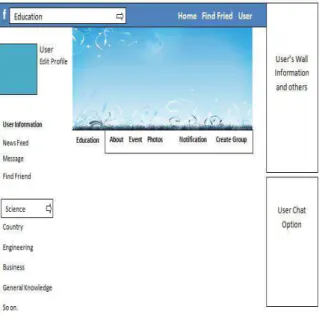
Figure 6 shows our proposed architecture for Facebook.Left column represents the options for searching e-learning pages. When a page is selected, it’s related posts will be shown in the middle column. In the upper right corner, one can access his Facebook related posts.Lower right corner represents the online buddies with which we can interact in real time. We want to integrate e-learning with Facebook. For this purpose we design an architecture module of our propose methodology. The design approach is illustrated in Fig- 6. in ingrate Education menu on the 1st left side of the Home menu. When any user clicks the Education menu a page is appeared like Fig-6.
We propose some fields under the Education menu. These fields appear on the left most side of the page like as- Science, Country, Engineering, Business, and Fashion etc. If any admin want to create any educational page relating Science then with other required information, he has to fill an additional option which will define that page as Science
related page. These operations are under the authoring module.
When any user browses science field, he gets all information about the Science related pages created by several admin. If users like any educational page then that page will appear left column of Fig-6 and all updated posts related to those pages appear under the cover photo of the middle portion.
The comments and like related notifications of those pages appears on the upper-right corner of the Education page and all education related advertisements will be displayed on the mentioned area.
V. CONCLUSION
Today most of the learning styles have been converted into e-learning. E-learning can also extend through social networks. We have proposed a way of how we can provide e-learning through Facebook. If it can attract the concerned authority, then it will be helpful for all of the learners who use Facebook across the world.In future, we want to propose our approach for all social networking sites.
REFERENCES
[1] Balakrishna Gokaraju, Surya S. Durbha, Roger L. King, and Nicolas H. YounanJalal, “Comprehensive Performance Analysis Of Spatio-Temporal Data Mining Approach On Multi-Temporal Coastal
Remote Sensing Datasets, ” 2011, IEEE.
[2] Eldon, Eric (December 18, 2008). "2008 Growth Puts Facebook In Better Position to Make Money". VentureBeat (San Francisco). Retrieved December 19, 2008.
[3] "Facebook Tops Billion-User Mark". The Wall Street Journal (New York). October 4, 2012. Retrieved October 4, 2012.
[4] Guanfeng Liu, Yan Wang and Mehmet A. Orgun,
Ee-Peng Lim “A Heuristic Algorithm for Trust-Oriented Service Provider Selection in Complex Social
Networks” 2010 IEEE.
[5] G. Liu, Y. Wang, and M. Orgun. Trust inference in complex trust-oriented social networks. In IEEE
CSE’09, pages 996–1001.
[6] Rafiqul Islam Azad (31 May 2013). "33 million Internet users in Bangladesh". The Independent (Dhaka: Independent Publications Limited). Retrieved 15 July 2013.
[7] TheodorosLappas, Marcos R. Vieira,
DimitriosGunopulos, Vassilis J. Tsotras “On the
Spatiotemporal Burstiness of Terms”, August 27th 31st 2012, Istanbul, Turkey.
[8] Jump up ^"Facebook: About 83 million accounts are fake". USA Today. Retrieved August 4, 2012. [9] Jump up ^Sharwood, Simon (9th November 2012).
"Facebook warehousing 180 PETABYTES of data a year". The Register. Retrieved August 8, 2013. [10] https://docs.google.com/forms/d/1QmTewMuimtiJ9Iu