Submitted21 September 2015 Accepted 15 April 2016 Published8 June 2016
Corresponding authors Chengxi Ye, [email protected] Zhanshan (Sam) Ma, [email protected]
Academic editor Jingyi Jessica Li
Additional Information and Declarations can be found on page 10
DOI10.7717/peerj.2016
Copyright 2016 Ye and Ma
Distributed under
Creative Commons CC-BY 4.0
OPEN ACCESS
Sparc: a sparsity-based consensus
algorithm for long erroneous sequencing
reads
Chengxi Ye1and Zhanshan (Sam) Ma2
1Department of Computer Science, University of Maryland, College Park, MD, USA
2Computational Biology and Medical Ecology Lab, State Key Laboratory of Genetic Resources and Evolution,
Kunming Institute of Zoology, Chinese Academy of Sciences, Kunming, Yunnan, China
ABSTRACT
Motivation. The third generation sequencing (3GS) technology generates long sequences of thousands of bases. However, its current error rates are estimated in the range of 15–40%, significantly higher than those of the prevalent next generation sequencing (NGS) technologies (less than 1%). Fundamental bioinformatics tasks such asde novogenome assembly and variant calling require high-quality sequences that need to be extracted from these long but erroneous 3GS sequences.
Results.We describe a versatile and efficient linear complexity consensus algorithm Sparc to facilitate de novo genome assembly. Sparc builds a sparse k-mer graph using a collection of sequences from a targeted genomic region. The heaviest path which approximates the most likely genome sequence is searched through a sparsity-induced reweighted graph as the consensus sequence. Sparc supports using NGS and 3GS data together, which leads to significant improvements in both cost efficiency and computational efficiency. Experiments with Sparc show that our algorithm can efficiently provide high-quality consensus sequences using both PacBio and Oxford Nanopore sequencing technologies. With only 30×PacBio data, Sparc can reach a
consensus with error rate <0.5%. With the more challenging Oxford Nanopore data, Sparc can also achieve similar error rate when combined with NGS data. Compared with the existing approaches, Sparc calculates the consensus with higher accuracy, and uses approximately 80% less memory and time.
Availability. The source code is available for download at https://github.com/ yechengxi/Sparc.
SubjectsBioinformatics, Biotechnology, Computational Biology, Genomics, Computational Science
Keywords Consensus algorithm, Genome assembly, Variant discovery, Single molecular sequencing, Third generation sequencing technology
INTRODUCTION
Figure 1 A standard Overlap-Layout-Consensus genome assembly pipeline.
as high as∼40% with Oxford Nanopore sequencing (Laver et al., 2015); this poses arguably
the most significant computational challenge for assembling genomes with 3GS reads. Genome assembly is the process of taking a large number of short and low-quality DNA sequences and putting them back together into contiguous pieces known ascontigsto create a high-quality representation of the original chromosomes from which the DNA originated (Myers et al., 2000;Nagarajan & Pop, 2013;Pevzner, Tang & Waterman, 2001). With the 3GS data, de novogenome assembly algorithms need to pass through three major bottlenecks: finding overlaps (Berlin et al., 2015;Ye et al., 2014), sequence alignment (Chaisson & Tesler, 2012;Myers, 2014) and sequence polishing/error correction. Efficiently correcting these long erroneous reads is a non-trivial problem (Au et al., 2012;Hackl et al., 2014;Koren et al., 2012;Salmela & Rivals, 2014). Given a low-quality target genomic region, fast algorithms are required to collect the query sequences that can be aligned to the target region, and an accurate aligner is necessary to exploit the layout relations of the query sequences. Finally, a polishing/consensus algorithm takes the layout information to infer the ‘‘ground truth’’ sequence.Figure 1summarizes the major challenges in a genome assembly pipeline, and the final step is the primary focus of this paper.
to the lack of efficient consensus algorithm, this consensus step is usually circumvented by simpler approaches such as replacing regions in the target sequences with the NGS reads or assemblies. Unfortunately, errors in the NGS sequences may corrupt the originally correct 3GS sequences and create unwanted consensus errors in the final assembly. Finally, it is also noteworthy that the consensus step in genome assembly pipelines often takes the largest portion of the computational time (Berlin et al., 2015;Chin et al., 2013;Lee et al., 2014). Therefore, an efficient consensus algorithm can significantly accelerate the whole genome assembly process.
Traditionally, multiple sequence alignment, known to be a computationally challenging task is used to find the layout and construct a sequence alignment graph (Edgar, 2004;Larkin et al., 2007;Lee, Grasso & Sharlow, 2002;Rausch et al., 2009). Alignments are refined and clustered to infer the alignment profile as the consensus in the target region. The higher error rates lead to much higher complexities with these traditional approaches. To lower the complexity, researchers have tried to simplify the multiple sequence alignment by aligning all query sequences to a backbone sequence and creating a multigraph representing the alignment graph (Chin et al., 2013). Each nucleotide base leads to a graph node. Graph simplifications are applied to merge the multiple edges, and the best scored path is found as the consensus sequence. For NGS data, a similar strategy using thede Bruijngraph (DBG) has been developed (Ronen et al., 2012) to correct the assembly errors in single cell sequence assembly.
Figure 2 The Pseudo-code ofSparc.
METHODS
Sparc consists of the following four simple steps: (i) Build an initial position specifick-mer graph (Ye et al., 2012) using the draft assembly/backbone sequence. (ii) Align sequences to the backbone to modify the existing graph. (iii) Adjust the edge weights with a sparse penalty. (iv) Search for a heaviest path and output the consensus sequence. The pseudo-code can be found inFig. 2.
Building the initial graph
Sparc uses k-mers to encode the local structure of the genomic region. It takes a preassembled draft assembly/backbone to build an initialk-mer graph (Fig. 3A). Thek-mers indifferentpositions of the backbone are treated asindependentnodes. Therefore this initial graph is a linear list of thek-mer nodes. Note that this is a major difference from the popular
de Bruijngraphs in genome assembly. Samek-mers in different locations are collapsed
in ade Bruijngraph. To deal with the long reads, it is important to differentiatek-mers by their positions in the genome. In the consensus context,k-mers are position specific; different positions are treatedindependently. It is noteworthy that allocatingk-mers in each location can take a large amount of memory, especially in the next stage. To circumvent this problem, we allow constructing a sparsek-mer graph (Ye et al., 2012) by storing a
k-mer in everygbases, which reduces the memory consumption up to 1/g. We also record the edge links between thek-mer nodes. The edge weight represents the confidence in the corresponding path. We use coverage/multiplicity to represent confidence for simplicity. In the initial graph, the edge links have multiplicity 1, therefore edge weights are set to be 1. A generalization of using quality score to model the confidence of the links is straightforward.
Figure 3 A toy example of constructing the position specific sparsek-mer graph.(A) The initialk-mer graph of the backbone. (B) Adding two sequences to the graph. (C) The heaviest path representing the consensus is found by graph traversal (original weights are used in this example).
multiplicity 1, and onek-mer node CC are allocated. (ii) If a query region perfectly aligns to an existing region in the graph, we increase the edges weights in the region without allocating new nodes. Examples can also be found inFig. 3B. When aligning the first five bases of Seq1 to the existing graph, nodes AC, GG and edge TGG are merged implicitly with the ones created by the original backbone, the edge weights are increased by 1. When aligning the last six bases of Seq2 to the existing graph, the nodes and edges are merged implicitly with the ones created by Seq1, the edge weights are changed accordingly. As previously mentioned, this construction process shares similarity with the construction of ade Bruijngraph, but the nodes in our graph are differentiated by theirk-mers and their positions in the backbone. In addition, Sparc is designed to facilitate hybrid assembly, and can leverage more weight to the high-quality data. When different types of sequencing data are available, higher weights can be assigned to the more reliable edges. The resultingk-mer graph contains rich information about the underlying genomic region. Next we describe another simple technique to extract the most likely sequence as the consensus output.
Adjusting the weights of the graph
Intuitively, a path in thek-mer graph is likely to be genuine if it is supported by multiple sequences. Based on this intuition, a path with the highest confidence, i.e., the largest sum of edge weights should be a good approximate of the ‘‘ground truth’’ sequence. However, a direct search for this path may result in an erroneous output. A simple example is a long insertion error: the sum of weights of this erroneous path is higher even though there is only one supporting sequence. To circumvent this type of error, we subtract the edge weight by a small amount. This amount is adaptively determined with consideration of the sequenc-ing coverage in each region. A fixed weight penalty is initially set to bec=1∼3; this shares
the same heuristic with the parameter setting in existingde Bruijngraph assemblers. These assemblers remove false positivek-mers/links by detecting and removing infrequent k -mers/links in the dataset. We make this penalty adaptive to the sequencing coverage by in-troducing an adaptive thresholdt=0.1∼0.3 of the average backbone multiplicity. The final
penalty is the larger of the two. In all experiments, we fix these two parameters to bec=2,
t=0.2. This penalty technique, also known as soft thresholding (Mallat, 2008), is equivalent
to put anl1-penalty on the edge weights. With this sparse penalty, the low coverage long insertion errors will be less likely to be favored compared to the genuine sequences.
Output the heaviest path as the consensus
Implementation details
The complexities of the above procedures described in all are linear to the data size. Currently Blasr (Chaisson & Tesler, 2012) is called to provide long read alignment information. Sparc takes a backbone file in fasta format and the Blasr alignment results as inputs. To avoid multiple placement of a query read, each read is mapped to one best matching region in the backbone. Reusing the consensus result as the input and iteratively running the consensus algorithm helps to improve the accuracy even more. Sparc allows for taking differentk-mer sizes (k) and skip sizes (g). Constructing a sparse graph by skipping everyg k-mers is beneficial since it consumes 1/g memory and has a similar resolving power with a dense graph using (k+g/2)-mers (Ye et al., 2012). As in thede
Bruijn graph, thek-mer size defines the anchor size when we analyze the alignments.
A large number helps to distinguish between the repeats and avoids merging unrelated sequences. However, since the 3GS data is usually of high error rates, a smallerk-mer size ensures that the weaker alignments still share enoughk-mers. A trade-off has to be made here and we find it is necessary to set this number smaller than in mostde Bruijngraphs. In our experiments we have found that usingk=1–3,g=1–5 is sufficient for practical
purposes. When high-quality NGS data is available, the edges supported by the high-quality data shall be treated with higher priority. A parameterbis introduced to selectively increase the weights of the reliable edges by a small amount (b=5∼10) to provide better cues for
the correct path.
RESULTS
Sparc has been tested on a variety of datasets. Here we demonstrate the test results from two PacBio datasets (http://schatzlab.cshl.edu/data/ectools/) and one Oxford Nanopore dataset (http://gigadb.org/dataset/100102). Sparc is designed to be a base-level consensus algorithm. While there are platform-specific ones that take into account signal processing-level information such as Quiver (for PacBio), and Nanopolish (for Oxford Nanopore), these programs usually take the outputs of the base-level ones as inputs to further improve the accuracy. As a fair comparison, we demonstrate results side-by-side with the most similar program to ours, which is PBdagcon (Chin et al., 2013). PBdagcon is the major module that is intensively used in HGAP (Chin et al., 2013) and MHAP (Berlin et al., 2015) pipelines to correct reads and generate consensus using base-level information. We therefore show the comparative results of both programs on these datasets. Both programs are fed with the same input data. We generate assembly backbones and collect the related reads for each backbone using DBG2OLC (Ye et al., 2014). Blasr (Chaisson & Tesler, 2012) is called (with option –m 5) to obtain the alignments. The final consensus error rates are calculated using thednadiff function in MUMmer 3 (Kurtz et al., 2004). All experiments are conducted on a workstation with AMD Opteron 2425 HE CPUs (@ 800 MHz frequency). In some experiments we provide both NGS data and 3GS data. In these ‘hybrid’ settings 50×Illumina assembly contigs by SparseAssembler (Ye et al., 2012) are included and the
edge weights are increased byb=5∼10. 50×Illumina data provides moderate coverage
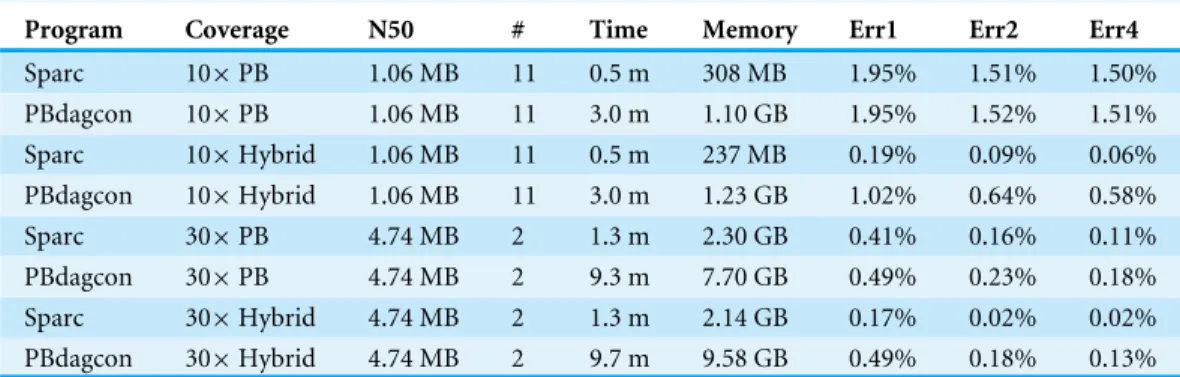
Table 1 Results on anE. colidataset using PacBio sequencing.
Program Coverage N50 # Time Memory Err1 Err2 Err4
Sparc 10×PB 1.06 MB 11 0.5 m 308 MB 1.95% 1.51% 1.50% PBdagcon 10×PB 1.06 MB 11 3.0 m 1.10 GB 1.95% 1.52% 1.51% Sparc 10×Hybrid 1.06 MB 11 0.5 m 237 MB 0.19% 0.09% 0.06% PBdagcon 10×Hybrid 1.06 MB 11 3.0 m 1.23 GB 1.02% 0.64% 0.58% Sparc 30×PB 4.74 MB 2 1.3 m 2.30 GB 0.41% 0.16% 0.11% PBdagcon 30×PB 4.74 MB 2 9.3 m 7.70 GB 0.49% 0.23% 0.18% Sparc 30×Hybrid 4.74 MB 2 1.3 m 2.14 GB 0.17% 0.02% 0.02% PBdagcon 30×Hybrid 4.74 MB 2 9.7 m 9.58 GB 0.49% 0.18% 0.13%
Table 2 Results on anA. thalianadataset using PacBio sequencing.
Program Coverage N50 # Time Memory Err1 Err2 Err4
Sparc 20×Hybrid 2.02 MB 469 21 m 1.7 GB 0.36% 0.19% 0.17% PBdagcon 20×Hybrid 2.02 MB 469 123 m 8.9 GB 0.81% 0.53% 0.47%
On PacBio datasets, we setk=1,g=1, and run the consensus algorithms for four
rounds. The per-base error rates after 1/2/4 rounds are reported as Err1, Err2 and Err4 in Tables 1and2, respectively. In the first experiment, we use anE. coliPacBio dataset and test the accuracy using different sequencing coverages. The longest backbones generated by DBG2OLC using 10×/ 30×data are 1.3 Mb and 4.6 Mbp respectively. TheE. coligenome
reference (4.6 Mbp) can be found with accession number NC_000913. An important assembly scenario is when we have both NGS and 3GS data, we find that Sparc facilitates this hybrid assembly approach and leads to both cost efficiency and computational efficiency. After two rounds, Sparc reaches an error rate of 0.09% using only 10×data in a hybrid
setting compared to 0.64% using PBdagcon. As expected, the quality is even better with 30×data (0.02%). The error rates of using PacBio (PB) data only (i.e., non-hybrid) are
higher as expected. Running the algorithms for more than two rounds lead to slightly more improvements, at the cost of more computational time. The time of running both programs for two rounds are reported inTables 1and2.
Sparc scales well to larger datasets; we show here the performance of Sparc and PBdagcon on a larger 20×PacBioA. thalianadataset (genome size 120 Mbp). The longest backbone
generated by DBG2OLC is 7.1 Mbp. Sparc finishes with 1/5th time and memory compared with PBdagcon while producing more accurate results. Here a pure PacBio full genome assembly generated by MHAP (Berlin et al., 2015) is used as the reference to calculate the error rates.
On an Oxford Nanopore dataset, we setk=2,g=2 and run the consensus algorithms
Table 3 Results on anE. colidataset using Oxford Nanopore sequencing.
Program Coverage N50 # Time Memory Err1 Err2 Err4
Sparc 30×ON 4.61 MB 1 2.3 m 1.89 GB 11.96% 9.22% 7.47% PBdagcon 30×ON 4.61 MB 1 10.0 m 8.38 GB 13.70% 12.96% 12.86% Sparc 30×Hybrid 4.61 MB 1 3.3 m 1.86 GB 0.72% 0.59% 0.46% PBdagcon 30×Hybrid 4.61 MB 1 13.2 m 9.56 GB 11.20% 10.01% 9.96%
Table 4 Memory and quality comparisons using differentk,gvalues.
K g Time Memory Error rate
1 1 43 s 2.3 GB 0.16%
2 1 55 s 3.5 GB 0.14%
1 2 59 s 1.6 GB 0.18%
2 2 68 s 2.3 GB 0.13%
Table 5 Performance of using differentbvalues.
Dataset b Err1 Err4
30×PB HybridE. coli 0 0.34% 0.05%
30×PB HybridE. coli 5 0.17% 0.02%
30×PB HybridE. coli 10 0.11% 0.02%
30×PB HybridE. coli 15 0.08% 0.02%
30×ON HybridE. coli 0 6.87% 6.69%
30×ON HybridE. coli 5 0.88% 0.70%
30×ON HybridE. coli 10 0.72% 0.46%
30×ON HybridE. coli 15 0.69% 0.48%
Below 0.5% error rate is reached even though the raw error rate could be as high as 40%. In contrast, non-hybrid consensus generated less usable results due to this excessive error rate. The longest backbone in this test is 4.6 Mbp. The time of running both programs for four rounds are reported inTable 3.
Sparc is relatively insensitive to different parameters and hence easy to use even for inexperienced users. We vary the parameters in the second round of the 30×PacBioE. coli
dataset using PacBio data only. The memory, time and quality of using differentk,g are
reported inTable 4. Using a slightly largerk-mer size increases the per-base accuracy, as more strict matches are enforced, this effect is more significant on multi-ploid genomes, as different strands will have more distinct representations. However, this also increases the memory consumption because more branching nodes are created. Setting a largerg
helps to reduce the memory consumption. The influence of various amount of weight increase (b=0,5,10,15) to NGS data in the hybrid consensus setting can be found in
Table 5. Empirically this parameter can be safely set asb=5∼15 without compromising
the accuracy. In practice we would tentatively set it to be a low values (b=5∼10) to more
CONCLUSION
Consensus module is a critical component in the Overlap-Layout-Consensus assembly framework. With the introduction of 3GS technology, its importance is further raised. In this work we demonstrated a simple but efficient consensus algorithm that usesk-mers as building blocks and produces high-quality consensus from a position-specifick-mer graph. It supports hybrid sequencing data which leads to the significant improvements in both cost efficiency and computational efficiency. The proposed method is expected to significantly expand its applications in error correction and variant discovery. The consensus quality can also be enhanced further by incorporating platform specific, signal-level information.
ACKNOWLEDGEMENTS
We thank Chris Hill and Jue Ruan for help and fruitful discussions.
ADDITIONAL INFORMATION AND DECLARATIONS
Funding
The research received funding from the following sources: NSFC (Grant No: 61175071 & 71473243) and ‘‘Exceptional Scientists Program of Yunnan Province, China.’’ The funders had no role in study design, data collection and analysis, decision to publish, or preparation of the manuscript.
Grant Disclosures
The following grant information was disclosed by the authors: NSFC: 61175071, 71473243.
Exceptional Scientists Program of Yunnan Province, China.
Competing Interests
The authors declare there are no competing interests.
Author Contributions
• Chengxi Ye conceived and designed the experiments, performed the experiments,
analyzed the data, wrote the paper, prepared figures and/or tables, reviewed drafts of the paper.
• Zhanshan (Sam) Ma conceived and designed the experiments, wrote the paper, reviewed
drafts of the paper.
Data Availability
The following information was supplied regarding data availability: The research in this article did not generate any raw data.
REFERENCES
Berlin K, Koren S, Chin C-S, Drake J, Landolin JM, Phillippy AM. 2015.Assembling large genomes with single-molecule sequencing and locality-sensitive hashing.
Nature Biotechnology33:623–630.
Chaisson M, Tesler G. 2012.Mapping single molecule sequencing reads using basic local alignment with successive refinement (BLASR): application and theory.BMC
Bioinformatics13:238DOI 10.1186/1471-2105-13-238.
Chin CS, Alexander DH, Marks P, Klammer AA, Drake J, Heiner C, Clum A, Copeland A, Huddleston J, Eichler EE, Turner SW, Korlach J. 2013.Nonhybrid, finished microbial genome assemblies from long-read SMRT sequencing data.Nature
Methods10:563–569DOI 10.1038/nmeth.2474.
Edgar RC. 2004.MUSCLE: multiple sequence alignment with high accuracy and high throughput.Nucleic Acids Research32:1792–1797DOI 10.1093/nar/gkh340. Hackl T, Hedrich R, Schultz J, Forster F. 2014.proovread: large-scale high-accuracy
PacBio correction through iterative short read consensus.Bioinformatics
30:3004–3011DOI 10.1093/bioinformatics/btu392.
Hannenhalli S, Feldman W, Lewis HF, Skiena SS, Pevzner PA. 1996.Positional sequencing by hybridization.Computer Applications in the Biosciences12:19–24. Huang XQ, Wang JM, Aluru S, Yang SP, Hillier L. 2003.PCAP: a whole-genome
assembly program.Genome Research13:2164–2170DOI 10.1101/gr.1390403. Koren S, Schatz MC, Walenz BP, Martin J, Howard JT, Ganapathy G, Wang Z, Rasko
DA, McCombie WR, Jarvis ED, Adam MP. 2012.Hybrid error correction andde novoassembly of single-molecule sequencing reads.Nat Biotechnol30:693–700 DOI 10.1038/nbt.2280.
Kurtz S, Phillippy A, Delcher A, Smoot M, Shumway M, Antonescu C, Salzberg S. 2004. Versatile and open software for comparing large genomes.Genome Biology5:R12 DOI 10.1186/gb-2004-5-2-r12.
Larkin MA, Blackshields G, Brown N, Chenna R, McGettigan PA, McWilliam H, Valentin F, Wallace IM, Wilm A, Lopez R. 2007.Clustal W and clustal X version
2.0.Bioinformatics23:2947–2948DOI 10.1093/bioinformatics/btm404.
Laver T, Harrison J, O’Neill P, Moore K, Farbos A, Paszkiewicz K, Studholme D. 2015.Assessing the performance of the Oxford Nanopore Technologies MinION.
Biomolecular Detection and Quantification3:1–8DOI 10.1016/j.bdq.2015.02.001.
Lee C, Grasso C, Sharlow MF. 2002.Multiple sequence alignment using partial order graphs.Bioinformatics18:452–464DOI 10.1093/bioinformatics/18.3.452.
Lee H, Gurtowski J, Yoo S, Marcus S, McCombie WR, Schatz M. 2014.Error correction and assembly complexity of single molecule sequencing reads.BioRxiv Preprint. BioRxiv:006395DOI 10.1101/006395.
Mallat S. 2008.A wavelet tour of signal processing: the sparse way. Cambridge: Academic press.
Mullikin JC, Ning ZM. 2003.The phusion assembler.Genome Research13:81–90 DOI 10.1101/gr.731003.
Myers G. 2014. Efficient local alignment discovery amongst noisy long reads. In:
Myers EW, Sutton GG, Delcher AL, Dew IM, Fasulo DP, Flanigan MJ, Kravitz SA, Mobarry CM, Reinert KH, Remington KA, Anson EL, Bolanos RA, Chou HH, Jordan CM, Halpern AL, Lonardi S, Beasley EM, Brandon RC, Chen L, Dunn PJ, Lai Z, Liang Y, Nusskern DR, Zhan M, Zhang Q, Zheng X, Rubin GM, Adams MD, Venter JC. 2000.A whole-genome assembly of Drosophila.Science287:2196–2204 DOI 10.1126/science.287.5461.2196.
Nagarajan N, Pop M. 2013.Sequence assembly demystified.Nature Reviews Genetics
14:157–167DOI 10.1038/nrg3367.
Pevzner PA, Tang H, Waterman MS. 2001.An Eulerian path approach to DNA fragment assembly.Proceedings of the National Academy of Sciences of the United States of
America98:9748–9753DOI 10.1073/pnas.171285098.
Rausch T, Koren S, Denisov G, Weese D, Emde AK, Doring A, Reinert K. 2009.A consistency-based consensus algorithm forde novoand reference-guided sequence assembly of short reads.Bioinformatics25:1118–1124
DOI 10.1093/bioinformatics/btp131.
Ronen R, Boucher C, Chitsaz H, Pevzner P. 2012.SEQuel: improving the accuracy of genome assemblies.Bioinformatics28:i188–i196DOI 10.1093/bioinformatics/bts219. Salmela L, Rivals E. 2014.LoRDEC: accurate and efficient long read error correction.
Bioinformatics30(24):3506–3514DOI 10.1093/bioinformatics/btu538.
Ye C, Hill C, Wu S, Ruan J, Ma Z. 2014.Efficient assembly of large genomes using long erroneous reads of the third generation sequencing technologies. ArXiv preprint. arXiv:14102801.
Ye C, Ma ZS, Cannon CH, Pop M, Yu DW. 2012.Exploiting sparseness inde novo