ON THE USE OF REPLACEMENT MESSAGES IN
GLEISON BRITO BATISTA
ON THE USE OF REPLACEMENT MESSAGES IN
API DEPRECATION: AN EMPIRICAL STUDY
Dissertation presented to the Graduate Program in Computer Science of the Fed-eral University of Minas Gerais in partial fulfillment of the requirements for the de-gree of Master in Computer Science.
Advisor: Marco Tulio de Oliveira Valente
Co-Advisor: Andre Cavalcante Hora
Belo Horizonte
© 2016, Gleison Brito Batista. Todos os direitos reservados
Ficha catalográfica elaborada pela Biblioteca do ICEx - UFMG
Batista, Gleison Brito.
B333o On the use of replacement messages in API deprecation: an empirical study. / Gleison Brito Batista.— Belo
Horizonte, 2016.
xviii, 57 f.: il.; 29 cm.
Dissertação (mest rad o) - Universidade Federal de
Minas Gerais – Departamento de Ciência da Computação. Orientador: Marco Túlio de Oliveira Valente.
Coorientador: André Cavalcante Hora
1. Computação – Teses. 2.Software – Manutenção – Teses. 3. Software – Desenvolvimento –Teses. I.
Orientador. II. Coorientador. III. Título.
Resumo
Como quaisquer sistemas de software, frameworks e bibliotecas evoluem ao longo do tempo, assim como suas APIs. Consequentemente, sistemas clientes devem ser con-stantemente atualizados para utilizarem APIs melhoradas. Para facilitar essa tarefa e preservar a compatibilidade com versões anteriores, elementos de API devem ser depreciados com mensagens de substituição. No entanto, na prática, existem evidên-cias de que esses elementos são usualmente depreciados sem tais mensagens. Nessa dissertação, são estudados um conjunto de questões relacionadas à adoção de men-sagens de depreciação. O trabalho objetiva: (i) mensurar a utilização de menmen-sagens de depreciação e (ii) investigar a necessidade de uma ferramenta para recomendar essas mensagens. Para tanto, foram verificados (i) a frequência de elementos depreciados com mensagens de depreciação, (ii) o impacto da evolução de software nessa frequência e (iii) as características dos sistemas com elementos depreciados corretamente. Para alcançar esses objetivos, foi realizado um estudo com 622 sistemas Java e 229 sistemas C#. Esse estudo mostrou que: (i) 66,7% dos elementos de APIs de um sistema são depreciados com mensagens de substituição em Java; para C# esse valor é 77,8%, (ii) em ambas linguagens há pouco esforço para melhorar as mensagens de depreciação ao longo do tempo e (iii) sistemas que depreciam elementos de API corretamente são estatisticamente diferentes em termos de tamanho, comunidade de desenvolvedores e atividade. Também foi realizado um segundo estudo para avaliar a viabilidade de uma ferramenta de recomendação capaz de inferir mensagens de substituição utilizando as soluções adotadas pelos desenvolvedores. Como resultado temos que: (i) 73% das recomendações sugeridas pela ferramenta correspondem de fato a mensagens de subs-tituição reais de elementos de API depreciados e (ii) os percentuais de mensagens de substituição cobertos pela ferramenta em três sistemas relevantes são 28,2%, 30,7% e 37,5%. Os resultados obtidos apontam que essa ferramenta pode oferecer sugestões úteis para mantenedores de software.
Keywords: Depreciação de APIs, Evolução de software, Manutenção de software.
Abstract
As any software system, frameworks and libraries evolve over time, and so their APIs. Consequently, client systems should be updated to benefit from improved APIs. To facilitate this task and preserve backward compatibility, API elements should be dep-recated with clear replacement messages. However, in practice, there are evidences that API elements are usually deprecated without such messages. In this dissertation, we study a set of questions regarding the adoption of deprecation messages. Our goal is twofold: to measure the usage of deprecation messages and to investigate whether a tool is needed to recommend such messages. Thus, we verify (i) the frequency of dep-recated elements with replacement messages, (ii) the impact of software evolution on such frequency, and (iii) the characteristics of systems with API elements deprecated in a correct way. To achieve these goals we perform an empirical study using 622 Java systems and 229 C# systems. Our large-scale analysis shows that (i) 66.7% of the API elements in Java are deprecated with replacement messages per system, and for C# this value is 77.8%, (ii) there is almost no major effort to improve deprecation messages over time in both languages, and (iii) systems that deprecate API elements in a cor-rect way are statistically significantly different in terms of size, developing community, and activity. In addition, we perform a second study to evaluate the feasibility of a recommendation tool to infer replacement messages by mining solutions adopted by developers. As result of this second study, we report that: (i) 73% of the recommenda-tions provided by the tool correspond to the real replacement messages of deprecated API elements and (ii) the percentage of replacement messages covered by the tool in three relevant systems are 28.2%, 30.7%, and 37.5%. These results suggest that this tool can provide real value to software maintainers.
Keywords: API deprecation, Software evolution, Software maintenance.
List of Figures
2.1 APIs acting as interfaces between clients and a provider software en-tity [Montandon, 2013]. . . 8
3.1 Distribution of number of stars, number of releases, and number of depre-cated API elements in the selected systems. . . 14 3.2 Number of systems in library and non-library categories. . . 15 3.3 Distribution of the percentage of deprecated APIs with replacement
mes-sages in the top-30% and bottom-30% systems. . . 20
4.1 Absolute distribution of deprecated API elements with replacement messages. 24 4.2 Relative distribution of deprecated API elements with replacement messages. 25 4.3 Relative distribution of deprecated API elements with replacement messages
in library and non-library systems. . . 27 4.4 Absolute distribution of deprecated API elements with replacement
mes-sages over time. . . 28 4.5 Relative distribution of deprecated APIs with replacement messages over
time. . . 29 4.6 Relative distribution of systems where the percentage of replacement
mes-sages increased from the first to the last release. . . 30 4.7 Relative distribution of systems where the percentage of replacement
mes-sages decreased from the first to the last release. . . 31 4.8 Examples of systems in each evolution category. . . 32 4.9 Number of releases for each category of system. . . 33 4.10 Relative distribution of replacement messages in systems in the increase
category, comparing the first and last releases. . . 34 4.11 Relative distribution of replacement messages in systems in the decrease
category, comparing the first and last releases. . . 34
5.1 Deprecated typeT without replacement message on the left and an example of suggested replacement message on the right. . . 44
List of Tables
3.1 Regular expressions to identify API elements in C# . . . 16
3.2 Number of deprecated API elements. . . 17
3.3 Frequency of replacement message guidelines in Java. . . 18
3.4 Frequency of replacement message guidelines in C#. . . 18
3.5 Metrics likely to impact API deprecation. . . 19
4.1 Number of deprecated API elements with replacement messages. . . 24
4.2 Number of systems in each evolution category . . . 32
4.3 Metrics and their respective p-values and d on top and bottom systems. Bold values mean p-value < 0.05 (statistically significant different), and d >0.147 (at least a small effect size). Level of significance for d-values: L = large, M = medium, S = Small, N = negligible. Rel. = relationship: “+” = top systems have significantly higher value on this metric. “-” = bottom systems have significantly higher value on this metric. . . 36
4.4 Comparison between a top and bottom Java system. . . 38
4.5 Comparison between a top and bottom C# system. . . 38
5.1 Examples of evolution rules . . . 45
Contents
Resumo vii
Abstract ix
List of Figures xi
List of Tables xiii
1 Introduction 1
1.1 Motivation . . . 1
1.2 Proposed Work . . . 2
1.3 Publications . . . 4
1.4 Outline of the Dissertation . . . 4
2 Background 7 2.1 Application Programming Interfaces . . . 7
2.2 API Deprecation . . . 9
2.2.1 API Deprecation in Java . . . 9
2.2.2 API Deprecation in C# . . . 11
2.3 Final Remarks . . . 12
3 Study Design 13 3.1 Selecting Case Studies . . . 13
3.2 Extracting Deprecated API Elements . . . 15
3.3 Extracting Replacement Messages . . . 17
3.4 Metrics Possibly Impacting API Deprecation . . . 18
3.5 Extracting Metrics from Case Studies . . . 20
3.6 Final Remarks . . . 21
4 Results 23
4.1 RQ1. What is the frequency of deprecated APIs with replacement
mes-sages? . . . 23
4.2 RQ2. What is the impact of software evolution on the frequency of replacement messages? . . . 28
4.3 RQ3. What are the characteristics of software systems with high and low frequency of replacement messages? . . . 35
4.4 Threats to Validity . . . 37
4.4.1 Construct Validity . . . 38
4.4.2 Internal Validity . . . 40
4.4.3 External Validity . . . 40
4.5 Final Remarks . . . 41
5 Practical Implications 43 5.1 Motivation . . . 43
5.2 Study Design . . . 44
5.2.1 Dataset . . . 44
5.2.2 Research Questions . . . 46
5.3 Results . . . 47
5.4 Final Remarks . . . 50
6 Conclusion 51 6.1 Overview . . . 51
6.2 Related Work . . . 52
6.2.1 API Evolution Impact . . . 52
6.2.2 API Evolution Analysis . . . 53
6.3 Contributions . . . 54
6.4 Future Work . . . 54
Bibliography 55
Chapter 1
Introduction
This chapter introduces this master dissertation. Initially, we discuss the motivations of the work in Section 1.1. Section 1.2 details the proposed study. Section 1.3 presents our publications. Finally, Section 1.4 presents the outline of this study.
1.1
Motivation
Nowadays, it is a common practice to implement systems on top of frameworks and libraries [Tourwé and Mens, 2003], taking advantage of their Application Programming Interfaces (APIs). This practice provides several benefits to client systems, for example:
• Reduction of development costs and time [Moser and Nierstrasz, 1996];
• Increase focus on the essential system requirements, since developers do not need
to re-implement the services provided by an API [Konstantopoulos et al., 2009];
• Increase software quality by using well-adopted, tested and documented code
elements.
However, as any software system, frameworks/libraries and their APIs evolve over time. Naturally, public types, methods, and fields provided by these APIs may be renamed, removed or updated. Consequently, client systems should migrate to benefit from improved API elements.
To facilitate client developers making the transition and preserve backward com-patibility, API elements should be deprecated with replacement messages. Mechanisms to support API deprecation are provided by most programming languages, such Java and C#. For example, Java has two solutions to deprecate types, methods, and fields:
2 Chapter 1. Introduction
using deprecation annotations and/or deprecation Javadoc tags. Both annotations and Javadoc tags are used to warn developers referencing deprecated API elements. How-ever, the latter may be accompanied by replacement messages to suggest what to use instead. Listing 1.1 presents an example of a deprecated method in Java. In this ex-ample, thegetPostParams method is deprecated with a @Deprecated annotation (line 4) and a Javadoc tag@deprecated (line 2). This tag contains a replacement suggestion for the deprecated method, which is, in the presented example, the methodgetParams. 1 /**
2 * @deprecated Use {@link #getParams()} instead. 3 */
4 @Deprecated
5 protected Map<String, String> getPostParams() throws AuthFailureError { 6 //...
7 }
Listing 1.1. Deprecated method in Java -google/ioshed
In a similar way, the standard solution to deprecate API elements in C# consists on using the Obsolete attribute accompanied by a replacement message. Listing 1.2 shows an example of a method deprecated with the Obsolete attribute (line 1). This attribute includes a parameter with the deprecation message.
1 [Obsolete("Use GenerateAsync instead")]
2 public static void Generate(PythonTypeDatabaseCreationRequest request) { 3 //...
4 }
Listing 1.2. Deprecated method in C# - Microsoft/PTVS
In practice, previous studies indicate that API elements are often deprecated with missing or unclear replacement messages. Robbes et al. [2012] perform a large-scale study in order to investigate the impact of API deprecation in a large-scale software ecosystem. In this study, the authors present preliminary evidences that APIs are usually deprecated without replacement messages. Hora et al. [2015] investigate the impact of API evolution also at an ecosystem level. Their results suggest that depre-cation mechanisms should be more adopted. However, we are still unaware about the scale of this phenomenon and whether it tends to get better (or worse) over time.
1.2
Proposed Work
In order to investigate the adoption of API deprecation messages, we analyse in this master dissertation the following factors:
1.2. Proposed Work 3
• The impact of software evolution on the frequency of replacement messages;
• The characteristics of systems which deprecate API elements in a correct way in
terms of popularity, size, community, activity, and maturity.
Our goal is twofold: to measure the usage of deprecation messages and to inves-tigate whether a tool is needed to recommend such messages. Thus, we propose the following research questions to support our study:
• RQ #1. What is the frequency of deprecated APIs with replacement
messages? In this research question, we analyse the frequency of deprecated API elements with replacement messages, using a large dataset of Java and C# systems. We detected that 66.7% of the API elements are deprecated with re-placement messages per system in Java. For C#, this value is 77.8%;
• RQ #2. What is the impact of software evolution on the frequency of
replacement messages? In this research question, we analyse the frequency of replacements messages by comparing (i) two releases in a first analysis and (ii) multiple releases in a second one. Overall, we detect that, in both languages, there is almost no major effort to improve such messages over time;
• RQ #3. What are the characteristics of software systems with high
and low frequency of replacement messages? In this research question, we investigate whether system popularity, size, community, activity, and maturity have an impact on the way developers deprecate API elements. We find that systems that follow best deprecation practices are statistically significant different from the ones that do not in terms of size, developing community, and activity.
4 Chapter 1. Introduction
To conclude, the major contributions of this dissertation are summarized as fol-lows:
• We provide a large-scale empirical study to better understand to what extend
APIs are deprecated using replacement messages.
• We provide evidences on the benefits of a recommendation tool to assist client
developers in the detection of missing replacement messages.
1.3
Publications
This master dissertation generated the following publications and therefore contains material of them:
• Brito, G., Hora, A., and Valente, M. T. (2015). Um estudo sobre a utilização de
mensagens de depreciação de APIs. In III Workshop de Visualização, Evolução e Manutenção de Software (VEM) (best paper)
• Brito, G., Hora, A., Valente, M. T., and Robbes, R. (2016). Do developers
depre-cate APIs with replacement messages? A large-scale analysis on Java systems. In 23rd International Conference on Software Analysis, Evolution and Reengineer-ing (SANER) (Qualis A2)
1.4
Outline of the Dissertation
We organized the remainder of this work as follows:
• Chapter 2 covers central concepts related to this master dissertation. In the
first part, we explain the concept of Application Programming Interfaces. In the second part, we describe how Java and C# systems deprecate API elements.
• Chapter 3 describes in detail the selection of case studies, the metrics used to
investigate API deprecation, the guidelines used to extract replacement messages, and the metrics possibly impacting API deprecation, in order to answer the proposed research questions.
• Chapter 4 answers and discusses the research questions proposed in this
1.4. Outline of the Dissertation 5
of such messages. Finally, we describe the characteristics that impact on the way developers deprecate API elements.
• Chapter 5evaluates possible practical implications of the study presented in this
master dissertation. First, we explain the motivation of this study and present the study design. Finally, we present preliminary results.
• Chapter 6 presents final considerations, including related work, a summary of
Chapter 2
Background
In this chapter, we provide a general review of the central topics required to understand the work presented in this dissertation. Section 2.1 explains the concept of API and Section 2.2 describes how Java and C# systems deprecate API elements.
2.1
Application Programming Interfaces
In this dissertation, we define Application Programming Interfaces (APIs) as interfaces used by software components to communicate with each other. Figure 2.1 presents a software entity connecting with clients via its API. Examples of successful APIs include Java API1
, .NET Framework Class Library2
, and Android API3
. More specifically, we define API elements as public/protected types, fields or methods. In addition, C# provides properties, which contain a mechanism to read or write the value of a field. Listing 2.1 shows an example of property. This example shows the declaration of an integer property MaximumPendingSessions (line 1), where the methods get and set are used to return and assign its value, respectively. In order to maintain compatibility between the two languages, we consider properties as fields elements.
1 int MaximumPendingSessions 2 {
3 get; 4 set; 5 }
Listing 2.1. Example of property in C# -mono/mono
1
https://docs.oracle.com/javase/8/docs/api/
2
http://msdn.microsoft.com/en-us/library/gg145045.aspx
3
http://developer.android.com/é-éreference
8 Chapter 2. Background
Figure 2.1. APIs acting as interfaces between clients and a provider software entity [Montandon, 2013].
APIs bring many benefits to modern software development [Konstantopoulos et al., 2009; Moser and Nierstrasz, 1996] such as (i) reduction of costs and time, (ii) increase focus on the essential system requirements, since developers do not need to re-implement the services provided by an API, and (iii) increase software quality, since APIs are usually developed by experts and are widely tested.
Listing 2.2 shows an example of API, which presents an excerpt of the Stack class in package java.util for Java Platform Standard Edition4
. In this example, the methods push, pop, peek, empty, and search are public, therefore they are defined as API elements. By contrast, serialVersionID field (line 18) is private, thus it is not an API element. Furthermore, the classStack is also an API element, because it is public.
1 public class Stack<E> extends Vector<E> { 2
3 public E push(E item) { 4 //...
5 }
6 public synchronized E pop() { 7 //...
8 }
9 public synchronized E peek() { 10 //...
11 }
12 public boolean empty() { 13 //...
14 }
15 public synchronized int search(Object o) { 16 //...
17 }
18 private static final long serialVersionUID = 1224463164541339165L; 19 }
Listing 2.2. Example of API elements in class java.util.Stack from Java
4
2.2. API Deprecation 9
2.2
API Deprecation
Software systems evolve over time, changing their elements e.g., methods, fields, and types, and so their APIs. When an API element changes, the impact propagates to client systems. To mitigate the impact of these changes, libraries and frameworks should use deprecation mechanisms, like messages to support developers. In fact, API deprecation is a way to alleviate the impact of API changes.
In theory, before being removed, API elements should be annotated as depre-cated to support client developers making the transition to new ones. Depredepre-cated API elements are kept in the system to preserve backward compatibility, but they should not be used by developers because they may be removed in the future.
Many studies investigate the impact of API evolution. For example, through an investigation on the Android ecosystem about adoption of API changes, McDonnell et al. [2013] found that when changes occur rapidly, clients have difficulty in adopting updates. In a large-scale study, Robbes et al. [2012] detected that some deprecation of APIs have large impact on the Smaltalk ecosystem, finding evidence that APIs are usually deprecated with missing and unclear messages. In addition, Hora et al. [2015] investigated the impact of API replacement and improvement on a large-scale ecosys-tem also written in Smalltalk. The results of this study confirm the large impact on client systems, recommending that deprecation mechanisms should be more adopted.
2.2.1
API Deprecation in Java
The Java language, since J2SE 5.0, provides a mechanism to deprecate types, methods, and fields, using the @Deprecated annotation. This annotation causes the compiler to issue a warning when it finds references to deprecated API elements. Listing 2.3 shows an example of a deprecated method using the@Deprecated annotation. In this example, the Database method is deprecated with this annotation (line 1), but it is not included any suggestion for a replacement.
1 @Deprecated
2 public Database(Context context) { 3 //...
4 }
Listing 2.3. Deprecated method in Java using @Deprecated annotation
-facebook/stetho
10 Chapter 2. Background
1 Note: Path\to\java\file.java uses or overrides a deprecated API. 2 Note: Recompile with -Xlint:deprecation for details.
Listing 2.4. Warning message caused by @Deprecated annotation
When using deprecation annotations, it is a good practice to document the rea-sons for the deprecation and/or to recommend alternative API elements. In order do support this practice, Java provides the Javadoc tag @deprecated (supported since J2SE 1.1). The tag should also be used to warn developers about deprecated elements. Listing 2.5 shows an example of a deprecated method using the @deprecated tag (line 3). The tag contains a deprecation message that suggests replacing the deprecated methodsetFieldOrder (lines 6-8) by the methodgetFieldOrder.
1 /**
2 * Force a compile-time error on the old method of field definition 3 * @deprecated Use the required method getFieldOrder() instead to 4 * indicate the order of fields in this structure.
5 */
6 protected final void setFieldOrder(String[] fields) { 7 //...
8 }
Listing 2.5. Deprecated method in Java using the Javadoc tag @deprecated
-java-native-access/jna
More specifically, Java documentation recommends the use of two solutions to deprecate elements with replacement messages, i.e., message to suggest developers what to use instead, as follows:
• Javadoc 1.1: This Javadoc version recommends to use the annotation @see to
indicate the replacement API.
• Javadoc 1.2 and later: These versions recommend to use the word use followed
by the annotation @link to indicate the replacement API.
Listing 2.6 presents an example of deprecated Java type using the Javadoc 1.1 guideline. In this example, the tag @deprecated (line 2) is used to generate documen-tation in order to help the developers. The tag @see (line 3) reports the replacement element. Furthermore, this tag is used to generate the See Also field in Javadoc doc-umentation. We also note the use of@Deprecated annotation to show the deprecation warning. The warning message is “since 1.4”.
2.2. API Deprecation 11
a link to the documentation of the replacement element. The warning message “Use @link #ScriptSortBuilder(Script, String) instead” will therefore be presented when developers compile a system that calls the deprecated method lang. This message contains the suggestion for the replacement element and the link for its documentation.
1 /**
2 * @deprecated since 1.4
3 * @see org.apache.accumulo.core.client.IteratorSetting.Column 4 */
5 @Deprecated
6 public class PerColumnIteratorConfig { 7 //...
8 }
Listing 2.6. Deprecated type in Java using Javadoc 1.1 guidelines - spring-projects/spring-framework
1 /**
2 * The language of the script.
3 * @deprecated Use {@link #ScriptSortBuilder(Script, String)} instead. 4 */
5 @Deprecated
6 public ScriptSortBuilder lang(String lang) { 7 //...
8 }
Listing 2.7. Deprecated method in Java using Javadoc 1.2 guidelines
-elastic/elasticsearch
Last but not least, Java deprecation guidelines are not mandatory; developers may adopt other conventions to create replacement messages, or simply do not use them at all.
2.2.2
API Deprecation in C#
The C# language proposes the attribute Obsolete to deprecate elements. Like @Dep-recated annotations in Java, when an element has the Obsolete attribute, the C# compiler issues a message if it is used. The attribute contains two arguments: (i) a message to support developers and (ii) a parameter to define if the use of deprecated element should cause a compiler error.
The Obsolete attribute can be used with no arguments, but it is recommended to include an explanation of why the item is obsolete and what API element should be used as a replacement.
12 Chapter 2. Background
1 [Obsolete("Use ApiTaskAsync instead.")]
2 protected virtual void ApiAsync(HttpMethod httpMethod, string path, object parameters, Type resultType, object userState)
3 {
4 //...
5 }
Listing 2.8. Deprecated method in C# using Obsolete attribute with a replacement message -facebook-csharp-sdk/facebook-csharp-sdk
Listing 2.9 shows a second example of a deprecated property. The Obsolete attribute is used with a message parameter and a compiler error parameter. The error message is “Unused. Use ItemType property instead”. The value of the compiler error parameter istrue.
1 [Obsolete("Unused. Use ItemType property instead.", true)] 2 public string ItemGroupName
3 {
4 get; 5 set; 6 }
Listing 2.9. Deprecated property in C# using Obsolete attribute with replacement message and warning parameter - Microsoft/msbuild
2.3
Final Remarks
Chapter 3
Study Design
In this chapter, we describe our experiment design, which is organized as follow. Section 3.1 describes the selection of case studies. Section 3.2 presents the metrics used to investigate API deprecation in this study. Section 3.3 describes the guidelines used to extract replacement messages. Section 3.4 discusses the metrics possibly impacting API deprecation. Section 3.5 describes the extraction of these metrics. Finally, Section 3.6 presents the final remarks.
3.1
Selecting Case Studies
We analyse Java and C# systems hosted on GitHub, a popular social coding platform. We use three criteria to select these systems: number of stars, releases, and deprecated API elements.
1. Number of stars. GitHub provides the stargazer button that allows users to show interest on systems. We select systems with 100 or more stars in order to consider real-world and popular systems only.
2. Number of releases. We select systems with three or more public releases available on GitHub. We use this criterion to assess API deprecation evolution.
3. Number of deprecated API elements with replacement messages. We select systems with at least one public/protected deprecated API element with replacement message. We use this criterion to filter out systems without replace-ment messages, which are not in the scope of our study.
Based on this filtering criteria, we selected 622 Java systems and 229 C# systems. To better characterize such systems, Figure 3.1 presents the
14 Chapter 3. Study Design
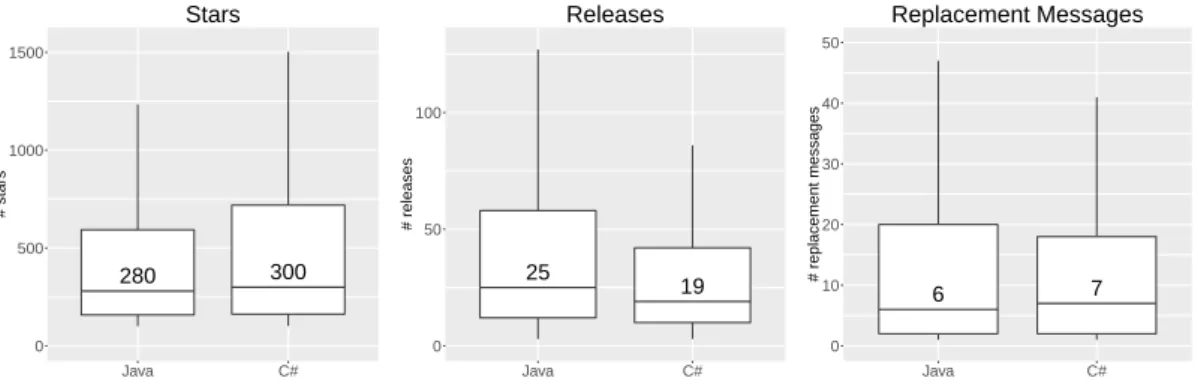
tion of the three aforementioned measures. For Java systems, the number of stars in the first quartile, median, and third quartile is 158, 280, and 593. For C#, the number of stars in the first quartile, median, and third quartile is 162, 300, and 719, respectively. The top-3 Java systems with more stars are elastic/elas-ticsearch(12.4K stars),nostra13/Android-Universal-Image-Loader(9.7K), and google/iosched (7.7K). For C#, the top-3 systems with more stars are dot-net/corefx (9.2K),SignalR/SignalR (5.6K), and dotnet/roslyn (4.5K). For Java, the number of releases in the first quartile, median, and third quartile is 12, 25, and 58, while for C# it is 10, 19, and 42. The top-3 Java systems with more releases areJetBrains/kotlin(2.9K releases),rstudio/rstudio(2.1K), and freenet/fred(1.9K), while for C# they arednnsoftware/Dnn.Platform(3.9K releases), Azure/azure-sdk-for-net (487), and mono/monodevelop (332). Fi-nally, for Java systems, the number of replacement messages in the first quartile, median, and third quartile is 2, 6, and 20, and for C# it is 2, 7, and 18. The top-3 Java systems with more replacement messages are groovy/groovy-eclipse (2K deprecated API elements with replacement messages), CyanogenMod/an-droid_frameworks_base (859), and OpenGamma/OG-Platform (815); and for C# they arednnsoftware/Dnn.Platform (588 deprecated API elements with replacement message), umbraco/Umbraco-CMS (500), and mono/mono (229).
300 280 0 500 1000 1500 Java C# # stars Stars 19 25 0 50 100 Java C# # releases Releases 7 6 0 10 20 30 40 50 Java C#
# replacement messages
Replacement Messages
Figure 3.1. Distribution of number of stars, number of releases, and number of deprecated API elements in the selected systems.
3.2. Extracting Deprecated API Elements 15
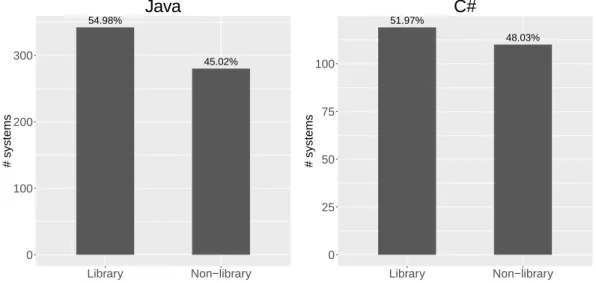
(54.98%) are libraries and 280 systems are non-libraries (45.02%). The values for C# are 119 (51.97%) and 110 (48.03%).
54.98%
45.02%
0 100 200 300
Library Non−library
# systems
Java
51.97%
48.03%
0 25 50 75 100
Library Non−library
# systems
C#
Figure 3.2. Number of systems in library and non-library categories.
3.2
Extracting Deprecated API Elements
As a first step to support answering our research questions, we extract all API elements (including types, fields, and methods) with deprecation annotations in Java and C# systems. For Java, we extract their associated Javadoc and in C# we extract the Ob-solete attribute. As presented in Section 2.2, Java API elements are deprecated using the annotation @Deprecated and the Javadoc tag @deprecated. Listing 3.1 presents an example of a deprecated method Java. In this example, the @deprecated annotation (line 6) is used to deprecate a method called onModule. Additionally, a Javadoc anno-tation is used to describe a replacement for the deprecated method instead of calling onModule, elastic/elasticsearchdevelopers should now call onIndexModule.
1 /**
2 * Old-style guice index level extension point 3 *
4 * @deprecated use #onIndexModule instead 5 */
6 @Deprecated
7 public final void onModule(IndexModule indexModule) { 8 //...
9 }
16 Chapter 3. Study Design
C# API elements are deprecated using the Obsolete attribute. Listing 3.2 presents an example of deprecated method in C#. In this example, the Obsolete attribute (line 1) is used to deprecate a type called IHashCodeProvider. Note that the Obsolete attribute is used to suggest a replacement for the deprecated type. As a substitute of calling IHashCodeProvider, Microsoft/CodeContracts developers should now callIEqualityComparer.
1 [Obsolete("Please, use IEqualityComparer insteaded.")] 2 public interface IHashCodeProvider {
3 //...
4 }
Listing 3.2. Example of obsolete method in C# - Microsoft/CodeCon-tracts
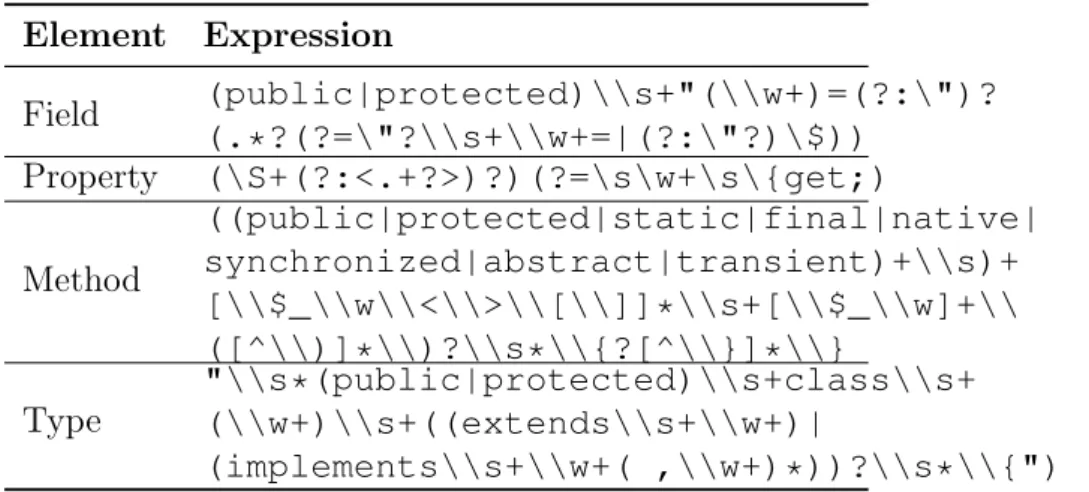
To find deprecated API elements in Java, we implemented a parser based on the Eclipse JDT library to search for deprecation annotations and tags. In order to find deprecated API elements in C#, we implemented an in-house tool based on lexical analysis to detect deprecation attributes. This tool uses regular expressions to identify methods, fields, and types and to check whether they are deprecated. Table 3.1 shows the regular expressions used by the tool. As mentioned in Section 2.1, in our study we consider property elements in C# as fields.
Table 3.1. Regular expressions to identify API elements in C#
Element Expression
Field (public|protected)\\s+"(\\w+)=(?:\")? (.*?(?=\"?\\s+\\w+=|(?:\"?)\$))
Property (\S+(?:<.+?>)?)(?=\s\w+\s\{get;)
Method
((public|protected|static|final|native| synchronized|abstract|transient)+\\s)+ [\\$_\\w\\<\\>\\[\\]]*\\s+[\\$_\\w]+\\ ([^\\)]*\\)?\\s*\\{?[^\\}]*\\}
Type
"\\s*(public|protected)\\s+class\\s+ (\\w+)\\s+((extends\\s+\\w+)|
(implements\\s+\\w+( ,\\w+)*))?\\s*\\{")
3.3. Extracting Replacement Messages 17
Table 3.2. Number of deprecated API elements.
Language Deprecated Types
Deprecated Fields
Deprecated Methods
All Deprecated Elements
Java 5,814 4,521 26,727 37,062
C# 1,277 2,197 4,723 8,197
3.3
Extracting Replacement Messages
In Java, when an element is deprecated using the Javadoc tag, it may be accompanied by a replacement message to help client developers. As presented in Section 2.2, Java guidelines propose two solutions to create deprecation replacement messages: (i) using the annotation @see, or (ii) using the word use and the annotation @link. However, to detect alternative guidelines followed by Java developers, we extracted deprecation messages with the support of the JDT library, and we manually inspected a subset of these messages. As a result of this analysis, we detected, in addition to the word use, seven frequent words/patterns to indicate replacement: refer,equivalent,replace* (i.e., replace, replaced, replacement), see, moved, instead, and should be used. We also confirmed that the two frequently adopted annotations are @link and @see.
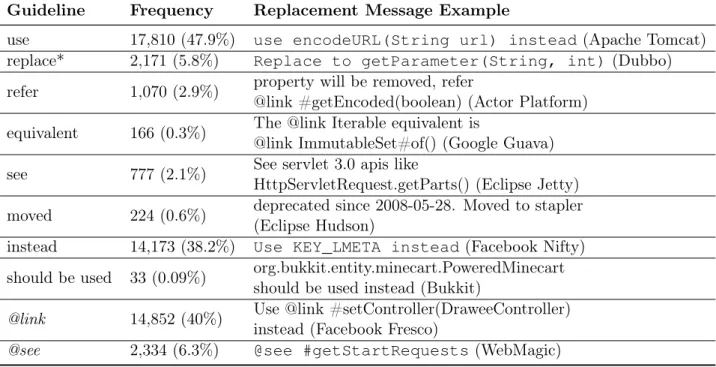
Table 3.3 shows the frequency of each replacement guideline found in our manual analysis, as well as message examples. The most adopted guideline is the word use, with 17,810 cases (47.9%). In contrast, the least adopted guideline is should be used, with 33 cases, (0.09%). Notice that some guidelines may co-occur in the same message. For example,usecommonly happens with@link. In total, 22,032 (59.4%) API elements were deprecated with replacement messages out of the 37,062 elements considered in this study.
For C#, when an element is deprecated with theObsolete attribute, like in Java, it may be accompanied by a replacement message to help client developers. In contrast to Java, we could not find guidelines to define replacement messages for C#. For this reason, we also performed a manual analysis to detect these guidelines in C#. First, we extacted deprecation messages in deprecated API elements. We looked for occurrences of the attribute Obsolete and we manually inspected a subset of these messages. As a result, we detected three frequent words/patterns that are used to indicate replacement: use, replace* (i.e., replace, replaced, replacement), andinstead.
re-18 Chapter 3. Study Design
Table 3.3. Frequency of replacement message guidelines in Java.
Guideline Frequency Replacement Message Example
use 17,810 (47.9%) use encodeURL(String url) instead(Apache Tomcat)
replace* 2,171 (5.8%) Replace to getParameter(String, int)(Dubbo)
refer 1,070 (2.9%) property will be removed, refer
@link #getEncoded(boolean) (Actor Platform)
equivalent 166 (0.3%) The @link Iterable equivalent is
@link ImmutableSet#of() (Google Guava)
see 777 (2.1%) See servlet 3.0 apis like
HttpServletRequest.getParts() (Eclipse Jetty)
moved 224 (0.6%) deprecated since 2008-05-28. Moved to stapler (Eclipse Hudson)
instead 14,173 (38.2%) Use KEY_LMETA instead(Facebook Nifty)
should be used 33 (0.09%) org.bukkit.entity.minecart.PoweredMinecart should be used instead (Bukkit)
@link 14,852 (40%) Use @link #setController(DraweeController)
instead (Facebook Fresco)
@see 2,334 (6.3%) @see #getStartRequests(WebMagic)
Table 3.4. Frequency of replacement message guidelines in C#.
Guideline Frequency Replacement Message Example
use 2,686 (49%) Use static Add() method instead. (Mono Monomac)
replace* 422 (8%) Replace it with both GetSupportedInterfaceOrientations (Redth/ZXing.Net.Mobile)
instead 3,118 (51%) This class is obsolete; use class Tree instead(Mono)
placement messages. This data is further explored in Research Question #1, and its evolution is analysed in Research Question #2.
3.4
Metrics Possibly Impacting API Deprecation
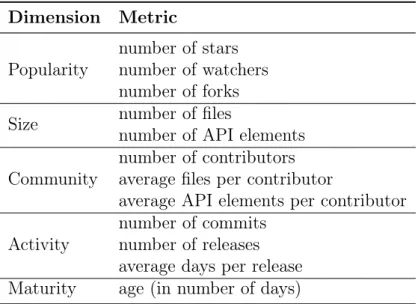
To support answering Research Question #3, about the characteristics of systems that deprecate API elements with replacement messages, we consider metrics in five dimensions which are likely to affect deprecation practices: popularity, size, community, activity, and maturity. The goal is to investigate whether such metrics have an impact on the way developers deprecate API elements. These metrics are described next and summarized in Table 3.5.
• Popularity. This dimension includes metrics that represent how popular is a
3.4. Metrics Possibly Impacting API Deprecation 19
The rationale is that popular systems may have more clients, thus their developers might have more concerns about their APIs.
• Size. This dimension includes metrics related to system size in terms ofnumber
of files and number of API elements (i.e., sum of number of types, fields, and methods). The rationale is that larger systems are harder to maintain, therefore it might be more difficult to keep track of all API changes. In contrast, smaller systems may be easier to control and to keep track of.
• Community. This dimension includes metrics that represent the system
com-munity, including number of contributors, average files per contributor, and av-erage API elements per contributor. The rationale is that systems with larger communities might be somehow easier to maintain, and to keep track of API changes.
Table 3.5. Metrics likely to impact API deprecation.
Dimension Metric
Popularity
number of stars number of watchers number of forks
Size number of files
number of API elements
Community
number of contributors average files per contributor
average API elements per contributor
Activity
number of commits number of releases average days per release Maturity age (in number of days)
• Activity. This dimension includes metrics related to the system activity level
in terms ofnumber of commits,number of releases, and average days per release. The rationale is that systems with more activity might respond faster to client complains. Therefore, they may be more likely to improve their APIs.
• Maturity. This dimension is about the system age, in number of days. The
20 Chapter 3. Study Design
3.5
Extracting Metrics from Case Studies
We extracted the proposed metrics from two groups of systems: the ones deprecating API elements in a correct way, i.e.,by providing replacement messages to deprecated API elements, and the ones not following this practice. Then, we assessed such groups to verify whether they are statistically different with respect to the proposed metrics. These two steps are detailed next.
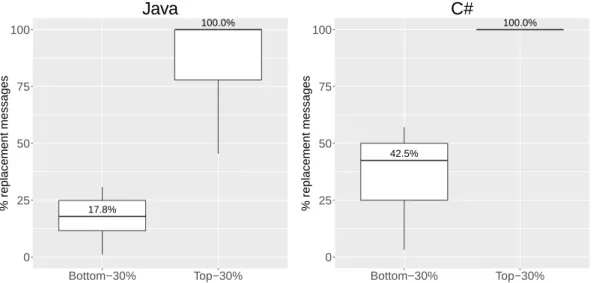
Selecting systems and extracting metrics. We sorted all systems, in de-scending order, based on the percentage of deprecated API elements with replacement messages. We selected two groups, top-30% (i.e.,systems with the highest percentage of deprecated API elements with replacement messages) and bottom-30% (i.e., systems with the lowest percentage). For Java, each group has 187 systems and for C# each group has 69 systems. Figure 3.3 shows the relative distribution of deprecated elements with replacement messages in each group. In the Java systems, the median percentage is 100% for thetop systems and 17.8% for the bottom systems. For C# systems, the median percentage is also 100% for the top systems and 42.5% for thebottom systems. Finally, we extracted the metrics described in Section 3.4 for the top and bottom systems.
17.8%
100.0%
0 25 50 75 100
Bottom−30% Top−30%
% replacement messages
Java
42.5%
100.0%
0 25 50 75 100
Bottom−30% Top−30%
% replacement messages
C#
Figure 3.3. Distribution of the percentage of deprecated APIs with replacement messages in the top-30% and bottom-30% systems.
3.6. Final Remarks 21
the effect size of the difference between the two groups, we compute Cliff’s Delta (or d). As in previous studies [Grissom and Kim, 2005; Tian et al., 2015; Linares-Vásquez et al., 2013], we interpret the effect size values as small for 0.147< d < 0.33, medium for 0.33< d < 0.474, and large ford >0.474.
3.6
Final Remarks
Chapter 4
Results
In this chapter, we answer and discuss the three research questions proposed in this study. Section 4.1 discusses the frequency of deprecated APIs with replacement mes-sages. Section 4.2 investigates the impact of software evolution on the frequency of such messages. Section 4.3 describes the characteristics that impact on the way devel-opers deprecate API elements. Section 4.4 presents possible threats to the validity of our study. Finally, in Section 4.5 we present some final remarks, as a conclusion to this chapter.
4.1
RQ1. What is the frequency of deprecated
APIs with replacement messages?
In this first research question, we analyze the frequency of deprecated API elements with replacement messages in the Java systems in the last release of the cases studies. As presented in Table 4.1, 3,789 deprecated types (65%) contain replacement messages. For deprecated fields and methods, these numbers are 2,675 (59%) and 15,568 (58.2%), respectively. Considering all deprecated API elements in Java, 22,032 (59.4%) contain replacement messages. We also present the frequency of deprecated API elements with replacement messages in the C# systems. As noticed in Table 4.1, 613 deprecated types (48%) in the C# systems contain replacement messages. For deprecated fields and methods, these numbers are 1,401 fields (63.8%), and 3,254 methods (68.9%), respectively. Considering all deprecated API elements in C#, 5,268 (64.2%) contain replacement messages. Therefore, the results measured for Java and C# are very similar, although C# systems have a slight tendency to include more replacement messages, in relative terms.
24 Chapter 4. Results
Table 4.1. Number of deprecated API elements with replacement messages.
Language Types Fields Methods All
Java 3,789 (65%) 2,675 (59%) 15,568 (58.2%) 22,032 (59.4%) C# 613 (48%) 1,401 (63.8%) 3,254 (68.9%) 5,268 (64.2%)
Next, we present the absolute and relative analysis per system. For both Java and C# systems, we consider only the ones that have at least one deprecated type, field, and method.
6 2 1 5 0 10 20 30 40 50
All Types Fields Methods
# replacement messages
Java 7 1 2 5 0 10 20 30 40
All Types Fields Methods
# replacement messages
C#
Figure 4.1. Absolute distribution of deprecated API elements with replacement messages.
Absolute analysis. Figure 4.1 shows the distribution of the number of deprecated API elements with replacement messages per system for Java and C#.
For types, in Java, the first quartile is 1, the median is 2, and the third quartile is 6, while in C# we have 1, 1, and 4. Regarding fields elements, for Java the first quartile, median and third quartile are 0, 1, and 5. For C#, these numbers are: 1, 2, and 5. For methods, in Java, first quartile, median, and third quartile are 2, 5, and 16. For C#, these values are 1, 5, and 15, respectively.
4.1. RQ1. What is the frequency of deprecated APIs with
replacement messages? 25
66.7% 71.4% 50.0% 66.7% 0 25 50 75 100
All Types Fields Methods
% replacement messages
Java
77.8%
75.0% 75.0% 75.0%
0 25 50 75 100
All Types Fields Methods
% replacement messages
C#
Figure 4.2. Relative distribution of deprecated API elements with replacement messages.
Relative analysis. Figure 4.2 presents the distribution of the relative number of deprecated API elements with replacement messages per system.
In Java, for types, the first quartile is 25%, the median is 71.4%, and the third quartile is 100%. There are 114 systems with 100% of their depre-cated types with replacement messages, such asspring-projects/spring-android, jenkinsci/github-plugin, and google/guava. In contrast, we found 57 systems with types deprecated without replacement messages, e.g., caelum/vraptor, cym-csg/UltimateAndroid, and spring-projects/spring-roo. For C#, the first quartile is 21%, the median is 75%, and the third quartile is 100%. We found 61 sys-tems with all deprecated types with replacement messages, such asapache/log4net, elastic/elasticsearch-net, and dotnet/corefx, while there are 30 systems with types deprecated without replacement messages, like mono/monodevelop, ws/aws-sdk-net, and Microsoft/PTVS.
ServiceS-26 Chapter 4. Results
tack/ServiceStack, and ASP-NET-MVC/aspnetwebstack. In contrast, we detect 14 systems with fields deprecated without replacement messages, such as nhibernate/nhibernate-core, Microsoft/msbuild, and mono/mono-tools. For methods, in Java, the first quartile is 33.3%, the median is 66.7%, and the third quartile is 100%. There are 160 Java systems with 100% of their deprecated meth-ods with replacement messages, such as square/picasso, nostra13/Android-Universal-Image-Loader, and eclipse/jgit. We also found 24 Java sys-tems with no replacement messages, such as JPMoresmau/eclipsefp, spring-projects/spring-data-neo4j, and hibernate/hibernate-validator. For C#, the values of the first quartile, median, and third quartile are 50%, 75%, and 100%. We found 63 systems with 100% of their deprecated methods with replacement messages, like googlesamples/cardboard-unity, libgit2/libgit2sharp, and Signal-R/SignalR. There are 20 systems in which methods are deprecated without replace-ment messages, such as unitycontainer/unity, JohnnyCrazy/SpotifyAPI-NET, and Microsoft/msbuild.
For Java, according to the median, types are the most deprecated elements with replacement messages (median of 71.4%), followed by methods (66.7%) and fields (50%). The third quartile at 100% for types, fields, and methods shows that 25% of the systems always deprecate all elements with replacement messages. In contrast, the first quartile at 0% for fields shows that 25% of the systems never deprecate fields with replacement messages. For C#, like in Java, the third quartile is 100% for all elements, and coincidentally, all three elements have the same median values (75%).
When considering all API elements, the first quartile is 33.3%, the median is 66.7%, and the third quartile is 100%, for the Java sytems. In other words, con-sidering the median, around 2/3 of the API elements are deprecated with replace-ment messages. In Java, there are 162 systems (26%) with 100% of their depre-cated API elements with replacement messages, such as code4craft/webmagic, google/guice, and bumptech/glide. For C#, the first quartile is 50%, the dian is 77.8%, and the third quartile is 100%. This means that, considering the me-dian, around 3/4 of the API elements are deprecated with replacement messages. We found 64 systems (28%) with 100% of deprecated API elements with replace-ment messages, likegoogle/google-api-dotnet-client,apache/log4net, and Azure/azure-sdk-for-net. In summary, C# systems, in relative terms, have a slight trend to include more replacement messages, when compared to the Java sys-tems in our dataset.
4.1. RQ1. What is the frequency of deprecated APIs with
replacement messages? 27
These numbers for C# are 119 and 110 systems, respectively. In order to compare the categories, we analyse the relative number of deprecated messages per system in each domain. Figure 4.3 presents the distribution for the categories. For Java, the first quartile, median, and third quartile are 40%, 71.2%, and 100%, for libraries. For non-libraries, these values are 28.6%, 60%, 86.8%, respectively. For C#, the numbers for libraries are 51.3%, 81.8%, and 97.2%. For non-libraries, these values are 50%, 73.7%, and 100%. The difference between the median values of the two categories is 11.2% (Java) and 8.1% (C#). In both languages, the percentage of replacement messages for libraries is greater than for non-libraries (median-values). There is more effort and concern to provide replacement messages in library systems than non-library systems. We also analysed the statistical significance of the difference between the two groups of systems, by applying the Mann Whitney Test at p-value = 0.05. For Java systems, the p-value is < 0.001, while in C# the value is 0.596. In C#, we do not observe a statistical difference between library and non-library categories.
71.2% 60.0% 0 25 50 75 100 Library Non−library
% replacement messages
Java 81.8% 73.7% 0 25 50 75 100 Library Non−library
% replacement messages
C#
Figure 4.3. Relative distribution of deprecated API elements with replacement messages in library and non-library systems.
28 Chapter 4. Results
4.2
RQ2. What is the impact of software evolution
on the frequency of replacement messages?
In order to study the impact of software evolution on deprecation, we analyze the frequency of deprecated API elements with replacement messages in two distinct releases of the Java and C# systems. We compare the first publicly available release with the last one (i.e.,the same releases considered in the Research Question #1). In Java, the number of deprecated APIs elements increases from 10,798 (first release) to 22,032 (last release). In C#, these values are 2,341 and 5,268 API elements, respectively. In addition, in the end of the section, we present a more detailed comparison by taking into account several releases.
Absolute analysis. Figure 4.4 shows the distribution of the absolute number of deprecated API elements with replacement messages per system for Java and C#, in the analysed releases (first and last). For Java, in the first release, the first quartile is 1, the median is 3, and the third quartile is 17. In the last release, the first quartile is 2, the median is 6, and the third quartile is 20. The values for C# are 0, 2, and 9 (first release). For the last release, we have 2, 7, and 18. Therefore, in both languages, there is an increase on the values of first quartile, median, and third quartile measures, from the first to the last considered releases. This is expected due to the natural evolution of the systems, which tend to provide more features and API elements.
3 6 0 10 20 30 40 50 First Last Releases
# replacement messages
Java 2 7 0 10 20 30 40 First Last Releases
# replacement messages
C#
Figure 4.4. Absolute distribution of deprecated API elements with replacement messages over time.
4.2. RQ2. What is the impact of software evolution on the frequency
of replacement messages? 29
58.7% 66.7% 0 25 50 75 100 First Last Releases
% replacement messages
Java 55.1% 77.8% 0 25 50 75 100 First Last Releases
% replacement messages
C#
Figure 4.5. Relative distribution of deprecated APIs with replacement messages over time.
deprecated API elements with replacement messages per system, in the two analysed releases. For Java, in the first release, the first quartile is 7.5%, the median is 58.7%, and the third quartile is 95.3%. In the last release, these measures are 33.3%, 66.7%, and 100%, respectively. Therefore, the median increases only by 8% between the considered releases (from 58.7% to 66.7%). We can then infer that there is no major effort from developers to provide deprecation messages. The third quartile also remains almost stable, increasing only 4.7% (from 95.3% to 100%). In contrast, by analysing the evolution of the first quartiles, we observe significant changes. This quartile increases by 25.8% (from 7.5% to 33.3%), meaning that the bottom 25% of the systems are increasingly adopting replacement messages.
For the C# systems, the values of first quartile, median, and third quartile are 0%, 55.1%, and 91.2%. In the last release, we have 50%, 77.8%, and 100%. Therefore, the first release, 25% of the systems do not use replacement messages. This value increases to 50% in the last release. In other words, 25% of the systems started to use replacement messages. The median of the relative number of deprecated API elements with replacement messages increases 22.7% (from 55.1% to 77.8%). Differently from Java, this means that there was a major effort by developers to provide deprecation messages. Similarly to Java, the third quartile keeps at very high percentage, increasing 8.8% (from 91.2% to 100%).
30 Chapter 4. Results
number of deprecated API elements with replacement messages in such systems. The median increased from 19% to 64.3%. Examples of systems in this category include spring-projects/spring-boot(increased from 0% to 55%) andNetflix/eureka (increased from 0% to 64%). For C#, the median increases from 40.0% to 81.8%. Examples of such systems includeelastic/elasticsearch-net(increased from 50% to 91.7%) and henon/GitSharp (increased from 0% to 66.7%).
19.0% 64.3% 0 25 50 75 100 First Last Releases
% replacement messages
Java 40.0% 81.8% 0 25 50 75 100 First Last Releases
% replacement messages
C#
Figure 4.6. Relative distribution of systems where the percentage of replacement messages increased from the first to the last release.
In contrast, in 87 Java systems (14%) the number of deprecated API elements with replacement messages decreased, while for C# this value is 23 systems (10%). Figure 4.7 presents the distribution for such systems. In the Java systems, the me-dian decreases from 84.1% to 53.3%. Examples of systems in this category include aptana/Pydev (decreased from 91.6% to 50%) and spring-projects/spring-framework(decreased from 98% to 68%). For C#, the median decreases from 91.3% to 69.1%. Examples of systems facing a reduction in the number of replacement mes-sages includedotnet/corefx(decreased from 82.7% to 52.5%) and Azure/azure-storage-net (decreased from 97.1% to 69%).
4.2. RQ2. What is the impact of software evolution on the frequency
of replacement messages? 31
84.1% 53.3% 0 25 50 75 100 First Last Releases
% replacement messages
Java 91.3% 69.1% 0 25 50 75 100 First Last Releases
% replacement messages
C#
Figure 4.7. Relative distribution of systems where the percentage of replacement messages decreased from the first to the last release.
Analysis using multiple versions. In addition to the previous analysis, where we reported a comparison between two single releases, we provide a second analysis by considering several releases in order to better understand the impact of software evolution on the quality of deprecation messages. Starting from the first release, we collected all the subsequent ones, considering an interval of at least two months. We then classify the variation in the percentage of replacement messages of a given system releases in four categories: (i) Decrease Trend: the percentage always decreases in the analysed releases, (ii) Increase Trend: the percentage always increases, (iii) Variant Trend: the percentage increases and decreases with no pattern, and (iv) Stable Trend: the percentage of replacement messages is constant in all releases. Figure 4.8 provides examples of systems in each of the categories.
32 Chapter 4. Results ● ● ● ● 40 45 50 55 60
Out−2014 Fev−2015 Jun−2015
% replacement messages
Decrease Trend (apache/flink)
● ● ● 7 8 9
Ago−2014 Fev−2015 Ago−2015
% replacement messages
Increase Trend (dotnet/roslyn)
● ● ● 79.6 79.8 80.0 80.2 80.4 Mai−2015 Jul−2015
% replacement messages
Stable Trend (facebook/fresco)
● ● ● ● ● ● ● ● ● ● ● ● ● ● ● 0 25 50 75 100
Set−2012 Set−2013 Set−2014 Set−2015
% replacement messages
Variant Trend (Azure/sdk−for−net)
Figure 4.8. Examples of systems in each evolution category.
Table 4.2. Number of systems in each evolution category
Language Decrease Increase Variant Stable
Java 40 (6%) 198 (32%) 245 (40%) 139 (22%) C# 25 (11%) 59 (26%) 83 (36%) 62 (27%)
4.2. RQ2. What is the impact of software evolution on the frequency
of replacement messages? 33
their deprecation messages over time.
18 18 14 48 0 50 100 150
Decrease Increase Stable Variant
# releases Java 22 14 11 40 0 25 50 75 100 125
Decrease Increase Stable Variant
# releases
C#
Figure 4.9. Number of releases for each category of system.
Figure 4.10 shows the distribution of the relative number of replacement mes-sages for systems with an increase trend in the percentage of replacement mesmes-sages, comparing the first and last releases. The value of the first quartile, median, and third quartile for the first release both in Java and in C# is 0%. For the last release in Java, the values are 42.4%, 80%, and 100%. For the last release in C#, the values are 50%, 66.9%, and 97.2%. Considering just the median, Java systems increase 80% (from 0% to 80%), and C# systems increase 67.1% (from 0% to 66.9%). Examples of Java sys-tems in the increase category include Netflix/netflix-graph (increased from 0% to 100%) and paypal/PayPal-Java-SDK (increased from 0% to 60%). For C#, ex-amples include JohnnyCrazy/SpotifyAPI-NET (increased from 0% to 50%) and mongodb/mongo-azure(increased from 0% to 100%). In summary, we note that in the initial release there are no replacement messages at all in such systems. Over time, these systems increase these numbers, meaning their the developers make the decision to provide replacement messages.
34 Chapter 4. Results 0% 80% 0 25 50 75 100 First Last Releases
% replacement messages
Java 0.0% 66.9% 0 25 50 75 100 First Last Releases
% replacement messages
C#
Figure 4.10. Relative distribution of replacement messages in systems in the increase category, comparing the first and last releases.
93.8% 50.0% 0 25 50 75 100 First Last Releases
% replacement messages
Java 64.7% 36.4% 0 25 50 75 100 First Last Releases
% replacement messages
C#
Figure 4.11. Relative distribution of replacement messages in systems in the decrease category, comparing the first and last releases.
from 29.2% to 17.5%) andgooglesamples/tango-examples-unity(decrease from 100% to 25%).
per-4.3. RQ3. What are the characteristics of software systems with high and low frequency of replacement messages? 35
centage, and 10% decrease. Considering several releases, we note that most systems increase and decrease the percentage of replacement messages over time.
4.3
RQ3. What are the characteristics of software
systems with high and low frequency of
replacement messages?
In this research question, we investigate whether system popularity, size, community, activity, and maturity have an impact on the way developers deprecate API elements, as indroduced in Section 3.4. We perform this investigation by comparingtop andbottom systems; top systems have 100% of their API elements deprecated with replacement messages, while bottom barely do that.
Table 4.3 presents the metrics and their respectivep-values and d applied on top and bottom systems, both for Java and C# (see Section 3.5). Metrics in bold have p-value < 0.05, and d > 0.147, i.e., they are statistically significant different with at least a small effect size in top and bottom systems.
For Java, the selectedtopandbottom systems are statistically significant different with at least a small effect size in 7 out of the 12 metrics, including all size and activity metrics as well as number of contributors and average files per contributor in community. The effect size is large in one metric (number of commits), medium in three (number of files, number API elements, and number of contributors), and small in three (number of contributors, average files per contributor, and average days per releases). Regarding the C# systems, eight metrics present statistical significance: all popularity and size metrics, and number of contributors, number of commits, and number of releases. The effect size is large in one metric (number of contributors), medium in six (all popularity and size metrics, and number of commits), and small in one (number of releases).
In the following we investigate each dimension.
• Popularity. In the Java systems, we detect that there is no difference in top
36 Chapter 4. Results
Table 4.3. Metrics and their respective p-values and d on top and bottom sys-tems. Bold values mean p-value < 0.05 (statistically significant different), and
d > 0.147 (at least a small effect size). Level of significance for d-values: L =
large, M = medium, S = Small, N = negligible. Rel. = relationship: “+” = top
systems have significantly higher value on this metric. “-” =bottom systems have significantly higher value on this metric.
Dimension Metric Java C#
p-value d-value Rel. p-value d-value Rel.
Popularity
number of
stars 0.674 0.142 (N) + 0.004 0.407 (M)
-number of
watchers 0.018 0.04 (N) + <0.001 0.454 (M)
-number of
forks 0.028 0.08 (N) + 0.003 0.447 (M)
-Size
number of
files <0.001 0.459 (M) - 0.034 0.419 (M)
-number of
API elements <0.001 0.374 (M) - <0.001 0.414 (M)
-Community
number of
contributors <0.001 0.376 (M) - 0.009 0.537 (L)
-avg. files
per contrib. <0.001 0.227 (S) - 0.648 0.160 (N)
-avg. API elem.
per contrib. <0.001 0.123 (N) - 0.303 0.110 (N)
-Activity
number of
commits <0.001 0.563 (L) - 0.009 0.342 (M)
-number of
releases 0.001 0.206 (S) - 0.014 0.244 (S)
-avg. days
per release 0.004 0.182 (S) - 0.201 0.292 (S)
-Maturity age (in number
of days) 0.253 0.009 (S) + 0.102 0.363 (M)
-• Size. For Java and C#, we observe that top systems are smaller than bottom
ones, as measured both innumber of files andnumber of API elements(notice the “-” on the relationship column). In fact, it is intuitive to consider that smaller systems are easier to maintain and to keep track of API elements, which also facilitates the provision of replacement messages.
• Community. We can see that top systems have less contributors than bottom
4.3. RQ3. What are the characteristics of software systems with high and low frequency of replacement messages? 37
have fewer contributors than bottom ones. In opposite to Java, the ratio of files per contributor has no significance. In both languages, the ratio ofAPI elements per contributor also does not have statistical significance.
• Activity. For the activity dimension, we observe that the top systems in Java
have less commits and releases than bottom ones. An explanation is that bottom systems have more code changes, thus they may be more likely to degrade their APIs. Like Java, number of commits and number of releases impact in the way developers deprecate API elements in Java. We also note that Java systems released in small time deprecate their APIs with replacement messages.
• Maturity. For Java and C#, we could not find relevant differences between
top and bottom systems with respect to their maturity (i.e., age in number of days). Although, someone might expect older systems to be more stable and to provide better APIs, in fact we concluded that system age has no effect on the way developers deprecate API elements with replacement messages.
As examples, we present in Tables 4.4 and 4.5 comparisons between top and bottom systems, for Java and C#, respectively. For Java, the top system is xiprox-/ErrorView: it has 100% of its API elements deprecated with replacement messages which corresponds to three elements. The bottom one is apache/maven: it has 24% (48 from a total of 199) of its API elements deprecated with replacement messages. In fact, size, community and activity aspects of both systems are clearly distinct: xiprox/ErrorView is easier to manage when comparing to apache/maven. For C#, the top system is GitTools/GitLink: it has 100% of its API elements depre-cated with replacement messages. The bottom one isAutoFixture/AutoFixture: it has 20% (30 out of 146) of its API elements deprecated with replacement messages. Therefore, we can note that size, community and activity aspects of both systems are divergent: AutoFixture/AutoFixturetends to be easier to administer than Git-Tools/GitLink.
38 Chapter 4. Results
Table 4.4. Comparison between a top and bottom Java system.
Metric median values
xiprox/ErrorView
(top system)
apache/maven
(bottom system)
number of files 668 67 1,934
number of API elem 4,901 101 8,601
number of contrib 18 2 45
avg. files per contrib 37.3 23.5 42.9
number of releases 25 4 44
number of commits 1,276 47 10,070
avg. days per release 54 42.5 99.3
Table 4.5. Comparison between a top and bottom C# system.
Metric median
values
GitTools/GitLink (top system)
AutoFixture/AutoFixture (bottom system)
number of stars 300 201 812
number of watchers 66 18 84
number of forks 119 27 143
number of files 35,543 7,123 72,029
number of API elem 4,270 242 6,257
number of contrib 22 19 38
number of commits 1,133 183 2,973
number of releases 19 8 175
4.4
Threats to Validity
We organize threats to validity in the following three categories:
4.4.1
Construct Validity
The construct validity is related to whether the measurement in the study reflects real-world situations.
4.4. Threats to Validity 39
in fact does not suggest alternatives to the deprecated field. In this case the message contains the keyword use, but does not suggest any replacement to the deprecated field.
1 /**
2 * @deprecated Deprecated, do not use. 3 */
4 public static final int CU_DEVICE_ATTRIBUTE_CAN_TEX2D_GATHER = 44;
Listing 4.1. Example of false-positive message in Java -deeplearning4j/nd4j
Next, we manually analysed 500 randomly selected deprecation messages classi-fied as not replacement messages. In this case, we detected 26 (5%) false-negatives, i.e., the message were classified as not including replacement information, but they indeed do include. Listing 4.2 presents an example of false-negative classification. In this example, the message used in the Javadoc @deprecated tag (line 3) was incorrectly classified as not including a replacement message, but it clearly includes. The message does not contain the keywords used to define replacement messages, but suggest the use of method getExceptions instead of deprecate method exceptionIterator.
1 /**
2 * @return The exception iterator.
3 * @deprecated in favor of #getExceptions 4 */
5 @Deprecated
6 public Iterator<Throwable> exceptionIterator() { 7 //...
8 }
Listing 4.2. Example of false-negative message in Java - spring-projects/spring-integration
For C#, we perform the same analysis. We found 1 (<1%) false-positive replace-ment message which is presented in Listing 4.3. In this example, the message used in the Obsolete attribute (line 1) to deprecate the method GetMatch was classified incorrectly as replacement message. The message contains the keyword use, but not contains suggestion for replacement.
1 [Obsolete("do not use this method", true)] 2 public static bool GetMatch(CallSite site) { 3 //...
4 }
Listing 4.3. Example of false-positive message in C# -mono/mono
![Figure 2.1. APIs acting as interfaces between clients and a provider software entity [Montandon, 2013].](https://thumb-eu.123doks.com/thumbv2/123dok_br/15210966.21278/24.892.325.573.176.264/figure-acting-interfaces-clients-provider-software-entity-montandon.webp)